
Oracle Critical Patch Update April 2026
Released April 2026 · Oracle's advisory ↗ · ← Critical Patch Update, January 2026 · Security Patch Update, May 2026 →
421 CVEs in this release, one square each
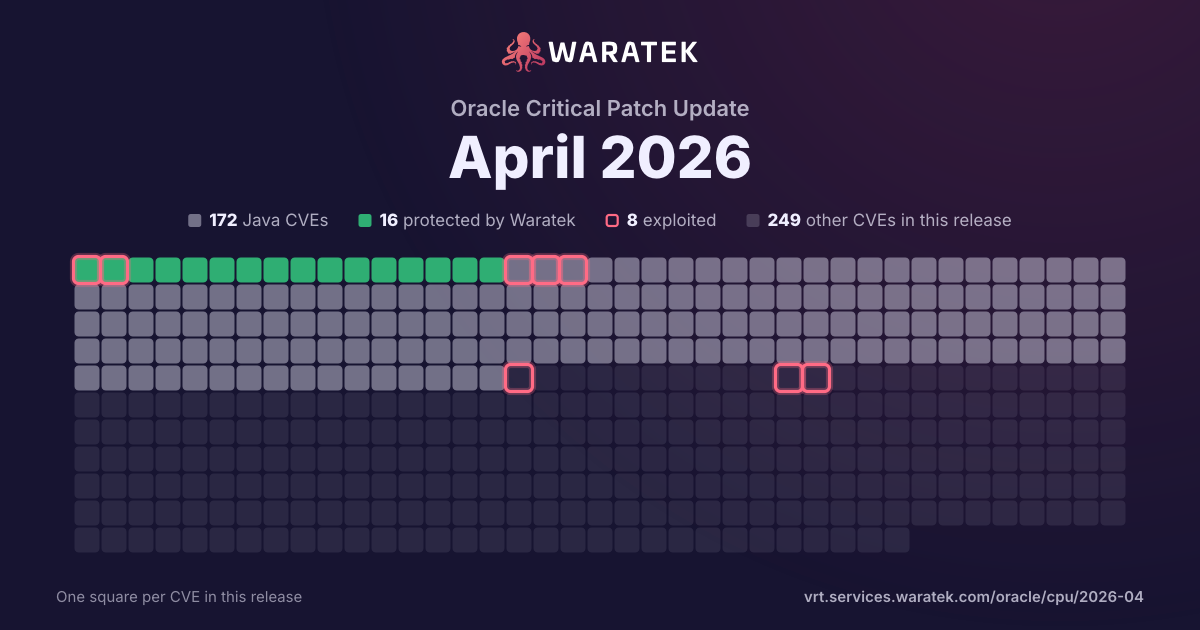
By status
16Protected by Waratek4Mitigation candidate152No exploit published10Outside Waratek scope239Not applicable
8Exploited, marked by the ring
No exploit published. For 51 of them, Oracle's security advisory is the source of public detail.
Protected by Waratek. Waratek RASP can block exploitation of these on systems that have not applied the patch yet.
Overview 187 matches · 75 in Waratek scope · 3 protected · 3 exploited · 0 CISA KEV · 4 public PoC · 2 EPSS ≥ 0.5
187matches
75in Waratek scope40.1%
3protected1.6%
3exploited1.6%
0CISA KEV0.0%
4public PoC2.1%
2EPSS ≥ 0.51.1%
Protected by Waratek
3
1.6%
Rule in development
0
0.0%
Mitigation candidate
2
1.1%
No exploit published
70
37.4%
Outside Waratek scope
4
2.1%
Not applicable
108
57.8%
Withdrawn CVE
0
0.0%
blocked by ARMR today
3
1.6%
partly blocked
0
0.0%
not blocked
184
98.4%
not established
0
0.0%
unrecorded
0
0.0%
split by
peak 67 / quarter
Q4 201
Protected by Waratek1
Medium1
blocked by ARMR today1
No public exploit1
Q1 210
Q2 211
No exploit published1
Medium1
not blocked1
No public exploit1
Q3 210
Q4 210
Q1 220
Q2 220
Q3 220
Q4 220
Q1 230
Q2 233
No exploit published3
Medium3
not blocked3
No public exploit3
Q3 230
Q4 232
No exploit published1
Outside Waratek scope1
Medium2
not blocked2
Exploited1
Proof of concept only1
Q1 243
No exploit published2
Not applicable1
Medium3
not blocked3
Proof of concept only1
No public exploit2
Q2 242
No exploit published1
Not applicable1
Medium2
not blocked2
Proof of concept only1
No public exploit1
Q3 240
Q4 244
No exploit published3
Outside Waratek scope1
Medium4
not blocked4
Proof of concept only2
No public exploit2
Q1 253
Mitigation candidate1
No exploit published1
Not applicable1
Medium3
not blocked3
Exploited1
Proof of concept only2
Q2 257
No exploit published3
Not applicable4
Medium7
not blocked7
Proof of concept only2
No public exploit5
Q3 2525
Protected by Waratek1
Mitigation candidate1
No exploit published9
Not applicable14
Medium25
blocked by ARMR today1
not blocked24
Exploited1
Working exploit published1
Proof of concept only5
No public exploit18
Q4 2526
Protected by Waratek1
No exploit published9
Not applicable16
Medium26
blocked by ARMR today1
not blocked25
Proof of concept only3
No public exploit23
Q1 2643
No exploit published4
Not applicable39
Medium43
not blocked43
Proof of concept only3
No public exploit40
Q2 2667
No exploit published33
Outside Waratek scope2
Not applicable32
Medium67
not blocked67
Proof of concept only1
No public exploit66
Q4 20Q2 21Q4 21Q2 22Q4 22Q2 23Q4 23Q2 24Q4 24Q2 25Q4 25Q2 26
| CVE | Severity | Published▾ | Status | Exploitation | Description |
|---|---|---|---|---|---|
| CVE-2025-14819 | Medium | 2026-01-08 | Not applicable | No public exploit | When doing TLS related transfers with reused easy or multi handles and altering the `CURLSSLOPT_NO_PARTIALCHAIN` option, libcurl could accidentally reuse a CA store cached in memory for which the partial chain option was reversed. Contrary to the user's wishes and expectations. This could make libcurl find and accept a trust chain that it otherwise would not. |
| CVE-2025-14524 | Medium | 2026-01-08 | Not applicable | No public exploit | When an OAuth2 bearer token is used for an HTTP(S) transfer, and that transfer performs a cross-protocol redirect to a second URL that uses an IMAP, LDAP, POP3 or SMTP scheme, curl might wrongly pass on the bearer token to the new target host. |
| CVE-2025-14017 | Medium | 2026-01-08 | Not applicable | No public exploit | When doing multi-threaded LDAPS transfers (LDAP over TLS) with libcurl, changing TLS options in one thread would inadvertently change them globally and therefore possibly also affect other concurrently setup transfers. Disabling certificate verification for a specific transfer could unintentionally disable the feature for other threads as well. |
| CVE-2025-13034 | Medium | 2026-01-08 | Not applicable | No public exploit | When using `CURLOPT_PINNEDPUBLICKEY` option with libcurl or `--pinnedpubkey` with the curl tool, curl should check the public key of the server certificate to verify the peer. This check was skipped in a certain condition that would then make curl allow the connection without performing the proper check, thus not noticing a possible impostor. To skip this check, the connection had to be done with QUIC with ngtcp2 built to use GnuTLS and the user had to explicitly disable the standard certificate verification. |
| CVE-2026-22184 | Medium | 2026-01-07 | Not applicable | Proof of concept only | zlib versions up to and including 1.3.1.2 include a global buffer overflow in the untgz utility located under contrib/untgz. The vulnerability is limited to the standalone demonstration utility and does not affect the core zlib compression library. The flaw occurs when a user executes the untgz command with an excessively long archive name supplied via the command line, leading to an out-of-bounds write in a fixed-size global buffer. |
| CVE-2025-69229 | Medium | 2026-01-06 | Not applicable | No public exploit | AIOHTTP is an asynchronous HTTP client/server framework for asyncio and Python. In versions 3.13.2 and below, handling of chunked messages can result in excessive blocking CPU usage when receiving a large number of chunks. If an application makes use of the request.read() method in an endpoint, it may be possible for an attacker to cause the server to spend a moderate amount of blocking CPU time (e.g. 1 second) while processing the request. This could potentially lead to DoS as the server would be unable to handle other requests during that time. This issue is fixed in version 3.13.3. |
| CVE-2025-69228 | Medium | 2026-01-06 | Not applicable | No public exploit | AIOHTTP is an asynchronous HTTP client/server framework for asyncio and Python. Versions 3.13.2 and below allow a request to be crafted in such a way that an AIOHTTP server's memory fills up uncontrollably during processing. If an application includes a handler that uses the Request.post() method, an attacker may be able to freeze the server by exhausting the memory. This issue is fixed in version 3.13.3. |
| CVE-2025-69227 | Medium | 2026-01-06 | Not applicable | No public exploit | AIOHTTP is an asynchronous HTTP client/server framework for asyncio and Python. Versions 3.13.2 and below allow for an infinite loop to occur when assert statements are bypassed, resulting in a DoS attack when processing a POST body. If optimizations are enabled (-O or PYTHONOPTIMIZE=1), and the application includes a handler that uses the Request.post() method, then an attacker may be able to execute a DoS attack with a specially crafted message. This issue is fixed in version 3.13.3. |
| CVE-2025-69226 | Medium | 2026-01-05 | Not applicable | No public exploit | AIOHTTP is an asynchronous HTTP client/server framework for asyncio and Python. Versions 3.13.2 and below enable an attacker to ascertain the existence of absolute path components through the path normalization logic for static files meant to prevent path traversal. If an application uses web.static() (not recommended for production deployments), it may be possible for an attacker to ascertain the existence of path components. This issue is fixed in version 3.13.3. |
| CVE-2025-69224 | Medium | 2026-01-05 | Not applicable | No public exploit | AIOHTTP is an asynchronous HTTP client/server framework for asyncio and Python. Versions 3.13.2 and below of the Python HTTP parser may allow a request smuggling attack with the presence of non-ASCII characters. If a pure Python version of AIOHTTP is installed (i.e. without the usual C extensions) or AIOHTTP_NO_EXTENSIONS is enabled, then an attacker may be able to execute a request smuggling attack to bypass certain firewalls or proxy protections. This issue is fixed in version 3.13.3. |
| CVE-2025-15284 | Medium | 2025-12-29 | Not applicable | No public exploit | Improper Input Validation vulnerability in qs (parse modules) allows HTTP DoS.This issue affects qs: < 6.14.1. Summary The arrayLimit option in qs did not enforce limits for bracket notation (a[]=1&a[]=2), only for indexed notation (a[0]=1). This is a consistency bug; arrayLimit should apply uniformly across all array notations. Note: The default parameterLimit of 1000 effectively mitigates the DoS scenario originally described. With default options, bracket notation cannot produce arrays larger than parameterLimit regardless of arrayLimit, because each a[]=valueconsumes one parameter slot. The severity has been reduced accordingly. Details The arrayLimit option only checked limits for indexed notation (a[0]=1&a[1]=2) but did not enforce it for bracket notation (a[]=1&a[]=2). Vulnerable code (lib/parse.js:159-162): if (root === '[]' && options.parseArrays) { obj = utils.combine([], leaf); // No arrayLimit check } Working code (lib/parse.js:175): else if (index <= options.arrayLimit) { // Limit checked here obj = []; obj[index] = leaf; } The bracket notation handler at line 159 uses utils.combine([], leaf) without validating against options.arrayLimit, while indexed notation at line 175 checks index <= options.arrayLimit before creating arrays. PoC const qs = require('qs'); const result = qs.parse('a[]=1&a[]=2&a[]=3&a[]=4&a[]=5&a[]=6', { arrayLimit: 5 }); console.log(result.a.length); // Output: 6 (should be max 5) Note on parameterLimit interaction: The original advisory's "DoS demonstration" claimed a length of 10,000, but parameterLimit (default: 1000) caps parsing to 1,000 parameters. With default options, the actual output is 1,000, not 10,000. Impact Consistency bug in arrayLimit enforcement. With default parameterLimit, the practical DoS risk is negligible since parameterLimit already caps the total number of parsed parameters (and thus array elements from bracket notation). The risk increases only when parameterLimit is explicitly set to a very high value. |
| CVE-2025-68161 | Medium | 2025-12-18 | No exploit published | No public exploit | The Socket Appender in Apache Log4j Core versions 2.0-beta9 through 2.25.2 does not perform TLS hostname verification of the peer certificate, even when the verifyHostName https://logging.apache.org/log4j/2.x/manual/appenders/network.html#SslConfiguration-attr-verifyHostName configuration attribute or the log4j2.sslVerifyHostName https://logging.apache.org/log4j/2.x/manual/systemproperties.html#log4j2.sslVerifyHostName system property is set to true. This issue may allow a man-in-the-middle attacker to intercept or redirect log traffic under the following conditions: * The attacker is able to intercept or redirect network traffic between the client and the log receiver. * The attacker can present a server certificate issued by a certification authority trusted by the Socket Appender’s configured trust store (or by the default Java trust store if no custom trust store is configured). Users are advised to upgrade to Apache Log4j Core version 2.25.3, which addresses this issue. As an alternative mitigation, the Socket Appender may be configured to use a private or restricted trust root to limit the set of trusted certificates. |
| CVE-2025-67735 | Medium | 2025-12-16 | No exploit published | Proof of concept only | Netty is an asynchronous, event-driven network application framework. In versions prior to 4.1.129.Final and 4.2.8.Final, the `io.netty.handler.codec.http.HttpRequestEncoder` has a CRLF injection with the request URI when constructing a request. This leads to request smuggling when `HttpRequestEncoder` is used without proper sanitization of the URI. Any application / framework using `HttpRequestEncoder` can be subject to be abused to perform request smuggling using CRLF injection. Versions 4.1.129.Final and 4.2.8.Final fix the issue. |
| CVE-2025-67638 | Medium | 2025-12-10 | No exploit published | No public exploit | Jenkins 2.540 and earlier, LTS 2.528.2 and earlier does not mask build authorization tokens displayed on the job configuration form, increasing the potential for attackers to observe and capture them. |
| CVE-2025-67637 | Medium | 2025-12-10 | No exploit published | No public exploit | Jenkins 2.540 and earlier, LTS 2.528.2 and earlier stores build authorization tokens unencrypted in job config.xml files on the Jenkins controller where they can be viewed by users with Item/Extended Read permission or access to the Jenkins controller file system. |
| CVE-2025-67636 | Medium | 2025-12-10 | No exploit published | No public exploit | A missing permission check in Jenkins 2.540 and earlier, LTS 2.528.2 and earlier allows attackers with View/Read permission to view encrypted password values in views. |
| CVE-2025-66200 | Medium | 2025-12-05 | Not applicable | No public exploit | mod_userdir+suexec bypass via AllowOverride FileInfo vulnerability in Apache HTTP Server. Users with access to use the RequestHeader directive in htaccess can cause some CGI scripts to run under an unexpected userid. This issue affects Apache HTTP Server: from 2.4.7 through 2.4.65. Users are recommended to upgrade to version 2.4.66, which fixes the issue. |
| CVE-2025-65082 | Medium | 2025-12-05 | Not applicable | No public exploit | Improper Neutralization of Escape, Meta, or Control Sequences vulnerability in Apache HTTP Server through environment variables set via the Apache configuration unexpectedly superseding variables calculated by the server for CGI programs. This issue affects Apache HTTP Server from 2.4.0 through 2.4.65. Users are recommended to upgrade to version 2.4.66 which fixes the issue. |
| CVE-2025-14104 | Medium | 2025-12-05 | Not applicable | No public exploit | A flaw was found in util-linux. This vulnerability allows a heap buffer overread when processing 256-byte usernames, specifically within the `setpwnam()` function, affecting SUID (Set User ID) login-utils utilities writing to the password database. |
| CVE-2025-66453 | Medium | 2025-12-03 | No exploit published | No public exploit | Rhino is an open-source implementation of JavaScript written entirely in Java. Prior to 1.8.1, 1.7.15.1, and 1.7.14.1, when an application passed an attacker controlled float poing number into the toFixed() function, it might lead to high CPU consumption and a potential Denial of Service. Small numbers go through this call stack: NativeNumber.numTo > DToA.JS_dtostr > DToA.JS_dtoa > DToA.pow5mult where pow5mult attempts to raise 5 to a ridiculous power. This vulnerability is fixed in 1.8.1, 1.7.15.1, and 1.7.14.1. |
| CVE-2025-61727 | Medium | 2025-12-03 | Not applicable | No public exploit | An excluded subdomain constraint in a certificate chain does not restrict the usage of wildcard SANs in the leaf certificate. For example a constraint that excludes the subdomain test.example.com does not prevent a leaf certificate from claiming the SAN *.example.com. |
| CVE-2025-64506 | Medium | 2025-11-25 | Not applicable | No public exploit | LIBPNG is a reference library for use in applications that read, create, and manipulate PNG (Portable Network Graphics) raster image files. From version 1.6.0 to before 1.6.51, a heap buffer over-read vulnerability exists in libpng's png_write_image_8bit function when processing 8-bit images through the simplified write API with convert_to_8bit enabled. The vulnerability affects 8-bit grayscale+alpha, RGB/RGBA, and images with incomplete row data. A conditional guard incorrectly allows 8-bit input to enter code expecting 16-bit input, causing reads up to 2 bytes beyond allocated buffer boundaries. This issue has been patched in version 1.6.51. |
| CVE-2025-64505 | Medium | 2025-11-25 | Not applicable | No public exploit | LIBPNG is a reference library for use in applications that read, create, and manipulate PNG (Portable Network Graphics) raster image files. Prior to version 1.6.51, a heap buffer over-read vulnerability exists in libpng's png_do_quantize function when processing PNG files with malformed palette indices. The vulnerability occurs when palette_lookup array bounds are not validated against externally-supplied image data, allowing an attacker to craft a PNG file with out-of-range palette indices that trigger out-of-bounds memory access. This issue has been patched in version 1.6.51. |
| CVE-2025-58181 | Medium | 2025-11-19 | Not applicable | No public exploit | SSH servers parsing GSSAPI authentication requests do not validate the number of mechanisms specified in the request, allowing an attacker to cause unbounded memory consumption. |
| CVE-2025-47914 | Medium | 2025-11-19 | Not applicable | No public exploit | SSH Agent servers do not validate the size of messages when processing new identity requests, which may cause the program to panic if the message is malformed due to an out of bounds read. |
| CVE-2025-31948 | Medium | 2025-11-11 | Not applicable | No public exploit | Improper input validation for some Intel(R) oneAPI Math Kernel Library before version 2025.2 within Ring 3: User Applications may allow a denial of service. Unprivileged software adversary with an authenticated user combined with a low complexity attack may enable denial of service. This result may potentially occur via local access when attack requirements are not present without special internal knowledge and requires no user interaction. The potential vulnerability may impact the confidentiality (none), integrity (none) and availability (low) of the vulnerable system, resulting in subsequent system confidentiality (none), integrity (none) and availability (none) impacts. |
| CVE-2025-61724 | Medium | 2025-10-29 | Not applicable | No public exploit | The Reader.ReadResponse function constructs a response string through repeated string concatenation of lines. When the number of lines in a response is large, this can cause excessive CPU consumption. |
| CVE-2025-58189 | Medium | 2025-10-29 | Not applicable | No public exploit | When Conn.Handshake fails during ALPN negotiation the error contains attacker controlled information (the ALPN protocols sent by the client) which is not escaped. |
| CVE-2025-58186 | Medium | 2025-10-29 | Not applicable | No public exploit | Despite HTTP headers having a default limit of 1MB, the number of cookies that can be parsed does not have a limit. By sending a lot of very small cookies such as "a=;", an attacker can make an HTTP server allocate a large amount of structs, causing large memory consumption. |
| CVE-2025-58185 | Medium | 2025-10-29 | Not applicable | No public exploit | Parsing a maliciously crafted DER payload could allocate large amounts of memory, causing memory exhaustion. |
| CVE-2025-58183 | Medium | 2025-10-29 | Not applicable | No public exploit | tar.Reader does not set a maximum size on the number of sparse region data blocks in GNU tar pax 1.0 sparse files. A maliciously-crafted archive containing a large number of sparse regions can cause a Reader to read an unbounded amount of data from the archive into memory. When reading from a compressed source, a small compressed input can result in large allocations. |
| CVE-2025-47912 | Medium | 2025-10-29 | Not applicable | No public exploit | The Parse function permits values other than IPv6 addresses to be included in square brackets within the host component of a URL. RFC 3986 permits IPv6 addresses to be included within the host component, enclosed within square brackets. For example: "http://[::1]/". IPv4 addresses and hostnames must not appear within square brackets. Parse did not enforce this requirement. |
| CVE-2025-61795 | Medium | 2025-10-27 | No exploit published | No public exploit | Improper Resource Shutdown or Release vulnerability in Apache Tomcat. If an error occurred (including exceeding limits) during the processing of a multipart upload, temporary copies of the uploaded parts written to disc were not cleaned up immediately but left for the garbage collection process to delete. Depending on JVM settings, application memory usage and application load, it was possible that space for the temporary copies of uploaded parts would be filled faster than GC cleared it, leading to a DoS. This issue affects Apache Tomcat: from 11.0.0-M1 through 11.0.11, from 10.1.0-M1 through 10.1.46, from 9.0.0.M1 through 9.0.109. The following versions were EOL at the time the CVE was created but are known to be affected: 8.5.0 though 8.5.100. Other, older, EOL versions may also be affected. Users are recommended to upgrade to version 11.0.12 or later, 10.1.47 or later or 9.0.110 or later which fixes the issue. |
| CVE-2024-31573 | Medium | 2025-10-17 | No exploit published | Proof of concept only | XMLUnit for Java before 2.10.0, in the default configuration, might allow code execution via an untrusted stylesheet (used for an XSLT transformation), because XSLT extension functions are enabled. |
| CVE-2025-41254 | Medium | 2025-10-16 | No exploit published | No public exploit | STOMP over WebSocket applications may be vulnerable to a security bypass that allows an attacker to send unauthorized messages. Affected Spring Products and VersionsSpring Framework: * 6.2.0 - 6.2.11 * 6.1.0 - 6.1.23 * 6.0.x - 6.0.29 * 5.3.0 - 5.3.45 * Older, unsupported versions are also affected. MitigationUsers of affected versions should upgrade to the corresponding fixed version. Affected version(s)Fix versionAvailability6.2.x6.2.12OSS6.1.x6.1.24 Commercial https://enterprise.spring.io/ 6.0.xN/A Out of support https://spring.io/projects/spring-framework#support 5.3.x5.3.46 Commercial https://enterprise.spring.io/ No further mitigation steps are necessary. CreditThis vulnerability was discovered and responsibly reported by Jannis Kaiser. |
| CVE-2025-59419 | Medium | 2025-10-15 | Protected by Waratek | Proof of concept only | Netty is an asynchronous, event-driven network application framework. In versions prior to 4.1.128.Final and 4.2.7.Final, the SMTP codec in Netty contains an SMTP command injection vulnerability due to insufficient input validation for Carriage Return (\r) and Line Feed (\n) characters in user-supplied parameters. The vulnerability exists in io.netty.handler.codec.smtp.DefaultSmtpRequest, where parameters are directly concatenated into the SMTP command string without sanitization. When methods such as SmtpRequests.rcpt(recipient) are called with a malicious string containing CRLF sequences, attackers can inject arbitrary SMTP commands. Because the injected commands are sent from the server's trusted IP address, resulting emails will likely pass SPF and DKIM authentication checks, making them appear legitimate. This allows remote attackers who can control SMTP command parameters (such as email recipients) to forge arbitrary emails from the trusted server, potentially impersonating executives and forging high-stakes corporate communications. This issue has been patched in versions 4.1.129.Final and 4.2.8.Final. No known workarounds exist. |
| CVE-2025-9232 | Medium | 2025-09-30 | Not applicable | No public exploit | Issue summary: An application using the OpenSSL HTTP client API functions may trigger an out-of-bounds read if the 'no_proxy' environment variable is set and the host portion of the authority component of the HTTP URL is an IPv6 address. Impact summary: An out-of-bounds read can trigger a crash which leads to Denial of Service for an application. The OpenSSL HTTP client API functions can be used directly by applications but they are also used by the OCSP client functions and CMP (Certificate Management Protocol) client implementation in OpenSSL. However the URLs used by these implementations are unlikely to be controlled by an attacker. In this vulnerable code the out of bounds read can only trigger a crash. Furthermore the vulnerability requires an attacker-controlled URL to be passed from an application to the OpenSSL function and the user has to have a 'no_proxy' environment variable set. For the aforementioned reasons the issue was assessed as Low severity. The vulnerable code was introduced in the following patch releases: 3.0.16, 3.1.8, 3.2.4, 3.3.3, 3.4.0 and 3.5.0. The FIPS modules in 3.5, 3.4, 3.3, 3.2, 3.1 and 3.0 are not affected by this issue, as the HTTP client implementation is outside the OpenSSL FIPS module boundary. |
| CVE-2025-9231 | Medium | 2025-09-30 | Not applicable | No public exploit | Issue summary: A timing side-channel which could potentially allow remote recovery of the private key exists in the SM2 algorithm implementation on 64 bit ARM platforms. Impact summary: A timing side-channel in SM2 signature computations on 64 bit ARM platforms could allow recovering the private key by an attacker.. While remote key recovery over a network was not attempted by the reporter, timing measurements revealed a timing signal which may allow such an attack. OpenSSL does not directly support certificates with SM2 keys in TLS, and so this CVE is not relevant in most TLS contexts. However, given that it is possible to add support for such certificates via a custom provider, coupled with the fact that in such a custom provider context the private key may be recoverable via remote timing measurements, we consider this to be a Moderate severity issue. The FIPS modules in 3.5, 3.4, 3.3, 3.2, 3.1 and 3.0 are not affected by this issue, as SM2 is not an approved algorithm. |
| CVE-2025-8869 | Medium | 2025-09-24 | Not applicable | No public exploit | When extracting a tar archive pip may not check symbolic links point into the extraction directory if the tarfile module doesn't implement PEP 706. Note that upgrading pip to a "fixed" version for this vulnerability doesn't fix all known vulnerabilities that are remediated by using a Python version that implements PEP 706. Note that this is a vulnerability in pip's fallback implementation of tar extraction for Python versions that don't implement PEP 706 and therefore are not secure to all vulnerabilities in the Python 'tarfile' module. If you're using a Python version that implements PEP 706 then pip doesn't use the "vulnerable" fallback code. Mitigations include upgrading to a version of pip that includes the fix, upgrading to a Python version that implements PEP 706 (Python >=3.9.17, >=3.10.12, >=3.11.4, or >=3.12), applying the linked patch, or inspecting source distributions (sdists) before installation as is already a best-practice. |
| CVE-2025-47910 | Medium | 2025-09-22 | Not applicable | No public exploit | When using http.CrossOriginProtection, the AddInsecureBypassPattern method can unexpectedly bypass more requests than intended. CrossOriginProtection then skips validation, but forwards the original request path, which may be served by a different handler without the intended security protections. |
| CVE-2025-59476 | Medium | 2025-09-17 | No exploit published | No public exploit | Jenkins 2.527 and earlier, LTS 2.516.2 and earlier does not restrict or transform the characters that can be inserted from user-specified content in log messages, allowing attackers able to control log message contents to insert line break characters, followed by forged log messages that may mislead administrators reviewing log output. |
| CVE-2025-59475 | Medium | 2025-09-17 | No exploit published | No public exploit | Jenkins 2.527 and earlier, LTS 2.516.2 and earlier does not perform a permission check for the authenticated user profile dropdown menu, allowing attackers without Overall/Read permission to obtain limited information about the Jenkins configuration by listing available options in this menu (e.g., whether Credentials Plugin is installed). |
| CVE-2025-59474 | Medium | 2025-09-17 | Mitigation candidate | Exploited | Jenkins 2.527 and earlier, LTS 2.516.2 and earlier does not perform a permission check in the sidepanel of a page intentionally accessible to users lacking Overall/Read permission, allowing attackers without Overall/Read permission to list agent names through its sidepanel executors widget. |
| CVE-2025-10148 | Medium | 2025-09-12 | Not applicable | No public exploit | curl's WebSocket code did not update the 32-bit mask pattern for each new outgoing frame as the specification says. Instead it used a fixed mask that persisted and was used throughout the entire connection. A predictable mask pattern allows for a malicious server to induce traffic between the two communicating parties that could be interpreted by an involved proxy (configured or transparent) as genuine, real, HTTP traffic with content and thereby poison its cache. That cached poisoned content could then be served to all users of that proxy. |
| CVE-2025-58057 | Medium | 2025-09-04 | No exploit published | Proof of concept only | Netty is an asynchronous event-driven network application framework for rapid development of maintainable high performance protocol servers & clients. In netty-codec-compression versions 4.1.124.Final and below, and netty-codec versions 4.2.4.Final and below, when supplied with specially crafted input, BrotliDecoder and certain other decompression decoders will allocate a large number of reachable byte buffers, which can lead to denial of service. BrotliDecoder.decompress has no limit in how often it calls pull, decompressing data 64K bytes at a time. The buffers are saved in the output list, and remain reachable until OOM is hit. This is fixed in versions 4.1.125.Final of netty-codec and 4.2.5.Final of netty-codec-compression. |
| CVE-2025-58050 | Medium | 2025-08-27 | Not applicable | Proof of concept only | The PCRE2 library is a set of C functions that implement regular expression pattern matching. In version 10.45, a heap-buffer-overflow read vulnerability exists in the PCRE2 regular expression matching engine, specifically within the handling of the (*scs:...) (Scan SubString) verb when combined with (*ACCEPT) in src/pcre2_match.c. This vulnerability may potentially lead to information disclosure if the out-of-bounds data read during the memcmp affects the final match result in a way observable by the attacker. This issue has been resolved in version 10.46. |
| CVE-2025-4877 | Medium | 2025-08-20 | Not applicable | No public exploit | There's a vulnerability in the libssh package where when a libssh consumer passes in an unexpectedly large input buffer to ssh_get_fingerprint_hash() function. In such cases the bin_to_base64() function can experience an integer overflow leading to a memory under allocation, when that happens it's possible that the program perform out of bounds write leading to a heap corruption. This issue affects only 32-bits builds of libssh. |
| CVE-2025-41242 | Medium | 2025-08-18 | Protected by Waratek | Working exploit published | Spring Framework MVC applications can be vulnerable to a “Path Traversal Vulnerability” when deployed on a non-compliant Servlet container. An application can be vulnerable when all the following are true: * the application is deployed as a WAR or with an embedded Servlet container * the Servlet container does not reject suspicious sequences https://jakarta.ee/specifications/servlet/6.1/jakarta-servlet-spec-6.1.html#uri-path-canonicalization * the application serves static resources https://docs.spring.io/spring-framework/reference/web/webmvc/mvc-config/static-resources.html#page-title with Spring resource handling We have verified that applications deployed on Apache Tomcat or Eclipse Jetty are not vulnerable, as long as default security features are not disabled in the configuration. Because we cannot check exploits against all Servlet containers and configuration variants, we strongly recommend upgrading your application. |
| CVE-2025-8916 | Medium | 2025-08-13 | No exploit published | No public exploit | Allocation of Resources Without Limits or Throttling vulnerability in Legion of the Bouncy Castle Inc. BC Java bcpkix on All (API modules), Legion of the Bouncy Castle Inc. BC Java bcprov on All (API modules), Legion of the Bouncy Castle Inc. BCPKIX FIPS bcpkix-fips on All (API modules) allows Excessive Allocation. This vulnerability is associated with program files https://github.Com/bcgit/bc-java/blob/main/pkix/src/main/java/org/bouncycastle/pkix/jcajce/PKIXCertPathReviewer.Java, https://github.Com/bcgit/bc-java/blob/main/prov/src/main/java/org/bouncycastle/x509/PKIXCertPathReviewer.Java. This issue affects BC Java: from 1.44 through 1.78; BC Java: from 1.44 through 1.78; BCPKIX FIPS: from 1.0.0 through 1.0.7, from 2.0.0 through 2.0.7. |
| CVE-2025-8885 | Medium | 2025-08-12 | No exploit published | No public exploit | Allocation of Resources Without Limits or Throttling vulnerability in Legion of the Bouncy Castle Inc. BC Java bcprov on All (API modules), Legion of the Bouncy Castle Inc. BC-FJA bc-fips on All allows Excessive Allocation. This vulnerability is associated with program files https://github.com/bcgit/bc-java/blob/main/core/src/main/java/org/bouncycastle/asn1/ASN1ObjectIdenti... https://github.com/bcgit/bc-java/blob/main/core/src/main/java/org/bouncycastle/asn1/ASN1ObjectIdentifier.Java . This issue affects BC Java: from 1.0 through 1.77; BC-FJA: from 1.0.0 through 1.0.2.5, from 2.0.0 through 2.0.1. |
| CVE-2025-54571 | Medium | 2025-08-06 | Not applicable | Proof of concept only | ModSecurity is an open source, cross platform web application firewall (WAF) engine for Apache, IIS and Nginx. In versions 2.9.11 and below, an attacker can override the HTTP response’s Content-Type, which could lead to several issues depending on the HTTP scenario. For example, we have demonstrated the potential for XSS and arbitrary script source code disclosure in the latest version of mod_security2. This issue is fixed in version 2.9.12. |
| CVE-2025-8177 | Medium | 2025-07-26 | Not applicable | Proof of concept only | A vulnerability was found in LibTIFF up to 4.7.0. It has been rated as critical. This issue affects the function setrow of the file tools/thumbnail.c. The manipulation leads to buffer overflow. An attack has to be approached locally. The patch is named e8c9d6c616b19438695fd829e58ae4fde5bfbc22. It is recommended to apply a patch to fix this issue. This vulnerability only affects products that are no longer supported by the maintainer. |
| CVE-2025-5449 | Medium | 2025-07-25 | Not applicable | No public exploit | A flaw was found in the SFTP server message decoding logic of libssh. The issue occurs due to an incorrect packet length check that allows an integer overflow when handling large payload sizes on 32-bit systems. This issue leads to failed memory allocation and causes the server process to crash, resulting in a denial of service. |
| CVE-2025-54090 | Medium | 2025-07-23 | Not applicable | No public exploit | A bug in Apache HTTP Server 2.4.64 results in all "RewriteCond expr ..." tests evaluating as "true". Users are recommended to upgrade to version 2.4.65, which fixes the issue. |
| CVE-2025-7962 | Medium | 2025-07-21 | No exploit published | No public exploit | In Jakarta Mail versions prior to 2.0.2 it is possible to perform an SMTP Injection by utilizing the \r and \n UTF-8 characters to separate different messages. |
| CVE-2025-48795 | Medium | 2025-07-15 | No exploit published | No public exploit | Apache CXF stores large stream based messages as temporary files on the local filesystem. A bug was introduced which means that the entire temporary file is read into memory and then logged. An attacker might be able to exploit this to cause a denial of service attack by causing an out of memory exception. In addition, it is possible to configure CXF to encrypt temporary files to prevent sensitive credentials from being cached unencrypted on the local filesystem, however this bug means that the cached files are written out to logs unencrypted. Users are recommended to upgrade to versions 3.5.11, 3.6.6, 4.0.7 or 4.1.1, which fixes this issue. |
| CVE-2025-53864 | Medium | 2025-07-11 | No exploit published | Proof of concept only | Connect2id Nimbus JOSE + JWT 10.0.x before 10.0.2 and 9.37.x before 9.37.4 allows a remote attacker to cause a denial of service via a deeply nested JSON object supplied in a JWT claim set, because of uncontrolled recursion. NOTE: this is independent of the Gson 2.11.0 issue because the Connect2id product could have checked the JSON object nesting depth, regardless of what limits (if any) were imposed by Gson. |
| CVE-2025-48924 | Medium | 2025-07-11 | No exploit published | No public exploit | Uncontrolled Recursion vulnerability in Apache Commons Lang. This issue affects Apache Commons Lang: Starting with commons-lang:commons-lang 2.0 to 2.6, and, from org.apache.commons:commons-lang3 3.0 before 3.18.0. The methods ClassUtils.getClass(...) can throw StackOverflowError on very long inputs. Because an Error is usually not handled by applications and libraries, a StackOverflowError could cause an application to stop. Users are recommended to upgrade to version 3.18.0, which fixes the issue. |
| CVE-2025-6395 | Medium | 2025-07-10 | Not applicable | No public exploit | A NULL pointer dereference flaw was found in the GnuTLS software in _gnutls_figure_common_ciphersuite(). |
| CVE-2025-32989 | Medium | 2025-07-10 | Not applicable | No public exploit | A heap-buffer-overread vulnerability was found in GnuTLS in how it handles the Certificate Transparency (CT) Signed Certificate Timestamp (SCT) extension during X.509 certificate parsing. This flaw allows a malicious user to create a certificate containing a malformed SCT extension (OID 1.3.6.1.4.1.11129.2.4.2) that contains sensitive data. This issue leads to the exposure of confidential information when GnuTLS verifies certificates from certain websites when the certificate (SCT) is not checked correctly. |
| CVE-2025-5351 | Medium | 2025-07-04 | Not applicable | No public exploit | A flaw was found in the key export functionality of libssh. The issue occurs in the internal function responsible for converting cryptographic keys into serialized formats. During error handling, a memory structure is freed but not cleared, leading to a potential double free issue if an additional failure occurs later in the function. This condition may result in heap corruption or application instability in low-memory scenarios, posing a risk to system reliability where key export operations are performed. |
| CVE-2025-52967 | Medium | 2025-06-23 | Not applicable | No public exploit | gateway_proxy_handler in MLflow before 3.1.0 lacks gateway_path validation. |
| CVE-2025-6069 | Medium | 2025-06-17 | Not applicable | No public exploit | The html.parser.HTMLParser class had worse-case quadratic complexity when processing certain crafted malformed inputs potentially leading to amplified denial-of-service. |
| CVE-2025-35036 | Medium | 2025-06-03 | No exploit published | Proof of concept only | Hibernate Validator before 6.2.0 and 7.0.0, by default and depending how it is used, may interpolate user-supplied input in a constraint violation message with Expression Language. This could allow an attacker to access sensitive information or execute arbitrary Java code. Hibernate Validator as of 6.2.0 and 7.0.0 no longer interpolates custom constraint violation messages with Expression Language and strongly recommends not allowing user-supplied input in constraint violation messages. CVE-2020-5245 and CVE-2025-4428 are examples of related, downstream vulnerabilities involving Expression Language intepolation of user-supplied data. |
| CVE-2025-47436 | Medium | 2025-05-14 | Not applicable | No public exploit | Heap-based Buffer Overflow vulnerability in Apache ORC. A vulnerability has been identified in the ORC C++ LZO decompression logic, where specially crafted malformed ORC files can cause the decompressor to allocate a 250-byte buffer but then attempts to copy 295 bytes into it. It causes memory corruption. This issue affects Apache ORC C++ library: through 1.8.8, from 1.9.0 through 1.9.5, from 2.0.0 through 2.0.4, from 2.1.0 through 2.1.1. Users are recommended to upgrade to version 1.8.9, 1.9.6, 2.0.5, and 2.1.2, which fix the issue. |
| CVE-2025-46392 | Medium | 2025-05-09 | No exploit published | No public exploit | Uncontrolled Resource Consumption vulnerability in Apache Commons Configuration 1.x. There are a number of issues in Apache Commons Configuration 1.x that allow excessive resource consumption when loading untrusted configurations or using unexpected usage patterns. The Apache Commons Configuration team does not intend to fix these issues in 1.x. Apache Commons Configuration 1.x is still safe to use in scenario's where you only load trusted configurations. Users that load untrusted configurations or give attackers control over usage patterns are recommended to upgrade to the 2.x version line, which fixes these issues. Apache Commons Configuration 2.x is not a drop-in replacement, but as it uses a separate Maven groupId and Java package namespace they can be loaded side-by-side, making it possible to do a gradual migration. |
| CVE-2025-31672 | Medium | 2025-04-09 | No exploit published | No public exploit | Improper Input Validation vulnerability in Apache POI. The issue affects the parsing of OOXML format files like xlsx, docx and pptx. These file formats are basically zip files and it is possible for malicious users to add zip entries with duplicate names (including the path) in the zip. In this case, products reading the affected file could read different data because 1 of the zip entries with the duplicate name is selected over another but different products may choose a different zip entry. This issue affects Apache POI poi-ooxml before 5.4.0. poi-ooxml 5.4.0 has a check that throws an exception if zip entries with duplicate file names are found in the input file. Users are recommended to upgrade to version poi-ooxml 5.4.0, which fixes the issue. Please read https://poi.apache.org/security.html for recommendations about how to use the POI libraries securely. |
| CVE-2025-29482 | Medium | 2025-04-07 | Not applicable | Proof of concept only | Buffer Overflow vulnerability in libheif 1.19.7 allows a local attacker to execute arbitrary code via the SAO (Sample Adaptive Offset) processing of libde265. |
| CVE-2025-27636 | Medium | 2025-03-09 | Mitigation candidate | Exploited | Bypass/Injection vulnerability in Apache Camel components under particular conditions. This issue affects Apache Camel: from 4.10.0 through <= 4.10.1, from 4.8.0 through <= 4.8.4, from 3.10.0 through <= 3.22.3. Users are recommended to upgrade to version 4.10.2 for 4.10.x LTS, 4.8.5 for 4.8.x LTS and 3.22.4 for 3.x releases. This vulnerability is present in Camel's default incoming header filter, that allows an attacker to include Camel specific headers that for some Camel components can alter the behaviours such as the camel-bean component, to call another method on the bean, than was coded in the application. In the camel-jms component, then a malicious header can be used to send the message to another queue (on the same broker) than was coded in the application. This could also be seen by using the camel-exec component The attacker would need to inject custom headers, such as HTTP protocols. So if you have Camel applications that are directly connected to the internet via HTTP, then an attacker could include malicious HTTP headers in the HTTP requests that are send to the Camel application. All the known Camel HTTP component such as camel-servlet, camel-jetty, camel-undertow, camel-platform-http, and camel-netty-http would be vulnerable out of the box. In these conditions an attacker could be able to forge a Camel header name and make the bean component invoking other methods in the same bean. In terms of usage of the default header filter strategy the list of components using that is: * camel-activemq * camel-activemq6 * camel-amqp * camel-aws2-sqs * camel-azure-servicebus * camel-cxf-rest * camel-cxf-soap * camel-http * camel-jetty * camel-jms * camel-kafka * camel-knative * camel-mail * camel-nats * camel-netty-http * camel-platform-http * camel-rest * camel-sjms * camel-spring-rabbitmq * camel-stomp * camel-tahu * camel-undertow * camel-xmpp The vulnerability arises due to a bug in the default filtering mechanism that only blocks headers starting with "Camel", "camel", or "org.apache.camel.". Mitigation: You can easily work around this in your Camel applications by removing the headers in your Camel routes. There are many ways of doing this, also globally or per route. This means you could use the removeHeaders EIP, to filter out anything like "cAmel, cAMEL" etc, or in general everything not starting with "Camel", "camel" or "org.apache.camel.". |
| CVE-2025-26791 | Medium | 2025-02-14 | Not applicable | Proof of concept only | DOMPurify before 3.2.4 has an incorrect template literal regular expression, sometimes leading to mutation cross-site scripting (mXSS). |
| CVE-2025-25193 | Medium | 2025-02-10 | No exploit published | Proof of concept only | Netty, an asynchronous, event-driven network application framework, has a vulnerability in versions up to and including 4.1.118.Final. An unsafe reading of environment file could potentially cause a denial of service in Netty. When loaded on an Windows application, Netty attempts to load a file that does not exist. If an attacker creates such a large file, the Netty application crash. A similar issue was previously reported as CVE-2024-47535. This issue was fixed, but the fix was incomplete in that null-bytes were not counted against the input limit. Commit d1fbda62d3a47835d3fb35db8bd42ecc205a5386 contains an updated fix. |
| CVE-2024-47535 | Medium | 2024-11-12 | No exploit published | Proof of concept only | Netty is an asynchronous event-driven network application framework for rapid development of maintainable high performance protocol servers & clients. An unsafe reading of environment file could potentially cause a denial of service in Netty. When loaded on an Windows application, Netty attempts to load a file that does not exist. If an attacker creates such a large file, the Netty application crashes. This vulnerability is fixed in 4.1.115. |
| CVE-2024-38820 | Medium | 2024-10-18 | No exploit published | No public exploit | The fix for CVE-2022-22968 made disallowedFields patterns in DataBinder case insensitive. However, String.toLowerCase() has some Locale dependent exceptions that could potentially result in fields not protected as expected. |
| CVE-2024-8184 | Medium | 2024-10-14 | No exploit published | No public exploit | There exists a security vulnerability in Jetty's ThreadLimitHandler.getRemote() which can be exploited by unauthorized users to cause remote denial-of-service (DoS) attack. By repeatedly sending crafted requests, attackers can trigger OutofMemory errors and exhaust the server's memory. |
| CVE-2024-6763 | Medium | 2024-10-14 | Outside Waratek scope | Proof of concept only | Eclipse Jetty is a lightweight, highly scalable, Java-based web server and Servlet engine . It includes a utility class, HttpURI, for URI/URL parsing. The HttpURI class does insufficient validation on the authority segment of a URI. However the behaviour of HttpURI differs from the common browsers in how it handles a URI that would be considered invalid if fully validated against the RRC. Specifically HttpURI and the browser may differ on the value of the host extracted from an invalid URI and thus a combination of Jetty and a vulnerable browser may be vulnerable to a open redirect attack or to a SSRF attack if the URI is used after passing validation checks. |
| CVE-2024-24789 | Medium | 2024-06-05 | Not applicable | Proof of concept only | The archive/zip package's handling of certain types of invalid zip files differs from the behavior of most zip implementations. This misalignment could be exploited to create an zip file with contents that vary depending on the implementation reading the file. The archive/zip package now rejects files containing these errors. |
| CVE-2024-36124 | Medium | 2024-06-03 | No exploit published | No public exploit | iq80 Snappy is a compression/decompression library. When uncompressing certain data, Snappy tries to read outside the bounds of the given byte arrays. Because Snappy uses the JDK class `sun.misc.Unsafe` to speed up memory access, no additional bounds checks are performed and this has similar security consequences as out-of-bounds access in C or C++, namely it can lead to non-deterministic behavior or crash the JVM. iq80 Snappy is not actively maintained anymore. As quick fix users can upgrade to version 0.5. |
| CVE-2023-5388 | Medium | 2024-03-19 | Not applicable | No public exploit | NSS was susceptible to a timing side-channel attack when performing RSA decryption. This attack could potentially allow an attacker to recover the private data. This vulnerability affects Firefox < 124, Firefox ESR < 115.9, and Thunderbird < 115.9. |
| CVE-2024-23944 | Medium | 2024-03-15 | No exploit published | No public exploit | Information disclosure in persistent watchers handling in Apache ZooKeeper due to missing ACL check. It allows an attacker to monitor child znodes by attaching a persistent watcher (addWatch command) to a parent which the attacker has already access to. ZooKeeper server doesn't do ACL check when the persistent watcher is triggered and as a consequence, the full path of znodes that a watch event gets triggered upon is exposed to the owner of the watcher. It's important to note that only the path is exposed by this vulnerability, not the data of znode, but since znode path can contain sensitive information like user name or login ID, this issue is potentially critical. Users are recommended to upgrade to version 3.9.2, 3.8.4 which fixes the issue. |
| CVE-2023-51775 | Medium | 2024-02-29 | No exploit published | Proof of concept only | The jose4j component before 0.9.4 for Java allows attackers to cause a denial of service (CPU consumption) via a large p2c (aka PBES2 Count) value. |
| CVE-2023-48795 | Medium | 2023-12-18 | Outside Waratek scope | Exploited | The SSH transport protocol with certain OpenSSH extensions, found in OpenSSH before 9.6 and other products, allows remote attackers to bypass integrity checks such that some packets are omitted (from the extension negotiation message), and a client and server may consequently end up with a connection for which some security features have been downgraded or disabled, aka a Terrapin attack. This occurs because the SSH Binary Packet Protocol (BPP), implemented by these extensions, mishandles the handshake phase and mishandles use of sequence numbers. For example, there is an effective attack against SSH's use of ChaCha20-Poly1305 (and CBC with Encrypt-then-MAC). The bypass occurs in chacha20-poly1305@openssh.com and (if CBC is used) the -etm@openssh.com MAC algorithms. This also affects Maverick Synergy Java SSH API before 3.1.0-SNAPSHOT, Dropbear through 2022.83, Ssh before 5.1.1 in Erlang/OTP, PuTTY before 0.80, AsyncSSH before 2.14.2, golang.org/x/crypto before 0.17.0, libssh before 0.10.6, libssh2 through 1.11.0, Thorn Tech SFTP Gateway before 3.4.6, Tera Term before 5.1, Paramiko before 3.4.0, jsch before 0.2.15, SFTPGo before 2.5.6, Netgate pfSense Plus through 23.09.1, Netgate pfSense CE through 2.7.2, HPN-SSH through 18.2.0, ProFTPD before 1.3.8b (and before 1.3.9rc2), ORYX CycloneSSH before 2.3.4, NetSarang XShell 7 before Build 0144, CrushFTP before 10.6.0, ConnectBot SSH library before 2.2.22, Apache MINA sshd through 2.11.0, sshj through 0.37.0, TinySSH through 20230101, trilead-ssh2 6401, LANCOM LCOS and LANconfig, FileZilla before 3.66.4, Nova before 11.8, PKIX-SSH before 14.4, SecureCRT before 9.4.3, Transmit5 before 5.10.4, Win32-OpenSSH before 9.5.0.0p1-Beta, WinSCP before 6.2.2, Bitvise SSH Server before 9.32, Bitvise SSH Client before 9.33, KiTTY through 0.76.1.13, the net-ssh gem 7.2.0 for Ruby, the mscdex ssh2 module before 1.15.0 for Node.js, the thrussh library before 0.35.1 for Rust, and the Russh crate before 0.40.2 for Rust. |
| CVE-2023-46750 | Medium | 2023-12-14 | No exploit published | Proof of concept only | URL Redirection to Untrusted Site ('Open Redirect') vulnerability when "form" authentication is used in Apache Shiro. Mitigation: Update to Apache Shiro 1.13.0+ or 2.0.0-alpha-4+. |
| CVE-2023-35116 | Medium | 2023-06-14 | No exploit published | No public exploit | jackson-databind through 2.15.2 allows attackers to cause a denial of service or other unspecified impact via a crafted object that uses cyclic dependencies. NOTE: the vendor's perspective is that this is not a valid vulnerability report, because the steps of constructing a cyclic data structure and trying to serialize it cannot be achieved by an external attacker. |
| CVE-2023-20862 | Medium | 2023-04-19 | No exploit published | No public exploit | In Spring Security, versions 5.7.x prior to 5.7.8, versions 5.8.x prior to 5.8.3, and versions 6.0.x prior to 6.0.3, the logout support does not properly clean the security context if using serialized versions. Additionally, it is not possible to explicitly save an empty security context to the HttpSessionSecurityContextRepository. This vulnerability can keep users authenticated even after they performed logout. Users of affected versions should apply the following mitigation. 5.7.x users should upgrade to 5.7.8. 5.8.x users should upgrade to 5.8.3. 6.0.x users should upgrade to 6.0.3. |
| CVE-2023-20863 | Medium | 2023-04-13 | No exploit published | No public exploit | In spring framework versions prior to 5.2.24 release+ ,5.3.27+ and 6.0.8+ , it is possible for a user to provide a specially crafted SpEL expression that may cause a denial-of-service (DoS) condition. |
| CVE-2021-28168 | Medium | 2021-04-22 | No exploit published | No public exploit | Eclipse Jersey 2.28 to 2.33 and Eclipse Jersey 3.0.0 to 3.0.1 contains a local information disclosure vulnerability. This is due to the use of the File.createTempFile which creates a file inside of the system temporary directory with the permissions: -rw-r--r--. Thus the contents of this file are viewable by all other users locally on the system. As such, if the contents written is security sensitive, it can be disclosed to other local users. |
| CVE-2020-17521 | Medium | 2020-12-07 | Protected by Waratek | No public exploit | Apache Groovy provides extension methods to aid with creating temporary directories. Prior to this fix, Groovy's implementation of those extension methods was using a now superseded Java JDK method call that is potentially not secure on some operating systems in some contexts. Users not using the extension methods mentioned in the advisory are not affected, but may wish to read the advisory for further details. Versions Affected: 2.0 to 2.4.20, 2.5.0 to 2.5.13, 3.0.0 to 3.0.6, and 4.0.0-alpha-1. Fixed in versions 2.4.21, 2.5.14, 3.0.7, 4.0.0-alpha-2. |