
Oracle Critical Patch Update April 2026
Released April 2026 · Oracle's advisory ↗ · ← Critical Patch Update, January 2026 · Security Patch Update, May 2026 →
421 CVEs in this release, one square each
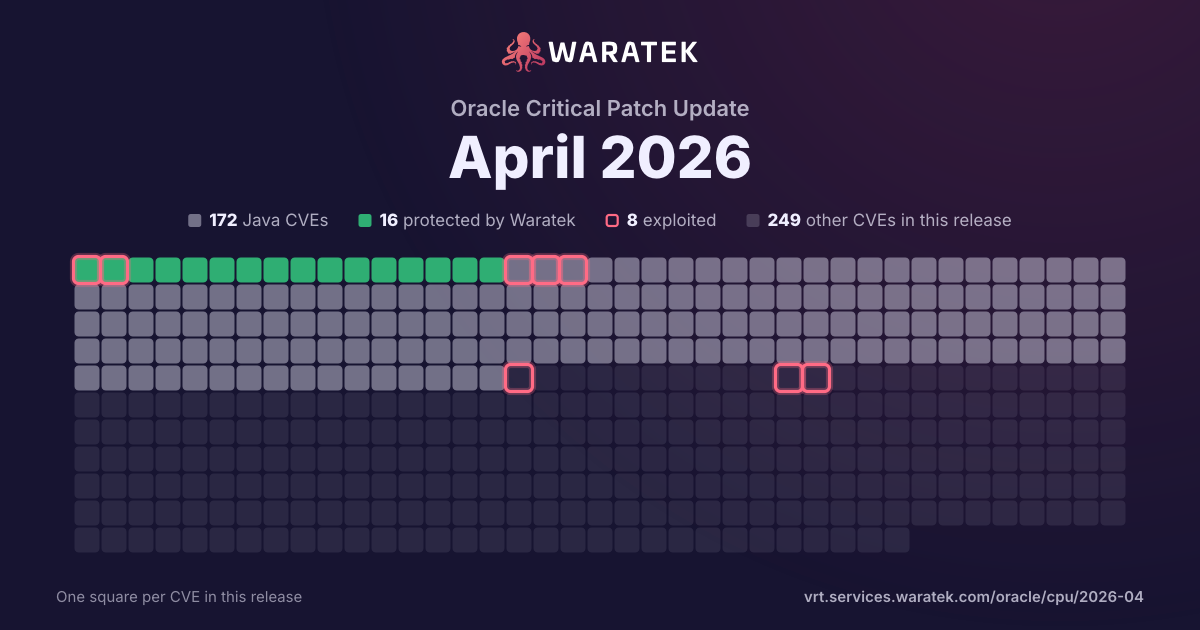
By status
13Protected by Waratek1Rule in development3Mitigation candidate157No exploit published6Outside Waratek scope241Not applicable
8Exploited, marked by the ring
No exploit published. For 51 of them, Oracle's security advisory is the source of public detail.
Protected by Waratek. Waratek RASP can block exploitation of these on systems that have not applied the patch yet.
Overview 10 matches · 0 protected · 1 exploited · 0 CISA KEV · 1 public PoC · 0 EPSS ≥ 0.5
Protected by Waratek
0
0.0%
Rule in development
0
0.0%
Mitigation candidate
1
10.0%
No exploit published
9
90.0%
blocked by ARMR today
0
0.0%
partly blocked
0
0.0%
not blocked
10
100.0%
not established
0
0.0%
unrecorded
0
0.0%
Exploited
1
10.0%
Working exploit published
0
0.0%
Proof of concept only
1
10.0%
Forecast only
0
0.0%
No public exploit
8
80.0%
split by
peak 2 / quarter
Q2 211
No exploit published1
Medium1
not blocked1
No public exploit1
Q3 210
Q4 210
Q1 220
Q2 220
Q3 220
Q4 220
Q1 230
Q2 232
No exploit published2
Medium2
not blocked2
No public exploit2
Q3 230
Q4 230
Q1 240
Q2 240
Q3 240
Q4 241
No exploit published1
Medium1
not blocked1
No public exploit1
Q1 252
Mitigation candidate1
No exploit published1
Medium2
not blocked2
Exploited1
Proof of concept only1
Q2 252
No exploit published2
Medium2
not blocked2
No public exploit2
Q3 252
No exploit published2
Medium2
not blocked2
No public exploit2
Q3 21Q1 22Q3 22Q1 23Q3 23Q1 24Q3 24Q1 25Q3 25
| CVE | Severity | Published▾ | Status | Exploitation | Description |
|---|---|---|---|---|---|
| CVE-2025-48795 | Medium | 2025-07-15 | No exploit published | No public exploit | Apache CXF stores large stream based messages as temporary files on the local filesystem. A bug was introduced which means that the entire temporary file is read into memory and then logged. An attacker might be able to exploit this to cause a denial of service attack by causing an out of memory exception. In addition, it is possible to configure CXF to encrypt temporary files to prevent sensitive credentials from being cached unencrypted on the local filesystem, however this bug means that the cached files are written out to logs unencrypted. Users are recommended to upgrade to versions 3.5.11, 3.6.6, 4.0.7 or 4.1.1, which fixes this issue. |
| CVE-2025-48924 | Medium | 2025-07-11 | No exploit published | No public exploit | Uncontrolled Recursion vulnerability in Apache Commons Lang. This issue affects Apache Commons Lang: Starting with commons-lang:commons-lang 2.0 to 2.6, and, from org.apache.commons:commons-lang3 3.0 before 3.18.0. The methods ClassUtils.getClass(...) can throw StackOverflowError on very long inputs. Because an Error is usually not handled by applications and libraries, a StackOverflowError could cause an application to stop. Users are recommended to upgrade to version 3.18.0, which fixes the issue. |
| CVE-2025-46392 | Medium | 2025-05-09 | No exploit published | No public exploit | Uncontrolled Resource Consumption vulnerability in Apache Commons Configuration 1.x. There are a number of issues in Apache Commons Configuration 1.x that allow excessive resource consumption when loading untrusted configurations or using unexpected usage patterns. The Apache Commons Configuration team does not intend to fix these issues in 1.x. Apache Commons Configuration 1.x is still safe to use in scenario's where you only load trusted configurations. Users that load untrusted configurations or give attackers control over usage patterns are recommended to upgrade to the 2.x version line, which fixes these issues. Apache Commons Configuration 2.x is not a drop-in replacement, but as it uses a separate Maven groupId and Java package namespace they can be loaded side-by-side, making it possible to do a gradual migration. |
| CVE-2025-31672 | Medium | 2025-04-09 | No exploit published | No public exploit | Improper Input Validation vulnerability in Apache POI. The issue affects the parsing of OOXML format files like xlsx, docx and pptx. These file formats are basically zip files and it is possible for malicious users to add zip entries with duplicate names (including the path) in the zip. In this case, products reading the affected file could read different data because 1 of the zip entries with the duplicate name is selected over another but different products may choose a different zip entry. This issue affects Apache POI poi-ooxml before 5.4.0. poi-ooxml 5.4.0 has a check that throws an exception if zip entries with duplicate file names are found in the input file. Users are recommended to upgrade to version poi-ooxml 5.4.0, which fixes the issue. Please read https://poi.apache.org/security.html for recommendations about how to use the POI libraries securely. |
| CVE-2025-27636 | Medium | 2025-03-09 | Mitigation candidate | Exploited | Bypass/Injection vulnerability in Apache Camel components under particular conditions. This issue affects Apache Camel: from 4.10.0 through <= 4.10.1, from 4.8.0 through <= 4.8.4, from 3.10.0 through <= 3.22.3. Users are recommended to upgrade to version 4.10.2 for 4.10.x LTS, 4.8.5 for 4.8.x LTS and 3.22.4 for 3.x releases. This vulnerability is present in Camel's default incoming header filter, that allows an attacker to include Camel specific headers that for some Camel components can alter the behaviours such as the camel-bean component, to call another method on the bean, than was coded in the application. In the camel-jms component, then a malicious header can be used to send the message to another queue (on the same broker) than was coded in the application. This could also be seen by using the camel-exec component The attacker would need to inject custom headers, such as HTTP protocols. So if you have Camel applications that are directly connected to the internet via HTTP, then an attacker could include malicious HTTP headers in the HTTP requests that are send to the Camel application. All the known Camel HTTP component such as camel-servlet, camel-jetty, camel-undertow, camel-platform-http, and camel-netty-http would be vulnerable out of the box. In these conditions an attacker could be able to forge a Camel header name and make the bean component invoking other methods in the same bean. In terms of usage of the default header filter strategy the list of components using that is: * camel-activemq * camel-activemq6 * camel-amqp * camel-aws2-sqs * camel-azure-servicebus * camel-cxf-rest * camel-cxf-soap * camel-http * camel-jetty * camel-jms * camel-kafka * camel-knative * camel-mail * camel-nats * camel-netty-http * camel-platform-http * camel-rest * camel-sjms * camel-spring-rabbitmq * camel-stomp * camel-tahu * camel-undertow * camel-xmpp The vulnerability arises due to a bug in the default filtering mechanism that only blocks headers starting with "Camel", "camel", or "org.apache.camel.". Mitigation: You can easily work around this in your Camel applications by removing the headers in your Camel routes. There are many ways of doing this, also globally or per route. This means you could use the removeHeaders EIP, to filter out anything like "cAmel, cAMEL" etc, or in general everything not starting with "Camel", "camel" or "org.apache.camel.". |
| CVE-2025-25193 | Medium | 2025-02-10 | No exploit published | Proof of concept only | Netty, an asynchronous, event-driven network application framework, has a vulnerability in versions up to and including 4.1.118.Final. An unsafe reading of environment file could potentially cause a denial of service in Netty. When loaded on an Windows application, Netty attempts to load a file that does not exist. If an attacker creates such a large file, the Netty application crash. A similar issue was previously reported as CVE-2024-47535. This issue was fixed, but the fix was incomplete in that null-bytes were not counted against the input limit. Commit d1fbda62d3a47835d3fb35db8bd42ecc205a5386 contains an updated fix. |
| CVE-2024-38820 | Medium | 2024-10-18 | No exploit published | No public exploit | The fix for CVE-2022-22968 made disallowedFields patterns in DataBinder case insensitive. However, String.toLowerCase() has some Locale dependent exceptions that could potentially result in fields not protected as expected. |
| CVE-2023-20862 | Medium | 2023-04-19 | No exploit published | No public exploit | In Spring Security, versions 5.7.x prior to 5.7.8, versions 5.8.x prior to 5.8.3, and versions 6.0.x prior to 6.0.3, the logout support does not properly clean the security context if using serialized versions. Additionally, it is not possible to explicitly save an empty security context to the HttpSessionSecurityContextRepository. This vulnerability can keep users authenticated even after they performed logout. Users of affected versions should apply the following mitigation. 5.7.x users should upgrade to 5.7.8. 5.8.x users should upgrade to 5.8.3. 6.0.x users should upgrade to 6.0.3. |
| CVE-2023-20863 | Medium | 2023-04-13 | No exploit published | No public exploit | In spring framework versions prior to 5.2.24 release+ ,5.3.27+ and 6.0.8+ , it is possible for a user to provide a specially crafted SpEL expression that may cause a denial-of-service (DoS) condition. |
| CVE-2021-28168 | Medium | 2021-04-22 | No exploit published | No public exploit | Eclipse Jersey 2.28 to 2.33 and Eclipse Jersey 3.0.0 to 3.0.1 contains a local information disclosure vulnerability. This is due to the use of the File.createTempFile which creates a file inside of the system temporary directory with the permissions: -rw-r--r--. Thus the contents of this file are viewable by all other users locally on the system. As such, if the contents written is security sensitive, it can be disclosed to other local users. |