
Oracle Critical Patch Update April 2026
Released April 2026 · Oracle's advisory ↗ · ← Critical Patch Update, January 2026 · Security Patch Update, May 2026 →
421 CVEs in this release, one square each
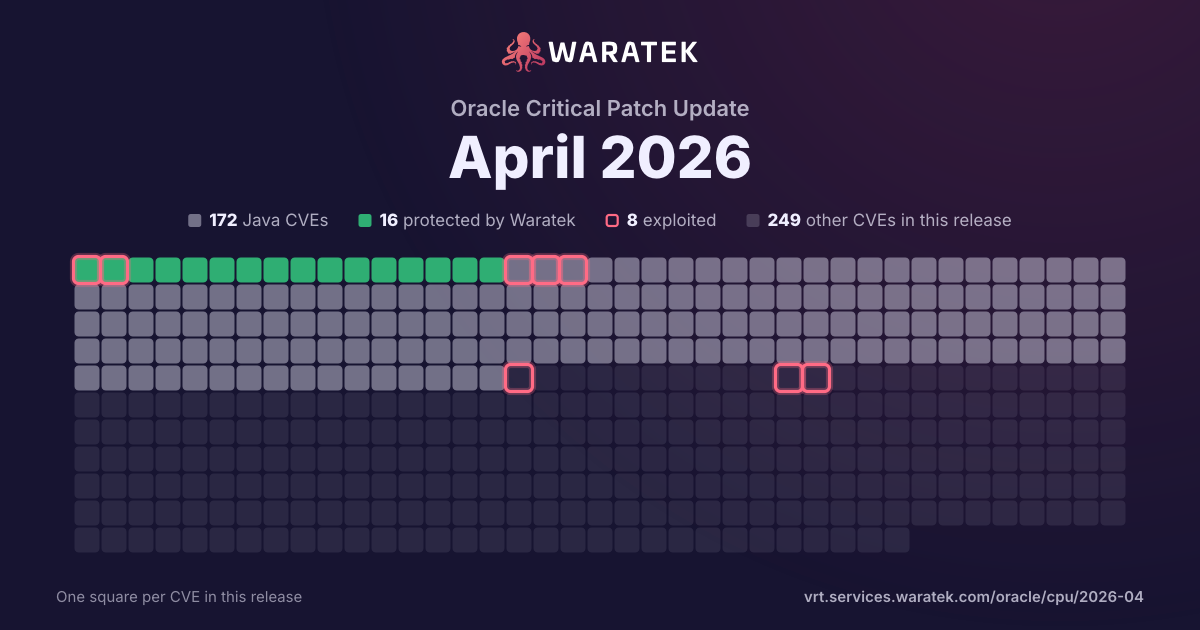
By status
16Protected by Waratek4Mitigation candidate152No exploit published10Outside Waratek scope239Not applicable
8Exploited, marked by the ring
No exploit published. For 51 of them, Oracle's security advisory is the source of public detail.
Protected by Waratek. Waratek RASP can block exploitation of these on systems that have not applied the patch yet.
Overview 132 matches · 0 protected · 0 exploited · 0 CISA KEV · 0 public PoC · 0 EPSS ≥ 0.5
132matches
0protected0.0%
0exploited0.0%
0CISA KEV0.0%
0public PoC0.0%
0EPSS ≥ 0.50.0%
Protected by Waratek
0
0.0%
Rule in development
0
0.0%
Mitigation candidate
0
0.0%
No exploit published
132
100.0%
blocked by ARMR today
0
0.0%
partly blocked
0
0.0%
not blocked
132
100.0%
not established
0
0.0%
unrecorded
0
0.0%
Exploited
0
0.0%
Working exploit published
0
0.0%
Proof of concept only
0
0.0%
Forecast only
0
0.0%
No public exploit
132
100.0%
split by
peak 53 / quarter
Q1 211
No exploit published1
High1
not blocked1
No public exploit1
Q2 211
No exploit published1
Medium1
not blocked1
No public exploit1
Q3 210
Q4 210
Q1 220
Q2 221
No exploit published1
High1
not blocked1
No public exploit1
Q3 222
No exploit published2
High2
not blocked2
No public exploit2
Q4 221
No exploit published1
High1
not blocked1
No public exploit1
Q1 230
Q2 234
No exploit published4
High1
Medium3
not blocked4
No public exploit4
Q3 233
No exploit published3
Critical1
High2
not blocked3
No public exploit3
Q4 232
No exploit published2
Critical2
not blocked2
No public exploit2
Q1 243
No exploit published3
Critical1
High1
Medium1
not blocked3
No public exploit3
Q2 244
No exploit published4
High3
Medium1
not blocked4
No public exploit4
Q3 244
No exploit published4
Critical1
High3
not blocked4
No public exploit4
Q4 243
No exploit published3
Critical1
Medium2
not blocked3
No public exploit3
Q1 251
No exploit published1
High1
not blocked1
No public exploit1
Q2 259
No exploit published9
High6
Medium2
Low1
not blocked9
No public exploit9
Q3 2512
No exploit published12
Critical1
High3
Medium7
Low1
not blocked12
No public exploit12
Q4 2515
No exploit published15
Critical1
High6
Medium7
Low1
not blocked15
No public exploit15
Q1 2613
No exploit published13
Critical2
High6
Medium4
Low1
not blocked13
No public exploit13
Q2 2653
No exploit published53
Critical5
High11
Medium33
Low4
not blocked53
No public exploit53
Q2 21Q4 21Q2 22Q4 22Q2 23Q4 23Q2 24Q4 24Q2 25Q4 25Q2 26
| CVE | Severity | Published▾ | Status | Exploitation | Description |
|---|---|---|---|---|---|
| CVE-2026-35252 | Medium | 2026-04-21 | No exploit published | No public exploit | Vulnerability in the Oracle Security Service product of Oracle Fusion Middleware (component: C Oracle SSL API). Supported versions that are affected are 12.2.1.4.0 and 12.1.3.0.0. Difficult to exploit vulnerability allows low privileged attacker with network access via HTTPS to compromise Oracle Security Service. Successful attacks require human interaction from a person other than the attacker. Successful attacks of this vulnerability can result in unauthorized creation, deletion or modification access to critical data or all Oracle Security Service accessible data as well as unauthorized access to critical data or complete access to all Oracle Security Service accessible data. CVSS 3.1 Base Score 6.4 (Confidentiality and Integrity impacts). CVSS Vector: (CVSS:3.1/AV:N/AC:H/PR:L/UI:R/S:U/C:H/I:H/A:N). |
| CVE-2026-35244 | Medium | 2026-04-21 | No exploit published | No public exploit | Vulnerability in the Oracle Hyperion Infrastructure Technology product of Oracle Hyperion (component: Lifecycle Management). The supported version that is affected is 11.2.24.0.000. Easily exploitable vulnerability allows high privileged attacker with network access via HTTP to compromise Oracle Hyperion Infrastructure Technology. Successful attacks require human interaction from a person other than the attacker. Successful attacks of this vulnerability can result in unauthorized creation, deletion or modification access to critical data or all Oracle Hyperion Infrastructure Technology accessible data as well as unauthorized read access to a subset of Oracle Hyperion Infrastructure Technology accessible data. CVSS 3.1 Base Score 5.2 (Confidentiality and Integrity impacts). CVSS Vector: (CVSS:3.1/AV:N/AC:L/PR:H/UI:R/S:U/C:L/I:H/A:N). |
| CVE-2026-35243 | High | 2026-04-21 | No exploit published | No public exploit | Vulnerability in the Oracle Application Development Framework (ADF) product of Oracle Fusion Middleware (component: ADF Faces). Supported versions that are affected are 12.2.1.4.0 and 14.1.2.0.0. Easily exploitable vulnerability allows low privileged attacker with logon to the infrastructure where Oracle Application Development Framework (ADF) executes to compromise Oracle Application Development Framework (ADF). Successful attacks of this vulnerability can result in takeover of Oracle Application Development Framework (ADF). CVSS 3.1 Base Score 7.8 (Confidentiality, Integrity and Availability impacts). CVSS Vector: (CVSS:3.1/AV:L/AC:L/PR:L/UI:N/S:U/C:H/I:H/A:H). |
| CVE-2026-35241 | Medium | 2026-04-21 | No exploit published | No public exploit | Vulnerability in the PeopleSoft Enterprise CS Student Records product of Oracle PeopleSoft (component: Research Tracking). The supported version that is affected is 9.2. Easily exploitable vulnerability allows low privileged attacker with network access via HTTP to compromise PeopleSoft Enterprise CS Student Records. Successful attacks require human interaction from a person other than the attacker. Successful attacks of this vulnerability can result in unauthorized access to critical data or complete access to all PeopleSoft Enterprise CS Student Records accessible data. CVSS 3.1 Base Score 5.7 (Confidentiality impacts). CVSS Vector: (CVSS:3.1/AV:N/AC:L/PR:L/UI:R/S:U/C:H/I:N/A:N). |
| CVE-2026-35232 | Medium | 2026-04-21 | No exploit published | No public exploit | Vulnerability in Oracle Fusion Middleware (component: Dynamic Monitoring Service). Supported versions that are affected are 12.2.1.4.0 and 14.1.2.0.0. Easily exploitable vulnerability allows low privileged attacker with network access via HTTP to compromise Oracle Fusion Middleware. Successful attacks require human interaction from a person other than the attacker and while the vulnerability is in Oracle Fusion Middleware, attacks may significantly impact additional products (scope change). Successful attacks of this vulnerability can result in unauthorized update, insert or delete access to some of Oracle Fusion Middleware accessible data as well as unauthorized read access to a subset of Oracle Fusion Middleware accessible data. CVSS 3.1 Base Score 5.4 (Confidentiality and Integrity impacts). CVSS Vector: (CVSS:3.1/AV:N/AC:L/PR:L/UI:R/S:C/C:L/I:L/A:N). |
| CVE-2026-35231 | High | 2026-04-21 | No exploit published | No public exploit | Vulnerability in the Oracle Financial Services Transaction Filtering product of Oracle Financial Services Applications (component: User Interface). The supported version that is affected is 8.1.2.8.0. Easily exploitable vulnerability allows unauthenticated attacker with network access via HTTP to compromise Oracle Financial Services Transaction Filtering. Successful attacks of this vulnerability can result in unauthorized access to critical data or complete access to all Oracle Financial Services Transaction Filtering accessible data. CVSS 3.1 Base Score 7.5 (Confidentiality impacts). CVSS Vector: (CVSS:3.1/AV:N/AC:L/PR:N/UI:N/S:U/C:H/I:N/A:N). |
| CVE-2026-34325 | Medium | 2026-04-21 | No exploit published | No public exploit | Vulnerability in the Oracle Financial Services Analytical Applications Infrastructure product of Oracle Financial Services Applications (component: User Interface). Supported versions that are affected are 8.0.7.9, 8.0.8.7 and 8.1.2.5. Easily exploitable vulnerability allows low privileged attacker with logon to the infrastructure where Oracle Financial Services Analytical Applications Infrastructure executes to compromise Oracle Financial Services Analytical Applications Infrastructure. Successful attacks require human interaction from a person other than the attacker. Successful attacks of this vulnerability can result in unauthorized access to critical data or complete access to all Oracle Financial Services Analytical Applications Infrastructure accessible data as well as unauthorized update, insert or delete access to some of Oracle Financial Services Analytical Applications Infrastructure accessible data and unauthorized ability to cause a hang or frequently repeatable crash (complete DOS) of Oracle Financial Services Analytical Applications Infrastructure. CVSS 3.1 Base Score 6.8 (Confidentiality, Integrity and Availability impacts). CVSS Vector: (CVSS:3.1/AV:L/AC:L/PR:L/UI:R/S:U/C:H/I:L/A:H). |
| CVE-2026-34324 | Medium | 2026-04-21 | No exploit published | No public exploit | Vulnerability in the Oracle Life Sciences InForm product of Oracle Life Science Applications (component: App Server). Supported versions that are affected are 7.0.1.0 and 7.0.1.1. Easily exploitable vulnerability allows unauthenticated attacker with network access via HTTP to compromise Oracle Life Sciences InForm. Successful attacks of this vulnerability can result in unauthorized update, insert or delete access to some of Oracle Life Sciences InForm accessible data as well as unauthorized read access to a subset of Oracle Life Sciences InForm accessible data. CVSS 3.1 Base Score 6.5 (Confidentiality and Integrity impacts). CVSS Vector: (CVSS:3.1/AV:N/AC:L/PR:N/UI:N/S:U/C:L/I:L/A:N). |
| CVE-2026-34323 | Medium | 2026-04-21 | No exploit published | No public exploit | Vulnerability in the Oracle Life Sciences InForm product of Oracle Life Science Applications (component: IDM Authentication). Supported versions that are affected are 7.0.1.0 and 7.0.1.1. Easily exploitable vulnerability allows unauthenticated attacker with network access via HTTP to compromise Oracle Life Sciences InForm. Successful attacks require human interaction from a person other than the attacker. Successful attacks of this vulnerability can result in unauthorized update, insert or delete access to some of Oracle Life Sciences InForm accessible data as well as unauthorized read access to a subset of Oracle Life Sciences InForm accessible data and unauthorized ability to cause a partial denial of service (partial DOS) of Oracle Life Sciences InForm. CVSS 3.1 Base Score 6.3 (Confidentiality, Integrity and Availability impacts). CVSS Vector: (CVSS:3.1/AV:N/AC:L/PR:N/UI:R/S:U/C:L/I:L/A:L). |
| CVE-2026-34321 | Medium | 2026-04-21 | No exploit published | No public exploit | Vulnerability in the Oracle Financial Services Analytical Applications Infrastructure product of Oracle Financial Services Applications (component: User Interface). Supported versions that are affected are 8.0.7.9, 8.0.8.7 and 8.1.2.5. Difficult to exploit vulnerability allows low privileged attacker with network access via HTTP to compromise Oracle Financial Services Analytical Applications Infrastructure. Successful attacks require human interaction from a person other than the attacker. Successful attacks of this vulnerability can result in unauthorized access to critical data or complete access to all Oracle Financial Services Analytical Applications Infrastructure accessible data. CVSS 3.1 Base Score 4.8 (Confidentiality impacts). CVSS Vector: (CVSS:3.1/AV:N/AC:H/PR:L/UI:R/S:U/C:H/I:N/A:N). |
| CVE-2026-34320 | High | 2026-04-21 | No exploit published | No public exploit | Vulnerability in the Oracle Financial Services Customer Screening product of Oracle Financial Services Applications (component: User Interface). The supported version that is affected is 8.1.2.8.0. Easily exploitable vulnerability allows unauthenticated attacker with network access via HTTP to compromise Oracle Financial Services Customer Screening. Successful attacks of this vulnerability can result in unauthorized access to critical data or complete access to all Oracle Financial Services Customer Screening accessible data. CVSS 3.1 Base Score 7.5 (Confidentiality impacts). CVSS Vector: (CVSS:3.1/AV:N/AC:L/PR:N/UI:N/S:U/C:H/I:N/A:N). |
| CVE-2026-34315 | Medium | 2026-04-21 | No exploit published | No public exploit | Vulnerability in the Oracle WebLogic Server product of Oracle Fusion Middleware (component: Web Services). Supported versions that are affected are 12.2.1.4.0, 14.1.1.0.0, 14.1.2.0.0 and 15.1.1.0.0. Easily exploitable vulnerability allows unauthenticated attacker with network access via HTTP to compromise Oracle WebLogic Server. Successful attacks require human interaction from a person other than the attacker. Successful attacks of this vulnerability can result in unauthorized creation, deletion or modification access to critical data or all Oracle WebLogic Server accessible data. CVSS 3.1 Base Score 6.5 (Integrity impacts). CVSS Vector: (CVSS:3.1/AV:N/AC:L/PR:N/UI:R/S:U/C:N/I:H/A:N). |
| CVE-2026-34314 | Medium | 2026-04-21 | No exploit published | No public exploit | Vulnerability in the Oracle Financial Services Analytical Applications Infrastructure product of Oracle Financial Services Applications (component: Platform). Supported versions that are affected are 8.0.7.9, 8.0.8.7 and 8.1.2.5. Difficult to exploit vulnerability allows low privileged attacker with network access via HTTP to compromise Oracle Financial Services Analytical Applications Infrastructure. Successful attacks of this vulnerability can result in unauthorized creation, deletion or modification access to critical data or all Oracle Financial Services Analytical Applications Infrastructure accessible data as well as unauthorized access to critical data or complete access to all Oracle Financial Services Analytical Applications Infrastructure accessible data. CVSS 3.1 Base Score 6.8 (Confidentiality and Integrity impacts). CVSS Vector: (CVSS:3.1/AV:N/AC:H/PR:L/UI:N/S:U/C:H/I:H/A:N). |
| CVE-2026-34313 | Medium | 2026-04-21 | No exploit published | No public exploit | Vulnerability in the Oracle Financial Services Analytical Applications Infrastructure product of Oracle Financial Services Applications (component: Platform). Supported versions that are affected are 8.0.7.9, 8.0.8.7 and 8.1.2.5. Easily exploitable vulnerability allows low privileged attacker with network access via HTTP to compromise Oracle Financial Services Analytical Applications Infrastructure. Successful attacks of this vulnerability can result in unauthorized access to critical data or complete access to all Oracle Financial Services Analytical Applications Infrastructure accessible data. CVSS 3.1 Base Score 6.5 (Confidentiality impacts). CVSS Vector: (CVSS:3.1/AV:N/AC:L/PR:L/UI:N/S:U/C:H/I:N/A:N). |
| CVE-2026-34310 | High | 2026-04-21 | No exploit published | No public exploit | Vulnerability in the Oracle Financial Services Analytical Applications Infrastructure product of Oracle Financial Services Applications (component: Platform). Supported versions that are affected are 8.0.7.9, 8.0.8.7 and 8.1.2.5. Easily exploitable vulnerability allows unauthenticated attacker with network access via HTTP to compromise Oracle Financial Services Analytical Applications Infrastructure. Successful attacks of this vulnerability can result in unauthorized access to critical data or complete access to all Oracle Financial Services Analytical Applications Infrastructure accessible data. CVSS 3.1 Base Score 7.5 (Confidentiality impacts). CVSS Vector: (CVSS:3.1/AV:N/AC:L/PR:N/UI:N/S:U/C:H/I:N/A:N). |
| CVE-2026-34309 | High | 2026-04-21 | No exploit published | No public exploit | Vulnerability in the PeopleSoft Enterprise PeopleTools product of Oracle PeopleSoft (component: Security). Supported versions that are affected are 8.61-8.62. Easily exploitable vulnerability allows low privileged attacker with network access via HTTP to compromise PeopleSoft Enterprise PeopleTools. Successful attacks of this vulnerability can result in unauthorized creation, deletion or modification access to critical data or all PeopleSoft Enterprise PeopleTools accessible data as well as unauthorized access to critical data or complete access to all PeopleSoft Enterprise PeopleTools accessible data. CVSS 3.1 Base Score 8.1 (Confidentiality and Integrity impacts). CVSS Vector: (CVSS:3.1/AV:N/AC:L/PR:L/UI:N/S:U/C:H/I:H/A:N). |
| CVE-2026-34307 | Medium | 2026-04-21 | No exploit published | No public exploit | Vulnerability in the PeopleSoft Enterprise PeopleTools product of Oracle PeopleSoft (component: Workflow). Supported versions that are affected are 8.61-8.62. Easily exploitable vulnerability allows low privileged attacker with network access via HTTP to compromise PeopleSoft Enterprise PeopleTools. Successful attacks require human interaction from a person other than the attacker and while the vulnerability is in PeopleSoft Enterprise PeopleTools, attacks may significantly impact additional products (scope change). Successful attacks of this vulnerability can result in unauthorized update, insert or delete access to some of PeopleSoft Enterprise PeopleTools accessible data as well as unauthorized read access to a subset of PeopleSoft Enterprise PeopleTools accessible data. CVSS 3.1 Base Score 5.4 (Confidentiality and Integrity impacts). CVSS Vector: (CVSS:3.1/AV:N/AC:L/PR:L/UI:R/S:C/C:L/I:L/A:N). |
| CVE-2026-34306 | Medium | 2026-04-21 | No exploit published | No public exploit | Vulnerability in the PeopleSoft Enterprise FIN Project Costing product of Oracle PeopleSoft (component: Projects). The supported version that is affected is 9.2. Easily exploitable vulnerability allows low privileged attacker with network access via HTTP to compromise PeopleSoft Enterprise FIN Project Costing. Successful attacks of this vulnerability can result in unauthorized access to critical data or complete access to all PeopleSoft Enterprise FIN Project Costing accessible data. CVSS 3.1 Base Score 6.5 (Confidentiality impacts). CVSS Vector: (CVSS:3.1/AV:N/AC:L/PR:L/UI:N/S:U/C:H/I:N/A:N). |
| CVE-2026-34302 | Medium | 2026-04-21 | No exploit published | No public exploit | Vulnerability in the Oracle Workflow product of Oracle E-Business Suite (component: Workflow Loader). Supported versions that are affected are 12.2.3-12.2.15. Easily exploitable vulnerability allows high privileged attacker with network access via HTTP to compromise Oracle Workflow. While the vulnerability is in Oracle Workflow, attacks may significantly impact additional products (scope change). Successful attacks of this vulnerability can result in unauthorized update, insert or delete access to some of Oracle Workflow accessible data and unauthorized ability to cause a partial denial of service (partial DOS) of Oracle Workflow. CVSS 3.1 Base Score 5.5 (Integrity and Availability impacts). CVSS Vector: (CVSS:3.1/AV:N/AC:L/PR:H/UI:N/S:C/C:N/I:L/A:L). |
| CVE-2026-34301 | Medium | 2026-04-21 | No exploit published | No public exploit | Vulnerability in the PeopleSoft Enterprise FIN Maintenance Management product of Oracle PeopleSoft (component: Work Order Management). The supported version that is affected is 9.2. Easily exploitable vulnerability allows low privileged attacker with network access via HTTP to compromise PeopleSoft Enterprise FIN Maintenance Management. Successful attacks of this vulnerability can result in unauthorized access to critical data or complete access to all PeopleSoft Enterprise FIN Maintenance Management accessible data. CVSS 3.1 Base Score 6.5 (Confidentiality impacts). CVSS Vector: (CVSS:3.1/AV:N/AC:L/PR:L/UI:N/S:U/C:H/I:N/A:N). |
| CVE-2026-34300 | Medium | 2026-04-21 | No exploit published | No public exploit | Vulnerability in the PeopleSoft Enterprise FIN Contracts product of Oracle PeopleSoft (component: Contracts). The supported version that is affected is 9.2. Easily exploitable vulnerability allows low privileged attacker with network access via HTTP to compromise PeopleSoft Enterprise FIN Contracts. Successful attacks of this vulnerability can result in unauthorized access to critical data or complete access to all PeopleSoft Enterprise FIN Contracts accessible data. CVSS 3.1 Base Score 6.5 (Confidentiality impacts). CVSS Vector: (CVSS:3.1/AV:N/AC:L/PR:L/UI:N/S:U/C:H/I:N/A:N). |
| CVE-2026-34299 | Medium | 2026-04-21 | No exploit published | No public exploit | Vulnerability in the PeopleSoft Enterprise FIN Maintenance Management product of Oracle PeopleSoft (component: Work Order Management). The supported version that is affected is 9.2. Easily exploitable vulnerability allows low privileged attacker with network access via HTTP to compromise PeopleSoft Enterprise FIN Maintenance Management. Successful attacks of this vulnerability can result in unauthorized access to critical data or complete access to all PeopleSoft Enterprise FIN Maintenance Management accessible data. CVSS 3.1 Base Score 6.5 (Confidentiality impacts). CVSS Vector: (CVSS:3.1/AV:N/AC:L/PR:L/UI:N/S:U/C:H/I:N/A:N). |
| CVE-2026-34298 | Medium | 2026-04-21 | No exploit published | No public exploit | Vulnerability in the Oracle Applications Framework product of Oracle E-Business Suite (component: Personalization). Supported versions that are affected are 12.2.9-12.2.15. Easily exploitable vulnerability allows high privileged attacker with network access via HTTP to compromise Oracle Applications Framework. Successful attacks of this vulnerability can result in unauthorized update, insert or delete access to some of Oracle Applications Framework accessible data as well as unauthorized read access to a subset of Oracle Applications Framework accessible data and unauthorized ability to cause a partial denial of service (partial DOS) of Oracle Applications Framework. CVSS 3.1 Base Score 4.7 (Confidentiality, Integrity and Availability impacts). CVSS Vector: (CVSS:3.1/AV:N/AC:L/PR:H/UI:N/S:U/C:L/I:L/A:L). |
| CVE-2026-34297 | High | 2026-04-21 | No exploit published | No public exploit | Vulnerability in the Oracle HCM Common Architecture product of Oracle E-Business Suite (component: Knowledge Integration). Supported versions that are affected are 12.2.3-12.2.15. Easily exploitable vulnerability allows unauthenticated attacker with network access via HTTP to compromise Oracle HCM Common Architecture. Successful attacks of this vulnerability can result in unauthorized access to critical data or complete access to all Oracle HCM Common Architecture accessible data. CVSS 3.1 Base Score 7.5 (Confidentiality impacts). CVSS Vector: (CVSS:3.1/AV:N/AC:L/PR:N/UI:N/S:U/C:H/I:N/A:N). |
| CVE-2026-34296 | Medium | 2026-04-21 | No exploit published | No public exploit | Vulnerability in the Oracle Agile Product Lifecycle Management for Process product of Oracle Supply Chain (component: Product Quality Management). The supported version that is affected is 6.2.4. Easily exploitable vulnerability allows low privileged attacker with network access via HTTP to compromise Oracle Agile Product Lifecycle Management for Process. Successful attacks of this vulnerability can result in unauthorized read access to a subset of Oracle Agile Product Lifecycle Management for Process accessible data. CVSS 3.1 Base Score 4.3 (Confidentiality impacts). CVSS Vector: (CVSS:3.1/AV:N/AC:L/PR:L/UI:N/S:U/C:L/I:N/A:N). |
| CVE-2026-34295 | Medium | 2026-04-21 | No exploit published | No public exploit | Vulnerability in the PeopleSoft Enterprise SCM Purchasing product of Oracle PeopleSoft (component: Purchasing). The supported version that is affected is 9.2. Easily exploitable vulnerability allows low privileged attacker with network access via HTTP to compromise PeopleSoft Enterprise SCM Purchasing. Successful attacks of this vulnerability can result in unauthorized access to critical data or complete access to all PeopleSoft Enterprise SCM Purchasing accessible data. CVSS 3.1 Base Score 6.5 (Confidentiality impacts). CVSS Vector: (CVSS:3.1/AV:N/AC:L/PR:L/UI:N/S:U/C:H/I:N/A:N). |
| CVE-2026-34294 | Medium | 2026-04-21 | No exploit published | No public exploit | Vulnerability in the Oracle Identity Manager Connector product of Oracle Fusion Middleware (component: Microsoft Active Directory). The supported version that is affected is 12.2.1.4.0. Difficult to exploit vulnerability allows low privileged attacker with network access via LDAP to compromise Oracle Identity Manager Connector. Successful attacks of this vulnerability can result in unauthorized creation, deletion or modification access to critical data or all Oracle Identity Manager Connector accessible data as well as unauthorized read access to a subset of Oracle Identity Manager Connector accessible data. CVSS 3.1 Base Score 5.9 (Confidentiality and Integrity impacts). CVSS Vector: (CVSS:3.1/AV:N/AC:H/PR:L/UI:N/S:U/C:L/I:H/A:N). |
| CVE-2026-34292 | High | 2026-04-21 | No exploit published | No public exploit | Vulnerability in the Oracle WebLogic Server product of Oracle Fusion Middleware (component: Core). Supported versions that are affected are 12.2.1.4.0 and 14.1.1.0.0. Easily exploitable vulnerability allows high privileged attacker with network access via HTTP to compromise Oracle WebLogic Server. Successful attacks of this vulnerability can result in takeover of Oracle WebLogic Server. CVSS 3.1 Base Score 7.2 (Confidentiality, Integrity and Availability impacts). CVSS Vector: (CVSS:3.1/AV:N/AC:L/PR:H/UI:N/S:U/C:H/I:H/A:H). |
| CVE-2026-34290 | High | 2026-04-21 | No exploit published | No public exploit | Vulnerability in the Oracle Identity Manager Connector product of Oracle Fusion Middleware (component: Core). The supported version that is affected is 12.2.1.4.0. Easily exploitable vulnerability allows unauthenticated attacker with network access via TCP to compromise Oracle Identity Manager Connector. Successful attacks of this vulnerability can result in unauthorized ability to cause a hang or frequently repeatable crash (complete DOS) of Oracle Identity Manager Connector. CVSS 3.1 Base Score 7.5 (Availability impacts). CVSS Vector: (CVSS:3.1/AV:N/AC:L/PR:N/UI:N/S:U/C:N/I:N/A:H). |
| CVE-2026-34289 | Medium | 2026-04-21 | No exploit published | No public exploit | Vulnerability in the Oracle Identity Manager Connector product of Oracle Fusion Middleware (component: Core). The supported version that is affected is 12.2.1.4.0. Difficult to exploit vulnerability allows unauthenticated attacker with network access via HTTPS to compromise Oracle Identity Manager Connector. Successful attacks of this vulnerability can result in unauthorized access to critical data or complete access to all Oracle Identity Manager Connector accessible data. CVSS 3.1 Base Score 5.9 (Confidentiality impacts). CVSS Vector: (CVSS:3.1/AV:N/AC:H/PR:N/UI:N/S:U/C:H/I:N/A:N). |
| CVE-2026-34288 | Medium | 2026-04-21 | No exploit published | No public exploit | Vulnerability in the Oracle Identity Manager Connector product of Oracle Fusion Middleware (component: Core). The supported version that is affected is 12.2.1.4.0. Difficult to exploit vulnerability allows unauthenticated attacker with network access via HTTP to compromise Oracle Identity Manager Connector. Successful attacks of this vulnerability can result in unauthorized access to critical data or complete access to all Oracle Identity Manager Connector accessible data. CVSS 3.1 Base Score 5.9 (Confidentiality impacts). CVSS Vector: (CVSS:3.1/AV:N/AC:H/PR:N/UI:N/S:U/C:H/I:N/A:N). |
| CVE-2026-34287 | Critical | 2026-04-21 | No exploit published | No public exploit | Vulnerability in the Oracle Identity Manager Connector product of Oracle Fusion Middleware (component: Core). The supported version that is affected is 12.2.1.4.0. Easily exploitable vulnerability allows unauthenticated attacker with network access via HTTPS to compromise Oracle Identity Manager Connector. Successful attacks of this vulnerability can result in unauthorized creation, deletion or modification access to critical data or all Oracle Identity Manager Connector accessible data as well as unauthorized access to critical data or complete access to all Oracle Identity Manager Connector accessible data. CVSS 3.1 Base Score 9.1 (Confidentiality and Integrity impacts). CVSS Vector: (CVSS:3.1/AV:N/AC:L/PR:N/UI:N/S:U/C:H/I:H/A:N). |
| CVE-2026-34286 | Critical | 2026-04-21 | No exploit published | No public exploit | Vulnerability in the Oracle Identity Manager Connector product of Oracle Fusion Middleware (component: Core). The supported version that is affected is 12.2.1.4.0. Easily exploitable vulnerability allows unauthenticated attacker with network access via HTTPS to compromise Oracle Identity Manager Connector. Successful attacks of this vulnerability can result in unauthorized creation, deletion or modification access to critical data or all Oracle Identity Manager Connector accessible data as well as unauthorized access to critical data or complete access to all Oracle Identity Manager Connector accessible data. CVSS 3.1 Base Score 9.1 (Confidentiality and Integrity impacts). CVSS Vector: (CVSS:3.1/AV:N/AC:L/PR:N/UI:N/S:U/C:H/I:H/A:N). |
| CVE-2026-34285 | Critical | 2026-04-21 | No exploit published | No public exploit | Vulnerability in the Oracle Identity Manager Connector product of Oracle Fusion Middleware (component: Core). The supported version that is affected is 12.2.1.4.0. Easily exploitable vulnerability allows unauthenticated attacker with network access via HTTPS to compromise Oracle Identity Manager Connector. Successful attacks of this vulnerability can result in unauthorized creation, deletion or modification access to critical data or all Oracle Identity Manager Connector accessible data as well as unauthorized access to critical data or complete access to all Oracle Identity Manager Connector accessible data. CVSS 3.1 Base Score 9.1 (Confidentiality and Integrity impacts). CVSS Vector: (CVSS:3.1/AV:N/AC:L/PR:N/UI:N/S:U/C:H/I:H/A:N). |
| CVE-2026-34284 | Medium | 2026-04-21 | No exploit published | No public exploit | Vulnerability in the Oracle Business Process Management Suite product of Oracle Fusion Middleware (component: Human workflow 11g+). Supported versions that are affected are 12.2.1.4.0 and 14.1.2.0.0. Easily exploitable vulnerability allows unauthenticated attacker with network access via HTTP to compromise Oracle Business Process Management Suite. Successful attacks require human interaction from a person other than the attacker and while the vulnerability is in Oracle Business Process Management Suite, attacks may significantly impact additional products (scope change). Successful attacks of this vulnerability can result in unauthorized update, insert or delete access to some of Oracle Business Process Management Suite accessible data as well as unauthorized read access to a subset of Oracle Business Process Management Suite accessible data. CVSS 3.1 Base Score 6.1 (Confidentiality and Integrity impacts). CVSS Vector: (CVSS:3.1/AV:N/AC:L/PR:N/UI:R/S:C/C:L/I:L/A:N). |
| CVE-2026-34283 | Medium | 2026-04-21 | No exploit published | No public exploit | Vulnerability in the Oracle Identity Manager product of Oracle Fusion Middleware (component: Identity Console). Supported versions that are affected are 12.2.1.4.0 and 14.1.2.0.0. Easily exploitable vulnerability allows unauthenticated attacker with network access via HTTP to compromise Oracle Identity Manager. Successful attacks require human interaction from a person other than the attacker and while the vulnerability is in Oracle Identity Manager, attacks may significantly impact additional products (scope change). Successful attacks of this vulnerability can result in unauthorized update, insert or delete access to some of Oracle Identity Manager accessible data as well as unauthorized read access to a subset of Oracle Identity Manager accessible data. CVSS 3.1 Base Score 6.1 (Confidentiality and Integrity impacts). CVSS Vector: (CVSS:3.1/AV:N/AC:L/PR:N/UI:R/S:C/C:L/I:L/A:N). |
| CVE-2026-34280 | Medium | 2026-04-21 | No exploit published | No public exploit | Vulnerability in the PeopleSoft Enterprise HCM Human Resources product of Oracle PeopleSoft (component: Job Profile Manager). The supported version that is affected is 9.2. Easily exploitable vulnerability allows high privileged attacker with network access via HTTP to compromise PeopleSoft Enterprise HCM Human Resources. Successful attacks of this vulnerability can result in unauthorized creation, deletion or modification access to critical data or all PeopleSoft Enterprise HCM Human Resources accessible data as well as unauthorized access to critical data or complete access to all PeopleSoft Enterprise HCM Human Resources accessible data. CVSS 3.1 Base Score 6.5 (Confidentiality and Integrity impacts). CVSS Vector: (CVSS:3.1/AV:N/AC:L/PR:H/UI:N/S:U/C:H/I:H/A:N). |
| CVE-2026-34279 | Critical | 2026-04-21 | No exploit published | No public exploit | Vulnerability in the Oracle Enterprise Manager Base Platform product of Oracle Enterprise Manager (component: Event Management). Supported versions that are affected are 13.5 and 24.1. Easily exploitable vulnerability allows high privileged attacker with network access via HTTP to compromise Oracle Enterprise Manager Base Platform. While the vulnerability is in Oracle Enterprise Manager Base Platform, attacks may significantly impact additional products (scope change). Successful attacks of this vulnerability can result in takeover of Oracle Enterprise Manager Base Platform. CVSS 3.1 Base Score 9.1 (Confidentiality, Integrity and Availability impacts). CVSS Vector: (CVSS:3.1/AV:N/AC:L/PR:H/UI:N/S:C/C:H/I:H/A:H). |
| CVE-2026-34277 | Medium | 2026-04-21 | No exploit published | No public exploit | Vulnerability in the PeopleSoft Enterprise PeopleTools product of Oracle PeopleSoft (component: Fluid Core). Supported versions that are affected are 8.61-8.62. Easily exploitable vulnerability allows high privileged attacker with network access via HTTP to compromise PeopleSoft Enterprise PeopleTools. While the vulnerability is in PeopleSoft Enterprise PeopleTools, attacks may significantly impact additional products (scope change). Successful attacks of this vulnerability can result in unauthorized update, insert or delete access to some of PeopleSoft Enterprise PeopleTools accessible data as well as unauthorized read access to a subset of PeopleSoft Enterprise PeopleTools accessible data and unauthorized ability to cause a partial denial of service (partial DOS) of PeopleSoft Enterprise PeopleTools. CVSS 3.1 Base Score 6.6 (Confidentiality, Integrity and Availability impacts). CVSS Vector: (CVSS:3.1/AV:N/AC:L/PR:H/UI:N/S:C/C:L/I:L/A:L). |
| CVE-2026-34275 | Critical | 2026-04-21 | No exploit published | No public exploit | Vulnerability in the Oracle Advanced Inbound Telephony product of Oracle E-Business Suite (component: Setup and Administration). Supported versions that are affected are 12.2.3-12.2.15. Easily exploitable vulnerability allows unauthenticated attacker with network access via HTTP to compromise Oracle Advanced Inbound Telephony. Successful attacks of this vulnerability can result in takeover of Oracle Advanced Inbound Telephony. CVSS 3.1 Base Score 9.8 (Confidentiality, Integrity and Availability impacts). CVSS Vector: (CVSS:3.1/AV:N/AC:L/PR:N/UI:N/S:U/C:H/I:H/A:H). |
| CVE-2026-34274 | Medium | 2026-04-21 | No exploit published | No public exploit | Vulnerability in the Oracle Configurator product of Oracle E-Business Suite (component: User Interface). Supported versions that are affected are 12.2.3-12.2.15. Easily exploitable vulnerability allows unauthenticated attacker with network access via HTTP to compromise Oracle Configurator. Successful attacks require human interaction from a person other than the attacker and while the vulnerability is in Oracle Configurator, attacks may significantly impact additional products (scope change). Successful attacks of this vulnerability can result in unauthorized update, insert or delete access to some of Oracle Configurator accessible data as well as unauthorized read access to a subset of Oracle Configurator accessible data. CVSS 3.1 Base Score 6.1 (Confidentiality and Integrity impacts). CVSS Vector: (CVSS:3.1/AV:N/AC:L/PR:N/UI:R/S:C/C:L/I:L/A:N). |
| CVE-2026-34269 | Medium | 2026-04-21 | No exploit published | No public exploit | Vulnerability in the PeopleSoft Enterprise PeopleTools product of Oracle PeopleSoft (component: Portal). Supported versions that are affected are 8.61-8.62. Easily exploitable vulnerability allows unauthenticated attacker with network access via HTTP to compromise PeopleSoft Enterprise PeopleTools. Successful attacks require human interaction from a person other than the attacker and while the vulnerability is in PeopleSoft Enterprise PeopleTools, attacks may significantly impact additional products (scope change). Successful attacks of this vulnerability can result in unauthorized update, insert or delete access to some of PeopleSoft Enterprise PeopleTools accessible data as well as unauthorized read access to a subset of PeopleSoft Enterprise PeopleTools accessible data. CVSS 3.1 Base Score 6.1 (Confidentiality and Integrity impacts). CVSS Vector: (CVSS:3.1/AV:N/AC:L/PR:N/UI:R/S:C/C:L/I:L/A:N). |
| CVE-2026-34268 | Low | 2026-04-21 | No exploit published | No public exploit | Vulnerability in the Oracle Java SE, Oracle GraalVM for JDK, Oracle GraalVM Enterprise Edition product of Oracle Java SE (component: Security). Supported versions that are affected are Oracle Java SE: 8u481, 8u481-b50, 8u481-perf, 11.0.30, 17.0.18, 21.0.10, 25.0.2, 26; Oracle GraalVM for JDK: 17.0.18 and 21.0.10; Oracle GraalVM Enterprise Edition: 21.3.17. Difficult to exploit vulnerability allows unauthenticated attacker with logon to the infrastructure where Oracle Java SE, Oracle GraalVM for JDK, Oracle GraalVM Enterprise Edition executes to compromise Oracle Java SE, Oracle GraalVM for JDK, Oracle GraalVM Enterprise Edition. Successful attacks of this vulnerability can result in unauthorized read access to a subset of Oracle Java SE, Oracle GraalVM for JDK, Oracle GraalVM Enterprise Edition accessible data. Note: This vulnerability can be exploited by using APIs in the specified Component, e.g., through a web service which supplies data to the APIs. This vulnerability also applies to Java deployments, typically in clients running sandboxed Java Web Start applications or sandboxed Java applets, that load and run untrusted code (e.g., code that comes from the internet) and rely on the Java sandbox for security. CVSS 3.1 Base Score 2.9 (Confidentiality impacts). CVSS Vector: (CVSS:3.1/AV:L/AC:H/PR:N/UI:N/S:U/C:L/I:N/A:N). |
| CVE-2026-34266 | Medium | 2026-04-21 | No exploit published | No public exploit | Vulnerability in the PeopleSoft Enterprise HCM Absence Management product of Oracle PeopleSoft (component: Absence Management). The supported version that is affected is 9.2. Easily exploitable vulnerability allows high privileged attacker with network access via HTTP to compromise PeopleSoft Enterprise HCM Absence Management. Successful attacks of this vulnerability can result in unauthorized creation, deletion or modification access to critical data or all PeopleSoft Enterprise HCM Absence Management accessible data as well as unauthorized access to critical data or complete access to all PeopleSoft Enterprise HCM Absence Management accessible data. CVSS 3.1 Base Score 6.5 (Confidentiality and Integrity impacts). CVSS Vector: (CVSS:3.1/AV:N/AC:L/PR:H/UI:N/S:U/C:H/I:H/A:N). |
| CVE-2026-22021 | Medium | 2026-04-21 | No exploit published | No public exploit | Vulnerability in the Oracle Java SE, Oracle GraalVM for JDK, Oracle GraalVM Enterprise Edition product of Oracle Java SE (component: JSSE). Supported versions that are affected are Oracle Java SE: 8u481, 8u481-b50, 8u481-perf, 11.0.30, 17.0.18, 21.0.10, 25.0.2, 26; Oracle GraalVM for JDK: 17.0.18 and 21.0.10; Oracle GraalVM Enterprise Edition: 21.3.17. Easily exploitable vulnerability allows unauthenticated attacker with network access via HTTPS to compromise Oracle Java SE, Oracle GraalVM for JDK, Oracle GraalVM Enterprise Edition. Successful attacks of this vulnerability can result in unauthorized ability to cause a partial denial of service (partial DOS) of Oracle Java SE, Oracle GraalVM for JDK, Oracle GraalVM Enterprise Edition. Note: This vulnerability can be exploited by using APIs in the specified Component, e.g., through a web service which supplies data to the APIs. This vulnerability also applies to Java deployments, typically in clients running sandboxed Java Web Start applications or sandboxed Java applets, that load and run untrusted code (e.g., code that comes from the internet) and rely on the Java sandbox for security. CVSS 3.1 Base Score 5.3 (Availability impacts). CVSS Vector: (CVSS:3.1/AV:N/AC:L/PR:N/UI:N/S:U/C:N/I:N/A:L). |
| CVE-2026-22019 | Medium | 2026-04-21 | No exploit published | No public exploit | Vulnerability in the PeopleSoft Enterprise HCM Shared Components product of Oracle PeopleSoft (component: Person Search). The supported version that is affected is 9.2. Easily exploitable vulnerability allows low privileged attacker with network access via HTTP to compromise PeopleSoft Enterprise HCM Shared Components. Successful attacks require human interaction from a person other than the attacker and while the vulnerability is in PeopleSoft Enterprise HCM Shared Components, attacks may significantly impact additional products (scope change). Successful attacks of this vulnerability can result in unauthorized update, insert or delete access to some of PeopleSoft Enterprise HCM Shared Components accessible data as well as unauthorized read access to a subset of PeopleSoft Enterprise HCM Shared Components accessible data. CVSS 3.1 Base Score 5.4 (Confidentiality and Integrity impacts). CVSS Vector: (CVSS:3.1/AV:N/AC:L/PR:L/UI:R/S:C/C:L/I:L/A:N). |
| CVE-2026-22018 | Low | 2026-04-21 | No exploit published | No public exploit | Vulnerability in the Oracle Java SE, Oracle GraalVM for JDK, Oracle GraalVM Enterprise Edition product of Oracle Java SE (component: Libraries). Supported versions that are affected are Oracle Java SE: 8u481, 8u481-b50, 8u481-perf, 11.0.30, 17.0.18, 21.0.10, 25.0.2, 26; Oracle GraalVM for JDK: 17.0.18 and 21.0.10; Oracle GraalVM Enterprise Edition: 21.3.17. Difficult to exploit vulnerability allows unauthenticated attacker with network access via multiple protocols to compromise Oracle Java SE, Oracle GraalVM for JDK, Oracle GraalVM Enterprise Edition. Successful attacks of this vulnerability can result in unauthorized ability to cause a partial denial of service (partial DOS) of Oracle Java SE, Oracle GraalVM for JDK, Oracle GraalVM Enterprise Edition. Note: This vulnerability can be exploited by using APIs in the specified Component, e.g., through a web service which supplies data to the APIs. This vulnerability also applies to Java deployments, typically in clients running sandboxed Java Web Start applications or sandboxed Java applets, that load and run untrusted code (e.g., code that comes from the internet) and rely on the Java sandbox for security. CVSS 3.1 Base Score 3.7 (Availability impacts). CVSS Vector: (CVSS:3.1/AV:N/AC:H/PR:N/UI:N/S:U/C:N/I:N/A:L). |
| CVE-2026-22014 | Low | 2026-04-21 | No exploit published | No public exploit | Vulnerability in the Oracle User Management product of Oracle E-Business Suite (component: Workflow and Business Events). Supported versions that are affected are 12.2.7-12.2.15. Easily exploitable vulnerability allows high privileged attacker with network access via HTTP to compromise Oracle User Management. Successful attacks of this vulnerability can result in unauthorized update, insert or delete access to some of Oracle User Management accessible data as well as unauthorized read access to a subset of Oracle User Management accessible data. CVSS 3.1 Base Score 3.8 (Confidentiality and Integrity impacts). CVSS Vector: (CVSS:3.1/AV:N/AC:L/PR:H/UI:N/S:U/C:L/I:L/A:N). |
| CVE-2026-22011 | High | 2026-04-21 | No exploit published | No public exploit | Vulnerability in the Oracle Applications DBA product of Oracle E-Business Suite (component: ADPatch). Supported versions that are affected are 12.2.3-12.2.15. Difficult to exploit vulnerability allows high privileged attacker with network access via HTTP to compromise Oracle Applications DBA. Successful attacks require human interaction from a person other than the attacker and while the vulnerability is in Oracle Applications DBA, attacks may significantly impact additional products (scope change). Successful attacks of this vulnerability can result in takeover of Oracle Applications DBA. CVSS 3.1 Base Score 7.6 (Confidentiality, Integrity and Availability impacts). CVSS Vector: (CVSS:3.1/AV:N/AC:H/PR:H/UI:R/S:C/C:H/I:H/A:H). |
| CVE-2026-22010 | High | 2026-04-21 | No exploit published | No public exploit | Vulnerability in the Oracle Financial Services Analytical Applications Infrastructure product of Oracle Financial Services Applications (component: Platform). Supported versions that are affected are 8.0.7.9, 8.0.8.7 and 8.1.2.5. Easily exploitable vulnerability allows unauthenticated attacker with network access via HTTP to compromise Oracle Financial Services Analytical Applications Infrastructure. Successful attacks of this vulnerability can result in unauthorized access to critical data or complete access to all Oracle Financial Services Analytical Applications Infrastructure accessible data. CVSS 3.1 Base Score 7.5 (Confidentiality impacts). CVSS Vector: (CVSS:3.1/AV:N/AC:L/PR:N/UI:N/S:U/C:H/I:N/A:N). |
| CVE-2026-22007 | Low | 2026-04-21 | No exploit published | No public exploit | Vulnerability in the Oracle Java SE, Oracle GraalVM for JDK, Oracle GraalVM Enterprise Edition product of Oracle Java SE (component: Security). Supported versions that are affected are Oracle Java SE: 8u481, 8u481-b50, 8u481-perf, 11.0.30, 17.0.18, 21.0.10, 25.0.2, 26; Oracle GraalVM for JDK: 17.0.18 and 21.0.10; Oracle GraalVM Enterprise Edition: 21.3.17. Difficult to exploit vulnerability allows unauthenticated attacker with logon to the infrastructure where Oracle Java SE, Oracle GraalVM for JDK, Oracle GraalVM Enterprise Edition executes to compromise Oracle Java SE, Oracle GraalVM for JDK, Oracle GraalVM Enterprise Edition. Successful attacks of this vulnerability can result in unauthorized read access to a subset of Oracle Java SE, Oracle GraalVM for JDK, Oracle GraalVM Enterprise Edition accessible data. Note: This vulnerability can be exploited by using APIs in the specified Component, e.g., through a web service which supplies data to the APIs. This vulnerability also applies to Java deployments, typically in clients running sandboxed Java Web Start applications or sandboxed Java applets, that load and run untrusted code (e.g., code that comes from the internet) and rely on the Java sandbox for security. CVSS 3.1 Base Score 2.9 (Confidentiality impacts). CVSS Vector: (CVSS:3.1/AV:L/AC:H/PR:N/UI:N/S:U/C:L/I:N/A:N). |
| CVE-2026-22006 | Medium | 2026-04-21 | No exploit published | No public exploit | Vulnerability in the PeopleSoft Enterprise HCM Human Resources product of Oracle PeopleSoft (component: Employee Snapshot). The supported version that is affected is 9.2. Easily exploitable vulnerability allows low privileged attacker with network access via HTTP to compromise PeopleSoft Enterprise HCM Human Resources. Successful attacks require human interaction from a person other than the attacker and while the vulnerability is in PeopleSoft Enterprise HCM Human Resources, attacks may significantly impact additional products (scope change). Successful attacks of this vulnerability can result in unauthorized update, insert or delete access to some of PeopleSoft Enterprise HCM Human Resources accessible data as well as unauthorized read access to a subset of PeopleSoft Enterprise HCM Human Resources accessible data. CVSS 3.1 Base Score 5.4 (Confidentiality and Integrity impacts). CVSS Vector: (CVSS:3.1/AV:N/AC:L/PR:L/UI:R/S:C/C:L/I:L/A:N). |
| CVE-2026-21997 | High | 2026-04-21 | No exploit published | No public exploit | Vulnerability in the Oracle Life Sciences Empirica Signal product of Oracle Life Science Applications (component: Common Core). Supported versions that are affected are 9.2.1-9.2.3. Easily exploitable vulnerability allows low privileged attacker with network access via HTTP to compromise Oracle Life Sciences Empirica Signal. While the vulnerability is in Oracle Life Sciences Empirica Signal, attacks may significantly impact additional products (scope change). Successful attacks of this vulnerability can result in unauthorized creation, deletion or modification access to critical data or all Oracle Life Sciences Empirica Signal accessible data as well as unauthorized read access to a subset of Oracle Life Sciences Empirica Signal accessible data. CVSS 3.1 Base Score 8.5 (Confidentiality and Integrity impacts). CVSS Vector: (CVSS:3.1/AV:N/AC:L/PR:L/UI:N/S:C/C:L/I:H/A:N). |
| CVE-2025-11143 | Medium | 2026-03-05 | No exploit published | No public exploit | The Jetty URI parser has some key differences to other common parsers when evaluating invalid or unusual URIs. Differential parsing of URIs in systems using multiple components may result in security by-pass. For example a component that enforces a black list may interpret the URIs differently from one that generates a response. At the very least, differential parsing may divulge implementation details. |
| CVE-2026-27100 | Medium | 2026-02-18 | No exploit published | No public exploit | Jenkins 2.550 and earlier, LTS 2.541.1 and earlier accepts Run Parameter values that refer to builds the user submitting the build does not have access to, allowing attackers with Item/Build and Item/Configure permission to obtain information about the existence of jobs, the existence of builds, and if a specified build exists, its display name. |
| CVE-2026-27099 | High | 2026-02-18 | No exploit published | No public exploit | Jenkins 2.483 through 2.550 (both inclusive), LTS 2.492.1 through 2.541.1 (both inclusive) does not escape the user-provided description of the "Mark temporarily offline" offline cause, resulting in a stored cross-site scripting (XSS) vulnerability exploitable by attackers with Agent/Configure or Agent/Disconnect permission. |
| CVE-2026-24734 | High | 2026-02-17 | No exploit published | No public exploit | Improper Input Validation vulnerability in Apache Tomcat Native, Apache Tomcat. When using an OCSP responder, Tomcat Native (and Tomcat's FFM port of the Tomcat Native code) did not complete verification or freshness checks on the OCSP response which could allow certificate revocation to be bypassed. This issue affects Apache Tomcat Native: from 1.3.0 through 1.3.4, from 2.0.0 through 2.0.11; Apache Tomcat: from 11.0.0-M1 through 11.0.17, from 10.1.0-M7 through 10.1.51, from 9.0.83 through 9.0.114. The following versions were EOL at the time the CVE was created but are known to be affected: from 1.1.23 through 1.1.34, from 1.2.0 through 1.2.39. Older EOL versions are not affected. Apache Tomcat Native users are recommended to upgrade to versions 1.3.5 or later or 2.0.12 or later, which fix the issue. Apache Tomcat users are recommended to upgrade to versions 11.0.18 or later, 10.1.52 or later or 9.0.115 or later which fix the issue. |
| CVE-2026-24733 | Medium | 2026-02-17 | No exploit published | No public exploit | Improper Input Validation vulnerability in Apache Tomcat. Tomcat did not limit HTTP/0.9 requests to the GET method. If a security constraint was configured to allow HEAD requests to a URI but deny GET requests, the user could bypass that constraint on GET requests by sending a (specification invalid) HEAD request using HTTP/0.9. This issue affects Apache Tomcat: from 11.0.0-M1 through 11.0.14, from 10.1.0-M1 through 10.1.49, from 9.0.0.M1 through 9.0.112. Older, EOL versions are also affected. Users are recommended to upgrade to version 11.0.15 or later, 10.1.50 or later or 9.0.113 or later, which fixes the issue. |
| CVE-2025-66614 | Critical | 2026-02-17 | No exploit published | No public exploit | Improper Input Validation vulnerability. This issue affects Apache Tomcat: from 11.0.0-M1 through 11.0.14, from 10.1.0-M1 through 10.1.49, from 9.0.0-M1 through 9.0.112. The following versions were EOL at the time the CVE was created but are known to be affected: 8.5.0 through 8.5.100. Older EOL versions are not affected. Tomcat did not validate that the host name provided via the SNI extension was the same as the host name provided in the HTTP host header field. If Tomcat was configured with more than one virtual host and the TLS configuration for one of those hosts did not require client certificate authentication but another one did, it was possible for a client to bypass the client certificate authentication by sending different host names in the SNI extension and the HTTP host header field. The vulnerability only applies if client certificate authentication is only enforced at the Connector. It does not apply if client certificate authentication is enforced at the web application. Users are recommended to upgrade to version 11.0.15 or later, 10.1.50 or later or 9.0.113 or later, which fix the issue. |
| CVE-2025-33042 | High | 2026-02-13 | No exploit published | No public exploit | Improper Control of Generation of Code ('Code Injection') vulnerability in Apache Avro Java SDK when generating specific records from untrusted Avro schemas. This issue affects Apache Avro Java SDK: all versions through 1.11.4 and version 1.12.0. Users are recommended to upgrade to version 1.12.1 or 1.11.5, which fix the issue. |
| CVE-2026-23901 | Low | 2026-02-10 | No exploit published | No public exploit | Observable Timing Discrepancy vulnerability in Apache Shiro. This issue affects Apache Shiro: from 1.*, 2.* before 2.0.7. Users are recommended to upgrade to version 2.0.7 or later, which fixes the issue. Prior to Shiro 2.0.7, code paths for non-existent vs. existing users are different enough, that a brute-force attack may be able to tell, by timing the requests only, determine if the request failed because of a non-existent user vs. wrong password. The most likely attack vector is a local attack only. Shiro security model https://shiro.apache.org/security-model.html#username_enumeration discusses this as well. Typically, brute force attack can be mitigated at the infrastructure level. |
| CVE-2026-23903 | Medium | 2026-02-09 | No exploit published | No public exploit | Authentication Bypass by Alternate Name vulnerability in Apache Shiro. This issue affects Apache Shiro: before 2.0.7. Users are recommended to upgrade to version 2.0.7, which fixes the issue. The issue only effects static files. If static files are served from a case-insensitive filesystem, such as default macOS setup, static files may be accessed by varying the case of the filename in the request. If only lower-case (common default) filters are present in Shiro, they may be bypassed this way. Shiro 2.1.0 and later has a new parameters to remediate this issue shiro.ini: filterChainResolver.caseInsensitive = true application.properties: shiro.caseInsensitive=true Shiro 3.0.0 and later makes this the default in shiro.ini-based configurations. Shiro 3.0.1 and later makes this the default in all configurations, including programmatic and Spring / Spring Boot. |
| CVE-2024-4027 | High | 2026-01-30 | No exploit published | No public exploit | A flaw was found in Undertow. Servlets using a method that calls HttpServletRequestImpl.getParameterNames() can cause an OutOfMemoryError when the client sends a request with large parameter names. This issue can be exploited by an unauthorized user to cause a remote denial-of-service (DoS) attack. |
| CVE-2026-22444 | High | 2026-01-21 | No exploit published | No public exploit | The "create core" API of Apache Solr 8.6 through 9.10.0 lacks sufficient input validation on some API parameters, which can cause Solr to check the existence of and attempt to read file-system paths that should be disallowed by Solr's "allowPaths" security setting https://https://solr.apache.org/guide/solr/latest/configuration-guide/configuring-solr-xml.html#the-solr-element . These read-only accesses can allow users to create cores using unexpected configsets if any are accessible via the filesystem. On Windows systems configured to allow UNC paths this can additionally cause disclosure of NTLM "user" hashes. Solr deployments are subject to this vulnerability if they meet the following criteria: * Solr is running in its "standalone" mode. * Solr's "allowPath" setting is being used to restrict file access to certain directories. * Solr's "create core" API is exposed and accessible to untrusted users. This can happen if Solr's RuleBasedAuthorizationPlugin https://solr.apache.org/guide/solr/latest/deployment-guide/rule-based-authorization-plugin.html is disabled, or if it is enabled but the "core-admin-edit" predefined permission (or an equivalent custom permission) is given to low-trust (i.e. non-admin) user roles. Users can mitigate this by enabling Solr's RuleBasedAuthorizationPlugin (if disabled) and configuring a permission-list that prevents untrusted users from creating new Solr cores. Users should also upgrade to Apache Solr 9.10.1 or greater, which contain fixes for this issue. |
| CVE-2026-22022 | High | 2026-01-21 | No exploit published | No public exploit | Deployments of Apache Solr 5.3.0 through 9.10.0 that rely on Solr's "Rule Based Authorization Plugin" are vulnerable to allowing unauthorized access to certain Solr APIs, due to insufficiently strict input validation in those components. Only deployments that meet all of the following criteria are impacted by this vulnerability: * Use of Solr's "RuleBasedAuthorizationPlugin" * A RuleBasedAuthorizationPlugin config (see security.json) that specifies multiple "roles" * A RuleBasedAuthorizationPlugin permission list (see security.json) that uses one or more of the following pre-defined permission rules: "config-read", "config-edit", "schema-read", "metrics-read", or "security-read". * A RuleBasedAuthorizationPlugin permission list that doesn't define the "all" pre-defined permission * A networking setup that allows clients to make unfiltered network requests to Solr. (i.e. user-submitted HTTP/HTTPS requests reach Solr as-is, unmodified or restricted by any intervening proxy or gateway) Users can mitigate this vulnerability by ensuring that their RuleBasedAuthorizationPlugin configuration specifies the "all" pre-defined permission and associates the permission with an "admin" or other privileged role. Users can also upgrade to a Solr version outside of the impacted range, such as the recently released Solr 9.10.1. |
| CVE-2026-21969 | Critical | 2026-01-20 | No exploit published | No public exploit | Vulnerability in the Oracle Agile Product Lifecycle Management for Process product of Oracle Supply Chain (component: Supplier Portal). The supported version that is affected is 6.2.4. Easily exploitable vulnerability allows unauthenticated attacker with network access via HTTP to compromise Oracle Agile Product Lifecycle Management for Process. Successful attacks of this vulnerability can result in takeover of Oracle Agile Product Lifecycle Management for Process. CVSS 3.1 Base Score 9.8 (Confidentiality, Integrity and Availability impacts). CVSS Vector: (CVSS:3.1/AV:N/AC:L/PR:N/UI:N/S:U/C:H/I:H/A:H). |
| CVE-2025-68161 | Medium | 2025-12-18 | No exploit published | No public exploit | The Socket Appender in Apache Log4j Core versions 2.0-beta9 through 2.25.2 does not perform TLS hostname verification of the peer certificate, even when the verifyHostName https://logging.apache.org/log4j/2.x/manual/appenders/network.html#SslConfiguration-attr-verifyHostName configuration attribute or the log4j2.sslVerifyHostName https://logging.apache.org/log4j/2.x/manual/systemproperties.html#log4j2.sslVerifyHostName system property is set to true. This issue may allow a man-in-the-middle attacker to intercept or redirect log traffic under the following conditions: * The attacker is able to intercept or redirect network traffic between the client and the log receiver. * The attacker can present a server certificate issued by a certification authority trusted by the Socket Appender’s configured trust store (or by the default Java trust store if no custom trust store is configured). Users are advised to upgrade to Apache Log4j Core version 2.25.3, which addresses this issue. As an alternative mitigation, the Socket Appender may be configured to use a private or restricted trust root to limit the set of trusted certificates. |
| CVE-2025-67639 | Low | 2025-12-10 | No exploit published | No public exploit | A cross-site request forgery (CSRF) vulnerability in Jenkins 2.540 and earlier, LTS 2.528.2 and earlier allows attackers to trick users into logging in to the attacker's account. |
| CVE-2025-67638 | Medium | 2025-12-10 | No exploit published | No public exploit | Jenkins 2.540 and earlier, LTS 2.528.2 and earlier does not mask build authorization tokens displayed on the job configuration form, increasing the potential for attackers to observe and capture them. |
| CVE-2025-67637 | Medium | 2025-12-10 | No exploit published | No public exploit | Jenkins 2.540 and earlier, LTS 2.528.2 and earlier stores build authorization tokens unencrypted in job config.xml files on the Jenkins controller where they can be viewed by users with Item/Extended Read permission or access to the Jenkins controller file system. |
| CVE-2025-67636 | Medium | 2025-12-10 | No exploit published | No public exploit | A missing permission check in Jenkins 2.540 and earlier, LTS 2.528.2 and earlier allows attackers with View/Read permission to view encrypted password values in views. |
| CVE-2025-67635 | High | 2025-12-10 | No exploit published | No public exploit | Jenkins 2.540 and earlier, LTS 2.528.2 and earlier does not properly close HTTP-based CLI connections when the connection stream becomes corrupted, allowing unauthenticated attackers to cause a denial of service. |
| CVE-2025-66566 | High | 2025-12-05 | No exploit published | No public exploit | yawkat LZ4 Java provides LZ4 compression for Java. Insufficient clearing of the output buffer in Java-based decompressor implementations in lz4-java 1.10.0 and earlier allows remote attackers to read previous buffer contents via crafted compressed input. In applications where the output buffer is reused without being cleared, this may lead to disclosure of sensitive data. JNI-based implementations are not affected. This vulnerability is fixed in 1.10.1. |
| CVE-2025-66453 | Medium | 2025-12-03 | No exploit published | No public exploit | Rhino is an open-source implementation of JavaScript written entirely in Java. Prior to 1.8.1, 1.7.15.1, and 1.7.14.1, when an application passed an attacker controlled float poing number into the toFixed() function, it might lead to high CPU consumption and a potential Denial of Service. Small numbers go through this call stack: NativeNumber.numTo > DToA.JS_dtostr > DToA.JS_dtoa > DToA.pow5mult where pow5mult attempts to raise 5 to a ridiculous power. This vulnerability is fixed in 1.8.1, 1.7.15.1, and 1.7.14.1. |
| CVE-2024-3884 | High | 2025-12-03 | No exploit published | No public exploit | A flaw was found in Undertow that can cause remote denial of service attacks. When the server uses the FormEncodedDataDefinition.doParse(StreamSourceChannel) method to parse large form data encoding with application/x-www-form-urlencoded, the method will cause an OutOfMemory issue. This flaw allows unauthorized users to cause a remote denial of service (DoS) attack. |
| CVE-2025-64775 | High | 2025-12-01 | No exploit published | No public exploit | Denial of Service vulnerability in Apache Struts, file leak in multipart request processing causes disk exhaustion. This issue affects Apache Struts: from 2.0.0 through 6.7.0, from 7.0.0 through 7.0.3. Users are recommended to upgrade to version 6.8.0 or 7.1.1, which fixes the issue. |
| CVE-2025-12183 | High | 2025-11-28 | No exploit published | No public exploit | Out-of-bounds memory operations in org.lz4:lz4-java 1.8.0 and earlier allow remote attackers to cause denial of service and read adjacent memory via untrusted compressed input. |
| CVE-2025-12383 | Critical | 2025-11-18 | No exploit published | No public exploit | In Eclipse Jersey versions 2.45, 3.0.16, 3.1.9 a race condition can cause ignoring of critical SSL configurations - such as mutual authentication, custom key/trust stores, and other security settings. This issue may result in SSLHandshakeException under normal circumstances, but under certain conditions, it could lead to unauthorized trust in insecure servers (see PoC) |
| CVE-2025-61795 | Medium | 2025-10-27 | No exploit published | No public exploit | Improper Resource Shutdown or Release vulnerability in Apache Tomcat. If an error occurred (including exceeding limits) during the processing of a multipart upload, temporary copies of the uploaded parts written to disc were not cleaned up immediately but left for the garbage collection process to delete. Depending on JVM settings, application memory usage and application load, it was possible that space for the temporary copies of uploaded parts would be filled faster than GC cleared it, leading to a DoS. This issue affects Apache Tomcat: from 11.0.0-M1 through 11.0.11, from 10.1.0-M1 through 10.1.46, from 9.0.0.M1 through 9.0.109. The following versions were EOL at the time the CVE was created but are known to be affected: 8.5.0 though 8.5.100. Other, older, EOL versions may also be affected. Users are recommended to upgrade to version 11.0.12 or later, 10.1.47 or later or 9.0.110 or later which fixes the issue. |
| CVE-2025-41254 | Medium | 2025-10-16 | No exploit published | No public exploit | STOMP over WebSocket applications may be vulnerable to a security bypass that allows an attacker to send unauthorized messages. Affected Spring Products and VersionsSpring Framework: * 6.2.0 - 6.2.11 * 6.1.0 - 6.1.23 * 6.0.x - 6.0.29 * 5.3.0 - 5.3.45 * Older, unsupported versions are also affected. MitigationUsers of affected versions should upgrade to the corresponding fixed version. Affected version(s)Fix versionAvailability6.2.x6.2.12OSS6.1.x6.1.24 Commercial https://enterprise.spring.io/ 6.0.xN/A Out of support https://spring.io/projects/spring-framework#support 5.3.x5.3.46 Commercial https://enterprise.spring.io/ No further mitigation steps are necessary. CreditThis vulnerability was discovered and responsibly reported by Jannis Kaiser. |
| CVE-2025-41253 | High | 2025-10-16 | No exploit published | No public exploit | The following versions of Spring Cloud Gateway Server Webflux may be vulnerable to the ability to expose environment variables and system properties to attackers. An application should be considered vulnerable when all the following are true: * The application is using Spring Cloud Gateway Server Webflux (Spring Cloud Gateway Server WebMVC is not vulnerable). * An admin or untrusted third party using Spring Expression Language (SpEL) to access environment variables or system properties via routes. * An untrusted third party could create a route that uses SpEL to access environment variables or system properties if: * The Spring Cloud Gateway Server Webflux actuator web endpoint is enabled via management.endpoints.web.exposure.include=gateway and management.endpoint.gateway.enabled=trueor management.endpoint.gateway.access=unrestricte. * The actuator endpoints are available to attackers. * The actuator endpoints are unsecured. |
| CVE-2025-59476 | Medium | 2025-09-17 | No exploit published | No public exploit | Jenkins 2.527 and earlier, LTS 2.516.2 and earlier does not restrict or transform the characters that can be inserted from user-specified content in log messages, allowing attackers able to control log message contents to insert line break characters, followed by forged log messages that may mislead administrators reviewing log output. |
| CVE-2025-59475 | Medium | 2025-09-17 | No exploit published | No public exploit | Jenkins 2.527 and earlier, LTS 2.516.2 and earlier does not perform a permission check for the authenticated user profile dropdown menu, allowing attackers without Overall/Read permission to obtain limited information about the Jenkins configuration by listing available options in this menu (e.g., whether Credentials Plugin is installed). |
| CVE-2025-41249 | High | 2025-09-16 | No exploit published | No public exploit | The Spring Framework annotation detection mechanism may not correctly resolve annotations on methods within type hierarchies with a parameterized super type with unbounded generics. This can be an issue if such annotations are used for authorization decisions. Your application may be affected by this if you are using Spring Security's @EnableMethodSecurity feature. You are not affected by this if you are not using @EnableMethodSecurity or if you do not use security annotations on methods in generic superclasses or generic interfaces. This CVE is published in conjunction with CVE-2025-41248 https://spring.io/security/cve-2025-41248 . |
| CVE-2025-41248 | High | 2025-09-16 | No exploit published | No public exploit | The Spring Security annotation detection mechanism may not correctly resolve annotations on methods within type hierarchies with a parameterized super type with unbounded generics. This can be an issue when using @PreAuthorize and other method security annotations, resulting in an authorization bypass. Your application may be affected by this if you are using Spring Security's @EnableMethodSecurity feature. You are not affected by this if you are not using @EnableMethodSecurity or if you do not use security annotations on methods in generic superclasses or generic interfaces. This CVE is published in conjunction with CVE-2025-41249 https://spring.io/security/cve-2025-41249 . |
| CVE-2025-58056 | Low | 2025-09-03 | No exploit published | No public exploit | Netty is an asynchronous event-driven network application framework for development of maintainable high performance protocol servers and clients. In versions 4.1.124.Final, and 4.2.0.Alpha3 through 4.2.4.Final, Netty incorrectly accepts standalone newline characters (LF) as a chunk-size line terminator, regardless of a preceding carriage return (CR), instead of requiring CRLF per HTTP/1.1 standards. When combined with reverse proxies that parse LF differently (treating it as part of the chunk extension), attackers can craft requests that the proxy sees as one request but Netty processes as two, enabling request smuggling attacks. This is fixed in versions 4.1.125.Final and 4.2.5.Final. |
| CVE-2025-5115 | High | 2025-08-20 | No exploit published | No public exploit | In Eclipse Jetty, versions <=9.4.57, <=10.0.25, <=11.0.25, <=12.0.21, <=12.1.0.alpha2, an HTTP/2 client may trigger the server to send RST_STREAM frames, for example by sending frames that are malformed or that should not be sent in a particular stream state, therefore forcing the server to consume resources such as CPU and memory. For example, a client can open a stream and then send WINDOW_UPDATE frames with window size increment of 0, which is illegal. Per specification https://www.rfc-editor.org/rfc/rfc9113.html#name-window_update , the server should send a RST_STREAM frame. The client can now open another stream and send another bad WINDOW_UPDATE, therefore causing the server to consume more resources than necessary, as this case does not exceed the max number of concurrent streams, yet the client is able to create an enormous amount of streams in a short period of time. The attack can be performed with other conditions (for example, a DATA frame for a closed stream) that cause the server to send a RST_STREAM frame. Links: * https://github.com/jetty/jetty.project/security/advisories/GHSA-mmxm-8w33-wc4h |
| CVE-2025-8916 | Medium | 2025-08-13 | No exploit published | No public exploit | Allocation of Resources Without Limits or Throttling vulnerability in Legion of the Bouncy Castle Inc. BC Java bcpkix on All (API modules), Legion of the Bouncy Castle Inc. BC Java bcprov on All (API modules), Legion of the Bouncy Castle Inc. BCPKIX FIPS bcpkix-fips on All (API modules) allows Excessive Allocation. This vulnerability is associated with program files https://github.Com/bcgit/bc-java/blob/main/pkix/src/main/java/org/bouncycastle/pkix/jcajce/PKIXCertPathReviewer.Java, https://github.Com/bcgit/bc-java/blob/main/prov/src/main/java/org/bouncycastle/x509/PKIXCertPathReviewer.Java. This issue affects BC Java: from 1.44 through 1.78; BC Java: from 1.44 through 1.78; BCPKIX FIPS: from 1.0.0 through 1.0.7, from 2.0.0 through 2.0.7. |
| CVE-2025-8885 | Medium | 2025-08-12 | No exploit published | No public exploit | Allocation of Resources Without Limits or Throttling vulnerability in Legion of the Bouncy Castle Inc. BC Java bcprov on All (API modules), Legion of the Bouncy Castle Inc. BC-FJA bc-fips on All allows Excessive Allocation. This vulnerability is associated with program files https://github.com/bcgit/bc-java/blob/main/core/src/main/java/org/bouncycastle/asn1/ASN1ObjectIdenti... https://github.com/bcgit/bc-java/blob/main/core/src/main/java/org/bouncycastle/asn1/ASN1ObjectIdentifier.Java . This issue affects BC Java: from 1.0 through 1.77; BC-FJA: from 1.0.0 through 1.0.2.5, from 2.0.0 through 2.0.1. |
| CVE-2025-48913 | Critical | 2025-08-08 | No exploit published | No public exploit | If untrusted users are allowed to configure JMS for Apache CXF, previously they could use RMI or LDAP URLs, potentially leading to code execution capabilities. This interface is now restricted to reject those protocols, removing this possibility. Users are recommended to upgrade to versions 3.6.8, 4.0.9 or 4.1.3, which fix this issue. |
| CVE-2025-7962 | Medium | 2025-07-21 | No exploit published | No public exploit | In Jakarta Mail versions prior to 2.0.2 it is possible to perform an SMTP Injection by utilizing the \r and \n UTF-8 characters to separate different messages. |
| CVE-2025-48795 | Medium | 2025-07-15 | No exploit published | No public exploit | Apache CXF stores large stream based messages as temporary files on the local filesystem. A bug was introduced which means that the entire temporary file is read into memory and then logged. An attacker might be able to exploit this to cause a denial of service attack by causing an out of memory exception. In addition, it is possible to configure CXF to encrypt temporary files to prevent sensitive credentials from being cached unencrypted on the local filesystem, however this bug means that the cached files are written out to logs unencrypted. Users are recommended to upgrade to versions 3.5.11, 3.6.6, 4.0.7 or 4.1.1, which fixes this issue. |
| CVE-2025-48924 | Medium | 2025-07-11 | No exploit published | No public exploit | Uncontrolled Recursion vulnerability in Apache Commons Lang. This issue affects Apache Commons Lang: Starting with commons-lang:commons-lang 2.0 to 2.6, and, from org.apache.commons:commons-lang3 3.0 before 3.18.0. The methods ClassUtils.getClass(...) can throw StackOverflowError on very long inputs. Because an Error is usually not handled by applications and libraries, a StackOverflowError could cause an application to stop. Users are recommended to upgrade to version 3.18.0, which fixes the issue. |
| CVE-2025-52999 | High | 2025-06-25 | No exploit published | No public exploit | jackson-core contains core low-level incremental ("streaming") parser and generator abstractions used by Jackson Data Processor. In versions prior to 2.15.0, if a user parses an input file and it has deeply nested data, Jackson could end up throwing a StackoverflowError if the depth is particularly large. jackson-core 2.15.0 contains a configurable limit for how deep Jackson will traverse in an input document, defaulting to an allowable depth of 1000. jackson-core will throw a StreamConstraintsException if the limit is reached. jackson-databind also benefits from this change because it uses jackson-core to parse JSON inputs. As a workaround, users should avoid parsing input files from untrusted sources. |
| CVE-2025-48976 | High | 2025-06-16 | No exploit published | No public exploit | Allocation of resources for multipart headers with insufficient limits enabled a DoS vulnerability in Apache Commons FileUpload. This issue affects Apache Commons FileUpload: from 1.0 before 1.6; from 2.0.0-M1 before 2.0.0-M4. Users are recommended to upgrade to versions 1.6 or 2.0.0-M4, which fix the issue. |
| CVE-2025-22233 | Low | 2025-05-16 | No exploit published | No public exploit | CVE-2024-38820 ensured Locale-independent, lowercase conversion for both the configured disallowedFields patterns and for request parameter names. However, there are still cases where it is possible to bypass the disallowedFields checks. Affected Spring Products and Versions Spring Framework: * 6.2.0 - 6.2.6 * 6.1.0 - 6.1.19 * 6.0.0 - 6.0.27 * 5.3.0 - 5.3.42 * Older, unsupported versions are also affected Mitigation Users of affected versions should upgrade to the corresponding fixed version. Affected version(s)Fix Version Availability 6.2.x 6.2.7 OSS6.1.x 6.1.20 OSS6.0.x 6.0.28 Commercial https://enterprise.spring.io/ 5.3.x 5.3.43 Commercial https://enterprise.spring.io/ No further mitigation steps are necessary. Generally, we recommend using a dedicated model object with properties only for data binding, or using constructor binding since constructor arguments explicitly declare what to bind together with turning off setter binding through the declarativeBinding flag. See the Model Design section in the reference documentation. For setting binding, prefer the use of allowedFields (an explicit list) over disallowedFields. Credit This issue was responsibly reported by the TERASOLUNA Framework Development Team from NTT DATA Group Corporation. |
| CVE-2025-46392 | Medium | 2025-05-09 | No exploit published | No public exploit | Uncontrolled Resource Consumption vulnerability in Apache Commons Configuration 1.x. There are a number of issues in Apache Commons Configuration 1.x that allow excessive resource consumption when loading untrusted configurations or using unexpected usage patterns. The Apache Commons Configuration team does not intend to fix these issues in 1.x. Apache Commons Configuration 1.x is still safe to use in scenario's where you only load trusted configurations. Users that load untrusted configurations or give attackers control over usage patterns are recommended to upgrade to the 2.x version line, which fixes these issues. Apache Commons Configuration 2.x is not a drop-in replacement, but as it uses a separate Maven groupId and Java package namespace they can be loaded side-by-side, making it possible to do a gradual migration. |
| CVE-2025-1948 | High | 2025-05-08 | No exploit published | No public exploit | In Eclipse Jetty versions 12.0.0 to 12.0.16 included, an HTTP/2 client can specify a very large value for the HTTP/2 settings parameter SETTINGS_MAX_HEADER_LIST_SIZE. The Jetty HTTP/2 server does not perform validation on this setting, and tries to allocate a ByteBuffer of the specified capacity to encode HTTP responses, likely resulting in OutOfMemoryError being thrown, or even the JVM process exiting. |
| CVE-2024-13009 | High | 2025-05-08 | No exploit published | No public exploit | In Eclipse Jetty versions 9.4.0 to 9.4.56 a buffer can be incorrectly released when confronted with a gzip error when inflating a request body. This can result in corrupted and/or inadvertent sharing of data between requests. |
| CVE-2025-46762 | High | 2025-05-06 | No exploit published | No public exploit | Schema parsing in the parquet-avro module of Apache Parquet 1.15.0 and previous versions allows bad actors to execute arbitrary code. While 1.15.1 introduced a fix to restrict untrusted packages, the default setting of trusted packages still allows malicious classes from these packages to be executed. The exploit is only applicable if the client code of parquet-avro uses the "specific" or the "reflect" models deliberately for reading Parquet files. ("generic" model is not impacted) Users are recommended to upgrade to 1.15.2 or set the system property "org.apache.parquet.avro.SERIALIZABLE_PACKAGES" to an empty string on 1.15.1. Both are sufficient to fix the issue. |