
Oracle Critical Patch Update January 2026
Released January 2026 · Oracle's advisory ↗ · ← Critical Patch Update, October 2025 · Critical Patch Update, April 2026 →
219 CVEs in this release, one square each
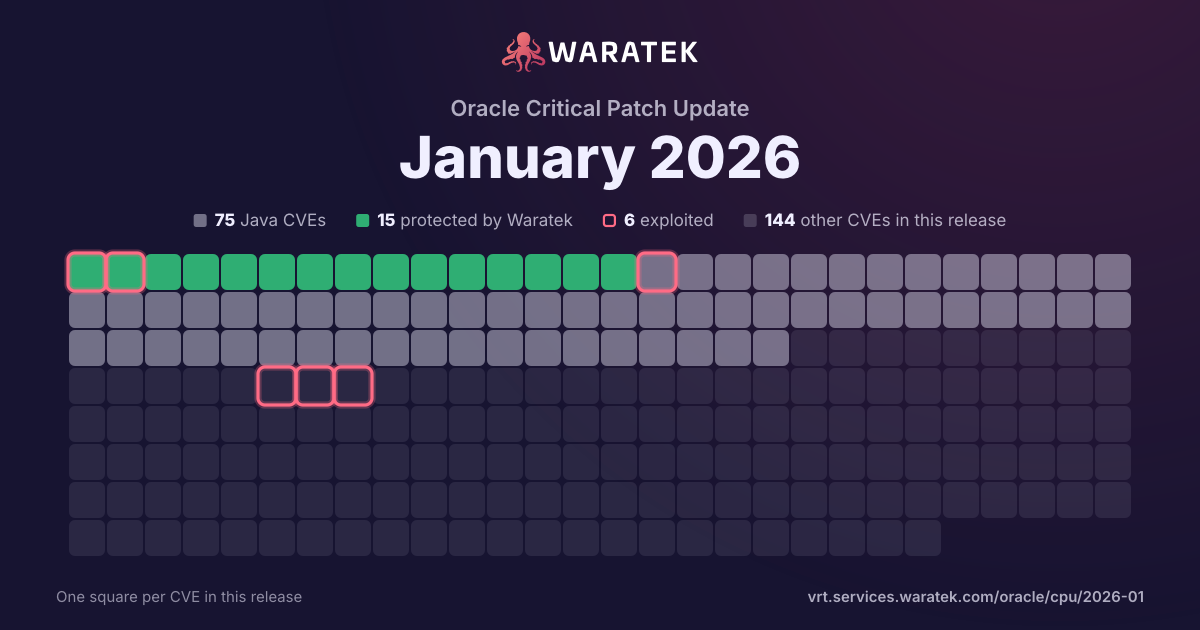
By status
15Protected by Waratek2Mitigation candidate58No exploit published14Outside Waratek scope130Not applicable
6Exploited, marked by the ring
No exploit published. For 26 of them, Oracle's security advisory is the source of public detail.
Protected by Waratek. Waratek RASP can block exploitation of these on systems that have not applied the patch yet.
Overview 174 matches · 60 in Waratek scope · 7 protected · 0 exploited · 0 CISA KEV · 0 public PoC · 0 EPSS ≥ 0.5
174matches
60in Waratek scope34.5%
7protected4.0%
0exploited0.0%
0CISA KEV0.0%
0public PoC0.0%
0EPSS ≥ 0.50.0%
Protected by Waratek
7
4.0%
Rule in development
0
0.0%
Mitigation candidate
0
0.0%
No exploit published
53
30.5%
Outside Waratek scope
11
6.3%
Not applicable
103
59.2%
Withdrawn CVE
0
0.0%
blocked by ARMR today
7
4.0%
partly blocked
0
0.0%
not blocked
167
96.0%
not established
0
0.0%
unrecorded
0
0.0%
Exploited
0
0.0%
Working exploit published
0
0.0%
Proof of concept only
0
0.0%
Forecast only
0
0.0%
No public exploit
174
100.0%
split by
peak 88 / year
20181
Protected by Waratek1
High1
blocked by ARMR today1
No public exploit1
20190
20201
Protected by Waratek1
Critical1
blocked by ARMR today1
No public exploit1
20213
Protected by Waratek3
Critical2
High1
blocked by ARMR today3
No public exploit3
20221
Not applicable1
Medium1
not blocked1
No public exploit1
20237
Not applicable7
High4
Medium3
not blocked7
No public exploit7
20248
Protected by Waratek1
No exploit published2
Not applicable5
Critical2
High1
Medium5
blocked by ARMR today1
not blocked7
No public exploit8
202588
Protected by Waratek1
No exploit published24
Outside Waratek scope7
Not applicable56
Critical5
High42
Medium33
Low8
blocked by ARMR today1
not blocked87
No public exploit88
202665
No exploit published27
Outside Waratek scope4
Not applicable34
Critical1
High19
Medium41
Low4
not blocked65
No public exploit65
201820192020202120222023202420252026
| CVE | Severity | Published▾ | Status | Exploitation | Description |
|---|---|---|---|---|---|
| CVE-2026-21990 | High | 2026-01-20 | Not applicable | No public exploit | Vulnerability in the Oracle VM VirtualBox product of Oracle Virtualization (component: Core). Supported versions that are affected are 7.1.14 and 7.2.4. Easily exploitable vulnerability allows high privileged attacker with logon to the infrastructure where Oracle VM VirtualBox executes to compromise Oracle VM VirtualBox. While the vulnerability is in Oracle VM VirtualBox, attacks may significantly impact additional products (scope change). Successful attacks of this vulnerability can result in takeover of Oracle VM VirtualBox. CVSS 3.1 Base Score 8.2 (Confidentiality, Integrity and Availability impacts). CVSS Vector: (CVSS:3.1/AV:L/AC:L/PR:H/UI:N/S:C/C:H/I:H/A:H). |
| CVE-2026-21989 | High | 2026-01-20 | Not applicable | No public exploit | Vulnerability in the Oracle VM VirtualBox product of Oracle Virtualization (component: Core). Supported versions that are affected are 7.1.14 and 7.2.4. Easily exploitable vulnerability allows high privileged attacker with logon to the infrastructure where Oracle VM VirtualBox executes to compromise Oracle VM VirtualBox. While the vulnerability is in Oracle VM VirtualBox, attacks may significantly impact additional products (scope change). Successful attacks of this vulnerability can result in unauthorized creation, deletion or modification access to critical data or all Oracle VM VirtualBox accessible data as well as unauthorized access to critical data or complete access to all Oracle VM VirtualBox accessible data and unauthorized ability to cause a partial denial of service (partial DOS) of Oracle VM VirtualBox. CVSS 3.1 Base Score 8.1 (Confidentiality, Integrity and Availability impacts). CVSS Vector: (CVSS:3.1/AV:L/AC:L/PR:H/UI:N/S:C/C:H/I:H/A:L). |
| CVE-2026-21988 | High | 2026-01-20 | Not applicable | No public exploit | Vulnerability in the Oracle VM VirtualBox product of Oracle Virtualization (component: Core). Supported versions that are affected are 7.1.14 and 7.2.4. Easily exploitable vulnerability allows high privileged attacker with logon to the infrastructure where Oracle VM VirtualBox executes to compromise Oracle VM VirtualBox. While the vulnerability is in Oracle VM VirtualBox, attacks may significantly impact additional products (scope change). Successful attacks of this vulnerability can result in takeover of Oracle VM VirtualBox. CVSS 3.1 Base Score 8.2 (Confidentiality, Integrity and Availability impacts). CVSS Vector: (CVSS:3.1/AV:L/AC:L/PR:H/UI:N/S:C/C:H/I:H/A:H). |
| CVE-2026-21987 | High | 2026-01-20 | Not applicable | No public exploit | Vulnerability in the Oracle VM VirtualBox product of Oracle Virtualization (component: Core). Supported versions that are affected are 7.1.14 and 7.2.4. Easily exploitable vulnerability allows high privileged attacker with logon to the infrastructure where Oracle VM VirtualBox executes to compromise Oracle VM VirtualBox. While the vulnerability is in Oracle VM VirtualBox, attacks may significantly impact additional products (scope change). Successful attacks of this vulnerability can result in takeover of Oracle VM VirtualBox. CVSS 3.1 Base Score 8.2 (Confidentiality, Integrity and Availability impacts). CVSS Vector: (CVSS:3.1/AV:L/AC:L/PR:H/UI:N/S:C/C:H/I:H/A:H). |
| CVE-2026-21986 | High | 2026-01-20 | Not applicable | No public exploit | Vulnerability in the Oracle VM VirtualBox product of Oracle Virtualization (component: Core). Supported versions that are affected are 7.1.14 and 7.2.4. Easily exploitable vulnerability allows unauthenticated attacker with logon to the infrastructure where Oracle VM VirtualBox executes to compromise Oracle VM VirtualBox. While the vulnerability is in Oracle VM VirtualBox, attacks may significantly impact additional products (scope change). Successful attacks of this vulnerability can result in unauthorized ability to cause a hang or frequently repeatable crash (complete DOS) of Oracle VM VirtualBox. Note: This vulnerability applies to Windows VMs only. CVSS 3.1 Base Score 7.1 (Availability impacts). CVSS Vector: (CVSS:3.1/AV:L/AC:L/PR:N/UI:N/S:C/C:N/I:N/A:H). |
| CVE-2026-21985 | Medium | 2026-01-20 | Not applicable | No public exploit | Vulnerability in the Oracle VM VirtualBox product of Oracle Virtualization (component: Core). Supported versions that are affected are 7.1.14 and 7.2.4. Easily exploitable vulnerability allows high privileged attacker with logon to the infrastructure where Oracle VM VirtualBox executes to compromise Oracle VM VirtualBox. While the vulnerability is in Oracle VM VirtualBox, attacks may significantly impact additional products (scope change). Successful attacks of this vulnerability can result in unauthorized access to critical data or complete access to all Oracle VM VirtualBox accessible data. CVSS 3.1 Base Score 6.0 (Confidentiality impacts). CVSS Vector: (CVSS:3.1/AV:L/AC:L/PR:H/UI:N/S:C/C:H/I:N/A:N). |
| CVE-2026-21984 | High | 2026-01-20 | Not applicable | No public exploit | Vulnerability in the Oracle VM VirtualBox product of Oracle Virtualization (component: Core). Supported versions that are affected are 7.1.14 and 7.2.4. Difficult to exploit vulnerability allows high privileged attacker with logon to the infrastructure where Oracle VM VirtualBox executes to compromise Oracle VM VirtualBox. While the vulnerability is in Oracle VM VirtualBox, attacks may significantly impact additional products (scope change). Successful attacks of this vulnerability can result in takeover of Oracle VM VirtualBox. CVSS 3.1 Base Score 7.5 (Confidentiality, Integrity and Availability impacts). CVSS Vector: (CVSS:3.1/AV:L/AC:H/PR:H/UI:N/S:C/C:H/I:H/A:H). |
| CVE-2026-21983 | High | 2026-01-20 | Not applicable | No public exploit | Vulnerability in the Oracle VM VirtualBox product of Oracle Virtualization (component: Core). Supported versions that are affected are 7.1.14 and 7.2.4. Difficult to exploit vulnerability allows high privileged attacker with logon to the infrastructure where Oracle VM VirtualBox executes to compromise Oracle VM VirtualBox. While the vulnerability is in Oracle VM VirtualBox, attacks may significantly impact additional products (scope change). Successful attacks of this vulnerability can result in takeover of Oracle VM VirtualBox. CVSS 3.1 Base Score 7.5 (Confidentiality, Integrity and Availability impacts). CVSS Vector: (CVSS:3.1/AV:L/AC:H/PR:H/UI:N/S:C/C:H/I:H/A:H). |
| CVE-2026-21982 | High | 2026-01-20 | Not applicable | No public exploit | Vulnerability in the Oracle VM VirtualBox product of Oracle Virtualization (component: Core). Supported versions that are affected are 7.1.14 and 7.2.4. Difficult to exploit vulnerability allows unauthenticated attacker with access to the physical communication segment attached to the hardware where the Oracle VM VirtualBox executes to compromise Oracle VM VirtualBox. Successful attacks of this vulnerability can result in takeover of Oracle VM VirtualBox. CVSS 3.1 Base Score 7.5 (Confidentiality, Integrity and Availability impacts). CVSS Vector: (CVSS:3.1/AV:A/AC:H/PR:N/UI:N/S:U/C:H/I:H/A:H). |
| CVE-2026-21981 | Medium | 2026-01-20 | Not applicable | No public exploit | Vulnerability in the Oracle VM VirtualBox product of Oracle Virtualization (component: Core). Supported versions that are affected are 7.1.14 and 7.2.4. Easily exploitable vulnerability allows high privileged attacker with logon to the infrastructure where Oracle VM VirtualBox executes to compromise Oracle VM VirtualBox. While the vulnerability is in Oracle VM VirtualBox, attacks may significantly impact additional products (scope change). Successful attacks of this vulnerability can result in unauthorized read access to a subset of Oracle VM VirtualBox accessible data and unauthorized ability to cause a partial denial of service (partial DOS) of Oracle VM VirtualBox. CVSS 3.1 Base Score 4.6 (Confidentiality and Availability impacts). CVSS Vector: (CVSS:3.1/AV:L/AC:L/PR:H/UI:N/S:C/C:L/I:N/A:L). |
| CVE-2026-21980 | Medium | 2026-01-20 | No exploit published | No public exploit | Vulnerability in the Oracle Life Sciences Central Coding product of Oracle Health Sciences Applications (component: Platform). The supported version that is affected is 7.0.1.0. Easily exploitable vulnerability allows unauthenticated attacker with network access via HTTP to compromise Oracle Life Sciences Central Coding. Successful attacks of this vulnerability can result in unauthorized update, insert or delete access to some of Oracle Life Sciences Central Coding accessible data as well as unauthorized read access to a subset of Oracle Life Sciences Central Coding accessible data. CVSS 3.1 Base Score 6.5 (Confidentiality and Integrity impacts). CVSS Vector: (CVSS:3.1/AV:N/AC:L/PR:N/UI:N/S:U/C:L/I:L/A:N). |
| CVE-2026-21979 | Medium | 2026-01-20 | No exploit published | No public exploit | Vulnerability in the Oracle Planning and Budgeting Cloud Service product of Oracle Hyperion (component: EPM Agent). The supported version that is affected is 25.04.07. Easily exploitable vulnerability allows high privileged attacker with logon to the infrastructure where Oracle Planning and Budgeting Cloud Service executes to compromise Oracle Planning and Budgeting Cloud Service. Successful attacks require human interaction from a person other than the attacker. Successful attacks of this vulnerability can result in unauthorized access to critical data or complete access to all Oracle Planning and Budgeting Cloud Service accessible data. Note: Update EPM Agent. Please refer to <a href="https://docs.oracle.com/en/cloud/saas/enterprise-performance-management-common/diepm/epm_agent_downloading_agent_110x80569d70.html">Downloading the EPM Agent for more information. CVSS 3.1 Base Score 4.2 (Confidentiality impacts). CVSS Vector: (CVSS:3.1/AV:L/AC:L/PR:H/UI:R/S:U/C:H/I:N/A:N). |
| CVE-2026-21978 | Medium | 2026-01-20 | No exploit published | No public exploit | Vulnerability in the Oracle FLEXCUBE Universal Banking product of Oracle Financial Services Applications (component: Relationship Pricing). Supported versions that are affected are 14.0.0.0.0-14.8.0.0.0. Easily exploitable vulnerability allows low privileged attacker with network access via HTTP to compromise Oracle FLEXCUBE Universal Banking. Successful attacks of this vulnerability can result in unauthorized access to critical data or complete access to all Oracle FLEXCUBE Universal Banking accessible data. CVSS 3.1 Base Score 6.5 (Confidentiality impacts). CVSS Vector: (CVSS:3.1/AV:N/AC:L/PR:L/UI:N/S:U/C:H/I:N/A:N). |
| CVE-2026-21977 | Low | 2026-01-20 | Not applicable | No public exploit | Vulnerability in the Oracle Zero Data Loss Recovery Appliance Software product of Oracle Zero Data Loss Recovery Appliance (component: Security). Supported versions that are affected are 23.1.0-23.1.202509. Difficult to exploit vulnerability allows unauthenticated attacker with network access via Oracle Net to compromise Oracle Zero Data Loss Recovery Appliance Software. Successful attacks require human interaction from a person other than the attacker. Successful attacks of this vulnerability can result in unauthorized read access to a subset of Oracle Zero Data Loss Recovery Appliance Software accessible data. CVSS 3.1 Base Score 3.1 (Confidentiality impacts). CVSS Vector: (CVSS:3.1/AV:N/AC:H/PR:N/UI:R/S:U/C:L/I:N/A:N). |
| CVE-2026-21976 | High | 2026-01-20 | Outside Waratek scope | No public exploit | Vulnerability in the Oracle Business Intelligence Enterprise Edition product of Oracle Analytics (component: Oracle Analytics Cloud). Supported versions that are affected are 7.6.0.0.0 and 8.2.0.0.0. Easily exploitable vulnerability allows low privileged attacker with logon to the infrastructure where Oracle Business Intelligence Enterprise Edition executes to compromise Oracle Business Intelligence Enterprise Edition. Successful attacks of this vulnerability can result in unauthorized creation, deletion or modification access to critical data or all Oracle Business Intelligence Enterprise Edition accessible data as well as unauthorized access to critical data or complete access to all Oracle Business Intelligence Enterprise Edition accessible data. CVSS 3.1 Base Score 7.1 (Confidentiality and Integrity impacts). CVSS Vector: (CVSS:3.1/AV:L/AC:L/PR:L/UI:N/S:U/C:H/I:H/A:N). |
| CVE-2026-21975 | Medium | 2026-01-20 | Not applicable | No public exploit | Vulnerability in the Java VM component of Oracle Database Server. Supported versions that are affected are 19.3-19.29 and 21.3-21.20. Easily exploitable vulnerability allows high privileged attacker having Authenticated User privilege with network access via Oracle Net to compromise Java VM. Successful attacks require human interaction from a person other than the attacker. Successful attacks of this vulnerability can result in unauthorized ability to cause a hang or frequently repeatable crash (complete DOS) of Java VM. CVSS 3.1 Base Score 4.5 (Availability impacts). CVSS Vector: (CVSS:3.1/AV:N/AC:L/PR:H/UI:R/S:U/C:N/I:N/A:H). |
| CVE-2026-21974 | Medium | 2026-01-20 | No exploit published | No public exploit | Vulnerability in the Oracle Life Sciences Central Designer product of Oracle Health Sciences Applications (component: Platform). The supported version that is affected is 7.0.1.0. Easily exploitable vulnerability allows unauthenticated attacker with network access via HTTP to compromise Oracle Life Sciences Central Designer. Successful attacks of this vulnerability can result in unauthorized read access to a subset of Oracle Life Sciences Central Designer accessible data. CVSS 3.1 Base Score 5.3 (Confidentiality impacts). CVSS Vector: (CVSS:3.1/AV:N/AC:L/PR:N/UI:N/S:U/C:L/I:N/A:N). |
| CVE-2026-21973 | High | 2026-01-20 | No exploit published | No public exploit | Vulnerability in the Oracle FLEXCUBE Investor Servicing product of Oracle Financial Services Applications (component: Security Management System). Supported versions that are affected are 14.5.0.15.0, 14.7.0.8.0 and 14.8.0.1.0. Easily exploitable vulnerability allows low privileged attacker with network access via HTTP to compromise Oracle FLEXCUBE Investor Servicing. Successful attacks of this vulnerability can result in unauthorized creation, deletion or modification access to critical data or all Oracle FLEXCUBE Investor Servicing accessible data as well as unauthorized access to critical data or complete access to all Oracle FLEXCUBE Investor Servicing accessible data. CVSS 3.1 Base Score 8.1 (Confidentiality and Integrity impacts). CVSS Vector: (CVSS:3.1/AV:N/AC:L/PR:L/UI:N/S:U/C:H/I:H/A:N). |
| CVE-2026-21972 | Medium | 2026-01-20 | No exploit published | No public exploit | Vulnerability in the Oracle Configurator product of Oracle E-Business Suite (component: User Interface). Supported versions that are affected are 12.2.3-12.2.15. Easily exploitable vulnerability allows unauthenticated attacker with network access via HTTP to compromise Oracle Configurator. Successful attacks of this vulnerability can result in unauthorized read access to a subset of Oracle Configurator accessible data. CVSS 3.1 Base Score 5.3 (Confidentiality impacts). CVSS Vector: (CVSS:3.1/AV:N/AC:L/PR:N/UI:N/S:U/C:L/I:N/A:N). |
| CVE-2026-21971 | Medium | 2026-01-20 | No exploit published | No public exploit | Vulnerability in the PeopleSoft Enterprise SCM Purchasing product of Oracle PeopleSoft (component: Purchasing). The supported version that is affected is 9.2. Easily exploitable vulnerability allows low privileged attacker with network access via HTTP to compromise PeopleSoft Enterprise SCM Purchasing. Successful attacks of this vulnerability can result in unauthorized update, insert or delete access to some of PeopleSoft Enterprise SCM Purchasing accessible data as well as unauthorized read access to a subset of PeopleSoft Enterprise SCM Purchasing accessible data. CVSS 3.1 Base Score 5.4 (Confidentiality and Integrity impacts). CVSS Vector: (CVSS:3.1/AV:N/AC:L/PR:L/UI:N/S:U/C:L/I:L/A:N). |
| CVE-2026-21970 | Medium | 2026-01-20 | No exploit published | No public exploit | Vulnerability in the Oracle Life Sciences Central Designer product of Oracle Health Sciences Applications (component: Platform). The supported version that is affected is 7.0.1.0. Easily exploitable vulnerability allows low privileged attacker with network access via HTTP to compromise Oracle Life Sciences Central Designer. Successful attacks of this vulnerability can result in unauthorized access to critical data or complete access to all Oracle Life Sciences Central Designer accessible data. CVSS 3.1 Base Score 6.5 (Confidentiality impacts). CVSS Vector: (CVSS:3.1/AV:N/AC:L/PR:L/UI:N/S:U/C:H/I:N/A:N). |
| CVE-2026-21969 | Critical | 2026-01-20 | No exploit published | No public exploit | Vulnerability in the Oracle Agile Product Lifecycle Management for Process product of Oracle Supply Chain (component: Supplier Portal). The supported version that is affected is 6.2.4. Easily exploitable vulnerability allows unauthenticated attacker with network access via HTTP to compromise Oracle Agile Product Lifecycle Management for Process. Successful attacks of this vulnerability can result in takeover of Oracle Agile Product Lifecycle Management for Process. CVSS 3.1 Base Score 9.8 (Confidentiality, Integrity and Availability impacts). CVSS Vector: (CVSS:3.1/AV:N/AC:L/PR:N/UI:N/S:U/C:H/I:H/A:H). |
| CVE-2026-21968 | Medium | 2026-01-20 | Not applicable | No public exploit | Vulnerability in the MySQL Server product of Oracle MySQL (component: Server: Optimizer). Supported versions that are affected are 8.0.0-8.0.44, 8.4.0-8.4.7 and 9.0.0-9.5.0. Easily exploitable vulnerability allows low privileged attacker with network access via multiple protocols to compromise MySQL Server. Successful attacks of this vulnerability can result in unauthorized ability to cause a hang or frequently repeatable crash (complete DOS) of MySQL Server. CVSS 3.1 Base Score 6.5 (Availability impacts). CVSS Vector: (CVSS:3.1/AV:N/AC:L/PR:L/UI:N/S:U/C:N/I:N/A:H). |
| CVE-2026-21967 | High | 2026-01-20 | No exploit published | No public exploit | Vulnerability in the Oracle Hospitality OPERA 5 product of Oracle Hospitality Applications (component: Opera Servlet). Supported versions that are affected are 5.6.19.23, 5.6.25.17, 5.6.26.10 and 5.6.27.4. Easily exploitable vulnerability allows unauthenticated attacker with network access via HTTP to compromise Oracle Hospitality OPERA 5. Successful attacks of this vulnerability can result in unauthorized access to critical data or complete access to all Oracle Hospitality OPERA 5 accessible data as well as unauthorized update, insert or delete access to some of Oracle Hospitality OPERA 5 accessible data and unauthorized ability to cause a partial denial of service (partial DOS) of Oracle Hospitality OPERA 5. CVSS 3.1 Base Score 8.6 (Confidentiality, Integrity and Availability impacts). CVSS Vector: (CVSS:3.1/AV:N/AC:L/PR:N/UI:N/S:U/C:H/I:L/A:L). |
| CVE-2026-21966 | Medium | 2026-01-20 | No exploit published | No public exploit | Vulnerability in the Oracle Hospitality OPERA 5 Property Services product of Oracle Hospitality Applications (component: Opera). Supported versions that are affected are 5.6.19.23, 5.6.25.17, 5.6.26.10 and 5.6.27.4. Easily exploitable vulnerability allows unauthenticated attacker with network access via HTTP to compromise Oracle Hospitality OPERA 5 Property Services. Successful attacks require human interaction from a person other than the attacker and while the vulnerability is in Oracle Hospitality OPERA 5 Property Services, attacks may significantly impact additional products (scope change). Successful attacks of this vulnerability can result in unauthorized update, insert or delete access to some of Oracle Hospitality OPERA 5 Property Services accessible data as well as unauthorized read access to a subset of Oracle Hospitality OPERA 5 Property Services accessible data. CVSS 3.1 Base Score 6.1 (Confidentiality and Integrity impacts). CVSS Vector: (CVSS:3.1/AV:N/AC:L/PR:N/UI:R/S:C/C:L/I:L/A:N). |
| CVE-2026-21965 | Low | 2026-01-20 | Not applicable | No public exploit | Vulnerability in the MySQL Server product of Oracle MySQL (component: Server: Pluggable Auth). Supported versions that are affected are 9.0.0-9.5.0. Easily exploitable vulnerability allows high privileged attacker with network access via multiple protocols to compromise MySQL Server. Successful attacks of this vulnerability can result in unauthorized ability to cause a partial denial of service (partial DOS) of MySQL Server. CVSS 3.1 Base Score 2.7 (Availability impacts). CVSS Vector: (CVSS:3.1/AV:N/AC:L/PR:H/UI:N/S:U/C:N/I:N/A:L). |
| CVE-2026-21964 | Medium | 2026-01-20 | Not applicable | No public exploit | Vulnerability in the MySQL Server product of Oracle MySQL (component: Server: Thread Pooling). Supported versions that are affected are 8.0.0-8.0.44, 8.4.0-8.4.7 and 9.0.0-9.5.0. Easily exploitable vulnerability allows high privileged attacker with network access via multiple protocols to compromise MySQL Server. Successful attacks of this vulnerability can result in unauthorized ability to cause a hang or frequently repeatable crash (complete DOS) of MySQL Server. CVSS 3.1 Base Score 4.9 (Availability impacts). CVSS Vector: (CVSS:3.1/AV:N/AC:L/PR:H/UI:N/S:U/C:N/I:N/A:H). |
| CVE-2026-21963 | Medium | 2026-01-20 | Not applicable | No public exploit | Vulnerability in the Oracle VM VirtualBox product of Oracle Virtualization (component: Core). Supported versions that are affected are 7.1.14 and 7.2.4. Easily exploitable vulnerability allows high privileged attacker with logon to the infrastructure where Oracle VM VirtualBox executes to compromise Oracle VM VirtualBox. While the vulnerability is in Oracle VM VirtualBox, attacks may significantly impact additional products (scope change). Successful attacks of this vulnerability can result in unauthorized access to critical data or complete access to all Oracle VM VirtualBox accessible data. CVSS 3.1 Base Score 6.0 (Confidentiality impacts). CVSS Vector: (CVSS:3.1/AV:L/AC:L/PR:H/UI:N/S:C/C:H/I:N/A:N). |
| CVE-2026-21961 | Medium | 2026-01-20 | No exploit published | No public exploit | Vulnerability in the PeopleSoft Enterprise HCM Human Resources product of Oracle PeopleSoft (component: Company Dir / Org Chart Viewer, Employee Snapshot). The supported version that is affected is 9.2. Easily exploitable vulnerability allows unauthenticated attacker with network access via HTTP to compromise PeopleSoft Enterprise HCM Human Resources. Successful attacks require human interaction from a person other than the attacker and while the vulnerability is in PeopleSoft Enterprise HCM Human Resources, attacks may significantly impact additional products (scope change). Successful attacks of this vulnerability can result in unauthorized update, insert or delete access to some of PeopleSoft Enterprise HCM Human Resources accessible data as well as unauthorized read access to a subset of PeopleSoft Enterprise HCM Human Resources accessible data. CVSS 3.1 Base Score 6.1 (Confidentiality and Integrity impacts). CVSS Vector: (CVSS:3.1/AV:N/AC:L/PR:N/UI:R/S:C/C:L/I:L/A:N). |
| CVE-2026-21960 | Medium | 2026-01-20 | No exploit published | No public exploit | Vulnerability in the Oracle Applications DBA product of Oracle E-Business Suite (component: Java utils). Supported versions that are affected are 12.2.3-12.2.15. Easily exploitable vulnerability allows high privileged attacker with network access via HTTP to compromise Oracle Applications DBA. Successful attacks of this vulnerability can result in unauthorized creation, deletion or modification access to critical data or all Oracle Applications DBA accessible data as well as unauthorized access to critical data or complete access to all Oracle Applications DBA accessible data. CVSS 3.1 Base Score 6.5 (Confidentiality and Integrity impacts). CVSS Vector: (CVSS:3.1/AV:N/AC:L/PR:H/UI:N/S:U/C:H/I:H/A:N). |
| CVE-2026-21959 | Medium | 2026-01-20 | No exploit published | No public exploit | Vulnerability in the Oracle Workflow product of Oracle E-Business Suite (component: Workflow Loader). Supported versions that are affected are 12.2.3-12.2.15. Easily exploitable vulnerability allows high privileged attacker with network access via HTTP to compromise Oracle Workflow. Successful attacks of this vulnerability can result in unauthorized access to critical data or complete access to all Oracle Workflow accessible data. CVSS 3.1 Base Score 4.9 (Confidentiality impacts). CVSS Vector: (CVSS:3.1/AV:N/AC:L/PR:H/UI:N/S:U/C:H/I:N/A:N). |
| CVE-2026-21957 | High | 2026-01-20 | Not applicable | No public exploit | Vulnerability in the Oracle VM VirtualBox product of Oracle Virtualization (component: Core). Supported versions that are affected are 7.1.14 and 7.2.4. Difficult to exploit vulnerability allows high privileged attacker with logon to the infrastructure where Oracle VM VirtualBox executes to compromise Oracle VM VirtualBox. While the vulnerability is in Oracle VM VirtualBox, attacks may significantly impact additional products (scope change). Successful attacks of this vulnerability can result in takeover of Oracle VM VirtualBox. CVSS 3.1 Base Score 7.5 (Confidentiality, Integrity and Availability impacts). CVSS Vector: (CVSS:3.1/AV:L/AC:H/PR:H/UI:N/S:C/C:H/I:H/A:H). |
| CVE-2026-21956 | High | 2026-01-20 | Not applicable | No public exploit | Vulnerability in the Oracle VM VirtualBox product of Oracle Virtualization (component: Core). Supported versions that are affected are 7.1.14 and 7.2.4. Easily exploitable vulnerability allows high privileged attacker with logon to the infrastructure where Oracle VM VirtualBox executes to compromise Oracle VM VirtualBox. While the vulnerability is in Oracle VM VirtualBox, attacks may significantly impact additional products (scope change). Successful attacks of this vulnerability can result in takeover of Oracle VM VirtualBox. CVSS 3.1 Base Score 8.2 (Confidentiality, Integrity and Availability impacts). CVSS Vector: (CVSS:3.1/AV:L/AC:L/PR:H/UI:N/S:C/C:H/I:H/A:H). |
| CVE-2026-21955 | High | 2026-01-20 | Not applicable | No public exploit | Vulnerability in the Oracle VM VirtualBox product of Oracle Virtualization (component: Core). Supported versions that are affected are 7.1.14 and 7.2.4. Easily exploitable vulnerability allows high privileged attacker with logon to the infrastructure where Oracle VM VirtualBox executes to compromise Oracle VM VirtualBox. While the vulnerability is in Oracle VM VirtualBox, attacks may significantly impact additional products (scope change). Successful attacks of this vulnerability can result in takeover of Oracle VM VirtualBox. CVSS 3.1 Base Score 8.2 (Confidentiality, Integrity and Availability impacts). CVSS Vector: (CVSS:3.1/AV:L/AC:L/PR:H/UI:N/S:C/C:H/I:H/A:H). |
| CVE-2026-21952 | Medium | 2026-01-20 | Not applicable | No public exploit | Vulnerability in the MySQL Server product of Oracle MySQL (component: Server: Parser). Supported versions that are affected are 9.0.0-9.5.0. Easily exploitable vulnerability allows high privileged attacker with network access via multiple protocols to compromise MySQL Server. Successful attacks of this vulnerability can result in unauthorized ability to cause a hang or frequently repeatable crash (complete DOS) of MySQL Server. CVSS 3.1 Base Score 4.9 (Availability impacts). CVSS Vector: (CVSS:3.1/AV:N/AC:L/PR:H/UI:N/S:U/C:N/I:N/A:H). |
| CVE-2026-21951 | Medium | 2026-01-20 | No exploit published | No public exploit | Vulnerability in the PeopleSoft Enterprise PeopleTools product of Oracle PeopleSoft (component: Integration Broker). Supported versions that are affected are 8.60, 8.61 and 8.62. Easily exploitable vulnerability allows unauthenticated attacker with network access via HTTP to compromise PeopleSoft Enterprise PeopleTools. Successful attacks require human interaction from a person other than the attacker and while the vulnerability is in PeopleSoft Enterprise PeopleTools, attacks may significantly impact additional products (scope change). Successful attacks of this vulnerability can result in unauthorized update, insert or delete access to some of PeopleSoft Enterprise PeopleTools accessible data as well as unauthorized read access to a subset of PeopleSoft Enterprise PeopleTools accessible data. CVSS 3.1 Base Score 6.1 (Confidentiality and Integrity impacts). CVSS Vector: (CVSS:3.1/AV:N/AC:L/PR:N/UI:R/S:C/C:L/I:L/A:N). |
| CVE-2026-21950 | Medium | 2026-01-20 | Not applicable | No public exploit | Vulnerability in the MySQL Server product of Oracle MySQL (component: Server: Optimizer). Supported versions that are affected are 9.0.0-9.5.0. Easily exploitable vulnerability allows low privileged attacker with network access via multiple protocols to compromise MySQL Server. Successful attacks of this vulnerability can result in unauthorized ability to cause a hang or frequently repeatable crash (complete DOS) of MySQL Server. CVSS 3.1 Base Score 6.5 (Availability impacts). CVSS Vector: (CVSS:3.1/AV:N/AC:L/PR:L/UI:N/S:U/C:N/I:N/A:H). |
| CVE-2026-21949 | Medium | 2026-01-20 | Not applicable | No public exploit | Vulnerability in the MySQL Server product of Oracle MySQL (component: Server: Optimizer). Supported versions that are affected are 9.0.0-9.5.0. Easily exploitable vulnerability allows low privileged attacker with network access via multiple protocols to compromise MySQL Server. Successful attacks of this vulnerability can result in unauthorized ability to cause a hang or frequently repeatable crash (complete DOS) of MySQL Server. CVSS 3.1 Base Score 6.5 (Availability impacts). CVSS Vector: (CVSS:3.1/AV:N/AC:L/PR:L/UI:N/S:U/C:N/I:N/A:H). |
| CVE-2026-21948 | Medium | 2026-01-20 | Not applicable | No public exploit | Vulnerability in the MySQL Server product of Oracle MySQL (component: Server: Optimizer). Supported versions that are affected are 8.0.0-8.0.44, 8.4.0-8.4.7 and 9.0.0-9.5.0. Easily exploitable vulnerability allows high privileged attacker with network access via multiple protocols to compromise MySQL Server. Successful attacks of this vulnerability can result in unauthorized ability to cause a hang or frequently repeatable crash (complete DOS) of MySQL Server. CVSS 3.1 Base Score 4.9 (Availability impacts). CVSS Vector: (CVSS:3.1/AV:N/AC:L/PR:H/UI:N/S:U/C:N/I:N/A:H). |
| CVE-2026-21947 | Low | 2026-01-20 | Outside Waratek scope | No public exploit | Vulnerability in Oracle Java SE (component: JavaFX). Supported versions that are affected are Oracle Java SE: 8u471-b50. Difficult to exploit vulnerability allows unauthenticated attacker with network access via multiple protocols to compromise Oracle Java SE. Successful attacks require human interaction from a person other than the attacker. Successful attacks of this vulnerability can result in unauthorized update, insert or delete access to some of Oracle Java SE accessible data. Note: This vulnerability applies to Java deployments, typically in clients running sandboxed Java Web Start applications or sandboxed Java applets, that load and run untrusted code (e.g., code that comes from the internet) and rely on the Java sandbox for security. This vulnerability does not apply to Java deployments, typically in servers, that load and run only trusted code (e.g., code installed by an administrator). CVSS 3.1 Base Score 3.1 (Integrity impacts). CVSS Vector: (CVSS:3.1/AV:N/AC:H/PR:N/UI:R/S:U/C:N/I:L/A:N). |
| CVE-2026-21946 | Medium | 2026-01-20 | No exploit published | No public exploit | Vulnerability in the JD Edwards EnterpriseOne Tools product of Oracle JD Edwards (component: Web Runtime SEC). Supported versions that are affected are 9.2.0.0-9.2.26.0. Easily exploitable vulnerability allows unauthenticated attacker with network access via HTTP to compromise JD Edwards EnterpriseOne Tools. Successful attacks require human interaction from a person other than the attacker and while the vulnerability is in JD Edwards EnterpriseOne Tools, attacks may significantly impact additional products (scope change). Successful attacks of this vulnerability can result in unauthorized update, insert or delete access to some of JD Edwards EnterpriseOne Tools accessible data as well as unauthorized read access to a subset of JD Edwards EnterpriseOne Tools accessible data. CVSS 3.1 Base Score 6.1 (Confidentiality and Integrity impacts). CVSS Vector: (CVSS:3.1/AV:N/AC:L/PR:N/UI:R/S:C/C:L/I:L/A:N). |
| CVE-2026-21945 | High | 2026-01-20 | Outside Waratek scope | No public exploit | Vulnerability in the Oracle Java SE, Oracle GraalVM for JDK, Oracle GraalVM Enterprise Edition product of Oracle Java SE (component: Security). Supported versions that are affected are Oracle Java SE: 8u471, 8u471-b50, 8u471-perf, 11.0.29, 17.0.17, 21.0.9, 25.0.1; Oracle GraalVM for JDK: 17.0.17 and 21.0.9; Oracle GraalVM Enterprise Edition: 21.3.16. Easily exploitable vulnerability allows unauthenticated attacker with network access via multiple protocols to compromise Oracle Java SE, Oracle GraalVM for JDK, Oracle GraalVM Enterprise Edition. Successful attacks of this vulnerability can result in unauthorized ability to cause a hang or frequently repeatable crash (complete DOS) of Oracle Java SE, Oracle GraalVM for JDK, Oracle GraalVM Enterprise Edition. Note: This vulnerability applies to Java deployments, typically in clients running sandboxed Java Web Start applications or sandboxed Java applets, that load and run untrusted code (e.g., code that comes from the internet) and rely on the Java sandbox for security. This vulnerability does not apply to Java deployments, typically in servers, that load and run only trusted code (e.g., code installed by an administrator). CVSS 3.1 Base Score 7.5 (Availability impacts). CVSS Vector: (CVSS:3.1/AV:N/AC:L/PR:N/UI:N/S:U/C:N/I:N/A:H). |
| CVE-2026-21944 | Medium | 2026-01-20 | No exploit published | No public exploit | Vulnerability in the Oracle Agile Product Lifecycle Management for Process product of Oracle Supply Chain (component: Product Quality Management). The supported version that is affected is 6.2.4. Easily exploitable vulnerability allows low privileged attacker with network access via HTTP to compromise Oracle Agile Product Lifecycle Management for Process. Successful attacks of this vulnerability can result in unauthorized access to critical data or complete access to all Oracle Agile Product Lifecycle Management for Process accessible data. CVSS 3.1 Base Score 6.5 (Confidentiality impacts). CVSS Vector: (CVSS:3.1/AV:N/AC:L/PR:L/UI:N/S:U/C:H/I:N/A:N). |
| CVE-2026-21943 | Medium | 2026-01-20 | No exploit published | No public exploit | Vulnerability in the Oracle Scripting product of Oracle E-Business Suite (component: Scripting Admin). Supported versions that are affected are 12.2.3-12.2.15. Easily exploitable vulnerability allows unauthenticated attacker with network access via HTTP to compromise Oracle Scripting. Successful attacks require human interaction from a person other than the attacker and while the vulnerability is in Oracle Scripting, attacks may significantly impact additional products (scope change). Successful attacks of this vulnerability can result in unauthorized update, insert or delete access to some of Oracle Scripting accessible data as well as unauthorized read access to a subset of Oracle Scripting accessible data. CVSS 3.1 Base Score 6.1 (Confidentiality and Integrity impacts). CVSS Vector: (CVSS:3.1/AV:N/AC:L/PR:N/UI:R/S:C/C:L/I:L/A:N). |
| CVE-2026-21942 | Medium | 2026-01-20 | Not applicable | No public exploit | Vulnerability in the Oracle Solaris product of Oracle Systems (component: Filesystems). Supported versions that are affected are 10 and 11. Easily exploitable vulnerability allows low privileged attacker with logon to the infrastructure where Oracle Solaris executes to compromise Oracle Solaris. Successful attacks require human interaction from a person other than the attacker. Successful attacks of this vulnerability can result in unauthorized ability to cause a hang or frequently repeatable crash (complete DOS) of Oracle Solaris. CVSS 3.1 Base Score 5.0 (Availability impacts). CVSS Vector: (CVSS:3.1/AV:L/AC:L/PR:L/UI:R/S:U/C:N/I:N/A:H). |
| CVE-2026-21941 | Medium | 2026-01-20 | Not applicable | No public exploit | Vulnerability in the MySQL Server product of Oracle MySQL (component: Server: Optimizer). Supported versions that are affected are 8.0.0-8.0.44, 8.4.0-8.4.7 and 9.0.0-9.5.0. Easily exploitable vulnerability allows high privileged attacker with network access via multiple protocols to compromise MySQL Server. Successful attacks of this vulnerability can result in unauthorized ability to cause a hang or frequently repeatable crash (complete DOS) of MySQL Server. CVSS 3.1 Base Score 4.9 (Availability impacts). CVSS Vector: (CVSS:3.1/AV:N/AC:L/PR:H/UI:N/S:U/C:N/I:N/A:H). |
| CVE-2026-21940 | High | 2026-01-20 | No exploit published | No public exploit | Vulnerability in the Oracle Agile PLM product of Oracle Supply Chain (component: User and User Group). The supported version that is affected is 9.3.6. Easily exploitable vulnerability allows unauthenticated attacker with network access via HTTP to compromise Oracle Agile PLM. Successful attacks of this vulnerability can result in unauthorized access to critical data or complete access to all Oracle Agile PLM accessible data. CVSS 3.1 Base Score 7.5 (Confidentiality impacts). CVSS Vector: (CVSS:3.1/AV:N/AC:L/PR:N/UI:N/S:U/C:H/I:N/A:N). |
| CVE-2026-21939 | High | 2026-01-20 | Not applicable | No public exploit | Vulnerability in the SQLcl component of Oracle Database Server. Supported versions that are affected are 23.4.0-23.26.0. Difficult to exploit vulnerability allows unauthenticated attacker with logon to the infrastructure where SQLcl executes to compromise SQLcl. Successful attacks require human interaction from a person other than the attacker. Successful attacks of this vulnerability can result in takeover of SQLcl. CVSS 3.1 Base Score 7.0 (Confidentiality, Integrity and Availability impacts). CVSS Vector: (CVSS:3.1/AV:L/AC:H/PR:N/UI:R/S:U/C:H/I:H/A:H). |
| CVE-2026-21938 | Medium | 2026-01-20 | No exploit published | No public exploit | Vulnerability in the PeopleSoft Enterprise PeopleTools product of Oracle PeopleSoft (component: Portal). Supported versions that are affected are 8.60, 8.61 and 8.62. Easily exploitable vulnerability allows unauthenticated attacker with network access via HTTP to compromise PeopleSoft Enterprise PeopleTools. Successful attacks require human interaction from a person other than the attacker and while the vulnerability is in PeopleSoft Enterprise PeopleTools, attacks may significantly impact additional products (scope change). Successful attacks of this vulnerability can result in unauthorized update, insert or delete access to some of PeopleSoft Enterprise PeopleTools accessible data as well as unauthorized read access to a subset of PeopleSoft Enterprise PeopleTools accessible data. CVSS 3.1 Base Score 6.1 (Confidentiality and Integrity impacts). CVSS Vector: (CVSS:3.1/AV:N/AC:L/PR:N/UI:R/S:C/C:L/I:L/A:N). |
| CVE-2026-21937 | Medium | 2026-01-20 | Not applicable | No public exploit | Vulnerability in the MySQL Server product of Oracle MySQL (component: Server: DDL). Supported versions that are affected are 8.0.0-8.0.44, 8.4.0-8.4.7 and 9.0.0-9.5.0. Easily exploitable vulnerability allows high privileged attacker with network access via multiple protocols to compromise MySQL Server. Successful attacks of this vulnerability can result in unauthorized ability to cause a hang or frequently repeatable crash (complete DOS) of MySQL Server. CVSS 3.1 Base Score 4.9 (Availability impacts). CVSS Vector: (CVSS:3.1/AV:N/AC:L/PR:H/UI:N/S:U/C:N/I:N/A:H). |
| CVE-2026-21936 | Medium | 2026-01-20 | Not applicable | No public exploit | Vulnerability in the MySQL Server product of Oracle MySQL (component: InnoDB). Supported versions that are affected are 8.0.0-8.0.44, 8.4.0-8.4.7 and 9.0.0-9.5.0. Easily exploitable vulnerability allows high privileged attacker with network access via multiple protocols to compromise MySQL Server. Successful attacks of this vulnerability can result in unauthorized ability to cause a hang or frequently repeatable crash (complete DOS) of MySQL Server. CVSS 3.1 Base Score 4.9 (Availability impacts). CVSS Vector: (CVSS:3.1/AV:N/AC:L/PR:H/UI:N/S:U/C:N/I:N/A:H). |
| CVE-2026-21935 | Medium | 2026-01-20 | Not applicable | No public exploit | Vulnerability in the Oracle Solaris product of Oracle Systems (component: Driver). The supported version that is affected is 11. Easily exploitable vulnerability allows high privileged attacker with logon to the infrastructure where Oracle Solaris executes to compromise Oracle Solaris. Successful attacks require human interaction from a person other than the attacker. Successful attacks of this vulnerability can result in unauthorized creation, deletion or modification access to critical data or all Oracle Solaris accessible data as well as unauthorized access to critical data or complete access to all Oracle Solaris accessible data. CVSS 3.1 Base Score 5.8 (Confidentiality and Integrity impacts). CVSS Vector: (CVSS:3.1/AV:L/AC:L/PR:H/UI:R/S:U/C:H/I:H/A:N). |
| CVE-2026-21934 | Medium | 2026-01-20 | No exploit published | No public exploit | Vulnerability in the PeopleSoft Enterprise PeopleTools product of Oracle PeopleSoft (component: Push Notifications). Supported versions that are affected are 8.60, 8.61 and 8.62. Easily exploitable vulnerability allows low privileged attacker with network access via HTTP to compromise PeopleSoft Enterprise PeopleTools. Successful attacks of this vulnerability can result in unauthorized update, insert or delete access to some of PeopleSoft Enterprise PeopleTools accessible data as well as unauthorized read access to a subset of PeopleSoft Enterprise PeopleTools accessible data. CVSS 3.1 Base Score 5.4 (Confidentiality and Integrity impacts). CVSS Vector: (CVSS:3.1/AV:N/AC:L/PR:L/UI:N/S:U/C:L/I:L/A:N). |
| CVE-2026-21933 | Medium | 2026-01-20 | No exploit published | No public exploit | Vulnerability in the Oracle Java SE, Oracle GraalVM for JDK, Oracle GraalVM Enterprise Edition product of Oracle Java SE (component: Networking). Supported versions that are affected are Oracle Java SE: 8u471, 8u471-b50, 8u471-perf, 11.0.29, 17.0.17, 21.0.9, 25.0.1; Oracle GraalVM for JDK: 17.0.17 and 21.0.9; Oracle GraalVM Enterprise Edition: 21.3.16. Easily exploitable vulnerability allows unauthenticated attacker with network access via multiple protocols to compromise Oracle Java SE, Oracle GraalVM for JDK, Oracle GraalVM Enterprise Edition. Successful attacks require human interaction from a person other than the attacker and while the vulnerability is in Oracle Java SE, Oracle GraalVM for JDK, Oracle GraalVM Enterprise Edition, attacks may significantly impact additional products (scope change). Successful attacks of this vulnerability can result in unauthorized update, insert or delete access to some of Oracle Java SE, Oracle GraalVM for JDK, Oracle GraalVM Enterprise Edition accessible data as well as unauthorized read access to a subset of Oracle Java SE, Oracle GraalVM for JDK, Oracle GraalVM Enterprise Edition accessible data. Note: This vulnerability can be exploited by using APIs in the specified Component, e.g., through a web service which supplies data to the APIs. This vulnerability also applies to Java deployments, typically in clients running sandboxed Java Web Start applications or sandboxed Java applets, that load and run untrusted code (e.g., code that comes from the internet) and rely on the Java sandbox for security. CVSS 3.1 Base Score 6.1 (Confidentiality and Integrity impacts). CVSS Vector: (CVSS:3.1/AV:N/AC:L/PR:N/UI:R/S:C/C:L/I:L/A:N). |
| CVE-2026-21932 | High | 2026-01-20 | Outside Waratek scope | No public exploit | Vulnerability in the Oracle Java SE, Oracle GraalVM for JDK, Oracle GraalVM Enterprise Edition product of Oracle Java SE (component: AWT, JavaFX). Supported versions that are affected are Oracle Java SE: 8u471, 8u471-b50, 8u471-perf, 11.0.29, 17.0.17, 21.0.9, 25.0.1; Oracle GraalVM for JDK: 17.0.17 and 21.0.9; Oracle GraalVM Enterprise Edition: 21.3.16. Easily exploitable vulnerability allows unauthenticated attacker with network access via multiple protocols to compromise Oracle Java SE, Oracle GraalVM for JDK, Oracle GraalVM Enterprise Edition. Successful attacks require human interaction from a person other than the attacker and while the vulnerability is in Oracle Java SE, Oracle GraalVM for JDK, Oracle GraalVM Enterprise Edition, attacks may significantly impact additional products (scope change). Successful attacks of this vulnerability can result in unauthorized creation, deletion or modification access to critical data or all Oracle Java SE, Oracle GraalVM for JDK, Oracle GraalVM Enterprise Edition accessible data. Note: This vulnerability applies to Java deployments, typically in clients running sandboxed Java Web Start applications or sandboxed Java applets, that load and run untrusted code (e.g., code that comes from the internet) and rely on the Java sandbox for security. This vulnerability does not apply to Java deployments, typically in servers, that load and run only trusted code (e.g., code installed by an administrator). CVSS 3.1 Base Score 7.4 (Integrity impacts). CVSS Vector: (CVSS:3.1/AV:N/AC:L/PR:N/UI:R/S:C/C:N/I:H/A:N). |
| CVE-2026-21931 | Medium | 2026-01-20 | Not applicable | No public exploit | Vulnerability in the Oracle APEX Sample Applications product of Oracle APEX (component: Brookstrut Sample App). Supported versions that are affected are 23.2.0, 23.2.1, 24.1.0, 24.2.0 and 24.2.1. Easily exploitable vulnerability allows low privileged attacker with network access via HTTP to compromise Oracle APEX Sample Applications. Successful attacks require human interaction from a person other than the attacker and while the vulnerability is in Oracle APEX Sample Applications, attacks may significantly impact additional products (scope change). Successful attacks of this vulnerability can result in unauthorized update, insert or delete access to some of Oracle APEX Sample Applications accessible data as well as unauthorized read access to a subset of Oracle APEX Sample Applications accessible data. CVSS 3.1 Base Score 5.4 (Confidentiality and Integrity impacts). CVSS Vector: (CVSS:3.1/AV:N/AC:L/PR:L/UI:R/S:C/C:L/I:L/A:N). |
| CVE-2026-21930 | Low | 2026-01-20 | Not applicable | No public exploit | Vulnerability in the Oracle ZFS Storage Appliance Kit product of Oracle Systems (component: Filesystems). The supported version that is affected is 8.8. Easily exploitable vulnerability allows high privileged attacker with logon to the infrastructure where Oracle ZFS Storage Appliance Kit executes to compromise Oracle ZFS Storage Appliance Kit. Successful attacks of this vulnerability can result in unauthorized update, insert or delete access to some of Oracle ZFS Storage Appliance Kit accessible data. CVSS 3.1 Base Score 2.3 (Integrity impacts). CVSS Vector: (CVSS:3.1/AV:L/AC:L/PR:H/UI:N/S:U/C:N/I:L/A:N). |
| CVE-2026-21929 | Medium | 2026-01-20 | Not applicable | No public exploit | Vulnerability in the MySQL Server product of Oracle MySQL (component: Server: Parser). Supported versions that are affected are 9.0.0-9.5.0. Difficult to exploit vulnerability allows low privileged attacker with network access via multiple protocols to compromise MySQL Server. Successful attacks of this vulnerability can result in unauthorized ability to cause a hang or frequently repeatable crash (complete DOS) of MySQL Server. CVSS 3.1 Base Score 5.3 (Availability impacts). CVSS Vector: (CVSS:3.1/AV:N/AC:H/PR:L/UI:N/S:U/C:N/I:N/A:H). |
| CVE-2026-21928 | Medium | 2026-01-20 | Not applicable | No public exploit | Vulnerability in the Oracle Solaris product of Oracle Systems (component: Kernel). The supported version that is affected is 11. Easily exploitable vulnerability allows unauthenticated attacker with network access via TCP to compromise Oracle Solaris. Successful attacks of this vulnerability can result in unauthorized read access to a subset of Oracle Solaris accessible data. CVSS 3.1 Base Score 5.3 (Confidentiality impacts). CVSS Vector: (CVSS:3.1/AV:N/AC:L/PR:N/UI:N/S:U/C:L/I:N/A:N). |
| CVE-2026-21927 | Medium | 2026-01-20 | Not applicable | No public exploit | Vulnerability in the Oracle Solaris product of Oracle Systems (component: Driver). The supported version that is affected is 11. Easily exploitable vulnerability allows high privileged attacker with logon to the infrastructure where Oracle Solaris executes to compromise Oracle Solaris. Successful attacks require human interaction from a person other than the attacker. Successful attacks of this vulnerability can result in unauthorized creation, deletion or modification access to critical data or all Oracle Solaris accessible data as well as unauthorized access to critical data or complete access to all Oracle Solaris accessible data. CVSS 3.1 Base Score 5.8 (Confidentiality and Integrity impacts). CVSS Vector: (CVSS:3.1/AV:L/AC:L/PR:H/UI:R/S:U/C:H/I:H/A:N). |
| CVE-2026-21926 | High | 2026-01-20 | No exploit published | No public exploit | Vulnerability in the Siebel CRM Deployment product of Oracle Siebel CRM (component: Server Infrastructure). Supported versions that are affected are 17.0-25.2. Easily exploitable vulnerability allows unauthenticated attacker with network access via TLS to compromise Siebel CRM Deployment. Successful attacks of this vulnerability can result in unauthorized ability to cause a hang or frequently repeatable crash (complete DOS) of Siebel CRM Deployment. CVSS 3.1 Base Score 7.5 (Availability impacts). CVSS Vector: (CVSS:3.1/AV:N/AC:L/PR:N/UI:N/S:U/C:N/I:N/A:H). |
| CVE-2026-21925 | Medium | 2026-01-20 | No exploit published | No public exploit | Vulnerability in the Oracle Java SE, Oracle GraalVM for JDK, Oracle GraalVM Enterprise Edition product of Oracle Java SE (component: RMI). Supported versions that are affected are Oracle Java SE: 8u471, 8u471-b50, 8u471-perf, 11.0.29, 17.0.17, 21.0.9, 25.0.1; Oracle GraalVM for JDK: 17.0.17 and 21.0.9; Oracle GraalVM Enterprise Edition: 21.3.16. Difficult to exploit vulnerability allows unauthenticated attacker with network access via multiple protocols to compromise Oracle Java SE, Oracle GraalVM for JDK, Oracle GraalVM Enterprise Edition. Successful attacks of this vulnerability can result in unauthorized update, insert or delete access to some of Oracle Java SE, Oracle GraalVM for JDK, Oracle GraalVM Enterprise Edition accessible data as well as unauthorized read access to a subset of Oracle Java SE, Oracle GraalVM for JDK, Oracle GraalVM Enterprise Edition accessible data. Note: This vulnerability can be exploited by using APIs in the specified Component, e.g., through a web service which supplies data to the APIs. This vulnerability also applies to Java deployments, typically in clients running sandboxed Java Web Start applications or sandboxed Java applets, that load and run untrusted code (e.g., code that comes from the internet) and rely on the Java sandbox for security. CVSS 3.1 Base Score 4.8 (Confidentiality and Integrity impacts). CVSS Vector: (CVSS:3.1/AV:N/AC:H/PR:N/UI:N/S:U/C:L/I:L/A:N). |
| CVE-2026-21924 | Medium | 2026-01-20 | No exploit published | No public exploit | Vulnerability in the Oracle Utilities Application Framework product of Oracle Utilities Applications (component: General). Supported versions that are affected are 4.4.0.3.0, 4.5.0.0.0, 4.5.0.1.1, 4.5.0.1.3, 4.5.0.2.0, 25.4 and 25.10. Easily exploitable vulnerability allows low privileged attacker with network access via HTTP to compromise Oracle Utilities Application Framework. Successful attacks require human interaction from a person other than the attacker and while the vulnerability is in Oracle Utilities Application Framework, attacks may significantly impact additional products (scope change). Successful attacks of this vulnerability can result in unauthorized update, insert or delete access to some of Oracle Utilities Application Framework accessible data as well as unauthorized read access to a subset of Oracle Utilities Application Framework accessible data. CVSS 3.1 Base Score 5.4 (Confidentiality and Integrity impacts). CVSS Vector: (CVSS:3.1/AV:N/AC:L/PR:L/UI:R/S:C/C:L/I:L/A:N). |
| CVE-2026-21923 | Medium | 2026-01-20 | No exploit published | No public exploit | Vulnerability in the Oracle Life Sciences Central Designer product of Oracle Health Sciences Applications (component: Platform). The supported version that is affected is 7.0.1.0. Easily exploitable vulnerability allows unauthenticated attacker with network access via HTTP to compromise Oracle Life Sciences Central Designer. Successful attacks of this vulnerability can result in unauthorized update, insert or delete access to some of Oracle Life Sciences Central Designer accessible data as well as unauthorized read access to a subset of Oracle Life Sciences Central Designer accessible data. CVSS 3.1 Base Score 6.5 (Confidentiality and Integrity impacts). CVSS Vector: (CVSS:3.1/AV:N/AC:L/PR:N/UI:N/S:U/C:L/I:L/A:N). |
| CVE-2026-21922 | Medium | 2026-01-20 | No exploit published | No public exploit | Vulnerability in the Oracle Planning and Budgeting Cloud Service product of Oracle Hyperion (component: EPM Agent). The supported version that is affected is 25.04.07. Easily exploitable vulnerability allows high privileged attacker with logon to the infrastructure where Oracle Planning and Budgeting Cloud Service executes to compromise Oracle Planning and Budgeting Cloud Service. Successful attacks require human interaction from a person other than the attacker. Successful attacks of this vulnerability can result in unauthorized creation, deletion or modification access to critical data or all Oracle Planning and Budgeting Cloud Service accessible data. Note: Update EPM Agent. Please refer to <a href="https://docs.oracle.com/en/cloud/saas/enterprise-performance-management-common/diepm/epm_agent_downloading_agent_110x80569d70.html">Downloading the EPM Agent for more information. CVSS 3.1 Base Score 4.2 (Integrity impacts). CVSS Vector: (CVSS:3.1/AV:L/AC:L/PR:H/UI:R/S:U/C:N/I:H/A:N). |
| CVE-2025-68161 | Medium | 2025-12-18 | No exploit published | No public exploit | The Socket Appender in Apache Log4j Core versions 2.0-beta9 through 2.25.2 does not perform TLS hostname verification of the peer certificate, even when the verifyHostName https://logging.apache.org/log4j/2.x/manual/appenders/network.html#SslConfiguration-attr-verifyHostName configuration attribute or the log4j2.sslVerifyHostName https://logging.apache.org/log4j/2.x/manual/systemproperties.html#log4j2.sslVerifyHostName system property is set to true. This issue may allow a man-in-the-middle attacker to intercept or redirect log traffic under the following conditions: * The attacker is able to intercept or redirect network traffic between the client and the log receiver. * The attacker can present a server certificate issued by a certification authority trusted by the Socket Appender’s configured trust store (or by the default Java trust store if no custom trust store is configured). Users are advised to upgrade to Apache Log4j Core version 2.25.3, which addresses this issue. As an alternative mitigation, the Socket Appender may be configured to use a private or restricted trust root to limit the set of trusted certificates. |
| CVE-2025-66566 | High | 2025-12-05 | No exploit published | No public exploit | yawkat LZ4 Java provides LZ4 compression for Java. Insufficient clearing of the output buffer in Java-based decompressor implementations in lz4-java 1.10.0 and earlier allows remote attackers to read previous buffer contents via crafted compressed input. In applications where the output buffer is reused without being cleared, this may lead to disclosure of sensitive data. JNI-based implementations are not affected. This vulnerability is fixed in 1.10.1. |
| CVE-2025-66471 | High | 2025-12-05 | Not applicable | No public exploit | urllib3 is a user-friendly HTTP client library for Python. Starting in version 1.0 and prior to 2.6.0, the Streaming API improperly handles highly compressed data. urllib3's streaming API is designed for the efficient handling of large HTTP responses by reading the content in chunks, rather than loading the entire response body into memory at once. When streaming a compressed response, urllib3 can perform decoding or decompression based on the HTTP Content-Encoding header (e.g., gzip, deflate, br, or zstd). The library must read compressed data from the network and decompress it until the requested chunk size is met. Any resulting decompressed data that exceeds the requested amount is held in an internal buffer for the next read operation. The decompression logic could cause urllib3 to fully decode a small amount of highly compressed data in a single operation. This can result in excessive resource consumption (high CPU usage and massive memory allocation for the decompressed data. |
| CVE-2025-66418 | High | 2025-12-05 | Not applicable | No public exploit | urllib3 is a user-friendly HTTP client library for Python. Starting in version 1.24 and prior to 2.6.0, the number of links in the decompression chain was unbounded allowing a malicious server to insert a virtually unlimited number of compression steps leading to high CPU usage and massive memory allocation for the decompressed data. This vulnerability is fixed in 2.6.0. |
| CVE-2025-66200 | Medium | 2025-12-05 | Not applicable | No public exploit | mod_userdir+suexec bypass via AllowOverride FileInfo vulnerability in Apache HTTP Server. Users with access to use the RequestHeader directive in htaccess can cause some CGI scripts to run under an unexpected userid. This issue affects Apache HTTP Server: from 2.4.7 through 2.4.65. Users are recommended to upgrade to version 2.4.66, which fixes the issue. |
| CVE-2025-65082 | Medium | 2025-12-05 | Not applicable | No public exploit | Improper Neutralization of Escape, Meta, or Control Sequences vulnerability in Apache HTTP Server through environment variables set via the Apache configuration unexpectedly superseding variables calculated by the server for CGI programs. This issue affects Apache HTTP Server from 2.4.0 through 2.4.65. Users are recommended to upgrade to version 2.4.66 which fixes the issue. |
| CVE-2025-59775 | High | 2025-12-05 | Not applicable | No public exploit | Server-Side Request Forgery (SSRF) vulnerability in Apache HTTP Server on Windows with AllowEncodedSlashes On and MergeSlashes Off allows to potentially leak NTLM hashes to a malicious server via SSRF and malicious requests or content Users are recommended to upgrade to version 2.4.66, which fixes the issue. |
| CVE-2025-58098 | High | 2025-12-05 | Not applicable | No public exploit | Apache HTTP Server 2.4.65 and earlier with Server Side Includes (SSI) enabled and mod_cgid (but not mod_cgi) passes the shell-escaped query string to #exec cmd="..." directives. This issue affects Apache HTTP Server before 2.4.66. Users are recommended to upgrade to version 2.4.66, which fixes the issue. |
| CVE-2025-55753 | High | 2025-12-05 | Not applicable | No public exploit | An integer overflow in the case of failed ACME certificate renewal leads, after a number of failures (~30 days in default configurations), to the backoff timer becoming 0. Attempts to renew the certificate then are repeated without delays until it succeeds. This issue affects Apache HTTP Server: from 2.4.30 before 2.4.66. Users are recommended to upgrade to version 2.4.66, which fixes the issue. |
| CVE-2025-13837 | Low | 2025-12-01 | Not applicable | No public exploit | When loading a plist file, the plistlib module reads data in size specified by the file itself, meaning a malicious file can cause OOM and DoS issues |
| CVE-2025-13836 | Medium | 2025-12-01 | Not applicable | No public exploit | When reading an HTTP response from a server, if no read amount is specified, the default behavior will be to use Content-Length. This allows a malicious server to cause the client to read large amounts of data into memory, potentially causing OOM or other DoS. |
| CVE-2025-12183 | High | 2025-11-28 | No exploit published | No public exploit | Out-of-bounds memory operations in org.lz4:lz4-java 1.8.0 and earlier allow remote attackers to cause denial of service and read adjacent memory via untrusted compressed input. |
| CVE-2025-64506 | Medium | 2025-11-25 | Not applicable | No public exploit | LIBPNG is a reference library for use in applications that read, create, and manipulate PNG (Portable Network Graphics) raster image files. From version 1.6.0 to before 1.6.51, a heap buffer over-read vulnerability exists in libpng's png_write_image_8bit function when processing 8-bit images through the simplified write API with convert_to_8bit enabled. The vulnerability affects 8-bit grayscale+alpha, RGB/RGBA, and images with incomplete row data. A conditional guard incorrectly allows 8-bit input to enter code expecting 16-bit input, causing reads up to 2 bytes beyond allocated buffer boundaries. This issue has been patched in version 1.6.51. |
| CVE-2025-64505 | Medium | 2025-11-25 | Not applicable | No public exploit | LIBPNG is a reference library for use in applications that read, create, and manipulate PNG (Portable Network Graphics) raster image files. Prior to version 1.6.51, a heap buffer over-read vulnerability exists in libpng's png_do_quantize function when processing PNG files with malformed palette indices. The vulnerability occurs when palette_lookup array bounds are not validated against externally-supplied image data, allowing an attacker to craft a PNG file with out-of-range palette indices that trigger out-of-bounds memory access. This issue has been patched in version 1.6.51. |
| CVE-2025-12816 | High | 2025-11-25 | Not applicable | No public exploit | An interpretation-conflict (CWE-436) vulnerability in node-forge versions 1.3.1 and earlier enables unauthenticated attackers to craft ASN.1 structures to desynchronize schema validations, yielding a semantic divergence that may bypass downstream cryptographic verifications and security decisions. |
| CVE-2025-12383 | Critical | 2025-11-18 | No exploit published | No public exploit | In Eclipse Jersey versions 2.45, 3.0.16, 3.1.9 a race condition can cause ignoring of critical SSL configurations - such as mutual authentication, custom key/trust stores, and other security settings. This issue may result in SSLHandshakeException under normal circumstances, but under certain conditions, it could lead to unauthorized trust in insecure servers (see PoC) |
| CVE-2025-64718 | Medium | 2025-11-13 | Not applicable | No public exploit | js-yaml is a JavaScript YAML parser and dumper. In js-yaml before 4.1.1 and 3.14.2, it's possible for an attacker to modify the prototype of the result of a parsed yaml document via prototype pollution (`__proto__`). All users who parse untrusted yaml documents may be impacted. The problem is patched in js-yaml 4.1.1 and 3.14.2. Users can protect against this kind of attack on the server by using `node --disable-proto=delete` or `deno` (in Deno, pollution protection is on by default). |
| CVE-2025-6075 | Low | 2025-10-31 | Not applicable | No public exploit | If the value passed to os.path.expandvars() is user-controlled a performance degradation is possible when expanding environment variables. |
| CVE-2025-61795 | Medium | 2025-10-27 | No exploit published | No public exploit | Improper Resource Shutdown or Release vulnerability in Apache Tomcat. If an error occurred (including exceeding limits) during the processing of a multipart upload, temporary copies of the uploaded parts written to disc were not cleaned up immediately but left for the garbage collection process to delete. Depending on JVM settings, application memory usage and application load, it was possible that space for the temporary copies of uploaded parts would be filled faster than GC cleared it, leading to a DoS. This issue affects Apache Tomcat: from 11.0.0-M1 through 11.0.11, from 10.1.0-M1 through 10.1.46, from 9.0.0.M1 through 9.0.109. The following versions were EOL at the time the CVE was created but are known to be affected: 8.5.0 though 8.5.100. Other, older, EOL versions may also be affected. Users are recommended to upgrade to version 11.0.12 or later, 10.1.47 or later or 9.0.110 or later which fixes the issue. |
| CVE-2025-61755 | Low | 2025-10-21 | Outside Waratek scope | No public exploit | Vulnerability in the Oracle GraalVM for JDK product of Oracle Java SE (component: Compiler). Supported versions that are affected are Oracle GraalVM for JDK: 17.0.16 and 21.0.8. Difficult to exploit vulnerability allows unauthenticated attacker with network access via multiple protocols to compromise Oracle GraalVM for JDK. Successful attacks of this vulnerability can result in unauthorized read access to a subset of Oracle GraalVM for JDK accessible data. CVSS 3.1 Base Score 3.7 (Confidentiality impacts). CVSS Vector: (CVSS:3.1/AV:N/AC:H/PR:N/UI:N/S:U/C:L/I:N/A:N). |
| CVE-2025-55039 | Medium | 2025-10-15 | No exploit published | No public exploit | This issue affects Apache Spark versions before 3.4.4, 3.5.2 and 4.0.0. Apache Spark versions before 4.0.0, 3.5.2 and 3.4.4 use an insecure default network encryption cipher for RPC communication between nodes. When spark.network.crypto.enabled is set to true (it is set to false by default), but spark.network.crypto.cipher is not explicitly configured, Spark defaults to AES in CTR mode (AES/CTR/NoPadding), which provides encryption without authentication. This vulnerability allows a man-in-the-middle attacker to modify encrypted RPC traffic undetected by flipping bits in ciphertext, potentially compromising heartbeat messages or application data and affecting the integrity of Spark workflows. To mitigate this issue, users should either configure spark.network.crypto.cipher to AES/GCM/NoPadding to enable authenticated encryption or enable SSL encryption by setting spark.ssl.enabled to true, which provides stronger transport security. |
| CVE-2025-59250 | High | 2025-10-14 | No exploit published | No public exploit | Improper input validation in JDBC Driver for SQL Server allows an unauthorized attacker to perform spoofing over a network. |
| CVE-2025-9232 | Medium | 2025-09-30 | Not applicable | No public exploit | Issue summary: An application using the OpenSSL HTTP client API functions may trigger an out-of-bounds read if the 'no_proxy' environment variable is set and the host portion of the authority component of the HTTP URL is an IPv6 address. Impact summary: An out-of-bounds read can trigger a crash which leads to Denial of Service for an application. The OpenSSL HTTP client API functions can be used directly by applications but they are also used by the OCSP client functions and CMP (Certificate Management Protocol) client implementation in OpenSSL. However the URLs used by these implementations are unlikely to be controlled by an attacker. In this vulnerable code the out of bounds read can only trigger a crash. Furthermore the vulnerability requires an attacker-controlled URL to be passed from an application to the OpenSSL function and the user has to have a 'no_proxy' environment variable set. For the aforementioned reasons the issue was assessed as Low severity. The vulnerable code was introduced in the following patch releases: 3.0.16, 3.1.8, 3.2.4, 3.3.3, 3.4.0 and 3.5.0. The FIPS modules in 3.5, 3.4, 3.3, 3.2, 3.1 and 3.0 are not affected by this issue, as the HTTP client implementation is outside the OpenSSL FIPS module boundary. |
| CVE-2025-9231 | Medium | 2025-09-30 | Not applicable | No public exploit | Issue summary: A timing side-channel which could potentially allow remote recovery of the private key exists in the SM2 algorithm implementation on 64 bit ARM platforms. Impact summary: A timing side-channel in SM2 signature computations on 64 bit ARM platforms could allow recovering the private key by an attacker.. While remote key recovery over a network was not attempted by the reporter, timing measurements revealed a timing signal which may allow such an attack. OpenSSL does not directly support certificates with SM2 keys in TLS, and so this CVE is not relevant in most TLS contexts. However, given that it is possible to add support for such certificates via a custom provider, coupled with the fact that in such a custom provider context the private key may be recoverable via remote timing measurements, we consider this to be a Moderate severity issue. The FIPS modules in 3.5, 3.4, 3.3, 3.2, 3.1 and 3.0 are not affected by this issue, as SM2 is not an approved algorithm. |
| CVE-2025-9230 | Critical | 2025-09-30 | Not applicable | No public exploit | Issue summary: An application trying to decrypt CMS messages encrypted using password based encryption can trigger an out-of-bounds read and write. Impact summary: This out-of-bounds read may trigger a crash which leads to Denial of Service for an application. The out-of-bounds write can cause a memory corruption which can have various consequences including a Denial of Service or Execution of attacker-supplied code. Although the consequences of a successful exploit of this vulnerability could be severe, the probability that the attacker would be able to perform it is low. Besides, password based (PWRI) encryption support in CMS messages is very rarely used. For that reason the issue was assessed as Moderate severity according to our Security Policy. The FIPS modules in 3.5, 3.4, 3.3, 3.2, 3.1 and 3.0 are not affected by this issue, as the CMS implementation is outside the OpenSSL FIPS module boundary. |
| CVE-2025-26333 | High | 2025-09-25 | Not applicable | No public exploit | Dell BSAFE Crypto-J generates an error message that includes sensitive information about its environment and associated data. A remote attacker could potentially exploit this vulnerability, leading to information exposure. |
| CVE-2025-10911 | Medium | 2025-09-25 | Outside Waratek scope | No public exploit | A use-after-free vulnerability was found in libxslt while parsing xsl nodes that may lead to the dereference of expired pointers and application crash. |
| CVE-2025-8869 | Medium | 2025-09-24 | Not applicable | No public exploit | When extracting a tar archive pip may not check symbolic links point into the extraction directory if the tarfile module doesn't implement PEP 706. Note that upgrading pip to a "fixed" version for this vulnerability doesn't fix all known vulnerabilities that are remediated by using a Python version that implements PEP 706. Note that this is a vulnerability in pip's fallback implementation of tar extraction for Python versions that don't implement PEP 706 and therefore are not secure to all vulnerabilities in the Python 'tarfile' module. If you're using a Python version that implements PEP 706 then pip doesn't use the "vulnerable" fallback code. Mitigations include upgrading to a version of pip that includes the fix, upgrading to a Python version that implements PEP 706 (Python >=3.9.17, >=3.10.12, >=3.11.4, or >=3.12), applying the linked patch, or inspecting source distributions (sdists) before installation as is already a best-practice. |
| CVE-2025-41249 | High | 2025-09-16 | No exploit published | No public exploit | The Spring Framework annotation detection mechanism may not correctly resolve annotations on methods within type hierarchies with a parameterized super type with unbounded generics. This can be an issue if such annotations are used for authorization decisions. Your application may be affected by this if you are using Spring Security's @EnableMethodSecurity feature. You are not affected by this if you are not using @EnableMethodSecurity or if you do not use security annotations on methods in generic superclasses or generic interfaces. This CVE is published in conjunction with CVE-2025-41248 https://spring.io/security/cve-2025-41248 . |
| CVE-2025-41248 | High | 2025-09-16 | No exploit published | No public exploit | The Spring Security annotation detection mechanism may not correctly resolve annotations on methods within type hierarchies with a parameterized super type with unbounded generics. This can be an issue when using @PreAuthorize and other method security annotations, resulting in an authorization bypass. Your application may be affected by this if you are using Spring Security's @EnableMethodSecurity feature. You are not affected by this if you are not using @EnableMethodSecurity or if you do not use security annotations on methods in generic superclasses or generic interfaces. This CVE is published in conjunction with CVE-2025-41249 https://spring.io/security/cve-2025-41249 . |
| CVE-2025-59375 | High | 2025-09-15 | Not applicable | No public exploit | libexpat in Expat before 2.7.2 allows attackers to trigger large dynamic memory allocations via a small document that is submitted for parsing. |
| CVE-2025-43368 | Medium | 2025-09-15 | Outside Waratek scope | No public exploit | A use-after-free issue was addressed with improved memory management. This issue is fixed in Safari 26, iOS 26 and iPadOS 26, macOS Tahoe 26. Processing maliciously crafted web content may lead to an unexpected Safari crash. |
| CVE-2025-43356 | Medium | 2025-09-15 | Not applicable | No public exploit | The issue was addressed with improved handling of caches. This issue is fixed in Safari 26, iOS 18.7 and iPadOS 18.7, iOS 26 and iPadOS 26, macOS Tahoe 26, tvOS 26, visionOS 26, watchOS 26. A website may be able to access sensor information without user consent. |
| CVE-2025-43342 | Critical | 2025-09-15 | Not applicable | No public exploit | A correctness issue was addressed with improved checks. This issue is fixed in Safari 26, iOS 18.7 and iPadOS 18.7, iOS 26 and iPadOS 26, macOS Tahoe 26, tvOS 26, visionOS 26, watchOS 26. Processing maliciously crafted web content may lead to an unexpected process crash. |
| CVE-2025-43272 | Medium | 2025-09-15 | Not applicable | No public exploit | The issue was addressed with improved memory handling. This issue is fixed in Safari 26, iOS 26 and iPadOS 26, macOS Tahoe 26, visionOS 26, watchOS 26. Processing maliciously crafted web content may lead to an unexpected Safari crash. |