
Oracle Critical Patch Update January 2026
Released January 2026 · Oracle's advisory ↗ · ← Critical Patch Update, October 2025 · Critical Patch Update, April 2026 →
219 CVEs in this release, one square each
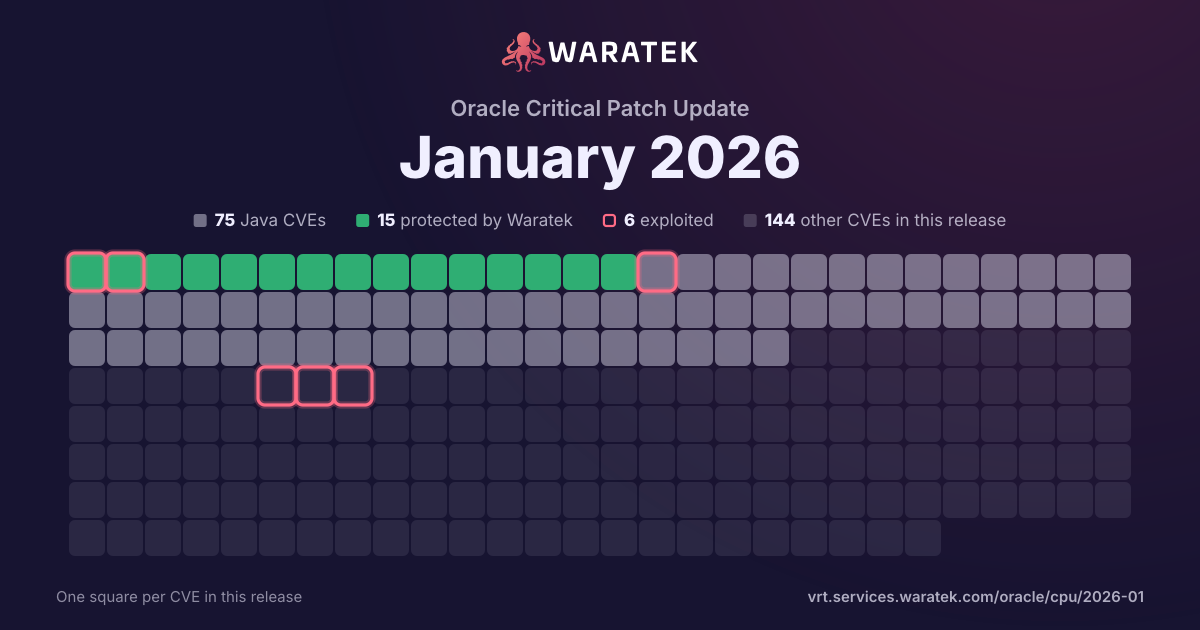
By status
15Protected by Waratek2Mitigation candidate58No exploit published14Outside Waratek scope130Not applicable
6Exploited, marked by the ring
No exploit published. For 26 of them, Oracle's security advisory is the source of public detail.
Protected by Waratek. Waratek RASP can block exploitation of these on systems that have not applied the patch yet.
Overview 174 matches · 60 in Waratek scope · 7 protected · 0 exploited · 0 CISA KEV · 0 public PoC · 0 EPSS ≥ 0.5
174matches
60in Waratek scope34.5%
7protected4.0%
0exploited0.0%
0CISA KEV0.0%
0public PoC0.0%
0EPSS ≥ 0.50.0%
Protected by Waratek
7
4.0%
Rule in development
0
0.0%
Mitigation candidate
0
0.0%
No exploit published
53
30.5%
Outside Waratek scope
11
6.3%
Not applicable
103
59.2%
Withdrawn CVE
0
0.0%
blocked by ARMR today
7
4.0%
partly blocked
0
0.0%
not blocked
167
96.0%
not established
0
0.0%
unrecorded
0
0.0%
Exploited
0
0.0%
Working exploit published
0
0.0%
Proof of concept only
0
0.0%
Forecast only
0
0.0%
No public exploit
174
100.0%
split by
peak 88 / year
20181
Protected by Waratek1
High1
blocked by ARMR today1
No public exploit1
20190
20201
Protected by Waratek1
Critical1
blocked by ARMR today1
No public exploit1
20213
Protected by Waratek3
Critical2
High1
blocked by ARMR today3
No public exploit3
20221
Not applicable1
Medium1
not blocked1
No public exploit1
20237
Not applicable7
High4
Medium3
not blocked7
No public exploit7
20248
Protected by Waratek1
No exploit published2
Not applicable5
Critical2
High1
Medium5
blocked by ARMR today1
not blocked7
No public exploit8
202588
Protected by Waratek1
No exploit published24
Outside Waratek scope7
Not applicable56
Critical5
High42
Medium33
Low8
blocked by ARMR today1
not blocked87
No public exploit88
202665
No exploit published27
Outside Waratek scope4
Not applicable34
Critical1
High19
Medium41
Low4
not blocked65
No public exploit65
201820192020202120222023202420252026
| CVE | Severity | Published▾ | Status | Exploitation | Description |
|---|---|---|---|---|---|
| CVE-2025-9086 | High | 2025-09-12 | Not applicable | No public exploit | 1. A cookie is set using the `secure` keyword for `https://target` 2. curl is redirected to or otherwise made to speak with `http://target` (same hostname, but using clear text HTTP) using the same cookie set 3. The same cookie name is set - but with only a slash as path (`path="/"`). Since this site is not secure, the cookie *should* be ignored. 4. A bug in the path comparison logic makes curl read outside a heap buffer boundary The bug either causes a crash or it potentially makes the comparison come to the wrong conclusion and lets the clear-text site override the contents of the secure cookie, contrary to expectations and depending on the memory contents immediately following the single-byte allocation that holds the path. The presumed and correct behavior would be to plainly ignore the second set of the cookie since it was already set as secure on a secure host so overriding it on an insecure host should not be okay. |
| CVE-2025-10148 | Medium | 2025-09-12 | Not applicable | No public exploit | curl's WebSocket code did not update the 32-bit mask pattern for each new outgoing frame as the specification says. Instead it used a fixed mask that persisted and was used throughout the entire connection. A predictable mask pattern allows for a malicious server to induce traffic between the two communicating parties that could be interpreted by an involved proxy (configured or transparent) as genuine, real, HTTP traffic with content and thereby poison its cache. That cached poisoned content could then be served to all users of that proxy. |
| CVE-2025-58056 | Low | 2025-09-03 | No exploit published | No public exploit | Netty is an asynchronous event-driven network application framework for development of maintainable high performance protocol servers and clients. In versions 4.1.124.Final, and 4.2.0.Alpha3 through 4.2.4.Final, Netty incorrectly accepts standalone newline characters (LF) as a chunk-size line terminator, regardless of a preceding carriage return (CR), instead of requiring CRLF per HTTP/1.1 standards. When combined with reverse proxies that parse LF differently (treating it as part of the chunk extension), attackers can craft requests that the proxy sees as one request but Netty processes as two, enabling request smuggling attacks. This is fixed in versions 4.1.125.Final and 4.2.5.Final. |
| CVE-2025-5115 | High | 2025-08-20 | No exploit published | No public exploit | In Eclipse Jetty, versions <=9.4.57, <=10.0.25, <=11.0.25, <=12.0.21, <=12.1.0.alpha2, an HTTP/2 client may trigger the server to send RST_STREAM frames, for example by sending frames that are malformed or that should not be sent in a particular stream state, therefore forcing the server to consume resources such as CPU and memory. For example, a client can open a stream and then send WINDOW_UPDATE frames with window size increment of 0, which is illegal. Per specification https://www.rfc-editor.org/rfc/rfc9113.html#name-window_update , the server should send a RST_STREAM frame. The client can now open another stream and send another bad WINDOW_UPDATE, therefore causing the server to consume more resources than necessary, as this case does not exceed the max number of concurrent streams, yet the client is able to create an enormous amount of streams in a short period of time. The attack can be performed with other conditions (for example, a DATA frame for a closed stream) that cause the server to send a RST_STREAM frame. Links: * https://github.com/jetty/jetty.project/security/advisories/GHSA-mmxm-8w33-wc4h |
| CVE-2025-4877 | Medium | 2025-08-20 | Not applicable | No public exploit | There's a vulnerability in the libssh package where when a libssh consumer passes in an unexpectedly large input buffer to ssh_get_fingerprint_hash() function. In such cases the bin_to_base64() function can experience an integer overflow leading to a memory under allocation, when that happens it's possible that the program perform out of bounds write leading to a heap corruption. This issue affects only 32-bits builds of libssh. |
| CVE-2025-8916 | Medium | 2025-08-13 | No exploit published | No public exploit | Allocation of Resources Without Limits or Throttling vulnerability in Legion of the Bouncy Castle Inc. BC Java bcpkix on All (API modules), Legion of the Bouncy Castle Inc. BC Java bcprov on All (API modules), Legion of the Bouncy Castle Inc. BCPKIX FIPS bcpkix-fips on All (API modules) allows Excessive Allocation. This vulnerability is associated with program files https://github.Com/bcgit/bc-java/blob/main/pkix/src/main/java/org/bouncycastle/pkix/jcajce/PKIXCertPathReviewer.Java, https://github.Com/bcgit/bc-java/blob/main/prov/src/main/java/org/bouncycastle/x509/PKIXCertPathReviewer.Java. This issue affects BC Java: from 1.44 through 1.78; BC Java: from 1.44 through 1.78; BCPKIX FIPS: from 1.0.0 through 1.0.7, from 2.0.0 through 2.0.7. |
| CVE-2025-55163 | High | 2025-08-13 | Outside Waratek scope | No public exploit | Netty is an asynchronous, event-driven network application framework. Prior to versions 4.1.124.Final and 4.2.4.Final, Netty is vulnerable to MadeYouReset DDoS. This is a logical vulnerability in the HTTP/2 protocol, that uses malformed HTTP/2 control frames in order to break the max concurrent streams limit - which results in resource exhaustion and distributed denial of service. This issue has been patched in versions 4.1.124.Final and 4.2.4.Final. |
| CVE-2025-48989 | High | 2025-08-13 | No exploit published | No public exploit | Improper Resource Shutdown or Release vulnerability in Apache Tomcat made Tomcat vulnerable to the made you reset attack. This issue affects Apache Tomcat: from 11.0.0-M1 through 11.0.9, from 10.1.0-M1 through 10.1.43 and from 9.0.0.M1 through 9.0.107. Older, EOL versions may also be affected. Users are recommended to upgrade to one of versions 11.0.10, 10.1.44 or 9.0.108 which fix the issue. |
| CVE-2025-8732 | Low | 2025-08-08 | Not applicable | No public exploit | A vulnerability was found in libxml2 up to 2.14.5. It has been declared as problematic. This vulnerability affects the function xmlParseSGMLCatalog of the component xmlcatalog. The manipulation leads to uncontrolled recursion. Attacking locally is a requirement. The exploit has been disclosed to the public and may be used. The real existence of this vulnerability is still doubted at the moment. The code maintainer explains, that "[t]he issue can only be triggered with untrusted SGML catalogs and it makes absolutely no sense to use untrusted catalogs. I also doubt that anyone is still using SGML catalogs at all." |
| CVE-2025-8194 | High | 2025-07-28 | Not applicable | No public exploit | There is a defect in the CPython “tarfile” module affecting the “TarFile” extraction and entry enumeration APIs. The tar implementation would process tar archives with negative offsets without error, resulting in an infinite loop and deadlock during the parsing of maliciously crafted tar archives. This vulnerability can be mitigated by including the following patch after importing the “tarfile” module: https://gist.github.com/sethmlarson/1716ac5b82b73dbcbf23ad2eff8b33e1 |
| CVE-2025-5449 | Medium | 2025-07-25 | Not applicable | No public exploit | A flaw was found in the SFTP server message decoding logic of libssh. The issue occurs due to an incorrect packet length check that allows an integer overflow when handling large payload sizes on 32-bit systems. This issue leads to failed memory allocation and causes the server process to crash, resulting in a denial of service. |
| CVE-2025-4878 | Low | 2025-07-22 | Not applicable | No public exploit | A vulnerability was found in libssh, where an uninitialized variable exists under certain conditions in the privatekey_from_file() function. This flaw can be triggered if the file specified by the filename doesn't exist and may lead to possible signing failures or heap corruption. |
| CVE-2025-7962 | Medium | 2025-07-21 | No exploit published | No public exploit | In Jakarta Mail versions prior to 2.0.2 it is possible to perform an SMTP Injection by utilizing the \r and \n UTF-8 characters to separate different messages. |
| CVE-2025-27209 | High | 2025-07-18 | Not applicable | No public exploit | The V8 release used in Node.js v24.0.0 has changed how string hashes are computed using rapidhash. This implementation re-introduces the HashDoS vulnerability as an attacker who can control the strings to be hashed can generate many hash collisions - an attacker can generate collisions even without knowing the hash-seed. * This vulnerability affects Node.js v24.x users. |
| CVE-2025-50059 | High | 2025-07-15 | Outside Waratek scope | No public exploit | Vulnerability in the Oracle Java SE, Oracle GraalVM for JDK, Oracle GraalVM Enterprise Edition product of Oracle Java SE (component: Networking). Supported versions that are affected are Oracle Java SE: 8u451-perf, 11.0.27, 17.0.15, 21.0.7, 24.0.1; Oracle GraalVM for JDK: 17.0.15, 21.0.7 and 24.0.1; Oracle GraalVM Enterprise Edition: 21.3.14. Easily exploitable vulnerability allows unauthenticated attacker with network access via multiple protocols to compromise Oracle Java SE, Oracle GraalVM for JDK, Oracle GraalVM Enterprise Edition. While the vulnerability is in Oracle Java SE, Oracle GraalVM for JDK, Oracle GraalVM Enterprise Edition, attacks may significantly impact additional products (scope change). Successful attacks of this vulnerability can result in unauthorized access to critical data or complete access to all Oracle Java SE, Oracle GraalVM for JDK, Oracle GraalVM Enterprise Edition accessible data. Note: This vulnerability applies to Java deployments, typically in clients running sandboxed Java Web Start applications or sandboxed Java applets, that load and run untrusted code (e.g., code that comes from the internet) and rely on the Java sandbox for security. This vulnerability does not apply to Java deployments, typically in servers, that load and run only trusted code (e.g., code installed by an administrator). CVSS 3.1 Base Score 8.6 (Confidentiality impacts). CVSS Vector: (CVSS:3.1/AV:N/AC:L/PR:N/UI:N/S:C/C:H/I:N/A:N). |
| CVE-2025-48795 | Medium | 2025-07-15 | No exploit published | No public exploit | Apache CXF stores large stream based messages as temporary files on the local filesystem. A bug was introduced which means that the entire temporary file is read into memory and then logged. An attacker might be able to exploit this to cause a denial of service attack by causing an out of memory exception. In addition, it is possible to configure CXF to encrypt temporary files to prevent sensitive credentials from being cached unencrypted on the local filesystem, however this bug means that the cached files are written out to logs unencrypted. Users are recommended to upgrade to versions 3.5.11, 3.6.6, 4.0.7 or 4.1.1, which fixes this issue. |
| CVE-2025-53643 | Low | 2025-07-14 | Not applicable | No public exploit | AIOHTTP is an asynchronous HTTP client/server framework for asyncio and Python. Prior to version 3.12.14, the Python parser is vulnerable to a request smuggling vulnerability due to not parsing trailer sections of an HTTP request. If a pure Python version of aiohttp is installed (i.e. without the usual C extensions) or AIOHTTP_NO_EXTENSIONS is enabled, then an attacker may be able to execute a request smuggling attack to bypass certain firewalls or proxy protections. Version 3.12.14 contains a patch for this issue. |
| CVE-2025-48924 | Medium | 2025-07-11 | No exploit published | No public exploit | Uncontrolled Recursion vulnerability in Apache Commons Lang. This issue affects Apache Commons Lang: Starting with commons-lang:commons-lang 2.0 to 2.6, and, from org.apache.commons:commons-lang3 3.0 before 3.18.0. The methods ClassUtils.getClass(...) can throw StackOverflowError on very long inputs. Because an Error is usually not handled by applications and libraries, a StackOverflowError could cause an application to stop. Users are recommended to upgrade to version 3.18.0, which fixes the issue. |
| CVE-2025-7424 | High | 2025-07-10 | Outside Waratek scope | No public exploit | A flaw was found in the libxslt library. The same memory field, psvi, is used for both stylesheet and input data, which can lead to type confusion during XML transformations. This vulnerability allows an attacker to crash the application or corrupt memory. In some cases, it may lead to denial of service or unexpected behavior. |
| CVE-2025-6395 | Medium | 2025-07-10 | Not applicable | No public exploit | A NULL pointer dereference flaw was found in the GnuTLS software in _gnutls_figure_common_ciphersuite(). |
| CVE-2025-52520 | High | 2025-07-10 | No exploit published | No public exploit | For some unlikely configurations of multipart upload, an Integer Overflow vulnerability in Apache Tomcat could lead to a DoS via bypassing of size limits. This issue affects Apache Tomcat: from 11.0.0-M1 through 11.0.8, from 10.1.0-M1 through 10.1.42, from 9.0.0.M1 through 9.0.106. The following versions were EOL at the time the CVE was created but are known to be affected: 8.5.0 through 8.5.100. Other, older, EOL versions may also be affected. Users are recommended to upgrade to version 11.0.9, 10.1.43 or 9.0.107, which fix the issue. |
| CVE-2025-49812 | High | 2025-07-10 | Not applicable | No public exploit | In some mod_ssl configurations on Apache HTTP Server versions through to 2.4.63, an HTTP desynchronisation attack allows a man-in-the-middle attacker to hijack an HTTP session via a TLS upgrade. Only configurations using "SSLEngine optional" to enable TLS upgrades are affected. Users are recommended to upgrade to version 2.4.64, which removes support for TLS upgrade. |
| CVE-2025-32990 | High | 2025-07-10 | Not applicable | No public exploit | A heap-buffer-overflow (off-by-one) flaw was found in the GnuTLS software in the template parsing logic within the certtool utility. When it reads certain settings from a template file, it allows an attacker to cause an out-of-bounds (OOB) NULL pointer write, resulting in memory corruption and a denial-of-service (DoS) that could potentially crash the system. |
| CVE-2025-32989 | Medium | 2025-07-10 | Not applicable | No public exploit | A heap-buffer-overread vulnerability was found in GnuTLS in how it handles the Certificate Transparency (CT) Signed Certificate Timestamp (SCT) extension during X.509 certificate parsing. This flaw allows a malicious user to create a certificate containing a malformed SCT extension (OID 1.3.6.1.4.1.11129.2.4.2) that contains sensitive data. This issue leads to the exposure of confidential information when GnuTLS verifies certificates from certain websites when the certificate (SCT) is not checked correctly. |
| CVE-2025-32988 | High | 2025-07-10 | Not applicable | No public exploit | A flaw was found in GnuTLS. A double-free vulnerability exists in GnuTLS due to incorrect ownership handling in the export logic of Subject Alternative Name (SAN) entries containing an otherName. If the type-id OID is invalid or malformed, GnuTLS will call asn1_delete_structure() on an ASN.1 node it does not own, leading to a double-free condition when the parent function or caller later attempts to free the same structure. This vulnerability can be triggered using only public GnuTLS APIs and may result in denial of service or memory corruption, depending on allocator behavior. |
| CVE-2024-47252 | High | 2025-07-10 | Not applicable | No public exploit | Insufficient escaping of user-supplied data in mod_ssl in Apache HTTP Server 2.4.63 and earlier allows an untrusted SSL/TLS client to insert escape characters into log files in some configurations. In a logging configuration where CustomLog is used with "%{varname}x" or "%{varname}c" to log variables provided by mod_ssl such as SSL_TLS_SNI, no escaping is performed by either mod_log_config or mod_ssl and unsanitized data provided by the client may appear in log files. |
| CVE-2024-43204 | High | 2025-07-10 | Not applicable | No public exploit | SSRF in Apache HTTP Server with mod_proxy loaded allows an attacker to send outbound proxy requests to a URL controlled by the attacker. Requires an unlikely configuration where mod_headers is configured to modify the Content-Type request or response header with a value provided in the HTTP request. Users are recommended to upgrade to version 2.4.64 which fixes this issue. |
| CVE-2024-42516 | High | 2025-07-10 | Not applicable | No public exploit | HTTP response splitting in the core of Apache HTTP Server allows an attacker who can manipulate the Content-Type response headers of applications hosted or proxied by the server can split the HTTP response. This vulnerability was described as CVE-2023-38709 but the patch included in Apache HTTP Server 2.4.59 did not address the issue. Users are recommended to upgrade to version 2.4.64, which fixes this issue. |
| CVE-2025-5987 | High | 2025-07-07 | Not applicable | No public exploit | A flaw was found in libssh when using the ChaCha20 cipher with the OpenSSL library. If an attacker manages to exhaust the heap space, this error is not detected and may lead to libssh using a partially initialized cipher context. This occurs because the OpenSSL error code returned aliases with the SSH_OK code, resulting in libssh not properly detecting the error returned by the OpenSSL library. This issue can lead to undefined behavior, including compromised data confidentiality and integrity or crashes. |
| CVE-2025-5372 | High | 2025-07-04 | Not applicable | No public exploit | A flaw was found in libssh versions built with OpenSSL versions older than 3.0, specifically in the ssh_kdf() function responsible for key derivation. Due to inconsistent interpretation of return values where OpenSSL uses 0 to indicate failure and libssh uses 0 for success—the function may mistakenly return a success status even when key derivation fails. This results in uninitialized cryptographic key buffers being used in subsequent communication, potentially compromising SSH sessions' confidentiality, integrity, and availability. |
| CVE-2025-5351 | Medium | 2025-07-04 | Not applicable | No public exploit | A flaw was found in the key export functionality of libssh. The issue occurs in the internal function responsible for converting cryptographic keys into serialized formats. During error handling, a memory structure is freed but not cleared, leading to a potential double free issue if an additional failure occurs later in the function. This condition may result in heap corruption or application instability in low-memory scenarios, posing a risk to system reliability where key export operations are performed. |
| CVE-2025-52891 | Medium | 2025-07-02 | Not applicable | No public exploit | ModSecurity is an open source, cross platform web application firewall (WAF) engine for Apache, IIS and Nginx. In versions 2.9.8 to before 2.9.11, an empty XML tag can cause a segmentation fault. If SecParseXmlIntoArgs is set to On or OnlyArgs, and the request type is application/xml, and at least one XML tag is empty (eg <foo></foo>), then a segmentation fault occurs. This issue has been patched in version 2.9.11. A workaround involves setting SecParseXmlIntoArgs to Off. |
| CVE-2025-52999 | High | 2025-06-25 | No exploit published | No public exploit | jackson-core contains core low-level incremental ("streaming") parser and generator abstractions used by Jackson Data Processor. In versions prior to 2.15.0, if a user parses an input file and it has deeply nested data, Jackson could end up throwing a StackoverflowError if the depth is particularly large. jackson-core 2.15.0 contains a configurable limit for how deep Jackson will traverse in an input document, defaulting to an allowable depth of 1000. jackson-core will throw a StreamConstraintsException if the limit is reached. jackson-databind also benefits from this change because it uses jackson-core to parse JSON inputs. As a workaround, users should avoid parsing input files from untrusted sources. |
| CVE-2025-5318 | High | 2025-06-24 | Not applicable | No public exploit | A flaw was found in the libssh library in versions less than 0.11.2. An out-of-bounds read can be triggered in the sftp_handle function due to an incorrect comparison check that permits the function to access memory beyond the valid handle list and to return an invalid pointer, which is used in further processing. This vulnerability allows an authenticated remote attacker to potentially read unintended memory regions, exposing sensitive information or affect service behavior. |
| CVE-2025-6069 | Medium | 2025-06-17 | Not applicable | No public exploit | The html.parser.HTMLParser class had worse-case quadratic complexity when processing certain crafted malformed inputs potentially leading to amplified denial-of-service. |
| CVE-2025-49796 | Critical | 2025-06-16 | Not applicable | No public exploit | A vulnerability was found in libxml2. Processing certain sch:name elements from the input XML file can trigger a memory corruption issue. This flaw allows an attacker to craft a malicious XML input file that can lead libxml to crash, resulting in a denial of service or other possible undefined behavior due to sensitive data being corrupted in memory. |
| CVE-2025-49795 | High | 2025-06-16 | Not applicable | No public exploit | A NULL pointer dereference vulnerability was found in libxml2 when processing XPath XML expressions. This flaw allows an attacker to craft a malicious XML input to libxml2, leading to a denial of service. |
| CVE-2025-49794 | Critical | 2025-06-16 | Not applicable | No public exploit | A use-after-free vulnerability was found in libxml2. This issue occurs when parsing XPath elements under certain circumstances when the XML schematron has the <sch:name path="..."/> schema elements. This flaw allows a malicious actor to craft a malicious XML document used as input for libxml, resulting in the program's crash using libxml or other possible undefined behaviors. |
| CVE-2025-48976 | High | 2025-06-16 | No exploit published | No public exploit | Allocation of resources for multipart headers with insufficient limits enabled a DoS vulnerability in Apache Commons FileUpload. This issue affects Apache Commons FileUpload: from 1.0 before 1.6; from 2.0.0-M1 before 2.0.0-M4. Users are recommended to upgrade to versions 1.6 or 2.0.0-M4, which fix the issue. |
| CVE-2025-6052 | High | 2025-06-13 | Outside Waratek scope | No public exploit | A flaw was found in how GLib’s GString manages memory when adding data to strings. If a string is already very large, combining it with more input can cause a hidden overflow in the size calculation. This makes the system think it has enough memory when it doesn’t. As a result, data may be written past the end of the allocated memory, leading to crashes or memory corruption. |
| CVE-2025-41234 | Medium | 2025-06-12 | No exploit published | No public exploit | Description In Spring Framework, versions 6.0.x as of 6.0.5, versions 6.1.x and 6.2.x, an application is vulnerable to a reflected file download (RFD) attack when it sets a “Content-Disposition” header with a non-ASCII charset, where the filename attribute is derived from user-supplied input. Specifically, an application is vulnerable when all the following are true: * The header is prepared with org.springframework.http.ContentDisposition. * The filename is set via ContentDisposition.Builder#filename(String, Charset). * The value for the filename is derived from user-supplied input. * The application does not sanitize the user-supplied input. * The downloaded content of the response is injected with malicious commands by the attacker (see RFD paper reference for details). An application is not vulnerable if any of the following is true: * The application does not set a “Content-Disposition” response header. * The header is not prepared with org.springframework.http.ContentDisposition. * The filename is set via one of: * ContentDisposition.Builder#filename(String), or * ContentDisposition.Builder#filename(String, ASCII) * The filename is not derived from user-supplied input. * The filename is derived from user-supplied input but sanitized by the application. * The attacker cannot inject malicious content in the downloaded content of the response. Affected Spring Products and VersionsSpring Framework: * 6.2.0 - 6.2.7 * 6.1.0 - 6.1.20 * 6.0.5 - 6.0.28 * Older, unsupported versions are not affected MitigationUsers of affected versions should upgrade to the corresponding fixed version. Affected version(s)Fix versionAvailability6.2.x6.2.8OSS6.1.x6.1.21OSS6.0.x6.0.29 Commercial https://enterprise.spring.io/ No further mitigation steps are necessary. CWE-113 in `Content-Disposition` handling in VMware Spring Framework versions 6.0.5 to 6.2.7 allows remote attackers to launch Reflected File Download (RFD) attacks via unsanitized user input in `ContentDisposition.Builder#filename(String, Charset)` with non-ASCII charsets. |
| CVE-2025-27818 | High | 2025-06-10 | Protected by Waratek | No public exploit | A possible security vulnerability has been identified in Apache Kafka. This requires access to a alterConfig to the cluster resource, or Kafka Connect worker, and the ability to create/modify connectors on it with an arbitrary Kafka client SASL JAAS config and a SASL-based security protocol, which has been possible on Kafka clusters since Apache Kafka 2.0.0 (Kafka Connect 2.3.0). When configuring the broker via config file or AlterConfig command, or connector via the Kafka Kafka Connect REST API, an authenticated operator can set the `sasl.jaas.config` property for any of the connector's Kafka clients to "com.sun.security.auth.module.LdapLoginModule", which can be done via the `producer.override.sasl.jaas.config`, `consumer.override.sasl.jaas.config`, or `admin.override.sasl.jaas.config` properties. This will allow the server to connect to the attacker's LDAP server and deserialize the LDAP response, which the attacker can use to execute java deserialization gadget chains on the Kafka connect server. Attacker can cause unrestricted deserialization of untrusted data (or) RCE vulnerability when there are gadgets in the classpath. Since Apache Kafka 3.0.0, users are allowed to specify these properties in connector configurations for Kafka Connect clusters running with out-of-the-box configurations. Before Apache Kafka 3.0.0, users may not specify these properties unless the Kafka Connect cluster has been reconfigured with a connector client override policy that permits them. Since Apache Kafka 3.9.1/4.0.0, we have added a system property ("-Dorg.apache.kafka.disallowed.login.modules") to disable the problematic login modules usage in SASL JAAS configuration. Also by default "com.sun.security.auth.module.JndiLoginModule,com.sun.security.auth.module.LdapLoginModule" are disabled in Apache Kafka Connect 3.9.1/4.0.0. We advise the Kafka users to validate connector configurations and only allow trusted LDAP configurations. Also examine connector dependencies for vulnerable versions and either upgrade their connectors, upgrading that specific dependency, or removing the connectors as options for remediation. Finally, in addition to leveraging the "org.apache.kafka.disallowed.login.modules" system property, Kafka Connect users can also implement their own connector client config override policy, which can be used to control which Kafka client properties can be overridden directly in a connector config and which cannot. |
| CVE-2025-4575 | Medium | 2025-05-22 | Not applicable | No public exploit | Issue summary: Use of -addreject option with the openssl x509 application adds a trusted use instead of a rejected use for a certificate. Impact summary: If a user intends to make a trusted certificate rejected for a particular use it will be instead marked as trusted for that use. A copy & paste error during minor refactoring of the code introduced this issue in the OpenSSL 3.5 version. If, for example, a trusted CA certificate should be trusted only for the purpose of authenticating TLS servers but not for CMS signature verification and the CMS signature verification is intended to be marked as rejected with the -addreject option, the resulting CA certificate will be trusted for CMS signature verification purpose instead. Only users which use the trusted certificate format who use the openssl x509 command line application to add rejected uses are affected by this issue. The issues affecting only the command line application are considered to be Low severity. The FIPS modules in 3.5, 3.4, 3.3, 3.2, 3.1 and 3.0 are not affected by this issue. OpenSSL 3.4, 3.3, 3.2, 3.1, 3.0, 1.1.1 and 1.0.2 are also not affected by this issue. |
| CVE-2025-22233 | Low | 2025-05-16 | No exploit published | No public exploit | CVE-2024-38820 ensured Locale-independent, lowercase conversion for both the configured disallowedFields patterns and for request parameter names. However, there are still cases where it is possible to bypass the disallowedFields checks. Affected Spring Products and Versions Spring Framework: * 6.2.0 - 6.2.6 * 6.1.0 - 6.1.19 * 6.0.0 - 6.0.27 * 5.3.0 - 5.3.42 * Older, unsupported versions are also affected Mitigation Users of affected versions should upgrade to the corresponding fixed version. Affected version(s)Fix Version Availability 6.2.x 6.2.7 OSS6.1.x 6.1.20 OSS6.0.x 6.0.28 Commercial https://enterprise.spring.io/ 5.3.x 5.3.43 Commercial https://enterprise.spring.io/ No further mitigation steps are necessary. Generally, we recommend using a dedicated model object with properties only for data binding, or using constructor binding since constructor arguments explicitly declare what to bind together with turning off setter binding through the declarativeBinding flag. See the Model Design section in the reference documentation. For setting binding, prefer the use of allowedFields (an explicit list) over disallowedFields. Credit This issue was responsibly reported by the TERASOLUNA Framework Development Team from NTT DATA Group Corporation. |
| CVE-2024-13009 | High | 2025-05-08 | No exploit published | No public exploit | In Eclipse Jetty versions 9.4.0 to 9.4.56 a buffer can be incorrectly released when confronted with a gzip error when inflating a request body. This can result in corrupted and/or inadvertent sharing of data between requests. |
| CVE-2025-46727 | High | 2025-05-07 | Not applicable | No public exploit | Rack is a modular Ruby web server interface. Prior to versions 2.2.14, 3.0.16, and 3.1.14, `Rack::QueryParser` parses query strings and `application/x-www-form-urlencoded` bodies into Ruby data structures without imposing any limit on the number of parameters, allowing attackers to send requests with extremely large numbers of parameters. The vulnerability arises because `Rack::QueryParser` iterates over each `&`-separated key-value pair and adds it to a Hash without enforcing an upper bound on the total number of parameters. This allows an attacker to send a single request containing hundreds of thousands (or more) of parameters, which consumes excessive memory and CPU during parsing. An attacker can trigger denial of service by sending specifically crafted HTTP requests, which can cause memory exhaustion or pin CPU resources, stalling or crashing the Rack server. This results in full service disruption until the affected worker is restarted. Versions 2.2.14, 3.0.16, and 3.1.14 fix the issue. Some other mitigations are available. One may use middleware to enforce a maximum query string size or parameter count, or employ a reverse proxy (such as Nginx) to limit request sizes and reject oversized query strings or bodies. Limiting request body sizes and query string lengths at the web server or CDN level is an effective mitigation. |
| CVE-2025-43967 | High | 2025-04-21 | Not applicable | No public exploit | libheif before 1.19.6 has a NULL pointer dereference in ImageItem_Grid::get_decoder in image-items/grid.cc because a grid image can reference a nonexistent image item. |
| CVE-2025-43966 | High | 2025-04-21 | Not applicable | No public exploit | libheif before 1.19.6 has a NULL pointer dereference in ImageItem_iden in image-items/iden.cc. |
| CVE-2024-56406 | High | 2025-04-13 | Not applicable | No public exploit | A heap buffer overflow vulnerability was discovered in Perl. Release branches 5.34, 5.36, 5.38 and 5.40 are affected, including development versions from 5.33.1 through 5.41.10. When there are non-ASCII bytes in the left-hand-side of the `tr` operator, `S_do_trans_invmap` can overflow the destination pointer `d`. $ perl -e '$_ = "\x{FF}" x 1000000; tr/\xFF/\x{100}/;' Segmentation fault (core dumped) It is believed that this vulnerability can enable Denial of Service and possibly Code Execution attacks on platforms that lack sufficient defenses. |
| CVE-2025-31672 | Medium | 2025-04-09 | No exploit published | No public exploit | Improper Input Validation vulnerability in Apache POI. The issue affects the parsing of OOXML format files like xlsx, docx and pptx. These file formats are basically zip files and it is possible for malicious users to add zip entries with duplicate names (including the path) in the zip. In this case, products reading the affected file could read different data because 1 of the zip entries with the duplicate name is selected over another but different products may choose a different zip entry. This issue affects Apache POI poi-ooxml before 5.4.0. poi-ooxml 5.4.0 has a check that throws an exception if zip entries with duplicate file names are found in the input file. Users are recommended to upgrade to version poi-ooxml 5.4.0, which fixes the issue. Please read https://poi.apache.org/security.html for recommendations about how to use the POI libraries securely. |
| CVE-2025-22228 | High | 2025-03-20 | No exploit published | No public exploit | BCryptPasswordEncoder.matches(CharSequence,String) will incorrectly return true for passwords larger than 72 characters as long as the first 72 characters are the same. |
| CVE-2024-12133 | Medium | 2025-02-10 | Not applicable | No public exploit | A flaw in libtasn1 causes inefficient handling of specific certificate data. When processing a large number of elements in a certificate, libtasn1 takes much longer than expected, which can slow down or even crash the system. This flaw allows an attacker to send a specially crafted certificate, causing a denial of service attack. |
| CVE-2025-23084 | Medium | 2025-01-28 | Not applicable | No public exploit | A vulnerability has been identified in Node.js, specifically affecting the handling of drive names in the Windows environment. Certain Node.js functions do not treat drive names as special on Windows. As a result, although Node.js assumes a relative path, it actually refers to the root directory. On Windows, a path that does not start with the file separator is treated as relative to the current directory. This vulnerability affects Windows users of `path.join` API. |
| CVE-2024-52046 | Critical | 2024-12-25 | Protected by Waratek | No public exploit | The ObjectSerializationDecoder in Apache MINA uses Java’s native deserialization protocol to process incoming serialized data but lacks the necessary security checks and defenses. This vulnerability allows attackers to exploit the deserialization process by sending specially crafted malicious serialized data, potentially leading to remote code execution (RCE) attacks. This issue affects MINA core versions 2.0.X, 2.1.X and 2.2.X, and will be fixed by the releases 2.0.27, 2.1.10 and 2.2.4. It's also important to note that an application using MINA core library will only be affected if the IoBuffer#getObject() method is called, and this specific method is potentially called when adding a ProtocolCodecFilter instance using the ObjectSerializationCodecFactory class in the filter chain. If your application is specifically using those classes, you have to upgrade to the latest version of MINA core library. Upgrading will not be enough: you also need to explicitly allow the classes the decoder will accept in the ObjectSerializationDecoder instance, using one of the three new methods: /** * Accept class names where the supplied ClassNameMatcher matches for * deserialization, unless they are otherwise rejected. * * @param classNameMatcher the matcher to use */ public void accept(ClassNameMatcher classNameMatcher) /** * Accept class names that match the supplied pattern for * deserialization, unless they are otherwise rejected. * * @param pattern standard Java regexp */ public void accept(Pattern pattern) /** * Accept the wildcard specified classes for deserialization, * unless they are otherwise rejected. * * @param patterns Wildcard file name patterns as defined by * {@link org.apache.commons.io.FilenameUtils#wildcardMatch(String, String) FilenameUtils.wildcardMatch} */ public void accept(String... patterns) By default, the decoder will reject *all* classes that will be present in the incoming data. Note: The FtpServer, SSHd and Vysper sub-project are not affected by this issue. |
| CVE-2024-46901 | Medium | 2024-12-09 | Not applicable | No public exploit | Insufficient validation of filenames against control characters in Apache Subversion repositories served via mod_dav_svn allows authenticated users with commit access to commit a corrupted revision, leading to disruption for users of the repository. All versions of Subversion up to and including Subversion 1.14.4 are affected if serving repositories via mod_dav_svn. Users are recommended to upgrade to version 1.14.5, which fixes this issue. Repositories served via other access methods are not affected. |
| CVE-2024-31141 | Medium | 2024-11-19 | No exploit published | No public exploit | Files or Directories Accessible to External Parties, Improper Privilege Management vulnerability in Apache Kafka Clients. Apache Kafka Clients accept configuration data for customizing behavior, and includes ConfigProvider plugins in order to manipulate these configurations. Apache Kafka also provides FileConfigProvider, DirectoryConfigProvider, and EnvVarConfigProvider implementations which include the ability to read from disk or environment variables. In applications where Apache Kafka Clients configurations can be specified by an untrusted party, attackers may use these ConfigProviders to read arbitrary contents of the disk and environment variables. In particular, this flaw may be used in Apache Kafka Connect to escalate from REST API access to filesystem/environment access, which may be undesirable in certain environments, including SaaS products. This issue affects Apache Kafka Clients: from 2.3.0 through 3.5.2, 3.6.2, 3.7.0. Users with affected applications are recommended to upgrade kafka-clients to version >=3.8.0, and set the JVM system property "org.apache.kafka.automatic.config.providers=none". Users of Kafka Connect with one of the listed ConfigProvider implementations specified in their worker config are also recommended to add appropriate "allowlist.pattern" and "allowed.paths" to restrict their operation to appropriate bounds. For users of Kafka Clients or Kafka Connect in environments that trust users with disk and environment variable access, it is not recommended to set the system property. For users of the Kafka Broker, Kafka MirrorMaker 2.0, Kafka Streams, and Kafka command-line tools, it is not recommended to set the system property. |
| CVE-2024-45720 | High | 2024-10-09 | Not applicable | No public exploit | On Windows platforms, a "best fit" character encoding conversion of command line arguments to Subversion's executables (e.g., svn.exe, etc.) may lead to unexpected command line argument interpretation, including argument injection and execution of other programs, if a specially crafted command line argument string is processed. All versions of Subversion up to and including Subversion 1.14.3 are affected on Windows platforms only. Users are recommended to upgrade to version Subversion 1.14.4, which fixes this issue. Subversion is not affected on UNIX-like platforms. |
| CVE-2024-47554 | Medium | 2024-10-03 | No exploit published | No public exploit | Uncontrolled Resource Consumption vulnerability in Apache Commons IO. The org.apache.commons.io.input.XmlStreamReader class may excessively consume CPU resources when processing maliciously crafted input. This issue affects Apache Commons IO: from 2.0 before 2.14.0. Users are recommended to upgrade to version 2.14.0 or later, which fixes the issue. |
| CVE-2024-43796 | Medium | 2024-09-10 | Not applicable | No public exploit | Express.js minimalist web framework for node. In express < 4.20.0, passing untrusted user input - even after sanitizing it - to response.redirect() may execute untrusted code. This issue is patched in express 4.20.0. |
| CVE-2024-23807 | Critical | 2024-02-29 | Not applicable | No public exploit | The Apache Xerces C++ XML parser on versions 3.0.0 before 3.2.5 contains a use-after-free error triggered during the scanning of external DTDs. Users are recommended to upgrade to version 3.2.5 which fixes the issue, or mitigate the issue by disabling DTD processing. This can be accomplished via the DOM using a standard parser feature, or via SAX using the XERCES_DISABLE_DTD environment variable. This issue has been disclosed before as CVE-2018-1311, but unfortunately that advisory incorrectly stated the issue would be fixed in version 3.2.3 or 3.2.4. |
| CVE-2023-29081 | Medium | 2024-01-26 | Not applicable | No public exploit | A vulnerability has been reported in Suite Setups built with versions prior to InstallShield 2023 R2. This vulnerability may allow locally authenticated users to cause a Denial of Service (DoS) condition when handling move operations on local, temporary folders. |
| CVE-2023-4154 | High | 2023-11-07 | Not applicable | No public exploit | A design flaw was found in Samba's DirSync control implementation, which exposes passwords and secrets in Active Directory to privileged users and Read-Only Domain Controllers (RODCs). This flaw allows RODCs and users possessing the GET_CHANGES right to access all attributes, including sensitive secrets and passwords. Even in a default setup, RODC DC accounts, which should only replicate some passwords, can gain access to all domain secrets, including the vital krbtgt, effectively eliminating the RODC / DC distinction. Furthermore, the vulnerability fails to account for error conditions (fail open), like out-of-memory situations, potentially granting access to secret attributes, even under low-privileged attacker influence. |
| CVE-2023-42669 | Medium | 2023-11-06 | Not applicable | No public exploit | A vulnerability was found in Samba's "rpcecho" development server, a non-Windows RPC server used to test Samba's DCE/RPC stack elements. This vulnerability stems from an RPC function that can be blocked indefinitely. The issue arises because the "rpcecho" service operates with only one worker in the main RPC task, allowing calls to the "rpcecho" server to be blocked for a specified time, causing service disruptions. This disruption is triggered by a "sleep()" call in the "dcesrv_echo_TestSleep()" function under specific conditions. Authenticated users or attackers can exploit this vulnerability to make calls to the "rpcecho" server, requesting it to block for a specified duration, effectively disrupting most services and leading to a complete denial of service on the AD DC. The DoS affects all other services as "rpcecho" runs in the main RPC task. |
| CVE-2023-42670 | Medium | 2023-11-03 | Not applicable | No public exploit | A flaw was found in Samba. It is susceptible to a vulnerability where multiple incompatible RPC listeners can be initiated, causing disruptions in the AD DC service. When Samba's RPC server experiences a high load or unresponsiveness, servers intended for non-AD DC purposes (for example, NT4-emulation "classic DCs") can erroneously start and compete for the same unix domain sockets. This issue leads to partial query responses from the AD DC, causing issues such as "The procedure number is out of range" when using tools like Active Directory Users. This flaw allows an attacker to disrupt AD DC services. |
| CVE-2023-4091 | Medium | 2023-11-03 | Not applicable | No public exploit | A vulnerability was discovered in Samba, where the flaw allows SMB clients to truncate files, even with read-only permissions when the Samba VFS module "acl_xattr" is configured with "acl_xattr:ignore system acls = yes". The SMB protocol allows opening files when the client requests read-only access but then implicitly truncates the opened file to 0 bytes if the client specifies a separate OVERWRITE create disposition request. The issue arises in configurations that bypass kernel file system permissions checks, relying solely on Samba's permissions. |
| CVE-2023-1393 | High | 2023-03-30 | Not applicable | No public exploit | A flaw was found in X.Org Server Overlay Window. A Use-After-Free may lead to local privilege escalation. If a client explicitly destroys the compositor overlay window (aka COW), the Xserver would leave a dangling pointer to that window in the CompScreen structure, which will trigger a use-after-free later. |
| CVE-2022-41342 | High | 2023-02-06 | Not applicable | No public exploit | Improper buffer restrictions in the Intel(R) C++ Compiler Classic before version 2021.7.1 for some Intel(R) oneAPI Toolkits before version 2022.3.1 may allow a privileged user to potentially enable escalation of privilege via local access. |
| CVE-2022-40196 | High | 2023-02-06 | Not applicable | No public exploit | Improper access control in the Intel(R) oneAPI DPC++/C++ Compiler before version 2022.2.1 and Intel C++ Compiler Classic before version 2021.7.1 for some Intel(R) oneAPI Toolkits before version 2022.3.1 may allow an authenticated user to potentially enable escalation of privilege via local access. |
| CVE-2022-23395 | Medium | 2022-03-02 | Not applicable | No public exploit | jQuery Cookie 1.4.1 is affected by prototype pollution, which can lead to DOM cross-site scripting (XSS). |
| CVE-2021-43113 | Critical | 2021-12-15 | Protected by Waratek | No public exploit | iTextPDF in iText 7 and up to (excluding 4.4.13.3) 7.1.17 allows command injection via a CompareTool filename that is mishandled on the gs (aka Ghostscript) command line in GhostscriptHelper.java. |
| CVE-2021-33813 | High | 2021-06-16 | Protected by Waratek | No public exploit | An XXE issue in SAXBuilder in JDOM through 2.0.6 allows attackers to cause a denial of service via a crafted HTTP request. |
| CVE-2021-23926 | Critical | 2021-01-14 | Protected by Waratek | No public exploit | The XML parsers used by XMLBeans up to version 2.6.0 did not set the properties needed to protect the user from malicious XML input. Vulnerabilities include possibilities for XML Entity Expansion attacks. Affects XMLBeans up to and including v2.6.0. |
| CVE-2020-10683 | Critical | 2020-05-01 | Protected by Waratek | No public exploit | dom4j before 2.0.3 and 2.1.x before 2.1.3 allows external DTDs and External Entities by default, which might enable XXE attacks. However, there is popular external documentation from OWASP showing how to enable the safe, non-default behavior in any application that uses dom4j. |
| CVE-2018-1000632 | High | 2018-08-20 | Protected by Waratek | No public exploit | dom4j version prior to version 2.1.1 contains a CWE-91: XML Injection vulnerability in Class: Element. Methods: addElement, addAttribute that can result in an attacker tampering with XML documents through XML injection. This attack appear to be exploitable via an attacker specifying attributes or elements in the XML document. This vulnerability appears to have been fixed in 2.1.1 or later. |