
Oracle Critical Patch Update January 2026
Released January 2026 · Oracle's advisory ↗ · ← Critical Patch Update, October 2025 · Critical Patch Update, April 2026 →
219 CVEs in this release, one square each
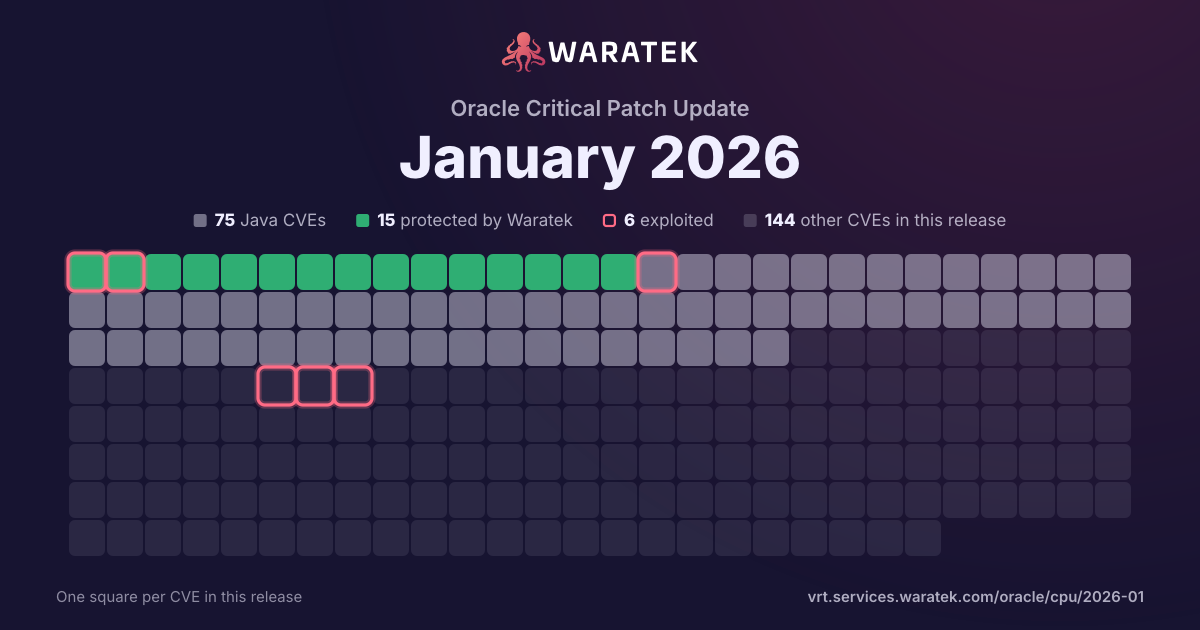
By status
15Protected by Waratek2Mitigation candidate58No exploit published14Outside Waratek scope130Not applicable
6Exploited, marked by the ring
No exploit published. For 26 of them, Oracle's security advisory is the source of public detail.
Protected by Waratek. Waratek RASP can block exploitation of these on systems that have not applied the patch yet.
Overview 7 matches · 0 protected · 0 exploited · 0 CISA KEV · 0 public PoC · 0 EPSS ≥ 0.5
7matches
0protected0.0%
0exploited0.0%
0CISA KEV0.0%
0public PoC0.0%
0EPSS ≥ 0.50.0%
Protected by Waratek
0
0.0%
Rule in development
0
0.0%
Mitigation candidate
0
0.0%
No exploit published
7
100.0%
blocked by ARMR today
0
0.0%
partly blocked
0
0.0%
not blocked
7
100.0%
not established
0
0.0%
unrecorded
0
0.0%
Exploited
0
0.0%
Working exploit published
0
0.0%
Proof of concept only
1
14.3%
Forecast only
0
0.0%
No public exploit
6
85.7%
split by
peak 2 / month
May 251
No exploit published1
High1
not blocked1
Proof of concept only1
Jun 251
No exploit published1
High1
not blocked1
No public exploit1
Jul 250
Aug 252
No exploit published2
High2
not blocked2
No public exploit2
Sep 252
No exploit published2
High2
not blocked2
No public exploit2
Oct 250
Nov 250
Dec 251
No exploit published1
High1
not blocked1
No public exploit1
May 25Jun 25Jul 25Aug 25Sep 25Oct 25Nov 25Dec 25
| CVE | Severity | Published▾ | Status | Exploitation | Description |
|---|---|---|---|---|---|
| CVE-2025-66566 | High | 2025-12-05 | No exploit published | No public exploit | yawkat LZ4 Java provides LZ4 compression for Java. Insufficient clearing of the output buffer in Java-based decompressor implementations in lz4-java 1.10.0 and earlier allows remote attackers to read previous buffer contents via crafted compressed input. In applications where the output buffer is reused without being cleared, this may lead to disclosure of sensitive data. JNI-based implementations are not affected. This vulnerability is fixed in 1.10.1. |
| CVE-2025-41249 | High | 2025-09-16 | No exploit published | No public exploit | The Spring Framework annotation detection mechanism may not correctly resolve annotations on methods within type hierarchies with a parameterized super type with unbounded generics. This can be an issue if such annotations are used for authorization decisions. Your application may be affected by this if you are using Spring Security's @EnableMethodSecurity feature. You are not affected by this if you are not using @EnableMethodSecurity or if you do not use security annotations on methods in generic superclasses or generic interfaces. This CVE is published in conjunction with CVE-2025-41248 https://spring.io/security/cve-2025-41248 . |
| CVE-2025-41248 | High | 2025-09-16 | No exploit published | No public exploit | The Spring Security annotation detection mechanism may not correctly resolve annotations on methods within type hierarchies with a parameterized super type with unbounded generics. This can be an issue when using @PreAuthorize and other method security annotations, resulting in an authorization bypass. Your application may be affected by this if you are using Spring Security's @EnableMethodSecurity feature. You are not affected by this if you are not using @EnableMethodSecurity or if you do not use security annotations on methods in generic superclasses or generic interfaces. This CVE is published in conjunction with CVE-2025-41249 https://spring.io/security/cve-2025-41249 . |
| CVE-2025-5115 | High | 2025-08-20 | No exploit published | No public exploit | In Eclipse Jetty, versions <=9.4.57, <=10.0.25, <=11.0.25, <=12.0.21, <=12.1.0.alpha2, an HTTP/2 client may trigger the server to send RST_STREAM frames, for example by sending frames that are malformed or that should not be sent in a particular stream state, therefore forcing the server to consume resources such as CPU and memory. For example, a client can open a stream and then send WINDOW_UPDATE frames with window size increment of 0, which is illegal. Per specification https://www.rfc-editor.org/rfc/rfc9113.html#name-window_update , the server should send a RST_STREAM frame. The client can now open another stream and send another bad WINDOW_UPDATE, therefore causing the server to consume more resources than necessary, as this case does not exceed the max number of concurrent streams, yet the client is able to create an enormous amount of streams in a short period of time. The attack can be performed with other conditions (for example, a DATA frame for a closed stream) that cause the server to send a RST_STREAM frame. Links: * https://github.com/jetty/jetty.project/security/advisories/GHSA-mmxm-8w33-wc4h |
| CVE-2025-48989 | High | 2025-08-13 | No exploit published | No public exploit | Improper Resource Shutdown or Release vulnerability in Apache Tomcat made Tomcat vulnerable to the made you reset attack. This issue affects Apache Tomcat: from 11.0.0-M1 through 11.0.9, from 10.1.0-M1 through 10.1.43 and from 9.0.0.M1 through 9.0.107. Older, EOL versions may also be affected. Users are recommended to upgrade to one of versions 11.0.10, 10.1.44 or 9.0.108 which fix the issue. |
| CVE-2025-48976 | High | 2025-06-16 | No exploit published | No public exploit | Allocation of resources for multipart headers with insufficient limits enabled a DoS vulnerability in Apache Commons FileUpload. This issue affects Apache Commons FileUpload: from 1.0 before 1.6; from 2.0.0-M1 before 2.0.0-M4. Users are recommended to upgrade to versions 1.6 or 2.0.0-M4, which fix the issue. |
| CVE-2025-48734 | High | 2025-05-28 | No exploit published | Proof of concept only | Improper Access Control vulnerability in Apache Commons. A special BeanIntrospector class was added in version 1.9.2. This can be used to stop attackers from using the declared class property of Java enum objects to get access to the classloader. However this protection was not enabled by default. PropertyUtilsBean (and consequently BeanUtilsBean) now disallows declared class level property access by default. Releases 1.11.0 and 2.0.0-M2 address a potential security issue when accessing enum properties in an uncontrolled way. If an application using Commons BeanUtils passes property paths from an external source directly to the getProperty() method of PropertyUtilsBean, an attacker can access the enum’s class loader via the “declaredClass” property available on all Java “enum” objects. Accessing the enum’s “declaredClass” allows remote attackers to access the ClassLoader and execute arbitrary code. The same issue exists with PropertyUtilsBean.getNestedProperty(). Starting in versions 1.11.0 and 2.0.0-M2 a special BeanIntrospector suppresses the “declaredClass” property. Note that this new BeanIntrospector is enabled by default, but you can disable it to regain the old behavior; see section 2.5 of the user's guide and the unit tests. This issue affects Apache Commons BeanUtils 1.x before 1.11.0, and 2.x before 2.0.0-M2.Users of the artifact commons-beanutils:commons-beanutils 1.x are recommended to upgrade to version 1.11.0, which fixes the issue. Users of the artifact org.apache.commons:commons-beanutils2 2.x are recommended to upgrade to version 2.0.0-M2, which fixes the issue. |