
Oracle Critical Patch Update October 2025
Released October 2025 · Oracle's advisory ↗ · ← Critical Patch Update, July 2025 · Critical Patch Update, January 2026 →
234 CVEs in this release, one square each
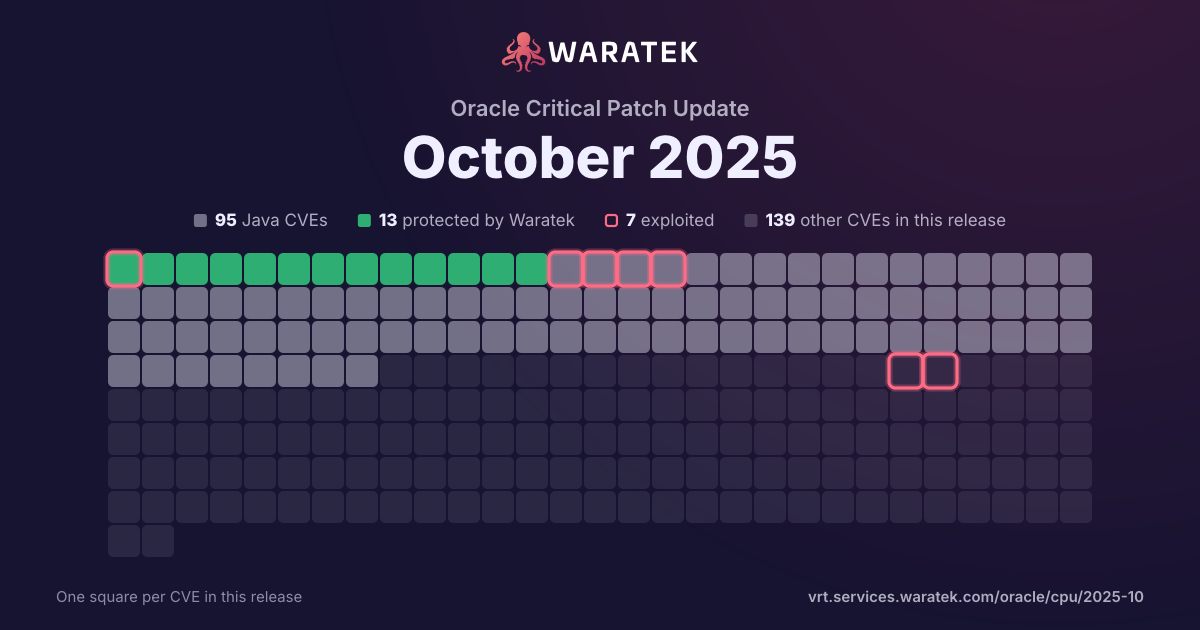
By status
13Protected by Waratek5Mitigation candidate77No exploit published15Outside Waratek scope124Not applicable
7Exploited, marked by the ring
No exploit published. For 36 of them, Oracle's security advisory is the source of public detail.
Protected by Waratek. Waratek RASP can block exploitation of these on systems that have not applied the patch yet.
Overview 15 matches · 0 in Waratek scope · 0 protected · 0 exploited · 0 CISA KEV · 0 public PoC · 1 EPSS ≥ 0.5
15matches
0in Waratek scope0.0%
0protected0.0%
0exploited0.0%
0CISA KEV0.0%
0public PoC0.0%
1EPSS ≥ 0.56.7%
Protected by Waratek
0
0.0%
Rule in development
0
0.0%
Mitigation candidate
0
0.0%
No exploit published
0
0.0%
Outside Waratek scope
15
100.0%
Not applicable
0
0.0%
Withdrawn CVE
0
0.0%
blocked by ARMR today
0
0.0%
partly blocked
0
0.0%
not blocked
15
100.0%
not established
0
0.0%
unrecorded
0
0.0%
Exploited
0
0.0%
Working exploit published
0
0.0%
Proof of concept only
3
20.0%
Forecast only
1
6.7%
No public exploit
11
73.3%
split by
peak 5 / quarter
Q4 201
Outside Waratek scope1
Medium1
not blocked1
No public exploit1
Q1 210
Q2 210
Q3 212
Outside Waratek scope2
Critical1
High1
not blocked2
Forecast only1
No public exploit1
Q4 210
Q1 220
Q2 220
Q3 220
Q4 220
Q1 230
Q2 230
Q3 230
Q4 230
Q1 241
Outside Waratek scope1
Medium1
not blocked1
Proof of concept only1
Q2 240
Q3 240
Q4 242
Outside Waratek scope2
Critical1
High1
not blocked2
No public exploit2
Q1 250
Q2 252
Outside Waratek scope2
Critical1
High1
not blocked2
Proof of concept only1
No public exploit1
Q3 252
Outside Waratek scope2
High2
not blocked2
Proof of concept only1
No public exploit1
Q4 255
Outside Waratek scope5
High1
Medium2
Low2
not blocked5
No public exploit5
Q4 20Q2 21Q4 21Q2 22Q4 22Q2 23Q4 23Q2 24Q4 24Q2 25Q4 25
| CVE | Severity | Published▾ | Status | Exploitation | Description |
|---|---|---|---|---|---|
| CVE-2025-61764 | Medium | 2025-10-21 | Outside Waratek scope | No public exploit | Vulnerability in the Oracle WebLogic Server product of Oracle Fusion Middleware (component: Core). Supported versions that are affected are 12.2.1.4.0, 14.1.1.0.0 and 14.1.2.0.0. Easily exploitable vulnerability allows unauthenticated attacker with network access via HTTP to compromise Oracle WebLogic Server. Successful attacks of this vulnerability can result in unauthorized read access to a subset of Oracle WebLogic Server accessible data. CVSS 3.1 Base Score 5.3 (Confidentiality impacts). CVSS Vector: (CVSS:3.1/AV:N/AC:L/PR:N/UI:N/S:U/C:L/I:N/A:N). |
| CVE-2025-61755 | Low | 2025-10-21 | Outside Waratek scope | No public exploit | Vulnerability in the Oracle GraalVM for JDK product of Oracle Java SE (component: Compiler). Supported versions that are affected are Oracle GraalVM for JDK: 17.0.16 and 21.0.8. Difficult to exploit vulnerability allows unauthenticated attacker with network access via multiple protocols to compromise Oracle GraalVM for JDK. Successful attacks of this vulnerability can result in unauthorized read access to a subset of Oracle GraalVM for JDK accessible data. CVSS 3.1 Base Score 3.7 (Confidentiality impacts). CVSS Vector: (CVSS:3.1/AV:N/AC:H/PR:N/UI:N/S:U/C:L/I:N/A:N). |
| CVE-2025-61752 | High | 2025-10-21 | Outside Waratek scope | No public exploit | Vulnerability in the Oracle WebLogic Server product of Oracle Fusion Middleware (component: Core). Supported versions that are affected are 14.1.1.0.0 and 14.1.2.0.0. Easily exploitable vulnerability allows unauthenticated attacker with network access via HTTP/2 to compromise Oracle WebLogic Server. Successful attacks of this vulnerability can result in unauthorized ability to cause a hang or frequently repeatable crash (complete DOS) of Oracle WebLogic Server. CVSS 3.1 Base Score 7.5 (Availability impacts). CVSS Vector: (CVSS:3.1/AV:N/AC:L/PR:N/UI:N/S:U/C:N/I:N/A:H). |
| CVE-2025-61748 | Low | 2025-10-21 | Outside Waratek scope | No public exploit | Vulnerability in the Oracle Java SE, Oracle GraalVM for JDK, Oracle GraalVM Enterprise Edition product of Oracle Java SE (component: Libraries). Supported versions that are affected are Oracle Java SE: 21.0.8 and 25; Oracle GraalVM for JDK: 21.0.8; Oracle GraalVM Enterprise Edition: 21.3.15. Difficult to exploit vulnerability allows unauthenticated attacker with network access via multiple protocols to compromise Oracle Java SE, Oracle GraalVM for JDK, Oracle GraalVM Enterprise Edition. Successful attacks of this vulnerability can result in unauthorized update, insert or delete access to some of Oracle Java SE, Oracle GraalVM for JDK, Oracle GraalVM Enterprise Edition accessible data. Note: This vulnerability can be exploited by using APIs in the specified Component, e.g., through a web service which supplies data to the APIs. This vulnerability also applies to Java deployments, typically in clients running sandboxed Java Web Start applications or sandboxed Java applets, that load and run untrusted code (e.g., code that comes from the internet) and rely on the Java sandbox for security. CVSS 3.1 Base Score 3.7 (Integrity impacts). CVSS Vector: (CVSS:3.1/AV:N/AC:H/PR:N/UI:N/S:U/C:N/I:L/A:N). |
| CVE-2025-53057 | Medium | 2025-10-21 | Outside Waratek scope | No public exploit | Vulnerability in the Oracle Java SE, Oracle GraalVM for JDK, Oracle GraalVM Enterprise Edition product of Oracle Java SE (component: Security). Supported versions that are affected are Oracle Java SE: 8u461, 8u461-perf, 11.0.28, 17.0.16, 21.0.8, 25; Oracle GraalVM for JDK: 17.0.16 and 21.0.8; Oracle GraalVM Enterprise Edition: 21.3.15. Difficult to exploit vulnerability allows unauthenticated attacker with network access via multiple protocols to compromise Oracle Java SE, Oracle GraalVM for JDK, Oracle GraalVM Enterprise Edition. Successful attacks of this vulnerability can result in unauthorized creation, deletion or modification access to critical data or all Oracle Java SE, Oracle GraalVM for JDK, Oracle GraalVM Enterprise Edition accessible data. Note: This vulnerability can be exploited by using APIs in the specified Component, e.g., through a web service which supplies data to the APIs. This vulnerability also applies to Java deployments, typically in clients running sandboxed Java Web Start applications or sandboxed Java applets, that load and run untrusted code (e.g., code that comes from the internet) and rely on the Java sandbox for security. CVSS 3.1 Base Score 5.9 (Integrity impacts). CVSS Vector: (CVSS:3.1/AV:N/AC:H/PR:N/UI:N/S:U/C:N/I:H/A:N). |
| CVE-2025-55163 | High | 2025-08-13 | Outside Waratek scope | No public exploit | Netty is an asynchronous, event-driven network application framework. Prior to versions 4.1.124.Final and 4.2.4.Final, Netty is vulnerable to MadeYouReset DDoS. This is a logical vulnerability in the HTTP/2 protocol, that uses malformed HTTP/2 control frames in order to break the max concurrent streams limit - which results in resource exhaustion and distributed denial of service. This issue has been patched in versions 4.1.124.Final and 4.2.4.Final. |
| CVE-2025-7425 | High | 2025-07-10 | Outside Waratek scope | Proof of concept only | A flaw was found in libxslt where the attribute type, atype, flags are modified in a way that corrupts internal memory management. When XSLT functions, such as the key() process, result in tree fragments, this corruption prevents the proper cleanup of ID attributes. As a result, the system may access freed memory, causing crashes or enabling attackers to trigger heap corruption. |
| CVE-2025-6021 | High | 2025-06-12 | Outside Waratek scope | Proof of concept only | A flaw was found in libxml2's xmlBuildQName function, where integer overflows in buffer size calculations can lead to a stack-based buffer overflow. This issue can result in memory corruption or a denial of service when processing crafted input. |
| CVE-2025-31651 | Critical | 2025-04-28 | Outside Waratek scope | No public exploit | Improper Neutralization of Escape, Meta, or Control Sequences vulnerability in Apache Tomcat. For a subset of unlikely rewrite rule configurations, it was possible for a specially crafted request to bypass some rewrite rules. If those rewrite rules effectively enforced security constraints, those constraints could be bypassed. This issue affects Apache Tomcat: from 11.0.0-M1 through 11.0.5, from 10.1.0-M1 through 10.1.39, from 9.0.0.M1 through 9.0.102. The following versions were EOL at the time the CVE was created but are known to be affected: 8.5.0 though 8.5.100. Other, older, EOL versions may also be affected. Users are recommended to upgrade to version [FIXED_VERSION], which fixes the issue. |
| CVE-2024-52533 | Critical | 2024-11-11 | Outside Waratek scope | No public exploit | gio/gsocks4aproxy.c in GNOME GLib before 2.82.1 has an off-by-one error and resultant buffer overflow because SOCKS4_CONN_MSG_LEN is not sufficient for a trailing '\0' character. |
| CVE-2024-9143 | High | 2024-10-16 | Outside Waratek scope | No public exploit | Issue summary: Use of the low-level GF(2^m) elliptic curve APIs with untrusted explicit values for the field polynomial can lead to out-of-bounds memory reads or writes. Impact summary: Out of bound memory writes can lead to an application crash or even a possibility of a remote code execution, however, in all the protocols involving Elliptic Curve Cryptography that we're aware of, either only "named curves" are supported, or, if explicit curve parameters are supported, they specify an X9.62 encoding of binary (GF(2^m)) curves that can't represent problematic input values. Thus the likelihood of existence of a vulnerable application is low. In particular, the X9.62 encoding is used for ECC keys in X.509 certificates, so problematic inputs cannot occur in the context of processing X.509 certificates. Any problematic use-cases would have to be using an "exotic" curve encoding. The affected APIs include: EC_GROUP_new_curve_GF2m(), EC_GROUP_new_from_params(), and various supporting BN_GF2m_*() functions. Applications working with "exotic" explicit binary (GF(2^m)) curve parameters, that make it possible to represent invalid field polynomials with a zero constant term, via the above or similar APIs, may terminate abruptly as a result of reading or writing outside of array bounds. Remote code execution cannot easily be ruled out. The FIPS modules in 3.3, 3.2, 3.1 and 3.0 are not affected by this issue. |
| CVE-2024-26462 | Medium | 2024-02-29 | Outside Waratek scope | Proof of concept only | Kerberos 5 (aka krb5) 1.21.2 contains a memory leak vulnerability in /krb5/src/kdc/ndr.c. |
| CVE-2021-3712 | High | 2021-08-24 | Outside Waratek scope | No public exploit | ASN.1 strings are represented internally within OpenSSL as an ASN1_STRING structure which contains a buffer holding the string data and a field holding the buffer length. This contrasts with normal C strings which are repesented as a buffer for the string data which is terminated with a NUL (0) byte. Although not a strict requirement, ASN.1 strings that are parsed using OpenSSL's own "d2i" functions (and other similar parsing functions) as well as any string whose value has been set with the ASN1_STRING_set() function will additionally NUL terminate the byte array in the ASN1_STRING structure. However, it is possible for applications to directly construct valid ASN1_STRING structures which do not NUL terminate the byte array by directly setting the "data" and "length" fields in the ASN1_STRING array. This can also happen by using the ASN1_STRING_set0() function. Numerous OpenSSL functions that print ASN.1 data have been found to assume that the ASN1_STRING byte array will be NUL terminated, even though this is not guaranteed for strings that have been directly constructed. Where an application requests an ASN.1 structure to be printed, and where that ASN.1 structure contains ASN1_STRINGs that have been directly constructed by the application without NUL terminating the "data" field, then a read buffer overrun can occur. The same thing can also occur during name constraints processing of certificates (for example if a certificate has been directly constructed by the application instead of loading it via the OpenSSL parsing functions, and the certificate contains non NUL terminated ASN1_STRING structures). It can also occur in the X509_get1_email(), X509_REQ_get1_email() and X509_get1_ocsp() functions. If a malicious actor can cause an application to directly construct an ASN1_STRING and then process it through one of the affected OpenSSL functions then this issue could be hit. This might result in a crash (causing a Denial of Service attack). It could also result in the disclosure of private memory contents (such as private keys, or sensitive plaintext). Fixed in OpenSSL 1.1.1l (Affected 1.1.1-1.1.1k). Fixed in OpenSSL 1.0.2za (Affected 1.0.2-1.0.2y). |
| CVE-2021-3711 | Critical | 2021-08-24 | Outside Waratek scope | Forecast only | In order to decrypt SM2 encrypted data an application is expected to call the API function EVP_PKEY_decrypt(). Typically an application will call this function twice. The first time, on entry, the "out" parameter can be NULL and, on exit, the "outlen" parameter is populated with the buffer size required to hold the decrypted plaintext. The application can then allocate a sufficiently sized buffer and call EVP_PKEY_decrypt() again, but this time passing a non-NULL value for the "out" parameter. A bug in the implementation of the SM2 decryption code means that the calculation of the buffer size required to hold the plaintext returned by the first call to EVP_PKEY_decrypt() can be smaller than the actual size required by the second call. This can lead to a buffer overflow when EVP_PKEY_decrypt() is called by the application a second time with a buffer that is too small. A malicious attacker who is able present SM2 content for decryption to an application could cause attacker chosen data to overflow the buffer by up to a maximum of 62 bytes altering the contents of other data held after the buffer, possibly changing application behaviour or causing the application to crash. The location of the buffer is application dependent but is typically heap allocated. Fixed in OpenSSL 1.1.1l (Affected 1.1.1-1.1.1k). |
| CVE-2020-13956 | Medium | 2020-12-02 | Outside Waratek scope | No public exploit | Apache HttpClient versions prior to version 4.5.13 and 5.0.3 can misinterpret malformed authority component in request URIs passed to the library as java.net.URI object and pick the wrong target host for request execution. |