
Oracle Critical Patch Update October 2025
Released October 2025 · Oracle's advisory ↗ · ← Critical Patch Update, July 2025 · Critical Patch Update, January 2026 →
234 CVEs in this release, one square each
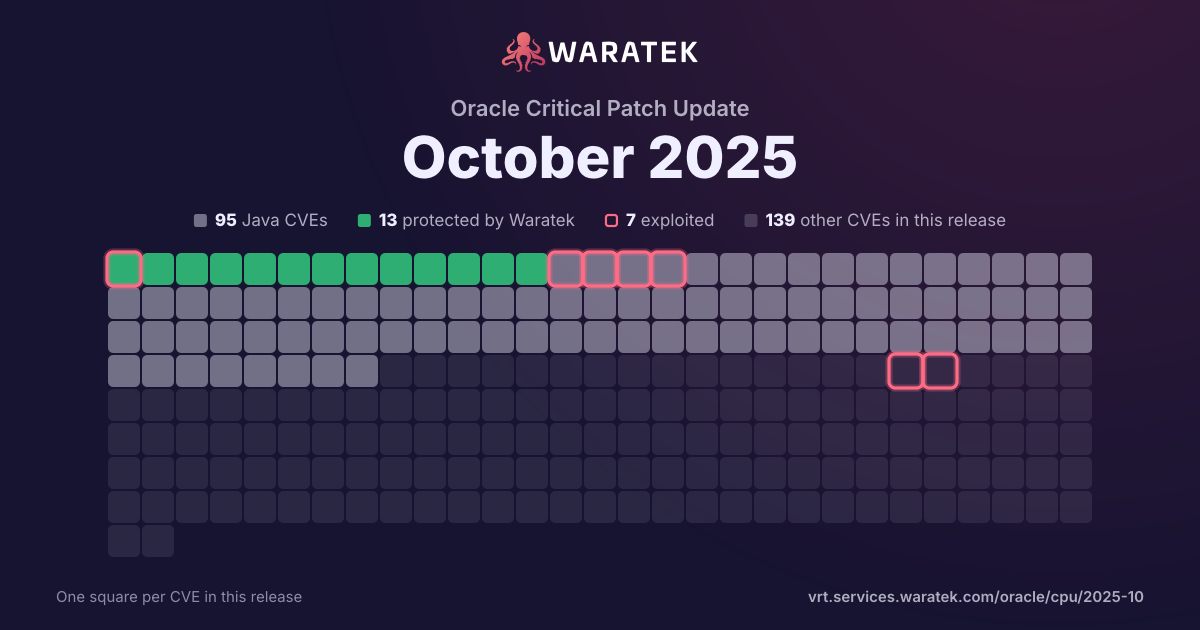
By status
13Protected by Waratek5Mitigation candidate77No exploit published15Outside Waratek scope124Not applicable
7Exploited, marked by the ring
No exploit published. For 36 of them, Oracle's security advisory is the source of public detail.
Protected by Waratek. Waratek RASP can block exploitation of these on systems that have not applied the patch yet.
Overview 234 matches · 95 in Waratek scope · 13 protected · 7 exploited · 3 CISA KEV · 13 public PoC · 8 EPSS ≥ 0.5
234matches
95in Waratek scope40.6%
13protected5.6%
7exploited3.0%
3CISA KEV1.3%
13public PoC5.6%
8EPSS ≥ 0.53.4%
Protected by Waratek
13
5.6%
Rule in development
0
0.0%
Mitigation candidate
5
2.1%
No exploit published
77
32.9%
Outside Waratek scope
15
6.4%
Not applicable
124
53.0%
Withdrawn CVE
0
0.0%
blocked by ARMR today
13
5.6%
partly blocked
0
0.0%
not blocked
219
93.6%
not established
2
0.9%
unrecorded
0
0.0%
split by
peak 76 / quarter
Q4 203
Protected by Waratek2
Outside Waratek scope1
Medium3
blocked by ARMR today2
not blocked1
No public exploit3
Q1 211
No exploit published1
High1
not blocked1
No public exploit1
Q2 212
No exploit published1
Not applicable1
High1
Medium1
not blocked2
Proof of concept only1
Forecast only1
Q3 212
Outside Waratek scope2
Critical1
High1
not blocked2
Forecast only1
No public exploit1
Q4 210
Q1 221
No exploit published1
Medium1
not blocked1
No public exploit1
Q2 222
Protected by Waratek1
No exploit published1
High1
Medium1
blocked by ARMR today1
not blocked1
No public exploit2
Q3 220
Q4 220
Q1 230
Q2 236
No exploit published1
Not applicable5
High1
Medium5
not blocked6
Proof of concept only1
No public exploit5
Q3 230
Q4 233
No exploit published2
Not applicable1
Critical1
High1
Medium1
not blocked3
No public exploit3
Q1 242
Outside Waratek scope1
Not applicable1
Critical1
Medium1
not blocked2
Proof of concept only1
No public exploit1
Q2 245
Not applicable5
Critical1
High2
Medium2
not blocked5
Forecast only1
No public exploit4
Q3 246
No exploit published2
Not applicable4
High2
Medium4
not blocked6
Proof of concept only1
No public exploit5
Q4 2411
Protected by Waratek3
No exploit published4
Outside Waratek scope2
Not applicable2
Critical3
High4
Medium4
blocked by ARMR today3
not blocked8
Working exploit published1
No public exploit10
Q1 2516
Protected by Waratek2
No exploit published4
Not applicable10
Critical1
High9
Medium5
Low1
blocked by ARMR today2
not blocked14
Exploited1
Proof of concept only3
No public exploit12
Q2 2543
Protected by Waratek3
Mitigation candidate2
No exploit published11
Outside Waratek scope2
Not applicable25
Critical4
High22
Medium15
Low2
blocked by ARMR today3
not blocked40
Exploited1
Working exploit published2
Proof of concept only12
No public exploit28
Q3 2555
Mitigation candidate1
No exploit published15
Outside Waratek scope2
Not applicable37
High27
Medium25
Low3
not blocked55
Exploited2
Working exploit published2
Proof of concept only7
No public exploit44
Q4 2576
Protected by Waratek2
Mitigation candidate2
No exploit published34
Outside Waratek scope5
Not applicable33
Critical4
High16
Medium50
Low6
blocked by ARMR today2
not blocked72
not established2
Exploited3
No public exploit73
Q4 20Q2 21Q4 21Q2 22Q4 22Q2 23Q4 23Q2 24Q4 24Q2 25Q4 25
| CVE | Severity | Published▾ | Status | Exploitation | Description |
|---|---|---|---|---|---|
| CVE-2024-47554 | Medium | 2024-10-03 | No exploit published | No public exploit | Uncontrolled Resource Consumption vulnerability in Apache Commons IO. The org.apache.commons.io.input.XmlStreamReader class may excessively consume CPU resources when processing maliciously crafted input. This issue affects Apache Commons IO: from 2.0 before 2.14.0. Users are recommended to upgrade to version 2.14.0 or later, which fixes the issue. |
| CVE-2024-7254 | High | 2024-09-19 | No exploit published | No public exploit | Any project that parses untrusted Protocol Buffers data containing an arbitrary number of nested groups / series of SGROUP tags can corrupted by exceeding the stack limit i.e. StackOverflow. Parsing nested groups as unknown fields with DiscardUnknownFieldsParser or Java Protobuf Lite parser, or against Protobuf map fields, creates unbounded recursions that can be abused by an attacker. |
| CVE-2024-8006 | Medium | 2024-08-31 | Not applicable | No public exploit | Remote packet capture support is disabled by default in libpcap. When a user builds libpcap with remote packet capture support enabled, one of the functions that become available is pcap_findalldevs_ex(). One of the function arguments can be a filesystem path, which normally means a directory with input data files. When the specified path cannot be used as a directory, the function receives NULL from opendir(), but does not check the return value and passes the NULL value to readdir(), which causes a NULL pointer derefence. |
| CVE-2023-7256 | Medium | 2024-08-31 | Not applicable | No public exploit | In affected libpcap versions during the setup of a remote packet capture the internal function sock_initaddress() calls getaddrinfo() and possibly freeaddrinfo(), but does not clearly indicate to the caller function whether freeaddrinfo() still remains to be called after the function returns. This makes it possible in some scenarios that both the function and its caller call freeaddrinfo() for the same allocated memory block. A similar problem was reported in Apple libpcap, to which Apple assigned CVE-2023-40400. |
| CVE-2024-8088 | High | 2024-08-22 | Not applicable | No public exploit | There is a HIGH severity vulnerability affecting the CPython "zipfile" module affecting "zipfile.Path". Note that the more common API "zipfile.ZipFile" class is unaffected. When iterating over names of entries in a zip archive (for example, methods of "zipfile.Path" like "namelist()", "iterdir()", etc) the process can be put into an infinite loop with a maliciously crafted zip archive. This defect applies when reading only metadata or extracting the contents of the zip archive. Programs that are not handling user-controlled zip archives are not affected. |
| CVE-2024-41909 | Medium | 2024-08-12 | No exploit published | No public exploit | Like many other SSH implementations, Apache MINA SSHD suffered from the issue that is more widely known as CVE-2023-48795. An attacker that can intercept traffic between client and server could drop certain packets from the stream, potentially causing client and server to consequently end up with a connection for which some security features have been downgraded or disabled, aka a Terrapin attack The mitigations to prevent this type of attack were implemented in Apache MINA SSHD 2.12.0, both client and server side. Users are recommended to upgrade to at least this version. Note that both the client and the server implementation must have mitigations applied against this issue, otherwise the connection may still be affected. |
| CVE-2024-6923 | Medium | 2024-08-01 | Not applicable | Proof of concept only | There is a MEDIUM severity vulnerability affecting CPython. The email module didn’t properly quote newlines for email headers when serializing an email message allowing for header injection when an email is serialized. |
| CVE-2024-37371 | Critical | 2024-06-28 | Not applicable | No public exploit | In MIT Kerberos 5 (aka krb5) before 1.21.3, an attacker can cause invalid memory reads during GSS message token handling by sending message tokens with invalid length fields. |
| CVE-2024-37370 | High | 2024-06-28 | Not applicable | No public exploit | In MIT Kerberos 5 (aka krb5) before 1.21.3, an attacker can modify the plaintext Extra Count field of a confidential GSS krb5 wrap token, causing the unwrapped token to appear truncated to the application. |
| CVE-2024-35195 | Medium | 2024-05-20 | Not applicable | No public exploit | Requests is a HTTP library. Prior to 2.32.0, when making requests through a Requests `Session`, if the first request is made with `verify=False` to disable cert verification, all subsequent requests to the same host will continue to ignore cert verification regardless of changes to the value of `verify`. This behavior will continue for the lifecycle of the connection in the connection pool. This vulnerability is fixed in 2.32.0. |
| CVE-2024-4140 | High | 2024-05-02 | Not applicable | No public exploit | An excessive memory use issue (CWE-770) exists in Email-MIME, before version 1.954, which can cause denial of service when parsing multipart MIME messages. The patch set (from 2020 and 2024) limits excessive depth and the total number of parts. |
| CVE-2024-28182 | Medium | 2024-04-04 | Not applicable | Forecast only | nghttp2 is an implementation of the Hypertext Transfer Protocol version 2 in C. The nghttp2 library prior to version 1.61.0 keeps reading the unbounded number of HTTP/2 CONTINUATION frames even after a stream is reset to keep HPACK context in sync. This causes excessive CPU usage to decode HPACK stream. nghttp2 v1.61.0 mitigates this vulnerability by limiting the number of CONTINUATION frames it accepts per stream. There is no workaround for this vulnerability. |
| CVE-2024-26462 | Medium | 2024-02-29 | Outside Waratek scope | Proof of concept only | Kerberos 5 (aka krb5) 1.21.2 contains a memory leak vulnerability in /krb5/src/kdc/ndr.c. |
| CVE-2024-23807 | Critical | 2024-02-29 | Not applicable | No public exploit | The Apache Xerces C++ XML parser on versions 3.0.0 before 3.2.5 contains a use-after-free error triggered during the scanning of external DTDs. Users are recommended to upgrade to version 3.2.5 which fixes the issue, or mitigate the issue by disabling DTD processing. This can be accomplished via the DOM using a standard parser feature, or via SAX using the XERCES_DISABLE_DTD environment variable. This issue has been disclosed before as CVE-2018-1311, but unfortunately that advisory incorrectly stated the issue would be fixed in version 3.2.3 or 3.2.4. |
| CVE-2023-34053 | High | 2023-11-28 | No exploit published | No public exploit | In Spring Framework versions 6.0.0 - 6.0.13, it is possible for a user to provide specially crafted HTTP requests that may cause a denial-of-service (DoS) condition. Specifically, an application is vulnerable when all of the following are true: * the application uses Spring MVC or Spring WebFlux * io.micrometer:micrometer-core is on the classpath * an ObservationRegistry is configured in the application to record observations Typically, Spring Boot applications need the org.springframework.boot:spring-boot-actuator dependency to meet all conditions. |
| CVE-2023-44483 | Medium | 2023-10-20 | No exploit published | No public exploit | All versions of Apache Santuario - XML Security for Java prior to 2.2.6, 2.3.4, and 3.0.3, when using the JSR 105 API, are vulnerable to an issue where a private key may be disclosed in log files when generating an XML Signature and logging with debug level is enabled. Users are recommended to upgrade to version 2.2.6, 2.3.4, or 3.0.3, which fixes this issue. |
| CVE-2023-45853 | Critical | 2023-10-14 | Not applicable | No public exploit | MiniZip in zlib through 1.3 has an integer overflow and resultant heap-based buffer overflow in zipOpenNewFileInZip4_64 via a long filename, comment, or extra field. NOTE: MiniZip is not a supported part of the zlib product. NOTE: pyminizip through 0.2.6 is also vulnerable because it bundles an affected zlib version, and exposes the applicable MiniZip code through its compress API. |
| CVE-2023-2976 | High | 2023-06-14 | No exploit published | No public exploit | Use of Java's default temporary directory for file creation in `FileBackedOutputStream` in Google Guava versions 1.0 to 31.1 on Unix systems and Android Ice Cream Sandwich allows other users and apps on the machine with access to the default Java temporary directory to be able to access the files created by the class. Even though the security vulnerability is fixed in version 32.0.0, we recommend using version 32.0.1 as version 32.0.0 breaks some functionality under Windows. |
| CVE-2023-26555 | Medium | 2023-04-11 | Not applicable | No public exploit | praecis_parse in ntpd/refclock_palisade.c in NTP 4.2.8p15 has an out-of-bounds write. Any attack method would be complex, e.g., with a manipulated GPS receiver. |
| CVE-2023-26554 | Medium | 2023-04-11 | Not applicable | Proof of concept only | mstolfp in libntp/mstolfp.c in NTP 4.2.8p15 has an out-of-bounds write when adding a '\0' character. An adversary may be able to attack a client ntpq process, but cannot attack ntpd. |
| CVE-2023-26553 | Medium | 2023-04-11 | Not applicable | No public exploit | mstolfp in libntp/mstolfp.c in NTP 4.2.8p15 has an out-of-bounds write when copying the trailing number. An adversary may be able to attack a client ntpq process, but cannot attack ntpd. |
| CVE-2023-26552 | Medium | 2023-04-11 | Not applicable | No public exploit | mstolfp in libntp/mstolfp.c in NTP 4.2.8p15 has an out-of-bounds write when adding a decimal point. An adversary may be able to attack a client ntpq process, but cannot attack ntpd. |
| CVE-2023-26551 | Medium | 2023-04-11 | Not applicable | No public exploit | mstolfp in libntp/mstolfp.c in NTP 4.2.8p15 has an out-of-bounds write in the cp<cpdec while loop. An adversary may be able to attack a client ntpq process, but cannot attack ntpd. |
| CVE-2022-25647 | High | 2022-05-01 | Protected by Waratek | No public exploit | The package com.google.code.gson:gson before 2.8.9 are vulnerable to Deserialization of Untrusted Data via the writeReplace() method in internal classes, which may lead to DoS attacks. |
| CVE-2022-22968 | Medium | 2022-04-14 | No exploit published | No public exploit | In Spring Framework versions 5.3.0 - 5.3.18, 5.2.0 - 5.2.20, and older unsupported versions, the patterns for disallowedFields on a DataBinder are case sensitive which means a field is not effectively protected unless it is listed with both upper and lower case for the first character of the field, including upper and lower case for the first character of all nested fields within the property path. |
| CVE-2022-24329 | Medium | 2022-02-25 | No exploit published | No public exploit | In JetBrains Kotlin before 1.6.0, it was not possible to lock dependencies for Multiplatform Gradle Projects. |
| CVE-2021-3712 | High | 2021-08-24 | Outside Waratek scope | No public exploit | ASN.1 strings are represented internally within OpenSSL as an ASN1_STRING structure which contains a buffer holding the string data and a field holding the buffer length. This contrasts with normal C strings which are repesented as a buffer for the string data which is terminated with a NUL (0) byte. Although not a strict requirement, ASN.1 strings that are parsed using OpenSSL's own "d2i" functions (and other similar parsing functions) as well as any string whose value has been set with the ASN1_STRING_set() function will additionally NUL terminate the byte array in the ASN1_STRING structure. However, it is possible for applications to directly construct valid ASN1_STRING structures which do not NUL terminate the byte array by directly setting the "data" and "length" fields in the ASN1_STRING array. This can also happen by using the ASN1_STRING_set0() function. Numerous OpenSSL functions that print ASN.1 data have been found to assume that the ASN1_STRING byte array will be NUL terminated, even though this is not guaranteed for strings that have been directly constructed. Where an application requests an ASN.1 structure to be printed, and where that ASN.1 structure contains ASN1_STRINGs that have been directly constructed by the application without NUL terminating the "data" field, then a read buffer overrun can occur. The same thing can also occur during name constraints processing of certificates (for example if a certificate has been directly constructed by the application instead of loading it via the OpenSSL parsing functions, and the certificate contains non NUL terminated ASN1_STRING structures). It can also occur in the X509_get1_email(), X509_REQ_get1_email() and X509_get1_ocsp() functions. If a malicious actor can cause an application to directly construct an ASN1_STRING and then process it through one of the affected OpenSSL functions then this issue could be hit. This might result in a crash (causing a Denial of Service attack). It could also result in the disclosure of private memory contents (such as private keys, or sensitive plaintext). Fixed in OpenSSL 1.1.1l (Affected 1.1.1-1.1.1k). Fixed in OpenSSL 1.0.2za (Affected 1.0.2-1.0.2y). |
| CVE-2021-3711 | Critical | 2021-08-24 | Outside Waratek scope | Forecast only | In order to decrypt SM2 encrypted data an application is expected to call the API function EVP_PKEY_decrypt(). Typically an application will call this function twice. The first time, on entry, the "out" parameter can be NULL and, on exit, the "outlen" parameter is populated with the buffer size required to hold the decrypted plaintext. The application can then allocate a sufficiently sized buffer and call EVP_PKEY_decrypt() again, but this time passing a non-NULL value for the "out" parameter. A bug in the implementation of the SM2 decryption code means that the calculation of the buffer size required to hold the plaintext returned by the first call to EVP_PKEY_decrypt() can be smaller than the actual size required by the second call. This can lead to a buffer overflow when EVP_PKEY_decrypt() is called by the application a second time with a buffer that is too small. A malicious attacker who is able present SM2 content for decryption to an application could cause attacker chosen data to overflow the buffer by up to a maximum of 62 bytes altering the contents of other data held after the buffer, possibly changing application behaviour or causing the application to crash. The location of the buffer is application dependent but is typically heap allocated. Fixed in OpenSSL 1.1.1l (Affected 1.1.1-1.1.1k). |
| CVE-2021-22897 | Medium | 2021-06-11 | Not applicable | Proof of concept only | curl 7.61.0 through 7.76.1 suffers from exposure of data element to wrong session due to a mistake in the code for CURLOPT_SSL_CIPHER_LIST when libcurl is built to use the Schannel TLS library. The selected cipher set was stored in a single "static" variable in the library, which has the surprising side-effect that if an application sets up multiple concurrent transfers, the last one that sets the ciphers will accidentally control the set used by all transfers. In a worst-case scenario, this weakens transport security significantly. |
| CVE-2021-28165 | High | 2021-04-01 | No exploit published | Forecast only | In Eclipse Jetty 7.2.2 to 9.4.38, 10.0.0.alpha0 to 10.0.1, and 11.0.0.alpha0 to 11.0.1, CPU usage can reach 100% upon receiving a large invalid TLS frame. |
| CVE-2020-11988 | High | 2021-02-24 | No exploit published | No public exploit | Apache XmlGraphics Commons 2.4 and earlier is vulnerable to server-side request forgery, caused by improper input validation by the XMPParser. By using a specially-crafted argument, an attacker could exploit this vulnerability to cause the underlying server to make arbitrary GET requests. Users should upgrade to 2.6 or later. |
| CVE-2020-17521 | Medium | 2020-12-07 | Protected by Waratek | No public exploit | Apache Groovy provides extension methods to aid with creating temporary directories. Prior to this fix, Groovy's implementation of those extension methods was using a now superseded Java JDK method call that is potentially not secure on some operating systems in some contexts. Users not using the extension methods mentioned in the advisory are not affected, but may wish to read the advisory for further details. Versions Affected: 2.0 to 2.4.20, 2.5.0 to 2.5.13, 3.0.0 to 3.0.6, and 4.0.0-alpha-1. Fixed in versions 2.4.21, 2.5.14, 3.0.7, 4.0.0-alpha-2. |
| CVE-2020-13956 | Medium | 2020-12-02 | Outside Waratek scope | No public exploit | Apache HttpClient versions prior to version 4.5.13 and 5.0.3 can misinterpret malformed authority component in request URIs passed to the library as java.net.URI object and pick the wrong target host for request execution. |
| CVE-2020-15250 | Medium | 2020-10-12 | Protected by Waratek | No public exploit | In JUnit4 from version 4.7 and before 4.13.1, the test rule TemporaryFolder contains a local information disclosure vulnerability. On Unix like systems, the system's temporary directory is shared between all users on that system. Because of this, when files and directories are written into this directory they are, by default, readable by other users on that same system. This vulnerability does not allow other users to overwrite the contents of these directories or files. This is purely an information disclosure vulnerability. This vulnerability impacts you if the JUnit tests write sensitive information, like API keys or passwords, into the temporary folder, and the JUnit tests execute in an environment where the OS has other untrusted users. Because certain JDK file system APIs were only added in JDK 1.7, this this fix is dependent upon the version of the JDK you are using. For Java 1.7 and higher users: this vulnerability is fixed in 4.13.1. For Java 1.6 and lower users: no patch is available, you must use the workaround below. If you are unable to patch, or are stuck running on Java 1.6, specifying the `java.io.tmpdir` system environment variable to a directory that is exclusively owned by the executing user will fix this vulnerability. For more information, including an example of vulnerable code, see the referenced GitHub Security Advisory. |