
Oracle Critical Patch Update July 2025
Released July 2025 · Oracle's advisory ↗ · ← Critical Patch Update, April 2025 · Critical Patch Update, October 2025 →
196 CVEs in this release, one square each
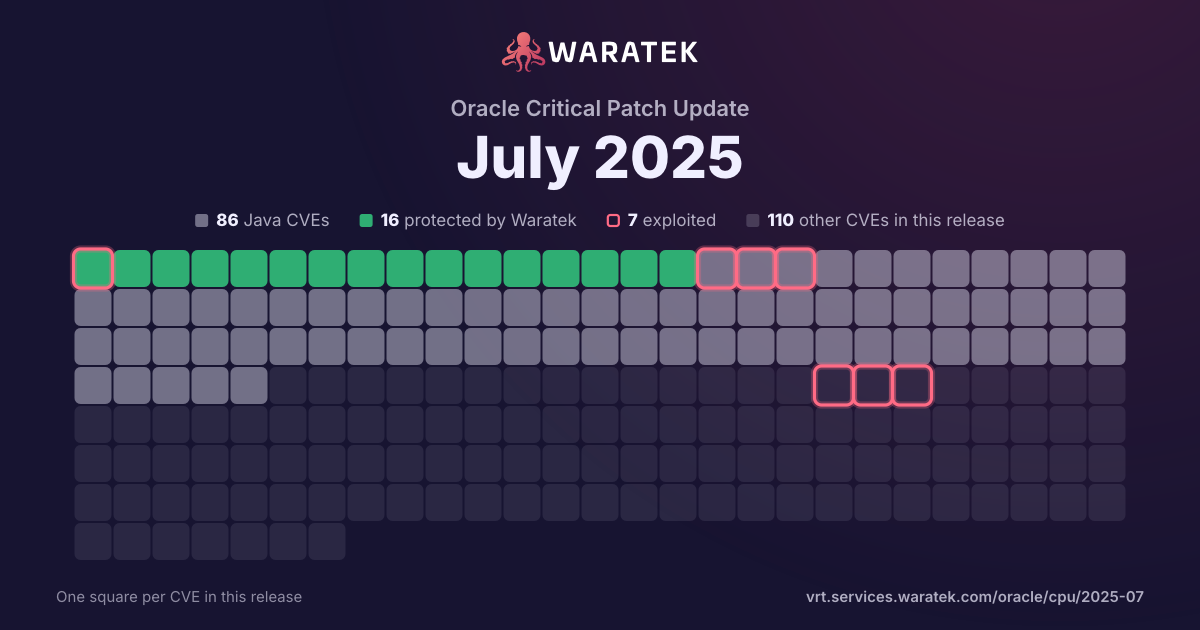
By status
16Protected by Waratek4Mitigation candidate66No exploit published14Outside Waratek scope96Not applicable
7Exploited, marked by the ring
No exploit published. For 31 of them, Oracle's security advisory is the source of public detail.
Protected by Waratek. Waratek RASP can block exploitation of these on systems that have not applied the patch yet.
Overview 11 matches · 8 in Waratek scope · 5 protected · 5 exploited · 2 CISA KEV · 8 EPSS ≥ 0.5
Protected by Waratek
5
45.5%
Rule in development
0
0.0%
Mitigation candidate
3
27.3%
No exploit published
0
0.0%
Outside Waratek scope
0
0.0%
Not applicable
3
27.3%
Withdrawn CVE
0
0.0%
blocked by ARMR today
5
45.5%
partly blocked
0
0.0%
not blocked
6
54.5%
not established
0
0.0%
unrecorded
0
0.0%
Exploited
5
45.5%
Working exploit published
4
36.4%
Proof of concept only
2
18.2%
Forecast only
0
0.0%
No public exploit
0
0.0%
split by
peak 4 / quarter
Q3 221
Protected by Waratek1
High1
blocked by ARMR today1
Proof of concept only1
Q4 220
Q1 230
Q2 230
Q3 230
Q4 230
Q1 240
Q2 240
Q3 241
Not applicable1
High1
not blocked1
Working exploit published1
Q4 241
Protected by Waratek1
High1
blocked by ARMR today1
Working exploit published1
Q1 254
Protected by Waratek1
Mitigation candidate1
Not applicable2
Critical2
High1
Medium1
blocked by ARMR today1
not blocked3
Exploited4
Q2 254
Protected by Waratek2
Mitigation candidate2
Critical1
High2
Medium1
blocked by ARMR today2
not blocked2
Exploited1
Working exploit published2
Proof of concept only1
Q3 22Q4 22Q1 23Q2 23Q3 23Q4 23Q1 24Q2 24Q3 24Q4 24Q1 25Q2 25
| CVE | Severity | Published▾ | Status | Exploitation | Description |
|---|---|---|---|---|---|
| CVE-2025-27817 | High | 2025-06-10 | Mitigation candidate | Exploited | A possible arbitrary file read and SSRF vulnerability has been identified in Apache Kafka Client. Apache Kafka Clients accept configuration data for setting the SASL/OAUTHBEARER connection with the brokers, including "sasl.oauthbearer.token.endpoint.url" and "sasl.oauthbearer.jwks.endpoint.url". Apache Kafka allows clients to read an arbitrary file and return the content in the error log, or sending requests to an unintended location. In applications where Apache Kafka Clients configurations can be specified by an untrusted party, attackers may use the "sasl.oauthbearer.token.endpoint.url" and "sasl.oauthbearer.jwks.endpoint.url" configuratin to read arbitrary contents of the disk and environment variables or make requests to an unintended location. In particular, this flaw may be used in Apache Kafka Connect to escalate from REST API access to filesystem/environment/URL access, which may be undesirable in certain environments, including SaaS products. Since Apache Kafka 3.9.1/4.0.0, we have added a system property ("-Dorg.apache.kafka.sasl.oauthbearer.allowed.urls") to set the allowed urls in SASL JAAS configuration. In 3.9.1, it accepts all urls by default for backward compatibility. However in 4.0.0 and newer, the default value is empty list and users have to set the allowed urls explicitly. |
| CVE-2025-27533 | Medium | 2025-05-07 | Mitigation candidate | Working exploit published | Memory Allocation with Excessive Size Value vulnerability in Apache ActiveMQ. During unmarshalling of OpenWire commands the size value of buffers was not properly validated which could lead to excessive memory allocation and be exploited to cause a denial of service (DoS) by depleting process memory, thereby affecting applications and services that rely on the availability of the ActiveMQ broker when not using mutual TLS connections. This issue affects Apache ActiveMQ: from 6.0.0 before 6.1.6, from 5.18.0 before 5.18.7, from 5.17.0 before 5.17.7, before 5.16.8. ActiveMQ 5.19.0 is not affected. Users are recommended to upgrade to version 6.1.6+, 5.19.0+, 5.18.7+, 5.17.7, or 5.16.8 or which fixes the issue. Existing users may implement mutual TLS to mitigate the risk on affected brokers. |
| CVE-2025-31650 | High | 2025-04-28 | Protected by Waratek | Working exploit published | Improper Input Validation vulnerability in Apache Tomcat. Incorrect error handling for some invalid HTTP priority headers resulted in incomplete clean-up of the failed request which created a memory leak. A large number of such requests could trigger an OutOfMemoryException resulting in a denial of service. This issue affects Apache Tomcat: from 9.0.76 through 9.0.102, from 10.1.10 through 10.1.39, from 11.0.0-M2 through 11.0.5. The following versions were EOL at the time the CVE was created but are known to be affected: 8.5.90 though 8.5.100. Users are recommended to upgrade to version 9.0.104, 10.1.40 or 11.0.6 which fix the issue. |
| CVE-2025-30065 | Critical | 2025-04-01 | Protected by Waratek | Proof of concept only | Schema parsing in the parquet-avro module of Apache Parquet 1.15.0 and previous versions allows bad actors to execute arbitrary code Users are recommended to upgrade to version 1.15.1, which fixes the issue. |
| CVE-2025-1974 | Critical | 2025-03-25 | Not applicable | Exploited | A security issue was discovered in Kubernetes where under certain conditions, an unauthenticated attacker with access to the pod network can achieve arbitrary code execution in the context of the ingress-nginx controller. This can lead to disclosure of Secrets accessible to the controller. (Note that in the default installation, the controller can access all Secrets cluster-wide.) |
| CVE-2025-27363 | High | 2025-03-11 | Not applicable | Exploited | An out of bounds write exists in FreeType versions 2.13.0 and below (newer versions of FreeType are not vulnerable) when attempting to parse font subglyph structures related to TrueType GX and variable font files. The vulnerable code assigns a signed short value to an unsigned long and then adds a static value causing it to wrap around and allocate too small of a heap buffer. The code then writes up to 6 signed long integers out of bounds relative to this buffer. This may result in arbitrary code execution. This vulnerability may have been exploited in the wild. |
| CVE-2025-24813 | Critical | 2025-03-10 | Protected by Waratek | Exploited | Path Equivalence: 'file.Name' (Internal Dot) leading to Remote Code Execution and/or Information disclosure and/or malicious content added to uploaded files via write enabled Default Servlet in Apache Tomcat. This issue affects Apache Tomcat: from 11.0.0-M1 through 11.0.2, from 10.1.0-M1 through 10.1.34, from 9.0.0.M1 through 9.0.98. The following versions were EOL at the time the CVE was created but are known to be affected: 8.5.0 though 8.5.100. Other, older, EOL versions may also be affected. If all of the following were true, a malicious user was able to view security sensitive files and/or inject content into those files: - writes enabled for the default servlet (disabled by default) - support for partial PUT (enabled by default) - a target URL for security sensitive uploads that was a sub-directory of a target URL for public uploads - attacker knowledge of the names of security sensitive files being uploaded - the security sensitive files also being uploaded via partial PUT If all of the following were true, a malicious user was able to perform remote code execution: - writes enabled for the default servlet (disabled by default) - support for partial PUT (enabled by default) - application was using Tomcat's file based session persistence with the default storage location - application included a library that may be leveraged in a deserialization attack Users are recommended to upgrade to version 11.0.3, 10.1.35 or 9.0.99, which fixes the issue. |
| CVE-2025-27636 | Medium | 2025-03-09 | Mitigation candidate | Exploited | Bypass/Injection vulnerability in Apache Camel components under particular conditions. This issue affects Apache Camel: from 4.10.0 through <= 4.10.1, from 4.8.0 through <= 4.8.4, from 3.10.0 through <= 3.22.3. Users are recommended to upgrade to version 4.10.2 for 4.10.x LTS, 4.8.5 for 4.8.x LTS and 3.22.4 for 3.x releases. This vulnerability is present in Camel's default incoming header filter, that allows an attacker to include Camel specific headers that for some Camel components can alter the behaviours such as the camel-bean component, to call another method on the bean, than was coded in the application. In the camel-jms component, then a malicious header can be used to send the message to another queue (on the same broker) than was coded in the application. This could also be seen by using the camel-exec component The attacker would need to inject custom headers, such as HTTP protocols. So if you have Camel applications that are directly connected to the internet via HTTP, then an attacker could include malicious HTTP headers in the HTTP requests that are send to the Camel application. All the known Camel HTTP component such as camel-servlet, camel-jetty, camel-undertow, camel-platform-http, and camel-netty-http would be vulnerable out of the box. In these conditions an attacker could be able to forge a Camel header name and make the bean component invoking other methods in the same bean. In terms of usage of the default header filter strategy the list of components using that is: * camel-activemq * camel-activemq6 * camel-amqp * camel-aws2-sqs * camel-azure-servicebus * camel-cxf-rest * camel-cxf-soap * camel-http * camel-jetty * camel-jms * camel-kafka * camel-knative * camel-mail * camel-nats * camel-netty-http * camel-platform-http * camel-rest * camel-sjms * camel-spring-rabbitmq * camel-stomp * camel-tahu * camel-undertow * camel-xmpp The vulnerability arises due to a bug in the default filtering mechanism that only blocks headers starting with "Camel", "camel", or "org.apache.camel.". Mitigation: You can easily work around this in your Camel applications by removing the headers in your Camel routes. There are many ways of doing this, also globally or per route. This means you could use the removeHeaders EIP, to filter out anything like "cAmel, cAMEL" etc, or in general everything not starting with "Camel", "camel" or "org.apache.camel.". |
| CVE-2024-38819 | High | 2024-12-19 | Protected by Waratek | Working exploit published | Applications serving static resources through the functional web frameworks WebMvc.fn or WebFlux.fn are vulnerable to path traversal attacks. An attacker can craft malicious HTTP requests and obtain any file on the file system that is also accessible to the process in which the Spring application is running. |
| CVE-2024-38472 | High | 2024-07-01 | Not applicable | Working exploit published | SSRF in Apache HTTP Server on Windows allows to potentially leak NTLM hashes to a malicious server via SSRF and malicious requests or content Users are recommended to upgrade to version 2.4.60 which fixes this issue. Note: Existing configurations that access UNC paths will have to configure new directive "UNCList" to allow access during request processing. |
| CVE-2022-34169 | High | 2022-07-19 | Protected by Waratek | Proof of concept only | The Apache Xalan Java XSLT library is vulnerable to an integer truncation issue when processing malicious XSLT stylesheets. This can be used to corrupt Java class files generated by the internal XSLTC compiler and execute arbitrary Java bytecode. Users are recommended to update to version 2.7.3 or later. Note: Java runtimes (such as OpenJDK) include repackaged copies of Xalan. |