
Oracle Critical Patch Update July 2025
Released July 2025 · Oracle's advisory ↗ · ← Critical Patch Update, April 2025 · Critical Patch Update, October 2025 →
196 CVEs in this release, one square each
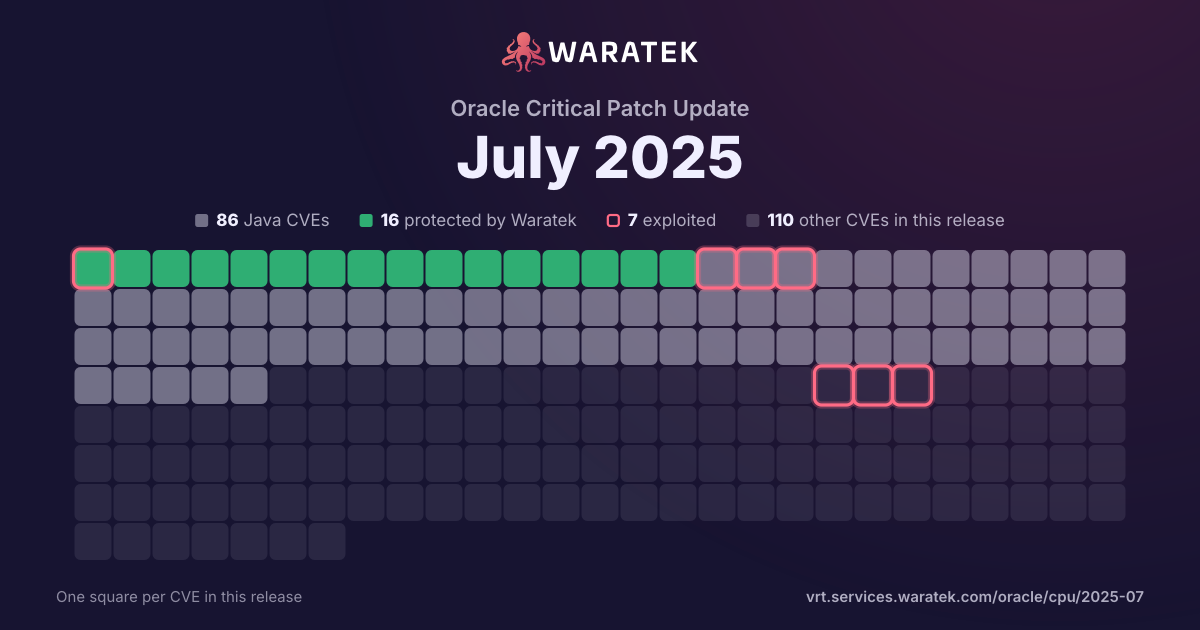
By status
16Protected by Waratek4Mitigation candidate66No exploit published14Outside Waratek scope96Not applicable
7Exploited, marked by the ring
No exploit published. For 31 of them, Oracle's security advisory is the source of public detail.
Protected by Waratek. Waratek RASP can block exploitation of these on systems that have not applied the patch yet.
Overview 102 matches · 43 in Waratek scope · 3 protected · 2 exploited · 0 CISA KEV · 2 public PoC · 3 EPSS ≥ 0.5
102matches
43in Waratek scope42.2%
3protected2.9%
2exploited2.0%
0CISA KEV0.0%
2public PoC2.0%
3EPSS ≥ 0.52.9%
Protected by Waratek
3
2.9%
Rule in development
0
0.0%
Mitigation candidate
3
2.9%
No exploit published
37
36.3%
Outside Waratek scope
5
4.9%
Not applicable
54
52.9%
Withdrawn CVE
0
0.0%
blocked by ARMR today
3
2.9%
partly blocked
0
0.0%
not blocked
99
97.1%
not established
0
0.0%
unrecorded
0
0.0%
split by
peak 52 / quarter
Q4 232
No exploit published2
Medium2
not blocked2
No public exploit2
Q1 242
No exploit published1
Not applicable1
Medium2
not blocked2
No public exploit2
Q2 248
No exploit published1
Outside Waratek scope2
Not applicable5
Medium8
not blocked8
Forecast only1
No public exploit7
Q3 246
Not applicable6
Medium6
not blocked6
No public exploit6
Q4 2413
No exploit published8
Outside Waratek scope1
Not applicable4
Medium13
not blocked13
Proof of concept only1
No public exploit12
Q1 2513
Protected by Waratek1
Mitigation candidate2
No exploit published3
Outside Waratek scope1
Not applicable6
Medium13
blocked by ARMR today1
not blocked12
Exploited2
Proof of concept only3
No public exploit8
Q2 256
Mitigation candidate1
No exploit published3
Not applicable2
Medium6
not blocked6
Working exploit published1
Proof of concept only2
No public exploit3
Q3 2552
Protected by Waratek2
No exploit published19
Outside Waratek scope1
Not applicable30
Medium52
blocked by ARMR today2
not blocked50
No public exploit52
Q4 23Q1 24Q2 24Q3 24Q4 24Q1 25Q2 25Q3 25
| CVE | Severity | Published▾ | Status | Exploitation | Description |
|---|---|---|---|---|---|
| CVE-2025-53032 | Medium | 2025-07-15 | Not applicable | No public exploit | Vulnerability in the MySQL Server product of Oracle MySQL (component: Server: Optimizer). Supported versions that are affected are 9.0.0-9.1.0. Easily exploitable vulnerability allows high privileged attacker with network access via multiple protocols to compromise MySQL Server. Successful attacks of this vulnerability can result in unauthorized ability to cause a hang or frequently repeatable crash (complete DOS) of MySQL Server. CVSS 3.1 Base Score 4.9 (Availability impacts). CVSS Vector: (CVSS:3.1/AV:N/AC:L/PR:H/UI:N/S:U/C:N/I:N/A:H). |
| CVE-2025-53031 | Medium | 2025-07-15 | No exploit published | No public exploit | Vulnerability in the Oracle Financial Services Analytical Applications Infrastructure product of Oracle Financial Services Applications (component: Platform). Supported versions that are affected are 8.0.7.8, 8.0.8.5, 8.0.8.6, 8.1.1.4 and 8.1.2.5. Easily exploitable vulnerability allows unauthenticated attacker with network access via HTTP to compromise Oracle Financial Services Analytical Applications Infrastructure. Successful attacks of this vulnerability can result in unauthorized read access to a subset of Oracle Financial Services Analytical Applications Infrastructure accessible data. CVSS 3.1 Base Score 5.3 (Confidentiality impacts). CVSS Vector: (CVSS:3.1/AV:N/AC:L/PR:N/UI:N/S:U/C:L/I:N/A:N). |
| CVE-2025-53030 | Medium | 2025-07-15 | Not applicable | No public exploit | Vulnerability in the Oracle VM VirtualBox product of Oracle Virtualization (component: Core). The supported version that is affected is 7.1.10. Easily exploitable vulnerability allows high privileged attacker with logon to the infrastructure where Oracle VM VirtualBox executes to compromise Oracle VM VirtualBox. While the vulnerability is in Oracle VM VirtualBox, attacks may significantly impact additional products (scope change). Successful attacks of this vulnerability can result in unauthorized access to critical data or complete access to all Oracle VM VirtualBox accessible data. CVSS 3.1 Base Score 6.0 (Confidentiality impacts). CVSS Vector: (CVSS:3.1/AV:L/AC:L/PR:H/UI:N/S:C/C:H/I:N/A:N). |
| CVE-2025-53026 | Medium | 2025-07-15 | Not applicable | No public exploit | Vulnerability in the Oracle VM VirtualBox product of Oracle Virtualization (component: Core). The supported version that is affected is 7.1.10. Easily exploitable vulnerability allows high privileged attacker with logon to the infrastructure where Oracle VM VirtualBox executes to compromise Oracle VM VirtualBox. While the vulnerability is in Oracle VM VirtualBox, attacks may significantly impact additional products (scope change). Successful attacks of this vulnerability can result in unauthorized access to critical data or complete access to all Oracle VM VirtualBox accessible data. CVSS 3.1 Base Score 6.0 (Confidentiality impacts). CVSS Vector: (CVSS:3.1/AV:L/AC:L/PR:H/UI:N/S:C/C:H/I:N/A:N). |
| CVE-2025-53025 | Medium | 2025-07-15 | Not applicable | No public exploit | Vulnerability in the Oracle VM VirtualBox product of Oracle Virtualization (component: Core). The supported version that is affected is 7.1.10. Easily exploitable vulnerability allows high privileged attacker with logon to the infrastructure where Oracle VM VirtualBox executes to compromise Oracle VM VirtualBox. While the vulnerability is in Oracle VM VirtualBox, attacks may significantly impact additional products (scope change). Successful attacks of this vulnerability can result in unauthorized access to critical data or complete access to all Oracle VM VirtualBox accessible data. CVSS 3.1 Base Score 6.0 (Confidentiality impacts). CVSS Vector: (CVSS:3.1/AV:L/AC:L/PR:H/UI:N/S:C/C:H/I:N/A:N). |
| CVE-2025-53023 | Medium | 2025-07-15 | Not applicable | No public exploit | Vulnerability in the MySQL Server product of Oracle MySQL (component: Server: Replication). Supported versions that are affected are 8.0.0-8.0.42. Easily exploitable vulnerability allows high privileged attacker with network access via multiple protocols to compromise MySQL Server. Successful attacks of this vulnerability can result in unauthorized ability to cause a hang or frequently repeatable crash (complete DOS) of MySQL Server. CVSS 3.1 Base Score 4.9 (Availability impacts). CVSS Vector: (CVSS:3.1/AV:N/AC:L/PR:H/UI:N/S:U/C:N/I:N/A:H). |
| CVE-2025-50108 | Medium | 2025-07-15 | No exploit published | No public exploit | Vulnerability in the Oracle Hyperion Financial Reporting product of Oracle Hyperion (component: Workspace). The supported version that is affected is 11.2.20.0.000. Easily exploitable vulnerability allows low privileged attacker with network access via HTTP to compromise Oracle Hyperion Financial Reporting. Successful attacks require human interaction from a person other than the attacker and while the vulnerability is in Oracle Hyperion Financial Reporting, attacks may significantly impact additional products (scope change). Successful attacks of this vulnerability can result in unauthorized update, insert or delete access to some of Oracle Hyperion Financial Reporting accessible data as well as unauthorized read access to a subset of Oracle Hyperion Financial Reporting accessible data. CVSS 3.1 Base Score 5.4 (Confidentiality and Integrity impacts). CVSS Vector: (CVSS:3.1/AV:N/AC:L/PR:L/UI:R/S:C/C:L/I:L/A:N). |
| CVE-2025-50107 | Medium | 2025-07-15 | No exploit published | No public exploit | Vulnerability in the Oracle Universal Work Queue product of Oracle E-Business Suite (component: Request handling). Supported versions that are affected are 12.2.5-12.2.14. Easily exploitable vulnerability allows unauthenticated attacker with network access via HTTP to compromise Oracle Universal Work Queue. Successful attacks require human interaction from a person other than the attacker and while the vulnerability is in Oracle Universal Work Queue, attacks may significantly impact additional products (scope change). Successful attacks of this vulnerability can result in unauthorized update, insert or delete access to some of Oracle Universal Work Queue accessible data as well as unauthorized read access to a subset of Oracle Universal Work Queue accessible data. CVSS 3.1 Base Score 6.1 (Confidentiality and Integrity impacts). CVSS Vector: (CVSS:3.1/AV:N/AC:L/PR:N/UI:R/S:C/C:L/I:L/A:N). |
| CVE-2025-50103 | Medium | 2025-07-15 | Not applicable | No public exploit | Vulnerability in the MySQL Server product of Oracle MySQL (component: Server: Security: LDAP Auth). Supported versions that are affected are 9.0.0-9.3.0. Difficult to exploit vulnerability allows high privileged attacker with network access via multiple protocols to compromise MySQL Server. Successful attacks of this vulnerability can result in unauthorized ability to cause a hang or frequently repeatable crash (complete DOS) of MySQL Server. CVSS 3.1 Base Score 4.4 (Availability impacts). CVSS Vector: (CVSS:3.1/AV:N/AC:H/PR:H/UI:N/S:U/C:N/I:N/A:H). |
| CVE-2025-50102 | Medium | 2025-07-15 | Not applicable | No public exploit | Vulnerability in the MySQL Server product of Oracle MySQL (component: Server: Optimizer). Supported versions that are affected are 8.0.0-8.0.42, 8.4.0-8.4.5 and 9.0.0-9.3.0. Easily exploitable vulnerability allows high privileged attacker with network access via multiple protocols to compromise MySQL Server. Successful attacks of this vulnerability can result in unauthorized ability to cause a hang or frequently repeatable crash (complete DOS) of MySQL Server. CVSS 3.1 Base Score 4.9 (Availability impacts). CVSS Vector: (CVSS:3.1/AV:N/AC:L/PR:H/UI:N/S:U/C:N/I:N/A:H). |
| CVE-2025-50101 | Medium | 2025-07-15 | Not applicable | No public exploit | Vulnerability in the MySQL Server product of Oracle MySQL (component: Server: Optimizer). Supported versions that are affected are 8.0.0-8.0.42, 8.4.0-8.4.5 and 9.0.0-9.3.0. Easily exploitable vulnerability allows high privileged attacker with network access via multiple protocols to compromise MySQL Server. Successful attacks of this vulnerability can result in unauthorized ability to cause a hang or frequently repeatable crash (complete DOS) of MySQL Server. CVSS 3.1 Base Score 4.9 (Availability impacts). CVSS Vector: (CVSS:3.1/AV:N/AC:L/PR:H/UI:N/S:U/C:N/I:N/A:H). |
| CVE-2025-50099 | Medium | 2025-07-15 | Not applicable | No public exploit | Vulnerability in the MySQL Server product of Oracle MySQL (component: InnoDB). Supported versions that are affected are 8.0.0-8.0.42, 8.4.0-8.4.5 and 9.0.0-9.3.0. Easily exploitable vulnerability allows high privileged attacker with network access via multiple protocols to compromise MySQL Server. Successful attacks of this vulnerability can result in unauthorized ability to cause a hang or frequently repeatable crash (complete DOS) of MySQL Server. CVSS 3.1 Base Score 4.9 (Availability impacts). CVSS Vector: (CVSS:3.1/AV:N/AC:L/PR:H/UI:N/S:U/C:N/I:N/A:H). |
| CVE-2025-50097 | Medium | 2025-07-15 | Not applicable | No public exploit | Vulnerability in the MySQL Server product of Oracle MySQL (component: Server: Security: Encryption). Supported versions that are affected are 8.0.0-8.0.42, 8.4.0-8.4.5 and 9.0.0-9.3.0. Easily exploitable vulnerability allows high privileged attacker with network access via multiple protocols to compromise MySQL Server. Successful attacks of this vulnerability can result in unauthorized ability to cause a hang or frequently repeatable crash (complete DOS) of MySQL Server. CVSS 3.1 Base Score 4.9 (Availability impacts). CVSS Vector: (CVSS:3.1/AV:N/AC:L/PR:H/UI:N/S:U/C:N/I:N/A:H). |
| CVE-2025-50096 | Medium | 2025-07-15 | Not applicable | No public exploit | Vulnerability in the MySQL Server product of Oracle MySQL (component: InnoDB). Supported versions that are affected are 8.0.0-8.0.42, 8.4.0-8.4.5 and 9.0.0-9.3.0. Easily exploitable vulnerability allows high privileged attacker with logon to the infrastructure where MySQL Server executes to compromise MySQL Server. Successful attacks of this vulnerability can result in unauthorized ability to cause a hang or frequently repeatable crash (complete DOS) of MySQL Server. CVSS 3.1 Base Score 4.4 (Availability impacts). CVSS Vector: (CVSS:3.1/AV:L/AC:L/PR:H/UI:N/S:U/C:N/I:N/A:H). |
| CVE-2025-50095 | Medium | 2025-07-15 | Not applicable | No public exploit | Vulnerability in the MySQL Server product of Oracle MySQL (component: Server: Optimizer). Supported versions that are affected are 9.0.0-9.3.0. Easily exploitable vulnerability allows high privileged attacker with network access via multiple protocols to compromise MySQL Server. Successful attacks of this vulnerability can result in unauthorized ability to cause a hang or frequently repeatable crash (complete DOS) of MySQL Server. CVSS 3.1 Base Score 4.9 (Availability impacts). CVSS Vector: (CVSS:3.1/AV:N/AC:L/PR:H/UI:N/S:U/C:N/I:N/A:H). |
| CVE-2025-50094 | Medium | 2025-07-15 | Not applicable | No public exploit | Vulnerability in the MySQL Server product of Oracle MySQL (component: Server: DDL). Supported versions that are affected are 8.0.42, 8.4.5 and 9.3.0. Easily exploitable vulnerability allows high privileged attacker with network access via multiple protocols to compromise MySQL Server. Successful attacks of this vulnerability can result in unauthorized ability to cause a hang or frequently repeatable crash (complete DOS) of MySQL Server. CVSS 3.1 Base Score 4.9 (Availability impacts). CVSS Vector: (CVSS:3.1/AV:N/AC:L/PR:H/UI:N/S:U/C:N/I:N/A:H). |
| CVE-2025-50093 | Medium | 2025-07-15 | Not applicable | No public exploit | Vulnerability in the MySQL Server product of Oracle MySQL (component: Server: DDL). Supported versions that are affected are 8.0.0-8.0.42, 8.4.0-8.4.5 and 9.0.0-9.3.0. Easily exploitable vulnerability allows high privileged attacker with network access via multiple protocols to compromise MySQL Server. Successful attacks of this vulnerability can result in unauthorized ability to cause a hang or frequently repeatable crash (complete DOS) of MySQL Server. CVSS 3.1 Base Score 4.9 (Availability impacts). CVSS Vector: (CVSS:3.1/AV:N/AC:L/PR:H/UI:N/S:U/C:N/I:N/A:H). |
| CVE-2025-50092 | Medium | 2025-07-15 | Not applicable | No public exploit | Vulnerability in the MySQL Server product of Oracle MySQL (component: InnoDB). Supported versions that are affected are 8.0.0-8.0.42, 8.4.0-8.4.5 and 9.0.0-9.3.0. Easily exploitable vulnerability allows high privileged attacker with network access via multiple protocols to compromise MySQL Server. Successful attacks of this vulnerability can result in unauthorized ability to cause a hang or frequently repeatable crash (complete DOS) of MySQL Server. CVSS 3.1 Base Score 4.9 (Availability impacts). CVSS Vector: (CVSS:3.1/AV:N/AC:L/PR:H/UI:N/S:U/C:N/I:N/A:H). |
| CVE-2025-50091 | Medium | 2025-07-15 | Not applicable | No public exploit | Vulnerability in the MySQL Server product of Oracle MySQL (component: Server: Optimizer). Supported versions that are affected are 8.0.0-8.0.42, 8.4.0-8.4.5 and 9.0.0-9.3.0. Easily exploitable vulnerability allows high privileged attacker with network access via multiple protocols to compromise MySQL Server. Successful attacks of this vulnerability can result in unauthorized ability to cause a hang or frequently repeatable crash (complete DOS) of MySQL Server. CVSS 3.1 Base Score 4.9 (Availability impacts). CVSS Vector: (CVSS:3.1/AV:N/AC:L/PR:H/UI:N/S:U/C:N/I:N/A:H). |
| CVE-2025-50090 | Medium | 2025-07-15 | No exploit published | No public exploit | Vulnerability in the Oracle Applications Framework product of Oracle E-Business Suite (component: Personalization). Supported versions that are affected are 12.2.3-12.2.14. Easily exploitable vulnerability allows low privileged attacker with network access via HTTP to compromise Oracle Applications Framework. Successful attacks require human interaction from a person other than the attacker and while the vulnerability is in Oracle Applications Framework, attacks may significantly impact additional products (scope change). Successful attacks of this vulnerability can result in unauthorized update, insert or delete access to some of Oracle Applications Framework accessible data as well as unauthorized read access to a subset of Oracle Applications Framework accessible data. CVSS 3.1 Base Score 5.4 (Confidentiality and Integrity impacts). CVSS Vector: (CVSS:3.1/AV:N/AC:L/PR:L/UI:R/S:C/C:L/I:L/A:N). |
| CVE-2025-50089 | Medium | 2025-07-15 | Not applicable | No public exploit | Vulnerability in the MySQL Server product of Oracle MySQL (component: Server: Optimizer). Supported versions that are affected are 9.0.0-9.1.0. Easily exploitable vulnerability allows high privileged attacker with network access via multiple protocols to compromise MySQL Server. Successful attacks of this vulnerability can result in unauthorized ability to cause a hang or frequently repeatable crash (complete DOS) of MySQL Server. CVSS 3.1 Base Score 4.9 (Availability impacts). CVSS Vector: (CVSS:3.1/AV:N/AC:L/PR:H/UI:N/S:U/C:N/I:N/A:H). |
| CVE-2025-50088 | Medium | 2025-07-15 | Not applicable | No public exploit | Vulnerability in the MySQL Server product of Oracle MySQL (component: InnoDB). Supported versions that are affected are 8.0.0-8.0.41, 8.4.0-8.4.4 and 9.0.0-9.2.0. Easily exploitable vulnerability allows high privileged attacker with network access via multiple protocols to compromise MySQL Server. Successful attacks of this vulnerability can result in unauthorized ability to cause a hang or frequently repeatable crash (complete DOS) of MySQL Server. CVSS 3.1 Base Score 4.9 (Availability impacts). CVSS Vector: (CVSS:3.1/AV:N/AC:L/PR:H/UI:N/S:U/C:N/I:N/A:H). |
| CVE-2025-50087 | Medium | 2025-07-15 | Not applicable | No public exploit | Vulnerability in the MySQL Server product of Oracle MySQL (component: Server: Optimizer). Supported versions that are affected are 8.0.0-8.0.42, 8.4.0-8.4.5 and 9.0.0-9.3.0. Easily exploitable vulnerability allows high privileged attacker with network access via multiple protocols to compromise MySQL Server. Successful attacks of this vulnerability can result in unauthorized creation, deletion or modification access to critical data or all MySQL Server accessible data. CVSS 3.1 Base Score 4.9 (Integrity impacts). CVSS Vector: (CVSS:3.1/AV:N/AC:L/PR:H/UI:N/S:U/C:N/I:H/A:N). |
| CVE-2025-50086 | Medium | 2025-07-15 | Not applicable | No public exploit | Vulnerability in the MySQL Server product of Oracle MySQL (component: Server: Components Services). Supported versions that are affected are 8.0.0-8.0.42, 8.4.0-8.4.5 and 9.0.0-9.3.0. Easily exploitable vulnerability allows high privileged attacker with network access via multiple protocols to compromise MySQL Server. Successful attacks of this vulnerability can result in unauthorized ability to cause a hang or frequently repeatable crash (complete DOS) of MySQL Server. CVSS 3.1 Base Score 4.9 (Availability impacts). CVSS Vector: (CVSS:3.1/AV:N/AC:L/PR:H/UI:N/S:U/C:N/I:N/A:H). |
| CVE-2025-50085 | Medium | 2025-07-15 | Not applicable | No public exploit | Vulnerability in the MySQL Server product of Oracle MySQL (component: InnoDB). Supported versions that are affected are 8.0.0-8.0.42, 8.4.0-8.4.5 and 9.0.0-9.3.0. Easily exploitable vulnerability allows high privileged attacker with network access via multiple protocols to compromise MySQL Server. Successful attacks of this vulnerability can result in unauthorized ability to cause a hang or frequently repeatable crash (complete DOS) of MySQL Server as well as unauthorized update, insert or delete access to some of MySQL Server accessible data. CVSS 3.1 Base Score 5.5 (Integrity and Availability impacts). CVSS Vector: (CVSS:3.1/AV:N/AC:L/PR:H/UI:N/S:U/C:N/I:L/A:H). |
| CVE-2025-50084 | Medium | 2025-07-15 | Not applicable | No public exploit | Vulnerability in the MySQL Server product of Oracle MySQL (component: Server: Optimizer). Supported versions that are affected are 8.0.0-8.0.42, 8.4.0-8.4.5 and 9.0.0-9.3.0. Easily exploitable vulnerability allows high privileged attacker with network access via multiple protocols to compromise MySQL Server. Successful attacks of this vulnerability can result in unauthorized ability to cause a hang or frequently repeatable crash (complete DOS) of MySQL Server. CVSS 3.1 Base Score 4.9 (Availability impacts). CVSS Vector: (CVSS:3.1/AV:N/AC:L/PR:H/UI:N/S:U/C:N/I:N/A:H). |
| CVE-2025-50083 | Medium | 2025-07-15 | Not applicable | No public exploit | Vulnerability in the MySQL Server product of Oracle MySQL (component: Server: Optimizer). Supported versions that are affected are 8.0.0-8.0.42, 8.4.0-8.4.5 and 9.0.0-9.3.0. Easily exploitable vulnerability allows low privileged attacker with network access via multiple protocols to compromise MySQL Server. Successful attacks of this vulnerability can result in unauthorized ability to cause a hang or frequently repeatable crash (complete DOS) of MySQL Server. CVSS 3.1 Base Score 6.5 (Availability impacts). CVSS Vector: (CVSS:3.1/AV:N/AC:L/PR:L/UI:N/S:U/C:N/I:N/A:H). |
| CVE-2025-50082 | Medium | 2025-07-15 | Not applicable | No public exploit | Vulnerability in the MySQL Server product of Oracle MySQL (component: Server: Optimizer). Supported versions that are affected are 8.0.0-8.0.42, 8.4.0-8.4.5 and 9.0.0-9.3.0. Easily exploitable vulnerability allows low privileged attacker with network access via multiple protocols to compromise MySQL Server. Successful attacks of this vulnerability can result in unauthorized ability to cause a hang or frequently repeatable crash (complete DOS) of MySQL Server. CVSS 3.1 Base Score 6.5 (Availability impacts). CVSS Vector: (CVSS:3.1/AV:N/AC:L/PR:L/UI:N/S:U/C:N/I:N/A:H). |
| CVE-2025-50080 | Medium | 2025-07-15 | Not applicable | No public exploit | Vulnerability in the MySQL Server product of Oracle MySQL (component: Server: Stored Procedure). Supported versions that are affected are 8.0.0-8.0.42, 8.4.0-8.4.5 and 9.0.0-9.3.0. Easily exploitable vulnerability allows high privileged attacker with network access via multiple protocols to compromise MySQL Server. Successful attacks of this vulnerability can result in unauthorized ability to cause a hang or frequently repeatable crash (complete DOS) of MySQL Server. CVSS 3.1 Base Score 4.9 (Availability impacts). CVSS Vector: (CVSS:3.1/AV:N/AC:L/PR:H/UI:N/S:U/C:N/I:N/A:H). |
| CVE-2025-50079 | Medium | 2025-07-15 | Not applicable | No public exploit | Vulnerability in the MySQL Server product of Oracle MySQL (component: Server: Optimizer). Supported versions that are affected are 8.0.0-8.0.42, 8.4.0-8.4.5 and 9.0.0-9.3.0. Easily exploitable vulnerability allows high privileged attacker with network access via multiple protocols to compromise MySQL Server. Successful attacks of this vulnerability can result in unauthorized ability to cause a hang or frequently repeatable crash (complete DOS) of MySQL Server. CVSS 3.1 Base Score 4.9 (Availability impacts). CVSS Vector: (CVSS:3.1/AV:N/AC:L/PR:H/UI:N/S:U/C:N/I:N/A:H). |
| CVE-2025-50078 | Medium | 2025-07-15 | Not applicable | No public exploit | Vulnerability in the MySQL Server product of Oracle MySQL (component: Server: DML). Supported versions that are affected are 8.0.0-8.0.42, 8.4.0-8.4.5 and 9.0.0-9.3.0. Easily exploitable vulnerability allows low privileged attacker with network access via multiple protocols to compromise MySQL Server. Successful attacks of this vulnerability can result in unauthorized ability to cause a hang or frequently repeatable crash (complete DOS) of MySQL Server. CVSS 3.1 Base Score 6.5 (Availability impacts). CVSS Vector: (CVSS:3.1/AV:N/AC:L/PR:L/UI:N/S:U/C:N/I:N/A:H). |
| CVE-2025-50077 | Medium | 2025-07-15 | Not applicable | No public exploit | Vulnerability in the MySQL Server product of Oracle MySQL (component: InnoDB). Supported versions that are affected are 8.0.0-8.0.42, 8.4.0-8.4.5 and 9.0.0-9.3.0. Easily exploitable vulnerability allows high privileged attacker with network access via multiple protocols to compromise MySQL Server. Successful attacks of this vulnerability can result in unauthorized ability to cause a hang or frequently repeatable crash (complete DOS) of MySQL Server. CVSS 3.1 Base Score 4.9 (Availability impacts). CVSS Vector: (CVSS:3.1/AV:N/AC:L/PR:H/UI:N/S:U/C:N/I:N/A:H). |
| CVE-2025-50076 | Medium | 2025-07-15 | Not applicable | No public exploit | Vulnerability in the MySQL Server product of Oracle MySQL (component: Server: DML). Supported versions that are affected are 8.0.0-8.0.25. Easily exploitable vulnerability allows low privileged attacker with network access via multiple protocols to compromise MySQL Server. Successful attacks of this vulnerability can result in unauthorized ability to cause a hang or frequently repeatable crash (complete DOS) of MySQL Server. CVSS 3.1 Base Score 6.5 (Availability impacts). CVSS Vector: (CVSS:3.1/AV:N/AC:L/PR:L/UI:N/S:U/C:N/I:N/A:H). |
| CVE-2025-50073 | Medium | 2025-07-15 | No exploit published | No public exploit | Vulnerability in the Oracle WebLogic Server product of Oracle Fusion Middleware (component: Web Container). Supported versions that are affected are 12.2.1.4.0, 14.1.1.0.0 and 14.1.2.0.0. Easily exploitable vulnerability allows unauthenticated attacker with network access via HTTP to compromise Oracle WebLogic Server. Successful attacks require human interaction from a person other than the attacker and while the vulnerability is in Oracle WebLogic Server, attacks may significantly impact additional products (scope change). Successful attacks of this vulnerability can result in unauthorized update, insert or delete access to some of Oracle WebLogic Server accessible data as well as unauthorized read access to a subset of Oracle WebLogic Server accessible data. CVSS 3.1 Base Score 6.1 (Confidentiality and Integrity impacts). CVSS Vector: (CVSS:3.1/AV:N/AC:L/PR:N/UI:R/S:C/C:L/I:L/A:N). |
| CVE-2025-50072 | Medium | 2025-07-15 | No exploit published | No public exploit | Vulnerability in the Oracle WebLogic Server product of Oracle Fusion Middleware (component: Core). Supported versions that are affected are 12.2.1.4.0, 14.1.1.0.0 and 14.1.2.0.0. Easily exploitable vulnerability allows unauthenticated attacker with logon to the infrastructure where Oracle WebLogic Server executes to compromise Oracle WebLogic Server. Successful attacks of this vulnerability can result in unauthorized update, insert or delete access to some of Oracle WebLogic Server accessible data. CVSS 3.1 Base Score 4.0 (Integrity impacts). CVSS Vector: (CVSS:3.1/AV:L/AC:L/PR:N/UI:N/S:U/C:N/I:L/A:N). |
| CVE-2025-50071 | Medium | 2025-07-15 | No exploit published | No public exploit | Vulnerability in the Oracle Applications Framework product of Oracle E-Business Suite (component: Web Utilities). Supported versions that are affected are 12.2.3-12.2.14. Easily exploitable vulnerability allows low privileged attacker with network access via HTTP to compromise Oracle Applications Framework. While the vulnerability is in Oracle Applications Framework, attacks may significantly impact additional products (scope change). Successful attacks of this vulnerability can result in unauthorized update, insert or delete access to some of Oracle Applications Framework accessible data as well as unauthorized read access to a subset of Oracle Applications Framework accessible data. CVSS 3.1 Base Score 6.4 (Confidentiality and Integrity impacts). CVSS Vector: (CVSS:3.1/AV:N/AC:L/PR:L/UI:N/S:C/C:L/I:L/A:N). |
| CVE-2025-50070 | Medium | 2025-07-15 | Outside Waratek scope | No public exploit | Vulnerability in the JDBC component of Oracle Database Server. Supported versions that are affected are 23.4-23.8. Difficult to exploit vulnerability allows low privileged attacker having Authenticated OS User privilege with logon to the infrastructure where JDBC executes to compromise JDBC. Successful attacks require human interaction from a person other than the attacker and while the vulnerability is in JDBC, attacks may significantly impact additional products (scope change). Successful attacks of this vulnerability can result in unauthorized access to critical data or complete access to all JDBC accessible data. CVSS 3.1 Base Score 5.3 (Confidentiality impacts). CVSS Vector: (CVSS:3.1/AV:L/AC:H/PR:L/UI:R/S:C/C:H/I:N/A:N). |
| CVE-2025-50068 | Medium | 2025-07-15 | Not applicable | No public exploit | Vulnerability in the MySQL Cluster product of Oracle MySQL (component: Cluster: General). Supported versions that are affected are 8.0.0-8.0.42, 8.4.0-8.4.5 and 9.0.0-9.3.0. Easily exploitable vulnerability allows high privileged attacker with logon to the infrastructure where MySQL Cluster executes to compromise MySQL Cluster. Successful attacks of this vulnerability can result in takeover of MySQL Cluster. CVSS 3.1 Base Score 6.7 (Confidentiality, Integrity and Availability impacts). CVSS Vector: (CVSS:3.1/AV:L/AC:L/PR:H/UI:N/S:U/C:H/I:H/A:H). |
| CVE-2025-50064 | Medium | 2025-07-15 | No exploit published | No public exploit | Vulnerability in the Oracle WebLogic Server product of Oracle Fusion Middleware (component: Core). Supported versions that are affected are 12.2.1.4.0, 14.1.1.0.0 and 14.1.2.0.0. Easily exploitable vulnerability allows high privileged attacker with network access via HTTP to compromise Oracle WebLogic Server. Successful attacks require human interaction from a person other than the attacker and while the vulnerability is in Oracle WebLogic Server, attacks may significantly impact additional products (scope change). Successful attacks of this vulnerability can result in unauthorized update, insert or delete access to some of Oracle WebLogic Server accessible data as well as unauthorized read access to a subset of Oracle WebLogic Server accessible data. CVSS 3.1 Base Score 4.8 (Confidentiality and Integrity impacts). CVSS Vector: (CVSS:3.1/AV:N/AC:L/PR:H/UI:R/S:C/C:L/I:L/A:N). |
| CVE-2025-50061 | Medium | 2025-07-15 | No exploit published | No public exploit | Vulnerability in the Primavera P6 Enterprise Project Portfolio Management product of Oracle Construction and Engineering (component: Web Access). Supported versions that are affected are 20.12.0-20.12.21, 21.12.0-21.12.21, 22.12.0-22.12.19, 23.12.0-23.12.13 and 24.12.0-24.12.4. Easily exploitable vulnerability allows low privileged attacker with network access via HTTP to compromise Primavera P6 Enterprise Project Portfolio Management. Successful attacks require human interaction from a person other than the attacker and while the vulnerability is in Primavera P6 Enterprise Project Portfolio Management, attacks may significantly impact additional products (scope change). Successful attacks of this vulnerability can result in unauthorized update, insert or delete access to some of Primavera P6 Enterprise Project Portfolio Management accessible data as well as unauthorized read access to a subset of Primavera P6 Enterprise Project Portfolio Management accessible data. CVSS 3.1 Base Score 5.4 (Confidentiality and Integrity impacts). CVSS Vector: (CVSS:3.1/AV:N/AC:L/PR:L/UI:R/S:C/C:L/I:L/A:N). |
| CVE-2025-30761 | Medium | 2025-07-15 | Protected by Waratek | No public exploit | Vulnerability in the Oracle Java SE, Oracle GraalVM Enterprise Edition product of Oracle Java SE (component: Scripting). Supported versions that are affected are Oracle Java SE: 8u451, 8u451-perf and 11.0.27; Oracle GraalVM Enterprise Edition: 21.3.14. Difficult to exploit vulnerability allows unauthenticated attacker with network access via multiple protocols to compromise Oracle Java SE, Oracle GraalVM Enterprise Edition. Successful attacks of this vulnerability can result in unauthorized creation, deletion or modification access to critical data or all Oracle Java SE, Oracle GraalVM Enterprise Edition accessible data. Note: This vulnerability can be exploited by using APIs in the specified Component, e.g., through a web service which supplies data to the APIs. This vulnerability also applies to Java deployments, typically in clients running sandboxed Java Web Start applications or sandboxed Java applets, that load and run untrusted code (e.g., code that comes from the internet) and rely on the Java sandbox for security. CVSS 3.1 Base Score 5.9 (Integrity impacts). CVSS Vector: (CVSS:3.1/AV:N/AC:H/PR:N/UI:N/S:U/C:N/I:H/A:N). |
| CVE-2025-30760 | Medium | 2025-07-15 | No exploit published | No public exploit | Vulnerability in the JD Edwards EnterpriseOne Tools product of Oracle JD Edwards (component: Web Runtime SEC). Supported versions that are affected are 9.2.0.0-9.2.9.3. Easily exploitable vulnerability allows low privileged attacker with network access via HTTP to compromise JD Edwards EnterpriseOne Tools. Successful attacks of this vulnerability can result in unauthorized update, insert or delete access to some of JD Edwards EnterpriseOne Tools accessible data as well as unauthorized read access to a subset of JD Edwards EnterpriseOne Tools accessible data. CVSS 3.1 Base Score 5.4 (Confidentiality and Integrity impacts). CVSS Vector: (CVSS:3.1/AV:N/AC:L/PR:L/UI:N/S:U/C:L/I:L/A:N). |
| CVE-2025-30759 | Medium | 2025-07-15 | No exploit published | No public exploit | Vulnerability in the Oracle Business Intelligence Enterprise Edition product of Oracle Analytics (component: Platform Security). Supported versions that are affected are 7.6.0.0.0, 8.2.0.0.0 and 12.2.1.4.0. Easily exploitable vulnerability allows unauthenticated attacker with network access via HTTP to compromise Oracle Business Intelligence Enterprise Edition. Successful attacks require human interaction from a person other than the attacker and while the vulnerability is in Oracle Business Intelligence Enterprise Edition, attacks may significantly impact additional products (scope change). Successful attacks of this vulnerability can result in unauthorized update, insert or delete access to some of Oracle Business Intelligence Enterprise Edition accessible data as well as unauthorized read access to a subset of Oracle Business Intelligence Enterprise Edition accessible data. CVSS 3.1 Base Score 6.1 (Confidentiality and Integrity impacts). CVSS Vector: (CVSS:3.1/AV:N/AC:L/PR:N/UI:R/S:C/C:L/I:L/A:N). |
| CVE-2025-30758 | Medium | 2025-07-15 | No exploit published | No public exploit | Vulnerability in the Siebel CRM End User product of Oracle Siebel CRM (component: User Interface). Supported versions that are affected are 25.0-25.5. Easily exploitable vulnerability allows unauthenticated attacker with network access via HTTP to compromise Siebel CRM End User. Successful attacks of this vulnerability can result in unauthorized read access to a subset of Siebel CRM End User accessible data. CVSS 3.1 Base Score 5.3 (Confidentiality impacts). CVSS Vector: (CVSS:3.1/AV:N/AC:L/PR:N/UI:N/S:U/C:L/I:N/A:N). |
| CVE-2025-30756 | Medium | 2025-07-15 | No exploit published | No public exploit | Vulnerability in Oracle REST Data Services (component: General). The supported version that is affected is 24.2.0. Easily exploitable vulnerability allows unauthenticated attacker with network access via HTTP to compromise Oracle REST Data Services. Successful attacks require human interaction from a person other than the attacker and while the vulnerability is in Oracle REST Data Services, attacks may significantly impact additional products (scope change). Successful attacks of this vulnerability can result in unauthorized update, insert or delete access to some of Oracle REST Data Services accessible data as well as unauthorized read access to a subset of Oracle REST Data Services accessible data. CVSS 3.1 Base Score 6.1 (Confidentiality and Integrity impacts). CVSS Vector: (CVSS:3.1/AV:N/AC:L/PR:N/UI:R/S:C/C:L/I:L/A:N). |
| CVE-2025-30754 | Medium | 2025-07-15 | Protected by Waratek | No public exploit | Vulnerability in the Oracle Java SE, Oracle GraalVM for JDK, Oracle GraalVM Enterprise Edition product of Oracle Java SE (component: JSSE). Supported versions that are affected are Oracle Java SE: 8u451, 8u451-perf, 11.0.27, 17.0.15, 21.0.7, 24.0.1; Oracle GraalVM for JDK: 17.0.15, 21.0.7 and 24.0.1; Oracle GraalVM Enterprise Edition: 21.3.14. Difficult to exploit vulnerability allows unauthenticated attacker with network access via TLS to compromise Oracle Java SE, Oracle GraalVM for JDK, Oracle GraalVM Enterprise Edition. Successful attacks of this vulnerability can result in unauthorized update, insert or delete access to some of Oracle Java SE, Oracle GraalVM for JDK, Oracle GraalVM Enterprise Edition accessible data as well as unauthorized read access to a subset of Oracle Java SE, Oracle GraalVM for JDK, Oracle GraalVM Enterprise Edition accessible data. Note: This vulnerability applies to Java deployments, typically in clients running sandboxed Java Web Start applications or sandboxed Java applets, that load and run untrusted code (e.g., code that comes from the internet) and rely on the Java sandbox for security. This vulnerability does not apply to Java deployments, typically in servers, that load and run only trusted code (e.g., code installed by an administrator). CVSS 3.1 Base Score 4.8 (Confidentiality and Integrity impacts). CVSS Vector: (CVSS:3.1/AV:N/AC:H/PR:N/UI:N/S:U/C:L/I:L/A:N). |
| CVE-2025-30753 | Medium | 2025-07-15 | No exploit published | No public exploit | Vulnerability in the Oracle WebLogic Server product of Oracle Fusion Middleware (component: Core). Supported versions that are affected are 12.2.1.4.0, 14.1.1.0.0 and 14.1.2.0.0. Easily exploitable vulnerability allows low privileged attacker with network access via HTTP to compromise Oracle WebLogic Server. Successful attacks of this vulnerability can result in unauthorized ability to cause a hang or frequently repeatable crash (complete DOS) of Oracle WebLogic Server. CVSS 3.1 Base Score 6.5 (Availability impacts). CVSS Vector: (CVSS:3.1/AV:N/AC:L/PR:L/UI:N/S:U/C:N/I:N/A:H). |
| CVE-2025-30748 | Medium | 2025-07-15 | No exploit published | No public exploit | Vulnerability in the PeopleSoft Enterprise PeopleTools product of Oracle PeopleSoft (component: PIA Core Technology). Supported versions that are affected are 8.60, 8.61 and 8.62. Easily exploitable vulnerability allows unauthenticated attacker with network access via HTTP to compromise PeopleSoft Enterprise PeopleTools. Successful attacks require human interaction from a person other than the attacker and while the vulnerability is in PeopleSoft Enterprise PeopleTools, attacks may significantly impact additional products (scope change). Successful attacks of this vulnerability can result in unauthorized update, insert or delete access to some of PeopleSoft Enterprise PeopleTools accessible data as well as unauthorized read access to a subset of PeopleSoft Enterprise PeopleTools accessible data. CVSS 3.1 Base Score 6.1 (Confidentiality and Integrity impacts). CVSS Vector: (CVSS:3.1/AV:N/AC:L/PR:N/UI:R/S:C/C:L/I:L/A:N). |
| CVE-2025-30747 | Medium | 2025-07-15 | No exploit published | No public exploit | Vulnerability in the PeopleSoft Enterprise PeopleTools product of Oracle PeopleSoft (component: PIA Core Technology). Supported versions that are affected are 8.60, 8.61 and 8.62. Easily exploitable vulnerability allows unauthenticated attacker with network access via HTTP to compromise PeopleSoft Enterprise PeopleTools. Successful attacks require human interaction from a person other than the attacker. Successful attacks of this vulnerability can result in unauthorized read access to a subset of PeopleSoft Enterprise PeopleTools accessible data. CVSS 3.1 Base Score 4.3 (Confidentiality impacts). CVSS Vector: (CVSS:3.1/AV:N/AC:L/PR:N/UI:R/S:U/C:L/I:N/A:N). |
| CVE-2025-30746 | Medium | 2025-07-15 | No exploit published | No public exploit | Vulnerability in the Oracle iStore product of Oracle E-Business Suite (component: Shopping Cart). Supported versions that are affected are 12.2.3-12.2.14. Easily exploitable vulnerability allows unauthenticated attacker with network access via HTTP to compromise Oracle iStore. Successful attacks require human interaction from a person other than the attacker and while the vulnerability is in Oracle iStore, attacks may significantly impact additional products (scope change). Successful attacks of this vulnerability can result in unauthorized update, insert or delete access to some of Oracle iStore accessible data as well as unauthorized read access to a subset of Oracle iStore accessible data. CVSS 3.1 Base Score 6.1 (Confidentiality and Integrity impacts). CVSS Vector: (CVSS:3.1/AV:N/AC:L/PR:N/UI:R/S:C/C:L/I:L/A:N). |
| CVE-2025-30745 | Medium | 2025-07-15 | No exploit published | No public exploit | Vulnerability in the Oracle MES for Process Manufacturing product of Oracle E-Business Suite (component: Device Integration). Supported versions that are affected are 12.2.12-12.2.13. Easily exploitable vulnerability allows unauthenticated attacker with network access via HTTP to compromise Oracle MES for Process Manufacturing. Successful attacks require human interaction from a person other than the attacker and while the vulnerability is in Oracle MES for Process Manufacturing, attacks may significantly impact additional products (scope change). Successful attacks of this vulnerability can result in unauthorized update, insert or delete access to some of Oracle MES for Process Manufacturing accessible data as well as unauthorized read access to a subset of Oracle MES for Process Manufacturing accessible data. CVSS 3.1 Base Score 6.1 (Confidentiality and Integrity impacts). CVSS Vector: (CVSS:3.1/AV:N/AC:L/PR:N/UI:R/S:C/C:L/I:L/A:N). |
| CVE-2025-30739 | Medium | 2025-07-15 | No exploit published | No public exploit | Vulnerability in the Oracle CRM Technical Foundation product of Oracle E-Business Suite (component: Preferences). Supported versions that are affected are 12.2.11-12.2.13. Easily exploitable vulnerability allows high privileged attacker with network access via HTTP to compromise Oracle CRM Technical Foundation. While the vulnerability is in Oracle CRM Technical Foundation, attacks may significantly impact additional products (scope change). Successful attacks of this vulnerability can result in unauthorized update, insert or delete access to some of Oracle CRM Technical Foundation accessible data as well as unauthorized read access to a subset of Oracle CRM Technical Foundation accessible data. CVSS 3.1 Base Score 5.5 (Confidentiality and Integrity impacts). CVSS Vector: (CVSS:3.1/AV:N/AC:L/PR:H/UI:N/S:C/C:L/I:L/A:N). |
| CVE-2025-4598 | Medium | 2025-05-30 | Not applicable | Proof of concept only | A vulnerability was found in systemd-coredump. This flaw allows an attacker to force a SUID process to crash and replace it with a non-SUID binary to access the original's privileged process coredump, allowing the attacker to read sensitive data, such as /etc/shadow content, loaded by the original process. A SUID binary or process has a special type of permission, which allows the process to run with the file owner's permissions, regardless of the user executing the binary. This allows the process to access more restricted data than unprivileged users or processes would be able to. An attacker can leverage this flaw by forcing a SUID process to crash and force the Linux kernel to recycle the process PID before systemd-coredump can analyze the /proc/pid/auxv file. If the attacker wins the race condition, they gain access to the original's SUID process coredump file. They can read sensitive content loaded into memory by the original binary, affecting data confidentiality. |
| CVE-2025-27533 | Medium | 2025-05-07 | Mitigation candidate | Working exploit published | Memory Allocation with Excessive Size Value vulnerability in Apache ActiveMQ. During unmarshalling of OpenWire commands the size value of buffers was not properly validated which could lead to excessive memory allocation and be exploited to cause a denial of service (DoS) by depleting process memory, thereby affecting applications and services that rely on the availability of the ActiveMQ broker when not using mutual TLS connections. This issue affects Apache ActiveMQ: from 6.0.0 before 6.1.6, from 5.18.0 before 5.18.7, from 5.17.0 before 5.17.7, before 5.16.8. ActiveMQ 5.19.0 is not affected. Users are recommended to upgrade to version 6.1.6+, 5.19.0+, 5.18.7+, 5.17.7, or 5.16.8 or which fixes the issue. Existing users may implement mutual TLS to mitigate the risk on affected brokers. |
| CVE-2025-31672 | Medium | 2025-04-09 | No exploit published | No public exploit | Improper Input Validation vulnerability in Apache POI. The issue affects the parsing of OOXML format files like xlsx, docx and pptx. These file formats are basically zip files and it is possible for malicious users to add zip entries with duplicate names (including the path) in the zip. In this case, products reading the affected file could read different data because 1 of the zip entries with the duplicate name is selected over another but different products may choose a different zip entry. This issue affects Apache POI poi-ooxml before 5.4.0. poi-ooxml 5.4.0 has a check that throws an exception if zip entries with duplicate file names are found in the input file. Users are recommended to upgrade to version poi-ooxml 5.4.0, which fixes the issue. Please read https://poi.apache.org/security.html for recommendations about how to use the POI libraries securely. |
| CVE-2025-29482 | Medium | 2025-04-07 | Not applicable | Proof of concept only | Buffer Overflow vulnerability in libheif 1.19.7 allows a local attacker to execute arbitrary code via the SAO (Sample Adaptive Offset) processing of libde265. |
| CVE-2025-31721 | Medium | 2025-04-02 | No exploit published | No public exploit | A missing permission check in Jenkins 2.503 and earlier, LTS 2.492.2 and earlier allows attackers with Computer/Create permission but without Computer/Configure permission to copy an agent, gaining access to encrypted secrets in its configuration. |
| CVE-2025-31720 | Medium | 2025-04-02 | No exploit published | No public exploit | A missing permission check in Jenkins 2.503 and earlier, LTS 2.492.2 and earlier allows attackers with Computer/Create permission but without Computer/Extended Read permission to copy an agent, gaining access to its configuration. |
| CVE-2025-30474 | Medium | 2025-03-23 | No exploit published | No public exploit | Exposure of Sensitive Information to an Unauthorized Actor vulnerability in Apache Commons VFS. The FtpFileObject class can throw an exception when a file is not found, revealing the original URI in its message, which may include a password. The fix is to mask the password in the exception message This issue affects Apache Commons VFS: before 2.10.0. Users are recommended to upgrade to version 2.10.0, which fixes the issue. |
| CVE-2025-29891 | Medium | 2025-03-12 | Mitigation candidate | Exploited | Bypass/Injection vulnerability in Apache Camel. This issue affects Apache Camel: from 4.10.0 before 4.10.2, from 4.8.0 before 4.8.5, from 3.10.0 before 3.22.4. Users are recommended to upgrade to version 4.10.2 for 4.10.x LTS, 4.8.5 for 4.8.x LTS and 3.22.4 for 3.x releases. This vulnerability is present in Camel's default incoming header filter, that allows an attacker to include Camel specific headers that for some Camel components can alter the behaviours such as the camel-bean component, or the camel-exec component. If you have Camel applications that are directly connected to the internet via HTTP, then an attacker could include parameters in the HTTP requests that are sent to the Camel application that get translated into headers. The headers could be both provided as request parameters for an HTTP methods invocation or as part of the payload of the HTTP methods invocation. All the known Camel HTTP component such as camel-servlet, camel-jetty, camel-undertow, camel-platform-http, and camel-netty-http would be vulnerable out of the box. This CVE is related to the CVE-2025-27636: while they have the same root cause and are fixed with the same fix, CVE-2025-27636 was assumed to only be exploitable if an attacker could add malicious HTTP headers, while we have now determined that it is also exploitable via HTTP parameters. Like in CVE-2025-27636, exploitation is only possible if the Camel route uses particular vulnerable components. |
| CVE-2025-27636 | Medium | 2025-03-09 | Mitigation candidate | Exploited | Bypass/Injection vulnerability in Apache Camel components under particular conditions. This issue affects Apache Camel: from 4.10.0 through <= 4.10.1, from 4.8.0 through <= 4.8.4, from 3.10.0 through <= 3.22.3. Users are recommended to upgrade to version 4.10.2 for 4.10.x LTS, 4.8.5 for 4.8.x LTS and 3.22.4 for 3.x releases. This vulnerability is present in Camel's default incoming header filter, that allows an attacker to include Camel specific headers that for some Camel components can alter the behaviours such as the camel-bean component, to call another method on the bean, than was coded in the application. In the camel-jms component, then a malicious header can be used to send the message to another queue (on the same broker) than was coded in the application. This could also be seen by using the camel-exec component The attacker would need to inject custom headers, such as HTTP protocols. So if you have Camel applications that are directly connected to the internet via HTTP, then an attacker could include malicious HTTP headers in the HTTP requests that are send to the Camel application. All the known Camel HTTP component such as camel-servlet, camel-jetty, camel-undertow, camel-platform-http, and camel-netty-http would be vulnerable out of the box. In these conditions an attacker could be able to forge a Camel header name and make the bean component invoking other methods in the same bean. In terms of usage of the default header filter strategy the list of components using that is: * camel-activemq * camel-activemq6 * camel-amqp * camel-aws2-sqs * camel-azure-servicebus * camel-cxf-rest * camel-cxf-soap * camel-http * camel-jetty * camel-jms * camel-kafka * camel-knative * camel-mail * camel-nats * camel-netty-http * camel-platform-http * camel-rest * camel-sjms * camel-spring-rabbitmq * camel-stomp * camel-tahu * camel-undertow * camel-xmpp The vulnerability arises due to a bug in the default filtering mechanism that only blocks headers starting with "Camel", "camel", or "org.apache.camel.". Mitigation: You can easily work around this in your Camel applications by removing the headers in your Camel routes. There are many ways of doing this, also globally or per route. This means you could use the removeHeaders EIP, to filter out anything like "cAmel, cAMEL" etc, or in general everything not starting with "Camel", "camel" or "org.apache.camel.". |
| CVE-2025-27516 | Medium | 2025-03-05 | Not applicable | No public exploit | Jinja is an extensible templating engine. Prior to 3.1.6, an oversight in how the Jinja sandboxed environment interacts with the |attr filter allows an attacker that controls the content of a template to execute arbitrary Python code. To exploit the vulnerability, an attacker needs to control the content of a template. Whether that is the case depends on the type of application using Jinja. This vulnerability impacts users of applications which execute untrusted templates. Jinja's sandbox does catch calls to str.format and ensures they don't escape the sandbox. However, it's possible to use the |attr filter to get a reference to a string's plain format method, bypassing the sandbox. After the fix, the |attr filter no longer bypasses the environment's attribute lookup. This vulnerability is fixed in 3.1.6. |
| CVE-2025-26791 | Medium | 2025-02-14 | Not applicable | Proof of concept only | DOMPurify before 3.2.4 has an incorrect template literal regular expression, sometimes leading to mutation cross-site scripting (mXSS). |
| CVE-2025-25193 | Medium | 2025-02-10 | No exploit published | Proof of concept only | Netty, an asynchronous, event-driven network application framework, has a vulnerability in versions up to and including 4.1.118.Final. An unsafe reading of environment file could potentially cause a denial of service in Netty. When loaded on an Windows application, Netty attempts to load a file that does not exist. If an attacker creates such a large file, the Netty application crash. A similar issue was previously reported as CVE-2024-47535. This issue was fixed, but the fix was incomplete in that null-bytes were not counted against the input limit. Commit d1fbda62d3a47835d3fb35db8bd42ecc205a5386 contains an updated fix. |
| CVE-2024-12133 | Medium | 2025-02-10 | Not applicable | No public exploit | A flaw in libtasn1 causes inefficient handling of specific certificate data. When processing a large number of elements in a certificate, libtasn1 takes much longer than expected, which can slow down or even crash the system. This flaw allows an attacker to send a specially crafted certificate, causing a denial of service attack. |
| CVE-2025-23085 | Medium | 2025-02-07 | Not applicable | No public exploit | A memory leak could occur when a remote peer abruptly closes the socket without sending a GOAWAY notification. Additionally, if an invalid header was detected by nghttp2, causing the connection to be terminated by the peer, the same leak was triggered. This flaw could lead to increased memory consumption and potential denial of service under certain conditions. This vulnerability affects HTTP/2 Server users on Node.js v18.x, v20.x, v22.x and v23.x. |
| CVE-2025-23084 | Medium | 2025-01-28 | Not applicable | No public exploit | A vulnerability has been identified in Node.js, specifically affecting the handling of drive names in the Windows environment. Certain Node.js functions do not treat drive names as special on Windows. As a result, although Node.js assumes a relative path, it actually refers to the root directory. On Windows, a path that does not start with the file separator is treated as relative to the current directory. This vulnerability affects Windows users of `path.join` API. |
| CVE-2025-24814 | Medium | 2025-01-27 | No exploit published | No public exploit | Core creation allows users to replace "trusted" configset files with arbitrary configuration Solr instances that (1) use the "FileSystemConfigSetService" component (the default in "standalone" or "user-managed" mode), and (2) are running without authentication and authorization are vulnerable to a sort of privilege escalation wherein individual "trusted" configset files can be ignored in favor of potentially-untrusted replacements available elsewhere on the filesystem. These replacement config files are treated as "trusted" and can use "<lib>" tags to add to Solr's classpath, which an attacker might use to load malicious code as a searchComponent or other plugin. This issue affects all Apache Solr versions up through Solr 9.7. Users can protect against the vulnerability by enabling authentication and authorization on their Solr clusters or switching to SolrCloud (and away from "FileSystemConfigSetService"). Users are also recommended to upgrade to Solr 9.8.0, which mitigates this issue by disabling use of "<lib>" tags by default. |
| CVE-2024-52012 | Medium | 2025-01-27 | Protected by Waratek | No public exploit | Relative Path Traversal vulnerability in Apache Solr. Solr instances running on Windows are vulnerable to arbitrary filepath write-access, due to a lack of input-sanitation in the "configset upload" API. Commonly known as a "zipslip", maliciously constructed ZIP files can use relative filepaths to write data to unanticipated parts of the filesystem. This issue affects Apache Solr: from 6.6 through 9.7.0. Users are recommended to upgrade to version 9.8.0, which fixes the issue. Users unable to upgrade may also safely prevent the issue by using Solr's "Rule-Based Authentication Plugin" to restrict access to the configset upload API, so that it can only be accessed by a trusted set of administrators/users. |
| CVE-2025-0395 | Medium | 2025-01-22 | Not applicable | Proof of concept only | When the assert() function in the GNU C Library versions 2.13 to 2.40 fails, it does not allocate enough space for the assertion failure message string and size information, which may lead to a buffer overflow if the message string size aligns to page size. |
| CVE-2024-13176 | Medium | 2025-01-20 | Outside Waratek scope | No public exploit | Issue summary: A timing side-channel which could potentially allow recovering the private key exists in the ECDSA signature computation. Impact summary: A timing side-channel in ECDSA signature computations could allow recovering the private key by an attacker. However, measuring the timing would require either local access to the signing application or a very fast network connection with low latency. There is a timing signal of around 300 nanoseconds when the top word of the inverted ECDSA nonce value is zero. This can happen with significant probability only for some of the supported elliptic curves. In particular the NIST P-521 curve is affected. To be able to measure this leak, the attacker process must either be located in the same physical computer or must have a very fast network connection with low latency. For that reason the severity of this vulnerability is Low. The FIPS modules in 3.4, 3.3, 3.2, 3.1 and 3.0 are affected by this issue. |
| CVE-2024-56326 | Medium | 2024-12-23 | Not applicable | No public exploit | Jinja is an extensible templating engine. Prior to 3.1.5, An oversight in how the Jinja sandboxed environment detects calls to str.format allows an attacker that controls the content of a template to execute arbitrary Python code. To exploit the vulnerability, an attacker needs to control the content of a template. Whether that is the case depends on the type of application using Jinja. This vulnerability impacts users of applications which execute untrusted templates. Jinja's sandbox does catch calls to str.format and ensures they don't escape the sandbox. However, it's possible to store a reference to a malicious string's format method, then pass that to a filter that calls it. No such filters are built-in to Jinja, but could be present through custom filters in an application. After the fix, such indirect calls are also handled by the sandbox. This vulnerability is fixed in 3.1.5. |
| CVE-2024-56201 | Medium | 2024-12-23 | Not applicable | No public exploit | Jinja is an extensible templating engine. In versions on the 3.x branch prior to 3.1.5, a bug in the Jinja compiler allows an attacker that controls both the content and filename of a template to execute arbitrary Python code, regardless of if Jinja's sandbox is used. To exploit the vulnerability, an attacker needs to control both the filename and the contents of a template. Whether that is the case depends on the type of application using Jinja. This vulnerability impacts users of applications which execute untrusted templates where the template author can also choose the template filename. This vulnerability is fixed in 3.1.5. |
| CVE-2024-12798 | Medium | 2024-12-19 | No exploit published | No public exploit | ACE vulnerability in JaninoEventEvaluator by QOS.CH logback-core upto including version 0.1 to 1.3.14 and 1.4.0 to 1.5.12 in Java applications allows attacker to execute arbitrary code by compromising an existing logback configuration file or by injecting an environment variable before program execution. Malicious logback configuration files can allow the attacker to execute arbitrary code using the JaninoEventEvaluator extension. A successful attack requires the user to have write access to a configuration file. Alternatively, the attacker could inject a malicious environment variable pointing to a malicious configuration file. In both cases, the attack requires existing privilege. |
| CVE-2024-56128 | Medium | 2024-12-18 | No exploit published | No public exploit | Incorrect Implementation of Authentication Algorithm in Apache Kafka's SCRAM implementation. Issue Summary: Apache Kafka's implementation of the Salted Challenge Response Authentication Mechanism (SCRAM) did not fully adhere to the requirements of RFC 5802 [1]. Specifically, as per RFC 5802, the server must verify that the nonce sent by the client in the second message matches the nonce sent by the server in its first message. However, Kafka's SCRAM implementation did not perform this validation. Impact: This vulnerability is exploitable only when an attacker has plaintext access to the SCRAM authentication exchange. However, the usage of SCRAM over plaintext is strongly discouraged as it is considered an insecure practice [2]. Apache Kafka recommends deploying SCRAM exclusively with TLS encryption to protect SCRAM exchanges from interception [3]. Deployments using SCRAM with TLS are not affected by this issue. How to Detect If You Are Impacted: If your deployment uses SCRAM authentication over plaintext communication channels (without TLS encryption), you are likely impacted. To check if TLS is enabled, review your server.properties configuration file for listeners property. If you have SASL_PLAINTEXT in the listeners, then you are likely impacted. Fix Details: The issue has been addressed by introducing nonce verification in the final message of the SCRAM authentication exchange to ensure compliance with RFC 5802. Affected Versions: Apache Kafka versions 0.10.2.0 through 3.9.0, excluding the fixed versions below. Fixed Versions: 3.9.0 3.8.1 3.7.2 Users are advised to upgrade to 3.7.2 or later to mitigate this issue. Recommendations for Mitigation: Users unable to upgrade to the fixed versions can mitigate the issue by: - Using TLS with SCRAM Authentication: Always deploy SCRAM over TLS to encrypt authentication exchanges and protect against interception. - Considering Alternative Authentication Mechanisms: Evaluate alternative authentication mechanisms, such as PLAIN, Kerberos or OAuth with TLS, which provide additional layers of security. |
| CVE-2024-38827 | Medium | 2024-12-02 | No exploit published | No public exploit | The usage of String.toLowerCase() and String.toUpperCase() has some Locale dependent exceptions that could potentially result in authorization rules not working properly. |
| CVE-2024-31141 | Medium | 2024-11-19 | No exploit published | No public exploit | Files or Directories Accessible to External Parties, Improper Privilege Management vulnerability in Apache Kafka Clients. Apache Kafka Clients accept configuration data for customizing behavior, and includes ConfigProvider plugins in order to manipulate these configurations. Apache Kafka also provides FileConfigProvider, DirectoryConfigProvider, and EnvVarConfigProvider implementations which include the ability to read from disk or environment variables. In applications where Apache Kafka Clients configurations can be specified by an untrusted party, attackers may use these ConfigProviders to read arbitrary contents of the disk and environment variables. In particular, this flaw may be used in Apache Kafka Connect to escalate from REST API access to filesystem/environment access, which may be undesirable in certain environments, including SaaS products. This issue affects Apache Kafka Clients: from 2.3.0 through 3.5.2, 3.6.2, 3.7.0. Users with affected applications are recommended to upgrade kafka-clients to version >=3.8.0, and set the JVM system property "org.apache.kafka.automatic.config.providers=none". Users of Kafka Connect with one of the listed ConfigProvider implementations specified in their worker config are also recommended to add appropriate "allowlist.pattern" and "allowed.paths" to restrict their operation to appropriate bounds. For users of Kafka Clients or Kafka Connect in environments that trust users with disk and environment variable access, it is not recommended to set the system property. For users of the Kafka Broker, Kafka MirrorMaker 2.0, Kafka Streams, and Kafka command-line tools, it is not recommended to set the system property. |
| CVE-2024-38828 | Medium | 2024-11-18 | No exploit published | No public exploit | Spring MVC controller methods with an @RequestBody byte[] method parameter are vulnerable to a DoS attack. |
| CVE-2024-49767 | Medium | 2024-10-25 | Not applicable | No public exploit | Werkzeug is a Web Server Gateway Interface web application library. Applications using `werkzeug.formparser.MultiPartParser` corresponding to a version of Werkzeug prior to 3.0.6 to parse `multipart/form-data` requests (e.g. all flask applications) are vulnerable to a relatively simple but effective resource exhaustion (denial of service) attack. A specifically crafted form submission request can cause the parser to allocate and block 3 to 8 times the upload size in main memory. There is no upper limit; a single upload at 1 Gbit/s can exhaust 32 GB of RAM in less than 60 seconds. Werkzeug version 3.0.6 fixes this issue. |
| CVE-2024-9287 | Medium | 2024-10-22 | Not applicable | No public exploit | A vulnerability has been found in the CPython `venv` module and CLI where path names provided when creating a virtual environment were not quoted properly, allowing the creator to inject commands into virtual environment "activation" scripts (ie "source venv/bin/activate"). This means that attacker-controlled virtual environments are able to run commands when the virtual environment is activated. Virtual environments which are not created by an attacker or which aren't activated before being used (ie "./venv/bin/python") are not affected. |
| CVE-2024-38820 | Medium | 2024-10-18 | No exploit published | No public exploit | The fix for CVE-2022-22968 made disallowedFields patterns in DataBinder case insensitive. However, String.toLowerCase() has some Locale dependent exceptions that could potentially result in fields not protected as expected. |
| CVE-2024-8184 | Medium | 2024-10-14 | No exploit published | No public exploit | There exists a security vulnerability in Jetty's ThreadLimitHandler.getRemote() which can be exploited by unauthorized users to cause remote denial-of-service (DoS) attack. By repeatedly sending crafted requests, attackers can trigger OutofMemory errors and exhaust the server's memory. |
| CVE-2024-6763 | Medium | 2024-10-14 | Outside Waratek scope | Proof of concept only | Eclipse Jetty is a lightweight, highly scalable, Java-based web server and Servlet engine . It includes a utility class, HttpURI, for URI/URL parsing. The HttpURI class does insufficient validation on the authority segment of a URI. However the behaviour of HttpURI differs from the common browsers in how it handles a URI that would be considered invalid if fully validated against the RRC. Specifically HttpURI and the browser may differ on the value of the host extracted from an invalid URI and thus a combination of Jetty and a vulnerable browser may be vulnerable to a open redirect attack or to a SSRF attack if the URI is used after passing validation checks. |
| CVE-2024-47554 | Medium | 2024-10-03 | No exploit published | No public exploit | Uncontrolled Resource Consumption vulnerability in Apache Commons IO. The org.apache.commons.io.input.XmlStreamReader class may excessively consume CPU resources when processing maliciously crafted input. This issue affects Apache Commons IO: from 2.0 before 2.14.0. Users are recommended to upgrade to version 2.14.0 or later, which fixes the issue. |
| CVE-2024-43796 | Medium | 2024-09-10 | Not applicable | No public exploit | Express.js minimalist web framework for node. In express < 4.20.0, passing untrusted user input - even after sanitizing it - to response.redirect() may execute untrusted code. This issue is patched in express 4.20.0. |
| CVE-2024-8006 | Medium | 2024-08-31 | Not applicable | No public exploit | Remote packet capture support is disabled by default in libpcap. When a user builds libpcap with remote packet capture support enabled, one of the functions that become available is pcap_findalldevs_ex(). One of the function arguments can be a filesystem path, which normally means a directory with input data files. When the specified path cannot be used as a directory, the function receives NULL from opendir(), but does not check the return value and passes the NULL value to readdir(), which causes a NULL pointer derefence. |
| CVE-2023-7256 | Medium | 2024-08-31 | Not applicable | No public exploit | In affected libpcap versions during the setup of a remote packet capture the internal function sock_initaddress() calls getaddrinfo() and possibly freeaddrinfo(), but does not clearly indicate to the caller function whether freeaddrinfo() still remains to be called after the function returns. This makes it possible in some scenarios that both the function and its caller call freeaddrinfo() for the same allocated memory block. A similar problem was reported in Apple libpcap, to which Apple assigned CVE-2023-40400. |
| CVE-2023-49582 | Medium | 2024-08-26 | Not applicable | No public exploit | Lax permissions set by the Apache Portable Runtime library on Unix platforms would allow local users read access to named shared memory segments, potentially revealing sensitive application data. This issue does not affect non-Unix platforms, or builds with APR_USE_SHMEM_SHMGET=1 (apr.h) Users are recommended to upgrade to APR version 1.7.5, which fixes this issue. |
| CVE-2024-7264 | Medium | 2024-07-31 | Not applicable | No public exploit | libcurl's ASN1 parser code has the `GTime2str()` function, used for parsing an ASN.1 Generalized Time field. If given an syntactically incorrect field, the parser might end up using -1 for the length of the *time fraction*, leading to a `strlen()` getting performed on a pointer to a heap buffer area that is not (purposely) null terminated. This flaw most likely leads to a crash, but can also lead to heap contents getting returned to the application when [CURLINFO_CERTINFO](https://curl.se/libcurl/c/CURLINFO_CERTINFO.html) is used. |
| CVE-2024-39884 | Medium | 2024-07-04 | Not applicable | No public exploit | A regression in the core of Apache HTTP Server 2.4.60 ignores some use of the legacy content-type based configuration of handlers. "AddType" and similar configuration, under some circumstances where files are requested indirectly, result in source code disclosure of local content. For example, PHP scripts may be served instead of interpreted. Users are recommended to upgrade to version 2.4.61, which fixes this issue. |
| CVE-2024-38357 | Medium | 2024-06-19 | Not applicable | No public exploit | TinyMCE is an open source rich text editor. A cross-site scripting (XSS) vulnerability was discovered in TinyMCE’s content parsing code. This allowed specially crafted noscript elements containing malicious code to be executed when that content was loaded into the editor. This vulnerability has been patched in TinyMCE 7.2.0, TinyMCE 6.8.4 and TinyMCE 5.11.0 LTS by ensuring that content within noscript elements are properly parsed. Users are advised to upgrade. There are no known workarounds for this vulnerability. |
| CVE-2024-38356 | Medium | 2024-06-19 | Not applicable | No public exploit | TinyMCE is an open source rich text editor. A cross-site scripting (XSS) vulnerability was discovered in TinyMCE’s content extraction code. When using the `noneditable_regexp` option, specially crafted HTML attributes containing malicious code were able to be executed when content was extracted from the editor. This vulnerability has been patched in TinyMCE 7.2.0, TinyMCE 6.8.4 and TinyMCE 5.11.0 LTS by ensuring that, when using the `noneditable_regexp` option, any content within an attribute is properly verified to match the configured regular expression before being added. Users are advised to upgrade. There are no known workarounds for this vulnerability. |
| CVE-2024-37891 | Medium | 2024-06-17 | Outside Waratek scope | No public exploit | urllib3 is a user-friendly HTTP client library for Python. When using urllib3's proxy support with `ProxyManager`, the `Proxy-Authorization` header is only sent to the configured proxy, as expected. However, when sending HTTP requests *without* using urllib3's proxy support, it's possible to accidentally configure the `Proxy-Authorization` header even though it won't have any effect as the request is not using a forwarding proxy or a tunneling proxy. In those cases, urllib3 doesn't treat the `Proxy-Authorization` HTTP header as one carrying authentication material and thus doesn't strip the header on cross-origin redirects. Because this is a highly unlikely scenario, we believe the severity of this vulnerability is low for almost all users. Out of an abundance of caution urllib3 will automatically strip the `Proxy-Authorization` header during cross-origin redirects to avoid the small chance that users are doing this on accident. Users should use urllib3's proxy support or disable automatic redirects to achieve safe processing of the `Proxy-Authorization` header, but we still decided to strip the header by default in order to further protect users who aren't using the correct approach. We believe the number of usages affected by this advisory is low. It requires all of the following to be true to be exploited: 1. Setting the `Proxy-Authorization` header without using urllib3's built-in proxy support. 2. Not disabling HTTP redirects. 3. Either not using an HTTPS origin server or for the proxy or target origin to redirect to a malicious origin. Users are advised to update to either version 1.26.19 or version 2.2.2. Users unable to upgrade may use the `Proxy-Authorization` header with urllib3's `ProxyManager`, disable HTTP redirects using `redirects=False` when sending requests, or not user the `Proxy-Authorization` header as mitigations. |
| CVE-2024-35195 | Medium | 2024-05-20 | Not applicable | No public exploit | Requests is a HTTP library. Prior to 2.32.0, when making requests through a Requests `Session`, if the first request is made with `verify=False` to disable cert verification, all subsequent requests to the same host will continue to ignore cert verification regardless of changes to the value of `verify`. This behavior will continue for the lifecycle of the connection in the connection pool. This vulnerability is fixed in 2.32.0. |
| CVE-2024-34517 | Medium | 2024-05-07 | No exploit published | No public exploit | The Cypher component in Neo4j 5.0.0 through 5.18 mishandles IMMUTABLE privileges in some situations where an attacker already has admin access. |
| CVE-2024-34064 | Medium | 2024-05-06 | Not applicable | No public exploit | Jinja is an extensible templating engine. The `xmlattr` filter in affected versions of Jinja accepts keys containing non-attribute characters. XML/HTML attributes cannot contain spaces, `/`, `>`, or `=`, as each would then be interpreted as starting a separate attribute. If an application accepts keys (as opposed to only values) as user input, and renders these in pages that other users see as well, an attacker could use this to inject other attributes and perform XSS. The fix for CVE-2024-22195 only addressed spaces but not other characters. Accepting keys as user input is now explicitly considered an unintended use case of the `xmlattr` filter, and code that does so without otherwise validating the input should be flagged as insecure, regardless of Jinja version. Accepting _values_ as user input continues to be safe. This vulnerability is fixed in 3.1.4. |
| CVE-2024-28182 | Medium | 2024-04-04 | Not applicable | Forecast only | nghttp2 is an implementation of the Hypertext Transfer Protocol version 2 in C. The nghttp2 library prior to version 1.61.0 keeps reading the unbounded number of HTTP/2 CONTINUATION frames even after a stream is reset to keep HPACK context in sync. This causes excessive CPU usage to decode HPACK stream. nghttp2 v1.61.0 mitigates this vulnerability by limiting the number of CONTINUATION frames it accepts per stream. There is no workaround for this vulnerability. |
| CVE-2024-24795 | Medium | 2024-04-04 | Outside Waratek scope | No public exploit | HTTP Response splitting in multiple modules in Apache HTTP Server allows an attacker that can inject malicious response headers into backend applications to cause an HTTP desynchronization attack. Users are recommended to upgrade to version 2.4.59, which fixes this issue. |
| CVE-2024-26143 | Medium | 2024-02-27 | Not applicable | No public exploit | Rails is a web-application framework. There is a possible XSS vulnerability when using the translation helpers in Action Controller. Applications using translation methods like translate, or t on a controller, with a key ending in "_html", a :default key which contains untrusted user input, and the resulting string is used in a view, may be susceptible to an XSS vulnerability. The vulnerability is fixed in 7.1.3.1 and 7.0.8.1. |
| CVE-2024-26308 | Medium | 2024-02-19 | No exploit published | No public exploit | Allocation of Resources Without Limits or Throttling vulnerability in Apache Commons Compress.This issue affects Apache Commons Compress: from 1.21 before 1.26. Users are recommended to upgrade to version 1.26, which fixes the issue. |