
Oracle Critical Patch Update April 2025
Released April 2025 · Oracle's advisory ↗ · ← Critical Patch Update, January 2025 · Critical Patch Update, July 2025 →
255 CVEs in this release, one square each
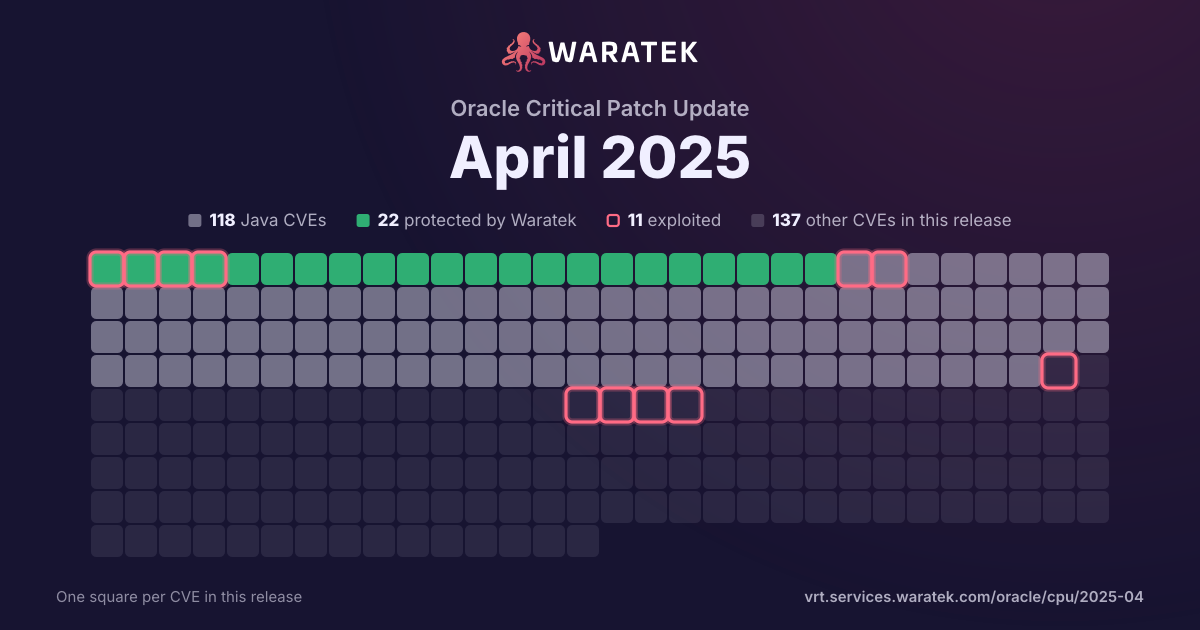
By status
22Protected by Waratek8Mitigation candidate88No exploit published16Outside Waratek scope121Not applicable
11Exploited, marked by the ring
No exploit published. For 33 of them, Oracle's security advisory is the source of public detail.
Protected by Waratek. Waratek RASP can block exploitation of these on systems that have not applied the patch yet.
Overview 16 matches · 0 in Waratek scope · 0 protected · 1 exploited · 0 CISA KEV · 2 public PoC · 2 EPSS ≥ 0.5
16matches
0in Waratek scope0.0%
0protected0.0%
1exploited6.2%
0CISA KEV0.0%
2public PoC12.5%
2EPSS ≥ 0.512.5%
Protected by Waratek
0
0.0%
Rule in development
0
0.0%
Mitigation candidate
0
0.0%
No exploit published
0
0.0%
Outside Waratek scope
16
100.0%
Not applicable
0
0.0%
Withdrawn CVE
0
0.0%
blocked by ARMR today
0
0.0%
partly blocked
0
0.0%
not blocked
16
100.0%
not established
0
0.0%
unrecorded
0
0.0%
Exploited
1
6.2%
Working exploit published
0
0.0%
Proof of concept only
3
18.8%
Forecast only
1
6.2%
No public exploit
11
68.8%
split by
peak 4 / quarter
Q2 211
Outside Waratek scope1
Medium1
not blocked1
No public exploit1
Q3 210
Q4 212
Outside Waratek scope2
Critical1
Medium1
not blocked2
Proof of concept only1
No public exploit1
Q1 220
Q2 220
Q3 220
Q4 220
Q1 230
Q2 230
Q3 230
Q4 231
Outside Waratek scope1
Medium1
not blocked1
Exploited1
Q1 240
Q2 242
Outside Waratek scope2
Critical1
Medium1
not blocked2
No public exploit2
Q3 241
Outside Waratek scope1
High1
not blocked1
Forecast only1
Q4 244
Outside Waratek scope4
Critical1
High1
Medium2
not blocked4
Proof of concept only2
No public exploit2
Q1 253
Outside Waratek scope3
Critical1
High1
Medium1
not blocked3
No public exploit3
Q2 252
Outside Waratek scope2
Medium2
not blocked2
No public exploit2
Q2 21Q4 21Q2 22Q4 22Q2 23Q4 23Q2 24Q4 24Q2 25
| CVE | Severity | Published▾ | Status | Exploitation | Description |
|---|---|---|---|---|---|
| CVE-2025-30722 | Medium | 2025-04-15 | Outside Waratek scope | No public exploit | Vulnerability in the MySQL Client product of Oracle MySQL (component: Client: mysqldump). Supported versions that are affected are 8.0.0-8.0.41, 8.4.0-8.4.4 and 9.0.0-9.2.0. Difficult to exploit vulnerability allows low privileged attacker with network access via multiple protocols to compromise MySQL Client. Successful attacks of this vulnerability can result in unauthorized access to critical data or complete access to all MySQL Client accessible data as well as unauthorized update, insert or delete access to some of MySQL Client accessible data. CVSS 3.1 Base Score 5.9 (Confidentiality and Integrity impacts). CVSS Vector: (CVSS:3.1/AV:N/AC:H/PR:L/UI:N/S:U/C:H/I:L/A:N). |
| CVE-2025-30698 | Medium | 2025-04-15 | Outside Waratek scope | No public exploit | Vulnerability in the Oracle Java SE, Oracle GraalVM for JDK, Oracle GraalVM Enterprise Edition product of Oracle Java SE (component: 2D). Supported versions that are affected are Oracle Java SE: 8u441, 8u441-perf, 11.0.26, 17.0.14, 21.0.6, 24; Oracle GraalVM for JDK: 17.0.14, 21.0.6, 24; Oracle GraalVM Enterprise Edition: 20.3.17 and 21.3.13. Difficult to exploit vulnerability allows unauthenticated attacker with network access via multiple protocols to compromise Oracle Java SE, Oracle GraalVM for JDK, Oracle GraalVM Enterprise Edition. Successful attacks of this vulnerability can result in unauthorized update, insert or delete access to some of Oracle Java SE, Oracle GraalVM for JDK, Oracle GraalVM Enterprise Edition accessible data as well as unauthorized read access to a subset of Oracle Java SE, Oracle GraalVM for JDK, Oracle GraalVM Enterprise Edition accessible data and unauthorized ability to cause a partial denial of service (partial DOS) of Oracle Java SE, Oracle GraalVM for JDK, Oracle GraalVM Enterprise Edition. Note: This vulnerability applies to Java deployments, typically in clients running sandboxed Java Web Start applications or sandboxed Java applets, that load and run untrusted code (e.g., code that comes from the internet) and rely on the Java sandbox for security. This vulnerability does not apply to Java deployments, typically in servers, that load and run only trusted code (e.g., code installed by an administrator). CVSS 3.1 Base Score 5.6 (Confidentiality, Integrity and Availability impacts). CVSS Vector: (CVSS:3.1/AV:N/AC:H/PR:N/UI:N/S:U/C:L/I:L/A:L). |
| CVE-2025-24928 | High | 2025-02-18 | Outside Waratek scope | No public exploit | libxml2 before 2.12.10 and 2.13.x before 2.13.6 has a stack-based buffer overflow in xmlSnprintfElements in valid.c. To exploit this, DTD validation must occur for an untrusted document or untrusted DTD. NOTE: this is similar to CVE-2017-9047. |
| CVE-2024-56171 | Critical | 2025-02-18 | Outside Waratek scope | No public exploit | libxml2 before 2.12.10 and 2.13.x before 2.13.6 has a use-after-free in xmlSchemaIDCFillNodeTables and xmlSchemaBubbleIDCNodeTables in xmlschemas.c. To exploit this, a crafted XML document must be validated against an XML schema with certain identity constraints, or a crafted XML schema must be used. |
| CVE-2024-13176 | Medium | 2025-01-20 | Outside Waratek scope | No public exploit | Issue summary: A timing side-channel which could potentially allow recovering the private key exists in the ECDSA signature computation. Impact summary: A timing side-channel in ECDSA signature computations could allow recovering the private key by an attacker. However, measuring the timing would require either local access to the signing application or a very fast network connection with low latency. There is a timing signal of around 300 nanoseconds when the top word of the inverted ECDSA nonce value is zero. This can happen with significant probability only for some of the supported elliptic curves. In particular the NIST P-521 curve is affected. To be able to measure this leak, the attacker process must either be located in the same physical computer or must have a very fast network connection with low latency. For that reason the severity of this vulnerability is Low. The FIPS modules in 3.4, 3.3, 3.2, 3.1 and 3.0 are affected by this issue. |
| CVE-2024-40896 | Critical | 2024-12-23 | Outside Waratek scope | No public exploit | In libxml2 2.11 before 2.11.9, 2.12 before 2.12.9, and 2.13 before 2.13.3, the SAX parser can produce events for external entities even if custom SAX handlers try to override entity content (by setting "checked"). This makes classic XXE attacks possible. |
| CVE-2024-50602 | Medium | 2024-10-27 | Outside Waratek scope | Proof of concept only | An issue was discovered in libexpat before 2.6.4. There is a crash within the XML_ResumeParser function because XML_StopParser can stop/suspend an unstarted parser. |
| CVE-2024-9143 | High | 2024-10-16 | Outside Waratek scope | No public exploit | Issue summary: Use of the low-level GF(2^m) elliptic curve APIs with untrusted explicit values for the field polynomial can lead to out-of-bounds memory reads or writes. Impact summary: Out of bound memory writes can lead to an application crash or even a possibility of a remote code execution, however, in all the protocols involving Elliptic Curve Cryptography that we're aware of, either only "named curves" are supported, or, if explicit curve parameters are supported, they specify an X9.62 encoding of binary (GF(2^m)) curves that can't represent problematic input values. Thus the likelihood of existence of a vulnerable application is low. In particular, the X9.62 encoding is used for ECC keys in X.509 certificates, so problematic inputs cannot occur in the context of processing X.509 certificates. Any problematic use-cases would have to be using an "exotic" curve encoding. The affected APIs include: EC_GROUP_new_curve_GF2m(), EC_GROUP_new_from_params(), and various supporting BN_GF2m_*() functions. Applications working with "exotic" explicit binary (GF(2^m)) curve parameters, that make it possible to represent invalid field polynomials with a zero constant term, via the above or similar APIs, may terminate abruptly as a result of reading or writing outside of array bounds. Remote code execution cannot easily be ruled out. The FIPS modules in 3.3, 3.2, 3.1 and 3.0 are not affected by this issue. |
| CVE-2024-6763 | Medium | 2024-10-14 | Outside Waratek scope | Proof of concept only | Eclipse Jetty is a lightweight, highly scalable, Java-based web server and Servlet engine . It includes a utility class, HttpURI, for URI/URL parsing. The HttpURI class does insufficient validation on the authority segment of a URI. However the behaviour of HttpURI differs from the common browsers in how it handles a URI that would be considered invalid if fully validated against the RRC. Specifically HttpURI and the browser may differ on the value of the host extracted from an invalid URI and thus a combination of Jetty and a vulnerable browser may be vulnerable to a open redirect attack or to a SSRF attack if the URI is used after passing validation checks. |
| CVE-2024-6119 | High | 2024-09-03 | Outside Waratek scope | Forecast only | Issue summary: Applications performing certificate name checks (e.g., TLS clients checking server certificates) may attempt to read an invalid memory address resulting in abnormal termination of the application process. Impact summary: Abnormal termination of an application can a cause a denial of service. Applications performing certificate name checks (e.g., TLS clients checking server certificates) may attempt to read an invalid memory address when comparing the expected name with an `otherName` subject alternative name of an X.509 certificate. This may result in an exception that terminates the application program. Note that basic certificate chain validation (signatures, dates, ...) is not affected, the denial of service can occur only when the application also specifies an expected DNS name, Email address or IP address. TLS servers rarely solicit client certificates, and even when they do, they generally don't perform a name check against a reference identifier (expected identity), but rather extract the presented identity after checking the certificate chain. So TLS servers are generally not affected and the severity of the issue is Moderate. The FIPS modules in 3.3, 3.2, 3.1 and 3.0 are not affected by this issue. |
| CVE-2024-5535 | Critical | 2024-06-27 | Outside Waratek scope | No public exploit | Issue summary: Calling the OpenSSL API function SSL_select_next_proto with an empty supported client protocols buffer may cause a crash or memory contents to be sent to the peer. Impact summary: A buffer overread can have a range of potential consequences such as unexpected application beahviour or a crash. In particular this issue could result in up to 255 bytes of arbitrary private data from memory being sent to the peer leading to a loss of confidentiality. However, only applications that directly call the SSL_select_next_proto function with a 0 length list of supported client protocols are affected by this issue. This would normally never be a valid scenario and is typically not under attacker control but may occur by accident in the case of a configuration or programming error in the calling application. The OpenSSL API function SSL_select_next_proto is typically used by TLS applications that support ALPN (Application Layer Protocol Negotiation) or NPN (Next Protocol Negotiation). NPN is older, was never standardised and is deprecated in favour of ALPN. We believe that ALPN is significantly more widely deployed than NPN. The SSL_select_next_proto function accepts a list of protocols from the server and a list of protocols from the client and returns the first protocol that appears in the server list that also appears in the client list. In the case of no overlap between the two lists it returns the first item in the client list. In either case it will signal whether an overlap between the two lists was found. In the case where SSL_select_next_proto is called with a zero length client list it fails to notice this condition and returns the memory immediately following the client list pointer (and reports that there was no overlap in the lists). This function is typically called from a server side application callback for ALPN or a client side application callback for NPN. In the case of ALPN the list of protocols supplied by the client is guaranteed by libssl to never be zero in length. The list of server protocols comes from the application and should never normally be expected to be of zero length. In this case if the SSL_select_next_proto function has been called as expected (with the list supplied by the client passed in the client/client_len parameters), then the application will not be vulnerable to this issue. If the application has accidentally been configured with a zero length server list, and has accidentally passed that zero length server list in the client/client_len parameters, and has additionally failed to correctly handle a "no overlap" response (which would normally result in a handshake failure in ALPN) then it will be vulnerable to this problem. In the case of NPN, the protocol permits the client to opportunistically select a protocol when there is no overlap. OpenSSL returns the first client protocol in the no overlap case in support of this. The list of client protocols comes from the application and should never normally be expected to be of zero length. However if the SSL_select_next_proto function is accidentally called with a client_len of 0 then an invalid memory pointer will be returned instead. If the application uses this output as the opportunistic protocol then the loss of confidentiality will occur. This issue has been assessed as Low severity because applications are most likely to be vulnerable if they are using NPN instead of ALPN - but NPN is not widely used. It also requires an application configuration or programming error. Finally, this issue would not typically be under attacker control making active exploitation unlikely. The FIPS modules in 3.3, 3.2, 3.1 and 3.0 are not affected by this issue. Due to the low severity of this issue we are not issuing new releases of OpenSSL at this time. The fix will be included in the next releases when they become available. |
| CVE-2024-37891 | Medium | 2024-06-17 | Outside Waratek scope | No public exploit | urllib3 is a user-friendly HTTP client library for Python. When using urllib3's proxy support with `ProxyManager`, the `Proxy-Authorization` header is only sent to the configured proxy, as expected. However, when sending HTTP requests *without* using urllib3's proxy support, it's possible to accidentally configure the `Proxy-Authorization` header even though it won't have any effect as the request is not using a forwarding proxy or a tunneling proxy. In those cases, urllib3 doesn't treat the `Proxy-Authorization` HTTP header as one carrying authentication material and thus doesn't strip the header on cross-origin redirects. Because this is a highly unlikely scenario, we believe the severity of this vulnerability is low for almost all users. Out of an abundance of caution urllib3 will automatically strip the `Proxy-Authorization` header during cross-origin redirects to avoid the small chance that users are doing this on accident. Users should use urllib3's proxy support or disable automatic redirects to achieve safe processing of the `Proxy-Authorization` header, but we still decided to strip the header by default in order to further protect users who aren't using the correct approach. We believe the number of usages affected by this advisory is low. It requires all of the following to be true to be exploited: 1. Setting the `Proxy-Authorization` header without using urllib3's built-in proxy support. 2. Not disabling HTTP redirects. 3. Either not using an HTTPS origin server or for the proxy or target origin to redirect to a malicious origin. Users are advised to update to either version 1.26.19 or version 2.2.2. Users unable to upgrade may use the `Proxy-Authorization` header with urllib3's `ProxyManager`, disable HTTP redirects using `redirects=False` when sending requests, or not user the `Proxy-Authorization` header as mitigations. |
| CVE-2023-48795 | Medium | 2023-12-18 | Outside Waratek scope | Exploited | The SSH transport protocol with certain OpenSSH extensions, found in OpenSSH before 9.6 and other products, allows remote attackers to bypass integrity checks such that some packets are omitted (from the extension negotiation message), and a client and server may consequently end up with a connection for which some security features have been downgraded or disabled, aka a Terrapin attack. This occurs because the SSH Binary Packet Protocol (BPP), implemented by these extensions, mishandles the handshake phase and mishandles use of sequence numbers. For example, there is an effective attack against SSH's use of ChaCha20-Poly1305 (and CBC with Encrypt-then-MAC). The bypass occurs in chacha20-poly1305@openssh.com and (if CBC is used) the -etm@openssh.com MAC algorithms. This also affects Maverick Synergy Java SSH API before 3.1.0-SNAPSHOT, Dropbear through 2022.83, Ssh before 5.1.1 in Erlang/OTP, PuTTY before 0.80, AsyncSSH before 2.14.2, golang.org/x/crypto before 0.17.0, libssh before 0.10.6, libssh2 through 1.11.0, Thorn Tech SFTP Gateway before 3.4.6, Tera Term before 5.1, Paramiko before 3.4.0, jsch before 0.2.15, SFTPGo before 2.5.6, Netgate pfSense Plus through 23.09.1, Netgate pfSense CE through 2.7.2, HPN-SSH through 18.2.0, ProFTPD before 1.3.8b (and before 1.3.9rc2), ORYX CycloneSSH before 2.3.4, NetSarang XShell 7 before Build 0144, CrushFTP before 10.6.0, ConnectBot SSH library before 2.2.22, Apache MINA sshd through 2.11.0, sshj through 0.37.0, TinySSH through 20230101, trilead-ssh2 6401, LANCOM LCOS and LANconfig, FileZilla before 3.66.4, Nova before 11.8, PKIX-SSH before 14.4, SecureCRT before 9.4.3, Transmit5 before 5.10.4, Win32-OpenSSH before 9.5.0.0p1-Beta, WinSCP before 6.2.2, Bitvise SSH Server before 9.32, Bitvise SSH Client before 9.33, KiTTY through 0.76.1.13, the net-ssh gem 7.2.0 for Ruby, the mscdex ssh2 module before 1.15.0 for Node.js, the thrussh library before 0.35.1 for Rust, and the Russh crate before 0.40.2 for Rust. |
| CVE-2021-23450 | Critical | 2021-12-17 | Outside Waratek scope | No public exploit | All versions of package dojo are vulnerable to Prototype Pollution via the setObject function. |
| CVE-2021-41184 | Medium | 2021-10-26 | Outside Waratek scope | Proof of concept only | jQuery-UI is the official jQuery user interface library. Prior to version 1.13.0, accepting the value of the `of` option of the `.position()` util from untrusted sources may execute untrusted code. The issue is fixed in jQuery UI 1.13.0. Any string value passed to the `of` option is now treated as a CSS selector. A workaround is to not accept the value of the `of` option from untrusted sources. |
| CVE-2021-28170 | Medium | 2021-05-26 | Outside Waratek scope | No public exploit | In the Jakarta Expression Language implementation 3.0.3 and earlier, a bug in the ELParserTokenManager enables invalid EL expressions to be evaluated as if they were valid. |