
Oracle Critical Patch Update April 2025
Released April 2025 · Oracle's advisory ↗ · ← Critical Patch Update, January 2025 · Critical Patch Update, July 2025 →
255 CVEs in this release, one square each
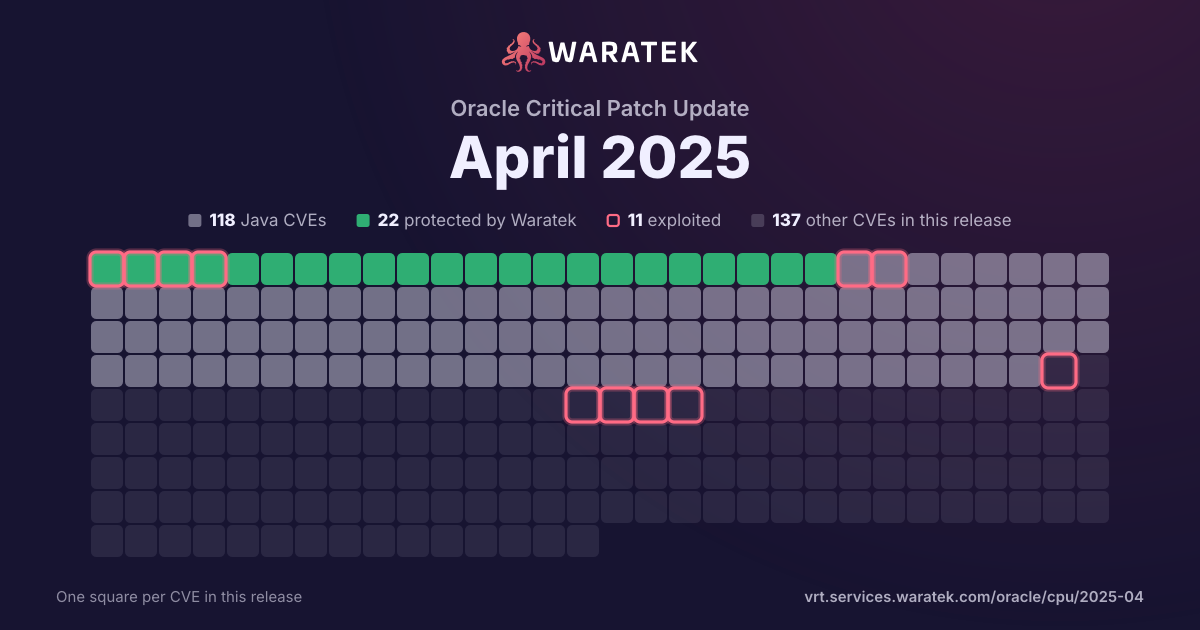
By status
22Protected by Waratek8Mitigation candidate88No exploit published16Outside Waratek scope121Not applicable
11Exploited, marked by the ring
No exploit published. For 33 of them, Oracle's security advisory is the source of public detail.
Protected by Waratek. Waratek RASP can block exploitation of these on systems that have not applied the patch yet.
Overview 36 matches · 0 protected · 1 exploited · 1 CISA KEV · 4 public PoC · 2 EPSS ≥ 0.5
Protected by Waratek
0
0.0%
Rule in development
0
0.0%
Mitigation candidate
4
11.1%
No exploit published
32
88.9%
blocked by ARMR today
0
0.0%
partly blocked
0
0.0%
not blocked
36
100.0%
not established
0
0.0%
unrecorded
0
0.0%
split by
peak 7 / quarter
Q2 201
Mitigation candidate1
High1
not blocked1
Proof of concept only1
Q3 201
Mitigation candidate1
High1
not blocked1
Working exploit published1
Q4 200
Q1 211
No exploit published1
High1
not blocked1
No public exploit1
Q2 211
No exploit published1
High1
not blocked1
No public exploit1
Q3 212
No exploit published2
High2
not blocked2
No public exploit2
Q4 210
Q1 221
No exploit published1
High1
not blocked1
No public exploit1
Q2 221
No exploit published1
High1
not blocked1
No public exploit1
Q3 220
Q4 222
No exploit published2
High2
not blocked2
No public exploit2
Q1 232
No exploit published2
High2
not blocked2
Proof of concept only1
No public exploit1
Q2 230
Q3 230
Q4 232
Mitigation candidate1
No exploit published1
High2
not blocked2
Exploited1
No public exploit1
Q1 245
Mitigation candidate1
No exploit published4
High5
not blocked5
Proof of concept only1
No public exploit4
Q2 243
No exploit published3
High3
not blocked3
No public exploit3
Q3 244
No exploit published4
High4
not blocked4
No public exploit4
Q4 240
Q1 253
No exploit published3
High3
not blocked3
Proof of concept only1
No public exploit2
Q2 257
No exploit published7
High7
not blocked7
No public exploit7
Q2 20Q4 20Q2 21Q4 21Q2 22Q4 22Q2 23Q4 23Q2 24Q4 24Q2 25
| CVE | Severity | Published▾ | Status | Exploitation | Description |
|---|---|---|---|---|---|
| CVE-2025-30735 | High | 2025-04-15 | No exploit published | No public exploit | Vulnerability in the PeopleSoft Enterprise CC Common Application Objects product of Oracle PeopleSoft (component: Page and Field Configuration). The supported version that is affected is 9.2. Easily exploitable vulnerability allows low privileged attacker with network access via HTTP to compromise PeopleSoft Enterprise CC Common Application Objects. Successful attacks of this vulnerability can result in unauthorized creation, deletion or modification access to critical data or all PeopleSoft Enterprise CC Common Application Objects accessible data as well as unauthorized access to critical data or complete access to all PeopleSoft Enterprise CC Common Application Objects accessible data. CVSS 3.1 Base Score 8.1 (Confidentiality and Integrity impacts). CVSS Vector: (CVSS:3.1/AV:N/AC:L/PR:L/UI:N/S:U/C:H/I:H/A:N). |
| CVE-2025-30730 | High | 2025-04-15 | No exploit published | No public exploit | Vulnerability in the Oracle Application Object Library product of Oracle E-Business Suite (component: Core). Supported versions that are affected are 12.2.5-12.2.14. Easily exploitable vulnerability allows unauthenticated attacker with network access via HTTP to compromise Oracle Application Object Library. Successful attacks of this vulnerability can result in unauthorized ability to cause a hang or frequently repeatable crash (complete DOS) of Oracle Application Object Library. CVSS 3.1 Base Score 7.5 (Availability impacts). CVSS Vector: (CVSS:3.1/AV:N/AC:L/PR:N/UI:N/S:U/C:N/I:N/A:H). |
| CVE-2025-30728 | High | 2025-04-15 | No exploit published | No public exploit | Vulnerability in the Oracle Configurator product of Oracle E-Business Suite (component: Core). Supported versions that are affected are 12.2.3-12.2.14. Easily exploitable vulnerability allows unauthenticated attacker with network access via HTTP to compromise Oracle Configurator. Successful attacks of this vulnerability can result in unauthorized access to critical data or complete access to all Oracle Configurator accessible data. CVSS 3.1 Base Score 7.5 (Confidentiality impacts). CVSS Vector: (CVSS:3.1/AV:N/AC:L/PR:N/UI:N/S:U/C:H/I:N/A:N). |
| CVE-2025-30724 | High | 2025-04-15 | No exploit published | No public exploit | Vulnerability in the Oracle BI Publisher product of Oracle Analytics (component: XML Services). Supported versions that are affected are 7.6.0.0.0 and 12.2.1.4.0. Easily exploitable vulnerability allows unauthenticated attacker with network access via HTTP to compromise Oracle BI Publisher. Successful attacks of this vulnerability can result in unauthorized access to critical data or complete access to all Oracle BI Publisher accessible data. CVSS 3.1 Base Score 7.5 (Confidentiality impacts). CVSS Vector: (CVSS:3.1/AV:N/AC:L/PR:N/UI:N/S:U/C:H/I:N/A:N). |
| CVE-2025-30716 | High | 2025-04-15 | No exploit published | No public exploit | Vulnerability in the Oracle Common Applications product of Oracle E-Business Suite (component: CRM User Management Framework). Supported versions that are affected are 12.2.3-12.2.14. Easily exploitable vulnerability allows unauthenticated attacker with network access via HTTP to compromise Oracle Common Applications. Successful attacks of this vulnerability can result in unauthorized access to critical data or complete access to all Oracle Common Applications accessible data. CVSS 3.1 Base Score 7.5 (Confidentiality impacts). CVSS Vector: (CVSS:3.1/AV:N/AC:L/PR:N/UI:N/S:U/C:H/I:N/A:N). |
| CVE-2025-30708 | High | 2025-04-15 | No exploit published | No public exploit | Vulnerability in the Oracle User Management product of Oracle E-Business Suite (component: Search and Register Users). Supported versions that are affected are 12.2.4-12.2.14. Easily exploitable vulnerability allows unauthenticated attacker with network access via HTTP to compromise Oracle User Management. Successful attacks of this vulnerability can result in unauthorized access to critical data or complete access to all Oracle User Management accessible data. CVSS 3.1 Base Score 7.5 (Confidentiality impacts). CVSS Vector: (CVSS:3.1/AV:N/AC:L/PR:N/UI:N/S:U/C:H/I:N/A:N). |
| CVE-2025-30707 | High | 2025-04-15 | No exploit published | No public exploit | Vulnerability in the Oracle iStore product of Oracle E-Business Suite (component: User Management). Supported versions that are affected are 12.2.3-12.2.14. Easily exploitable vulnerability allows unauthenticated attacker with network access via HTTP to compromise Oracle iStore. Successful attacks of this vulnerability can result in unauthorized access to critical data or complete access to all Oracle iStore accessible data. CVSS 3.1 Base Score 7.5 (Confidentiality impacts). CVSS Vector: (CVSS:3.1/AV:N/AC:L/PR:N/UI:N/S:U/C:H/I:N/A:N). |
| CVE-2025-24970 | High | 2025-02-10 | No exploit published | Proof of concept only | Netty, an asynchronous, event-driven network application framework, has a vulnerability starting in version 4.1.91.Final and prior to version 4.1.118.Final. When a special crafted packet is received via SslHandler it doesn't correctly handle validation of such a packet in all cases which can lead to a native crash. Version 4.1.118.Final contains a patch. As workaround its possible to either disable the usage of the native SSLEngine or change the code manually. |
| CVE-2025-23184 | High | 2025-01-21 | No exploit published | No public exploit | A potential denial of service vulnerability is present in versions of Apache CXF before 3.5.10, 3.6.5 and 4.0.6. In some edge cases, the CachedOutputStream instances may not be closed and, if backed by temporary files, may fill up the file system (it applies to servers and clients). |
| CVE-2024-43709 | High | 2025-01-21 | No exploit published | No public exploit | An allocation of resources without limits or throttling in Elasticsearch can lead to an OutOfMemoryError exception resulting in a crash via a specially crafted query using an SQL function. |
| CVE-2024-47197 | High | 2024-09-26 | No exploit published | No public exploit | Exposure of Sensitive Information to an Unauthorized Actor, Insecure Storage of Sensitive Information vulnerability in Maven Archetype Plugin. This issue affects Maven Archetype Plugin: from 3.2.1 before 3.3.0. Users are recommended to upgrade to version 3.3.0, which fixes the issue. Archetype integration testing creates a file called ./target/classes/archetype-it/archetype-settings.xml This file contains all the content from the users ~/.m2/settings.xml file, which often contains information they do not want to publish. We expect that on many developer machines, this also contains credentials. When the user runs mvn verify again (without a mvn clean), this file becomes part of the final artifact. If a developer were to publish this into Maven Central or any other remote repository (whether as a release or a snapshot) their credentials would be published without them knowing. |
| CVE-2024-7254 | High | 2024-09-19 | No exploit published | No public exploit | Any project that parses untrusted Protocol Buffers data containing an arbitrary number of nested groups / series of SGROUP tags can corrupted by exceeding the stack limit i.e. StackOverflow. Parsing nested groups as unknown fields with DiscardUnknownFieldsParser or Java Protobuf Lite parser, or against Protobuf map fields, creates unbounded recursions that can be abused by an attacker. |
| CVE-2024-25638 | High | 2024-07-22 | No exploit published | No public exploit | dnsjava is an implementation of DNS in Java. Records in DNS replies are not checked for their relevance to the query, allowing an attacker to respond with RRs from different zones. This vulnerability is fixed in 3.6.0. |
| CVE-2024-32007 | High | 2024-07-19 | No exploit published | No public exploit | An improper input validation of the p2c parameter in the Apache CXF JOSE code before 4.0.5, 3.6.4 and 3.5.9 allows an attacker to perform a denial of service attack by specifying a large value for this parameter in a token. |
| CVE-2024-36114 | High | 2024-05-29 | No exploit published | No public exploit | Aircompressor is a library with ports of the Snappy, LZO, LZ4, and Zstandard compression algorithms to Java. All decompressor implementations of Aircompressor (LZ4, LZO, Snappy, Zstandard) can crash the JVM for certain input, and in some cases also leak the content of other memory of the Java process (which could contain sensitive information). When decompressing certain data, the decompressors try to access memory outside the bounds of the given byte arrays or byte buffers. Because Aircompressor uses the JDK class `sun.misc.Unsafe` to speed up memory access, no additional bounds checks are performed and this has similar security consequences as out-of-bounds access in C or C++, namely it can lead to non-deterministic behavior or crash the JVM. Users should update to Aircompressor 0.27 or newer where these issues have been fixed. When decompressing data from untrusted users, this can be exploited for a denial-of-service attack by crashing the JVM, or to leak other sensitive information from the Java process. There are no known workarounds for this issue. |
| CVE-2024-30172 | High | 2024-05-14 | No exploit published | No public exploit | An issue was discovered in Bouncy Castle Java Cryptography APIs before 1.78. An Ed25519 verification code infinite loop can occur via a crafted signature and public key. |
| CVE-2024-29857 | High | 2024-05-14 | No exploit published | No public exploit | An issue was discovered in ECCurve.java and ECCurve.cs in Bouncy Castle Java (BC Java) before 1.78, BC Java LTS before 2.73.6, BC-FJA before 1.0.2.5, and BC C# .Net before 2.3.1. Importing an EC certificate with crafted F2m parameters can lead to excessive CPU consumption during the evaluation of the curve parameters. |
| CVE-2023-5685 | High | 2024-03-22 | No exploit published | No public exploit | A flaw was found in XNIO. The XNIO NotifierState that can cause a Stack Overflow Exception when the chain of notifier states becomes problematically large can lead to uncontrolled resource management and a possible denial of service (DoS). |
| CVE-2024-24549 | High | 2024-03-13 | Mitigation candidate | Proof of concept only | Denial of Service due to improper input validation vulnerability for HTTP/2 requests in Apache Tomcat. When processing an HTTP/2 request, if the request exceeded any of the configured limits for headers, the associated HTTP/2 stream was not reset until after all of the headers had been processed.This issue affects Apache Tomcat: from 11.0.0-M1 through 11.0.0-M16, from 10.1.0-M1 through 10.1.18, from 9.0.0-M1 through 9.0.85, from 8.5.0 through 8.5.98. Other, older, EOL versions may also be affected. Users are recommended to upgrade to version 11.0.0-M17, 10.1.19, 9.0.86 or 8.5.99 which fix the issue. |
| CVE-2024-25710 | High | 2024-02-19 | No exploit published | No public exploit | Loop with Unreachable Exit Condition ('Infinite Loop') vulnerability in Apache Commons Compress.This issue affects Apache Commons Compress: from 1.3 through 1.25.0. Users are recommended to upgrade to version 1.26.0 which fixes the issue. |
| CVE-2023-52428 | High | 2024-02-11 | No exploit published | No public exploit | In Connect2id Nimbus JOSE+JWT before 9.37.2, an attacker can cause a denial of service (resource consumption) via a large JWE p2c header value (aka iteration count) for the PasswordBasedDecrypter (PBKDF2) component. |
| CVE-2023-51441 | High | 2024-01-06 | No exploit published | No public exploit | ** UNSUPPORTED WHEN ASSIGNED ** Improper Input Validation vulnerability in Apache Axis allowed users with access to the admin service to perform possible SSRF This issue affects Apache Axis: through 1.3. As Axis 1 has been EOL we recommend you migrate to a different SOAP engine, such as Apache Axis 2/Java. Alternatively you could use a build of Axis with the patch from https://github.com/apache/axis-axis1-java/commit/685c309febc64aa393b2d64a05f90e7eb9f73e06 applied. The Apache Axis project does not expect to create an Axis 1.x release fixing this problem, though contributors that would like to work towards this are welcome. |
| CVE-2023-46589 | High | 2023-11-28 | No exploit published | No public exploit | Improper Input Validation vulnerability in Apache Tomcat.Tomcat from 11.0.0-M1 through 11.0.0-M10, from 10.1.0-M1 through 10.1.15, from 9.0.0-M1 through 9.0.82 and from 8.5.0 through 8.5.95 did not correctly parse HTTP trailer headers. A trailer header that exceeded the header size limit could cause Tomcat to treat a single request as multiple requests leading to the possibility of request smuggling when behind a reverse proxy. Older, EOL versions may also be affected. Users are recommended to upgrade to version 11.0.0-M11 onwards, 10.1.16 onwards, 9.0.83 onwards or 8.5.96 onwards, which fix the issue. |
| CVE-2023-44487 | High | 2023-10-10 | Mitigation candidate | Exploited | The HTTP/2 protocol allows a denial of service (server resource consumption) because request cancellation can reset many streams quickly, as exploited in the wild in August through October 2023. |
| CVE-2023-1370 | High | 2023-03-22 | No exploit published | Proof of concept only | [Json-smart](https://netplex.github.io/json-smart/) is a performance focused, JSON processor lib. When reaching a ‘[‘ or ‘{‘ character in the JSON input, the code parses an array or an object respectively. It was discovered that the code does not have any limit to the nesting of such arrays or objects. Since the parsing of nested arrays and objects is done recursively, nesting too many of them can cause a stack exhaustion (stack overflow) and crash the software. |
| CVE-2023-24998 | High | 2023-02-20 | No exploit published | No public exploit | Apache Commons FileUpload before 1.5 does not limit the number of request parts to be processed resulting in the possibility of an attacker triggering a DoS with a malicious upload or series of uploads. Note that, like all of the file upload limits, the new configuration option (FileUploadBase#setFileCountMax) is not enabled by default and must be explicitly configured. |
| CVE-2022-42252 | High | 2022-11-01 | No exploit published | No public exploit | If Apache Tomcat 8.5.0 to 8.5.82, 9.0.0-M1 to 9.0.67, 10.0.0-M1 to 10.0.26 or 10.1.0-M1 to 10.1.0 was configured to ignore invalid HTTP headers via setting rejectIllegalHeader to false (the default for 8.5.x only), Tomcat did not reject a request containing an invalid Content-Length header making a request smuggling attack possible if Tomcat was located behind a reverse proxy that also failed to reject the request with the invalid header. |
| CVE-2022-42003 | High | 2022-10-02 | No exploit published | No public exploit | In FasterXML jackson-databind before versions 2.13.4.1 and 2.12.17.1, resource exhaustion can occur because of a lack of a check in primitive value deserializers to avoid deep wrapper array nesting, when the UNWRAP_SINGLE_VALUE_ARRAYS feature is enabled. |
| CVE-2022-25762 | High | 2022-05-13 | No exploit published | No public exploit | If a web application sends a WebSocket message concurrently with the WebSocket connection closing when running on Apache Tomcat 8.5.0 to 8.5.75 or Apache Tomcat 9.0.0.M1 to 9.0.20, it is possible that the application will continue to use the socket after it has been closed. The error handling triggered in this case could cause the a pooled object to be placed in the pool twice. This could result in subsequent connections using the same object concurrently which could result in data being returned to the wrong use and/or other errors. |
| CVE-2020-36518 | High | 2022-03-11 | No exploit published | No public exploit | jackson-databind before 2.13.0 allows a Java StackOverflow exception and denial of service via a large depth of nested objects. |
| CVE-2021-41079 | High | 2021-09-16 | No exploit published | No public exploit | Apache Tomcat 8.5.0 to 8.5.63, 9.0.0-M1 to 9.0.43 and 10.0.0-M1 to 10.0.2 did not properly validate incoming TLS packets. When Tomcat was configured to use NIO+OpenSSL or NIO2+OpenSSL for TLS, a specially crafted packet could be used to trigger an infinite loop resulting in a denial of service. |
| CVE-2021-37714 | High | 2021-08-18 | No exploit published | No public exploit | jsoup is a Java library for working with HTML. Those using jsoup versions prior to 1.14.2 to parse untrusted HTML or XML may be vulnerable to DOS attacks. If the parser is run on user supplied input, an attacker may supply content that causes the parser to get stuck (loop indefinitely until cancelled), to complete more slowly than usual, or to throw an unexpected exception. This effect may support a denial of service attack. The issue is patched in version 1.14.2. There are a few available workarounds. Users may rate limit input parsing, limit the size of inputs based on system resources, and/or implement thread watchdogs to cap and timeout parse runtimes. |
| CVE-2021-31684 | High | 2021-06-01 | No exploit published | No public exploit | A vulnerability was discovered in the indexOf function of JSONParserByteArray in JSON Smart versions 1.3 and 2.4 which causes a denial of service (DOS) via a crafted web request. |
| CVE-2020-13936 | High | 2021-03-10 | No exploit published | No public exploit | An attacker that is able to modify Velocity templates may execute arbitrary Java code or run arbitrary system commands with the same privileges as the account running the Servlet container. This applies to applications that allow untrusted users to upload/modify velocity templates running Apache Velocity Engine versions up to 2.2. |
| CVE-2020-13935 | High | 2020-07-14 | Mitigation candidate | Working exploit published | The payload length in a WebSocket frame was not correctly validated in Apache Tomcat 10.0.0-M1 to 10.0.0-M6, 9.0.0.M1 to 9.0.36, 8.5.0 to 8.5.56 and 7.0.27 to 7.0.104. Invalid payload lengths could trigger an infinite loop. Multiple requests with invalid payload lengths could lead to a denial of service. |
| CVE-2020-11996 | High | 2020-06-26 | Mitigation candidate | Proof of concept only | A specially crafted sequence of HTTP/2 requests sent to Apache Tomcat 10.0.0-M1 to 10.0.0-M5, 9.0.0.M1 to 9.0.35 and 8.5.0 to 8.5.55 could trigger high CPU usage for several seconds. If a sufficient number of such requests were made on concurrent HTTP/2 connections, the server could become unresponsive. |