
Oracle Critical Patch Update April 2025
Released April 2025 · Oracle's advisory ↗ · ← Critical Patch Update, January 2025 · Critical Patch Update, July 2025 →
255 CVEs in this release, one square each
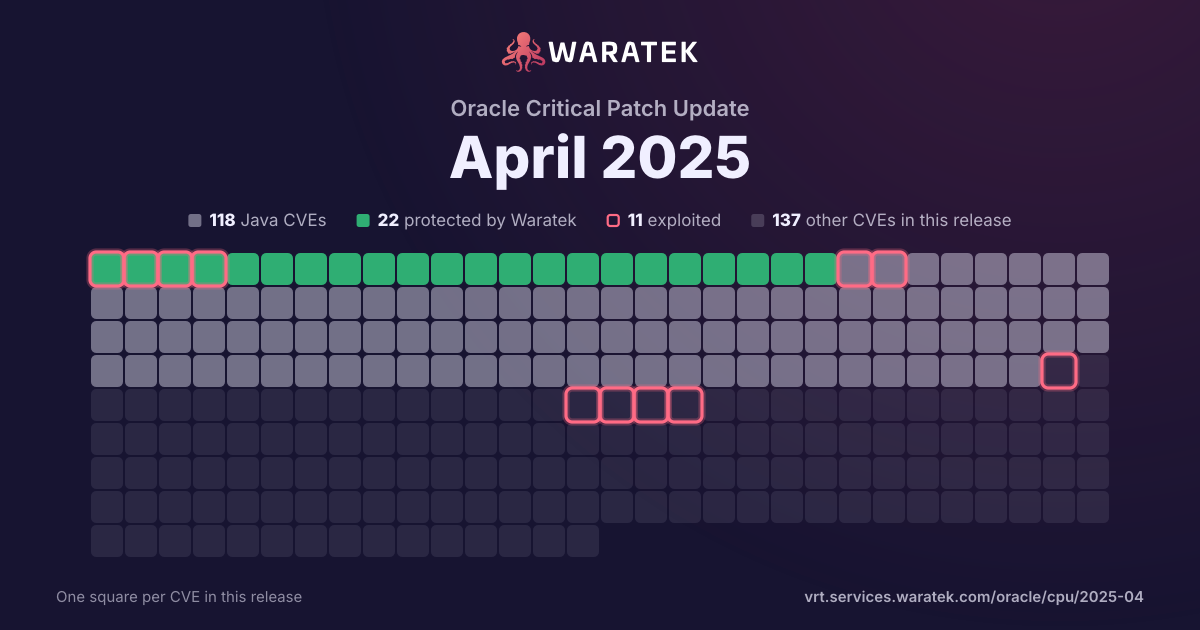
By status
22Protected by Waratek9Mitigation candidate94No exploit published3Outside Waratek scope127Not applicable
11Exploited, marked by the ring
No exploit published. For 29 of them, Oracle's security advisory is the source of public detail.
Protected by Waratek. Waratek RASP can block exploitation of these on systems that have not applied the patch yet.
Overview 6 matches · 3 in Waratek scope · 0 protected · 0 exploited · 0 CISA KEV · 0 public PoC · 0 EPSS ≥ 0.5
6matches
3in Waratek scope50.0%
0protected0.0%
0exploited0.0%
0CISA KEV0.0%
0public PoC0.0%
0EPSS ≥ 0.50.0%
Protected by Waratek
0
0.0%
Rule in development
0
0.0%
Mitigation candidate
0
0.0%
No exploit published
3
50.0%
Outside Waratek scope
0
0.0%
Not applicable
3
50.0%
Withdrawn CVE
0
0.0%
blocked by ARMR today
0
0.0%
partly blocked
0
0.0%
not blocked
6
100.0%
not established
0
0.0%
unrecorded
0
0.0%
Exploited
0
0.0%
Working exploit published
0
0.0%
Proof of concept only
6
100.0%
Forecast only
0
0.0%
No public exploit
0
0.0%
split by
peak 3 / month
Jan 25Feb 25Mar 25Apr 25
| CVE | Severity | Published▾ | Status | Exploitation | Description |
|---|---|---|---|---|---|
| CVE-2025-30712 | High | 2025-04-15 | Not applicable | Proof of concept only | Vulnerability in the Oracle VM VirtualBox product of Oracle Virtualization (component: Core). The supported version that is affected is 7.1.6. Easily exploitable vulnerability allows high privileged attacker with logon to the infrastructure where Oracle VM VirtualBox executes to compromise Oracle VM VirtualBox. While the vulnerability is in Oracle VM VirtualBox, attacks may significantly impact additional products (scope change). Successful attacks of this vulnerability can result in unauthorized creation, deletion or modification access to critical data or all Oracle VM VirtualBox accessible data as well as unauthorized access to critical data or complete access to all Oracle VM VirtualBox accessible data and unauthorized ability to cause a partial denial of service (partial DOS) of Oracle VM VirtualBox. CVSS 3.1 Base Score 8.1 (Confidentiality, Integrity and Availability impacts). CVSS Vector: (CVSS:3.1/AV:L/AC:L/PR:H/UI:N/S:C/C:H/I:H/A:L). |
| CVE-2025-27789 | Medium | 2025-03-11 | Not applicable | Proof of concept only | Babel is a compiler for writing next generation JavaScript. When using versions of Babel prior to 7.26.10 and 8.0.0-alpha.17 to compile regular expression named capturing groups, Babel will generate a polyfill for the `.replace` method that has quadratic complexity on some specific replacement pattern strings (i.e. the second argument passed to `.replace`). Generated code is vulnerable if all the following conditions are true: Using Babel to compile regular expression named capturing groups, using the `.replace` method on a regular expression that contains named capturing groups, and the code using untrusted strings as the second argument of `.replace`. This problem has been fixed in `@babel/helpers` and `@babel/runtime` 7.26.10 and 8.0.0-alpha.17. It's likely that individual users do not directly depend on `@babel/helpers`, and instead depend on `@babel/core` (which itself depends on `@babel/helpers`). Upgrading to `@babel/core` 7.26.10 is not required, but it guarantees use of a new enough `@babel/helpers` version. Note that just updating Babel dependencies is not enough; one will also need to re-compile the code. No known workarounds are available. |
| CVE-2025-25193 | Medium | 2025-02-10 | No exploit published | Proof of concept only | Netty, an asynchronous, event-driven network application framework, has a vulnerability in versions up to and including 4.1.118.Final. An unsafe reading of environment file could potentially cause a denial of service in Netty. When loaded on an Windows application, Netty attempts to load a file that does not exist. If an attacker creates such a large file, the Netty application crash. A similar issue was previously reported as CVE-2024-47535. This issue was fixed, but the fix was incomplete in that null-bytes were not counted against the input limit. Commit d1fbda62d3a47835d3fb35db8bd42ecc205a5386 contains an updated fix. |
| CVE-2025-24970 | High | 2025-02-10 | No exploit published | Proof of concept only | Netty, an asynchronous, event-driven network application framework, has a vulnerability starting in version 4.1.91.Final and prior to version 4.1.118.Final. When a special crafted packet is received via SslHandler it doesn't correctly handle validation of such a packet in all cases which can lead to a native crash. Version 4.1.118.Final contains a patch. As workaround its possible to either disable the usage of the native SSLEngine or change the code manually. |
| CVE-2024-57699 | High | 2025-02-05 | No exploit published | Proof of concept only | A security issue was found in Netplex Json-smart 2.5.0 through 2.5.1. When loading a specially crafted JSON input, containing a large number of ’{’, a stack exhaustion can be trigger, which could allow an attacker to cause a Denial of Service (DoS). This issue exists because of an incomplete fix for CVE-2023-1370. |
| CVE-2025-23022 | Medium | 2025-01-10 | Not applicable | Proof of concept only | FreeType 2.8.1 has a signed integer overflow in cf2_doFlex in cff/cf2intrp.c. |