
Oracle Critical Patch Update January 2025
Released January 2025 · Oracle's advisory ↗ · ← Critical Patch Update, October 2024 · Critical Patch Update, April 2025 →
253 CVEs in this release, one square each
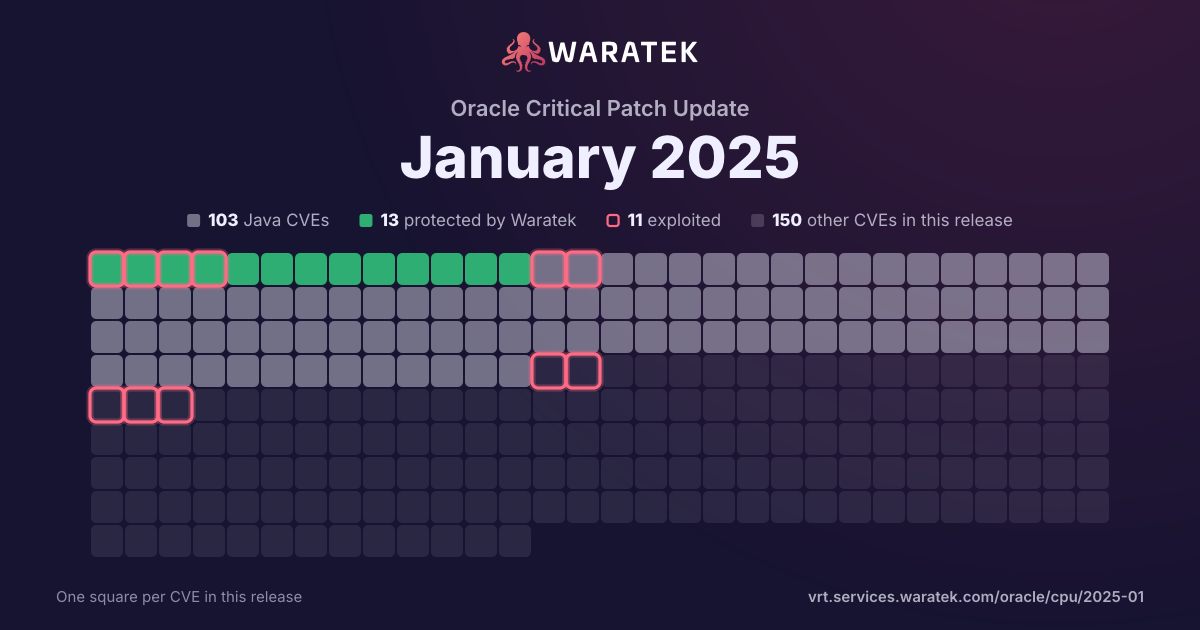
By status
13Protected by Waratek4Mitigation candidate86No exploit published17Outside Waratek scope133Not applicable
11Exploited, marked by the ring
No exploit published. For 48 of them, Oracle's security advisory is the source of public detail.
Protected by Waratek. Waratek RASP can block exploitation of these on systems that have not applied the patch yet.
Overview 13 matches · 4 exploited · 1 CISA KEV · 6 public PoC · 4 EPSS ≥ 0.5
Protected by Waratek
13
100.0%
Rule in development
0
0.0%
Mitigation candidate
0
0.0%
No exploit published
0
0.0%
blocked by ARMR today
13
100.0%
partly blocked
0
0.0%
not blocked
0
0.0%
not established
0
0.0%
unrecorded
0
0.0%
split by
peak 3 / quarter
Q4 191
Protected by Waratek1
Medium1
blocked by ARMR today1
No public exploit1
Q1 201
Protected by Waratek1
Critical1
blocked by ARMR today1
Proof of concept only1
Q2 200
Q3 200
Q4 200
Q1 211
Protected by Waratek1
Critical1
blocked by ARMR today1
No public exploit1
Q2 211
Protected by Waratek1
High1
blocked by ARMR today1
No public exploit1
Q3 210
Q4 210
Q1 220
Q2 220
Q3 221
Protected by Waratek1
High1
blocked by ARMR today1
Proof of concept only1
Q4 220
Q1 230
Q2 230
Q3 231
Protected by Waratek1
High1
blocked by ARMR today1
No public exploit1
Q4 231
Protected by Waratek1
Critical1
blocked by ARMR today1
Exploited1
Q1 240
Q2 240
Q3 242
Protected by Waratek2
High1
Medium1
blocked by ARMR today2
Exploited1
No public exploit1
Q4 243
Protected by Waratek3
Critical2
High1
blocked by ARMR today3
Exploited1
Working exploit published1
No public exploit1
Q1 251
Protected by Waratek1
Critical1
blocked by ARMR today1
Exploited1
Q1 20Q3 20Q1 21Q3 21Q1 22Q3 22Q1 23Q3 23Q1 24Q3 24Q1 25
| CVE | Severity | Published▾ | Status | Exploitation | Description |
|---|---|---|---|---|---|
| CVE-2025-21535 | Critical | 2025-01-21 | Protected by Waratek | Exploited | Vulnerability in the Oracle WebLogic Server product of Oracle Fusion Middleware (component: Core). Supported versions that are affected are 12.2.1.4.0 and 14.1.1.0.0. Easily exploitable vulnerability allows unauthenticated attacker with network access via T3, IIOP to compromise Oracle WebLogic Server. Successful attacks of this vulnerability can result in takeover of Oracle WebLogic Server. CVSS 3.1 Base Score 9.8 (Confidentiality, Integrity and Availability impacts). CVSS Vector: (CVSS:3.1/AV:N/AC:L/PR:N/UI:N/S:U/C:H/I:H/A:H). |
| CVE-2024-38819 | High | 2024-12-19 | Protected by Waratek | Working exploit published | Applications serving static resources through the functional web frameworks WebMvc.fn or WebFlux.fn are vulnerable to path traversal attacks. An attacker can craft malicious HTTP requests and obtain any file on the file system that is also accessible to the process in which the Spring application is running. |
| CVE-2024-53677 | Critical | 2024-12-11 | Protected by Waratek | Exploited | File upload logic in Apache Struts is flawed. An attacker can manipulate file upload params to enable paths traversal and under some circumstances this can lead to uploading a malicious file which can be used to perform Remote Code Execution. This issue affects Apache Struts: from 2.0.0 before 6.4.0. Users are recommended to upgrade to version 6.4.0 at least and migrate to the new file upload mechanism https://struts.apache.org/core-developers/file-upload . If you are not using an old file upload logic based on FileuploadInterceptor your application is safe. You can find more details in https://cwiki.apache.org/confluence/display/WW/S2-067 |
| CVE-2024-47561 | Critical | 2024-10-03 | Protected by Waratek | No public exploit | Schema parsing in the Java SDK of Apache Avro 1.11.3 and previous versions allows bad actors to execute arbitrary code. Users are recommended to upgrade to version 1.11.4 or 1.12.0, which fix this issue. |
| CVE-2024-38816 | High | 2024-09-13 | Protected by Waratek | Exploited | Applications serving static resources through the functional web frameworks WebMvc.fn or WebFlux.fn are vulnerable to path traversal attacks. An attacker can craft malicious HTTP requests and obtain any file on the file system that is also accessible to the process in which the Spring application is running. Specifically, an application is vulnerable when both of the following are true: * the web application uses RouterFunctions to serve static resources * resource handling is explicitly configured with a FileSystemResource location However, malicious requests are blocked and rejected when any of the following is true: * the Spring Security HTTP Firewall https://docs.spring.io/spring-security/reference/servlet/exploits/firewall.html is in use * the application runs on Tomcat or Jetty |
| CVE-2024-38807 | Medium | 2024-08-23 | Protected by Waratek | No public exploit | Applications that use spring-boot-loader or spring-boot-loader-classic and contain custom code that performs signature verification of nested jar files may be vulnerable to signature forgery where content that appears to have been signed by one signer has, in fact, been signed by another. |
| CVE-2023-46604 | Critical | 2023-10-27 | Protected by Waratek | Exploited | The Java OpenWire protocol marshaller is vulnerable to Remote Code Execution. This vulnerability may allow a remote attacker with network access to either a Java-based OpenWire broker or client to run arbitrary shell commands by manipulating serialized class types in the OpenWire protocol to cause either the client or the broker (respectively) to instantiate any class on the classpath. Users are recommended to upgrade both brokers and clients to version 5.15.16, 5.16.7, 5.17.6, or 5.18.3 which fixes this issue. |
| CVE-2023-39410 | High | 2023-09-29 | Protected by Waratek | No public exploit | When deserializing untrusted or corrupted data, it is possible for a reader to consume memory beyond the allowed constraints and thus lead to out of memory on the system. This issue affects Java applications using Apache Avro Java SDK up to and including 1.11.2. Users should update to apache-avro version 1.11.3 which addresses this issue. |
| CVE-2022-34169 | High | 2022-07-19 | Protected by Waratek | Proof of concept only | The Apache Xalan Java XSLT library is vulnerable to an integer truncation issue when processing malicious XSLT stylesheets. This can be used to corrupt Java class files generated by the internal XSLTC compiler and execute arbitrary Java bytecode. Users are recommended to update to version 2.7.3 or later. Note: Java runtimes (such as OpenJDK) include repackaged copies of Xalan. |
| CVE-2021-33813 | High | 2021-06-16 | Protected by Waratek | No public exploit | An XXE issue in SAXBuilder in JDOM through 2.0.6 allows attackers to cause a denial of service via a crafted HTTP request. |
| CVE-2021-23926 | Critical | 2021-01-14 | Protected by Waratek | No public exploit | The XML parsers used by XMLBeans up to version 2.6.0 did not set the properties needed to protect the user from malicious XML input. Vulnerabilities include possibilities for XML Entity Expansion attacks. Affects XMLBeans up to and including v2.6.0. |
| CVE-2016-1000027 | Critical | 2020-01-02 | Protected by Waratek | Proof of concept only | Pivotal Spring Framework through 5.3.16 suffers from a potential remote code execution (RCE) issue if used for Java deserialization of untrusted data. Depending on how the library is implemented within a product, this issue may or not occur, and authentication may be required. NOTE: the vendor's position is that untrusted data is not an intended use case. The product's behavior will not be changed because some users rely on deserialization of trusted data. |
| CVE-2019-12415 | Medium | 2019-10-23 | Protected by Waratek | No public exploit | In Apache POI up to 4.1.0, when using the tool XSSFExportToXml to convert user-provided Microsoft Excel documents, a specially crafted document can allow an attacker to read files from the local filesystem or from internal network resources via XML External Entity (XXE) Processing. |