
Oracle Critical Patch Update January 2025
Released January 2025 · Oracle's advisory ↗ · ← Critical Patch Update, October 2024 · Critical Patch Update, April 2025 →
253 CVEs in this release, one square each
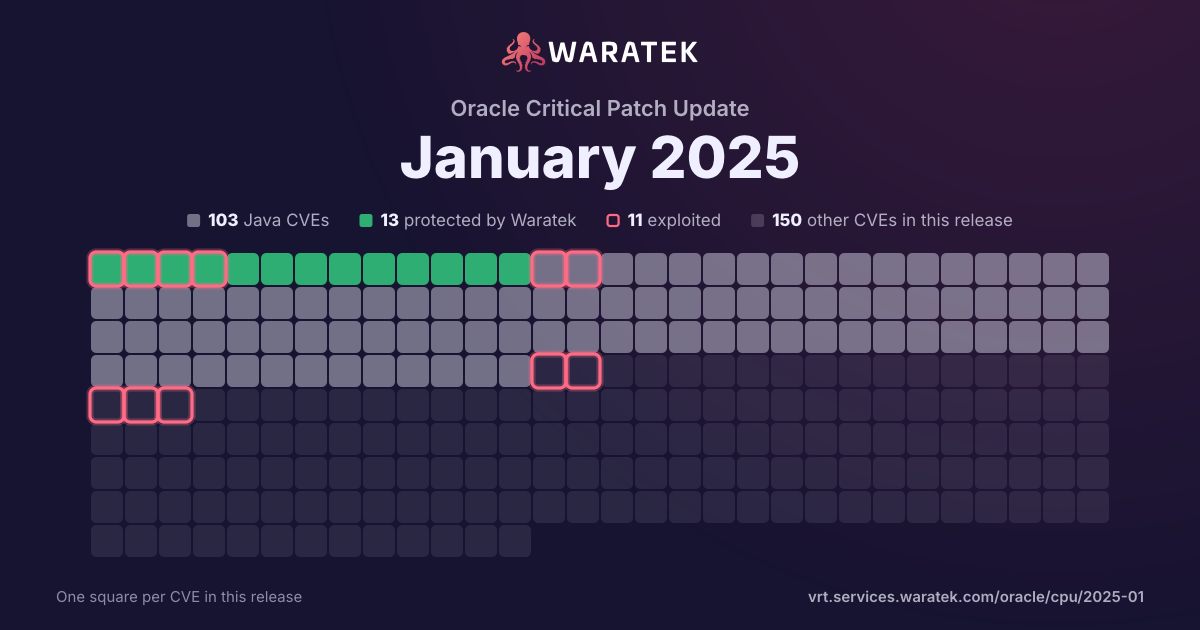
By status
13Protected by Waratek4Mitigation candidate86No exploit published17Outside Waratek scope133Not applicable
11Exploited, marked by the ring
No exploit published. For 48 of them, Oracle's security advisory is the source of public detail.
Protected by Waratek. Waratek RASP can block exploitation of these on systems that have not applied the patch yet.
Overview 253 matches · 103 in Waratek scope · 13 protected · 11 exploited · 3 CISA KEV · 18 public PoC · 12 EPSS ≥ 0.5
253matches
103in Waratek scope40.7%
13protected5.1%
11exploited4.3%
3CISA KEV1.2%
18public PoC7.1%
12EPSS ≥ 0.54.7%
Protected by Waratek
13
5.1%
Rule in development
0
0.0%
Mitigation candidate
4
1.6%
No exploit published
86
34.0%
Outside Waratek scope
17
6.7%
Not applicable
133
52.6%
Withdrawn CVE
0
0.0%
blocked by ARMR today
13
5.1%
partly blocked
0
0.0%
not blocked
240
94.9%
not established
0
0.0%
unrecorded
0
0.0%
split by
peak 85 / quarter
Q2 191
Not applicable1
Medium1
not blocked1
No public exploit1
Q3 192
No exploit published1
Not applicable1
Critical1
Medium1
not blocked2
No public exploit2
Q4 191
Protected by Waratek1
Medium1
blocked by ARMR today1
No public exploit1
Q1 201
Protected by Waratek1
Critical1
blocked by ARMR today1
Proof of concept only1
Q2 201
No exploit published1
High1
not blocked1
No public exploit1
Q3 200
Q4 204
No exploit published2
Outside Waratek scope1
Not applicable1
High3
Medium1
not blocked4
Proof of concept only1
No public exploit3
Q1 211
Protected by Waratek1
Critical1
blocked by ARMR today1
No public exploit1
Q2 213
Protected by Waratek1
No exploit published2
High2
Medium1
blocked by ARMR today1
not blocked2
No public exploit3
Q3 211
Not applicable1
High1
not blocked1
No public exploit1
Q4 210
Q1 220
Q2 220
Q3 222
Protected by Waratek1
No exploit published1
High2
blocked by ARMR today1
not blocked1
Proof of concept only1
No public exploit1
Q4 220
Q1 233
No exploit published1
Not applicable2
High2
Medium1
not blocked3
No public exploit3
Q2 234
No exploit published1
Not applicable3
High2
Medium2
not blocked4
No public exploit4
Q3 2311
Protected by Waratek1
No exploit published1
Not applicable9
Critical1
High6
Medium4
blocked by ARMR today1
not blocked10
No public exploit11
Q4 2321
Protected by Waratek1
Mitigation candidate1
No exploit published3
Outside Waratek scope1
Not applicable15
Critical2
High6
Medium13
blocked by ARMR today1
not blocked20
Exploited3
Proof of concept only2
No public exploit16
Q1 2428
Mitigation candidate1
No exploit published9
Outside Waratek scope1
Not applicable17
Critical1
High12
Medium15
not blocked28
Proof of concept only7
No public exploit21
Q2 2432
No exploit published7
Outside Waratek scope7
Not applicable18
Critical3
High19
Medium10
not blocked32
Exploited2
Proof of concept only3
Forecast only1
No public exploit26
Q3 2429
Protected by Waratek2
No exploit published4
Outside Waratek scope1
Not applicable22
Critical6
High14
Medium7
Low2
blocked by ARMR today2
not blocked27
Exploited2
Working exploit published1
Proof of concept only3
Forecast only1
No public exploit22
Q4 2423
Protected by Waratek3
Mitigation candidate2
No exploit published9
Outside Waratek scope4
Not applicable5
Critical5
High4
Medium12
Low2
blocked by ARMR today3
not blocked20
Exploited3
Working exploit published1
Proof of concept only5
No public exploit14
Q1 2585
Protected by Waratek1
No exploit published44
Outside Waratek scope2
Not applicable38
Critical4
High13
Medium65
Low3
blocked by ARMR today1
not blocked84
Exploited1
No public exploit84
Q3 19Q1 20Q3 20Q1 21Q3 21Q1 22Q3 22Q1 23Q3 23Q1 24Q3 24Q1 25
| CVE | Severity | Published▾ | Status | Exploitation | Description |
|---|---|---|---|---|---|
| CVE-2024-9143 | High | 2024-10-16 | Outside Waratek scope | No public exploit | Issue summary: Use of the low-level GF(2^m) elliptic curve APIs with untrusted explicit values for the field polynomial can lead to out-of-bounds memory reads or writes. Impact summary: Out of bound memory writes can lead to an application crash or even a possibility of a remote code execution, however, in all the protocols involving Elliptic Curve Cryptography that we're aware of, either only "named curves" are supported, or, if explicit curve parameters are supported, they specify an X9.62 encoding of binary (GF(2^m)) curves that can't represent problematic input values. Thus the likelihood of existence of a vulnerable application is low. In particular, the X9.62 encoding is used for ECC keys in X.509 certificates, so problematic inputs cannot occur in the context of processing X.509 certificates. Any problematic use-cases would have to be using an "exotic" curve encoding. The affected APIs include: EC_GROUP_new_curve_GF2m(), EC_GROUP_new_from_params(), and various supporting BN_GF2m_*() functions. Applications working with "exotic" explicit binary (GF(2^m)) curve parameters, that make it possible to represent invalid field polynomials with a zero constant term, via the above or similar APIs, may terminate abruptly as a result of reading or writing outside of array bounds. Remote code execution cannot easily be ruled out. The FIPS modules in 3.3, 3.2, 3.1 and 3.0 are not affected by this issue. |
| CVE-2024-21211 | Low | 2024-10-15 | No exploit published | No public exploit | Vulnerability in the Oracle Java SE, Oracle GraalVM for JDK, Oracle GraalVM Enterprise Edition product of Oracle Java SE (component: Compiler). Supported versions that are affected are Oracle Java SE: 23; Oracle GraalVM for JDK: 17.0.12, 21.0.4, 23; Oracle GraalVM Enterprise Edition: 20.3.15 and 21.3.11. Difficult to exploit vulnerability allows unauthenticated attacker with network access via multiple protocols to compromise Oracle Java SE, Oracle GraalVM for JDK, Oracle GraalVM Enterprise Edition. Successful attacks of this vulnerability can result in unauthorized update, insert or delete access to some of Oracle Java SE, Oracle GraalVM for JDK, Oracle GraalVM Enterprise Edition accessible data. Note: This vulnerability can be exploited by using APIs in the specified Component, e.g., through a web service which supplies data to the APIs. This vulnerability also applies to Java deployments, typically in clients running sandboxed Java Web Start applications or sandboxed Java applets, that load and run untrusted code (e.g., code that comes from the internet) and rely on the Java sandbox for security. CVSS 3.1 Base Score 3.7 (Integrity impacts). CVSS Vector: (CVSS:3.1/AV:N/AC:H/PR:N/UI:N/S:U/C:N/I:L/A:N). |
| CVE-2024-6763 | Medium | 2024-10-14 | Outside Waratek scope | Proof of concept only | Eclipse Jetty is a lightweight, highly scalable, Java-based web server and Servlet engine . It includes a utility class, HttpURI, for URI/URL parsing. The HttpURI class does insufficient validation on the authority segment of a URI. However the behaviour of HttpURI differs from the common browsers in how it handles a URI that would be considered invalid if fully validated against the RRC. Specifically HttpURI and the browser may differ on the value of the host extracted from an invalid URI and thus a combination of Jetty and a vulnerable browser may be vulnerable to a open redirect attack or to a SSRF attack if the URI is used after passing validation checks. |
| CVE-2024-8927 | High | 2024-10-08 | Not applicable | No public exploit | In PHP versions 8.1.* before 8.1.30, 8.2.* before 8.2.24, 8.3.* before 8.3.12, HTTP_REDIRECT_STATUS variable is used to check whether or not CGI binary is being run by the HTTP server. However, in certain scenarios, the content of this variable can be controlled by the request submitter via HTTP headers, which can lead to cgi.force_redirect option not being correctly applied. In certain configurations this may lead to arbitrary file inclusion in PHP. |
| CVE-2024-47561 | Critical | 2024-10-03 | Protected by Waratek | No public exploit | Schema parsing in the Java SDK of Apache Avro 1.11.3 and previous versions allows bad actors to execute arbitrary code. Users are recommended to upgrade to version 1.11.4 or 1.12.0, which fix this issue. |
| CVE-2024-47554 | Medium | 2024-10-03 | No exploit published | No public exploit | Uncontrolled Resource Consumption vulnerability in Apache Commons IO. The org.apache.commons.io.input.XmlStreamReader class may excessively consume CPU resources when processing maliciously crafted input. This issue affects Apache Commons IO: from 2.0 before 2.14.0. Users are recommended to upgrade to version 2.14.0 or later, which fixes the issue. |
| CVE-2024-47804 | Medium | 2024-10-02 | No exploit published | No public exploit | If an attempt is made to create an item of a type prohibited by `ACL#hasCreatePermission2` or `TopLevelItemDescriptor#isApplicableIn(ItemGroup)` through the Jenkins CLI or the REST API and either of these checks fail, Jenkins 2.478 and earlier, LTS 2.462.2 and earlier creates the item in memory, only deleting it from disk, allowing attackers with Item/Configure permission to save the item to persist it, effectively bypassing the item creation restriction. |
| CVE-2024-47803 | Medium | 2024-10-02 | No exploit published | No public exploit | Jenkins 2.478 and earlier, LTS 2.462.2 and earlier does not redact multi-line secret values in error messages generated for form submissions involving the `secretTextarea` form field. |
| CVE-2024-38809 | Medium | 2024-09-27 | Not applicable | No public exploit | Applications that parse ETags from "If-Match" or "If-None-Match" request headers are vulnerable to DoS attack. Users of affected versions should upgrade to the corresponding fixed version. Users of older, unsupported versions could enforce a size limit on "If-Match" and "If-None-Match" headers, e.g. through a Filter. |
| CVE-2024-7254 | High | 2024-09-19 | No exploit published | No public exploit | Any project that parses untrusted Protocol Buffers data containing an arbitrary number of nested groups / series of SGROUP tags can corrupted by exceeding the stack limit i.e. StackOverflow. Parsing nested groups as unknown fields with DiscardUnknownFieldsParser or Java Protobuf Lite parser, or against Protobuf map fields, creates unbounded recursions that can be abused by an attacker. |
| CVE-2024-45801 | High | 2024-09-16 | Not applicable | No public exploit | DOMPurify is a DOM-only, super-fast, uber-tolerant XSS sanitizer for HTML, MathML and SVG. It has been discovered that malicious HTML using special nesting techniques can bypass the depth checking added to DOMPurify in recent releases. It was also possible to use Prototype Pollution to weaken the depth check. This renders dompurify unable to avoid cross site scripting (XSS) attacks. This issue has been addressed in versions 2.5.4 and 3.1.3 of DOMPurify. All users are advised to upgrade. There are no known workarounds for this vulnerability. |
| CVE-2024-38816 | High | 2024-09-13 | Protected by Waratek | Exploited | Applications serving static resources through the functional web frameworks WebMvc.fn or WebFlux.fn are vulnerable to path traversal attacks. An attacker can craft malicious HTTP requests and obtain any file on the file system that is also accessible to the process in which the Spring application is running. Specifically, an application is vulnerable when both of the following are true: * the web application uses RouterFunctions to serve static resources * resource handling is explicitly configured with a FileSystemResource location However, malicious requests are blocked and rejected when any of the following is true: * the Spring Security HTTP Firewall https://docs.spring.io/spring-security/reference/servlet/exploits/firewall.html is in use * the application runs on Tomcat or Jetty |
| CVE-2024-8096 | Medium | 2024-09-11 | Not applicable | No public exploit | When curl is told to use the Certificate Status Request TLS extension, often referred to as OCSP stapling, to verify that the server certificate is valid, it might fail to detect some OCSP problems and instead wrongly consider the response as fine. If the returned status reports another error than 'revoked' (like for example 'unauthorized') it is not treated as a bad certficate. |
| CVE-2024-36138 | High | 2024-09-07 | Not applicable | No public exploit | Bypass incomplete fix of CVE-2024-27980, that arises from improper handling of batch files with all possible extensions on Windows via child_process.spawn / child_process.spawnSync. A malicious command line argument can inject arbitrary commands and achieve code execution even if the shell option is not enabled. |
| CVE-2024-36137 | Low | 2024-09-07 | Not applicable | No public exploit | A vulnerability has been identified in Node.js, affecting users of the experimental permission model when the --allow-fs-write flag is used. Node.js Permission Model do not operate on file descriptors, however, operations such as fs.fchown or fs.fchmod can use a "read-only" file descriptor to change the owner and permissions of a file. |
| CVE-2024-6232 | High | 2024-09-03 | Not applicable | No public exploit | There is a MEDIUM severity vulnerability affecting CPython. Regular expressions that allowed excessive backtracking during tarfile.TarFile header parsing are vulnerable to ReDoS via specifically-crafted tar archives. |
| CVE-2024-6119 | High | 2024-09-03 | Outside Waratek scope | Forecast only | Issue summary: Applications performing certificate name checks (e.g., TLS clients checking server certificates) may attempt to read an invalid memory address resulting in abnormal termination of the application process. Impact summary: Abnormal termination of an application can a cause a denial of service. Applications performing certificate name checks (e.g., TLS clients checking server certificates) may attempt to read an invalid memory address when comparing the expected name with an `otherName` subject alternative name of an X.509 certificate. This may result in an exception that terminates the application program. Note that basic certificate chain validation (signatures, dates, ...) is not affected, the denial of service can occur only when the application also specifies an expected DNS name, Email address or IP address. TLS servers rarely solicit client certificates, and even when they do, they generally don't perform a name check against a reference identifier (expected identity), but rather extract the presented identity after checking the certificate chain. So TLS servers are generally not affected and the severity of the issue is Moderate. The FIPS modules in 3.3, 3.2, 3.1 and 3.0 are not affected by this issue. |
| CVE-2024-8006 | Medium | 2024-08-31 | Not applicable | No public exploit | Remote packet capture support is disabled by default in libpcap. When a user builds libpcap with remote packet capture support enabled, one of the functions that become available is pcap_findalldevs_ex(). One of the function arguments can be a filesystem path, which normally means a directory with input data files. When the specified path cannot be used as a directory, the function receives NULL from opendir(), but does not check the return value and passes the NULL value to readdir(), which causes a NULL pointer derefence. |
| CVE-2023-7256 | Medium | 2024-08-31 | Not applicable | No public exploit | In affected libpcap versions during the setup of a remote packet capture the internal function sock_initaddress() calls getaddrinfo() and possibly freeaddrinfo(), but does not clearly indicate to the caller function whether freeaddrinfo() still remains to be called after the function returns. This makes it possible in some scenarios that both the function and its caller call freeaddrinfo() for the same allocated memory block. A similar problem was reported in Apple libpcap, to which Apple assigned CVE-2023-40400. |
| CVE-2024-45492 | Critical | 2024-08-30 | Not applicable | No public exploit | An issue was discovered in libexpat before 2.6.3. nextScaffoldPart in xmlparse.c can have an integer overflow for m_groupSize on 32-bit platforms (where UINT_MAX equals SIZE_MAX). |
| CVE-2024-45491 | Critical | 2024-08-30 | Not applicable | No public exploit | An issue was discovered in libexpat before 2.6.3. dtdCopy in xmlparse.c can have an integer overflow for nDefaultAtts on 32-bit platforms (where UINT_MAX equals SIZE_MAX). |
| CVE-2024-45490 | Critical | 2024-08-30 | Not applicable | No public exploit | An issue was discovered in libexpat before 2.6.3. xmlparse.c does not reject a negative length for XML_ParseBuffer. |
| CVE-2023-49582 | Medium | 2024-08-26 | Not applicable | No public exploit | Lax permissions set by the Apache Portable Runtime library on Unix platforms would allow local users read access to named shared memory segments, potentially revealing sensitive application data. This issue does not affect non-Unix platforms, or builds with APR_USE_SHMEM_SHMGET=1 (apr.h) Users are recommended to upgrade to APR version 1.7.5, which fixes this issue. |
| CVE-2024-38807 | Medium | 2024-08-23 | Protected by Waratek | No public exploit | Applications that use spring-boot-loader or spring-boot-loader-classic and contain custom code that performs signature verification of nested jar files may be vulnerable to signature forgery where content that appears to have been signed by one signer has, in fact, been signed by another. |
| CVE-2024-7885 | High | 2024-08-21 | No exploit published | No public exploit | A vulnerability was found in Undertow where the ProxyProtocolReadListener reuses the same StringBuilder instance across multiple requests. This issue occurs when the parseProxyProtocolV1 method processes multiple requests on the same HTTP connection. As a result, different requests may share the same StringBuilder instance, potentially leading to information leakage between requests or responses. In some cases, a value from a previous request or response may be erroneously reused, which could lead to unintended data exposure. This issue primarily results in errors and connection termination but creates a risk of data leakage in multi-request environments. |
| CVE-2024-7592 | High | 2024-08-19 | Not applicable | Proof of concept only | There is a LOW severity vulnerability affecting CPython, specifically the 'http.cookies' standard library module. When parsing cookies that contained backslashes for quoted characters in the cookie value, the parser would use an algorithm with quadratic complexity, resulting in excess CPU resources being used while parsing the value. |
| CVE-2024-41817 | High | 2024-07-29 | Not applicable | Proof of concept only | ImageMagick is a free and open-source software suite, used for editing and manipulating digital images. The `AppImage` version `ImageMagick` might use an empty path when setting `MAGICK_CONFIGURE_PATH` and `LD_LIBRARY_PATH` environment variables while executing, which might lead to arbitrary code execution by loading malicious configuration files or shared libraries in the current working directory while executing `ImageMagick`. The vulnerability is fixed in 7.11-36. |
| CVE-2024-25638 | High | 2024-07-22 | No exploit published | No public exploit | dnsjava is an implementation of DNS in Java. Records in DNS replies are not checked for their relevance to the query, allowing an attacker to respond with RRs from different zones. This vulnerability is fixed in 3.6.0. |
| CVE-2024-40898 | Critical | 2024-07-18 | Not applicable | No public exploit | SSRF in Apache HTTP Server on Windows with mod_rewrite in server/vhost context, allows to potentially leak NTML hashes to a malicious server via SSRF and malicious requests. Users are recommended to upgrade to version 2.4.62 which fixes this issue. |
| CVE-2023-7272 | High | 2024-07-17 | Not applicable | No public exploit | In Eclipse Parsson before 1.0.4 and 1.1.3, a document with a large depth of nested objects can allow an attacker to cause a Java stack overflow exception and denial of service. Eclipse Parsson allows processing (e.g. parse, generate, transform and query) JSON documents. |
| CVE-2024-22018 | Low | 2024-07-10 | Not applicable | No public exploit | A vulnerability has been identified in Node.js, affecting users of the experimental permission model when the --allow-fs-read flag is used. This flaw arises from an inadequate permission model that fails to restrict file stats through the fs.lstat API. As a result, malicious actors can retrieve stats from files that they do not have explicit read access to. This vulnerability affects all users using the experimental permission model in Node.js 20 and Node.js 21. Please note that at the time this CVE was issued, the permission model is an experimental feature of Node.js. |
| CVE-2024-3596 | Critical | 2024-07-09 | Not applicable | Proof of concept only | RADIUS Protocol under RFC 2865 is susceptible to forgery attacks by a local attacker who can modify any valid Response (Access-Accept, Access-Reject, or Access-Challenge) to any other response using a chosen-prefix collision attack against MD5 Response Authenticator signature. |
| CVE-2024-22020 | Medium | 2024-07-09 | Not applicable | No public exploit | A security flaw in Node.js allows a bypass of network import restrictions. By embedding non-network imports in data URLs, an attacker can execute arbitrary code, compromising system security. Verified on various platforms, the vulnerability is mitigated by forbidding data URLs in network imports. Exploiting this flaw can violate network import security, posing a risk to developers and servers. |
| CVE-2024-34750 | High | 2024-07-03 | No exploit published | No public exploit | Improper Handling of Exceptional Conditions, Uncontrolled Resource Consumption vulnerability in Apache Tomcat. When processing an HTTP/2 stream, Tomcat did not handle some cases of excessive HTTP headers correctly. This led to a miscounting of active HTTP/2 streams which in turn led to the use of an incorrect infinite timeout which allowed connections to remain open which should have been closed. This issue affects Apache Tomcat: from 11.0.0-M1 through 11.0.0-M20, from 10.1.0-M1 through 10.1.24, from 9.0.0-M1 through 9.0.89. The following versions were EOL at the time the CVE was created but are known to be affected: 8.5.0 though 8.5.100. Other EOL versions may also be affected. Users are recommended to upgrade to version 11.0.0-M21, 10.1.25 or 9.0.90, which fixes the issue. |
| CVE-2024-24791 | High | 2024-07-02 | Not applicable | No public exploit | The net/http HTTP/1.1 client mishandled the case where a server responds to a request with an "Expect: 100-continue" header with a non-informational (200 or higher) status. This mishandling could leave a client connection in an invalid state, where the next request sent on the connection will fail. An attacker sending a request to a net/http/httputil.ReverseProxy proxy can exploit this mishandling to cause a denial of service by sending "Expect: 100-continue" requests which elicit a non-informational response from the backend. Each such request leaves the proxy with an invalid connection, and causes one subsequent request using that connection to fail. |
| CVE-2024-38475 | Critical | 2024-07-01 | Not applicable | Exploited | Improper escaping of output in mod_rewrite in Apache HTTP Server 2.4.59 and earlier allows an attacker to map URLs to filesystem locations that are permitted to be served by the server but are not intentionally/directly reachable by any URL, resulting in code execution or source code disclosure. Substitutions in server context that use a backreferences or variables as the first segment of the substitution are affected. Some unsafe RewiteRules will be broken by this change and the rewrite flag "UnsafePrefixStat" can be used to opt back in once ensuring the substitution is appropriately constrained. |
| CVE-2024-38473 | High | 2024-07-01 | Not applicable | Working exploit published | Encoding problem in mod_proxy in Apache HTTP Server 2.4.59 and earlier allows request URLs with incorrect encoding to be sent to backend services, potentially bypassing authentication via crafted requests. Users are recommended to upgrade to version 2.4.60, which fixes this issue. |
| CVE-2024-37371 | Critical | 2024-06-28 | Not applicable | No public exploit | In MIT Kerberos 5 (aka krb5) before 1.21.3, an attacker can cause invalid memory reads during GSS message token handling by sending message tokens with invalid length fields. |
| CVE-2024-37370 | High | 2024-06-28 | Not applicable | No public exploit | In MIT Kerberos 5 (aka krb5) before 1.21.3, an attacker can modify the plaintext Extra Count field of a confidential GSS krb5 wrap token, causing the unwrapped token to appear truncated to the application. |
| CVE-2024-5535 | Critical | 2024-06-27 | Outside Waratek scope | No public exploit | Issue summary: Calling the OpenSSL API function SSL_select_next_proto with an empty supported client protocols buffer may cause a crash or memory contents to be sent to the peer. Impact summary: A buffer overread can have a range of potential consequences such as unexpected application beahviour or a crash. In particular this issue could result in up to 255 bytes of arbitrary private data from memory being sent to the peer leading to a loss of confidentiality. However, only applications that directly call the SSL_select_next_proto function with a 0 length list of supported client protocols are affected by this issue. This would normally never be a valid scenario and is typically not under attacker control but may occur by accident in the case of a configuration or programming error in the calling application. The OpenSSL API function SSL_select_next_proto is typically used by TLS applications that support ALPN (Application Layer Protocol Negotiation) or NPN (Next Protocol Negotiation). NPN is older, was never standardised and is deprecated in favour of ALPN. We believe that ALPN is significantly more widely deployed than NPN. The SSL_select_next_proto function accepts a list of protocols from the server and a list of protocols from the client and returns the first protocol that appears in the server list that also appears in the client list. In the case of no overlap between the two lists it returns the first item in the client list. In either case it will signal whether an overlap between the two lists was found. In the case where SSL_select_next_proto is called with a zero length client list it fails to notice this condition and returns the memory immediately following the client list pointer (and reports that there was no overlap in the lists). This function is typically called from a server side application callback for ALPN or a client side application callback for NPN. In the case of ALPN the list of protocols supplied by the client is guaranteed by libssl to never be zero in length. The list of server protocols comes from the application and should never normally be expected to be of zero length. In this case if the SSL_select_next_proto function has been called as expected (with the list supplied by the client passed in the client/client_len parameters), then the application will not be vulnerable to this issue. If the application has accidentally been configured with a zero length server list, and has accidentally passed that zero length server list in the client/client_len parameters, and has additionally failed to correctly handle a "no overlap" response (which would normally result in a handshake failure in ALPN) then it will be vulnerable to this problem. In the case of NPN, the protocol permits the client to opportunistically select a protocol when there is no overlap. OpenSSL returns the first client protocol in the no overlap case in support of this. The list of client protocols comes from the application and should never normally be expected to be of zero length. However if the SSL_select_next_proto function is accidentally called with a client_len of 0 then an invalid memory pointer will be returned instead. If the application uses this output as the opportunistic protocol then the loss of confidentiality will occur. This issue has been assessed as Low severity because applications are most likely to be vulnerable if they are using NPN instead of ALPN - but NPN is not widely used. It also requires an application configuration or programming error. Finally, this issue would not typically be under attacker control making active exploitation unlikely. The FIPS modules in 3.3, 3.2, 3.1 and 3.0 are not affected by this issue. Due to the low severity of this issue we are not issuing new releases of OpenSSL at this time. The fix will be included in the next releases when they become available. |
| CVE-2024-38526 | High | 2024-06-26 | Not applicable | Exploited | pdoc provides API Documentation for Python Projects. Documentation generated with `pdoc --math` linked to JavaScript files from polyfill.io. The polyfill.io CDN has been sold and now serves malicious code. This issue has been fixed in pdoc 14.5.1. |
| CVE-2024-6162 | High | 2024-06-20 | No exploit published | No public exploit | A vulnerability was found in Undertow, where URL-encoded request paths can be mishandled during concurrent requests on the AJP listener. This issue arises because the same buffer is used to decode the paths for multiple requests simultaneously, leading to incorrect path information being processed. As a result, the server may attempt to access the wrong path, causing errors such as "404 Not Found" or other application failures. This flaw can potentially lead to a denial of service, as legitimate resources become inaccessible due to the path mix-up. |
| CVE-2024-4032 | High | 2024-06-17 | Not applicable | No public exploit | The “ipaddress” module contained incorrect information about whether certain IPv4 and IPv6 addresses were designated as “globally reachable” or “private”. This affected the is_private and is_global properties of the ipaddress.IPv4Address, ipaddress.IPv4Network, ipaddress.IPv6Address, and ipaddress.IPv6Network classes, where values wouldn’t be returned in accordance with the latest information from the IANA Special-Purpose Address Registries. CPython 3.12.4 and 3.13.0a6 contain updated information from these registries and thus have the intended behavior. |
| CVE-2024-37891 | Medium | 2024-06-17 | Outside Waratek scope | No public exploit | urllib3 is a user-friendly HTTP client library for Python. When using urllib3's proxy support with `ProxyManager`, the `Proxy-Authorization` header is only sent to the configured proxy, as expected. However, when sending HTTP requests *without* using urllib3's proxy support, it's possible to accidentally configure the `Proxy-Authorization` header even though it won't have any effect as the request is not using a forwarding proxy or a tunneling proxy. In those cases, urllib3 doesn't treat the `Proxy-Authorization` HTTP header as one carrying authentication material and thus doesn't strip the header on cross-origin redirects. Because this is a highly unlikely scenario, we believe the severity of this vulnerability is low for almost all users. Out of an abundance of caution urllib3 will automatically strip the `Proxy-Authorization` header during cross-origin redirects to avoid the small chance that users are doing this on accident. Users should use urllib3's proxy support or disable automatic redirects to achieve safe processing of the `Proxy-Authorization` header, but we still decided to strip the header by default in order to further protect users who aren't using the correct approach. We believe the number of usages affected by this advisory is low. It requires all of the following to be true to be exploited: 1. Setting the `Proxy-Authorization` header without using urllib3's built-in proxy support. 2. Not disabling HTTP redirects. 3. Either not using an HTTPS origin server or for the proxy or target origin to redirect to a malicious origin. Users are advised to update to either version 1.26.19 or version 2.2.2. Users unable to upgrade may use the `Proxy-Authorization` header with urllib3's `ProxyManager`, disable HTTP redirects using `redirects=False` when sending requests, or not user the `Proxy-Authorization` header as mitigations. |
| CVE-2024-0397 | High | 2024-06-17 | Not applicable | No public exploit | A defect was discovered in the Python “ssl” module where there is a memory race condition with the ssl.SSLContext methods “cert_store_stats()” and “get_ca_certs()”. The race condition can be triggered if the methods are called at the same time as certificates are loaded into the SSLContext, such as during the TLS handshake with a certificate directory configured. This issue is fixed in CPython 3.10.14, 3.11.9, 3.12.3, and 3.13.0a5. |
| CVE-2024-36114 | High | 2024-05-29 | No exploit published | No public exploit | Aircompressor is a library with ports of the Snappy, LZO, LZ4, and Zstandard compression algorithms to Java. All decompressor implementations of Aircompressor (LZ4, LZO, Snappy, Zstandard) can crash the JVM for certain input, and in some cases also leak the content of other memory of the Java process (which could contain sensitive information). When decompressing certain data, the decompressors try to access memory outside the bounds of the given byte arrays or byte buffers. Because Aircompressor uses the JDK class `sun.misc.Unsafe` to speed up memory access, no additional bounds checks are performed and this has similar security consequences as out-of-bounds access in C or C++, namely it can lead to non-deterministic behavior or crash the JVM. Users should update to Aircompressor 0.27 or newer where these issues have been fixed. When decompressing data from untrusted users, this can be exploited for a denial-of-service attack by crashing the JVM, or to leak other sensitive information from the Java process. There are no known workarounds for this issue. |
| CVE-2024-35195 | Medium | 2024-05-20 | Not applicable | No public exploit | Requests is a HTTP library. Prior to 2.32.0, when making requests through a Requests `Session`, if the first request is made with `verify=False` to disable cert verification, all subsequent requests to the same host will continue to ignore cert verification regardless of changes to the value of `verify`. This behavior will continue for the lifecycle of the connection in the connection pool. This vulnerability is fixed in 2.32.0. |
| CVE-2024-4603 | Medium | 2024-05-16 | Not applicable | No public exploit | Issue summary: Checking excessively long DSA keys or parameters may be very slow. Impact summary: Applications that use the functions EVP_PKEY_param_check() or EVP_PKEY_public_check() to check a DSA public key or DSA parameters may experience long delays. Where the key or parameters that are being checked have been obtained from an untrusted source this may lead to a Denial of Service. The functions EVP_PKEY_param_check() or EVP_PKEY_public_check() perform various checks on DSA parameters. Some of those computations take a long time if the modulus (`p` parameter) is too large. Trying to use a very large modulus is slow and OpenSSL will not allow using public keys with a modulus which is over 10,000 bits in length for signature verification. However the key and parameter check functions do not limit the modulus size when performing the checks. An application that calls EVP_PKEY_param_check() or EVP_PKEY_public_check() and supplies a key or parameters obtained from an untrusted source could be vulnerable to a Denial of Service attack. These functions are not called by OpenSSL itself on untrusted DSA keys so only applications that directly call these functions may be vulnerable. Also vulnerable are the OpenSSL pkey and pkeyparam command line applications when using the `-check` option. The OpenSSL SSL/TLS implementation is not affected by this issue. The OpenSSL 3.0 and 3.1 FIPS providers are affected by this issue. |
| CVE-2024-30172 | High | 2024-05-14 | No exploit published | No public exploit | An issue was discovered in Bouncy Castle Java Cryptography APIs before 1.78. An Ed25519 verification code infinite loop can occur via a crafted signature and public key. |
| CVE-2024-30171 | Medium | 2024-05-14 | No exploit published | No public exploit | An issue was discovered in Bouncy Castle Java TLS API and JSSE Provider before 1.78. Timing-based leakage may occur in RSA based handshakes because of exception processing. |
| CVE-2024-29857 | High | 2024-05-14 | No exploit published | No public exploit | An issue was discovered in ECCurve.java and ECCurve.cs in Bouncy Castle Java (BC Java) before 1.78, BC Java LTS before 2.73.6, BC-FJA before 1.0.2.5, and BC C# .Net before 2.3.1. Importing an EC certificate with crafted F2m parameters can lead to excessive CPU consumption during the evaluation of the curve parameters. |
| CVE-2024-27282 | Medium | 2024-05-14 | Not applicable | No public exploit | An issue was discovered in Ruby 3.x through 3.3.0. If attacker-supplied data is provided to the Ruby regex compiler, it is possible to extract arbitrary heap data relative to the start of the text, including pointers and sensitive strings. The fixed versions are 3.0.7, 3.1.5, 3.2.4, and 3.3.1. |
| CVE-2024-27281 | Medium | 2024-05-14 | Not applicable | Proof of concept only | An issue was discovered in RDoc 6.3.3 through 6.6.2, as distributed in Ruby 3.x through 3.3.0. When parsing .rdoc_options (used for configuration in RDoc) as a YAML file, object injection and resultant remote code execution are possible because there are no restrictions on the classes that can be restored. (When loading the documentation cache, object injection and resultant remote code execution are also possible if there were a crafted cache.) The main fixed version is 6.6.3.1. For Ruby 3.0 users, a fixed version is rdoc 6.3.4.1. For Ruby 3.1 users, a fixed version is rdoc 6.4.1.1. For Ruby 3.2 users, a fixed version is rdoc 6.5.1.1. |
| CVE-2024-27280 | Critical | 2024-05-14 | Not applicable | No public exploit | A buffer-overread issue was discovered in StringIO 3.0.1, as distributed in Ruby 3.0.x through 3.0.6 and 3.1.x through 3.1.4. The ungetbyte and ungetc methods on a StringIO can read past the end of a string, and a subsequent call to StringIO.gets may return the memory value. 3.0.3 is the main fixed version; however, for Ruby 3.0 users, a fixed version is stringio 3.0.1.1, and for Ruby 3.1 users, a fixed version is stringio 3.0.1.2. |
| CVE-2024-4030 | High | 2024-05-07 | Not applicable | No public exploit | On Windows a directory returned by tempfile.mkdtemp() would not always have permissions set to restrict reading and writing to the temporary directory by other users, instead usually inheriting the correct permissions from the default location. Alternate configurations or users without a profile directory may not have the intended permissions. If you’re not using Windows or haven’t changed the temporary directory location then you aren’t affected by this vulnerability. On other platforms the returned directory is consistently readable and writable only by the current user. This issue was caused by Python not supporting Unix permissions on Windows. The fix adds support for Unix “700” for the mkdir function on Windows which is used by mkdtemp() to ensure the newly created directory has the proper permissions. |
| CVE-2024-34064 | Medium | 2024-05-06 | Not applicable | No public exploit | Jinja is an extensible templating engine. The `xmlattr` filter in affected versions of Jinja accepts keys containing non-attribute characters. XML/HTML attributes cannot contain spaces, `/`, `>`, or `=`, as each would then be interpreted as starting a separate attribute. If an application accepts keys (as opposed to only values) as user input, and renders these in pages that other users see as well, an attacker could use this to inject other attributes and perform XSS. The fix for CVE-2024-22195 only addressed spaces but not other characters. Accepting keys as user input is now explicitly considered an unintended use case of the `xmlattr` filter, and code that does so without otherwise validating the input should be flagged as insecure, regardless of Jinja version. Accepting _values_ as user input continues to be safe. This vulnerability is fixed in 3.1.4. |
| CVE-2024-33602 | High | 2024-05-06 | Outside Waratek scope | No public exploit | nscd: netgroup cache assumes NSS callback uses in-buffer strings The Name Service Cache Daemon's (nscd) netgroup cache can corrupt memory when the NSS callback does not store all strings in the provided buffer. The flaw was introduced in glibc 2.15 when the cache was added to nscd. This vulnerability is only present in the nscd binary. |
| CVE-2024-33601 | High | 2024-05-06 | Not applicable | No public exploit | nscd: netgroup cache may terminate daemon on memory allocation failure The Name Service Cache Daemon's (nscd) netgroup cache uses xmalloc or xrealloc and these functions may terminate the process due to a memory allocation failure resulting in a denial of service to the clients. The flaw was introduced in glibc 2.15 when the cache was added to nscd. This vulnerability is only present in the nscd binary. |
| CVE-2024-33600 | Medium | 2024-05-06 | Outside Waratek scope | No public exploit | nscd: Null pointer crashes after notfound response If the Name Service Cache Daemon's (nscd) cache fails to add a not-found netgroup response to the cache, the client request can result in a null pointer dereference. This flaw was introduced in glibc 2.15 when the cache was added to nscd. This vulnerability is only present in the nscd binary. |
| CVE-2024-33599 | High | 2024-05-06 | Not applicable | No public exploit | nscd: Stack-based buffer overflow in netgroup cache If the Name Service Cache Daemon's (nscd) fixed size cache is exhausted by client requests then a subsequent client request for netgroup data may result in a stack-based buffer overflow. This flaw was introduced in glibc 2.15 when the cache was added to nscd. This vulnerability is only present in the nscd binary. |
| CVE-2024-34447 | High | 2024-05-03 | No exploit published | No public exploit | An issue was discovered in the Bouncy Castle Crypto Package For Java before BC TLS Java 1.0.19 (ships with BC Java 1.78, BC Java (LTS) 2.73.6) and before BC FIPS TLS Java 1.0.19. When endpoint identification is enabled in the BCJSSE and an SSL socket is created without an explicit hostname (as happens with HttpsURLConnection), hostname verification could be performed against a DNS-resolved IP address in some situations, opening up a possibility of DNS poisoning. |
| CVE-2024-2961 | High | 2024-04-17 | Outside Waratek scope | Exploited | The iconv() function in the GNU C Library versions 2.39 and older may overflow the output buffer passed to it by up to 4 bytes when converting strings to the ISO-2022-CN-EXT character set, which may be used to crash an application or overwrite a neighbouring variable. |
| CVE-2024-1135 | High | 2024-04-16 | Not applicable | No public exploit | Gunicorn fails to properly validate Transfer-Encoding headers, leading to HTTP Request Smuggling (HRS) vulnerabilities. By crafting requests with conflicting Transfer-Encoding headers, attackers can bypass security restrictions and access restricted endpoints. This issue is due to Gunicorn's handling of Transfer-Encoding headers, where it incorrectly processes requests with multiple, conflicting Transfer-Encoding headers, treating them as chunked regardless of the final encoding specified. This vulnerability allows for a range of attacks including cache poisoning, session manipulation, and data exposure. |
| CVE-2024-27309 | High | 2024-04-12 | No exploit published | No public exploit | While an Apache Kafka cluster is being migrated from ZooKeeper mode to KRaft mode, in some cases ACLs will not be correctly enforced. Two preconditions are needed to trigger the bug: 1. The administrator decides to remove an ACL 2. The resource associated with the removed ACL continues to have two or more other ACLs associated with it after the removal. When those two preconditions are met, Kafka will treat the resource as if it had only one ACL associated with it after the removal, rather than the two or more that would be correct. The incorrect condition is cleared by removing all brokers in ZK mode, or by adding a new ACL to the affected resource. Once the migration is completed, there is no metadata loss (the ACLs all remain). The full impact depends on the ACLs in use. If only ALLOW ACLs were configured during the migration, the impact would be limited to availability impact. if DENY ACLs were configured, the impact could include confidentiality and integrity impact depending on the ACLs configured, as the DENY ACLs might be ignored due to this vulnerability during the migration period. |
| CVE-2023-52070 | High | 2024-04-10 | Not applicable | No public exploit | JFreeChart v1.5.4 was discovered to be vulnerable to ArrayIndexOutOfBounds via the 'setSeriesNeedle(int index, int type)' method. NOTE: this is disputed by multiple third parties who believe there was not reasonable evidence to determine the existence of a vulnerability. The submission may have been based on a tool that is not sufficiently robust for vulnerability identification. |
| CVE-2024-27983 | High | 2024-04-09 | Not applicable | Proof of concept only | An attacker can make the Node.js HTTP/2 server completely unavailable by sending a small amount of HTTP/2 frames packets with a few HTTP/2 frames inside. It is possible to leave some data in nghttp2 memory after reset when headers with HTTP/2 CONTINUATION frame are sent to the server and then a TCP connection is abruptly closed by the client triggering the Http2Session destructor while header frames are still being processed (and stored in memory) causing a race condition. |
| CVE-2024-2511 | Medium | 2024-04-08 | Outside Waratek scope | Forecast only | Issue summary: Some non-default TLS server configurations can cause unbounded memory growth when processing TLSv1.3 sessions Impact summary: An attacker may exploit certain server configurations to trigger unbounded memory growth that would lead to a Denial of Service This problem can occur in TLSv1.3 if the non-default SSL_OP_NO_TICKET option is being used (but not if early_data support is also configured and the default anti-replay protection is in use). In this case, under certain conditions, the session cache can get into an incorrect state and it will fail to flush properly as it fills. The session cache will continue to grow in an unbounded manner. A malicious client could deliberately create the scenario for this failure to force a Denial of Service. It may also happen by accident in normal operation. This issue only affects TLS servers supporting TLSv1.3. It does not affect TLS clients. The FIPS modules in 3.2, 3.1 and 3.0 are not affected by this issue. OpenSSL 1.0.2 is also not affected by this issue. |
| CVE-2023-38709 | High | 2024-04-04 | Outside Waratek scope | Proof of concept only | Faulty input validation in the core of Apache allows malicious or exploitable backend/content generators to split HTTP responses. This issue affects Apache HTTP Server: through 2.4.58. |
| CVE-2024-28219 | Medium | 2024-04-03 | Not applicable | No public exploit | In _imagingcms.c in Pillow before 10.3.0, a buffer overflow exists because strcpy is used instead of strncpy. |
| CVE-2024-29041 | Medium | 2024-03-25 | Not applicable | No public exploit | Express.js minimalist web framework for node. Versions of Express.js prior to 4.19.0 and all pre-release alpha and beta versions of 5.0 are affected by an open redirect vulnerability using malformed URLs. When a user of Express performs a redirect using a user-provided URL Express performs an encode [using `encodeurl`](https://github.com/pillarjs/encodeurl) on the contents before passing it to the `location` header. This can cause malformed URLs to be evaluated in unexpected ways by common redirect allow list implementations in Express applications, leading to an Open Redirect via bypass of a properly implemented allow list. The main method impacted is `res.location()` but this is also called from within `res.redirect()`. The vulnerability is fixed in 4.19.2 and 5.0.0-beta.3. |
| CVE-2024-29025 | Medium | 2024-03-25 | No exploit published | Proof of concept only | Netty is an asynchronous event-driven network application framework for rapid development of maintainable high performance protocol servers & clients. The `HttpPostRequestDecoder` can be tricked to accumulate data. While the decoder can store items on the disk if configured so, there are no limits to the number of fields the form can have, an attacher can send a chunked post consisting of many small fields that will be accumulated in the `bodyListHttpData` list. The decoder cumulates bytes in the `undecodedChunk` buffer until it can decode a field, this field can cumulate data without limits. This vulnerability is fixed in 4.1.108.Final. |
| CVE-2024-29133 | Medium | 2024-03-21 | No exploit published | No public exploit | Out-of-bounds Write vulnerability in Apache Commons Configuration.This issue affects Apache Commons Configuration: from 2.0 before 2.10.1. Users are recommended to upgrade to version 2.10.1, which fixes the issue. |
| CVE-2024-29131 | High | 2024-03-21 | No exploit published | No public exploit | Out-of-bounds Write vulnerability in Apache Commons Configuration.This issue affects Apache Commons Configuration: from 2.0 before 2.10.1. Users are recommended to upgrade to version 2.10.1, which fixes the issue. |
| CVE-2024-28835 | Medium | 2024-03-21 | Not applicable | No public exploit | A flaw has been discovered in GnuTLS where an application crash can be induced when attempting to verify a specially crafted .pem bundle using the "certtool --verify-chain" command. |
| CVE-2024-28834 | Medium | 2024-03-21 | Not applicable | No public exploit | A flaw was found in GnuTLS. The Minerva attack is a cryptographic vulnerability that exploits deterministic behavior in systems like GnuTLS, leading to side-channel leaks. In specific scenarios, such as when using the GNUTLS_PRIVKEY_FLAG_REPRODUCIBLE flag, it can result in a noticeable step in nonce size from 513 to 512 bits, exposing a potential timing side-channel. |
| CVE-2024-0450 | Medium | 2024-03-19 | Not applicable | Proof of concept only | An issue was found in the CPython `zipfile` module affecting versions 3.12.1, 3.11.7, 3.10.13, 3.9.18, and 3.8.18 and prior. The zipfile module is vulnerable to “quoted-overlap” zip-bombs which exploit the zip format to create a zip-bomb with a high compression ratio. The fixed versions of CPython makes the zipfile module reject zip archives which overlap entries in the archive. |
| CVE-2023-6597 | High | 2024-03-19 | Not applicable | No public exploit | An issue was found in the CPython `tempfile.TemporaryDirectory` class affecting versions 3.12.1, 3.11.7, 3.10.13, 3.9.18, and 3.8.18 and prior. The tempfile.TemporaryDirectory class would dereference symlinks during cleanup of permissions-related errors. This means users which can run privileged programs are potentially able to modify permissions of files referenced by symlinks in some circumstances. |
| CVE-2024-28849 | Medium | 2024-03-14 | Not applicable | Proof of concept only | follow-redirects is an open source, drop-in replacement for Node's `http` and `https` modules that automatically follows redirects. In affected versions follow-redirects only clears authorization header during cross-domain redirect, but keep the proxy-authentication header which contains credentials too. This vulnerability may lead to credentials leak, but has been addressed in version 1.15.6. Users are advised to upgrade. There are no known workarounds for this vulnerability. |
| CVE-2024-24549 | High | 2024-03-13 | Mitigation candidate | Proof of concept only | Denial of Service due to improper input validation vulnerability for HTTP/2 requests in Apache Tomcat. When processing an HTTP/2 request, if the request exceeded any of the configured limits for headers, the associated HTTP/2 stream was not reset until after all of the headers had been processed.This issue affects Apache Tomcat: from 11.0.0-M1 through 11.0.0-M16, from 10.1.0-M1 through 10.1.18, from 9.0.0-M1 through 9.0.85, from 8.5.0 through 8.5.98. Other, older, EOL versions may also be affected. Users are recommended to upgrade to version 11.0.0-M17, 10.1.19, 9.0.86 or 8.5.99 which fix the issue. |
| CVE-2024-23672 | Medium | 2024-03-13 | No exploit published | No public exploit | Denial of Service via incomplete cleanup vulnerability in Apache Tomcat. It was possible for WebSocket clients to keep WebSocket connections open leading to increased resource consumption.This issue affects Apache Tomcat: from 11.0.0-M1 through 11.0.0-M16, from 10.1.0-M1 through 10.1.18, from 9.0.0-M1 through 9.0.85, from 8.5.0 through 8.5.98. Older, EOL versions may also be affected. Users are recommended to upgrade to version 11.0.0-M17, 10.1.19, 9.0.86 or 8.5.99 which fix the issue. |
| CVE-2024-1442 | High | 2024-03-07 | Not applicable | No public exploit | A user with the permissions to create a data source can use Grafana API to create a data source with UID set to *. Doing this will grant the user access to read, query, edit and delete all data sources within the organization. |
| CVE-2024-24786 | High | 2024-03-05 | Not applicable | No public exploit | The protojson.Unmarshal function can enter an infinite loop when unmarshaling certain forms of invalid JSON. This condition can occur when unmarshaling into a message which contains a google.protobuf.Any value, or when the UnmarshalOptions.DiscardUnknown option is set. |
| CVE-2024-23807 | Critical | 2024-02-29 | Not applicable | No public exploit | The Apache Xerces C++ XML parser on versions 3.0.0 before 3.2.5 contains a use-after-free error triggered during the scanning of external DTDs. Users are recommended to upgrade to version 3.2.5 which fixes the issue, or mitigate the issue by disabling DTD processing. This can be accomplished via the DOM using a standard parser feature, or via SAX using the XERCES_DISABLE_DTD environment variable. This issue has been disclosed before as CVE-2018-1311, but unfortunately that advisory incorrectly stated the issue would be fixed in version 3.2.3 or 3.2.4. |
| CVE-2023-51775 | Medium | 2024-02-29 | No exploit published | Proof of concept only | The jose4j component before 0.9.4 for Java allows attackers to cause a denial of service (CPU consumption) via a large p2c (aka PBES2 Count) value. |
| CVE-2024-26130 | High | 2024-02-21 | Not applicable | No public exploit | cryptography is a package designed to expose cryptographic primitives and recipes to Python developers. Starting in version 38.0.0 and prior to version 42.0.4, if `pkcs12.serialize_key_and_certificates` is called with both a certificate whose public key did not match the provided private key and an `encryption_algorithm` with `hmac_hash` set (via `PrivateFormat.PKCS12.encryption_builder().hmac_hash(...)`, then a NULL pointer dereference would occur, crashing the Python process. This has been resolved in version 42.0.4, the first version in which a `ValueError` is properly raised. |
| CVE-2024-22019 | High | 2024-02-20 | Not applicable | No public exploit | A vulnerability in Node.js HTTP servers allows an attacker to send a specially crafted HTTP request with chunked encoding, leading to resource exhaustion and denial of service (DoS). The server reads an unbounded number of bytes from a single connection, exploiting the lack of limitations on chunk extension bytes. The issue can cause CPU and network bandwidth exhaustion, bypassing standard safeguards like timeouts and body size limits. |
| CVE-2024-26308 | Medium | 2024-02-19 | No exploit published | No public exploit | Allocation of Resources Without Limits or Throttling vulnerability in Apache Commons Compress.This issue affects Apache Commons Compress: from 1.21 before 1.26. Users are recommended to upgrade to version 1.26, which fixes the issue. |
| CVE-2024-25710 | High | 2024-02-19 | No exploit published | No public exploit | Loop with Unreachable Exit Condition ('Infinite Loop') vulnerability in Apache Commons Compress.This issue affects Apache Commons Compress: from 1.3 through 1.25.0. Users are recommended to upgrade to version 1.26.0 which fixes the issue. |
| CVE-2023-50868 | High | 2024-02-14 | Outside Waratek scope | Proof of concept only | The Closest Encloser Proof aspect of the DNS protocol (in RFC 5155 when RFC 9276 guidance is skipped) allows remote attackers to cause a denial of service (CPU consumption for SHA-1 computations) via DNSSEC responses in a random subdomain attack, aka the "NSEC3" issue. The RFC 5155 specification implies that an algorithm must perform thousands of iterations of a hash function in certain situations. |
| CVE-2023-4408 | High | 2024-02-13 | Not applicable | No public exploit | The DNS message parsing code in `named` includes a section whose computational complexity is overly high. It does not cause problems for typical DNS traffic, but crafted queries and responses may cause excessive CPU load on the affected `named` instance by exploiting this flaw. This issue affects both authoritative servers and recursive resolvers. This issue affects BIND 9 versions 9.0.0 through 9.16.45, 9.18.0 through 9.18.21, 9.19.0 through 9.19.19, 9.9.3-S1 through 9.11.37-S1, 9.16.8-S1 through 9.16.45-S1, and 9.18.11-S1 through 9.18.21-S1. |
| CVE-2023-52428 | High | 2024-02-11 | No exploit published | No public exploit | In Connect2id Nimbus JOSE+JWT before 9.37.2, an attacker can cause a denial of service (resource consumption) via a large JWE p2c header value (aka iteration count) for the PasswordBasedDecrypter (PBKDF2) component. |
| CVE-2023-50782 | High | 2024-02-05 | Not applicable | Proof of concept only | A flaw was found in the python-cryptography package. This issue may allow a remote attacker to decrypt captured messages in TLS servers that use RSA key exchanges, which may lead to exposure of confidential or sensitive data. |
| CVE-2024-23635 | Medium | 2024-02-02 | No exploit published | No public exploit | AntiSamy is a library for performing fast, configurable cleansing of HTML coming from untrusted sources. Prior to 1.7.5, there is a potential for a mutation XSS (mXSS) vulnerability in AntiSamy caused by flawed parsing of the HTML being sanitized. To be subject to this vulnerability the `preserveComments` directive must be enabled in your policy file. As a result, certain crafty inputs can result in elements in comment tags being interpreted as executable when using AntiSamy's sanitized output. Patched in AntiSamy 1.7.5 and later. |
| CVE-2024-0727 | Medium | 2024-01-26 | Not applicable | No public exploit | Issue summary: Processing a maliciously formatted PKCS12 file may lead OpenSSL to crash leading to a potential Denial of Service attack Impact summary: Applications loading files in the PKCS12 format from untrusted sources might terminate abruptly. A file in PKCS12 format can contain certificates and keys and may come from an untrusted source. The PKCS12 specification allows certain fields to be NULL, but OpenSSL does not correctly check for this case. This can lead to a NULL pointer dereference that results in OpenSSL crashing. If an application processes PKCS12 files from an untrusted source using the OpenSSL APIs then that application will be vulnerable to this issue. OpenSSL APIs that are vulnerable to this are: PKCS12_parse(), PKCS12_unpack_p7data(), PKCS12_unpack_p7encdata(), PKCS12_unpack_authsafes() and PKCS12_newpass(). We have also fixed a similar issue in SMIME_write_PKCS7(). However since this function is related to writing data we do not consider it security significant. The FIPS modules in 3.2, 3.1 and 3.0 are not affected by this issue. |
| CVE-2024-0232 | Medium | 2024-01-16 | Not applicable | No public exploit | A heap use-after-free issue has been identified in SQLite in the jsonParseAddNodeArray() function in sqlite3.c. This flaw allows a local attacker to leverage a victim to pass specially crafted malicious input to the application, potentially causing a crash and leading to a denial of service. |
| CVE-2024-22195 | Medium | 2024-01-11 | Not applicable | No public exploit | Jinja is an extensible templating engine. Special placeholders in the template allow writing code similar to Python syntax. It is possible to inject arbitrary HTML attributes into the rendered HTML template, potentially leading to Cross-Site Scripting (XSS). The Jinja `xmlattr` filter can be abused to inject arbitrary HTML attribute keys and values, bypassing the auto escaping mechanism and potentially leading to XSS. It may also be possible to bypass attribute validation checks if they are blacklist-based. |
| CVE-2023-6129 | Medium | 2024-01-09 | Not applicable | No public exploit | Issue summary: The POLY1305 MAC (message authentication code) implementation contains a bug that might corrupt the internal state of applications running on PowerPC CPU based platforms if the CPU provides vector instructions. Impact summary: If an attacker can influence whether the POLY1305 MAC algorithm is used, the application state might be corrupted with various application dependent consequences. The POLY1305 MAC (message authentication code) implementation in OpenSSL for PowerPC CPUs restores the contents of vector registers in a different order than they are saved. Thus the contents of some of these vector registers are corrupted when returning to the caller. The vulnerable code is used only on newer PowerPC processors supporting the PowerISA 2.07 instructions. The consequences of this kind of internal application state corruption can be various - from no consequences, if the calling application does not depend on the contents of non-volatile XMM registers at all, to the worst consequences, where the attacker could get complete control of the application process. However unless the compiler uses the vector registers for storing pointers, the most likely consequence, if any, would be an incorrect result of some application dependent calculations or a crash leading to a denial of service. The POLY1305 MAC algorithm is most frequently used as part of the CHACHA20-POLY1305 AEAD (authenticated encryption with associated data) algorithm. The most common usage of this AEAD cipher is with TLS protocol versions 1.2 and 1.3. If this cipher is enabled on the server a malicious client can influence whether this AEAD cipher is used. This implies that TLS server applications using OpenSSL can be potentially impacted. However we are currently not aware of any concrete application that would be affected by this issue therefore we consider this a Low severity security issue. |
| CVE-2023-51074 | Medium | 2023-12-27 | No exploit published | No public exploit | json-path v2.8.0 was discovered to contain a stack overflow via the Criteria.parse() method. |
| CVE-2023-48795 | Medium | 2023-12-18 | Outside Waratek scope | Exploited | The SSH transport protocol with certain OpenSSH extensions, found in OpenSSH before 9.6 and other products, allows remote attackers to bypass integrity checks such that some packets are omitted (from the extension negotiation message), and a client and server may consequently end up with a connection for which some security features have been downgraded or disabled, aka a Terrapin attack. This occurs because the SSH Binary Packet Protocol (BPP), implemented by these extensions, mishandles the handshake phase and mishandles use of sequence numbers. For example, there is an effective attack against SSH's use of ChaCha20-Poly1305 (and CBC with Encrypt-then-MAC). The bypass occurs in chacha20-poly1305@openssh.com and (if CBC is used) the -etm@openssh.com MAC algorithms. This also affects Maverick Synergy Java SSH API before 3.1.0-SNAPSHOT, Dropbear through 2022.83, Ssh before 5.1.1 in Erlang/OTP, PuTTY before 0.80, AsyncSSH before 2.14.2, golang.org/x/crypto before 0.17.0, libssh before 0.10.6, libssh2 through 1.11.0, Thorn Tech SFTP Gateway before 3.4.6, Tera Term before 5.1, Paramiko before 3.4.0, jsch before 0.2.15, SFTPGo before 2.5.6, Netgate pfSense Plus through 23.09.1, Netgate pfSense CE through 2.7.2, HPN-SSH through 18.2.0, ProFTPD before 1.3.8b (and before 1.3.9rc2), ORYX CycloneSSH before 2.3.4, NetSarang XShell 7 before Build 0144, CrushFTP before 10.6.0, ConnectBot SSH library before 2.2.22, Apache MINA sshd through 2.11.0, sshj through 0.37.0, TinySSH through 20230101, trilead-ssh2 6401, LANCOM LCOS and LANconfig, FileZilla before 3.66.4, Nova before 11.8, PKIX-SSH before 14.4, SecureCRT before 9.4.3, Transmit5 before 5.10.4, Win32-OpenSSH before 9.5.0.0p1-Beta, WinSCP before 6.2.2, Bitvise SSH Server before 9.32, Bitvise SSH Client before 9.33, KiTTY through 0.76.1.13, the net-ssh gem 7.2.0 for Ruby, the mscdex ssh2 module before 1.15.0 for Node.js, the thrussh library before 0.35.1 for Rust, and the Russh crate before 0.40.2 for Rust. |
| CVE-2023-46219 | Medium | 2023-12-12 | Not applicable | Proof of concept only | When saving HSTS data to an excessively long file name, curl could end up removing all contents, making subsequent requests using that file unaware of the HSTS status they should otherwise use. |