
Oracle Critical Patch Update January 2025
Released January 2025 · Oracle's advisory ↗ · ← Critical Patch Update, October 2024 · Critical Patch Update, April 2025 →
253 CVEs in this release, one square each
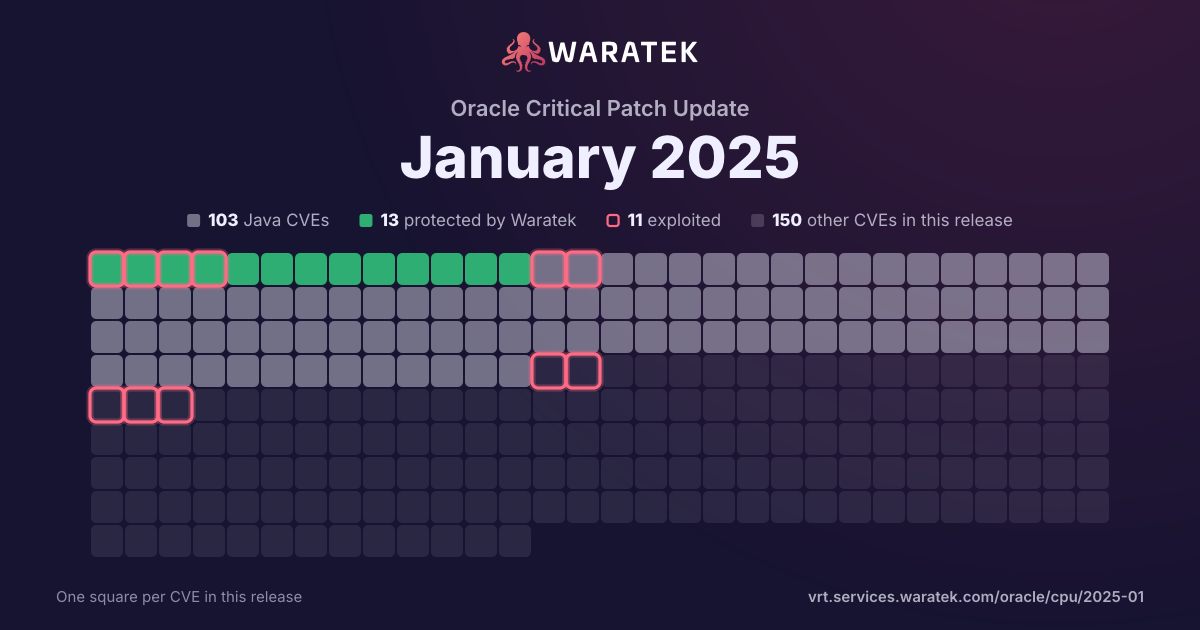
By status
13Protected by Waratek4Mitigation candidate86No exploit published17Outside Waratek scope133Not applicable
11Exploited, marked by the ring
No exploit published. For 48 of them, Oracle's security advisory is the source of public detail.
Protected by Waratek. Waratek RASP can block exploitation of these on systems that have not applied the patch yet.
Overview 25 matches · 11 in Waratek scope · 6 protected · 5 exploited · 2 CISA KEV · 6 public PoC · 3 EPSS ≥ 0.5
25matches
11in Waratek scope44.0%
6protected24.0%
5exploited20.0%
2CISA KEV8.0%
6public PoC24.0%
3EPSS ≥ 0.512.0%
Protected by Waratek
6
24.0%
Rule in development
0
0.0%
Mitigation candidate
2
8.0%
No exploit published
3
12.0%
Outside Waratek scope
2
8.0%
Not applicable
12
48.0%
Withdrawn CVE
0
0.0%
blocked by ARMR today
6
24.0%
partly blocked
0
0.0%
not blocked
19
76.0%
not established
0
0.0%
unrecorded
0
0.0%
Exploited
5
20.0%
Working exploit published
0
0.0%
Proof of concept only
3
12.0%
Forecast only
0
0.0%
No public exploit
17
68.0%
split by
peak 6 / quarter
Q3 191
Not applicable1
Critical1
not blocked1
No public exploit1
Q4 190
Q1 201
Protected by Waratek1
Critical1
blocked by ARMR today1
Proof of concept only1
Q2 200
Q3 200
Q4 200
Q1 211
Protected by Waratek1
Critical1
blocked by ARMR today1
No public exploit1
Q2 210
Q3 210
Q4 210
Q1 220
Q2 220
Q3 220
Q4 220
Q1 230
Q2 230
Q3 231
Not applicable1
Critical1
not blocked1
No public exploit1
Q4 232
Protected by Waratek1
Not applicable1
Critical2
blocked by ARMR today1
not blocked1
Exploited1
No public exploit1
Q1 241
Not applicable1
Critical1
not blocked1
No public exploit1
Q2 243
Outside Waratek scope1
Not applicable2
Critical3
not blocked3
No public exploit3
Q3 246
Not applicable6
Critical6
not blocked6
Exploited1
Proof of concept only1
No public exploit4
Q4 245
Protected by Waratek2
Mitigation candidate2
Outside Waratek scope1
Critical5
blocked by ARMR today2
not blocked3
Exploited2
Proof of concept only1
No public exploit2
Q1 254
Protected by Waratek1
No exploit published3
Critical4
blocked by ARMR today1
not blocked3
Exploited1
No public exploit3
Q3 19Q1 20Q3 20Q1 21Q3 21Q1 22Q3 22Q1 23Q3 23Q1 24Q3 24Q1 25
| CVE | Severity | Published▾ | Status | Exploitation | Description |
|---|---|---|---|---|---|
| CVE-2025-21556 | Critical | 2025-01-21 | No exploit published | No public exploit | Vulnerability in the Oracle Agile PLM Framework product of Oracle Supply Chain (component: Agile Integration Services). The supported version that is affected is 9.3.6. Easily exploitable vulnerability allows low privileged attacker with network access via HTTP to compromise Oracle Agile PLM Framework. While the vulnerability is in Oracle Agile PLM Framework, attacks may significantly impact additional products (scope change). Successful attacks of this vulnerability can result in takeover of Oracle Agile PLM Framework. CVSS 3.1 Base Score 9.9 (Confidentiality, Integrity and Availability impacts). CVSS Vector: (CVSS:3.1/AV:N/AC:L/PR:L/UI:N/S:C/C:H/I:H/A:H). |
| CVE-2025-21547 | Critical | 2025-01-21 | No exploit published | No public exploit | Vulnerability in the Oracle Hospitality OPERA 5 product of Oracle Hospitality Applications (component: Opera Servlet). Supported versions that are affected are 5.6.19.20, 5.6.25.8, 5.6.26.6 and 5.6.27.1. Easily exploitable vulnerability allows unauthenticated attacker with network access via HTTP to compromise Oracle Hospitality OPERA 5. Successful attacks of this vulnerability can result in unauthorized access to critical data or complete access to all Oracle Hospitality OPERA 5 accessible data and unauthorized ability to cause a hang or frequently repeatable crash (complete DOS) of Oracle Hospitality OPERA 5. CVSS 3.1 Base Score 9.1 (Confidentiality and Availability impacts). CVSS Vector: (CVSS:3.1/AV:N/AC:L/PR:N/UI:N/S:U/C:H/I:N/A:H). |
| CVE-2025-21535 | Critical | 2025-01-21 | Protected by Waratek | Exploited | Vulnerability in the Oracle WebLogic Server product of Oracle Fusion Middleware (component: Core). Supported versions that are affected are 12.2.1.4.0 and 14.1.1.0.0. Easily exploitable vulnerability allows unauthenticated attacker with network access via T3, IIOP to compromise Oracle WebLogic Server. Successful attacks of this vulnerability can result in takeover of Oracle WebLogic Server. CVSS 3.1 Base Score 9.8 (Confidentiality, Integrity and Availability impacts). CVSS Vector: (CVSS:3.1/AV:N/AC:L/PR:N/UI:N/S:U/C:H/I:H/A:H). |
| CVE-2025-21524 | Critical | 2025-01-21 | No exploit published | No public exploit | Vulnerability in the JD Edwards EnterpriseOne Tools product of Oracle JD Edwards (component: Monitoring and Diagnostics SEC). Supported versions that are affected are Prior to 9.2.9.0. Easily exploitable vulnerability allows unauthenticated attacker with network access via HTTP to compromise JD Edwards EnterpriseOne Tools. Successful attacks of this vulnerability can result in takeover of JD Edwards EnterpriseOne Tools. CVSS 3.1 Base Score 9.8 (Confidentiality, Integrity and Availability impacts). CVSS Vector: (CVSS:3.1/AV:N/AC:L/PR:N/UI:N/S:U/C:H/I:H/A:H). |
| CVE-2024-56337 | Critical | 2024-12-20 | Mitigation candidate | Exploited | Time-of-check Time-of-use (TOCTOU) Race Condition vulnerability in Apache Tomcat. This issue affects Apache Tomcat: from 11.0.0-M1 through 11.0.1, from 10.1.0-M1 through 10.1.33, from 9.0.0.M1 through 9.0.97. The following versions were EOL at the time the CVE was created but are known to be affected: 8.5.0 though 8.5.100. Other, older, EOL versions may also be affected. The mitigation for CVE-2024-50379 was incomplete. Users running Tomcat on a case insensitive file system with the default servlet write enabled (readonly initialisation parameter set to the non-default value of false) may need additional configuration to fully mitigate CVE-2024-50379 depending on which version of Java they are using with Tomcat: - running on Java 8 or Java 11: the system property sun.io.useCanonCaches must be explicitly set to false (it defaults to true) - running on Java 17: the system property sun.io.useCanonCaches, if set, must be set to false (it defaults to false) - running on Java 21 onwards: no further configuration is required (the system property and the problematic cache have been removed) Tomcat 11.0.3, 10.1.35 and 9.0.99 onwards will include checks that sun.io.useCanonCaches is set appropriately before allowing the default servlet to be write enabled on a case insensitive file system. Tomcat will also set sun.io.useCanonCaches to false by default where it can. |
| CVE-2024-50379 | Critical | 2024-12-17 | Mitigation candidate | Proof of concept only | Time-of-check Time-of-use (TOCTOU) Race Condition vulnerability during JSP compilation in Apache Tomcat permits an RCE on case insensitive file systems when the default servlet is enabled for write (non-default configuration). This issue affects Apache Tomcat: from 11.0.0-M1 through 11.0.1, from 10.1.0-M1 through 10.1.33, from 9.0.0.M1 through 9.0.97. The following versions were EOL at the time the CVE was created but are known to be affected: 8.5.0 though 8.5.100. Other, older, EOL versions may also be affected. Users are recommended to upgrade to version 11.0.2, 10.1.34 or 9.0.98, which fixes the issue. |
| CVE-2024-53677 | Critical | 2024-12-11 | Protected by Waratek | Exploited | File upload logic in Apache Struts is flawed. An attacker can manipulate file upload params to enable paths traversal and under some circumstances this can lead to uploading a malicious file which can be used to perform Remote Code Execution. This issue affects Apache Struts: from 2.0.0 before 6.4.0. Users are recommended to upgrade to version 6.4.0 at least and migrate to the new file upload mechanism https://struts.apache.org/core-developers/file-upload . If you are not using an old file upload logic based on FileuploadInterceptor your application is safe. You can find more details in https://cwiki.apache.org/confluence/display/WW/S2-067 |
| CVE-2024-4741 | Critical | 2024-11-13 | Outside Waratek scope | No public exploit | Issue summary: Calling the OpenSSL API function SSL_free_buffers may cause memory to be accessed that was previously freed in some situations Impact summary: A use after free can have a range of potential consequences such as the corruption of valid data, crashes or execution of arbitrary code. However, only applications that directly call the SSL_free_buffers function are affected by this issue. Applications that do not call this function are not vulnerable. Our investigations indicate that this function is rarely used by applications. The SSL_free_buffers function is used to free the internal OpenSSL buffer used when processing an incoming record from the network. The call is only expected to succeed if the buffer is not currently in use. However, two scenarios have been identified where the buffer is freed even when still in use. The first scenario occurs where a record header has been received from the network and processed by OpenSSL, but the full record body has not yet arrived. In this case calling SSL_free_buffers will succeed even though a record has only been partially processed and the buffer is still in use. The second scenario occurs where a full record containing application data has been received and processed by OpenSSL but the application has only read part of this data. Again a call to SSL_free_buffers will succeed even though the buffer is still in use. While these scenarios could occur accidentally during normal operation a malicious attacker could attempt to engineer a stituation where this occurs. We are not aware of this issue being actively exploited. The FIPS modules in 3.3, 3.2, 3.1 and 3.0 are not affected by this issue. |
| CVE-2024-47561 | Critical | 2024-10-03 | Protected by Waratek | No public exploit | Schema parsing in the Java SDK of Apache Avro 1.11.3 and previous versions allows bad actors to execute arbitrary code. Users are recommended to upgrade to version 1.11.4 or 1.12.0, which fix this issue. |
| CVE-2024-45492 | Critical | 2024-08-30 | Not applicable | No public exploit | An issue was discovered in libexpat before 2.6.3. nextScaffoldPart in xmlparse.c can have an integer overflow for m_groupSize on 32-bit platforms (where UINT_MAX equals SIZE_MAX). |
| CVE-2024-45491 | Critical | 2024-08-30 | Not applicable | No public exploit | An issue was discovered in libexpat before 2.6.3. dtdCopy in xmlparse.c can have an integer overflow for nDefaultAtts on 32-bit platforms (where UINT_MAX equals SIZE_MAX). |
| CVE-2024-45490 | Critical | 2024-08-30 | Not applicable | No public exploit | An issue was discovered in libexpat before 2.6.3. xmlparse.c does not reject a negative length for XML_ParseBuffer. |
| CVE-2024-40898 | Critical | 2024-07-18 | Not applicable | No public exploit | SSRF in Apache HTTP Server on Windows with mod_rewrite in server/vhost context, allows to potentially leak NTML hashes to a malicious server via SSRF and malicious requests. Users are recommended to upgrade to version 2.4.62 which fixes this issue. |
| CVE-2024-3596 | Critical | 2024-07-09 | Not applicable | Proof of concept only | RADIUS Protocol under RFC 2865 is susceptible to forgery attacks by a local attacker who can modify any valid Response (Access-Accept, Access-Reject, or Access-Challenge) to any other response using a chosen-prefix collision attack against MD5 Response Authenticator signature. |
| CVE-2024-38475 | Critical | 2024-07-01 | Not applicable | Exploited | Improper escaping of output in mod_rewrite in Apache HTTP Server 2.4.59 and earlier allows an attacker to map URLs to filesystem locations that are permitted to be served by the server but are not intentionally/directly reachable by any URL, resulting in code execution or source code disclosure. Substitutions in server context that use a backreferences or variables as the first segment of the substitution are affected. Some unsafe RewiteRules will be broken by this change and the rewrite flag "UnsafePrefixStat" can be used to opt back in once ensuring the substitution is appropriately constrained. |
| CVE-2024-37371 | Critical | 2024-06-28 | Not applicable | No public exploit | In MIT Kerberos 5 (aka krb5) before 1.21.3, an attacker can cause invalid memory reads during GSS message token handling by sending message tokens with invalid length fields. |
| CVE-2024-5535 | Critical | 2024-06-27 | Outside Waratek scope | No public exploit | Issue summary: Calling the OpenSSL API function SSL_select_next_proto with an empty supported client protocols buffer may cause a crash or memory contents to be sent to the peer. Impact summary: A buffer overread can have a range of potential consequences such as unexpected application beahviour or a crash. In particular this issue could result in up to 255 bytes of arbitrary private data from memory being sent to the peer leading to a loss of confidentiality. However, only applications that directly call the SSL_select_next_proto function with a 0 length list of supported client protocols are affected by this issue. This would normally never be a valid scenario and is typically not under attacker control but may occur by accident in the case of a configuration or programming error in the calling application. The OpenSSL API function SSL_select_next_proto is typically used by TLS applications that support ALPN (Application Layer Protocol Negotiation) or NPN (Next Protocol Negotiation). NPN is older, was never standardised and is deprecated in favour of ALPN. We believe that ALPN is significantly more widely deployed than NPN. The SSL_select_next_proto function accepts a list of protocols from the server and a list of protocols from the client and returns the first protocol that appears in the server list that also appears in the client list. In the case of no overlap between the two lists it returns the first item in the client list. In either case it will signal whether an overlap between the two lists was found. In the case where SSL_select_next_proto is called with a zero length client list it fails to notice this condition and returns the memory immediately following the client list pointer (and reports that there was no overlap in the lists). This function is typically called from a server side application callback for ALPN or a client side application callback for NPN. In the case of ALPN the list of protocols supplied by the client is guaranteed by libssl to never be zero in length. The list of server protocols comes from the application and should never normally be expected to be of zero length. In this case if the SSL_select_next_proto function has been called as expected (with the list supplied by the client passed in the client/client_len parameters), then the application will not be vulnerable to this issue. If the application has accidentally been configured with a zero length server list, and has accidentally passed that zero length server list in the client/client_len parameters, and has additionally failed to correctly handle a "no overlap" response (which would normally result in a handshake failure in ALPN) then it will be vulnerable to this problem. In the case of NPN, the protocol permits the client to opportunistically select a protocol when there is no overlap. OpenSSL returns the first client protocol in the no overlap case in support of this. The list of client protocols comes from the application and should never normally be expected to be of zero length. However if the SSL_select_next_proto function is accidentally called with a client_len of 0 then an invalid memory pointer will be returned instead. If the application uses this output as the opportunistic protocol then the loss of confidentiality will occur. This issue has been assessed as Low severity because applications are most likely to be vulnerable if they are using NPN instead of ALPN - but NPN is not widely used. It also requires an application configuration or programming error. Finally, this issue would not typically be under attacker control making active exploitation unlikely. The FIPS modules in 3.3, 3.2, 3.1 and 3.0 are not affected by this issue. Due to the low severity of this issue we are not issuing new releases of OpenSSL at this time. The fix will be included in the next releases when they become available. |
| CVE-2024-27280 | Critical | 2024-05-14 | Not applicable | No public exploit | A buffer-overread issue was discovered in StringIO 3.0.1, as distributed in Ruby 3.0.x through 3.0.6 and 3.1.x through 3.1.4. The ungetbyte and ungetc methods on a StringIO can read past the end of a string, and a subsequent call to StringIO.gets may return the memory value. 3.0.3 is the main fixed version; however, for Ruby 3.0 users, a fixed version is stringio 3.0.1.1, and for Ruby 3.1 users, a fixed version is stringio 3.0.1.2. |
| CVE-2024-23807 | Critical | 2024-02-29 | Not applicable | No public exploit | The Apache Xerces C++ XML parser on versions 3.0.0 before 3.2.5 contains a use-after-free error triggered during the scanning of external DTDs. Users are recommended to upgrade to version 3.2.5 which fixes the issue, or mitigate the issue by disabling DTD processing. This can be accomplished via the DOM using a standard parser feature, or via SAX using the XERCES_DISABLE_DTD environment variable. This issue has been disclosed before as CVE-2018-1311, but unfortunately that advisory incorrectly stated the issue would be fixed in version 3.2.3 or 3.2.4. |
| CVE-2023-3961 | Critical | 2023-11-03 | Not applicable | No public exploit | A path traversal vulnerability was identified in Samba when processing client pipe names connecting to Unix domain sockets within a private directory. Samba typically uses this mechanism to connect SMB clients to remote procedure call (RPC) services like SAMR LSA or SPOOLSS, which Samba initiates on demand. However, due to inadequate sanitization of incoming client pipe names, allowing a client to send a pipe name containing Unix directory traversal characters (../). This could result in SMB clients connecting as root to Unix domain sockets outside the private directory. If an attacker or client managed to send a pipe name resolving to an external service using an existing Unix domain socket, it could potentially lead to unauthorized access to the service and consequential adverse events, including compromise or service crashes. |
| CVE-2023-46604 | Critical | 2023-10-27 | Protected by Waratek | Exploited | The Java OpenWire protocol marshaller is vulnerable to Remote Code Execution. This vulnerability may allow a remote attacker with network access to either a Java-based OpenWire broker or client to run arbitrary shell commands by manipulating serialized class types in the OpenWire protocol to cause either the client or the broker (respectively) to instantiate any class on the classpath. Users are recommended to upgrade both brokers and clients to version 5.15.16, 5.16.7, 5.17.6, or 5.18.3 which fixes this issue. |
| CVE-2023-29824 | Critical | 2023-07-06 | Not applicable | No public exploit | A use-after-free issue was discovered in Py_FindObjects() function in SciPy versions prior to 1.8.0. NOTE: the vendor and discoverer indicate that this is not a security issue. |
| CVE-2021-23926 | Critical | 2021-01-14 | Protected by Waratek | No public exploit | The XML parsers used by XMLBeans up to version 2.6.0 did not set the properties needed to protect the user from malicious XML input. Vulnerabilities include possibilities for XML Entity Expansion attacks. Affects XMLBeans up to and including v2.6.0. |
| CVE-2016-1000027 | Critical | 2020-01-02 | Protected by Waratek | Proof of concept only | Pivotal Spring Framework through 5.3.16 suffers from a potential remote code execution (RCE) issue if used for Java deserialization of untrusted data. Depending on how the library is implemented within a product, this issue may or not occur, and authentication may be required. NOTE: the vendor's position is that untrusted data is not an intended use case. The product's behavior will not be changed because some users rely on deserialization of trusted data. |
| CVE-2019-15052 | Critical | 2019-08-14 | Not applicable | No public exploit | The HTTP client in Gradle before 5.6 sends authentication credentials originally destined for the configured host. If that host returns a 30x redirect, Gradle also sends those credentials to all subsequent hosts that the request redirects to. This is similar to CVE-2018-1000007. |