
Oracle Critical Patch Update January 2025
Released January 2025 · Oracle's advisory ↗ · ← Critical Patch Update, October 2024 · Critical Patch Update, April 2025 →
253 CVEs in this release, one square each
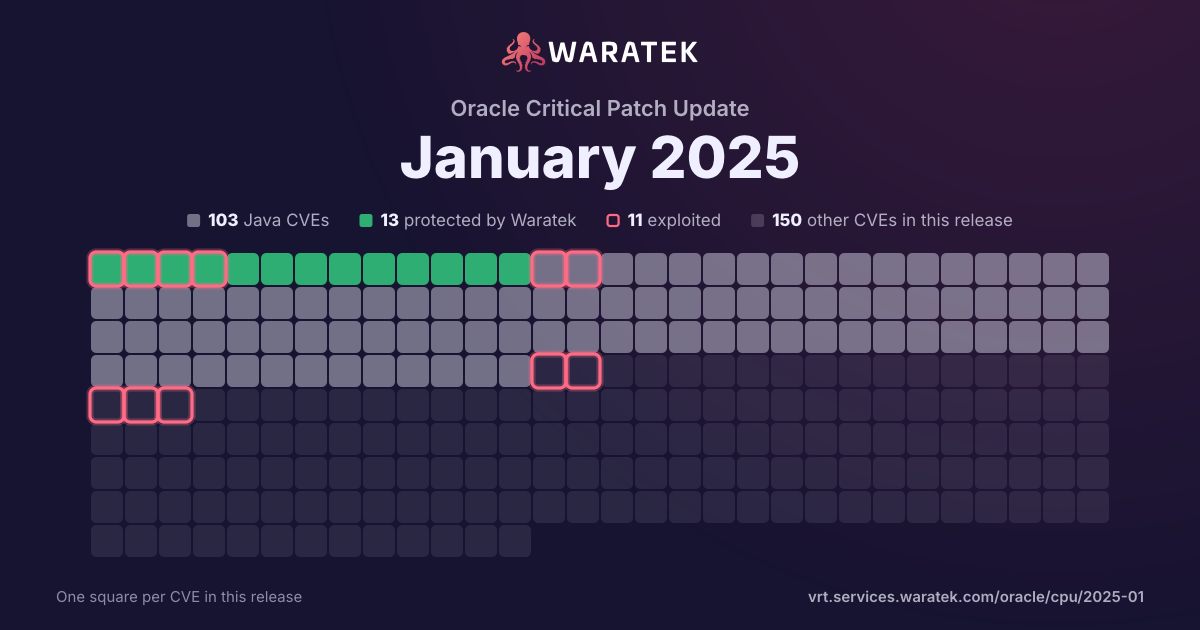
By status
13Protected by Waratek4Mitigation candidate86No exploit published17Outside Waratek scope133Not applicable
11Exploited, marked by the ring
No exploit published. For 48 of them, Oracle's security advisory is the source of public detail.
Protected by Waratek. Waratek RASP can block exploitation of these on systems that have not applied the patch yet.
Overview 18 matches · 9 in Waratek scope · 6 protected · 8 exploited · 3 CISA KEV · 10 EPSS ≥ 0.5
Protected by Waratek
6
33.3%
Rule in development
0
0.0%
Mitigation candidate
3
16.7%
No exploit published
0
0.0%
Outside Waratek scope
4
22.2%
Not applicable
5
27.8%
Withdrawn CVE
0
0.0%
blocked by ARMR today
6
33.3%
partly blocked
0
0.0%
not blocked
12
66.7%
not established
0
0.0%
unrecorded
0
0.0%
Exploited
8
44.4%
Working exploit published
2
11.1%
Proof of concept only
8
44.4%
Forecast only
0
0.0%
No public exploit
0
0.0%
split by
peak 4 / quarter
Q1 201
Protected by Waratek1
Critical1
blocked by ARMR today1
Proof of concept only1
Q2 200
Q3 200
Q4 200
Q1 210
Q2 210
Q3 210
Q4 210
Q1 220
Q2 220
Q3 221
Protected by Waratek1
High1
blocked by ARMR today1
Proof of concept only1
Q4 220
Q1 230
Q2 230
Q3 230
Q4 233
Protected by Waratek1
Mitigation candidate1
Outside Waratek scope1
Critical1
High1
Medium1
blocked by ARMR today1
not blocked2
Exploited3
Q1 242
Mitigation candidate1
Outside Waratek scope1
High2
not blocked2
Proof of concept only2
Q2 244
Outside Waratek scope2
Not applicable2
High4
not blocked4
Exploited2
Proof of concept only2
Q3 244
Protected by Waratek1
Not applicable3
Critical2
High2
blocked by ARMR today1
not blocked3
Exploited2
Working exploit published1
Proof of concept only1
Q4 243
Protected by Waratek2
Mitigation candidate1
Critical2
High1
blocked by ARMR today2
not blocked1
Exploited1
Working exploit published1
Proof of concept only1
Q2 20Q4 20Q2 21Q4 21Q2 22Q4 22Q2 23Q4 23Q2 24Q4 24
| CVE | Severity | Published▾ | Status | Exploitation | Description |
|---|---|---|---|---|---|
| CVE-2024-38819 | High | 2024-12-19 | Protected by Waratek | Working exploit published | Applications serving static resources through the functional web frameworks WebMvc.fn or WebFlux.fn are vulnerable to path traversal attacks. An attacker can craft malicious HTTP requests and obtain any file on the file system that is also accessible to the process in which the Spring application is running. |
| CVE-2024-50379 | Critical | 2024-12-17 | Mitigation candidate | Proof of concept only | Time-of-check Time-of-use (TOCTOU) Race Condition vulnerability during JSP compilation in Apache Tomcat permits an RCE on case insensitive file systems when the default servlet is enabled for write (non-default configuration). This issue affects Apache Tomcat: from 11.0.0-M1 through 11.0.1, from 10.1.0-M1 through 10.1.33, from 9.0.0.M1 through 9.0.97. The following versions were EOL at the time the CVE was created but are known to be affected: 8.5.0 though 8.5.100. Other, older, EOL versions may also be affected. Users are recommended to upgrade to version 11.0.2, 10.1.34 or 9.0.98, which fixes the issue. |
| CVE-2024-53677 | Critical | 2024-12-11 | Protected by Waratek | Exploited | File upload logic in Apache Struts is flawed. An attacker can manipulate file upload params to enable paths traversal and under some circumstances this can lead to uploading a malicious file which can be used to perform Remote Code Execution. This issue affects Apache Struts: from 2.0.0 before 6.4.0. Users are recommended to upgrade to version 6.4.0 at least and migrate to the new file upload mechanism https://struts.apache.org/core-developers/file-upload . If you are not using an old file upload logic based on FileuploadInterceptor your application is safe. You can find more details in https://cwiki.apache.org/confluence/display/WW/S2-067 |
| CVE-2024-38816 | High | 2024-09-13 | Protected by Waratek | Exploited | Applications serving static resources through the functional web frameworks WebMvc.fn or WebFlux.fn are vulnerable to path traversal attacks. An attacker can craft malicious HTTP requests and obtain any file on the file system that is also accessible to the process in which the Spring application is running. Specifically, an application is vulnerable when both of the following are true: * the web application uses RouterFunctions to serve static resources * resource handling is explicitly configured with a FileSystemResource location However, malicious requests are blocked and rejected when any of the following is true: * the Spring Security HTTP Firewall https://docs.spring.io/spring-security/reference/servlet/exploits/firewall.html is in use * the application runs on Tomcat or Jetty |
| CVE-2024-3596 | Critical | 2024-07-09 | Not applicable | Proof of concept only | RADIUS Protocol under RFC 2865 is susceptible to forgery attacks by a local attacker who can modify any valid Response (Access-Accept, Access-Reject, or Access-Challenge) to any other response using a chosen-prefix collision attack against MD5 Response Authenticator signature. |
| CVE-2024-38475 | Critical | 2024-07-01 | Not applicable | Exploited | Improper escaping of output in mod_rewrite in Apache HTTP Server 2.4.59 and earlier allows an attacker to map URLs to filesystem locations that are permitted to be served by the server but are not intentionally/directly reachable by any URL, resulting in code execution or source code disclosure. Substitutions in server context that use a backreferences or variables as the first segment of the substitution are affected. Some unsafe RewiteRules will be broken by this change and the rewrite flag "UnsafePrefixStat" can be used to opt back in once ensuring the substitution is appropriately constrained. |
| CVE-2024-38473 | High | 2024-07-01 | Not applicable | Working exploit published | Encoding problem in mod_proxy in Apache HTTP Server 2.4.59 and earlier allows request URLs with incorrect encoding to be sent to backend services, potentially bypassing authentication via crafted requests. Users are recommended to upgrade to version 2.4.60, which fixes this issue. |
| CVE-2024-38526 | High | 2024-06-26 | Not applicable | Exploited | pdoc provides API Documentation for Python Projects. Documentation generated with `pdoc --math` linked to JavaScript files from polyfill.io. The polyfill.io CDN has been sold and now serves malicious code. This issue has been fixed in pdoc 14.5.1. |
| CVE-2024-2961 | High | 2024-04-17 | Outside Waratek scope | Exploited | The iconv() function in the GNU C Library versions 2.39 and older may overflow the output buffer passed to it by up to 4 bytes when converting strings to the ISO-2022-CN-EXT character set, which may be used to crash an application or overwrite a neighbouring variable. |
| CVE-2024-27983 | High | 2024-04-09 | Not applicable | Proof of concept only | An attacker can make the Node.js HTTP/2 server completely unavailable by sending a small amount of HTTP/2 frames packets with a few HTTP/2 frames inside. It is possible to leave some data in nghttp2 memory after reset when headers with HTTP/2 CONTINUATION frame are sent to the server and then a TCP connection is abruptly closed by the client triggering the Http2Session destructor while header frames are still being processed (and stored in memory) causing a race condition. |
| CVE-2023-38709 | High | 2024-04-04 | Outside Waratek scope | Proof of concept only | Faulty input validation in the core of Apache allows malicious or exploitable backend/content generators to split HTTP responses. This issue affects Apache HTTP Server: through 2.4.58. |
| CVE-2024-24549 | High | 2024-03-13 | Mitigation candidate | Proof of concept only | Denial of Service due to improper input validation vulnerability for HTTP/2 requests in Apache Tomcat. When processing an HTTP/2 request, if the request exceeded any of the configured limits for headers, the associated HTTP/2 stream was not reset until after all of the headers had been processed.This issue affects Apache Tomcat: from 11.0.0-M1 through 11.0.0-M16, from 10.1.0-M1 through 10.1.18, from 9.0.0-M1 through 9.0.85, from 8.5.0 through 8.5.98. Other, older, EOL versions may also be affected. Users are recommended to upgrade to version 11.0.0-M17, 10.1.19, 9.0.86 or 8.5.99 which fix the issue. |
| CVE-2023-50868 | High | 2024-02-14 | Outside Waratek scope | Proof of concept only | The Closest Encloser Proof aspect of the DNS protocol (in RFC 5155 when RFC 9276 guidance is skipped) allows remote attackers to cause a denial of service (CPU consumption for SHA-1 computations) via DNSSEC responses in a random subdomain attack, aka the "NSEC3" issue. The RFC 5155 specification implies that an algorithm must perform thousands of iterations of a hash function in certain situations. |
| CVE-2023-48795 | Medium | 2023-12-18 | Outside Waratek scope | Exploited | The SSH transport protocol with certain OpenSSH extensions, found in OpenSSH before 9.6 and other products, allows remote attackers to bypass integrity checks such that some packets are omitted (from the extension negotiation message), and a client and server may consequently end up with a connection for which some security features have been downgraded or disabled, aka a Terrapin attack. This occurs because the SSH Binary Packet Protocol (BPP), implemented by these extensions, mishandles the handshake phase and mishandles use of sequence numbers. For example, there is an effective attack against SSH's use of ChaCha20-Poly1305 (and CBC with Encrypt-then-MAC). The bypass occurs in chacha20-poly1305@openssh.com and (if CBC is used) the -etm@openssh.com MAC algorithms. This also affects Maverick Synergy Java SSH API before 3.1.0-SNAPSHOT, Dropbear through 2022.83, Ssh before 5.1.1 in Erlang/OTP, PuTTY before 0.80, AsyncSSH before 2.14.2, golang.org/x/crypto before 0.17.0, libssh before 0.10.6, libssh2 through 1.11.0, Thorn Tech SFTP Gateway before 3.4.6, Tera Term before 5.1, Paramiko before 3.4.0, jsch before 0.2.15, SFTPGo before 2.5.6, Netgate pfSense Plus through 23.09.1, Netgate pfSense CE through 2.7.2, HPN-SSH through 18.2.0, ProFTPD before 1.3.8b (and before 1.3.9rc2), ORYX CycloneSSH before 2.3.4, NetSarang XShell 7 before Build 0144, CrushFTP before 10.6.0, ConnectBot SSH library before 2.2.22, Apache MINA sshd through 2.11.0, sshj through 0.37.0, TinySSH through 20230101, trilead-ssh2 6401, LANCOM LCOS and LANconfig, FileZilla before 3.66.4, Nova before 11.8, PKIX-SSH before 14.4, SecureCRT before 9.4.3, Transmit5 before 5.10.4, Win32-OpenSSH before 9.5.0.0p1-Beta, WinSCP before 6.2.2, Bitvise SSH Server before 9.32, Bitvise SSH Client before 9.33, KiTTY through 0.76.1.13, the net-ssh gem 7.2.0 for Ruby, the mscdex ssh2 module before 1.15.0 for Node.js, the thrussh library before 0.35.1 for Rust, and the Russh crate before 0.40.2 for Rust. |
| CVE-2023-46604 | Critical | 2023-10-27 | Protected by Waratek | Exploited | The Java OpenWire protocol marshaller is vulnerable to Remote Code Execution. This vulnerability may allow a remote attacker with network access to either a Java-based OpenWire broker or client to run arbitrary shell commands by manipulating serialized class types in the OpenWire protocol to cause either the client or the broker (respectively) to instantiate any class on the classpath. Users are recommended to upgrade both brokers and clients to version 5.15.16, 5.16.7, 5.17.6, or 5.18.3 which fixes this issue. |
| CVE-2023-44487 | High | 2023-10-10 | Mitigation candidate | Exploited | The HTTP/2 protocol allows a denial of service (server resource consumption) because request cancellation can reset many streams quickly, as exploited in the wild in August through October 2023. |
| CVE-2022-34169 | High | 2022-07-19 | Protected by Waratek | Proof of concept only | The Apache Xalan Java XSLT library is vulnerable to an integer truncation issue when processing malicious XSLT stylesheets. This can be used to corrupt Java class files generated by the internal XSLTC compiler and execute arbitrary Java bytecode. Users are recommended to update to version 2.7.3 or later. Note: Java runtimes (such as OpenJDK) include repackaged copies of Xalan. |
| CVE-2016-1000027 | Critical | 2020-01-02 | Protected by Waratek | Proof of concept only | Pivotal Spring Framework through 5.3.16 suffers from a potential remote code execution (RCE) issue if used for Java deserialization of untrusted data. Depending on how the library is implemented within a product, this issue may or not occur, and authentication may be required. NOTE: the vendor's position is that untrusted data is not an intended use case. The product's behavior will not be changed because some users rely on deserialization of trusted data. |