
Oracle Critical Patch Update October 2024
Released October 2024 · Oracle's advisory ↗ · ← Critical Patch Update, July 2024 · Critical Patch Update, January 2025 →
278 CVEs in this release, one square each
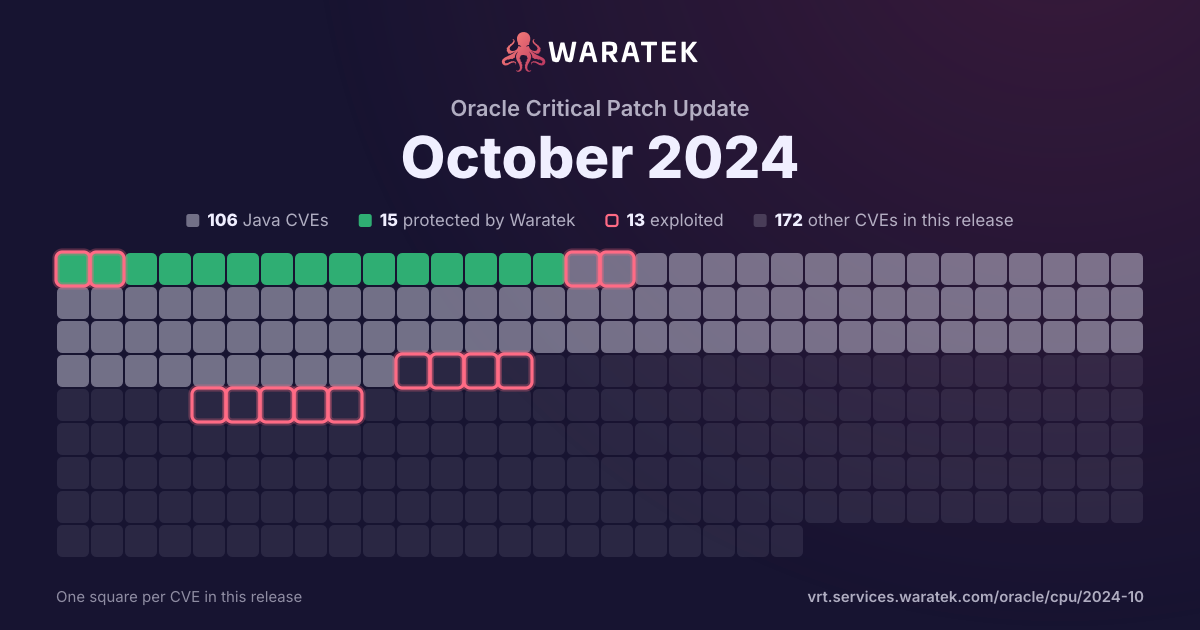
By status
14Protected by Waratek2Mitigation candidate90No exploit published4Outside Waratek scope166Not applicable2Withdrawn CVE
13Exploited, marked by the ring
No exploit published. For 44 of them, Oracle's security advisory is the source of public detail.
Protected by Waratek. Waratek RASP can block exploitation of these on systems that have not applied the patch yet.
Overview 23 matches · 0 protected · 0 exploited · 0 CISA KEV · 0 public PoC · 0 EPSS ≥ 0.5
23matches
0protected0.0%
0exploited0.0%
0CISA KEV0.0%
0public PoC0.0%
0EPSS ≥ 0.50.0%
Protected by Waratek
0
0.0%
Rule in development
0
0.0%
Mitigation candidate
0
0.0%
No exploit published
23
100.0%
blocked by ARMR today
0
0.0%
partly blocked
0
0.0%
not blocked
23
100.0%
not established
0
0.0%
unrecorded
0
0.0%
Exploited
0
0.0%
Working exploit published
0
0.0%
Proof of concept only
3
13.0%
Forecast only
0
0.0%
No public exploit
20
87.0%
split by
peak 9 / quarter
Q4 202
No exploit published2
Medium1
Low1
not blocked2
No public exploit2
Q1 210
Q2 211
No exploit published1
Medium1
not blocked1
No public exploit1
Q3 210
Q4 211
No exploit published1
High1
not blocked1
No public exploit1
Q1 220
Q2 220
Q3 220
Q4 220
Q1 230
Q2 232
No exploit published2
High1
Medium1
not blocked2
No public exploit2
Q3 232
No exploit published2
High1
Medium1
not blocked2
No public exploit2
Q4 235
No exploit published5
Critical1
High2
Medium2
not blocked5
No public exploit5
Q1 249
No exploit published9
Critical1
High4
Medium4
not blocked9
Proof of concept only3
No public exploit6
Q2 241
No exploit published1
High1
not blocked1
No public exploit1
Q4 20Q2 21Q4 21Q2 22Q4 22Q2 23Q4 23Q2 24
| CVE | Severity | Published▾ | Status | Exploitation | Description |
|---|---|---|---|---|---|
| CVE-2024-29857 | High | 2024-05-14 | No exploit published | No public exploit | An issue was discovered in ECCurve.java and ECCurve.cs in Bouncy Castle Java (BC Java) before 1.78, BC Java LTS before 2.73.6, BC-FJA before 1.0.2.5, and BC C# .Net before 2.3.1. Importing an EC certificate with crafted F2m parameters can lead to excessive CPU consumption during the evaluation of the curve parameters. |
| CVE-2024-29025 | Medium | 2024-03-25 | No exploit published | Proof of concept only | Netty is an asynchronous event-driven network application framework for rapid development of maintainable high performance protocol servers & clients. The `HttpPostRequestDecoder` can be tricked to accumulate data. While the decoder can store items on the disk if configured so, there are no limits to the number of fields the form can have, an attacher can send a chunked post consisting of many small fields that will be accumulated in the `bodyListHttpData` list. The decoder cumulates bytes in the `undecodedChunk` buffer until it can decode a field, this field can cumulate data without limits. This vulnerability is fixed in 4.1.108.Final. |
| CVE-2023-5685 | High | 2024-03-22 | No exploit published | No public exploit | A flaw was found in XNIO. The XNIO NotifierState that can cause a Stack Overflow Exception when the chain of notifier states becomes problematically large can lead to uncontrolled resource management and a possible denial of service (DoS). |
| CVE-2024-22257 | High | 2024-03-18 | No exploit published | No public exploit | In Spring Security, versions 5.7.x prior to 5.7.12, 5.8.x prior to 5.8.11, versions 6.0.x prior to 6.0.9, versions 6.1.x prior to 6.1.8, versions 6.2.x prior to 6.2.3, an application is possible vulnerable to broken access control when it directly uses the AuthenticatedVoter#vote passing a null Authentication parameter. |
| CVE-2024-28752 | Critical | 2024-03-15 | No exploit published | No public exploit | A SSRF vulnerability using the Aegis DataBinding in versions of Apache CXF before 4.0.4, 3.6.3 and 3.5.8 allows an attacker to perform SSRF style attacks on webservices that take at least one parameter of any type. Users of other data bindings (including the default databinding) are not impacted. |
| CVE-2024-23672 | Medium | 2024-03-13 | No exploit published | No public exploit | Denial of Service via incomplete cleanup vulnerability in Apache Tomcat. It was possible for WebSocket clients to keep WebSocket connections open leading to increased resource consumption.This issue affects Apache Tomcat: from 11.0.0-M1 through 11.0.0-M16, from 10.1.0-M1 through 10.1.18, from 9.0.0-M1 through 9.0.85, from 8.5.0 through 8.5.98. Older, EOL versions may also be affected. Users are recommended to upgrade to version 11.0.0-M17, 10.1.19, 9.0.86 or 8.5.99 which fix the issue. |
| CVE-2023-51775 | Medium | 2024-02-29 | No exploit published | Proof of concept only | The jose4j component before 0.9.4 for Java allows attackers to cause a denial of service (CPU consumption) via a large p2c (aka PBES2 Count) value. |
| CVE-2024-22201 | High | 2024-02-26 | No exploit published | Proof of concept only | Jetty is a Java based web server and servlet engine. An HTTP/2 SSL connection that is established and TCP congested will be leaked when it times out. An attacker can cause many connections to end up in this state, and the server may run out of file descriptors, eventually causing the server to stop accepting new connections from valid clients. The vulnerability is patched in 9.4.54, 10.0.20, 11.0.20, and 12.0.6. |
| CVE-2024-26308 | Medium | 2024-02-19 | No exploit published | No public exploit | Allocation of Resources Without Limits or Throttling vulnerability in Apache Commons Compress.This issue affects Apache Commons Compress: from 1.21 before 1.26. Users are recommended to upgrade to version 1.26, which fixes the issue. |
| CVE-2024-25710 | High | 2024-02-19 | No exploit published | No public exploit | Loop with Unreachable Exit Condition ('Infinite Loop') vulnerability in Apache Commons Compress.This issue affects Apache Commons Compress: from 1.3 through 1.25.0. Users are recommended to upgrade to version 1.26.0 which fixes the issue. |
| CVE-2023-34055 | Medium | 2023-11-28 | No exploit published | No public exploit | In Spring Boot versions 2.7.0 - 2.7.17, 3.0.0-3.0.12 and 3.1.0-3.1.5, it is possible for a user to provide specially crafted HTTP requests that may cause a denial-of-service (DoS) condition. Specifically, an application is vulnerable when all of the following are true: * the application uses Spring MVC or Spring WebFlux * org.springframework.boot:spring-boot-actuator is on the classpath |
| CVE-2022-46337 | Critical | 2023-11-20 | No exploit published | No public exploit | A cleverly devised username might bypass LDAP authentication checks. In LDAP-authenticated Derby installations, this could let an attacker fill up the disk by creating junk Derby databases. In LDAP-authenticated Derby installations, this could also allow the attacker to execute malware which was visible to and executable by the account which booted the Derby server. In LDAP-protected databases which weren't also protected by SQL GRANT/REVOKE authorization, this vulnerability could also let an attacker view and corrupt sensitive data and run sensitive database functions and procedures. Mitigation: Users should upgrade to Java 21 and Derby 10.17.1.0. Alternatively, users who wish to remain on older Java versions should build their own Derby distribution from one of the release families to which the fix was backported: 10.16, 10.15, and 10.14. Those are the releases which correspond, respectively, with Java LTS versions 17, 11, and 8. |
| CVE-2023-4043 | High | 2023-11-03 | No exploit published | No public exploit | In Eclipse Parsson before versions 1.1.4 and 1.0.5, Parsing JSON from untrusted sources can lead malicious actors to exploit the fact that the built-in support for parsing numbers with large scale in Java has a number of edge cases where the input text of a number can lead to much larger processing time than one would expect. To mitigate the risk, parsson put in place a size limit for the numbers as well as their scale. |
| CVE-2023-44483 | Medium | 2023-10-20 | No exploit published | No public exploit | All versions of Apache Santuario - XML Security for Java prior to 2.2.6, 2.3.4, and 3.0.3, when using the JSR 105 API, are vulnerable to an issue where a private key may be disclosed in log files when generating an XML Signature and logging with debug level is enabled. Users are recommended to upgrade to version 2.2.6, 2.3.4, or 3.0.3, which fixes this issue. |
| CVE-2023-5072 | High | 2023-10-12 | No exploit published | No public exploit | Denial of Service in JSON-Java versions up to and including 20230618. A bug in the parser means that an input string of modest size can lead to indefinite amounts of memory being used. |
| CVE-2023-3635 | High | 2023-07-12 | No exploit published | No public exploit | GzipSource does not handle an exception that might be raised when parsing a malformed gzip buffer. This may lead to denial of service of the Okio client when handling a crafted GZIP archive, by using the GzipSource class. |
| CVE-2023-33201 | Medium | 2023-07-05 | No exploit published | No public exploit | Bouncy Castle For Java before 1.74 is affected by an LDAP injection vulnerability. The vulnerability only affects applications that use an LDAP CertStore from Bouncy Castle to validate X.509 certificates. During the certificate validation process, Bouncy Castle inserts the certificate's Subject Name into an LDAP search filter without any escaping, which leads to an LDAP injection vulnerability. |
| CVE-2023-2976 | High | 2023-06-14 | No exploit published | No public exploit | Use of Java's default temporary directory for file creation in `FileBackedOutputStream` in Google Guava versions 1.0 to 31.1 on Unix systems and Android Ice Cream Sandwich allows other users and apps on the machine with access to the default Java temporary directory to be able to access the files created by the class. Even though the security vulnerability is fixed in version 32.0.0, we recommend using version 32.0.1 as version 32.0.0 breaks some functionality under Windows. |
| CVE-2023-20863 | Medium | 2023-04-13 | No exploit published | No public exploit | In spring framework versions prior to 5.2.24 release+ ,5.3.27+ and 6.0.8+ , it is possible for a user to provide a specially crafted SpEL expression that may cause a denial-of-service (DoS) condition. |
| CVE-2021-37137 | High | 2021-10-19 | No exploit published | No public exploit | The Snappy frame decoder function doesn't restrict the chunk length which may lead to excessive memory usage. Beside this it also may buffer reserved skippable chunks until the whole chunk was received which may lead to excessive memory usage as well. This vulnerability can be triggered by supplying malicious input that decompresses to a very big size (via a network stream or a file) or by sending a huge skippable chunk. |
| CVE-2021-28170 | Medium | 2021-05-26 | No exploit published | No public exploit | In the Jakarta Expression Language implementation 3.0.3 and earlier, a bug in the ELParserTokenManager enables invalid EL expressions to be evaluated as if they were valid. |
| CVE-2020-8908 | Low | 2020-12-10 | No exploit published | No public exploit | A temp directory creation vulnerability exists in all versions of Guava, allowing an attacker with access to the machine to potentially access data in a temporary directory created by the Guava API com.google.common.io.Files.createTempDir(). By default, on unix-like systems, the created directory is world-readable (readable by an attacker with access to the system). The method in question has been marked @Deprecated in versions 30.0 and later and should not be used. For Android developers, we recommend choosing a temporary directory API provided by Android, such as context.getCacheDir(). For other Java developers, we recommend migrating to the Java 7 API java.nio.file.Files.createTempDirectory() which explicitly configures permissions of 700, or configuring the Java runtime's java.io.tmpdir system property to point to a location whose permissions are appropriately configured. |
| CVE-2020-13956 | Medium | 2020-12-02 | No exploit published | No public exploit | Apache HttpClient versions prior to version 4.5.13 and 5.0.3 can misinterpret malformed authority component in request URIs passed to the library as java.net.URI object and pick the wrong target host for request execution. |