
Oracle Critical Patch Update October 2024
Released October 2024 · Oracle's advisory ↗ · ← Critical Patch Update, July 2024 · Critical Patch Update, January 2025 →
278 CVEs in this release, one square each
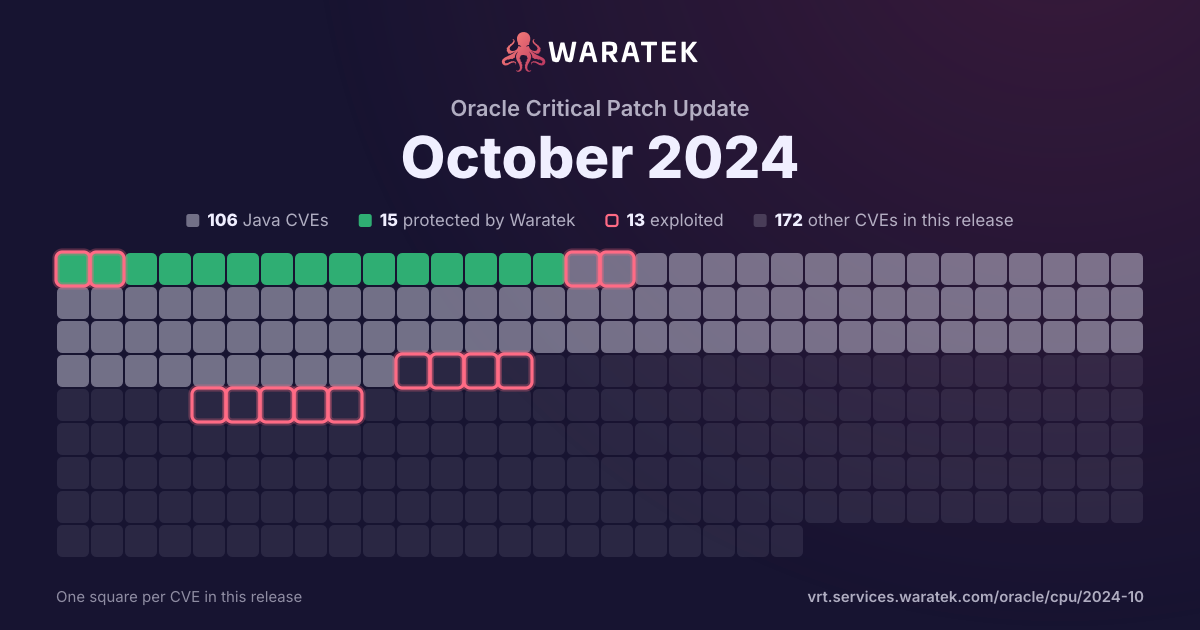
By status
15Protected by Waratek3Mitigation candidate88No exploit published26Outside Waratek scope144Not applicable2Withdrawn CVE
13Exploited, marked by the ring
No exploit published. For 51 of them, Oracle's security advisory is the source of public detail.
Protected by Waratek. Waratek RASP can block exploitation of these on systems that have not applied the patch yet.
Overview 278 matches · 106 in Waratek scope · 15 protected · 13 exploited · 5 CISA KEV · 23 public PoC · 21 EPSS ≥ 0.5
278matches
106in Waratek scope38.1%
15protected5.4%
13exploited4.7%
5CISA KEV1.8%
23public PoC8.3%
21EPSS ≥ 0.57.6%
Protected by Waratek
15
5.4%
Rule in development
0
0.0%
Mitigation candidate
3
1.1%
No exploit published
88
31.7%
Outside Waratek scope
26
9.4%
Not applicable
144
51.8%
Withdrawn CVE
2
0.7%
blocked by ARMR today
15
5.4%
partly blocked
0
0.0%
not blocked
263
94.6%
not established
0
0.0%
unrecorded
0
0.0%
split by
peak 86 / quarter
Q4 191
Protected by Waratek1
High1
blocked by ARMR today1
No public exploit1
Q1 200
Q2 203
Outside Waratek scope3
Medium3
not blocked3
Exploited2
No public exploit1
Q3 201
Outside Waratek scope1
High1
not blocked1
Proof of concept only1
Q4 203
Protected by Waratek1
No exploit published1
Outside Waratek scope1
Medium2
Low1
blocked by ARMR today1
not blocked2
No public exploit3
Q1 211
Not applicable1
High1
not blocked1
Proof of concept only1
Q2 212
Protected by Waratek1
Outside Waratek scope1
Critical1
Medium1
blocked by ARMR today1
not blocked1
No public exploit2
Q3 210
Q4 215
Protected by Waratek1
Outside Waratek scope4
High2
Medium3
blocked by ARMR today1
not blocked4
Proof of concept only1
No public exploit4
Q1 225
Protected by Waratek3
No exploit published1
Not applicable1
Critical1
High2
Medium1
Low1
blocked by ARMR today3
not blocked2
Proof of concept only1
Forecast only2
No public exploit2
Q2 222
Outside Waratek scope2
Critical2
not blocked2
Proof of concept only2
Q3 222
Outside Waratek scope1
Not applicable1
High1
Medium1
not blocked2
Proof of concept only2
Q4 222
Not applicable2
High2
not blocked2
No public exploit2
Q1 2312
Protected by Waratek1
Not applicable11
Critical1
High7
Medium4
blocked by ARMR today1
not blocked11
Exploited1
Proof of concept only1
Forecast only1
No public exploit9
Q2 234
No exploit published3
Outside Waratek scope1
High2
Medium2
not blocked4
No public exploit4
Q3 2310
Protected by Waratek1
No exploit published4
Not applicable5
Critical1
High5
Medium4
blocked by ARMR today1
not blocked9
Exploited1
Proof of concept only1
No public exploit8
Q4 2316
Mitigation candidate1
No exploit published5
Outside Waratek scope2
Not applicable8
Critical2
High6
Medium8
not blocked16
Exploited2
Proof of concept only3
No public exploit11
Q1 2442
Mitigation candidate1
No exploit published13
Outside Waratek scope1
Not applicable26
Withdrawn CVE1
Critical4
High21
Medium16
Unknown1
not blocked42
Proof of concept only7
No public exploit35
Q2 2437
Protected by Waratek1
Mitigation candidate1
No exploit published2
Outside Waratek scope6
Not applicable27
Critical4
High17
Medium16
blocked by ARMR today1
not blocked36
Exploited4
Proof of concept only7
Forecast only2
No public exploit24
Q3 2443
Protected by Waratek3
No exploit published12
Outside Waratek scope1
Not applicable26
Withdrawn CVE1
Critical9
High19
Medium11
Low3
Unknown1
blocked by ARMR today3
not blocked40
Exploited3
Working exploit published2
Proof of concept only5
Forecast only1
No public exploit32
Q4 2486
Protected by Waratek2
No exploit published47
Outside Waratek scope2
Not applicable35
Critical3
High32
Medium36
Low15
blocked by ARMR today2
not blocked84
No public exploit86
Q1 251
Not applicable1
Low1
not blocked1
No public exploit1
Q1 20Q3 20Q1 21Q3 21Q1 22Q3 22Q1 23Q3 23Q1 24Q3 24Q1 25
| CVE | Severity | Published▾ | Status | Exploitation | Description |
|---|---|---|---|---|---|
| CVE-2024-37372 | Low | 2025-01-09 | Not applicable | No public exploit | The Permission Model assumes that any path starting with two backslashes \ has a four-character prefix that can be ignored, which is not always true. This subtle bug leads to vulnerable edge cases. |
| CVE-2024-4741 | Critical | 2024-11-13 | Outside Waratek scope | No public exploit | Issue summary: Calling the OpenSSL API function SSL_free_buffers may cause memory to be accessed that was previously freed in some situations Impact summary: A use after free can have a range of potential consequences such as the corruption of valid data, crashes or execution of arbitrary code. However, only applications that directly call the SSL_free_buffers function are affected by this issue. Applications that do not call this function are not vulnerable. Our investigations indicate that this function is rarely used by applications. The SSL_free_buffers function is used to free the internal OpenSSL buffer used when processing an incoming record from the network. The call is only expected to succeed if the buffer is not currently in use. However, two scenarios have been identified where the buffer is freed even when still in use. The first scenario occurs where a record header has been received from the network and processed by OpenSSL, but the full record body has not yet arrived. In this case calling SSL_free_buffers will succeed even though a record has only been partially processed and the buffer is still in use. The second scenario occurs where a full record containing application data has been received and processed by OpenSSL but the application has only read part of this data. Again a call to SSL_free_buffers will succeed even though the buffer is still in use. While these scenarios could occur accidentally during normal operation a malicious attacker could attempt to engineer a stituation where this occurs. We are not aware of this issue being actively exploited. The FIPS modules in 3.3, 3.2, 3.1 and 3.0 are not affected by this issue. |
| CVE-2024-21286 | Medium | 2024-10-15 | No exploit published | No public exploit | Vulnerability in the PeopleSoft Enterprise ELM Enterprise Learning Management product of Oracle PeopleSoft (component: Enterprise Learning Management). The supported version that is affected is 9.2. Easily exploitable vulnerability allows low privileged attacker with network access via HTTP to compromise PeopleSoft Enterprise ELM Enterprise Learning Management. Successful attacks require human interaction from a person other than the attacker and while the vulnerability is in PeopleSoft Enterprise ELM Enterprise Learning Management, attacks may significantly impact additional products (scope change). Successful attacks of this vulnerability can result in unauthorized update, insert or delete access to some of PeopleSoft Enterprise ELM Enterprise Learning Management accessible data as well as unauthorized read access to a subset of PeopleSoft Enterprise ELM Enterprise Learning Management accessible data. CVSS 3.1 Base Score 5.4 (Confidentiality and Integrity impacts). CVSS Vector: (CVSS:3.1/AV:N/AC:L/PR:L/UI:R/S:C/C:L/I:L/A:N). |
| CVE-2024-21285 | High | 2024-10-15 | No exploit published | No public exploit | Vulnerability in the Oracle Banking Liquidity Management product of Oracle Financial Services Applications (component: Reports). The supported version that is affected is 14.5.0.12.0. Difficult to exploit vulnerability allows low privileged attacker with network access via HTTP to compromise Oracle Banking Liquidity Management. Successful attacks require human interaction from a person other than the attacker. Successful attacks of this vulnerability can result in takeover of Oracle Banking Liquidity Management. CVSS 3.1 Base Score 7.1 (Confidentiality, Integrity and Availability impacts). CVSS Vector: (CVSS:3.1/AV:N/AC:H/PR:L/UI:R/S:U/C:H/I:H/A:H). |
| CVE-2024-21284 | High | 2024-10-15 | No exploit published | No public exploit | Vulnerability in the Oracle Banking Liquidity Management product of Oracle Financial Services Applications (component: Reports). The supported version that is affected is 14.5.0.12.0. Difficult to exploit vulnerability allows low privileged attacker with network access via HTTP to compromise Oracle Banking Liquidity Management. Successful attacks require human interaction from a person other than the attacker. Successful attacks of this vulnerability can result in takeover of Oracle Banking Liquidity Management. CVSS 3.1 Base Score 7.1 (Confidentiality, Integrity and Availability impacts). CVSS Vector: (CVSS:3.1/AV:N/AC:H/PR:L/UI:R/S:U/C:H/I:H/A:H). |
| CVE-2024-21283 | High | 2024-10-15 | No exploit published | No public exploit | Vulnerability in the PeopleSoft Enterprise HCM Global Payroll Core product of Oracle PeopleSoft (component: Global Payroll for Core). Supported versions that are affected are 9.2.48-9.2.50. Easily exploitable vulnerability allows low privileged attacker with network access via HTTP to compromise PeopleSoft Enterprise HCM Global Payroll Core. Successful attacks of this vulnerability can result in unauthorized creation, deletion or modification access to critical data or all PeopleSoft Enterprise HCM Global Payroll Core accessible data as well as unauthorized access to critical data or complete access to all PeopleSoft Enterprise HCM Global Payroll Core accessible data. CVSS 3.1 Base Score 8.1 (Confidentiality and Integrity impacts). CVSS Vector: (CVSS:3.1/AV:N/AC:L/PR:L/UI:N/S:U/C:H/I:H/A:N). |
| CVE-2024-21282 | High | 2024-10-15 | No exploit published | No public exploit | Vulnerability in the Oracle Financials product of Oracle E-Business Suite (component: Common Components). Supported versions that are affected are 12.2.3-12.2.13. Easily exploitable vulnerability allows low privileged attacker with network access via HTTP to compromise Oracle Financials. Successful attacks of this vulnerability can result in unauthorized creation, deletion or modification access to critical data or all Oracle Financials accessible data as well as unauthorized access to critical data or complete access to all Oracle Financials accessible data. CVSS 3.1 Base Score 8.1 (Confidentiality and Integrity impacts). CVSS Vector: (CVSS:3.1/AV:N/AC:L/PR:L/UI:N/S:U/C:H/I:H/A:N). |
| CVE-2024-21281 | Medium | 2024-10-15 | No exploit published | No public exploit | Vulnerability in the Oracle Banking Liquidity Management product of Oracle Financial Services Applications (component: Infrastructure). The supported version that is affected is 14.7.0.6.0. Difficult to exploit vulnerability allows high privileged attacker with network access via HTTP to compromise Oracle Banking Liquidity Management. Successful attacks require human interaction from a person other than the attacker. Successful attacks of this vulnerability can result in unauthorized creation, deletion or modification access to critical data or all Oracle Banking Liquidity Management accessible data as well as unauthorized read access to a subset of Oracle Banking Liquidity Management accessible data and unauthorized ability to cause a partial denial of service (partial DOS) of Oracle Banking Liquidity Management. CVSS 3.1 Base Score 5.3 (Confidentiality, Integrity and Availability impacts). CVSS Vector: (CVSS:3.1/AV:N/AC:H/PR:H/UI:R/S:U/C:L/I:H/A:L). |
| CVE-2024-21280 | High | 2024-10-15 | No exploit published | No public exploit | Vulnerability in the Oracle Service Contracts product of Oracle E-Business Suite (component: Authoring). Supported versions that are affected are 12.2.5-12.2.13. Easily exploitable vulnerability allows low privileged attacker with network access via HTTP to compromise Oracle Service Contracts. Successful attacks of this vulnerability can result in unauthorized creation, deletion or modification access to critical data or all Oracle Service Contracts accessible data as well as unauthorized access to critical data or complete access to all Oracle Service Contracts accessible data. CVSS 3.1 Base Score 8.1 (Confidentiality and Integrity impacts). CVSS Vector: (CVSS:3.1/AV:N/AC:L/PR:L/UI:N/S:U/C:H/I:H/A:N). |
| CVE-2024-21279 | High | 2024-10-15 | No exploit published | No public exploit | Vulnerability in the Oracle Sourcing product of Oracle E-Business Suite (component: Auctions). Supported versions that are affected are 12.2.3-12.2.13. Easily exploitable vulnerability allows low privileged attacker with network access via HTTP to compromise Oracle Sourcing. Successful attacks of this vulnerability can result in unauthorized creation, deletion or modification access to critical data or all Oracle Sourcing accessible data as well as unauthorized access to critical data or complete access to all Oracle Sourcing accessible data. CVSS 3.1 Base Score 8.1 (Confidentiality and Integrity impacts). CVSS Vector: (CVSS:3.1/AV:N/AC:L/PR:L/UI:N/S:U/C:H/I:H/A:N). |
| CVE-2024-21278 | High | 2024-10-15 | No exploit published | No public exploit | Vulnerability in the Oracle Contract Lifecycle Management for Public Sector product of Oracle E-Business Suite (component: Award Processes). Supported versions that are affected are 12.2.3-12.2.13. Easily exploitable vulnerability allows low privileged attacker with network access via HTTP to compromise Oracle Contract Lifecycle Management for Public Sector. Successful attacks of this vulnerability can result in unauthorized creation, deletion or modification access to critical data or all Oracle Contract Lifecycle Management for Public Sector accessible data as well as unauthorized access to critical data or complete access to all Oracle Contract Lifecycle Management for Public Sector accessible data. CVSS 3.1 Base Score 8.1 (Confidentiality and Integrity impacts). CVSS Vector: (CVSS:3.1/AV:N/AC:L/PR:L/UI:N/S:U/C:H/I:H/A:N). |
| CVE-2024-21277 | High | 2024-10-15 | No exploit published | No public exploit | Vulnerability in the Oracle MES for Process Manufacturing product of Oracle E-Business Suite (component: Device Integration). Supported versions that are affected are 12.2.3-12.2.13. Easily exploitable vulnerability allows low privileged attacker with network access via HTTP to compromise Oracle MES for Process Manufacturing. Successful attacks of this vulnerability can result in unauthorized creation, deletion or modification access to critical data or all Oracle MES for Process Manufacturing accessible data as well as unauthorized access to critical data or complete access to all Oracle MES for Process Manufacturing accessible data. CVSS 3.1 Base Score 8.1 (Confidentiality and Integrity impacts). CVSS Vector: (CVSS:3.1/AV:N/AC:L/PR:L/UI:N/S:U/C:H/I:H/A:N). |
| CVE-2024-21276 | High | 2024-10-15 | No exploit published | No public exploit | Vulnerability in the Oracle Work in Process product of Oracle E-Business Suite (component: Messages). Supported versions that are affected are 12.2.3-12.2.13. Easily exploitable vulnerability allows low privileged attacker with network access via HTTP to compromise Oracle Work in Process. Successful attacks of this vulnerability can result in unauthorized creation, deletion or modification access to critical data or all Oracle Work in Process accessible data as well as unauthorized access to critical data or complete access to all Oracle Work in Process accessible data. CVSS 3.1 Base Score 8.1 (Confidentiality and Integrity impacts). CVSS Vector: (CVSS:3.1/AV:N/AC:L/PR:L/UI:N/S:U/C:H/I:H/A:N). |
| CVE-2024-21275 | High | 2024-10-15 | No exploit published | No public exploit | Vulnerability in the Oracle Quoting product of Oracle E-Business Suite (component: User Interface). Supported versions that are affected are 12.2.7-12.2.13. Easily exploitable vulnerability allows low privileged attacker with network access via HTTP to compromise Oracle Quoting. Successful attacks of this vulnerability can result in unauthorized creation, deletion or modification access to critical data or all Oracle Quoting accessible data as well as unauthorized access to critical data or complete access to all Oracle Quoting accessible data. CVSS 3.1 Base Score 8.1 (Confidentiality and Integrity impacts). CVSS Vector: (CVSS:3.1/AV:N/AC:L/PR:L/UI:N/S:U/C:H/I:H/A:N). |
| CVE-2024-21274 | High | 2024-10-15 | No exploit published | No public exploit | Vulnerability in the Oracle WebLogic Server product of Oracle Fusion Middleware (component: Console). Supported versions that are affected are 12.2.1.4.0 and 14.1.1.0.0. Easily exploitable vulnerability allows unauthenticated attacker with network access via HTTP to compromise Oracle WebLogic Server. Successful attacks of this vulnerability can result in unauthorized ability to cause a hang or frequently repeatable crash (complete DOS) of Oracle WebLogic Server. CVSS 3.1 Base Score 7.5 (Availability impacts). CVSS Vector: (CVSS:3.1/AV:N/AC:L/PR:N/UI:N/S:U/C:N/I:N/A:H). |
| CVE-2024-21273 | Medium | 2024-10-15 | Not applicable | No public exploit | Vulnerability in the Oracle VM VirtualBox product of Oracle Virtualization (component: Core). Supported versions that are affected are Prior to 7.0.22 and prior to 7.1.2. Easily exploitable vulnerability allows high privileged attacker with logon to the infrastructure where Oracle VM VirtualBox executes to compromise Oracle VM VirtualBox. While the vulnerability is in Oracle VM VirtualBox, attacks may significantly impact additional products (scope change). Successful attacks of this vulnerability can result in unauthorized access to critical data or complete access to all Oracle VM VirtualBox accessible data. CVSS 3.1 Base Score 6.0 (Confidentiality impacts). CVSS Vector: (CVSS:3.1/AV:L/AC:L/PR:H/UI:N/S:C/C:H/I:N/A:N). |
| CVE-2024-21272 | High | 2024-10-15 | Not applicable | No public exploit | Vulnerability in the MySQL Connectors product of Oracle MySQL (component: Connector/Python). Supported versions that are affected are 9.0.0 and prior. Difficult to exploit vulnerability allows low privileged attacker with network access via multiple protocols to compromise MySQL Connectors. Successful attacks of this vulnerability can result in takeover of MySQL Connectors. CVSS 3.1 Base Score 7.5 (Confidentiality, Integrity and Availability impacts). CVSS Vector: (CVSS:3.1/AV:N/AC:H/PR:L/UI:N/S:U/C:H/I:H/A:H). |
| CVE-2024-21271 | High | 2024-10-15 | No exploit published | No public exploit | Vulnerability in the Oracle Field Service product of Oracle E-Business Suite (component: Field Service Engineer Portal). Supported versions that are affected are 12.2.3-12.2.13. Easily exploitable vulnerability allows low privileged attacker with network access via HTTP to compromise Oracle Field Service. Successful attacks of this vulnerability can result in unauthorized creation, deletion or modification access to critical data or all Oracle Field Service accessible data as well as unauthorized access to critical data or complete access to all Oracle Field Service accessible data. CVSS 3.1 Base Score 8.1 (Confidentiality and Integrity impacts). CVSS Vector: (CVSS:3.1/AV:N/AC:L/PR:L/UI:N/S:U/C:H/I:H/A:N). |
| CVE-2024-21270 | High | 2024-10-15 | No exploit published | No public exploit | Vulnerability in the Oracle Common Applications Calendar product of Oracle E-Business Suite (component: Tasks). Supported versions that are affected are 12.2.6-12.2.13. Easily exploitable vulnerability allows low privileged attacker with network access via HTTP to compromise Oracle Common Applications Calendar. Successful attacks of this vulnerability can result in unauthorized creation, deletion or modification access to critical data or all Oracle Common Applications Calendar accessible data as well as unauthorized access to critical data or complete access to all Oracle Common Applications Calendar accessible data. CVSS 3.1 Base Score 8.1 (Confidentiality and Integrity impacts). CVSS Vector: (CVSS:3.1/AV:N/AC:L/PR:L/UI:N/S:U/C:H/I:H/A:N). |
| CVE-2024-21269 | High | 2024-10-15 | No exploit published | No public exploit | Vulnerability in the Oracle Incentive Compensation product of Oracle E-Business Suite (component: Compensation Plan). Supported versions that are affected are 12.2.3-12.2.13. Easily exploitable vulnerability allows low privileged attacker with network access via HTTP to compromise Oracle Incentive Compensation. Successful attacks of this vulnerability can result in unauthorized creation, deletion or modification access to critical data or all Oracle Incentive Compensation accessible data as well as unauthorized access to critical data or complete access to all Oracle Incentive Compensation accessible data. CVSS 3.1 Base Score 8.1 (Confidentiality and Integrity impacts). CVSS Vector: (CVSS:3.1/AV:N/AC:L/PR:L/UI:N/S:U/C:H/I:H/A:N). |
| CVE-2024-21268 | High | 2024-10-15 | No exploit published | No public exploit | Vulnerability in the Oracle Applications Manager product of Oracle E-Business Suite (component: Diagnostics). Supported versions that are affected are 12.2.11-12.2.13. Easily exploitable vulnerability allows low privileged attacker with network access via HTTP to compromise Oracle Applications Manager. Successful attacks of this vulnerability can result in unauthorized creation, deletion or modification access to critical data or all Oracle Applications Manager accessible data as well as unauthorized access to critical data or complete access to all Oracle Applications Manager accessible data. CVSS 3.1 Base Score 8.1 (Confidentiality and Integrity impacts). CVSS Vector: (CVSS:3.1/AV:N/AC:L/PR:L/UI:N/S:U/C:H/I:H/A:N). |
| CVE-2024-21267 | High | 2024-10-15 | No exploit published | No public exploit | Vulnerability in the Oracle Cost Management product of Oracle E-Business Suite (component: Cost Planning). Supported versions that are affected are 12.2.12-12.2.13. Easily exploitable vulnerability allows low privileged attacker with network access via HTTP to compromise Oracle Cost Management. Successful attacks of this vulnerability can result in unauthorized creation, deletion or modification access to critical data or all Oracle Cost Management accessible data as well as unauthorized access to critical data or complete access to all Oracle Cost Management accessible data. CVSS 3.1 Base Score 8.1 (Confidentiality and Integrity impacts). CVSS Vector: (CVSS:3.1/AV:N/AC:L/PR:L/UI:N/S:U/C:H/I:H/A:N). |
| CVE-2024-21266 | High | 2024-10-15 | No exploit published | No public exploit | Vulnerability in the Oracle Advanced Pricing product of Oracle E-Business Suite (component: Price List). Supported versions that are affected are 12.2.3-12.2.13. Easily exploitable vulnerability allows low privileged attacker with network access via HTTP to compromise Oracle Advanced Pricing. Successful attacks of this vulnerability can result in unauthorized creation, deletion or modification access to critical data or all Oracle Advanced Pricing accessible data as well as unauthorized access to critical data or complete access to all Oracle Advanced Pricing accessible data. CVSS 3.1 Base Score 8.1 (Confidentiality and Integrity impacts). CVSS Vector: (CVSS:3.1/AV:N/AC:L/PR:L/UI:N/S:U/C:H/I:H/A:N). |
| CVE-2024-21265 | High | 2024-10-15 | No exploit published | No public exploit | Vulnerability in the Oracle Site Hub product of Oracle E-Business Suite (component: Site Hierarchy Flows). Supported versions that are affected are 12.2.3-12.2.13. Easily exploitable vulnerability allows low privileged attacker with network access via HTTP to compromise Oracle Site Hub. Successful attacks of this vulnerability can result in unauthorized creation, deletion or modification access to critical data or all Oracle Site Hub accessible data as well as unauthorized access to critical data or complete access to all Oracle Site Hub accessible data. CVSS 3.1 Base Score 8.1 (Confidentiality and Integrity impacts). CVSS Vector: (CVSS:3.1/AV:N/AC:L/PR:L/UI:N/S:U/C:H/I:H/A:N). |
| CVE-2024-21264 | Medium | 2024-10-15 | No exploit published | No public exploit | Vulnerability in the PeopleSoft Enterprise CC Common Application Objects product of Oracle PeopleSoft (component: Activity Guide Composer). The supported version that is affected is 9.2. Easily exploitable vulnerability allows low privileged attacker with network access via HTTP to compromise PeopleSoft Enterprise CC Common Application Objects. Successful attacks of this vulnerability can result in unauthorized update, insert or delete access to some of PeopleSoft Enterprise CC Common Application Objects accessible data as well as unauthorized read access to a subset of PeopleSoft Enterprise CC Common Application Objects accessible data. CVSS 3.1 Base Score 5.4 (Confidentiality and Integrity impacts). CVSS Vector: (CVSS:3.1/AV:N/AC:L/PR:L/UI:N/S:U/C:L/I:L/A:N). |
| CVE-2024-21263 | Medium | 2024-10-15 | Not applicable | No public exploit | Vulnerability in the Oracle VM VirtualBox product of Oracle Virtualization (component: Core). Supported versions that are affected are Prior to 7.0.22 and prior to 7.1.2. Easily exploitable vulnerability allows low privileged attacker with logon to the infrastructure where Oracle VM VirtualBox executes to compromise Oracle VM VirtualBox. Successful attacks of this vulnerability can result in unauthorized ability to cause a hang or frequently repeatable crash (complete DOS) of Oracle VM VirtualBox and unauthorized read access to a subset of Oracle VM VirtualBox accessible data. CVSS 3.1 Base Score 6.1 (Confidentiality and Availability impacts). CVSS Vector: (CVSS:3.1/AV:L/AC:L/PR:L/UI:N/S:U/C:L/I:N/A:H). |
| CVE-2024-21262 | Medium | 2024-10-15 | Outside Waratek scope | No public exploit | Vulnerability in the MySQL Connectors product of Oracle MySQL (component: Connector/ODBC). Supported versions that are affected are 9.0.0 and prior. Easily exploitable vulnerability allows unauthenticated attacker with network access via multiple protocols to compromise MySQL Connectors. Successful attacks of this vulnerability can result in unauthorized update, insert or delete access to some of MySQL Connectors accessible data and unauthorized ability to cause a partial denial of service (partial DOS) of MySQL Connectors. CVSS 3.1 Base Score 6.5 (Integrity and Availability impacts). CVSS Vector: (CVSS:3.1/AV:N/AC:L/PR:N/UI:N/S:U/C:N/I:L/A:L). |
| CVE-2024-21261 | Medium | 2024-10-15 | No exploit published | No public exploit | Vulnerability in Oracle Application Express (component: General). Supported versions that are affected are 23.2 and 24.1. Difficult to exploit vulnerability allows low privileged attacker with network access via HTTP to compromise Oracle Application Express. While the vulnerability is in Oracle Application Express, attacks may significantly impact additional products (scope change). Successful attacks of this vulnerability can result in unauthorized update, insert or delete access to some of Oracle Application Express accessible data as well as unauthorized read access to a subset of Oracle Application Express accessible data. CVSS 3.1 Base Score 4.9 (Confidentiality and Integrity impacts). CVSS Vector: (CVSS:3.1/AV:N/AC:H/PR:L/UI:N/S:C/C:L/I:L/A:N). |
| CVE-2024-21260 | High | 2024-10-15 | No exploit published | No public exploit | Vulnerability in the Oracle WebLogic Server product of Oracle Fusion Middleware (component: Core). Supported versions that are affected are 12.2.1.4.0 and 14.1.1.0.0. Easily exploitable vulnerability allows unauthenticated attacker with network access via T3, IIOP to compromise Oracle WebLogic Server. Successful attacks of this vulnerability can result in unauthorized ability to cause a hang or frequently repeatable crash (complete DOS) of Oracle WebLogic Server. CVSS 3.1 Base Score 7.5 (Availability impacts). CVSS Vector: (CVSS:3.1/AV:N/AC:L/PR:N/UI:N/S:U/C:N/I:N/A:H). |
| CVE-2024-21259 | High | 2024-10-15 | Not applicable | No public exploit | Vulnerability in the Oracle VM VirtualBox product of Oracle Virtualization (component: Core). Supported versions that are affected are Prior to 7.0.22 and prior to 7.1.2. Difficult to exploit vulnerability allows high privileged attacker with logon to the infrastructure where Oracle VM VirtualBox executes to compromise Oracle VM VirtualBox. While the vulnerability is in Oracle VM VirtualBox, attacks may significantly impact additional products (scope change). Successful attacks of this vulnerability can result in takeover of Oracle VM VirtualBox. CVSS 3.1 Base Score 7.5 (Confidentiality, Integrity and Availability impacts). CVSS Vector: (CVSS:3.1/AV:L/AC:H/PR:H/UI:N/S:C/C:H/I:H/A:H). |
| CVE-2024-21258 | Medium | 2024-10-15 | No exploit published | No public exploit | Vulnerability in the Oracle Installed Base product of Oracle E-Business Suite (component: User Interface). Supported versions that are affected are 12.2.3-12.2.14. Easily exploitable vulnerability allows unauthenticated attacker with network access via HTTP to compromise Oracle Installed Base. Successful attacks of this vulnerability can result in unauthorized read access to a subset of Oracle Installed Base accessible data. CVSS 3.1 Base Score 5.3 (Confidentiality impacts). CVSS Vector: (CVSS:3.1/AV:N/AC:L/PR:N/UI:N/S:U/C:L/I:N/A:N). |
| CVE-2024-21257 | Low | 2024-10-15 | No exploit published | No public exploit | Vulnerability in the Oracle Hyperion BI+ product of Oracle Hyperion (component: UI and Visualization). The supported version that is affected is 11.2.18.0.000. Easily exploitable vulnerability allows low privileged attacker with access to the physical communication segment attached to the hardware where the Oracle Hyperion BI+ executes to compromise Oracle Hyperion BI+. Successful attacks require human interaction from a person other than the attacker. Successful attacks of this vulnerability can result in unauthorized read access to a subset of Oracle Hyperion BI+ accessible data. CVSS 3.1 Base Score 3.0 (Confidentiality impacts). CVSS Vector: (CVSS:3.1/AV:A/AC:L/PR:L/UI:R/S:U/C:L/I:N/A:N). |
| CVE-2024-21255 | High | 2024-10-15 | No exploit published | No public exploit | Vulnerability in the PeopleSoft Enterprise PeopleTools product of Oracle PeopleSoft (component: XMLPublisher). Supported versions that are affected are 8.59, 8.60 and 8.61. Easily exploitable vulnerability allows low privileged attacker with network access via HTTP to compromise PeopleSoft Enterprise PeopleTools. Successful attacks of this vulnerability can result in takeover of PeopleSoft Enterprise PeopleTools. CVSS 3.1 Base Score 8.8 (Confidentiality, Integrity and Availability impacts). CVSS Vector: (CVSS:3.1/AV:N/AC:L/PR:L/UI:N/S:U/C:H/I:H/A:H). |
| CVE-2024-21254 | High | 2024-10-15 | No exploit published | No public exploit | Vulnerability in the Oracle BI Publisher product of Oracle Analytics (component: Web Server). Supported versions that are affected are 7.0.0.0.0, 7.6.0.0.0 and 12.2.1.4.0. Easily exploitable vulnerability allows low privileged attacker with network access via HTTP to compromise Oracle BI Publisher. Successful attacks of this vulnerability can result in takeover of Oracle BI Publisher. CVSS 3.1 Base Score 8.8 (Confidentiality, Integrity and Availability impacts). CVSS Vector: (CVSS:3.1/AV:N/AC:L/PR:L/UI:N/S:U/C:H/I:H/A:H). |
| CVE-2024-21253 | Low | 2024-10-15 | Not applicable | No public exploit | Vulnerability in the Oracle VM VirtualBox product of Oracle Virtualization (component: Core). Supported versions that are affected are Prior to 7.0.22. Easily exploitable vulnerability allows high privileged attacker with logon to the infrastructure where Oracle VM VirtualBox executes to compromise Oracle VM VirtualBox. Successful attacks of this vulnerability can result in unauthorized ability to cause a partial denial of service (partial DOS) of Oracle VM VirtualBox. CVSS 3.1 Base Score 2.3 (Availability impacts). CVSS Vector: (CVSS:3.1/AV:L/AC:L/PR:H/UI:N/S:U/C:N/I:N/A:L). |
| CVE-2024-21252 | High | 2024-10-15 | No exploit published | No public exploit | Vulnerability in the Oracle Product Hub product of Oracle E-Business Suite (component: Item Catalog). Supported versions that are affected are 12.2.3-12.2.13. Easily exploitable vulnerability allows low privileged attacker with network access via HTTP to compromise Oracle Product Hub. Successful attacks of this vulnerability can result in unauthorized creation, deletion or modification access to critical data or all Oracle Product Hub accessible data as well as unauthorized access to critical data or complete access to all Oracle Product Hub accessible data. CVSS 3.1 Base Score 8.1 (Confidentiality and Integrity impacts). CVSS Vector: (CVSS:3.1/AV:N/AC:L/PR:L/UI:N/S:U/C:H/I:H/A:N). |
| CVE-2024-21251 | Low | 2024-10-15 | Not applicable | No public exploit | Vulnerability in the Java VM component of Oracle Database Server. Supported versions that are affected are 19.3-19.24, 21.3-21.15 and 23.4-23.5. Difficult to exploit vulnerability allows low privileged attacker having Create Session, Create Procedure privilege with network access via Oracle Net to compromise Java VM. Successful attacks of this vulnerability can result in unauthorized update, insert or delete access to some of Java VM accessible data. CVSS 3.1 Base Score 3.1 (Integrity impacts). CVSS Vector: (CVSS:3.1/AV:N/AC:H/PR:L/UI:N/S:U/C:N/I:L/A:N). |
| CVE-2024-21250 | High | 2024-10-15 | No exploit published | No public exploit | Vulnerability in the Oracle Process Manufacturing Product Development product of Oracle E-Business Suite (component: Quality Manager Specification). Supported versions that are affected are 12.2.13-12.2.14. Easily exploitable vulnerability allows low privileged attacker with network access via HTTP to compromise Oracle Process Manufacturing Product Development. Successful attacks of this vulnerability can result in unauthorized creation, deletion or modification access to critical data or all Oracle Process Manufacturing Product Development accessible data as well as unauthorized access to critical data or complete access to all Oracle Process Manufacturing Product Development accessible data. CVSS 3.1 Base Score 8.1 (Confidentiality and Integrity impacts). CVSS Vector: (CVSS:3.1/AV:N/AC:L/PR:L/UI:N/S:U/C:H/I:H/A:N). |
| CVE-2024-21249 | Medium | 2024-10-15 | No exploit published | No public exploit | Vulnerability in the PeopleSoft Enterprise FIN Expenses product of Oracle PeopleSoft (component: Expenses). The supported version that is affected is 9.2. Easily exploitable vulnerability allows low privileged attacker with network access via HTTP to compromise PeopleSoft Enterprise FIN Expenses. Successful attacks of this vulnerability can result in unauthorized read access to a subset of PeopleSoft Enterprise FIN Expenses accessible data. CVSS 3.1 Base Score 4.3 (Confidentiality impacts). CVSS Vector: (CVSS:3.1/AV:N/AC:L/PR:L/UI:N/S:U/C:L/I:N/A:N). |
| CVE-2024-21248 | Medium | 2024-10-15 | Not applicable | No public exploit | Vulnerability in the Oracle VM VirtualBox product of Oracle Virtualization (component: Core). Supported versions that are affected are Prior to 7.0.22 and prior to 7.1.2. Difficult to exploit vulnerability allows low privileged attacker with logon to the infrastructure where Oracle VM VirtualBox executes to compromise Oracle VM VirtualBox. While the vulnerability is in Oracle VM VirtualBox, attacks may significantly impact additional products (scope change). Successful attacks of this vulnerability can result in unauthorized update, insert or delete access to some of Oracle VM VirtualBox accessible data as well as unauthorized read access to a subset of Oracle VM VirtualBox accessible data and unauthorized ability to cause a partial denial of service (partial DOS) of Oracle VM VirtualBox. CVSS 3.1 Base Score 5.3 (Confidentiality, Integrity and Availability impacts). CVSS Vector: (CVSS:3.1/AV:L/AC:H/PR:L/UI:N/S:C/C:L/I:L/A:L). |
| CVE-2024-21247 | Low | 2024-10-15 | Not applicable | No public exploit | Vulnerability in the MySQL Client product of Oracle MySQL (component: Client: mysqldump). Supported versions that are affected are 8.0.39 and prior, 8.4.2 and prior and 9.0.1 and prior. Easily exploitable vulnerability allows high privileged attacker with network access via multiple protocols to compromise MySQL Client. Successful attacks of this vulnerability can result in unauthorized update, insert or delete access to some of MySQL Client accessible data as well as unauthorized read access to a subset of MySQL Client accessible data. CVSS 3.1 Base Score 3.8 (Confidentiality and Integrity impacts). CVSS Vector: (CVSS:3.1/AV:N/AC:L/PR:H/UI:N/S:U/C:L/I:L/A:N). |
| CVE-2024-21246 | High | 2024-10-15 | No exploit published | No public exploit | Vulnerability in the Oracle Service Bus product of Oracle Fusion Middleware (component: OSB Core Functionality). The supported version that is affected is 12.2.1.4.0. Easily exploitable vulnerability allows unauthenticated attacker with network access via HTTP to compromise Oracle Service Bus. Successful attacks of this vulnerability can result in unauthorized access to critical data or complete access to all Oracle Service Bus accessible data. CVSS 3.1 Base Score 7.5 (Confidentiality impacts). CVSS Vector: (CVSS:3.1/AV:N/AC:L/PR:N/UI:N/S:U/C:H/I:N/A:N). |
| CVE-2024-21244 | Low | 2024-10-15 | Not applicable | No public exploit | Vulnerability in the MySQL Server product of Oracle MySQL (component: Server: Telemetry). Supported versions that are affected are 8.4.2 and prior and 9.0.1 and prior. Difficult to exploit vulnerability allows high privileged attacker with network access via multiple protocols to compromise MySQL Server. Successful attacks of this vulnerability can result in unauthorized read access to a subset of MySQL Server accessible data. CVSS 3.1 Base Score 2.2 (Confidentiality impacts). CVSS Vector: (CVSS:3.1/AV:N/AC:H/PR:H/UI:N/S:U/C:L/I:N/A:N). |
| CVE-2024-21243 | Low | 2024-10-15 | Not applicable | No public exploit | Vulnerability in the MySQL Server product of Oracle MySQL (component: Server: Telemetry). Supported versions that are affected are 8.4.2 and prior and 9.0.1 and prior. Difficult to exploit vulnerability allows high privileged attacker with network access via multiple protocols to compromise MySQL Server. Successful attacks of this vulnerability can result in unauthorized read access to a subset of MySQL Server accessible data. CVSS 3.1 Base Score 2.2 (Confidentiality impacts). CVSS Vector: (CVSS:3.1/AV:N/AC:H/PR:H/UI:N/S:U/C:L/I:N/A:N). |
| CVE-2024-21242 | Low | 2024-10-15 | Not applicable | No public exploit | Vulnerability in the XML Database component of Oracle Database Server. Supported versions that are affected are 19.3-19.24, 21.3-21.15 and 23.4-23.5. Easily exploitable vulnerability allows low privileged attacker having Create Session privilege with network access via HTTP to compromise XML Database. Successful attacks require human interaction from a person other than the attacker. Successful attacks of this vulnerability can result in unauthorized ability to cause a partial denial of service (partial DOS) of XML Database. CVSS 3.1 Base Score 3.5 (Availability impacts). CVSS Vector: (CVSS:3.1/AV:N/AC:L/PR:L/UI:R/S:U/C:N/I:N/A:L). |
| CVE-2024-21241 | Medium | 2024-10-15 | Not applicable | No public exploit | Vulnerability in the MySQL Server product of Oracle MySQL (component: Server: Optimizer). Supported versions that are affected are 8.0.39 and prior, 8.4.2 and prior and 9.0.1 and prior. Easily exploitable vulnerability allows high privileged attacker with network access via multiple protocols to compromise MySQL Server. Successful attacks of this vulnerability can result in unauthorized ability to cause a hang or frequently repeatable crash (complete DOS) of MySQL Server. CVSS 3.1 Base Score 4.9 (Availability impacts). CVSS Vector: (CVSS:3.1/AV:N/AC:L/PR:H/UI:N/S:U/C:N/I:N/A:H). |
| CVE-2024-21239 | Medium | 2024-10-15 | Not applicable | No public exploit | Vulnerability in the MySQL Server product of Oracle MySQL (component: InnoDB). Supported versions that are affected are 8.0.39 and prior, 8.4.2 and prior and 9.0.1 and prior. Easily exploitable vulnerability allows high privileged attacker with network access via multiple protocols to compromise MySQL Server. Successful attacks of this vulnerability can result in unauthorized ability to cause a hang or frequently repeatable crash (complete DOS) of MySQL Server. CVSS 3.1 Base Score 4.9 (Availability impacts). CVSS Vector: (CVSS:3.1/AV:N/AC:L/PR:H/UI:N/S:U/C:N/I:N/A:H). |
| CVE-2024-21238 | Medium | 2024-10-15 | Not applicable | No public exploit | Vulnerability in the MySQL Server product of Oracle MySQL (component: Server: Thread Pooling). Supported versions that are affected are 8.0.39 and prior, 8.4.1 and prior and 9.0.1 and prior. Difficult to exploit vulnerability allows low privileged attacker with network access via multiple protocols to compromise MySQL Server. Successful attacks of this vulnerability can result in unauthorized ability to cause a hang or frequently repeatable crash (complete DOS) of MySQL Server. CVSS 3.1 Base Score 5.3 (Availability impacts). CVSS Vector: (CVSS:3.1/AV:N/AC:H/PR:L/UI:N/S:U/C:N/I:N/A:H). |
| CVE-2024-21237 | Low | 2024-10-15 | Not applicable | No public exploit | Vulnerability in the MySQL Server product of Oracle MySQL (component: Server: Group Replication GCS). Supported versions that are affected are 8.0.39 and prior, 8.4.2 and prior and 9.0.1 and prior. Difficult to exploit vulnerability allows high privileged attacker with network access via multiple protocols to compromise MySQL Server. Successful attacks of this vulnerability can result in unauthorized ability to cause a partial denial of service (partial DOS) of MySQL Server. CVSS 3.1 Base Score 2.2 (Availability impacts). CVSS Vector: (CVSS:3.1/AV:N/AC:H/PR:H/UI:N/S:U/C:N/I:N/A:L). |
| CVE-2024-21236 | Medium | 2024-10-15 | Not applicable | No public exploit | Vulnerability in the MySQL Server product of Oracle MySQL (component: InnoDB). Supported versions that are affected are 8.0.39 and prior, 8.4.2 and prior and 9.0.1 and prior. Easily exploitable vulnerability allows high privileged attacker with network access via multiple protocols to compromise MySQL Server. Successful attacks of this vulnerability can result in unauthorized ability to cause a hang or frequently repeatable crash (complete DOS) of MySQL Server. CVSS 3.1 Base Score 4.9 (Availability impacts). CVSS Vector: (CVSS:3.1/AV:N/AC:L/PR:H/UI:N/S:U/C:N/I:N/A:H). |
| CVE-2024-21235 | Medium | 2024-10-15 | No exploit published | No public exploit | Vulnerability in the Oracle Java SE, Oracle GraalVM for JDK, Oracle GraalVM Enterprise Edition product of Oracle Java SE (component: Hotspot). Supported versions that are affected are Oracle Java SE: 8u421, 8u421-perf, 11.0.24, 17.0.12, 21.0.4, 23; Oracle GraalVM for JDK: 17.0.12, 21.0.4, 23; Oracle GraalVM Enterprise Edition: 20.3.15 and 21.3.11. Difficult to exploit vulnerability allows unauthenticated attacker with network access via multiple protocols to compromise Oracle Java SE, Oracle GraalVM for JDK, Oracle GraalVM Enterprise Edition. Successful attacks of this vulnerability can result in unauthorized update, insert or delete access to some of Oracle Java SE, Oracle GraalVM for JDK, Oracle GraalVM Enterprise Edition accessible data as well as unauthorized read access to a subset of Oracle Java SE, Oracle GraalVM for JDK, Oracle GraalVM Enterprise Edition accessible data. Note: This vulnerability can be exploited by using APIs in the specified Component, e.g., through a web service which supplies data to the APIs. This vulnerability also applies to Java deployments, typically in clients running sandboxed Java Web Start applications or sandboxed Java applets, that load and run untrusted code (e.g., code that comes from the internet) and rely on the Java sandbox for security. CVSS 3.1 Base Score 4.8 (Confidentiality and Integrity impacts). CVSS Vector: (CVSS:3.1/AV:N/AC:H/PR:N/UI:N/S:U/C:L/I:L/A:N). |
| CVE-2024-21234 | High | 2024-10-15 | No exploit published | No public exploit | Vulnerability in the Oracle WebLogic Server product of Oracle Fusion Middleware (component: Core). Supported versions that are affected are 12.2.1.4.0 and 14.1.1.0.0. Easily exploitable vulnerability allows unauthenticated attacker with network access via T3, IIOP to compromise Oracle WebLogic Server. Successful attacks of this vulnerability can result in unauthorized access to critical data or complete access to all Oracle WebLogic Server accessible data. CVSS 3.1 Base Score 7.5 (Confidentiality impacts). CVSS Vector: (CVSS:3.1/AV:N/AC:L/PR:N/UI:N/S:U/C:H/I:N/A:N). |
| CVE-2024-21233 | Medium | 2024-10-15 | No exploit published | No public exploit | Vulnerability in the Oracle Database Core component of Oracle Database Server. Supported versions that are affected are 19.3-19.24, 21.3-21.15 and 23.4-23.5. Easily exploitable vulnerability allows low privileged attacker having Create Session privilege with network access via Oracle Net to compromise Oracle Database Core. Successful attacks of this vulnerability can result in unauthorized update, insert or delete access to some of Oracle Database Core accessible data. CVSS 3.1 Base Score 4.3 (Integrity impacts). CVSS Vector: (CVSS:3.1/AV:N/AC:L/PR:L/UI:N/S:U/C:N/I:L/A:N). |
| CVE-2024-21232 | Low | 2024-10-15 | Not applicable | No public exploit | Vulnerability in the MySQL Server product of Oracle MySQL (component: Server: Components Services). Supported versions that are affected are 8.4.2 and prior and 9.0.1 and prior. Difficult to exploit vulnerability allows high privileged attacker with network access via multiple protocols to compromise MySQL Server. Successful attacks of this vulnerability can result in unauthorized ability to cause a partial denial of service (partial DOS) of MySQL Server. CVSS 3.1 Base Score 2.2 (Availability impacts). CVSS Vector: (CVSS:3.1/AV:N/AC:H/PR:H/UI:N/S:U/C:N/I:N/A:L). |
| CVE-2024-21231 | Low | 2024-10-15 | Not applicable | No public exploit | Vulnerability in the MySQL Server product of Oracle MySQL (component: Client programs). Supported versions that are affected are 8.0.39 and prior, 8.4.2 and prior and 9.0.1 and prior. Difficult to exploit vulnerability allows low privileged attacker with network access via multiple protocols to compromise MySQL Server. Successful attacks of this vulnerability can result in unauthorized ability to cause a partial denial of service (partial DOS) of MySQL Server. CVSS 3.1 Base Score 3.1 (Availability impacts). CVSS Vector: (CVSS:3.1/AV:N/AC:H/PR:L/UI:N/S:U/C:N/I:N/A:L). |
| CVE-2024-21230 | Medium | 2024-10-15 | Not applicable | No public exploit | Vulnerability in the MySQL Server product of Oracle MySQL (component: Server: Optimizer). Supported versions that are affected are 8.0.39 and prior, 8.4.2 and prior and 9.0.1 and prior. Easily exploitable vulnerability allows low privileged attacker with network access via multiple protocols to compromise MySQL Server. Successful attacks of this vulnerability can result in unauthorized ability to cause a hang or frequently repeatable crash (complete DOS) of MySQL Server. CVSS 3.1 Base Score 6.5 (Availability impacts). CVSS Vector: (CVSS:3.1/AV:N/AC:L/PR:L/UI:N/S:U/C:N/I:N/A:H). |
| CVE-2024-21219 | Medium | 2024-10-15 | Not applicable | No public exploit | Vulnerability in the MySQL Server product of Oracle MySQL (component: Server: DML). Supported versions that are affected are 8.0.39 and prior, 8.4.2 and prior and 9.0.1 and prior. Easily exploitable vulnerability allows high privileged attacker with network access via multiple protocols to compromise MySQL Server. Successful attacks of this vulnerability can result in unauthorized ability to cause a hang or frequently repeatable crash (complete DOS) of MySQL Server. CVSS 3.1 Base Score 4.9 (Availability impacts). CVSS Vector: (CVSS:3.1/AV:N/AC:L/PR:H/UI:N/S:U/C:N/I:N/A:H). |
| CVE-2024-21218 | Medium | 2024-10-15 | Not applicable | No public exploit | Vulnerability in the MySQL Server product of Oracle MySQL (component: InnoDB). Supported versions that are affected are 8.0.39 and prior, 8.4.2 and prior and 9.0.1 and prior. Easily exploitable vulnerability allows high privileged attacker with network access via multiple protocols to compromise MySQL Server. Successful attacks of this vulnerability can result in unauthorized ability to cause a hang or frequently repeatable crash (complete DOS) of MySQL Server. CVSS 3.1 Base Score 4.9 (Availability impacts). CVSS Vector: (CVSS:3.1/AV:N/AC:L/PR:H/UI:N/S:U/C:N/I:N/A:H). |
| CVE-2024-21217 | Low | 2024-10-15 | Protected by Waratek | No public exploit | Vulnerability in the Oracle Java SE, Oracle GraalVM for JDK, Oracle GraalVM Enterprise Edition product of Oracle Java SE (component: Serialization). Supported versions that are affected are Oracle Java SE: 8u421, 8u421-perf, 11.0.24, 17.0.12, 21.0.4, 23; Oracle GraalVM for JDK: 17.0.12, 21.0.4, 23; Oracle GraalVM Enterprise Edition: 20.3.15 and 21.3.11. Difficult to exploit vulnerability allows unauthenticated attacker with network access via multiple protocols to compromise Oracle Java SE, Oracle GraalVM for JDK, Oracle GraalVM Enterprise Edition. Successful attacks of this vulnerability can result in unauthorized ability to cause a partial denial of service (partial DOS) of Oracle Java SE, Oracle GraalVM for JDK, Oracle GraalVM Enterprise Edition. Note: This vulnerability can be exploited by using APIs in the specified Component, e.g., through a web service which supplies data to the APIs. This vulnerability also applies to Java deployments, typically in clients running sandboxed Java Web Start applications or sandboxed Java applets, that load and run untrusted code (e.g., code that comes from the internet) and rely on the Java sandbox for security. CVSS 3.1 Base Score 3.7 (Availability impacts). CVSS Vector: (CVSS:3.1/AV:N/AC:H/PR:N/UI:N/S:U/C:N/I:N/A:L). |
| CVE-2024-21216 | Critical | 2024-10-15 | No exploit published | No public exploit | Vulnerability in the Oracle WebLogic Server product of Oracle Fusion Middleware (component: Core). Supported versions that are affected are 12.2.1.4.0 and 14.1.1.0.0. Easily exploitable vulnerability allows unauthenticated attacker with network access via T3, IIOP to compromise Oracle WebLogic Server. Successful attacks of this vulnerability can result in takeover of Oracle WebLogic Server. CVSS 3.1 Base Score 9.8 (Confidentiality, Integrity and Availability impacts). CVSS Vector: (CVSS:3.1/AV:N/AC:L/PR:N/UI:N/S:U/C:H/I:H/A:H). |
| CVE-2024-21215 | High | 2024-10-15 | No exploit published | No public exploit | Vulnerability in the Oracle WebLogic Server product of Oracle Fusion Middleware (component: Core). Supported versions that are affected are 12.2.1.4.0 and 14.1.1.0.0. Easily exploitable vulnerability allows unauthenticated attacker with network access via HTTP to compromise Oracle WebLogic Server. Successful attacks of this vulnerability can result in unauthorized ability to cause a hang or frequently repeatable crash (complete DOS) of Oracle WebLogic Server. CVSS 3.1 Base Score 7.5 (Availability impacts). CVSS Vector: (CVSS:3.1/AV:N/AC:L/PR:N/UI:N/S:U/C:N/I:N/A:H). |
| CVE-2024-21214 | High | 2024-10-15 | No exploit published | No public exploit | Vulnerability in the PeopleSoft Enterprise PeopleTools product of Oracle PeopleSoft (component: Query). Supported versions that are affected are 8.59, 8.60 and 8.61. Easily exploitable vulnerability allows low privileged attacker with network access via HTTP to compromise PeopleSoft Enterprise PeopleTools. Successful attacks of this vulnerability can result in unauthorized creation, deletion or modification access to critical data or all PeopleSoft Enterprise PeopleTools accessible data as well as unauthorized access to critical data or complete access to all PeopleSoft Enterprise PeopleTools accessible data. CVSS 3.1 Base Score 8.1 (Confidentiality and Integrity impacts). CVSS Vector: (CVSS:3.1/AV:N/AC:L/PR:L/UI:N/S:U/C:H/I:H/A:N). |
| CVE-2024-21213 | Medium | 2024-10-15 | Not applicable | No public exploit | Vulnerability in the MySQL Server product of Oracle MySQL (component: InnoDB). Supported versions that are affected are 8.0.39 and prior, 8.4.2 and prior and 9.0.1 and prior. Easily exploitable vulnerability allows high privileged attacker with logon to the infrastructure where MySQL Server executes to compromise MySQL Server. Successful attacks require human interaction from a person other than the attacker. Successful attacks of this vulnerability can result in unauthorized ability to cause a hang or frequently repeatable crash (complete DOS) of MySQL Server. CVSS 3.1 Base Score 4.2 (Availability impacts). CVSS Vector: (CVSS:3.1/AV:L/AC:L/PR:H/UI:R/S:U/C:N/I:N/A:H). |
| CVE-2024-21212 | Medium | 2024-10-15 | Not applicable | No public exploit | Vulnerability in the MySQL Server product of Oracle MySQL (component: Server: Health Monitor). Supported versions that are affected are 8.0.39 and prior and 8.4.0. Difficult to exploit vulnerability allows high privileged attacker with network access via multiple protocols to compromise MySQL Server. Successful attacks of this vulnerability can result in unauthorized ability to cause a hang or frequently repeatable crash (complete DOS) of MySQL Server. CVSS 3.1 Base Score 4.4 (Availability impacts). CVSS Vector: (CVSS:3.1/AV:N/AC:H/PR:H/UI:N/S:U/C:N/I:N/A:H). |
| CVE-2024-21211 | Low | 2024-10-15 | No exploit published | No public exploit | Vulnerability in the Oracle Java SE, Oracle GraalVM for JDK, Oracle GraalVM Enterprise Edition product of Oracle Java SE (component: Compiler). Supported versions that are affected are Oracle Java SE: 23; Oracle GraalVM for JDK: 17.0.12, 21.0.4, 23; Oracle GraalVM Enterprise Edition: 20.3.15 and 21.3.11. Difficult to exploit vulnerability allows unauthenticated attacker with network access via multiple protocols to compromise Oracle Java SE, Oracle GraalVM for JDK, Oracle GraalVM Enterprise Edition. Successful attacks of this vulnerability can result in unauthorized update, insert or delete access to some of Oracle Java SE, Oracle GraalVM for JDK, Oracle GraalVM Enterprise Edition accessible data. Note: This vulnerability can be exploited by using APIs in the specified Component, e.g., through a web service which supplies data to the APIs. This vulnerability also applies to Java deployments, typically in clients running sandboxed Java Web Start applications or sandboxed Java applets, that load and run untrusted code (e.g., code that comes from the internet) and rely on the Java sandbox for security. CVSS 3.1 Base Score 3.7 (Integrity impacts). CVSS Vector: (CVSS:3.1/AV:N/AC:H/PR:N/UI:N/S:U/C:N/I:L/A:N). |
| CVE-2024-21210 | Low | 2024-10-15 | No exploit published | No public exploit | Vulnerability in Oracle Java SE (component: Hotspot). Supported versions that are affected are Oracle Java SE: 8u421, 8u421-perf, 11.0.24, 17.0.12, 21.0.4 and 23. Difficult to exploit vulnerability allows unauthenticated attacker with network access via multiple protocols to compromise Oracle Java SE. Successful attacks of this vulnerability can result in unauthorized update, insert or delete access to some of Oracle Java SE accessible data. Note: This vulnerability can be exploited by using APIs in the specified Component, e.g., through a web service which supplies data to the APIs. This vulnerability also applies to Java deployments, typically in clients running sandboxed Java Web Start applications or sandboxed Java applets, that load and run untrusted code (e.g., code that comes from the internet) and rely on the Java sandbox for security. CVSS 3.1 Base Score 3.7 (Integrity impacts). CVSS Vector: (CVSS:3.1/AV:N/AC:H/PR:N/UI:N/S:U/C:N/I:L/A:N). |
| CVE-2024-21209 | Low | 2024-10-15 | Not applicable | No public exploit | Vulnerability in the MySQL Client product of Oracle MySQL (component: Client: mysqldump). Supported versions that are affected are 8.4.2 and prior and 9.0.1 and prior. Difficult to exploit vulnerability allows high privileged attacker with network access via multiple protocols to compromise MySQL Client. Successful attacks require human interaction from a person other than the attacker. Successful attacks of this vulnerability can result in unauthorized read access to a subset of MySQL Client accessible data. CVSS 3.1 Base Score 2.0 (Confidentiality impacts). CVSS Vector: (CVSS:3.1/AV:N/AC:H/PR:H/UI:R/S:U/C:L/I:N/A:N). |
| CVE-2024-21208 | Low | 2024-10-15 | Protected by Waratek | No public exploit | Vulnerability in the Oracle Java SE, Oracle GraalVM for JDK, Oracle GraalVM Enterprise Edition product of Oracle Java SE (component: Networking). Supported versions that are affected are Oracle Java SE: 8u421, 8u421-perf, 11.0.24, 17.0.12, 21.0.4, 23; Oracle GraalVM for JDK: 17.0.12, 21.0.4, 23; Oracle GraalVM Enterprise Edition: 20.3.15 and 21.3.11. Difficult to exploit vulnerability allows unauthenticated attacker with network access via multiple protocols to compromise Oracle Java SE, Oracle GraalVM for JDK, Oracle GraalVM Enterprise Edition. Successful attacks of this vulnerability can result in unauthorized ability to cause a partial denial of service (partial DOS) of Oracle Java SE, Oracle GraalVM for JDK, Oracle GraalVM Enterprise Edition. Note: This vulnerability applies to Java deployments, typically in clients running sandboxed Java Web Start applications or sandboxed Java applets, that load and run untrusted code (e.g., code that comes from the internet) and rely on the Java sandbox for security. This vulnerability does not apply to Java deployments, typically in servers, that load and run only trusted code (e.g., code installed by an administrator). CVSS 3.1 Base Score 3.7 (Availability impacts). CVSS Vector: (CVSS:3.1/AV:N/AC:H/PR:N/UI:N/S:U/C:N/I:N/A:L). |
| CVE-2024-21207 | Medium | 2024-10-15 | Not applicable | No public exploit | Vulnerability in the MySQL Server product of Oracle MySQL (component: InnoDB). Supported versions that are affected are 8.0.38 and prior, 8.4.1 and prior and 9.0.1 and prior. Easily exploitable vulnerability allows high privileged attacker with network access via multiple protocols to compromise MySQL Server. Successful attacks of this vulnerability can result in unauthorized ability to cause a hang or frequently repeatable crash (complete DOS) of MySQL Server. CVSS 3.1 Base Score 4.9 (Availability impacts). CVSS Vector: (CVSS:3.1/AV:N/AC:L/PR:H/UI:N/S:U/C:N/I:N/A:H). |
| CVE-2024-21206 | Medium | 2024-10-15 | No exploit published | No public exploit | Vulnerability in the Oracle Enterprise Command Center Framework product of Oracle E-Business Suite (component: Diagnostics). Supported versions that are affected are ECC:11-13. Easily exploitable vulnerability allows low privileged attacker with network access via HTTP to compromise Oracle Enterprise Command Center Framework. Successful attacks of this vulnerability can result in unauthorized read access to a subset of Oracle Enterprise Command Center Framework accessible data. CVSS 3.1 Base Score 4.3 (Confidentiality impacts). CVSS Vector: (CVSS:3.1/AV:N/AC:L/PR:L/UI:N/S:U/C:L/I:N/A:N). |
| CVE-2024-21205 | Medium | 2024-10-15 | No exploit published | No public exploit | Vulnerability in the Oracle Service Bus product of Oracle Fusion Middleware (component: OSB Core Functionality). The supported version that is affected is 12.2.1.4.0. Easily exploitable vulnerability allows low privileged attacker with network access via HTTP to compromise Oracle Service Bus. Successful attacks of this vulnerability can result in unauthorized access to critical data or complete access to all Oracle Service Bus accessible data. CVSS 3.1 Base Score 6.5 (Confidentiality impacts). CVSS Vector: (CVSS:3.1/AV:N/AC:L/PR:L/UI:N/S:U/C:H/I:N/A:N). |
| CVE-2024-21204 | Medium | 2024-10-15 | Not applicable | No public exploit | Vulnerability in the MySQL Server product of Oracle MySQL (component: Server: PS). Supported versions that are affected are 8.4.0 and 9.0.1 and prior. Easily exploitable vulnerability allows high privileged attacker with network access via multiple protocols to compromise MySQL Server. Successful attacks of this vulnerability can result in unauthorized ability to cause a hang or frequently repeatable crash (complete DOS) of MySQL Server. CVSS 3.1 Base Score 4.9 (Availability impacts). CVSS Vector: (CVSS:3.1/AV:N/AC:L/PR:H/UI:N/S:U/C:N/I:N/A:H). |
| CVE-2024-21203 | Medium | 2024-10-15 | Not applicable | No public exploit | Vulnerability in the MySQL Server product of Oracle MySQL (component: Server: FTS). Supported versions that are affected are 8.0.39 and prior, 8.4.2 and prior and 9.0.1 and prior. Easily exploitable vulnerability allows high privileged attacker with network access via multiple protocols to compromise MySQL Server. Successful attacks of this vulnerability can result in unauthorized ability to cause a hang or frequently repeatable crash (complete DOS) of MySQL Server. CVSS 3.1 Base Score 4.9 (Availability impacts). CVSS Vector: (CVSS:3.1/AV:N/AC:L/PR:H/UI:N/S:U/C:N/I:N/A:H). |
| CVE-2024-21202 | Medium | 2024-10-15 | No exploit published | No public exploit | Vulnerability in the PeopleSoft Enterprise PeopleTools product of Oracle PeopleSoft (component: PIA Core Technology). Supported versions that are affected are 8.59, 8.60 and 8.61. Easily exploitable vulnerability allows unauthenticated attacker with network access via HTTP to compromise PeopleSoft Enterprise PeopleTools. Successful attacks require human interaction from a person other than the attacker and while the vulnerability is in PeopleSoft Enterprise PeopleTools, attacks may significantly impact additional products (scope change). Successful attacks of this vulnerability can result in unauthorized update, insert or delete access to some of PeopleSoft Enterprise PeopleTools accessible data as well as unauthorized read access to a subset of PeopleSoft Enterprise PeopleTools accessible data. CVSS 3.1 Base Score 6.1 (Confidentiality and Integrity impacts). CVSS Vector: (CVSS:3.1/AV:N/AC:L/PR:N/UI:R/S:C/C:L/I:L/A:N). |
| CVE-2024-21201 | Medium | 2024-10-15 | Not applicable | No public exploit | Vulnerability in the MySQL Server product of Oracle MySQL (component: Server: Optimizer). Supported versions that are affected are 8.0.39 and prior, 8.4.2 and prior and 9.0.1 and prior. Easily exploitable vulnerability allows high privileged attacker with network access via multiple protocols to compromise MySQL Server. Successful attacks of this vulnerability can result in unauthorized ability to cause a hang or frequently repeatable crash (complete DOS) of MySQL Server. CVSS 3.1 Base Score 4.9 (Availability impacts). CVSS Vector: (CVSS:3.1/AV:N/AC:L/PR:H/UI:N/S:U/C:N/I:N/A:H). |
| CVE-2024-21200 | Medium | 2024-10-15 | Not applicable | No public exploit | Vulnerability in the MySQL Server product of Oracle MySQL (component: Server: Optimizer). Supported versions that are affected are 8.0.35 and prior. Easily exploitable vulnerability allows high privileged attacker with network access via multiple protocols to compromise MySQL Server. Successful attacks of this vulnerability can result in unauthorized ability to cause a hang or frequently repeatable crash (complete DOS) of MySQL Server. CVSS 3.1 Base Score 4.9 (Availability impacts). CVSS Vector: (CVSS:3.1/AV:N/AC:L/PR:H/UI:N/S:U/C:N/I:N/A:H). |
| CVE-2024-21199 | Medium | 2024-10-15 | Not applicable | No public exploit | Vulnerability in the MySQL Server product of Oracle MySQL (component: InnoDB). Supported versions that are affected are 8.0.39 and prior, 8.4.2 and prior and 9.0.1 and prior. Easily exploitable vulnerability allows high privileged attacker with network access via multiple protocols to compromise MySQL Server. Successful attacks of this vulnerability can result in unauthorized ability to cause a hang or frequently repeatable crash (complete DOS) of MySQL Server. CVSS 3.1 Base Score 4.9 (Availability impacts). CVSS Vector: (CVSS:3.1/AV:N/AC:L/PR:H/UI:N/S:U/C:N/I:N/A:H). |
| CVE-2024-21198 | Medium | 2024-10-15 | Not applicable | No public exploit | Vulnerability in the MySQL Server product of Oracle MySQL (component: Server: DDL). Supported versions that are affected are 8.0.39 and prior, 8.4.2 and prior and 9.0.1 and prior. Easily exploitable vulnerability allows high privileged attacker with network access via multiple protocols to compromise MySQL Server. Successful attacks of this vulnerability can result in unauthorized ability to cause a hang or frequently repeatable crash (complete DOS) of MySQL Server. CVSS 3.1 Base Score 4.9 (Availability impacts). CVSS Vector: (CVSS:3.1/AV:N/AC:L/PR:H/UI:N/S:U/C:N/I:N/A:H). |
| CVE-2024-21197 | Medium | 2024-10-15 | Not applicable | No public exploit | Vulnerability in the MySQL Server product of Oracle MySQL (component: Server: Information Schema). Supported versions that are affected are 8.0.39 and prior, 8.4.2 and prior and 9.0.1 and prior. Easily exploitable vulnerability allows high privileged attacker with network access via multiple protocols to compromise MySQL Server. Successful attacks of this vulnerability can result in unauthorized ability to cause a hang or frequently repeatable crash (complete DOS) of MySQL Server. CVSS 3.1 Base Score 4.9 (Availability impacts). CVSS Vector: (CVSS:3.1/AV:N/AC:L/PR:H/UI:N/S:U/C:N/I:N/A:H). |
| CVE-2024-21196 | Medium | 2024-10-15 | Not applicable | No public exploit | Vulnerability in the MySQL Server product of Oracle MySQL (component: Server: X Plugin). Supported versions that are affected are 8.0.39 and prior, 8.4.2 and prior and 9.0.1 and prior. Easily exploitable vulnerability allows low privileged attacker with network access via multiple protocols to compromise MySQL Server. Successful attacks of this vulnerability can result in unauthorized ability to cause a hang or frequently repeatable crash (complete DOS) of MySQL Server. CVSS 3.1 Base Score 6.5 (Availability impacts). CVSS Vector: (CVSS:3.1/AV:N/AC:L/PR:L/UI:N/S:U/C:N/I:N/A:H). |
| CVE-2024-21195 | High | 2024-10-15 | No exploit published | No public exploit | Vulnerability in the Oracle BI Publisher product of Oracle Analytics (component: Layout Templates). Supported versions that are affected are 7.0.0.0.0, 7.6.0.0.0 and 12.2.1.4.0. Easily exploitable vulnerability allows low privileged attacker with network access via HTTP to compromise Oracle BI Publisher. Successful attacks of this vulnerability can result in unauthorized access to critical data or complete access to all Oracle BI Publisher accessible data as well as unauthorized update, insert or delete access to some of Oracle BI Publisher accessible data and unauthorized ability to cause a partial denial of service (partial DOS) of Oracle BI Publisher. CVSS 3.1 Base Score 7.6 (Confidentiality, Integrity and Availability impacts). CVSS Vector: (CVSS:3.1/AV:N/AC:L/PR:L/UI:N/S:U/C:H/I:L/A:L). |
| CVE-2024-21194 | Medium | 2024-10-15 | Not applicable | No public exploit | Vulnerability in the MySQL Server product of Oracle MySQL (component: InnoDB). Supported versions that are affected are 8.0.39 and prior, 8.4.2 and prior and 9.0.1 and prior. Easily exploitable vulnerability allows high privileged attacker with network access via multiple protocols to compromise MySQL Server. Successful attacks of this vulnerability can result in unauthorized ability to cause a hang or frequently repeatable crash (complete DOS) of MySQL Server. CVSS 3.1 Base Score 4.9 (Availability impacts). CVSS Vector: (CVSS:3.1/AV:N/AC:L/PR:H/UI:N/S:U/C:N/I:N/A:H). |
| CVE-2024-21193 | Medium | 2024-10-15 | Not applicable | No public exploit | Vulnerability in the MySQL Server product of Oracle MySQL (component: Server: PS). Supported versions that are affected are 8.0.39 and prior, 8.4.2 and prior and 9.0.1 and prior. Easily exploitable vulnerability allows high privileged attacker with network access via multiple protocols to compromise MySQL Server. Successful attacks of this vulnerability can result in unauthorized ability to cause a hang or frequently repeatable crash (complete DOS) of MySQL Server. CVSS 3.1 Base Score 4.9 (Availability impacts). CVSS Vector: (CVSS:3.1/AV:N/AC:L/PR:H/UI:N/S:U/C:N/I:N/A:H). |
| CVE-2024-21192 | Medium | 2024-10-15 | No exploit published | No public exploit | Vulnerability in the Oracle Enterprise Manager for Fusion Middleware product of Oracle Fusion Middleware (component: WebLogic Mgmt). The supported version that is affected is 12.2.1.4.0. Easily exploitable vulnerability allows high privileged attacker with logon to the infrastructure where Oracle Enterprise Manager for Fusion Middleware executes to compromise Oracle Enterprise Manager for Fusion Middleware. Successful attacks of this vulnerability can result in unauthorized access to critical data or complete access to all Oracle Enterprise Manager for Fusion Middleware accessible data. CVSS 3.1 Base Score 4.4 (Confidentiality impacts). CVSS Vector: (CVSS:3.1/AV:L/AC:L/PR:H/UI:N/S:U/C:H/I:N/A:N). |
| CVE-2024-21191 | High | 2024-10-15 | No exploit published | No public exploit | Vulnerability in the Oracle Enterprise Manager Fusion Middleware Control product of Oracle Fusion Middleware (component: FMW Control Plugin). The supported version that is affected is 12.2.1.4.0. Easily exploitable vulnerability allows low privileged attacker with network access via HTTP to compromise Oracle Enterprise Manager Fusion Middleware Control. Successful attacks require human interaction from a person other than the attacker and while the vulnerability is in Oracle Enterprise Manager Fusion Middleware Control, attacks may significantly impact additional products (scope change). Successful attacks of this vulnerability can result in unauthorized access to critical data or complete access to all Oracle Enterprise Manager Fusion Middleware Control accessible data as well as unauthorized update, insert or delete access to some of Oracle Enterprise Manager Fusion Middleware Control accessible data. CVSS 3.1 Base Score 7.6 (Confidentiality and Integrity impacts). CVSS Vector: (CVSS:3.1/AV:N/AC:L/PR:L/UI:R/S:C/C:H/I:L/A:N). |
| CVE-2024-21190 | High | 2024-10-15 | No exploit published | No public exploit | Vulnerability in the Oracle Global Lifecycle Management FMW Installer product of Oracle Fusion Middleware (component: Cloning). The supported version that is affected is 12.2.1.4.0. Easily exploitable vulnerability allows unauthenticated attacker with network access via SFTP to compromise Oracle Global Lifecycle Management FMW Installer. Successful attacks of this vulnerability can result in unauthorized creation, deletion or modification access to critical data or all Oracle Global Lifecycle Management FMW Installer accessible data. CVSS 3.1 Base Score 7.5 (Integrity impacts). CVSS Vector: (CVSS:3.1/AV:N/AC:L/PR:N/UI:N/S:U/C:N/I:H/A:N). |
| CVE-2024-21172 | Critical | 2024-10-15 | No exploit published | No public exploit | Vulnerability in the Oracle Hospitality OPERA 5 product of Oracle Hospitality Applications (component: Opera Servlet). Supported versions that are affected are 5.6.19.19, 5.6.25.8 and 5.6.26.4. Difficult to exploit vulnerability allows unauthenticated attacker with network access via HTTP to compromise Oracle Hospitality OPERA 5. While the vulnerability is in Oracle Hospitality OPERA 5, attacks may significantly impact additional products (scope change). Successful attacks of this vulnerability can result in takeover of Oracle Hospitality OPERA 5. CVSS 3.1 Base Score 9.0 (Confidentiality, Integrity and Availability impacts). CVSS Vector: (CVSS:3.1/AV:N/AC:H/PR:N/UI:N/S:C/C:H/I:H/A:H). |
| CVE-2024-38809 | Medium | 2024-09-27 | Not applicable | No public exploit | Applications that parse ETags from "If-Match" or "If-None-Match" request headers are vulnerable to DoS attack. Users of affected versions should upgrade to the corresponding fixed version. Users of older, unsupported versions could enforce a size limit on "If-Match" and "If-None-Match" headers, e.g. through a Filter. |
| CVE-2024-7254 | High | 2024-09-19 | No exploit published | No public exploit | Any project that parses untrusted Protocol Buffers data containing an arbitrary number of nested groups / series of SGROUP tags can corrupted by exceeding the stack limit i.e. StackOverflow. Parsing nested groups as unknown fields with DiscardUnknownFieldsParser or Java Protobuf Lite parser, or against Protobuf map fields, creates unbounded recursions that can be abused by an attacker. |
| CVE-2024-45801 | High | 2024-09-16 | Not applicable | No public exploit | DOMPurify is a DOM-only, super-fast, uber-tolerant XSS sanitizer for HTML, MathML and SVG. It has been discovered that malicious HTML using special nesting techniques can bypass the depth checking added to DOMPurify in recent releases. It was also possible to use Prototype Pollution to weaken the depth check. This renders dompurify unable to avoid cross site scripting (XSS) attacks. This issue has been addressed in versions 2.5.4 and 3.1.3 of DOMPurify. All users are advised to upgrade. There are no known workarounds for this vulnerability. |
| CVE-2024-38816 | High | 2024-09-13 | Protected by Waratek | Exploited | Applications serving static resources through the functional web frameworks WebMvc.fn or WebFlux.fn are vulnerable to path traversal attacks. An attacker can craft malicious HTTP requests and obtain any file on the file system that is also accessible to the process in which the Spring application is running. Specifically, an application is vulnerable when both of the following are true: * the web application uses RouterFunctions to serve static resources * resource handling is explicitly configured with a FileSystemResource location However, malicious requests are blocked and rejected when any of the following is true: * the Spring Security HTTP Firewall https://docs.spring.io/spring-security/reference/servlet/exploits/firewall.html is in use * the application runs on Tomcat or Jetty |
| CVE-2024-36138 | High | 2024-09-07 | Not applicable | No public exploit | Bypass incomplete fix of CVE-2024-27980, that arises from improper handling of batch files with all possible extensions on Windows via child_process.spawn / child_process.spawnSync. A malicious command line argument can inject arbitrary commands and achieve code execution even if the shell option is not enabled. |
| CVE-2024-36137 | Low | 2024-09-07 | Not applicable | No public exploit | A vulnerability has been identified in Node.js, affecting users of the experimental permission model when the --allow-fs-write flag is used. Node.js Permission Model do not operate on file descriptors, however, operations such as fs.fchown or fs.fchmod can use a "read-only" file descriptor to change the owner and permissions of a file. |
| CVE-2024-6119 | High | 2024-09-03 | Outside Waratek scope | Forecast only | Issue summary: Applications performing certificate name checks (e.g., TLS clients checking server certificates) may attempt to read an invalid memory address resulting in abnormal termination of the application process. Impact summary: Abnormal termination of an application can a cause a denial of service. Applications performing certificate name checks (e.g., TLS clients checking server certificates) may attempt to read an invalid memory address when comparing the expected name with an `otherName` subject alternative name of an X.509 certificate. This may result in an exception that terminates the application program. Note that basic certificate chain validation (signatures, dates, ...) is not affected, the denial of service can occur only when the application also specifies an expected DNS name, Email address or IP address. TLS servers rarely solicit client certificates, and even when they do, they generally don't perform a name check against a reference identifier (expected identity), but rather extract the presented identity after checking the certificate chain. So TLS servers are generally not affected and the severity of the issue is Moderate. The FIPS modules in 3.3, 3.2, 3.1 and 3.0 are not affected by this issue. |
| CVE-2024-45492 | Critical | 2024-08-30 | Not applicable | No public exploit | An issue was discovered in libexpat before 2.6.3. nextScaffoldPart in xmlparse.c can have an integer overflow for m_groupSize on 32-bit platforms (where UINT_MAX equals SIZE_MAX). |
| CVE-2024-45491 | Critical | 2024-08-30 | Not applicable | No public exploit | An issue was discovered in libexpat before 2.6.3. dtdCopy in xmlparse.c can have an integer overflow for nDefaultAtts on 32-bit platforms (where UINT_MAX equals SIZE_MAX). |
| CVE-2024-45490 | Critical | 2024-08-30 | Not applicable | No public exploit | An issue was discovered in libexpat before 2.6.3. xmlparse.c does not reject a negative length for XML_ParseBuffer. |
| CVE-2024-7885 | High | 2024-08-21 | No exploit published | No public exploit | A vulnerability was found in Undertow where the ProxyProtocolReadListener reuses the same StringBuilder instance across multiple requests. This issue occurs when the parseProxyProtocolV1 method processes multiple requests on the same HTTP connection. As a result, different requests may share the same StringBuilder instance, potentially leading to information leakage between requests or responses. In some cases, a value from a previous request or response may be erroneously reused, which could lead to unintended data exposure. This issue primarily results in errors and connection termination but creates a risk of data leakage in multi-request environments. |
| CVE-2024-43411 | Low | 2024-08-21 | Not applicable | No public exploit | CKEditor4 is an open source what-you-see-is-what-you-get HTML editor. A theoretical vulnerability has been identified in CKEditor 4.22 (and above). In a highly unlikely scenario where an attacker gains control over the https://cke4.ckeditor.com domain, they could potentially execute an attack on CKEditor 4 instances. The issue impacts only editor instances with enabled version notifications. Please note that this feature is disabled by default in all CKEditor 4 LTS versions. Therefore, if you use CKEditor 4 LTS, it is highly unlikely that you are affected by this vulnerability. If you are unsure, please contact us. The fix is available in version 4.25.0-lts. |
| CVE-2024-43407 | Medium | 2024-08-21 | Not applicable | No public exploit | CKEditor4 is an open source what-you-see-is-what-you-get HTML editor. A potential vulnerability has been discovered in CKEditor 4 Code Snippet GeSHi plugin. The vulnerability allowed a reflected XSS attack by exploiting a flaw in the GeSHi syntax highlighter library hosted by the victim. The GeSHi library was included as a vendor dependency in CKEditor 4 source files. In a specific scenario, an attacker could craft a malicious script that could be executed by sending a request to the GeSHi library hosted on a PHP web server. The GeSHi library is no longer actively maintained. Due to the lack of ongoing support and updates, potential security vulnerabilities have been identified with its continued use. To mitigate these risks and enhance the overall security of the CKEditor 4, we have decided to completely remove the GeSHi library as a dependency. This change aims to maintain a secure environment and reduce the risk of any security incidents related to outdated or unsupported software. The fix is be available in version 4.25.0-lts. |