
Oracle Critical Patch Update July 2024
Released July 2024 · Oracle's advisory ↗ · ← Critical Patch Update, April 2024 · Critical Patch Update, October 2024 →
231 CVEs in this release, one square each
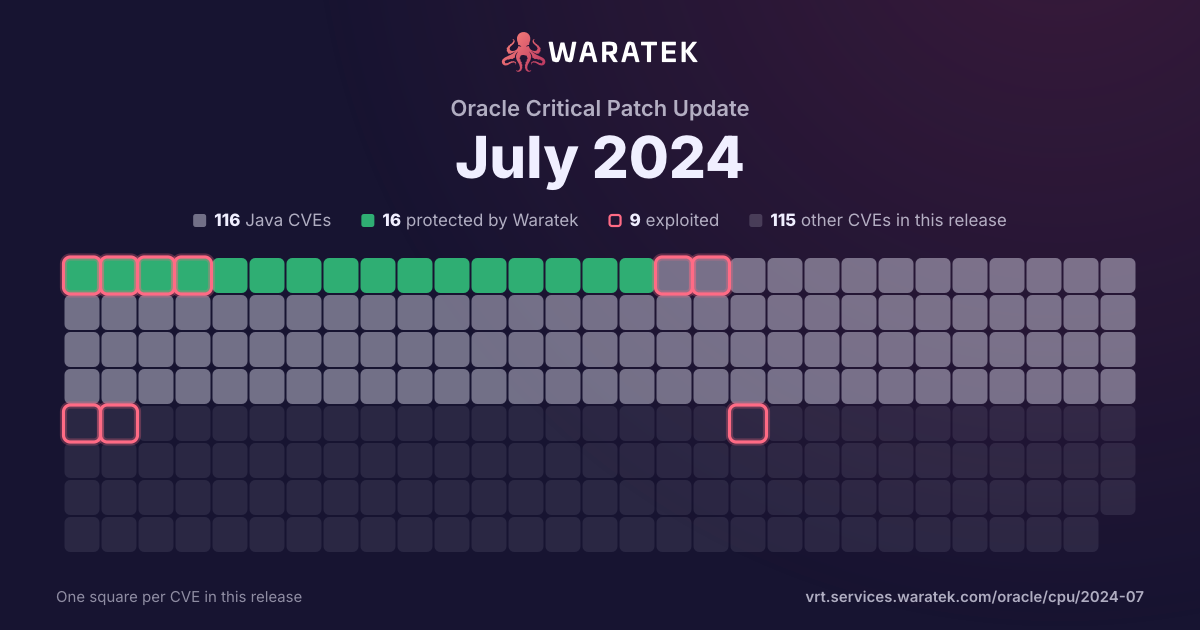
By status
16Protected by Waratek4Mitigation candidate96No exploit published18Outside Waratek scope97Not applicable
9Exploited, marked by the ring
No exploit published. For 35 of them, Oracle's security advisory is the source of public detail.
Protected by Waratek. Waratek RASP can block exploitation of these on systems that have not applied the patch yet.
Overview 39 matches · 0 protected · 0 exploited · 0 CISA KEV · 0 public PoC · 1 EPSS ≥ 0.5
Protected by Waratek
0
0.0%
Rule in development
0
0.0%
Mitigation candidate
0
0.0%
No exploit published
39
100.0%
blocked by ARMR today
0
0.0%
partly blocked
0
0.0%
not blocked
39
100.0%
not established
0
0.0%
unrecorded
0
0.0%
Exploited
0
0.0%
Working exploit published
0
0.0%
Proof of concept only
6
15.4%
Forecast only
1
2.6%
No public exploit
32
82.1%
split by
peak 8 / quarter
Q1 211
No exploit published1
High1
not blocked1
No public exploit1
Q2 210
Q3 211
No exploit published1
High1
not blocked1
No public exploit1
Q4 210
Q1 220
Q2 220
Q3 223
No exploit published3
High3
not blocked3
Proof of concept only1
No public exploit2
Q4 226
No exploit published6
High6
not blocked6
Proof of concept only2
No public exploit4
Q1 233
No exploit published3
High3
not blocked3
Proof of concept only2
No public exploit1
Q2 231
No exploit published1
High1
not blocked1
No public exploit1
Q3 231
No exploit published1
High1
not blocked1
No public exploit1
Q4 234
No exploit published4
High4
not blocked4
No public exploit4
Q1 248
No exploit published8
High8
not blocked8
Proof of concept only1
Forecast only1
No public exploit6
Q2 244
No exploit published4
High4
not blocked4
No public exploit4
Q3 247
No exploit published7
High7
not blocked7
No public exploit7
Q1 21Q3 21Q1 22Q3 22Q1 23Q3 23Q1 24Q3 24
| CVE | Severity | Published▾ | Status | Exploitation | Description |
|---|---|---|---|---|---|
| CVE-2024-21183 | High | 2024-07-16 | No exploit published | No public exploit | Vulnerability in the Oracle WebLogic Server product of Oracle Fusion Middleware (component: Core). Supported versions that are affected are 12.2.1.4.0 and 14.1.1.0.0. Easily exploitable vulnerability allows unauthenticated attacker with network access via T3, IIOP to compromise Oracle WebLogic Server. Successful attacks of this vulnerability can result in unauthorized access to critical data or complete access to all Oracle WebLogic Server accessible data. CVSS 3.1 Base Score 7.5 (Confidentiality impacts). CVSS Vector: (CVSS:3.1/AV:N/AC:L/PR:N/UI:N/S:U/C:H/I:N/A:N). |
| CVE-2024-21167 | High | 2024-07-16 | No exploit published | No public exploit | Vulnerability in the Oracle Trading Community product of Oracle E-Business Suite (component: Party Search UI). Supported versions that are affected are 12.2.3-12.2.13. Easily exploitable vulnerability allows low privileged attacker with network access via HTTP to compromise Oracle Trading Community. Successful attacks of this vulnerability can result in unauthorized creation, deletion or modification access to critical data or all Oracle Trading Community accessible data as well as unauthorized access to critical data or complete access to all Oracle Trading Community accessible data. CVSS 3.1 Base Score 8.1 (Confidentiality and Integrity impacts). CVSS Vector: (CVSS:3.1/AV:N/AC:L/PR:L/UI:N/S:U/C:H/I:H/A:N). |
| CVE-2024-21153 | High | 2024-07-16 | No exploit published | No public exploit | Vulnerability in the Oracle Process Manufacturing Product Development product of Oracle E-Business Suite (component: Quality Management Specs). The supported version that is affected is 12.2.13. Easily exploitable vulnerability allows low privileged attacker with network access via HTTP to compromise Oracle Process Manufacturing Product Development. Successful attacks of this vulnerability can result in unauthorized creation, deletion or modification access to critical data or all Oracle Process Manufacturing Product Development accessible data as well as unauthorized access to critical data or complete access to all Oracle Process Manufacturing Product Development accessible data. CVSS 3.1 Base Score 8.1 (Confidentiality and Integrity impacts). CVSS Vector: (CVSS:3.1/AV:N/AC:L/PR:L/UI:N/S:U/C:H/I:H/A:N). |
| CVE-2024-21152 | High | 2024-07-16 | No exploit published | No public exploit | Vulnerability in the Oracle Process Manufacturing Financials product of Oracle E-Business Suite (component: Allocation Rules). Supported versions that are affected are 12.2.12-12.2.13. Easily exploitable vulnerability allows low privileged attacker with network access via HTTP to compromise Oracle Process Manufacturing Financials. Successful attacks of this vulnerability can result in unauthorized creation, deletion or modification access to critical data or all Oracle Process Manufacturing Financials accessible data as well as unauthorized access to critical data or complete access to all Oracle Process Manufacturing Financials accessible data. CVSS 3.1 Base Score 8.1 (Confidentiality and Integrity impacts). CVSS Vector: (CVSS:3.1/AV:N/AC:L/PR:L/UI:N/S:U/C:H/I:H/A:N). |
| CVE-2024-21149 | High | 2024-07-16 | No exploit published | No public exploit | Vulnerability in the Oracle Enterprise Asset Management product of Oracle E-Business Suite (component: Work Definition Issues). Supported versions that are affected are 12.2.11-12.2.13. Easily exploitable vulnerability allows low privileged attacker with network access via HTTP to compromise Oracle Enterprise Asset Management. Successful attacks of this vulnerability can result in unauthorized creation, deletion or modification access to critical data or all Oracle Enterprise Asset Management accessible data as well as unauthorized access to critical data or complete access to all Oracle Enterprise Asset Management accessible data. CVSS 3.1 Base Score 8.1 (Confidentiality and Integrity impacts). CVSS Vector: (CVSS:3.1/AV:N/AC:L/PR:L/UI:N/S:U/C:H/I:H/A:N). |
| CVE-2024-21147 | High | 2024-07-16 | No exploit published | No public exploit | Vulnerability in the Oracle Java SE, Oracle GraalVM for JDK, Oracle GraalVM Enterprise Edition product of Oracle Java SE (component: Hotspot). Supported versions that are affected are Oracle Java SE: 8u411, 8u411-perf, 11.0.23, 17.0.11, 21.0.3, 22.0.1; Oracle GraalVM for JDK: 17.0.11, 21.0.3, 22.0.1; Oracle GraalVM Enterprise Edition: 20.3.14 and 21.3.10. Difficult to exploit vulnerability allows unauthenticated attacker with network access via multiple protocols to compromise Oracle Java SE, Oracle GraalVM for JDK, Oracle GraalVM Enterprise Edition. Successful attacks of this vulnerability can result in unauthorized creation, deletion or modification access to critical data or all Oracle Java SE, Oracle GraalVM for JDK, Oracle GraalVM Enterprise Edition accessible data as well as unauthorized access to critical data or complete access to all Oracle Java SE, Oracle GraalVM for JDK, Oracle GraalVM Enterprise Edition accessible data. Note: This vulnerability can be exploited by using APIs in the specified Component, e.g., through a web service which supplies data to the APIs. This vulnerability also applies to Java deployments, typically in clients running sandboxed Java Web Start applications or sandboxed Java applets, that load and run untrusted code (e.g., code that comes from the internet) and rely on the Java sandbox for security. CVSS 3.1 Base Score 7.4 (Confidentiality and Integrity impacts). CVSS Vector: (CVSS:3.1/AV:N/AC:H/PR:N/UI:N/S:U/C:H/I:H/A:N). |
| CVE-2024-21146 | High | 2024-07-16 | No exploit published | No public exploit | Vulnerability in the Oracle Trade Management product of Oracle E-Business Suite (component: GL Accounts). Supported versions that are affected are 12.2.3-12.2.13. Easily exploitable vulnerability allows low privileged attacker with network access via HTTP to compromise Oracle Trade Management. Successful attacks of this vulnerability can result in unauthorized creation, deletion or modification access to critical data or all Oracle Trade Management accessible data as well as unauthorized access to critical data or complete access to all Oracle Trade Management accessible data. CVSS 3.1 Base Score 8.1 (Confidentiality and Integrity impacts). CVSS Vector: (CVSS:3.1/AV:N/AC:L/PR:L/UI:N/S:U/C:H/I:H/A:N). |
| CVE-2024-6162 | High | 2024-06-20 | No exploit published | No public exploit | A vulnerability was found in Undertow, where URL-encoded request paths can be mishandled during concurrent requests on the AJP listener. This issue arises because the same buffer is used to decode the paths for multiple requests simultaneously, leading to incorrect path information being processed. As a result, the server may attempt to access the wrong path, causing errors such as "404 Not Found" or other application failures. This flaw can potentially lead to a denial of service, as legitimate resources become inaccessible due to the path mix-up. |
| CVE-2024-30172 | High | 2024-05-14 | No exploit published | No public exploit | An issue was discovered in Bouncy Castle Java Cryptography APIs before 1.78. An Ed25519 verification code infinite loop can occur via a crafted signature and public key. |
| CVE-2024-29857 | High | 2024-05-14 | No exploit published | No public exploit | An issue was discovered in ECCurve.java and ECCurve.cs in Bouncy Castle Java (BC Java) before 1.78, BC Java LTS before 2.73.6, BC-FJA before 1.0.2.5, and BC C# .Net before 2.3.1. Importing an EC certificate with crafted F2m parameters can lead to excessive CPU consumption during the evaluation of the curve parameters. |
| CVE-2024-34447 | High | 2024-05-03 | No exploit published | No public exploit | An issue was discovered in the Bouncy Castle Crypto Package For Java before BC TLS Java 1.0.19 (ships with BC Java 1.78, BC Java (LTS) 2.73.6) and before BC FIPS TLS Java 1.0.19. When endpoint identification is enabled in the BCJSSE and an SSL socket is created without an explicit hostname (as happens with HttpsURLConnection), hostname verification could be performed against a DNS-resolved IP address in some situations, opening up a possibility of DNS poisoning. |
| CVE-2023-5685 | High | 2024-03-22 | No exploit published | No public exploit | A flaw was found in XNIO. The XNIO NotifierState that can cause a Stack Overflow Exception when the chain of notifier states becomes problematically large can lead to uncontrolled resource management and a possible denial of service (DoS). |
| CVE-2024-29131 | High | 2024-03-21 | No exploit published | No public exploit | Out-of-bounds Write vulnerability in Apache Commons Configuration.This issue affects Apache Commons Configuration: from 2.0 before 2.10.1. Users are recommended to upgrade to version 2.10.1, which fixes the issue. |
| CVE-2024-22257 | High | 2024-03-18 | No exploit published | No public exploit | In Spring Security, versions 5.7.x prior to 5.7.12, 5.8.x prior to 5.8.11, versions 6.0.x prior to 6.0.9, versions 6.1.x prior to 6.1.8, versions 6.2.x prior to 6.2.3, an application is possible vulnerable to broken access control when it directly uses the AuthenticatedVoter#vote passing a null Authentication parameter. |
| CVE-2024-22201 | High | 2024-02-26 | No exploit published | Proof of concept only | Jetty is a Java based web server and servlet engine. An HTTP/2 SSL connection that is established and TCP congested will be leaked when it times out. An attacker can cause many connections to end up in this state, and the server may run out of file descriptors, eventually causing the server to stop accepting new connections from valid clients. The vulnerability is patched in 9.4.54, 10.0.20, 11.0.20, and 12.0.6. |
| CVE-2024-22234 | High | 2024-02-20 | No exploit published | No public exploit | In Spring Security, versions 6.1.x prior to 6.1.7 and versions 6.2.x prior to 6.2.2, an application is vulnerable to broken access control when it directly uses the AuthenticationTrustResolver.isFullyAuthenticated(Authentication) method. Specifically, an application is vulnerable if: * The application uses AuthenticationTrustResolver.isFullyAuthenticated(Authentication) directly and a null authentication parameter is passed to it resulting in an erroneous true return value. An application is not vulnerable if any of the following is true: * The application does not use AuthenticationTrustResolver.isFullyAuthenticated(Authentication) directly. * The application does not pass null to AuthenticationTrustResolver.isFullyAuthenticated * The application only uses isFullyAuthenticated via Method Security https://docs.spring.io/spring-security/reference/servlet/authorization/method-security.html or HTTP Request Security https://docs.spring.io/spring-security/reference/servlet/authorization/authorize-http-requests.html |
| CVE-2024-25710 | High | 2024-02-19 | No exploit published | No public exploit | Loop with Unreachable Exit Condition ('Infinite Loop') vulnerability in Apache Commons Compress.This issue affects Apache Commons Compress: from 1.3 through 1.25.0. Users are recommended to upgrade to version 1.26.0 which fixes the issue. |
| CVE-2023-52428 | High | 2024-02-11 | No exploit published | No public exploit | In Connect2id Nimbus JOSE+JWT before 9.37.2, an attacker can cause a denial of service (resource consumption) via a large JWE p2c header value (aka iteration count) for the PasswordBasedDecrypter (PBKDF2) component. |
| CVE-2024-23898 | High | 2024-01-24 | No exploit published | Forecast only | Jenkins 2.217 through 2.441 (both inclusive), LTS 2.222.1 through 2.426.2 (both inclusive) does not perform origin validation of requests made through the CLI WebSocket endpoint, resulting in a cross-site WebSocket hijacking (CSWSH) vulnerability, allowing attackers to execute CLI commands on the Jenkins controller. |
| CVE-2023-46589 | High | 2023-11-28 | No exploit published | No public exploit | Improper Input Validation vulnerability in Apache Tomcat.Tomcat from 11.0.0-M1 through 11.0.0-M10, from 10.1.0-M1 through 10.1.15, from 9.0.0-M1 through 9.0.82 and from 8.5.0 through 8.5.95 did not correctly parse HTTP trailer headers. A trailer header that exceeded the header size limit could cause Tomcat to treat a single request as multiple requests leading to the possibility of request smuggling when behind a reverse proxy. Older, EOL versions may also be affected. Users are recommended to upgrade to version 11.0.0-M11 onwards, 10.1.16 onwards, 9.0.83 onwards or 8.5.96 onwards, which fix the issue. |
| CVE-2023-4043 | High | 2023-11-03 | No exploit published | No public exploit | In Eclipse Parsson before versions 1.1.4 and 1.0.5, Parsing JSON from untrusted sources can lead malicious actors to exploit the fact that the built-in support for parsing numbers with large scale in Java has a number of edge cases where the input text of a number can lead to much larger processing time than one would expect. To mitigate the risk, parsson put in place a size limit for the numbers as well as their scale. |
| CVE-2023-5072 | High | 2023-10-12 | No exploit published | No public exploit | Denial of Service in JSON-Java versions up to and including 20230618. A bug in the parser means that an input string of modest size can lead to indefinite amounts of memory being used. |
| CVE-2023-36478 | High | 2023-10-10 | No exploit published | No public exploit | Eclipse Jetty provides a web server and servlet container. In versions 11.0.0 through 11.0.15, 10.0.0 through 10.0.15, and 9.0.0 through 9.4.52, an integer overflow in `MetaDataBuilder.checkSize` allows for HTTP/2 HPACK header values to exceed their size limit. `MetaDataBuilder.java` determines if a header name or value exceeds the size limit, and throws an exception if the limit is exceeded. However, when length is very large and huffman is true, the multiplication by 4 in line 295 will overflow, and length will become negative. `(_size+length)` will now be negative, and the check on line 296 will not be triggered. Furthermore, `MetaDataBuilder.checkSize` allows for user-entered HPACK header value sizes to be negative, potentially leading to a very large buffer allocation later on when the user-entered size is multiplied by 2. This means that if a user provides a negative length value (or, more precisely, a length value which, when multiplied by the 4/3 fudge factor, is negative), and this length value is a very large positive number when multiplied by 2, then the user can cause a very large buffer to be allocated on the server. Users of HTTP/2 can be impacted by a remote denial of service attack. The issue has been fixed in versions 11.0.16, 10.0.16, and 9.4.53. There are no known workarounds. |
| CVE-2023-4759 | High | 2023-09-12 | No exploit published | No public exploit | Arbitrary File Overwrite in Eclipse JGit <= 6.6.0 In Eclipse JGit, all versions <= 6.6.0.202305301015-r, a symbolic link present in a specially crafted git repository can be used to write a file to locations outside the working tree when this repository is cloned with JGit to a case-insensitive filesystem, or when a checkout from a clone of such a repository is performed on a case-insensitive filesystem. This can happen on checkout (DirCacheCheckout), merge (ResolveMerger via its WorkingTreeUpdater), pull (PullCommand using merge), and when applying a patch (PatchApplier). This can be exploited for remote code execution (RCE), for instance if the file written outside the working tree is a git filter that gets executed on a subsequent git command. The issue occurs only on case-insensitive filesystems, like the default filesystems on Windows and macOS. The user performing the clone or checkout must have the rights to create symbolic links for the problem to occur, and symbolic links must be enabled in the git configuration. Setting git configuration option core.symlinks = false before checking out avoids the problem. The issue was fixed in Eclipse JGit version 6.6.1.202309021850-r and 6.7.0.202309050840-r, available via Maven Central https://repo1.maven.org/maven2/org/eclipse/jgit/ and repo.eclipse.org https://repo.eclipse.org/content/repositories/jgit-releases/ . A backport is available in 5.13.3 starting from 5.13.3.202401111512-r. The JGit maintainers would like to thank RyotaK for finding and reporting this issue. |
| CVE-2023-2976 | High | 2023-06-14 | No exploit published | No public exploit | Use of Java's default temporary directory for file creation in `FileBackedOutputStream` in Google Guava versions 1.0 to 31.1 on Unix systems and Android Ice Cream Sandwich allows other users and apps on the machine with access to the default Java temporary directory to be able to access the files created by the class. Even though the security vulnerability is fixed in version 32.0.0, we recommend using version 32.0.1 as version 32.0.0 breaks some functionality under Windows. |
| CVE-2023-1436 | High | 2023-03-22 | No exploit published | Proof of concept only | An infinite recursion is triggered in Jettison when constructing a JSONArray from a Collection that contains a self-reference in one of its elements. This leads to a StackOverflowError exception being thrown. |
| CVE-2023-1370 | High | 2023-03-22 | No exploit published | Proof of concept only | [Json-smart](https://netplex.github.io/json-smart/) is a performance focused, JSON processor lib. When reaching a ‘[‘ or ‘{‘ character in the JSON input, the code parses an array or an object respectively. It was discovered that the code does not have any limit to the nesting of such arrays or objects. Since the parsing of nested arrays and objects is done recursively, nesting too many of them can cause a stack exhaustion (stack overflow) and crash the software. |
| CVE-2023-24998 | High | 2023-02-20 | No exploit published | No public exploit | Apache Commons FileUpload before 1.5 does not limit the number of request parts to be processed resulting in the possibility of an attacker triggering a DoS with a malicious upload or series of uploads. Note that, like all of the file upload limits, the new configuration option (FileUploadBase#setFileCountMax) is not enabled by default and must be explicitly configured. |
| CVE-2022-45693 | High | 2022-12-13 | No exploit published | Proof of concept only | Jettison before v1.5.2 was discovered to contain a stack overflow via the map parameter. This vulnerability allows attackers to cause a Denial of Service (DoS) via a crafted string. |
| CVE-2022-45685 | High | 2022-12-13 | No exploit published | No public exploit | A stack overflow in Jettison before v1.5.2 allows attackers to cause a Denial of Service (DoS) via crafted JSON data. |
| CVE-2022-41881 | High | 2022-12-12 | No exploit published | Proof of concept only | Netty project is an event-driven asynchronous network application framework. In versions prior to 4.1.86.Final, a StackOverflowError can be raised when parsing a malformed crafted message due to an infinite recursion. This issue is patched in version 4.1.86.Final. There is no workaround, except using a custom HaProxyMessageDecoder. |
| CVE-2022-42890 | High | 2022-10-25 | No exploit published | No public exploit | A vulnerability in Batik of Apache XML Graphics allows an attacker to run Java code from untrusted SVG via JavaScript. This issue affects Apache XML Graphics prior to 1.16. Users are recommended to upgrade to version 1.16. |
| CVE-2022-41704 | High | 2022-10-25 | No exploit published | No public exploit | A vulnerability in Batik of Apache XML Graphics allows an attacker to run untrusted Java code from an SVG. This issue affects Apache XML Graphics prior to 1.16. It is recommended to update to version 1.16. |
| CVE-2022-42003 | High | 2022-10-02 | No exploit published | No public exploit | In FasterXML jackson-databind before versions 2.13.4.1 and 2.12.17.1, resource exhaustion can occur because of a lack of a check in primitive value deserializers to avoid deep wrapper array nesting, when the UNWRAP_SINGLE_VALUE_ARRAYS feature is enabled. |
| CVE-2022-40152 | High | 2022-09-16 | No exploit published | Proof of concept only | Those using Woodstox to parse XML data may be vulnerable to Denial of Service attacks (DOS) if DTD support is enabled. If the parser is running on user supplied input, an attacker may supply content that causes the parser to crash by stackoverflow. This effect may support a denial of service attack. |
| CVE-2022-40150 | High | 2022-09-16 | No exploit published | No public exploit | Those using Jettison to parse untrusted XML or JSON data may be vulnerable to Denial of Service attacks (DOS). If the parser is running on user supplied input, an attacker may supply content that causes the parser to crash by Out of memory. This effect may support a denial of service attack. |
| CVE-2022-40149 | High | 2022-09-16 | No exploit published | No public exploit | Those using Jettison to parse untrusted XML or JSON data may be vulnerable to Denial of Service attacks (DOS). If the parser is running on user supplied input, an attacker may supply content that causes the parser to crash by stackoverflow. This effect may support a denial of service attack. |
| CVE-2021-36090 | High | 2021-07-13 | No exploit published | No public exploit | When reading a specially crafted ZIP archive, Compress can be made to allocate large amounts of memory that finally leads to an out of memory error even for very small inputs. This could be used to mount a denial of service attack against services that use Compress' zip package. |
| CVE-2020-11987 | High | 2021-02-24 | No exploit published | No public exploit | Apache Batik 1.13 is vulnerable to server-side request forgery, caused by improper input validation by the NodePickerPanel. By using a specially-crafted argument, an attacker could exploit this vulnerability to cause the underlying server to make arbitrary GET requests. |