
Oracle Critical Patch Update July 2024
Released July 2024 · Oracle's advisory ↗ · ← Critical Patch Update, April 2024 · Critical Patch Update, October 2024 →
231 CVEs in this release, one square each
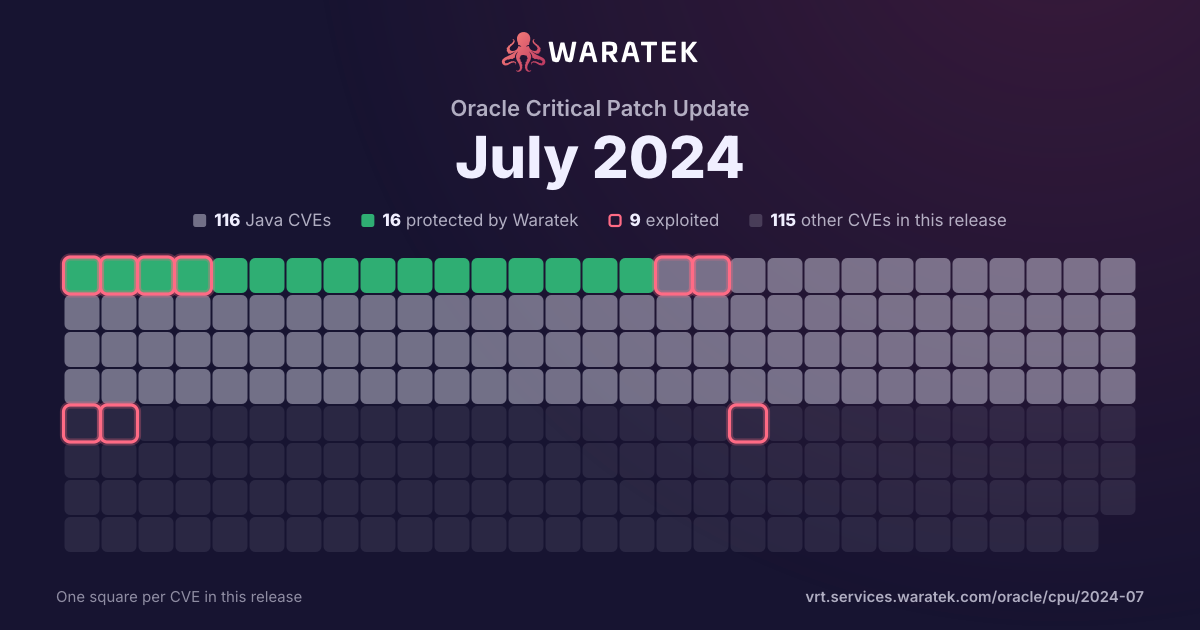
By status
16Protected by Waratek4Mitigation candidate96No exploit published18Outside Waratek scope97Not applicable
9Exploited, marked by the ring
No exploit published. For 35 of them, Oracle's security advisory is the source of public detail.
Protected by Waratek. Waratek RASP can block exploitation of these on systems that have not applied the patch yet.
Overview 74 matches · 43 in Waratek scope · 0 protected · 3 exploited · 1 CISA KEV · 11 public PoC · 6 EPSS ≥ 0.5
74matches
43in Waratek scope58.1%
0protected0.0%
3exploited4.1%
1CISA KEV1.4%
11public PoC14.9%
6EPSS ≥ 0.58.1%
Protected by Waratek
0
0.0%
Rule in development
0
0.0%
Mitigation candidate
4
5.4%
No exploit published
39
52.7%
Outside Waratek scope
3
4.1%
Not applicable
28
37.8%
Withdrawn CVE
0
0.0%
blocked by ARMR today
0
0.0%
partly blocked
0
0.0%
not blocked
74
100.0%
not established
0
0.0%
unrecorded
0
0.0%
split by
peak 18 / quarter
Q1 211
No exploit published1
High1
not blocked1
No public exploit1
Q2 211
Outside Waratek scope1
High1
not blocked1
No public exploit1
Q3 211
No exploit published1
High1
not blocked1
No public exploit1
Q4 210
Q1 220
Q2 220
Q3 224
Mitigation candidate1
No exploit published3
High4
not blocked4
Proof of concept only2
No public exploit2
Q4 227
No exploit published6
Not applicable1
High7
not blocked7
Proof of concept only3
No public exploit4
Q1 233
No exploit published3
High3
not blocked3
Proof of concept only2
No public exploit1
Q2 231
No exploit published1
High1
not blocked1
No public exploit1
Q3 232
No exploit published1
Not applicable1
High2
not blocked2
No public exploit2
Q4 2314
Mitigation candidate1
No exploit published4
Not applicable9
High14
not blocked14
Exploited1
Proof of concept only3
No public exploit10
Q1 2418
Mitigation candidate1
No exploit published8
Not applicable9
High18
not blocked18
Proof of concept only3
Forecast only1
No public exploit14
Q2 2412
Mitigation candidate1
No exploit published4
Outside Waratek scope2
Not applicable5
High12
not blocked12
Exploited2
Working exploit published1
Proof of concept only4
No public exploit5
Q3 249
No exploit published7
Not applicable2
High9
not blocked9
No public exploit9
Q4 240
Q1 251
Not applicable1
High1
not blocked1
No public exploit1
Q1 21Q3 21Q1 22Q3 22Q1 23Q3 23Q1 24Q3 24Q1 25
| CVE | Severity | Published▾ | Status | Exploitation | Description |
|---|---|---|---|---|---|
| CVE-2024-27980 | High | 2025-01-09 | Not applicable | No public exploit | Due to the improper handling of batch files in child_process.spawn / child_process.spawnSync, a malicious command line argument can inject arbitrary commands and achieve code execution even if the shell option is not enabled. |
| CVE-2024-21184 | High | 2024-07-16 | Not applicable | No public exploit | Vulnerability in the Oracle Database RDBMS Security component of Oracle Database Server. Supported versions that are affected are 19.3-19.23. Easily exploitable vulnerability allows high privileged attacker having Execute on SYS.XS_DIAG privilege with network access via Oracle Net to compromise Oracle Database RDBMS Security. Successful attacks of this vulnerability can result in takeover of Oracle Database RDBMS Security. CVSS 3.1 Base Score 7.2 (Confidentiality, Integrity and Availability impacts). CVSS Vector: (CVSS:3.1/AV:N/AC:L/PR:H/UI:N/S:U/C:H/I:H/A:H). |
| CVE-2024-21183 | High | 2024-07-16 | No exploit published | No public exploit | Vulnerability in the Oracle WebLogic Server product of Oracle Fusion Middleware (component: Core). Supported versions that are affected are 12.2.1.4.0 and 14.1.1.0.0. Easily exploitable vulnerability allows unauthenticated attacker with network access via T3, IIOP to compromise Oracle WebLogic Server. Successful attacks of this vulnerability can result in unauthorized access to critical data or complete access to all Oracle WebLogic Server accessible data. CVSS 3.1 Base Score 7.5 (Confidentiality impacts). CVSS Vector: (CVSS:3.1/AV:N/AC:L/PR:N/UI:N/S:U/C:H/I:N/A:N). |
| CVE-2024-21167 | High | 2024-07-16 | No exploit published | No public exploit | Vulnerability in the Oracle Trading Community product of Oracle E-Business Suite (component: Party Search UI). Supported versions that are affected are 12.2.3-12.2.13. Easily exploitable vulnerability allows low privileged attacker with network access via HTTP to compromise Oracle Trading Community. Successful attacks of this vulnerability can result in unauthorized creation, deletion or modification access to critical data or all Oracle Trading Community accessible data as well as unauthorized access to critical data or complete access to all Oracle Trading Community accessible data. CVSS 3.1 Base Score 8.1 (Confidentiality and Integrity impacts). CVSS Vector: (CVSS:3.1/AV:N/AC:L/PR:L/UI:N/S:U/C:H/I:H/A:N). |
| CVE-2024-21153 | High | 2024-07-16 | No exploit published | No public exploit | Vulnerability in the Oracle Process Manufacturing Product Development product of Oracle E-Business Suite (component: Quality Management Specs). The supported version that is affected is 12.2.13. Easily exploitable vulnerability allows low privileged attacker with network access via HTTP to compromise Oracle Process Manufacturing Product Development. Successful attacks of this vulnerability can result in unauthorized creation, deletion or modification access to critical data or all Oracle Process Manufacturing Product Development accessible data as well as unauthorized access to critical data or complete access to all Oracle Process Manufacturing Product Development accessible data. CVSS 3.1 Base Score 8.1 (Confidentiality and Integrity impacts). CVSS Vector: (CVSS:3.1/AV:N/AC:L/PR:L/UI:N/S:U/C:H/I:H/A:N). |
| CVE-2024-21152 | High | 2024-07-16 | No exploit published | No public exploit | Vulnerability in the Oracle Process Manufacturing Financials product of Oracle E-Business Suite (component: Allocation Rules). Supported versions that are affected are 12.2.12-12.2.13. Easily exploitable vulnerability allows low privileged attacker with network access via HTTP to compromise Oracle Process Manufacturing Financials. Successful attacks of this vulnerability can result in unauthorized creation, deletion or modification access to critical data or all Oracle Process Manufacturing Financials accessible data as well as unauthorized access to critical data or complete access to all Oracle Process Manufacturing Financials accessible data. CVSS 3.1 Base Score 8.1 (Confidentiality and Integrity impacts). CVSS Vector: (CVSS:3.1/AV:N/AC:L/PR:L/UI:N/S:U/C:H/I:H/A:N). |
| CVE-2024-21149 | High | 2024-07-16 | No exploit published | No public exploit | Vulnerability in the Oracle Enterprise Asset Management product of Oracle E-Business Suite (component: Work Definition Issues). Supported versions that are affected are 12.2.11-12.2.13. Easily exploitable vulnerability allows low privileged attacker with network access via HTTP to compromise Oracle Enterprise Asset Management. Successful attacks of this vulnerability can result in unauthorized creation, deletion or modification access to critical data or all Oracle Enterprise Asset Management accessible data as well as unauthorized access to critical data or complete access to all Oracle Enterprise Asset Management accessible data. CVSS 3.1 Base Score 8.1 (Confidentiality and Integrity impacts). CVSS Vector: (CVSS:3.1/AV:N/AC:L/PR:L/UI:N/S:U/C:H/I:H/A:N). |
| CVE-2024-21147 | High | 2024-07-16 | No exploit published | No public exploit | Vulnerability in the Oracle Java SE, Oracle GraalVM for JDK, Oracle GraalVM Enterprise Edition product of Oracle Java SE (component: Hotspot). Supported versions that are affected are Oracle Java SE: 8u411, 8u411-perf, 11.0.23, 17.0.11, 21.0.3, 22.0.1; Oracle GraalVM for JDK: 17.0.11, 21.0.3, 22.0.1; Oracle GraalVM Enterprise Edition: 20.3.14 and 21.3.10. Difficult to exploit vulnerability allows unauthenticated attacker with network access via multiple protocols to compromise Oracle Java SE, Oracle GraalVM for JDK, Oracle GraalVM Enterprise Edition. Successful attacks of this vulnerability can result in unauthorized creation, deletion or modification access to critical data or all Oracle Java SE, Oracle GraalVM for JDK, Oracle GraalVM Enterprise Edition accessible data as well as unauthorized access to critical data or complete access to all Oracle Java SE, Oracle GraalVM for JDK, Oracle GraalVM Enterprise Edition accessible data. Note: This vulnerability can be exploited by using APIs in the specified Component, e.g., through a web service which supplies data to the APIs. This vulnerability also applies to Java deployments, typically in clients running sandboxed Java Web Start applications or sandboxed Java applets, that load and run untrusted code (e.g., code that comes from the internet) and rely on the Java sandbox for security. CVSS 3.1 Base Score 7.4 (Confidentiality and Integrity impacts). CVSS Vector: (CVSS:3.1/AV:N/AC:H/PR:N/UI:N/S:U/C:H/I:H/A:N). |
| CVE-2024-21146 | High | 2024-07-16 | No exploit published | No public exploit | Vulnerability in the Oracle Trade Management product of Oracle E-Business Suite (component: GL Accounts). Supported versions that are affected are 12.2.3-12.2.13. Easily exploitable vulnerability allows low privileged attacker with network access via HTTP to compromise Oracle Trade Management. Successful attacks of this vulnerability can result in unauthorized creation, deletion or modification access to critical data or all Oracle Trade Management accessible data as well as unauthorized access to critical data or complete access to all Oracle Trade Management accessible data. CVSS 3.1 Base Score 8.1 (Confidentiality and Integrity impacts). CVSS Vector: (CVSS:3.1/AV:N/AC:L/PR:L/UI:N/S:U/C:H/I:H/A:N). |
| CVE-2024-21141 | High | 2024-07-16 | Not applicable | No public exploit | Vulnerability in the Oracle VM VirtualBox product of Oracle Virtualization (component: Core). Supported versions that are affected are Prior to 7.0.20. Easily exploitable vulnerability allows high privileged attacker with logon to the infrastructure where Oracle VM VirtualBox executes to compromise Oracle VM VirtualBox. While the vulnerability is in Oracle VM VirtualBox, attacks may significantly impact additional products (scope change). Successful attacks of this vulnerability can result in takeover of Oracle VM VirtualBox. CVSS 3.1 Base Score 8.2 (Confidentiality, Integrity and Availability impacts). CVSS Vector: (CVSS:3.1/AV:L/AC:L/PR:H/UI:N/S:C/C:H/I:H/A:H). |
| CVE-2024-6162 | High | 2024-06-20 | No exploit published | No public exploit | A vulnerability was found in Undertow, where URL-encoded request paths can be mishandled during concurrent requests on the AJP listener. This issue arises because the same buffer is used to decode the paths for multiple requests simultaneously, leading to incorrect path information being processed. As a result, the server may attempt to access the wrong path, causing errors such as "404 Not Found" or other application failures. This flaw can potentially lead to a denial of service, as legitimate resources become inaccessible due to the path mix-up. |
| CVE-2024-0397 | High | 2024-06-17 | Not applicable | No public exploit | A defect was discovered in the Python “ssl” module where there is a memory race condition with the ssl.SSLContext methods “cert_store_stats()” and “get_ca_certs()”. The race condition can be triggered if the methods are called at the same time as certificates are loaded into the SSLContext, such as during the TLS handshake with a certificate directory configured. This issue is fixed in CPython 3.10.14, 3.11.9, 3.12.3, and 3.13.0a5. |
| CVE-2024-34459 | High | 2024-05-14 | Not applicable | Proof of concept only | An issue was discovered in xmllint (from libxml2) before 2.11.8 and 2.12.x before 2.12.7. Formatting error messages with xmllint --htmlout can result in a buffer over-read in xmlHTMLPrintFileContext in xmllint.c. |
| CVE-2024-30172 | High | 2024-05-14 | No exploit published | No public exploit | An issue was discovered in Bouncy Castle Java Cryptography APIs before 1.78. An Ed25519 verification code infinite loop can occur via a crafted signature and public key. |
| CVE-2024-29857 | High | 2024-05-14 | No exploit published | No public exploit | An issue was discovered in ECCurve.java and ECCurve.cs in Bouncy Castle Java (BC Java) before 1.78, BC Java LTS before 2.73.6, BC-FJA before 1.0.2.5, and BC C# .Net before 2.3.1. Importing an EC certificate with crafted F2m parameters can lead to excessive CPU consumption during the evaluation of the curve parameters. |
| CVE-2024-34069 | High | 2024-05-06 | Not applicable | Working exploit published | Werkzeug is a comprehensive WSGI web application library. The debugger in affected versions of Werkzeug can allow an attacker to execute code on a developer's machine under some circumstances. This requires the attacker to get the developer to interact with a domain and subdomain they control, and enter the debugger PIN, but if they are successful it allows access to the debugger even if it is only running on localhost. This also requires the attacker to guess a URL in the developer's application that will trigger the debugger. This vulnerability is fixed in 3.0.3. |
| CVE-2024-34447 | High | 2024-05-03 | No exploit published | No public exploit | An issue was discovered in the Bouncy Castle Crypto Package For Java before BC TLS Java 1.0.19 (ships with BC Java 1.78, BC Java (LTS) 2.73.6) and before BC FIPS TLS Java 1.0.19. When endpoint identification is enabled in the BCJSSE and an SSL socket is created without an explicit hostname (as happens with HttpsURLConnection), hostname verification could be performed against a DNS-resolved IP address in some situations, opening up a possibility of DNS poisoning. |
| CVE-2024-32114 | High | 2024-05-02 | Mitigation candidate | Exploited | In Apache ActiveMQ 6.x, the default configuration doesn't secure the API web context (where the Jolokia JMX REST API and the Message REST API are located). It means that anyone can use these layers without any required authentication. Potentially, anyone can interact with the broker (using Jolokia JMX REST API) and/or produce/consume messages or purge/delete destinations (using the Message REST API). To mitigate, users can update the default conf/jetty.xml configuration file to add authentication requirement: <bean id="securityConstraintMapping" class="org.eclipse.jetty.security.ConstraintMapping"> <property name="constraint" ref="securityConstraint" /> <property name="pathSpec" value="/" /> </bean> Or we encourage users to upgrade to Apache ActiveMQ 6.1.2 where the default configuration has been updated with authentication by default. |
| CVE-2024-2961 | High | 2024-04-17 | Outside Waratek scope | Exploited | The iconv() function in the GNU C Library versions 2.39 and older may overflow the output buffer passed to it by up to 4 bytes when converting strings to the ISO-2022-CN-EXT character set, which may be used to crash an application or overwrite a neighbouring variable. |
| CVE-2024-27983 | High | 2024-04-09 | Not applicable | Proof of concept only | An attacker can make the Node.js HTTP/2 server completely unavailable by sending a small amount of HTTP/2 frames packets with a few HTTP/2 frames inside. It is possible to leave some data in nghttp2 memory after reset when headers with HTTP/2 CONTINUATION frame are sent to the server and then a TCP connection is abruptly closed by the client triggering the Http2Session destructor while header frames are still being processed (and stored in memory) causing a race condition. |
| CVE-2024-27316 | High | 2024-04-04 | Not applicable | Proof of concept only | HTTP/2 incoming headers exceeding the limit are temporarily buffered in nghttp2 in order to generate an informative HTTP 413 response. If a client does not stop sending headers, this leads to memory exhaustion. |
| CVE-2023-38709 | High | 2024-04-04 | Outside Waratek scope | Proof of concept only | Faulty input validation in the core of Apache allows malicious or exploitable backend/content generators to split HTTP responses. This issue affects Apache HTTP Server: through 2.4.58. |
| CVE-2023-5685 | High | 2024-03-22 | No exploit published | No public exploit | A flaw was found in XNIO. The XNIO NotifierState that can cause a Stack Overflow Exception when the chain of notifier states becomes problematically large can lead to uncontrolled resource management and a possible denial of service (DoS). |
| CVE-2024-29131 | High | 2024-03-21 | No exploit published | No public exploit | Out-of-bounds Write vulnerability in Apache Commons Configuration.This issue affects Apache Commons Configuration: from 2.0 before 2.10.1. Users are recommended to upgrade to version 2.10.1, which fixes the issue. |
| CVE-2023-6597 | High | 2024-03-19 | Not applicable | No public exploit | An issue was found in the CPython `tempfile.TemporaryDirectory` class affecting versions 3.12.1, 3.11.7, 3.10.13, 3.9.18, and 3.8.18 and prior. The tempfile.TemporaryDirectory class would dereference symlinks during cleanup of permissions-related errors. This means users which can run privileged programs are potentially able to modify permissions of files referenced by symlinks in some circumstances. |
| CVE-2024-22257 | High | 2024-03-18 | No exploit published | No public exploit | In Spring Security, versions 5.7.x prior to 5.7.12, 5.8.x prior to 5.8.11, versions 6.0.x prior to 6.0.9, versions 6.1.x prior to 6.1.8, versions 6.2.x prior to 6.2.3, an application is possible vulnerable to broken access control when it directly uses the AuthenticatedVoter#vote passing a null Authentication parameter. |
| CVE-2024-24549 | High | 2024-03-13 | Mitigation candidate | Proof of concept only | Denial of Service due to improper input validation vulnerability for HTTP/2 requests in Apache Tomcat. When processing an HTTP/2 request, if the request exceeded any of the configured limits for headers, the associated HTTP/2 stream was not reset until after all of the headers had been processed.This issue affects Apache Tomcat: from 11.0.0-M1 through 11.0.0-M16, from 10.1.0-M1 through 10.1.18, from 9.0.0-M1 through 9.0.85, from 8.5.0 through 8.5.98. Other, older, EOL versions may also be affected. Users are recommended to upgrade to version 11.0.0-M17, 10.1.19, 9.0.86 or 8.5.99 which fix the issue. |
| CVE-2024-28757 | High | 2024-03-10 | Not applicable | No public exploit | libexpat through 2.6.1 allows an XML Entity Expansion attack when there is isolated use of external parsers (created via XML_ExternalEntityParserCreate). |
| CVE-2024-22201 | High | 2024-02-26 | No exploit published | Proof of concept only | Jetty is a Java based web server and servlet engine. An HTTP/2 SSL connection that is established and TCP congested will be leaked when it times out. An attacker can cause many connections to end up in this state, and the server may run out of file descriptors, eventually causing the server to stop accepting new connections from valid clients. The vulnerability is patched in 9.4.54, 10.0.20, 11.0.20, and 12.0.6. |
| CVE-2024-22243 | High | 2024-02-23 | Not applicable | Proof of concept only | Applications that use UriComponentsBuilder to parse an externally provided URL (e.g. through a query parameter) AND perform validation checks on the host of the parsed URL may be vulnerable to a open redirect https://cwe.mitre.org/data/definitions/601.html attack or to a SSRF attack if the URL is used after passing validation checks. |
| CVE-2024-26130 | High | 2024-02-21 | Not applicable | No public exploit | cryptography is a package designed to expose cryptographic primitives and recipes to Python developers. Starting in version 38.0.0 and prior to version 42.0.4, if `pkcs12.serialize_key_and_certificates` is called with both a certificate whose public key did not match the provided private key and an `encryption_algorithm` with `hmac_hash` set (via `PrivateFormat.PKCS12.encryption_builder().hmac_hash(...)`, then a NULL pointer dereference would occur, crashing the Python process. This has been resolved in version 42.0.4, the first version in which a `ValueError` is properly raised. |
| CVE-2024-22234 | High | 2024-02-20 | No exploit published | No public exploit | In Spring Security, versions 6.1.x prior to 6.1.7 and versions 6.2.x prior to 6.2.2, an application is vulnerable to broken access control when it directly uses the AuthenticationTrustResolver.isFullyAuthenticated(Authentication) method. Specifically, an application is vulnerable if: * The application uses AuthenticationTrustResolver.isFullyAuthenticated(Authentication) directly and a null authentication parameter is passed to it resulting in an erroneous true return value. An application is not vulnerable if any of the following is true: * The application does not use AuthenticationTrustResolver.isFullyAuthenticated(Authentication) directly. * The application does not pass null to AuthenticationTrustResolver.isFullyAuthenticated * The application only uses isFullyAuthenticated via Method Security https://docs.spring.io/spring-security/reference/servlet/authorization/method-security.html or HTTP Request Security https://docs.spring.io/spring-security/reference/servlet/authorization/authorize-http-requests.html |
| CVE-2024-22019 | High | 2024-02-20 | Not applicable | No public exploit | A vulnerability in Node.js HTTP servers allows an attacker to send a specially crafted HTTP request with chunked encoding, leading to resource exhaustion and denial of service (DoS). The server reads an unbounded number of bytes from a single connection, exploiting the lack of limitations on chunk extension bytes. The issue can cause CPU and network bandwidth exhaustion, bypassing standard safeguards like timeouts and body size limits. |
| CVE-2024-21892 | High | 2024-02-20 | Not applicable | No public exploit | On Linux, Node.js ignores certain environment variables if those may have been set by an unprivileged user while the process is running with elevated privileges with the only exception of CAP_NET_BIND_SERVICE. Due to a bug in the implementation of this exception, Node.js incorrectly applies this exception even when certain other capabilities have been set. This allows unprivileged users to inject code that inherits the process's elevated privileges. |
| CVE-2024-25710 | High | 2024-02-19 | No exploit published | No public exploit | Loop with Unreachable Exit Condition ('Infinite Loop') vulnerability in Apache Commons Compress.This issue affects Apache Commons Compress: from 1.3 through 1.25.0. Users are recommended to upgrade to version 1.26.0 which fixes the issue. |
| CVE-2023-52428 | High | 2024-02-11 | No exploit published | No public exploit | In Connect2id Nimbus JOSE+JWT before 9.37.2, an attacker can cause a denial of service (resource consumption) via a large JWE p2c header value (aka iteration count) for the PasswordBasedDecrypter (PBKDF2) component. |
| CVE-2024-25062 | High | 2024-02-04 | Not applicable | No public exploit | An issue was discovered in libxml2 before 2.11.7 and 2.12.x before 2.12.5. When using the XML Reader interface with DTD validation and XInclude expansion enabled, processing crafted XML documents can lead to an xmlValidatePopElement use-after-free. |
| CVE-2023-52425 | High | 2024-02-04 | Not applicable | No public exploit | libexpat through 2.5.0 allows a denial of service (resource consumption) because many full reparsings are required in the case of a large token for which multiple buffer fills are needed. |
| CVE-2024-23898 | High | 2024-01-24 | No exploit published | Forecast only | Jenkins 2.217 through 2.441 (both inclusive), LTS 2.222.1 through 2.426.2 (both inclusive) does not perform origin validation of requests made through the CLI WebSocket endpoint, resulting in a cross-site WebSocket hijacking (CSWSH) vulnerability, allowing attackers to execute CLI commands on the Jenkins controller. |
| CVE-2023-50447 | High | 2024-01-19 | Not applicable | No public exploit | Pillow through 10.1.0 allows PIL.ImageMath.eval Arbitrary Code Execution via the environment parameter, a different vulnerability than CVE-2022-22817 (which was about the expression parameter). |
| CVE-2023-5764 | High | 2023-12-12 | Not applicable | No public exploit | A template injection flaw was found in Ansible where a user's controller internal templating operations may remove the unsafe designation from template data. This issue could allow an attacker to use a specially crafted file to introduce templating injection when supplying templating data. |
| CVE-2023-49081 | High | 2023-11-30 | Not applicable | Proof of concept only | aiohttp is an asynchronous HTTP client/server framework for asyncio and Python. Improper validation made it possible for an attacker to modify the HTTP request (e.g. to insert a new header) or create a new HTTP request if the attacker controls the HTTP version. The vulnerability only occurs if the attacker can control the HTTP version of the request. This issue has been patched in version 3.9.0. |
| CVE-2023-49083 | High | 2023-11-29 | Not applicable | Proof of concept only | cryptography is a package designed to expose cryptographic primitives and recipes to Python developers. Calling `load_pem_pkcs7_certificates` or `load_der_pkcs7_certificates` could lead to a NULL-pointer dereference and segfault. Exploitation of this vulnerability poses a serious risk of Denial of Service (DoS) for any application attempting to deserialize a PKCS7 blob/certificate. The consequences extend to potential disruptions in system availability and stability. This vulnerability has been patched in version 41.0.6. |
| CVE-2023-46589 | High | 2023-11-28 | No exploit published | No public exploit | Improper Input Validation vulnerability in Apache Tomcat.Tomcat from 11.0.0-M1 through 11.0.0-M10, from 10.1.0-M1 through 10.1.15, from 9.0.0-M1 through 9.0.82 and from 8.5.0 through 8.5.95 did not correctly parse HTTP trailer headers. A trailer header that exceeded the header size limit could cause Tomcat to treat a single request as multiple requests leading to the possibility of request smuggling when behind a reverse proxy. Older, EOL versions may also be affected. Users are recommended to upgrade to version 11.0.0-M11 onwards, 10.1.16 onwards, 9.0.83 onwards or 8.5.96 onwards, which fix the issue. |
| CVE-2023-26031 | High | 2023-11-16 | Not applicable | No public exploit | Relative library resolution in linux container-executor binary in Apache Hadoop 3.3.1-3.3.4 on Linux allows local user to gain root privileges. If the YARN cluster is accepting work from remote (authenticated) users, this MAY permit remote users to gain root privileges. Hadoop 3.3.0 updated the " YARN Secure Containers https://hadoop.apache.org/docs/stable/hadoop-yarn/hadoop-yarn-site/SecureContainer.html " to add a feature for executing user-submitted applications in isolated linux containers. The native binary HADOOP_HOME/bin/container-executor is used to launch these containers; it must be owned by root and have the suid bit set in order for the YARN processes to run the containers as the specific users submitting the jobs. The patch " YARN-10495 https://issues.apache.org/jira/browse/YARN-10495 . make the rpath of container-executor configurable" modified the library loading path for loading .so files from "$ORIGIN/" to ""$ORIGIN/:../lib/native/". This is the a path through which libcrypto.so is located. Thus it is is possible for a user with reduced privileges to install a malicious libcrypto library into a path to which they have write access, invoke the container-executor command, and have their modified library executed as root. If the YARN cluster is accepting work from remote (authenticated) users, and these users' submitted job are executed in the physical host, rather than a container, then the CVE permits remote users to gain root privileges. The fix for the vulnerability is to revert the change, which is done in YARN-11441 https://issues.apache.org/jira/browse/YARN-11441 , "Revert YARN-10495". This patch is in hadoop-3.3.5. To determine whether a version of container-executor is vulnerable, use the readelf command. If the RUNPATH or RPATH value contains the relative path "./lib/native/" then it is at risk $ readelf -d container-executor|grep 'RUNPATH\|RPATH' 0x000000000000001d (RUNPATH) Library runpath: [$ORIGIN/:../lib/native/] If it does not, then it is safe: $ readelf -d container-executor|grep 'RUNPATH\|RPATH' 0x000000000000001d (RUNPATH) Library runpath: [$ORIGIN/] For an at-risk version of container-executor to enable privilege escalation, the owner must be root and the suid bit must be set $ ls -laF /opt/hadoop/bin/container-executor ---Sr-s---. 1 root hadoop 802968 May 9 20:21 /opt/hadoop/bin/container-executor A safe installation lacks the suid bit; ideally is also not owned by root. $ ls -laF /opt/hadoop/bin/container-executor -rwxr-xr-x. 1 yarn hadoop 802968 May 9 20:21 /opt/hadoop/bin/container-executor This configuration does not support Yarn Secure Containers, but all other hadoop services, including YARN job execution outside secure containers continue to work. |
| CVE-2023-47627 | High | 2023-11-14 | Not applicable | Proof of concept only | aiohttp is an asynchronous HTTP client/server framework for asyncio and Python. The HTTP parser in AIOHTTP has numerous problems with header parsing, which could lead to request smuggling. This parser is only used when AIOHTTP_NO_EXTENSIONS is enabled (or not using a prebuilt wheel). These bugs have been addressed in commit `d5c12ba89` which has been included in release version 3.8.6. Users are advised to upgrade. There are no known workarounds for these issues. |
| CVE-2023-4043 | High | 2023-11-03 | No exploit published | No public exploit | In Eclipse Parsson before versions 1.1.4 and 1.0.5, Parsing JSON from untrusted sources can lead malicious actors to exploit the fact that the built-in support for parsing numbers with large scale in Java has a number of edge cases where the input text of a number can lead to much larger processing time than one would expect. To mitigate the risk, parsson put in place a size limit for the numbers as well as their scale. |
| CVE-2023-5363 | High | 2023-10-25 | Not applicable | No public exploit | Issue summary: A bug has been identified in the processing of key and initialisation vector (IV) lengths. This can lead to potential truncation or overruns during the initialisation of some symmetric ciphers. Impact summary: A truncation in the IV can result in non-uniqueness, which could result in loss of confidentiality for some cipher modes. When calling EVP_EncryptInit_ex2(), EVP_DecryptInit_ex2() or EVP_CipherInit_ex2() the provided OSSL_PARAM array is processed after the key and IV have been established. Any alterations to the key length, via the "keylen" parameter or the IV length, via the "ivlen" parameter, within the OSSL_PARAM array will not take effect as intended, potentially causing truncation or overreading of these values. The following ciphers and cipher modes are impacted: RC2, RC4, RC5, CCM, GCM and OCB. For the CCM, GCM and OCB cipher modes, truncation of the IV can result in loss of confidentiality. For example, when following NIST's SP 800-38D section 8.2.1 guidance for constructing a deterministic IV for AES in GCM mode, truncation of the counter portion could lead to IV reuse. Both truncations and overruns of the key and overruns of the IV will produce incorrect results and could, in some cases, trigger a memory exception. However, these issues are not currently assessed as security critical. Changing the key and/or IV lengths is not considered to be a common operation and the vulnerable API was recently introduced. Furthermore it is likely that application developers will have spotted this problem during testing since decryption would fail unless both peers in the communication were similarly vulnerable. For these reasons we expect the probability of an application being vulnerable to this to be quite low. However if an application is vulnerable then this issue is considered very serious. For these reasons we have assessed this issue as Moderate severity overall. The OpenSSL SSL/TLS implementation is not affected by this issue. The OpenSSL 3.0 and 3.1 FIPS providers are not affected by this because the issue lies outside of the FIPS provider boundary. OpenSSL 3.1 and 3.0 are vulnerable to this issue. |
| CVE-2023-39331 | High | 2023-10-18 | Not applicable | No public exploit | A previously disclosed vulnerability (CVE-2023-30584) was patched insufficiently in commit 205f1e6. The new path traversal vulnerability arises because the implementation does not protect itself against the application overwriting built-in utility functions with user-defined implementations. Please note that at the time this CVE was issued, the permission model is an experimental feature of Node.js. |
| CVE-2023-38552 | High | 2023-10-18 | Not applicable | No public exploit | When the Node.js policy feature checks the integrity of a resource against a trusted manifest, the application can intercept the operation and return a forged checksum to the node's policy implementation, thus effectively disabling the integrity check. Impacts: This vulnerability affects all users using the experimental policy mechanism in all active release lines: 18.x and, 20.x. Please note that at the time this CVE was issued, the policy mechanism is an experimental feature of Node.js. |
| CVE-2023-5072 | High | 2023-10-12 | No exploit published | No public exploit | Denial of Service in JSON-Java versions up to and including 20230618. A bug in the parser means that an input string of modest size can lead to indefinite amounts of memory being used. |
| CVE-2023-37536 | High | 2023-10-11 | Not applicable | No public exploit | An integer overflow in xerces-c++ 3.2.3 in BigFix Platform allows remote attackers to cause out-of-bound access via HTTP request. |
| CVE-2023-44487 | High | 2023-10-10 | Mitigation candidate | Exploited | The HTTP/2 protocol allows a denial of service (server resource consumption) because request cancellation can reset many streams quickly, as exploited in the wild in August through October 2023. |
| CVE-2023-36478 | High | 2023-10-10 | No exploit published | No public exploit | Eclipse Jetty provides a web server and servlet container. In versions 11.0.0 through 11.0.15, 10.0.0 through 10.0.15, and 9.0.0 through 9.4.52, an integer overflow in `MetaDataBuilder.checkSize` allows for HTTP/2 HPACK header values to exceed their size limit. `MetaDataBuilder.java` determines if a header name or value exceeds the size limit, and throws an exception if the limit is exceeded. However, when length is very large and huffman is true, the multiplication by 4 in line 295 will overflow, and length will become negative. `(_size+length)` will now be negative, and the check on line 296 will not be triggered. Furthermore, `MetaDataBuilder.checkSize` allows for user-entered HPACK header value sizes to be negative, potentially leading to a very large buffer allocation later on when the user-entered size is multiplied by 2. This means that if a user provides a negative length value (or, more precisely, a length value which, when multiplied by the 4/3 fudge factor, is negative), and this length value is a very large positive number when multiplied by 2, then the user can cause a very large buffer to be allocated on the server. Users of HTTP/2 can be impacted by a remote denial of service attack. The issue has been fixed in versions 11.0.16, 10.0.16, and 9.4.53. There are no known workarounds. |
| CVE-2023-4759 | High | 2023-09-12 | No exploit published | No public exploit | Arbitrary File Overwrite in Eclipse JGit <= 6.6.0 In Eclipse JGit, all versions <= 6.6.0.202305301015-r, a symbolic link present in a specially crafted git repository can be used to write a file to locations outside the working tree when this repository is cloned with JGit to a case-insensitive filesystem, or when a checkout from a clone of such a repository is performed on a case-insensitive filesystem. This can happen on checkout (DirCacheCheckout), merge (ResolveMerger via its WorkingTreeUpdater), pull (PullCommand using merge), and when applying a patch (PatchApplier). This can be exploited for remote code execution (RCE), for instance if the file written outside the working tree is a git filter that gets executed on a subsequent git command. The issue occurs only on case-insensitive filesystems, like the default filesystems on Windows and macOS. The user performing the clone or checkout must have the rights to create symbolic links for the problem to occur, and symbolic links must be enabled in the git configuration. Setting git configuration option core.symlinks = false before checking out avoids the problem. The issue was fixed in Eclipse JGit version 6.6.1.202309021850-r and 6.7.0.202309050840-r, available via Maven Central https://repo1.maven.org/maven2/org/eclipse/jgit/ and repo.eclipse.org https://repo.eclipse.org/content/repositories/jgit-releases/ . A backport is available in 5.13.3 starting from 5.13.3.202401111512-r. The JGit maintainers would like to thank RyotaK for finding and reporting this issue. |
| CVE-2023-41105 | High | 2023-08-23 | Not applicable | No public exploit | An issue was discovered in Python 3.11 through 3.11.4. If a path containing '\0' bytes is passed to os.path.normpath(), the path will be truncated unexpectedly at the first '\0' byte. There are plausible cases in which an application would have rejected a filename for security reasons in Python 3.10.x or earlier, but that filename is no longer rejected in Python 3.11.x. |
| CVE-2023-2976 | High | 2023-06-14 | No exploit published | No public exploit | Use of Java's default temporary directory for file creation in `FileBackedOutputStream` in Google Guava versions 1.0 to 31.1 on Unix systems and Android Ice Cream Sandwich allows other users and apps on the machine with access to the default Java temporary directory to be able to access the files created by the class. Even though the security vulnerability is fixed in version 32.0.0, we recommend using version 32.0.1 as version 32.0.0 breaks some functionality under Windows. |
| CVE-2023-1436 | High | 2023-03-22 | No exploit published | Proof of concept only | An infinite recursion is triggered in Jettison when constructing a JSONArray from a Collection that contains a self-reference in one of its elements. This leads to a StackOverflowError exception being thrown. |
| CVE-2023-1370 | High | 2023-03-22 | No exploit published | Proof of concept only | [Json-smart](https://netplex.github.io/json-smart/) is a performance focused, JSON processor lib. When reaching a ‘[‘ or ‘{‘ character in the JSON input, the code parses an array or an object respectively. It was discovered that the code does not have any limit to the nesting of such arrays or objects. Since the parsing of nested arrays and objects is done recursively, nesting too many of them can cause a stack exhaustion (stack overflow) and crash the software. |
| CVE-2023-24998 | High | 2023-02-20 | No exploit published | No public exploit | Apache Commons FileUpload before 1.5 does not limit the number of request parts to be processed resulting in the possibility of an attacker triggering a DoS with a malicious upload or series of uploads. Note that, like all of the file upload limits, the new configuration option (FileUploadBase#setFileCountMax) is not enabled by default and must be explicitly configured. |
| CVE-2022-45693 | High | 2022-12-13 | No exploit published | Proof of concept only | Jettison before v1.5.2 was discovered to contain a stack overflow via the map parameter. This vulnerability allows attackers to cause a Denial of Service (DoS) via a crafted string. |
| CVE-2022-45685 | High | 2022-12-13 | No exploit published | No public exploit | A stack overflow in Jettison before v1.5.2 allows attackers to cause a Denial of Service (DoS) via crafted JSON data. |
| CVE-2022-41881 | High | 2022-12-12 | No exploit published | Proof of concept only | Netty project is an event-driven asynchronous network application framework. In versions prior to 4.1.86.Final, a StackOverflowError can be raised when parsing a malformed crafted message due to an infinite recursion. This issue is patched in version 4.1.86.Final. There is no workaround, except using a custom HaProxyMessageDecoder. |
| CVE-2022-3786 | High | 2022-11-01 | Not applicable | Proof of concept only | A buffer overrun can be triggered in X.509 certificate verification, specifically in name constraint checking. Note that this occurs after certificate chain signature verification and requires either a CA to have signed a malicious certificate or for an application to continue certificate verification despite failure to construct a path to a trusted issuer. An attacker can craft a malicious email address in a certificate to overflow an arbitrary number of bytes containing the `.' character (decimal 46) on the stack. This buffer overflow could result in a crash (causing a denial of service). In a TLS client, this can be triggered by connecting to a malicious server. In a TLS server, this can be triggered if the server requests client authentication and a malicious client connects. |
| CVE-2022-42890 | High | 2022-10-25 | No exploit published | No public exploit | A vulnerability in Batik of Apache XML Graphics allows an attacker to run Java code from untrusted SVG via JavaScript. This issue affects Apache XML Graphics prior to 1.16. Users are recommended to upgrade to version 1.16. |
| CVE-2022-41704 | High | 2022-10-25 | No exploit published | No public exploit | A vulnerability in Batik of Apache XML Graphics allows an attacker to run untrusted Java code from an SVG. This issue affects Apache XML Graphics prior to 1.16. It is recommended to update to version 1.16. |
| CVE-2022-42003 | High | 2022-10-02 | No exploit published | No public exploit | In FasterXML jackson-databind before versions 2.13.4.1 and 2.12.17.1, resource exhaustion can occur because of a lack of a check in primitive value deserializers to avoid deep wrapper array nesting, when the UNWRAP_SINGLE_VALUE_ARRAYS feature is enabled. |
| CVE-2022-40146 | High | 2022-09-22 | Mitigation candidate | Proof of concept only | Server-Side Request Forgery (SSRF) vulnerability in Batik of Apache XML Graphics allows an attacker to access files using a Jar url. This issue affects Apache XML Graphics Batik 1.14. |
| CVE-2022-40152 | High | 2022-09-16 | No exploit published | Proof of concept only | Those using Woodstox to parse XML data may be vulnerable to Denial of Service attacks (DOS) if DTD support is enabled. If the parser is running on user supplied input, an attacker may supply content that causes the parser to crash by stackoverflow. This effect may support a denial of service attack. |
| CVE-2022-40150 | High | 2022-09-16 | No exploit published | No public exploit | Those using Jettison to parse untrusted XML or JSON data may be vulnerable to Denial of Service attacks (DOS). If the parser is running on user supplied input, an attacker may supply content that causes the parser to crash by Out of memory. This effect may support a denial of service attack. |
| CVE-2022-40149 | High | 2022-09-16 | No exploit published | No public exploit | Those using Jettison to parse untrusted XML or JSON data may be vulnerable to Denial of Service attacks (DOS). If the parser is running on user supplied input, an attacker may supply content that causes the parser to crash by stackoverflow. This effect may support a denial of service attack. |
| CVE-2021-36090 | High | 2021-07-13 | No exploit published | No public exploit | When reading a specially crafted ZIP archive, Compress can be made to allocate large amounts of memory that finally leads to an out of memory error even for very small inputs. This could be used to mount a denial of service attack against services that use Compress' zip package. |
| CVE-2021-29489 | High | 2021-05-05 | Outside Waratek scope | No public exploit | Highcharts JS is a JavaScript charting library based on SVG. In Highcharts versions 8 and earlier, the chart options structure was not systematically filtered for XSS vectors. The potential impact was that content from untrusted sources could execute code in the end user's browser. The vulnerability is patched in version 9. As a workaround, implementers who are not able to upgrade may apply DOMPurify recursively to the options structure to filter out malicious markup. |
| CVE-2020-11987 | High | 2021-02-24 | No exploit published | No public exploit | Apache Batik 1.13 is vulnerable to server-side request forgery, caused by improper input validation by the NodePickerPanel. By using a specially-crafted argument, an attacker could exploit this vulnerability to cause the underlying server to make arbitrary GET requests. |