
Oracle Critical Patch Update April 2024
Released April 2024 · Oracle's advisory ↗ · ← Critical Patch Update, January 2024 · Critical Patch Update, July 2024 →
312 CVEs in this release, one square each
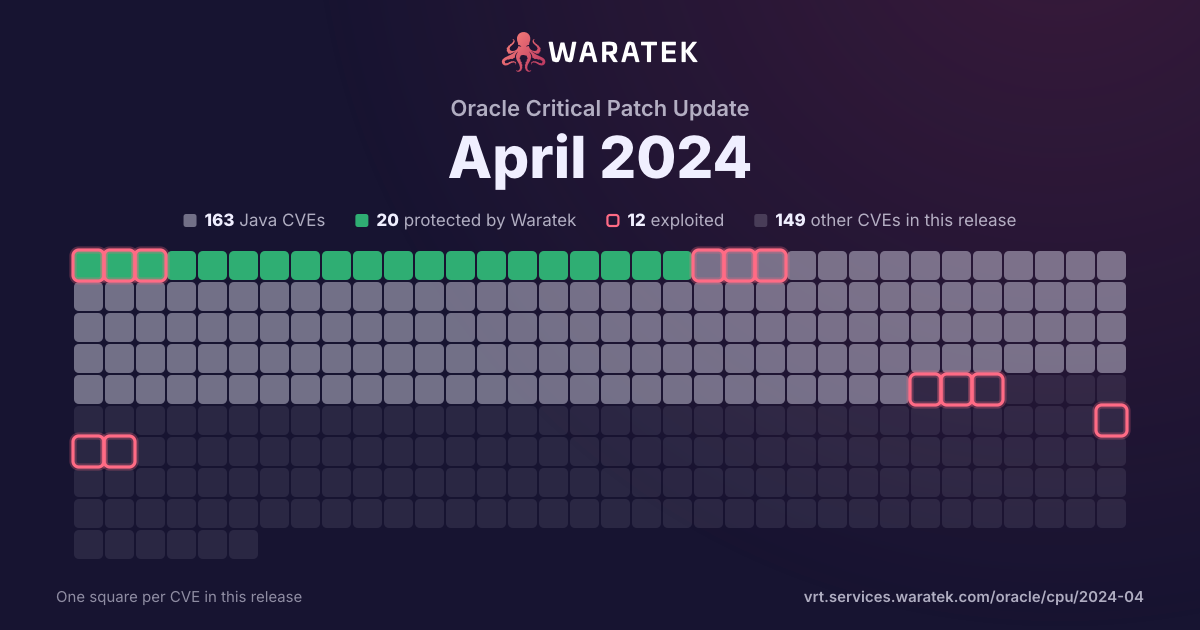
By status
19Protected by Waratek1Rule in development6Mitigation candidate138No exploit published15Outside Waratek scope132Not applicable1Withdrawn CVE
12Exploited, marked by the ring
No exploit published. For 69 of them, Oracle's security advisory is the source of public detail.
Protected by Waratek. Waratek RASP can block exploitation of these on systems that have not applied the patch yet.
Overview 19 matches · 0 protected · 0 exploited · 0 CISA KEV · 0 public PoC · 0 EPSS ≥ 0.5
19matches
0protected0.0%
0exploited0.0%
0CISA KEV0.0%
0public PoC0.0%
0EPSS ≥ 0.50.0%
Protected by Waratek
0
0.0%
Rule in development
0
0.0%
Mitigation candidate
0
0.0%
No exploit published
19
100.0%
blocked by ARMR today
0
0.0%
partly blocked
0
0.0%
not blocked
19
100.0%
not established
0
0.0%
unrecorded
0
0.0%
Exploited
0
0.0%
Working exploit published
0
0.0%
Proof of concept only
2
10.5%
Forecast only
0
0.0%
No public exploit
17
89.5%
split by
peak 5 / month
Oct 234
No exploit published4
Critical1
High2
Medium1
not blocked4
No public exploit4
Nov 235
No exploit published5
Critical1
High3
Medium1
not blocked5
No public exploit5
Dec 232
No exploit published2
High1
Medium1
not blocked2
No public exploit2
Jan 241
No exploit published1
High1
not blocked1
No public exploit1
Feb 245
No exploit published5
High3
Medium2
not blocked5
Proof of concept only2
No public exploit3
Mar 242
No exploit published2
High2
not blocked2
No public exploit2
Oct 23Nov 23Dec 23Jan 24Feb 24Mar 24
| CVE | Severity | Published▾ | Status | Exploitation | Description |
|---|---|---|---|---|---|
| CVE-2024-22257 | High | 2024-03-18 | No exploit published | No public exploit | In Spring Security, versions 5.7.x prior to 5.7.12, 5.8.x prior to 5.8.11, versions 6.0.x prior to 6.0.9, versions 6.1.x prior to 6.1.8, versions 6.2.x prior to 6.2.3, an application is possible vulnerable to broken access control when it directly uses the AuthenticatedVoter#vote passing a null Authentication parameter. |
| CVE-2024-22259 | High | 2024-03-16 | No exploit published | No public exploit | Applications that use UriComponentsBuilder in Spring Framework to parse an externally provided URL (e.g. through a query parameter) AND perform validation checks on the host of the parsed URL may be vulnerable to a open redirect https://cwe.mitre.org/data/definitions/601.html attack or to a SSRF attack if the URL is used after passing validation checks. This is the same as CVE-2024-22243 https://spring.io/security/cve-2024-22243 , but with different input. |
| CVE-2023-51775 | Medium | 2024-02-29 | No exploit published | Proof of concept only | The jose4j component before 0.9.4 for Java allows attackers to cause a denial of service (CPU consumption) via a large p2c (aka PBES2 Count) value. |
| CVE-2024-22201 | High | 2024-02-26 | No exploit published | Proof of concept only | Jetty is a Java based web server and servlet engine. An HTTP/2 SSL connection that is established and TCP congested will be leaked when it times out. An attacker can cause many connections to end up in this state, and the server may run out of file descriptors, eventually causing the server to stop accepting new connections from valid clients. The vulnerability is patched in 9.4.54, 10.0.20, 11.0.20, and 12.0.6. |
| CVE-2024-26308 | Medium | 2024-02-19 | No exploit published | No public exploit | Allocation of Resources Without Limits or Throttling vulnerability in Apache Commons Compress.This issue affects Apache Commons Compress: from 1.21 before 1.26. Users are recommended to upgrade to version 1.26, which fixes the issue. |
| CVE-2024-25710 | High | 2024-02-19 | No exploit published | No public exploit | Loop with Unreachable Exit Condition ('Infinite Loop') vulnerability in Apache Commons Compress.This issue affects Apache Commons Compress: from 1.3 through 1.25.0. Users are recommended to upgrade to version 1.26.0 which fixes the issue. |
| CVE-2024-1635 | High | 2024-02-19 | No exploit published | No public exploit | A vulnerability was found in Undertow. This vulnerability impacts a server that supports the wildfly-http-client protocol. Whenever a malicious user opens and closes a connection with the HTTP port of the server and then closes the connection immediately, the server will end with both memory and open file limits exhausted at some point, depending on the amount of memory available. At HTTP upgrade to remoting, the WriteTimeoutStreamSinkConduit leaks connections if RemotingConnection is closed by Remoting ServerConnectionOpenListener. Because the remoting connection originates in Undertow as part of the HTTP upgrade, there is an external layer to the remoting connection. This connection is unaware of the outermost layer when closing the connection during the connection opening procedure. Hence, the Undertow WriteTimeoutStreamSinkConduit is not notified of the closed connection in this scenario. Because WriteTimeoutStreamSinkConduit creates a timeout task, the whole dependency tree leaks via that task, which is added to XNIO WorkerThread. So, the workerThread points to the Undertow conduit, which contains the connections and causes the leak. |
| CVE-2024-22233 | High | 2024-01-22 | No exploit published | No public exploit | In Spring Framework versions 6.0.15 and 6.1.2, it is possible for a user to provide specially crafted HTTP requests that may cause a denial-of-service (DoS) condition. Specifically, an application is vulnerable when all of the following are true: * the application uses Spring MVC * Spring Security 6.1.6+ or 6.2.1+ is on the classpath Typically, Spring Boot applications need the org.springframework.boot:spring-boot-starter-web and org.springframework.boot:spring-boot-starter-security dependencies to meet all conditions. |
| CVE-2023-51074 | Medium | 2023-12-27 | No exploit published | No public exploit | json-path v2.8.0 was discovered to contain a stack overflow via the Criteria.parse() method. |
| CVE-2023-5379 | High | 2023-12-12 | No exploit published | No public exploit | A flaw was found in Undertow. When an AJP request is sent that exceeds the max-header-size attribute in ajp-listener, JBoss EAP is marked in an error state by mod_cluster in httpd, causing JBoss EAP to close the TCP connection without returning an AJP response. This happens because mod_proxy_cluster marks the JBoss EAP instance as an error worker when the TCP connection is closed from the backend after sending the AJP request without receiving an AJP response, and stops forwarding. This issue could allow a malicious user could to repeatedly send requests that exceed the max-header-size, causing a Denial of Service (DoS). |
| CVE-2023-46589 | High | 2023-11-28 | No exploit published | No public exploit | Improper Input Validation vulnerability in Apache Tomcat.Tomcat from 11.0.0-M1 through 11.0.0-M10, from 10.1.0-M1 through 10.1.15, from 9.0.0-M1 through 9.0.82 and from 8.5.0 through 8.5.95 did not correctly parse HTTP trailer headers. A trailer header that exceeded the header size limit could cause Tomcat to treat a single request as multiple requests leading to the possibility of request smuggling when behind a reverse proxy. Older, EOL versions may also be affected. Users are recommended to upgrade to version 11.0.0-M11 onwards, 10.1.16 onwards, 9.0.83 onwards or 8.5.96 onwards, which fix the issue. |
| CVE-2023-34055 | Medium | 2023-11-28 | No exploit published | No public exploit | In Spring Boot versions 2.7.0 - 2.7.17, 3.0.0-3.0.12 and 3.1.0-3.1.5, it is possible for a user to provide specially crafted HTTP requests that may cause a denial-of-service (DoS) condition. Specifically, an application is vulnerable when all of the following are true: * the application uses Spring MVC or Spring WebFlux * org.springframework.boot:spring-boot-actuator is on the classpath |
| CVE-2023-34053 | High | 2023-11-28 | No exploit published | No public exploit | In Spring Framework versions 6.0.0 - 6.0.13, it is possible for a user to provide specially crafted HTTP requests that may cause a denial-of-service (DoS) condition. Specifically, an application is vulnerable when all of the following are true: * the application uses Spring MVC or Spring WebFlux * io.micrometer:micrometer-core is on the classpath * an ObservationRegistry is configured in the application to record observations Typically, Spring Boot applications need the org.springframework.boot:spring-boot-actuator dependency to meet all conditions. |
| CVE-2022-46337 | Critical | 2023-11-20 | No exploit published | No public exploit | A cleverly devised username might bypass LDAP authentication checks. In LDAP-authenticated Derby installations, this could let an attacker fill up the disk by creating junk Derby databases. In LDAP-authenticated Derby installations, this could also allow the attacker to execute malware which was visible to and executable by the account which booted the Derby server. In LDAP-protected databases which weren't also protected by SQL GRANT/REVOKE authorization, this vulnerability could also let an attacker view and corrupt sensitive data and run sensitive database functions and procedures. Mitigation: Users should upgrade to Java 21 and Derby 10.17.1.0. Alternatively, users who wish to remain on older Java versions should build their own Derby distribution from one of the release families to which the fix was backported: 10.16, 10.15, and 10.14. Those are the releases which correspond, respectively, with Java LTS versions 17, 11, and 8. |
| CVE-2023-4043 | High | 2023-11-03 | No exploit published | No public exploit | In Eclipse Parsson before versions 1.1.4 and 1.0.5, Parsing JSON from untrusted sources can lead malicious actors to exploit the fact that the built-in support for parsing numbers with large scale in Java has a number of edge cases where the input text of a number can lead to much larger processing time than one would expect. To mitigate the risk, parsson put in place a size limit for the numbers as well as their scale. |
| CVE-2023-44483 | Medium | 2023-10-20 | No exploit published | No public exploit | All versions of Apache Santuario - XML Security for Java prior to 2.2.6, 2.3.4, and 3.0.3, when using the JSR 105 API, are vulnerable to an issue where a private key may be disclosed in log files when generating an XML Signature and logging with debug level is enabled. Users are recommended to upgrade to version 2.2.6, 2.3.4, or 3.0.3, which fixes this issue. |
| CVE-2023-5072 | High | 2023-10-12 | No exploit published | No public exploit | Denial of Service in JSON-Java versions up to and including 20230618. A bug in the parser means that an input string of modest size can lead to indefinite amounts of memory being used. |
| CVE-2023-44981 | Critical | 2023-10-11 | No exploit published | No public exploit | Authorization Bypass Through User-Controlled Key vulnerability in Apache ZooKeeper. If SASL Quorum Peer authentication is enabled in ZooKeeper (quorum.auth.enableSasl=true), the authorization is done by verifying that the instance part in SASL authentication ID is listed in zoo.cfg server list. The instance part in SASL auth ID is optional and if it's missing, like 'eve@EXAMPLE.COM', the authorization check will be skipped. As a result an arbitrary endpoint could join the cluster and begin propagating counterfeit changes to the leader, essentially giving it complete read-write access to the data tree. Quorum Peer authentication is not enabled by default. Users are recommended to upgrade to version 3.9.1, 3.8.3, 3.7.2, which fixes the issue. Alternately ensure the ensemble election/quorum communication is protected by a firewall as this will mitigate the issue. See the documentation for more details on correct cluster administration. |
| CVE-2023-36478 | High | 2023-10-10 | No exploit published | No public exploit | Eclipse Jetty provides a web server and servlet container. In versions 11.0.0 through 11.0.15, 10.0.0 through 10.0.15, and 9.0.0 through 9.4.52, an integer overflow in `MetaDataBuilder.checkSize` allows for HTTP/2 HPACK header values to exceed their size limit. `MetaDataBuilder.java` determines if a header name or value exceeds the size limit, and throws an exception if the limit is exceeded. However, when length is very large and huffman is true, the multiplication by 4 in line 295 will overflow, and length will become negative. `(_size+length)` will now be negative, and the check on line 296 will not be triggered. Furthermore, `MetaDataBuilder.checkSize` allows for user-entered HPACK header value sizes to be negative, potentially leading to a very large buffer allocation later on when the user-entered size is multiplied by 2. This means that if a user provides a negative length value (or, more precisely, a length value which, when multiplied by the 4/3 fudge factor, is negative), and this length value is a very large positive number when multiplied by 2, then the user can cause a very large buffer to be allocated on the server. Users of HTTP/2 can be impacted by a remote denial of service attack. The issue has been fixed in versions 11.0.16, 10.0.16, and 9.4.53. There are no known workarounds. |