
Oracle Critical Patch Update April 2024
Released April 2024 · Oracle's advisory ↗ · ← Critical Patch Update, January 2024 · Critical Patch Update, July 2024 →
312 CVEs in this release, one square each
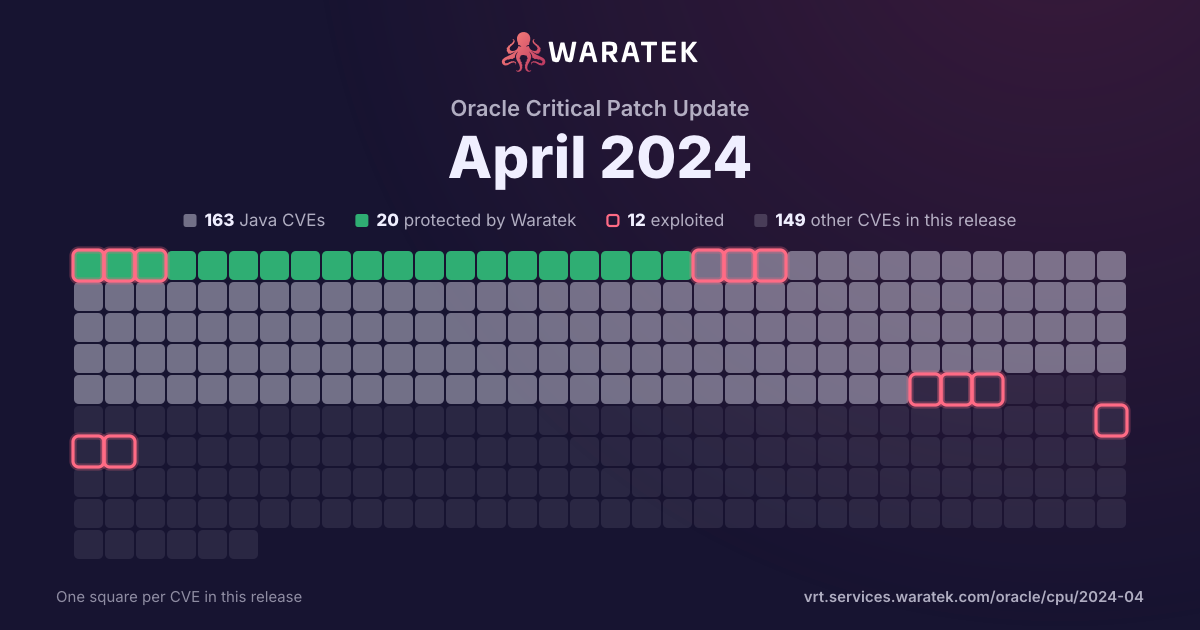
By status
19Protected by Waratek1Rule in development6Mitigation candidate138No exploit published15Outside Waratek scope132Not applicable1Withdrawn CVE
12Exploited, marked by the ring
No exploit published. For 69 of them, Oracle's security advisory is the source of public detail.
Protected by Waratek. Waratek RASP can block exploitation of these on systems that have not applied the patch yet.
Overview 23 matches · 0 protected · 1 exploited · 1 CISA KEV · 1 public PoC · 1 EPSS ≥ 0.5
Protected by Waratek
0
0.0%
Rule in development
0
0.0%
Mitigation candidate
1
4.3%
No exploit published
22
95.7%
blocked by ARMR today
0
0.0%
partly blocked
0
0.0%
not blocked
23
100.0%
not established
0
0.0%
unrecorded
0
0.0%
Exploited
1
4.3%
Working exploit published
0
0.0%
Proof of concept only
3
13.0%
Forecast only
0
0.0%
No public exploit
19
82.6%
split by
peak 3 / month
Feb 231
No exploit published1
High1
not blocked1
No public exploit1
Mar 232
No exploit published2
High2
not blocked2
Proof of concept only2
Apr 230
May 230
Jun 233
No exploit published3
High3
not blocked3
No public exploit3
Jul 231
No exploit published1
High1
not blocked1
No public exploit1
Aug 230
Sep 233
No exploit published3
High3
not blocked3
No public exploit3
Oct 233
Mitigation candidate1
No exploit published2
High3
not blocked3
Exploited1
No public exploit2
Nov 233
No exploit published3
High3
not blocked3
No public exploit3
Dec 231
No exploit published1
High1
not blocked1
No public exploit1
Jan 241
No exploit published1
High1
not blocked1
No public exploit1
Feb 243
No exploit published3
High3
not blocked3
Proof of concept only1
No public exploit2
Mar 242
No exploit published2
High2
not blocked2
No public exploit2
Mar 23May 23Jul 23Sep 23Nov 23Jan 24Mar 24
| CVE | Severity | Published▾ | Status | Exploitation | Description |
|---|---|---|---|---|---|
| CVE-2024-22257 | High | 2024-03-18 | No exploit published | No public exploit | In Spring Security, versions 5.7.x prior to 5.7.12, 5.8.x prior to 5.8.11, versions 6.0.x prior to 6.0.9, versions 6.1.x prior to 6.1.8, versions 6.2.x prior to 6.2.3, an application is possible vulnerable to broken access control when it directly uses the AuthenticatedVoter#vote passing a null Authentication parameter. |
| CVE-2024-22259 | High | 2024-03-16 | No exploit published | No public exploit | Applications that use UriComponentsBuilder in Spring Framework to parse an externally provided URL (e.g. through a query parameter) AND perform validation checks on the host of the parsed URL may be vulnerable to a open redirect https://cwe.mitre.org/data/definitions/601.html attack or to a SSRF attack if the URL is used after passing validation checks. This is the same as CVE-2024-22243 https://spring.io/security/cve-2024-22243 , but with different input. |
| CVE-2024-22201 | High | 2024-02-26 | No exploit published | Proof of concept only | Jetty is a Java based web server and servlet engine. An HTTP/2 SSL connection that is established and TCP congested will be leaked when it times out. An attacker can cause many connections to end up in this state, and the server may run out of file descriptors, eventually causing the server to stop accepting new connections from valid clients. The vulnerability is patched in 9.4.54, 10.0.20, 11.0.20, and 12.0.6. |
| CVE-2024-25710 | High | 2024-02-19 | No exploit published | No public exploit | Loop with Unreachable Exit Condition ('Infinite Loop') vulnerability in Apache Commons Compress.This issue affects Apache Commons Compress: from 1.3 through 1.25.0. Users are recommended to upgrade to version 1.26.0 which fixes the issue. |
| CVE-2024-1635 | High | 2024-02-19 | No exploit published | No public exploit | A vulnerability was found in Undertow. This vulnerability impacts a server that supports the wildfly-http-client protocol. Whenever a malicious user opens and closes a connection with the HTTP port of the server and then closes the connection immediately, the server will end with both memory and open file limits exhausted at some point, depending on the amount of memory available. At HTTP upgrade to remoting, the WriteTimeoutStreamSinkConduit leaks connections if RemotingConnection is closed by Remoting ServerConnectionOpenListener. Because the remoting connection originates in Undertow as part of the HTTP upgrade, there is an external layer to the remoting connection. This connection is unaware of the outermost layer when closing the connection during the connection opening procedure. Hence, the Undertow WriteTimeoutStreamSinkConduit is not notified of the closed connection in this scenario. Because WriteTimeoutStreamSinkConduit creates a timeout task, the whole dependency tree leaks via that task, which is added to XNIO WorkerThread. So, the workerThread points to the Undertow conduit, which contains the connections and causes the leak. |
| CVE-2024-22233 | High | 2024-01-22 | No exploit published | No public exploit | In Spring Framework versions 6.0.15 and 6.1.2, it is possible for a user to provide specially crafted HTTP requests that may cause a denial-of-service (DoS) condition. Specifically, an application is vulnerable when all of the following are true: * the application uses Spring MVC * Spring Security 6.1.6+ or 6.2.1+ is on the classpath Typically, Spring Boot applications need the org.springframework.boot:spring-boot-starter-web and org.springframework.boot:spring-boot-starter-security dependencies to meet all conditions. |
| CVE-2023-5379 | High | 2023-12-12 | No exploit published | No public exploit | A flaw was found in Undertow. When an AJP request is sent that exceeds the max-header-size attribute in ajp-listener, JBoss EAP is marked in an error state by mod_cluster in httpd, causing JBoss EAP to close the TCP connection without returning an AJP response. This happens because mod_proxy_cluster marks the JBoss EAP instance as an error worker when the TCP connection is closed from the backend after sending the AJP request without receiving an AJP response, and stops forwarding. This issue could allow a malicious user could to repeatedly send requests that exceed the max-header-size, causing a Denial of Service (DoS). |
| CVE-2023-46589 | High | 2023-11-28 | No exploit published | No public exploit | Improper Input Validation vulnerability in Apache Tomcat.Tomcat from 11.0.0-M1 through 11.0.0-M10, from 10.1.0-M1 through 10.1.15, from 9.0.0-M1 through 9.0.82 and from 8.5.0 through 8.5.95 did not correctly parse HTTP trailer headers. A trailer header that exceeded the header size limit could cause Tomcat to treat a single request as multiple requests leading to the possibility of request smuggling when behind a reverse proxy. Older, EOL versions may also be affected. Users are recommended to upgrade to version 11.0.0-M11 onwards, 10.1.16 onwards, 9.0.83 onwards or 8.5.96 onwards, which fix the issue. |
| CVE-2023-34053 | High | 2023-11-28 | No exploit published | No public exploit | In Spring Framework versions 6.0.0 - 6.0.13, it is possible for a user to provide specially crafted HTTP requests that may cause a denial-of-service (DoS) condition. Specifically, an application is vulnerable when all of the following are true: * the application uses Spring MVC or Spring WebFlux * io.micrometer:micrometer-core is on the classpath * an ObservationRegistry is configured in the application to record observations Typically, Spring Boot applications need the org.springframework.boot:spring-boot-actuator dependency to meet all conditions. |
| CVE-2023-4043 | High | 2023-11-03 | No exploit published | No public exploit | In Eclipse Parsson before versions 1.1.4 and 1.0.5, Parsing JSON from untrusted sources can lead malicious actors to exploit the fact that the built-in support for parsing numbers with large scale in Java has a number of edge cases where the input text of a number can lead to much larger processing time than one would expect. To mitigate the risk, parsson put in place a size limit for the numbers as well as their scale. |
| CVE-2023-5072 | High | 2023-10-12 | No exploit published | No public exploit | Denial of Service in JSON-Java versions up to and including 20230618. A bug in the parser means that an input string of modest size can lead to indefinite amounts of memory being used. |
| CVE-2023-44487 | High | 2023-10-10 | Mitigation candidate | Exploited | The HTTP/2 protocol allows a denial of service (server resource consumption) because request cancellation can reset many streams quickly, as exploited in the wild in August through October 2023. |
| CVE-2023-36478 | High | 2023-10-10 | No exploit published | No public exploit | Eclipse Jetty provides a web server and servlet container. In versions 11.0.0 through 11.0.15, 10.0.0 through 10.0.15, and 9.0.0 through 9.4.52, an integer overflow in `MetaDataBuilder.checkSize` allows for HTTP/2 HPACK header values to exceed their size limit. `MetaDataBuilder.java` determines if a header name or value exceeds the size limit, and throws an exception if the limit is exceeded. However, when length is very large and huffman is true, the multiplication by 4 in line 295 will overflow, and length will become negative. `(_size+length)` will now be negative, and the check on line 296 will not be triggered. Furthermore, `MetaDataBuilder.checkSize` allows for user-entered HPACK header value sizes to be negative, potentially leading to a very large buffer allocation later on when the user-entered size is multiplied by 2. This means that if a user provides a negative length value (or, more precisely, a length value which, when multiplied by the 4/3 fudge factor, is negative), and this length value is a very large positive number when multiplied by 2, then the user can cause a very large buffer to be allocated on the server. Users of HTTP/2 can be impacted by a remote denial of service attack. The issue has been fixed in versions 11.0.16, 10.0.16, and 9.4.53. There are no known workarounds. |
| CVE-2023-43498 | High | 2023-09-20 | No exploit published | No public exploit | In Jenkins 2.423 and earlier, LTS 2.414.1 and earlier, processing file uploads using MultipartFormDataParser creates temporary files in the default system temporary directory with the default permissions for newly created files, potentially allowing attackers with access to the Jenkins controller file system to read and write the files before they are used. |
| CVE-2023-43497 | High | 2023-09-20 | No exploit published | No public exploit | In Jenkins 2.423 and earlier, LTS 2.414.1 and earlier, processing file uploads using the Stapler web framework creates temporary files in the default system temporary directory with the default permissions for newly created files, potentially allowing attackers with access to the Jenkins controller file system to read and write the files before they are used. |
| CVE-2023-43496 | High | 2023-09-20 | No exploit published | No public exploit | Jenkins 2.423 and earlier, LTS 2.414.1 and earlier creates a temporary file in the system temporary directory with the default permissions for newly created files when installing a plugin from a URL, potentially allowing attackers with access to the system temporary directory to replace the file before it is installed in Jenkins, potentially resulting in arbitrary code execution. |
| CVE-2023-3635 | High | 2023-07-12 | No exploit published | No public exploit | GzipSource does not handle an exception that might be raised when parsing a malformed gzip buffer. This may lead to denial of service of the Okio client when handling a crafted GZIP archive, by using the GzipSource class. |
| CVE-2023-34981 | High | 2023-06-21 | No exploit published | No public exploit | A regression in the fix for bug 66512 in Apache Tomcat 11.0.0-M5, 10.1.8, 9.0.74 and 8.5.88 meant that, if a response did not include any HTTP headers no AJP SEND_HEADERS messare woudl be sent for the response which in turn meant that at least one AJP proxy (mod_proxy_ajp) would use the response headers from the previous request leading to an information leak. |
| CVE-2023-35141 | High | 2023-06-14 | No exploit published | No public exploit | In Jenkins 2.399 and earlier, LTS 2.387.3 and earlier, POST requests are sent in order to load the list of context actions. If part of the URL includes insufficiently escaped user-provided values, a victim may be tricked into sending a POST request to an unexpected endpoint by opening a context menu. |
| CVE-2023-2976 | High | 2023-06-14 | No exploit published | No public exploit | Use of Java's default temporary directory for file creation in `FileBackedOutputStream` in Google Guava versions 1.0 to 31.1 on Unix systems and Android Ice Cream Sandwich allows other users and apps on the machine with access to the default Java temporary directory to be able to access the files created by the class. Even though the security vulnerability is fixed in version 32.0.0, we recommend using version 32.0.1 as version 32.0.0 breaks some functionality under Windows. |
| CVE-2023-1436 | High | 2023-03-22 | No exploit published | Proof of concept only | An infinite recursion is triggered in Jettison when constructing a JSONArray from a Collection that contains a self-reference in one of its elements. This leads to a StackOverflowError exception being thrown. |
| CVE-2023-1370 | High | 2023-03-22 | No exploit published | Proof of concept only | [Json-smart](https://netplex.github.io/json-smart/) is a performance focused, JSON processor lib. When reaching a ‘[‘ or ‘{‘ character in the JSON input, the code parses an array or an object respectively. It was discovered that the code does not have any limit to the nesting of such arrays or objects. Since the parsing of nested arrays and objects is done recursively, nesting too many of them can cause a stack exhaustion (stack overflow) and crash the software. |
| CVE-2023-24998 | High | 2023-02-20 | No exploit published | No public exploit | Apache Commons FileUpload before 1.5 does not limit the number of request parts to be processed resulting in the possibility of an attacker triggering a DoS with a malicious upload or series of uploads. Note that, like all of the file upload limits, the new configuration option (FileUploadBase#setFileCountMax) is not enabled by default and must be explicitly configured. |