
Oracle Critical Patch Update April 2024
Released April 2024 · Oracle's advisory ↗ · ← Critical Patch Update, January 2024 · Critical Patch Update, July 2024 →
312 CVEs in this release, one square each
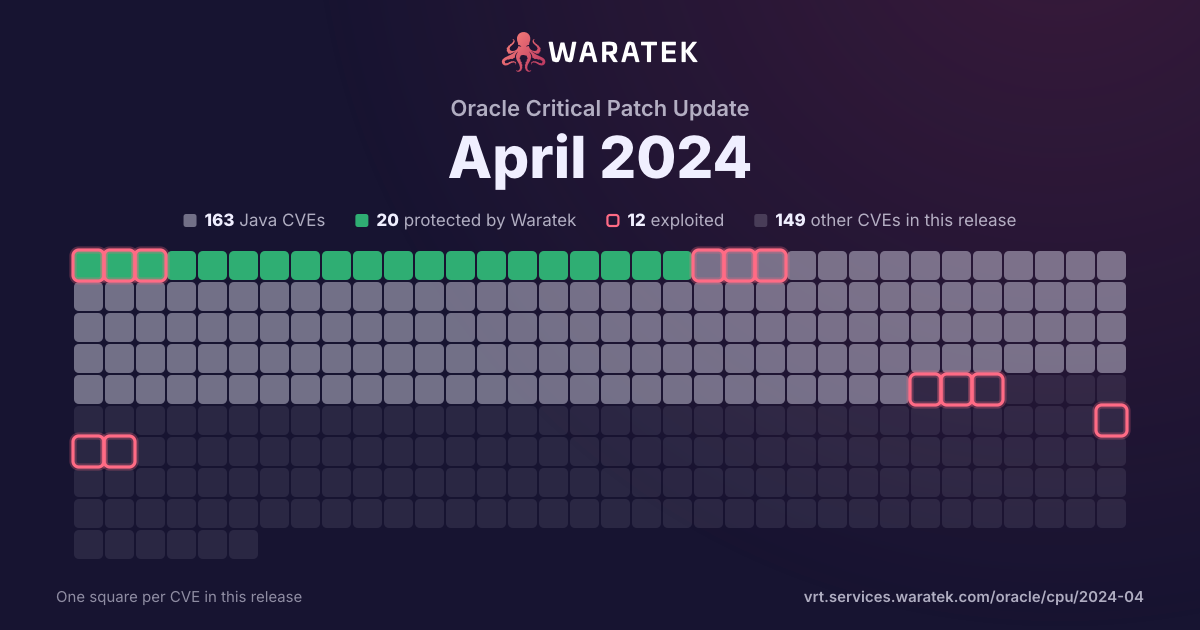
By status
20Protected by Waratek6Mitigation candidate137No exploit published40Outside Waratek scope108Not applicable1Withdrawn CVE
12Exploited, marked by the ring
No exploit published. For 82 of them, Oracle's security advisory is the source of public detail.
Protected by Waratek. Waratek RASP can block exploitation of these on systems that have not applied the patch yet.
Overview 137 matches · 0 protected · 0 exploited · 0 CISA KEV · 0 public PoC · 0 EPSS ≥ 0.5
137matches
0protected0.0%
0exploited0.0%
0CISA KEV0.0%
0public PoC0.0%
0EPSS ≥ 0.50.0%
Protected by Waratek
0
0.0%
Rule in development
0
0.0%
Mitigation candidate
0
0.0%
No exploit published
137
100.0%
Outside Waratek scope
0
0.0%
Not applicable
0
0.0%
Withdrawn CVE
0
0.0%
blocked by ARMR today
0
0.0%
partly blocked
0
0.0%
not blocked
137
100.0%
not established
0
0.0%
unrecorded
0
0.0%
Exploited
0
0.0%
Working exploit published
0
0.0%
Proof of concept only
6
4.4%
Forecast only
0
0.0%
No public exploit
131
95.6%
split by
peak 69 / quarter
Q4 201
No exploit published1
Low1
not blocked1
No public exploit1
Q1 210
Q2 210
Q3 212
No exploit published2
Medium2
not blocked2
No public exploit2
Q4 210
Q1 223
No exploit published3
Medium3
not blocked3
No public exploit3
Q2 221
No exploit published1
High1
not blocked1
No public exploit1
Q3 223
No exploit published3
Critical2
High1
not blocked3
Proof of concept only1
No public exploit2
Q4 226
No exploit published6
Critical1
High4
Medium1
not blocked6
Proof of concept only1
No public exploit5
Q1 236
No exploit published6
High4
Medium2
not blocked6
Proof of concept only2
No public exploit4
Q2 235
No exploit published5
High3
Medium2
not blocked5
No public exploit5
Q3 2314
No exploit published14
High5
Medium8
Low1
not blocked14
No public exploit14
Q4 2312
No exploit published12
Critical2
High6
Medium4
not blocked12
No public exploit12
Q1 2415
No exploit published15
High9
Medium5
Low1
not blocked15
Proof of concept only2
No public exploit13
Q2 2469
No exploit published69
Critical2
High14
Medium48
Low5
not blocked69
No public exploit69
Q4 20Q2 21Q4 21Q2 22Q4 22Q2 23Q4 23Q2 24
| CVE | Severity | Published▾ | Status | Exploitation | Description |
|---|---|---|---|---|---|
| CVE-2024-21100 | Medium | 2024-04-16 | No exploit published | No public exploit | Vulnerability in the Oracle Commerce Platform product of Oracle Commerce (component: Platform). Supported versions that are affected are 11.3.0, 11.3.1 and 11.3.2. Difficult to exploit vulnerability allows unauthenticated attacker with network access via HTTP to compromise Oracle Commerce Platform. While the vulnerability is in Oracle Commerce Platform, attacks may significantly impact additional products (scope change). Successful attacks of this vulnerability can result in unauthorized update, insert or delete access to some of Oracle Commerce Platform accessible data. CVSS 3.1 Base Score 4.0 (Integrity impacts). CVSS Vector: (CVSS:3.1/AV:N/AC:H/PR:N/UI:N/S:C/C:N/I:L/A:N). |
| CVE-2024-21099 | Medium | 2024-04-16 | No exploit published | No public exploit | Vulnerability in the Oracle Business Intelligence Enterprise Edition product of Oracle Analytics (component: Data Visualization). The supported version that is affected is 7.0.0.0.0. Easily exploitable vulnerability allows low privileged attacker with network access via HTTP to compromise Oracle Business Intelligence Enterprise Edition. Successful attacks of this vulnerability can result in unauthorized read access to a subset of Oracle Business Intelligence Enterprise Edition accessible data. CVSS 3.1 Base Score 4.3 (Confidentiality impacts). CVSS Vector: (CVSS:3.1/AV:N/AC:L/PR:L/UI:N/S:U/C:L/I:N/A:N). |
| CVE-2024-21098 | Low | 2024-04-16 | No exploit published | No public exploit | Vulnerability in the Oracle GraalVM for JDK, Oracle GraalVM Enterprise Edition product of Oracle Java SE (component: Compiler). Supported versions that are affected are Oracle GraalVM for JDK: 17.0.10, 21.0.2, 22; Oracle GraalVM Enterprise Edition: 20.3.13 and 21.3.9. Difficult to exploit vulnerability allows unauthenticated attacker with network access via multiple protocols to compromise Oracle GraalVM for JDK, Oracle GraalVM Enterprise Edition. Successful attacks of this vulnerability can result in unauthorized ability to cause a partial denial of service (partial DOS) of Oracle GraalVM for JDK, Oracle GraalVM Enterprise Edition. CVSS 3.1 Base Score 3.7 (Availability impacts). CVSS Vector: (CVSS:3.1/AV:N/AC:H/PR:N/UI:N/S:U/C:N/I:N/A:L). |
| CVE-2024-21097 | Medium | 2024-04-16 | No exploit published | No public exploit | Vulnerability in the PeopleSoft Enterprise PeopleTools product of Oracle PeopleSoft (component: Security). Supported versions that are affected are 8.59, 8.60 and 8.61. Easily exploitable vulnerability allows high privileged attacker with network access via HTTP to compromise PeopleSoft Enterprise PeopleTools. Successful attacks of this vulnerability can result in unauthorized access to critical data or complete access to all PeopleSoft Enterprise PeopleTools accessible data. CVSS 3.1 Base Score 4.9 (Confidentiality impacts). CVSS Vector: (CVSS:3.1/AV:N/AC:L/PR:H/UI:N/S:U/C:H/I:N/A:N). |
| CVE-2024-21095 | High | 2024-04-16 | No exploit published | No public exploit | Vulnerability in the Primavera P6 Enterprise Project Portfolio Management product of Oracle Construction and Engineering (component: Web Access). Supported versions that are affected are 19.12.0-19.12.22, 20.12.0-20.12.21, 21.12.0-21.12.18, 22.12.0-22.12.12 and 23.12.0-23.12.2. Easily exploitable vulnerability allows unauthenticated attacker with network access via HTTP to compromise Primavera P6 Enterprise Project Portfolio Management. Successful attacks of this vulnerability can result in unauthorized access to critical data or complete access to all Primavera P6 Enterprise Project Portfolio Management accessible data as well as unauthorized update, insert or delete access to some of Primavera P6 Enterprise Project Portfolio Management accessible data. CVSS 3.1 Base Score 8.2 (Confidentiality and Integrity impacts). CVSS Vector: (CVSS:3.1/AV:N/AC:L/PR:N/UI:N/S:U/C:H/I:L/A:N). |
| CVE-2024-21094 | Low | 2024-04-16 | No exploit published | No public exploit | Vulnerability in the Oracle Java SE, Oracle GraalVM for JDK, Oracle GraalVM Enterprise Edition product of Oracle Java SE (component: Hotspot). Supported versions that are affected are Oracle Java SE: 8u401, 8u401-perf, 11.0.22, 17.0.10, 21.0.2, 22; Oracle GraalVM for JDK: 17.0.10, 21.0.2, 22; Oracle GraalVM Enterprise Edition: 20.3.13 and 21.3.9. Difficult to exploit vulnerability allows unauthenticated attacker with network access via multiple protocols to compromise Oracle Java SE, Oracle GraalVM for JDK, Oracle GraalVM Enterprise Edition. Successful attacks of this vulnerability can result in unauthorized update, insert or delete access to some of Oracle Java SE, Oracle GraalVM for JDK, Oracle GraalVM Enterprise Edition accessible data. Note: This vulnerability can be exploited by using APIs in the specified Component, e.g., through a web service which supplies data to the APIs. This vulnerability also applies to Java deployments, typically in clients running sandboxed Java Web Start applications or sandboxed Java applets, that load and run untrusted code (e.g., code that comes from the internet) and rely on the Java sandbox for security. CVSS 3.1 Base Score 3.7 (Integrity impacts). CVSS Vector: (CVSS:3.1/AV:N/AC:H/PR:N/UI:N/S:U/C:N/I:L/A:N). |
| CVE-2024-21092 | High | 2024-04-16 | No exploit published | No public exploit | Vulnerability in the Oracle Agile Product Lifecycle Management for Process product of Oracle Supply Chain (component: Product Quality Management). The supported version that is affected is 6.2.4.2. Easily exploitable vulnerability allows low privileged attacker with network access via HTTP to compromise Oracle Agile Product Lifecycle Management for Process. Successful attacks of this vulnerability can result in unauthorized creation, deletion or modification access to critical data or all Oracle Agile Product Lifecycle Management for Process accessible data as well as unauthorized access to critical data or complete access to all Oracle Agile Product Lifecycle Management for Process accessible data. CVSS 3.1 Base Score 8.1 (Confidentiality and Integrity impacts). CVSS Vector: (CVSS:3.1/AV:N/AC:L/PR:L/UI:N/S:U/C:H/I:H/A:N). |
| CVE-2024-21091 | Medium | 2024-04-16 | No exploit published | No public exploit | Vulnerability in the Oracle Agile Product Lifecycle Management for Process product of Oracle Supply Chain (component: Data Import). The supported version that is affected is 6.2.4.2. Easily exploitable vulnerability allows low privileged attacker with network access via HTTP to compromise Oracle Agile Product Lifecycle Management for Process. Successful attacks of this vulnerability can result in unauthorized access to critical data or complete access to all Oracle Agile Product Lifecycle Management for Process accessible data. CVSS 3.1 Base Score 6.5 (Confidentiality impacts). CVSS Vector: (CVSS:3.1/AV:N/AC:L/PR:L/UI:N/S:U/C:H/I:N/A:N). |
| CVE-2024-21089 | Medium | 2024-04-16 | No exploit published | No public exploit | Vulnerability in the Oracle Concurrent Processing product of Oracle E-Business Suite (component: Request Submission and Scheduling). Supported versions that are affected are 12.2.3-12.2.13. Easily exploitable vulnerability allows low privileged attacker with network access via HTTP to compromise Oracle Concurrent Processing. Successful attacks of this vulnerability can result in unauthorized access to critical data or complete access to all Oracle Concurrent Processing accessible data. CVSS 3.1 Base Score 6.5 (Confidentiality impacts). CVSS Vector: (CVSS:3.1/AV:N/AC:L/PR:L/UI:N/S:U/C:H/I:N/A:N). |
| CVE-2024-21088 | High | 2024-04-16 | No exploit published | No public exploit | Vulnerability in the Oracle Production Scheduling product of Oracle E-Business Suite (component: Import Utility). Supported versions that are affected are 12.2.4-12.2.12. Easily exploitable vulnerability allows unauthenticated attacker with network access via HTTP to compromise Oracle Production Scheduling. Successful attacks of this vulnerability can result in unauthorized creation, deletion or modification access to critical data or all Oracle Production Scheduling accessible data. CVSS 3.1 Base Score 7.5 (Integrity impacts). CVSS Vector: (CVSS:3.1/AV:N/AC:L/PR:N/UI:N/S:U/C:N/I:H/A:N). |
| CVE-2024-21086 | Medium | 2024-04-16 | No exploit published | No public exploit | Vulnerability in the Oracle CRM Technical Foundation product of Oracle E-Business Suite (component: Preferences). Supported versions that are affected are 12.2.3-12.2.13. Easily exploitable vulnerability allows unauthenticated attacker with network access via HTTP to compromise Oracle CRM Technical Foundation. Successful attacks require human interaction from a person other than the attacker. Successful attacks of this vulnerability can result in unauthorized update, insert or delete access to some of Oracle CRM Technical Foundation accessible data. CVSS 3.1 Base Score 4.3 (Integrity impacts). CVSS Vector: (CVSS:3.1/AV:N/AC:L/PR:N/UI:R/S:U/C:N/I:L/A:N). |
| CVE-2024-21084 | Medium | 2024-04-16 | No exploit published | No public exploit | Vulnerability in the Oracle BI Publisher product of Oracle Analytics (component: Service Gateway). Supported versions that are affected are 7.0.0.0.0 and 12.2.1.4.0. Easily exploitable vulnerability allows unauthenticated attacker with network access via HTTP to compromise Oracle BI Publisher. While the vulnerability is in Oracle BI Publisher, attacks may significantly impact additional products (scope change). Successful attacks of this vulnerability can result in unauthorized read access to a subset of Oracle BI Publisher accessible data. CVSS 3.1 Base Score 5.8 (Confidentiality impacts). CVSS Vector: (CVSS:3.1/AV:N/AC:L/PR:N/UI:N/S:C/C:L/I:N/A:N). |
| CVE-2024-21083 | High | 2024-04-16 | No exploit published | No public exploit | Vulnerability in the Oracle BI Publisher product of Oracle Analytics (component: Script Engine). Supported versions that are affected are 7.0.0.0.0 and 12.2.1.4.0. Easily exploitable vulnerability allows high privileged attacker with network access via HTTP to compromise Oracle BI Publisher. Successful attacks of this vulnerability can result in takeover of Oracle BI Publisher. CVSS 3.1 Base Score 7.2 (Confidentiality, Integrity and Availability impacts). CVSS Vector: (CVSS:3.1/AV:N/AC:L/PR:H/UI:N/S:U/C:H/I:H/A:H). |
| CVE-2024-21082 | Critical | 2024-04-16 | No exploit published | No public exploit | Vulnerability in the Oracle BI Publisher product of Oracle Analytics (component: XML Services). Supported versions that are affected are 7.0.0.0.0 and 12.2.1.4.0. Easily exploitable vulnerability allows unauthenticated attacker with network access via HTTP to compromise Oracle BI Publisher. Successful attacks of this vulnerability can result in takeover of Oracle BI Publisher. CVSS 3.1 Base Score 9.8 (Confidentiality, Integrity and Availability impacts). CVSS Vector: (CVSS:3.1/AV:N/AC:L/PR:N/UI:N/S:U/C:H/I:H/A:H). |
| CVE-2024-21081 | Medium | 2024-04-16 | No exploit published | No public exploit | Vulnerability in the Oracle Partner Management product of Oracle E-Business Suite (component: Attribute Admin Setup). Supported versions that are affected are 12.2.3-12.2.13. Easily exploitable vulnerability allows unauthenticated attacker with network access via HTTP to compromise Oracle Partner Management. Successful attacks require human interaction from a person other than the attacker and while the vulnerability is in Oracle Partner Management, attacks may significantly impact additional products (scope change). Successful attacks of this vulnerability can result in unauthorized update, insert or delete access to some of Oracle Partner Management accessible data. CVSS 3.1 Base Score 4.7 (Integrity impacts). CVSS Vector: (CVSS:3.1/AV:N/AC:L/PR:N/UI:R/S:C/C:N/I:L/A:N). |
| CVE-2024-21080 | Medium | 2024-04-16 | No exploit published | No public exploit | Vulnerability in the Oracle Applications Framework product of Oracle E-Business Suite (component: REST Services). Supported versions that are affected are 12.2.9-12.2.13. Easily exploitable vulnerability allows low privileged attacker with network access via HTTP to compromise Oracle Applications Framework. Successful attacks of this vulnerability can result in unauthorized access to critical data or complete access to all Oracle Applications Framework accessible data. CVSS 3.1 Base Score 6.5 (Confidentiality impacts). CVSS Vector: (CVSS:3.1/AV:N/AC:L/PR:L/UI:N/S:U/C:H/I:N/A:N). |
| CVE-2024-21079 | High | 2024-04-16 | No exploit published | No public exploit | Vulnerability in the Oracle Marketing product of Oracle E-Business Suite (component: Campaign LOV). Supported versions that are affected are 12.2.3-12.2.13. Easily exploitable vulnerability allows unauthenticated attacker with network access via HTTP to compromise Oracle Marketing. Successful attacks of this vulnerability can result in unauthorized access to critical data or complete access to all Oracle Marketing accessible data. CVSS 3.1 Base Score 7.5 (Confidentiality impacts). CVSS Vector: (CVSS:3.1/AV:N/AC:L/PR:N/UI:N/S:U/C:H/I:N/A:N). |
| CVE-2024-21078 | High | 2024-04-16 | No exploit published | No public exploit | Vulnerability in the Oracle Marketing product of Oracle E-Business Suite (component: Campaign LOV). Supported versions that are affected are 12.2.3-12.2.13. Easily exploitable vulnerability allows unauthenticated attacker with network access via HTTP to compromise Oracle Marketing. Successful attacks of this vulnerability can result in unauthorized access to critical data or complete access to all Oracle Marketing accessible data. CVSS 3.1 Base Score 7.5 (Confidentiality impacts). CVSS Vector: (CVSS:3.1/AV:N/AC:L/PR:N/UI:N/S:U/C:H/I:N/A:N). |
| CVE-2024-21077 | High | 2024-04-16 | No exploit published | No public exploit | Vulnerability in the Oracle Trade Management product of Oracle E-Business Suite (component: GL Accounts LOV). Supported versions that are affected are 12.2.3-12.2.13. Easily exploitable vulnerability allows unauthenticated attacker with network access via HTTP to compromise Oracle Trade Management. Successful attacks of this vulnerability can result in unauthorized access to critical data or complete access to all Oracle Trade Management accessible data. CVSS 3.1 Base Score 7.5 (Confidentiality impacts). CVSS Vector: (CVSS:3.1/AV:N/AC:L/PR:N/UI:N/S:U/C:H/I:N/A:N). |
| CVE-2024-21076 | High | 2024-04-16 | No exploit published | No public exploit | Vulnerability in the Oracle Trade Management product of Oracle E-Business Suite (component: Offer LOV). Supported versions that are affected are 12.2.3-12.2.13. Easily exploitable vulnerability allows unauthenticated attacker with network access via HTTP to compromise Oracle Trade Management. Successful attacks of this vulnerability can result in unauthorized access to critical data or complete access to all Oracle Trade Management accessible data. CVSS 3.1 Base Score 7.5 (Confidentiality impacts). CVSS Vector: (CVSS:3.1/AV:N/AC:L/PR:N/UI:N/S:U/C:H/I:N/A:N). |
| CVE-2024-21075 | High | 2024-04-16 | No exploit published | No public exploit | Vulnerability in the Oracle Trade Management product of Oracle E-Business Suite (component: Claim Line LOV). Supported versions that are affected are 12.2.3-12.2.13. Easily exploitable vulnerability allows unauthenticated attacker with network access via HTTP to compromise Oracle Trade Management. Successful attacks of this vulnerability can result in unauthorized access to critical data or complete access to all Oracle Trade Management accessible data. CVSS 3.1 Base Score 7.5 (Confidentiality impacts). CVSS Vector: (CVSS:3.1/AV:N/AC:L/PR:N/UI:N/S:U/C:H/I:N/A:N). |
| CVE-2024-21074 | High | 2024-04-16 | No exploit published | No public exploit | Vulnerability in the Oracle Trade Management product of Oracle E-Business Suite (component: Finance LOV). Supported versions that are affected are 12.2.3-12.2.13. Easily exploitable vulnerability allows unauthenticated attacker with network access via HTTP to compromise Oracle Trade Management. Successful attacks of this vulnerability can result in unauthorized access to critical data or complete access to all Oracle Trade Management accessible data. CVSS 3.1 Base Score 7.5 (Confidentiality impacts). CVSS Vector: (CVSS:3.1/AV:N/AC:L/PR:N/UI:N/S:U/C:H/I:N/A:N). |
| CVE-2024-21073 | High | 2024-04-16 | No exploit published | No public exploit | Vulnerability in the Oracle Trade Management product of Oracle E-Business Suite (component: Claim LOV). Supported versions that are affected are 12.2.3-12.2.13. Easily exploitable vulnerability allows unauthenticated attacker with network access via HTTP to compromise Oracle Trade Management. Successful attacks of this vulnerability can result in unauthorized access to critical data or complete access to all Oracle Trade Management accessible data. CVSS 3.1 Base Score 7.5 (Confidentiality impacts). CVSS Vector: (CVSS:3.1/AV:N/AC:L/PR:N/UI:N/S:U/C:H/I:N/A:N). |
| CVE-2024-21072 | Medium | 2024-04-16 | No exploit published | No public exploit | Vulnerability in the Oracle Installed Base product of Oracle E-Business Suite (component: Data Provider UI). Supported versions that are affected are 12.2.3-12.2.13. Easily exploitable vulnerability allows unauthenticated attacker with network access via HTTP to compromise Oracle Installed Base. Successful attacks require human interaction from a person other than the attacker and while the vulnerability is in Oracle Installed Base, attacks may significantly impact additional products (scope change). Successful attacks of this vulnerability can result in unauthorized update, insert or delete access to some of Oracle Installed Base accessible data as well as unauthorized read access to a subset of Oracle Installed Base accessible data. CVSS 3.1 Base Score 6.1 (Confidentiality and Integrity impacts). CVSS Vector: (CVSS:3.1/AV:N/AC:L/PR:N/UI:R/S:C/C:L/I:L/A:N). |
| CVE-2024-21071 | Critical | 2024-04-16 | No exploit published | No public exploit | Vulnerability in the Oracle Workflow product of Oracle E-Business Suite (component: Admin Screens and Grants UI). Supported versions that are affected are 12.2.3-12.2.13. Easily exploitable vulnerability allows high privileged attacker with network access via HTTP to compromise Oracle Workflow. While the vulnerability is in Oracle Workflow, attacks may significantly impact additional products (scope change). Successful attacks of this vulnerability can result in takeover of Oracle Workflow. CVSS 3.1 Base Score 9.1 (Confidentiality, Integrity and Availability impacts). CVSS Vector: (CVSS:3.1/AV:N/AC:L/PR:H/UI:N/S:C/C:H/I:H/A:H). |
| CVE-2024-21070 | Medium | 2024-04-16 | No exploit published | No public exploit | Vulnerability in the PeopleSoft Enterprise PeopleTools product of Oracle PeopleSoft (component: Search Framework). Supported versions that are affected are 8.59, 8.60 and 8.61. Easily exploitable vulnerability allows unauthenticated attacker with network access via HTTP to compromise PeopleSoft Enterprise PeopleTools. Successful attacks require human interaction from a person other than the attacker. Successful attacks of this vulnerability can result in unauthorized update, insert or delete access to some of PeopleSoft Enterprise PeopleTools accessible data as well as unauthorized read access to a subset of PeopleSoft Enterprise PeopleTools accessible data. CVSS 3.1 Base Score 5.4 (Confidentiality and Integrity impacts). CVSS Vector: (CVSS:3.1/AV:N/AC:L/PR:N/UI:R/S:U/C:L/I:L/A:N). |
| CVE-2024-21068 | Low | 2024-04-16 | No exploit published | No public exploit | Vulnerability in the Oracle Java SE, Oracle GraalVM for JDK, Oracle GraalVM Enterprise Edition product of Oracle Java SE (component: Hotspot). Supported versions that are affected are Oracle Java SE: 8u401-perf, 11.0.22, 17.0.10, 21.0.2, 22; Oracle GraalVM for JDK: 17.0.10, 21.0.2 and 22; Oracle GraalVM Enterprise Edition: 21.3.9. Difficult to exploit vulnerability allows unauthenticated attacker with network access via multiple protocols to compromise Oracle Java SE, Oracle GraalVM for JDK, Oracle GraalVM Enterprise Edition. Successful attacks of this vulnerability can result in unauthorized update, insert or delete access to some of Oracle Java SE, Oracle GraalVM for JDK, Oracle GraalVM Enterprise Edition accessible data. Note: This vulnerability can be exploited by using APIs in the specified Component, e.g., through a web service which supplies data to the APIs. This vulnerability also applies to Java deployments, typically in clients running sandboxed Java Web Start applications or sandboxed Java applets, that load and run untrusted code (e.g., code that comes from the internet) and rely on the Java sandbox for security. CVSS 3.1 Base Score 3.7 (Integrity impacts). CVSS Vector: (CVSS:3.1/AV:N/AC:H/PR:N/UI:N/S:U/C:N/I:L/A:N). |
| CVE-2024-21067 | High | 2024-04-16 | No exploit published | No public exploit | Vulnerability in the Oracle Enterprise Manager Base Platform product of Oracle Enterprise Manager (component: Host Management). The supported version that is affected is 13.5.0.0. Easily exploitable vulnerability allows low privileged attacker with logon to the infrastructure where Oracle Enterprise Manager Base Platform executes to compromise Oracle Enterprise Manager Base Platform. While the vulnerability is in Oracle Enterprise Manager Base Platform, attacks may significantly impact additional products (scope change). Successful attacks of this vulnerability can result in takeover of Oracle Enterprise Manager Base Platform. CVSS 3.1 Base Score 8.8 (Confidentiality, Integrity and Availability impacts). CVSS Vector: (CVSS:3.1/AV:L/AC:L/PR:L/UI:N/S:C/C:H/I:H/A:H). |
| CVE-2024-21065 | Medium | 2024-04-16 | No exploit published | No public exploit | Vulnerability in the PeopleSoft Enterprise PeopleTools product of Oracle PeopleSoft (component: Workflow). Supported versions that are affected are 8.59, 8.60 and 8.61. Easily exploitable vulnerability allows unauthenticated attacker with network access via HTTP to compromise PeopleSoft Enterprise PeopleTools. Successful attacks require human interaction from a person other than the attacker and while the vulnerability is in PeopleSoft Enterprise PeopleTools, attacks may significantly impact additional products (scope change). Successful attacks of this vulnerability can result in unauthorized update, insert or delete access to some of PeopleSoft Enterprise PeopleTools accessible data as well as unauthorized read access to a subset of PeopleSoft Enterprise PeopleTools accessible data. CVSS 3.1 Base Score 6.1 (Confidentiality and Integrity impacts). CVSS Vector: (CVSS:3.1/AV:N/AC:L/PR:N/UI:R/S:C/C:L/I:L/A:N). |
| CVE-2024-21064 | Medium | 2024-04-16 | No exploit published | No public exploit | Vulnerability in the Oracle Business Intelligence Enterprise Edition product of Oracle Analytics (component: Analytics Web Answers). Supported versions that are affected are 7.0.0.0.0 and 12.2.1.4.0. Easily exploitable vulnerability allows low privileged attacker with network access via HTTP to compromise Oracle Business Intelligence Enterprise Edition. Successful attacks require human interaction from a person other than the attacker and while the vulnerability is in Oracle Business Intelligence Enterprise Edition, attacks may significantly impact additional products (scope change). Successful attacks of this vulnerability can result in unauthorized update, insert or delete access to some of Oracle Business Intelligence Enterprise Edition accessible data as well as unauthorized read access to a subset of Oracle Business Intelligence Enterprise Edition accessible data. CVSS 3.1 Base Score 5.4 (Confidentiality and Integrity impacts). CVSS Vector: (CVSS:3.1/AV:N/AC:L/PR:L/UI:R/S:C/C:L/I:L/A:N). |
| CVE-2024-21063 | Medium | 2024-04-16 | No exploit published | No public exploit | Vulnerability in the PeopleSoft Enterprise HCM Benefits Administration product of Oracle PeopleSoft (component: Benefits Administration). The supported version that is affected is 9.2. Easily exploitable vulnerability allows low privileged attacker with logon to the infrastructure where PeopleSoft Enterprise HCM Benefits Administration executes to compromise PeopleSoft Enterprise HCM Benefits Administration. Successful attacks require human interaction from a person other than the attacker. Successful attacks of this vulnerability can result in unauthorized access to critical data or complete access to all PeopleSoft Enterprise HCM Benefits Administration accessible data as well as unauthorized update, insert or delete access to some of PeopleSoft Enterprise HCM Benefits Administration accessible data and unauthorized ability to cause a partial denial of service (partial DOS) of PeopleSoft Enterprise HCM Benefits Administration. CVSS 3.1 Base Score 6.1 (Confidentiality, Integrity and Availability impacts). CVSS Vector: (CVSS:3.1/AV:L/AC:L/PR:L/UI:R/S:U/C:H/I:L/A:L). |
| CVE-2024-21048 | Medium | 2024-04-16 | No exploit published | No public exploit | Vulnerability in the Oracle Web Applications Desktop Integrator product of Oracle E-Business Suite (component: XML input). Supported versions that are affected are 12.2.3-12.2.13. Easily exploitable vulnerability allows low privileged attacker with network access via HTTP to compromise Oracle Web Applications Desktop Integrator. Successful attacks of this vulnerability can result in unauthorized read access to a subset of Oracle Web Applications Desktop Integrator accessible data. CVSS 3.1 Base Score 4.3 (Confidentiality impacts). CVSS Vector: (CVSS:3.1/AV:N/AC:L/PR:L/UI:N/S:U/C:L/I:N/A:N). |
| CVE-2024-21046 | Medium | 2024-04-16 | No exploit published | No public exploit | Vulnerability in the Oracle Complex Maintenance, Repair, and Overhaul product of Oracle E-Business Suite (component: LOV). Supported versions that are affected are 12.2.3-12.2.13. Easily exploitable vulnerability allows unauthenticated attacker with network access via HTTP to compromise Oracle Complex Maintenance, Repair, and Overhaul. Successful attacks require human interaction from a person other than the attacker and while the vulnerability is in Oracle Complex Maintenance, Repair, and Overhaul, attacks may significantly impact additional products (scope change). Successful attacks of this vulnerability can result in unauthorized update, insert or delete access to some of Oracle Complex Maintenance, Repair, and Overhaul accessible data as well as unauthorized read access to a subset of Oracle Complex Maintenance, Repair, and Overhaul accessible data. CVSS 3.1 Base Score 6.1 (Confidentiality and Integrity impacts). CVSS Vector: (CVSS:3.1/AV:N/AC:L/PR:N/UI:R/S:C/C:L/I:L/A:N). |
| CVE-2024-21045 | Medium | 2024-04-16 | No exploit published | No public exploit | Vulnerability in the Oracle Complex Maintenance, Repair, and Overhaul product of Oracle E-Business Suite (component: LOV). Supported versions that are affected are 12.2.3-12.2.13. Easily exploitable vulnerability allows unauthenticated attacker with network access via HTTP to compromise Oracle Complex Maintenance, Repair, and Overhaul. Successful attacks require human interaction from a person other than the attacker and while the vulnerability is in Oracle Complex Maintenance, Repair, and Overhaul, attacks may significantly impact additional products (scope change). Successful attacks of this vulnerability can result in unauthorized update, insert or delete access to some of Oracle Complex Maintenance, Repair, and Overhaul accessible data as well as unauthorized read access to a subset of Oracle Complex Maintenance, Repair, and Overhaul accessible data. CVSS 3.1 Base Score 6.1 (Confidentiality and Integrity impacts). CVSS Vector: (CVSS:3.1/AV:N/AC:L/PR:N/UI:R/S:C/C:L/I:L/A:N). |
| CVE-2024-21044 | Medium | 2024-04-16 | No exploit published | No public exploit | Vulnerability in the Oracle Complex Maintenance, Repair, and Overhaul product of Oracle E-Business Suite (component: LOV). Supported versions that are affected are 12.2.3-12.2.13. Easily exploitable vulnerability allows unauthenticated attacker with network access via HTTP to compromise Oracle Complex Maintenance, Repair, and Overhaul. Successful attacks require human interaction from a person other than the attacker and while the vulnerability is in Oracle Complex Maintenance, Repair, and Overhaul, attacks may significantly impact additional products (scope change). Successful attacks of this vulnerability can result in unauthorized update, insert or delete access to some of Oracle Complex Maintenance, Repair, and Overhaul accessible data as well as unauthorized read access to a subset of Oracle Complex Maintenance, Repair, and Overhaul accessible data. CVSS 3.1 Base Score 6.1 (Confidentiality and Integrity impacts). CVSS Vector: (CVSS:3.1/AV:N/AC:L/PR:N/UI:R/S:C/C:L/I:L/A:N). |
| CVE-2024-21043 | Medium | 2024-04-16 | No exploit published | No public exploit | Vulnerability in the Oracle Complex Maintenance, Repair, and Overhaul product of Oracle E-Business Suite (component: LOV). Supported versions that are affected are 12.2.3-12.2.13. Easily exploitable vulnerability allows unauthenticated attacker with network access via HTTP to compromise Oracle Complex Maintenance, Repair, and Overhaul. Successful attacks require human interaction from a person other than the attacker and while the vulnerability is in Oracle Complex Maintenance, Repair, and Overhaul, attacks may significantly impact additional products (scope change). Successful attacks of this vulnerability can result in unauthorized update, insert or delete access to some of Oracle Complex Maintenance, Repair, and Overhaul accessible data as well as unauthorized read access to a subset of Oracle Complex Maintenance, Repair, and Overhaul accessible data. CVSS 3.1 Base Score 6.1 (Confidentiality and Integrity impacts). CVSS Vector: (CVSS:3.1/AV:N/AC:L/PR:N/UI:R/S:C/C:L/I:L/A:N). |
| CVE-2024-21042 | Medium | 2024-04-16 | No exploit published | No public exploit | Vulnerability in the Oracle Complex Maintenance, Repair, and Overhaul product of Oracle E-Business Suite (component: LOV). Supported versions that are affected are 12.2.3-12.2.13. Easily exploitable vulnerability allows unauthenticated attacker with network access via HTTP to compromise Oracle Complex Maintenance, Repair, and Overhaul. Successful attacks require human interaction from a person other than the attacker and while the vulnerability is in Oracle Complex Maintenance, Repair, and Overhaul, attacks may significantly impact additional products (scope change). Successful attacks of this vulnerability can result in unauthorized update, insert or delete access to some of Oracle Complex Maintenance, Repair, and Overhaul accessible data as well as unauthorized read access to a subset of Oracle Complex Maintenance, Repair, and Overhaul accessible data. CVSS 3.1 Base Score 6.1 (Confidentiality and Integrity impacts). CVSS Vector: (CVSS:3.1/AV:N/AC:L/PR:N/UI:R/S:C/C:L/I:L/A:N). |
| CVE-2024-21041 | Medium | 2024-04-16 | No exploit published | No public exploit | Vulnerability in the Oracle Complex Maintenance, Repair, and Overhaul product of Oracle E-Business Suite (component: LOV). Supported versions that are affected are 12.2.3-12.2.13. Easily exploitable vulnerability allows unauthenticated attacker with network access via HTTP to compromise Oracle Complex Maintenance, Repair, and Overhaul. Successful attacks require human interaction from a person other than the attacker and while the vulnerability is in Oracle Complex Maintenance, Repair, and Overhaul, attacks may significantly impact additional products (scope change). Successful attacks of this vulnerability can result in unauthorized update, insert or delete access to some of Oracle Complex Maintenance, Repair, and Overhaul accessible data as well as unauthorized read access to a subset of Oracle Complex Maintenance, Repair, and Overhaul accessible data. CVSS 3.1 Base Score 6.1 (Confidentiality and Integrity impacts). CVSS Vector: (CVSS:3.1/AV:N/AC:L/PR:N/UI:R/S:C/C:L/I:L/A:N). |
| CVE-2024-21040 | Medium | 2024-04-16 | No exploit published | No public exploit | Vulnerability in the Oracle Complex Maintenance, Repair, and Overhaul product of Oracle E-Business Suite (component: LOV). Supported versions that are affected are 12.2.3-12.2.13. Easily exploitable vulnerability allows unauthenticated attacker with network access via HTTP to compromise Oracle Complex Maintenance, Repair, and Overhaul. Successful attacks require human interaction from a person other than the attacker and while the vulnerability is in Oracle Complex Maintenance, Repair, and Overhaul, attacks may significantly impact additional products (scope change). Successful attacks of this vulnerability can result in unauthorized update, insert or delete access to some of Oracle Complex Maintenance, Repair, and Overhaul accessible data as well as unauthorized read access to a subset of Oracle Complex Maintenance, Repair, and Overhaul accessible data. CVSS 3.1 Base Score 6.1 (Confidentiality and Integrity impacts). CVSS Vector: (CVSS:3.1/AV:N/AC:L/PR:N/UI:R/S:C/C:L/I:L/A:N). |
| CVE-2024-21039 | Medium | 2024-04-16 | No exploit published | No public exploit | Vulnerability in the Oracle Complex Maintenance, Repair, and Overhaul product of Oracle E-Business Suite (component: LOV). Supported versions that are affected are 12.2.3-12.2.13. Easily exploitable vulnerability allows unauthenticated attacker with network access via HTTP to compromise Oracle Complex Maintenance, Repair, and Overhaul. Successful attacks require human interaction from a person other than the attacker and while the vulnerability is in Oracle Complex Maintenance, Repair, and Overhaul, attacks may significantly impact additional products (scope change). Successful attacks of this vulnerability can result in unauthorized update, insert or delete access to some of Oracle Complex Maintenance, Repair, and Overhaul accessible data as well as unauthorized read access to a subset of Oracle Complex Maintenance, Repair, and Overhaul accessible data. CVSS 3.1 Base Score 6.1 (Confidentiality and Integrity impacts). CVSS Vector: (CVSS:3.1/AV:N/AC:L/PR:N/UI:R/S:C/C:L/I:L/A:N). |
| CVE-2024-21038 | Medium | 2024-04-16 | No exploit published | No public exploit | Vulnerability in the Oracle Complex Maintenance, Repair, and Overhaul product of Oracle E-Business Suite (component: LOV). Supported versions that are affected are 12.2.3-12.2.13. Easily exploitable vulnerability allows unauthenticated attacker with network access via HTTP to compromise Oracle Complex Maintenance, Repair, and Overhaul. Successful attacks require human interaction from a person other than the attacker and while the vulnerability is in Oracle Complex Maintenance, Repair, and Overhaul, attacks may significantly impact additional products (scope change). Successful attacks of this vulnerability can result in unauthorized update, insert or delete access to some of Oracle Complex Maintenance, Repair, and Overhaul accessible data as well as unauthorized read access to a subset of Oracle Complex Maintenance, Repair, and Overhaul accessible data. CVSS 3.1 Base Score 6.1 (Confidentiality and Integrity impacts). CVSS Vector: (CVSS:3.1/AV:N/AC:L/PR:N/UI:R/S:C/C:L/I:L/A:N). |
| CVE-2024-21037 | Medium | 2024-04-16 | No exploit published | No public exploit | Vulnerability in the Oracle Complex Maintenance, Repair, and Overhaul product of Oracle E-Business Suite (component: LOV). Supported versions that are affected are 12.2.3-12.2.13. Easily exploitable vulnerability allows unauthenticated attacker with network access via HTTP to compromise Oracle Complex Maintenance, Repair, and Overhaul. Successful attacks require human interaction from a person other than the attacker and while the vulnerability is in Oracle Complex Maintenance, Repair, and Overhaul, attacks may significantly impact additional products (scope change). Successful attacks of this vulnerability can result in unauthorized update, insert or delete access to some of Oracle Complex Maintenance, Repair, and Overhaul accessible data as well as unauthorized read access to a subset of Oracle Complex Maintenance, Repair, and Overhaul accessible data. CVSS 3.1 Base Score 6.1 (Confidentiality and Integrity impacts). CVSS Vector: (CVSS:3.1/AV:N/AC:L/PR:N/UI:R/S:C/C:L/I:L/A:N). |
| CVE-2024-21036 | Medium | 2024-04-16 | No exploit published | No public exploit | Vulnerability in the Oracle Complex Maintenance, Repair, and Overhaul product of Oracle E-Business Suite (component: LOV). Supported versions that are affected are 12.2.3-12.2.13. Easily exploitable vulnerability allows unauthenticated attacker with network access via HTTP to compromise Oracle Complex Maintenance, Repair, and Overhaul. Successful attacks require human interaction from a person other than the attacker and while the vulnerability is in Oracle Complex Maintenance, Repair, and Overhaul, attacks may significantly impact additional products (scope change). Successful attacks of this vulnerability can result in unauthorized update, insert or delete access to some of Oracle Complex Maintenance, Repair, and Overhaul accessible data as well as unauthorized read access to a subset of Oracle Complex Maintenance, Repair, and Overhaul accessible data. CVSS 3.1 Base Score 6.1 (Confidentiality and Integrity impacts). CVSS Vector: (CVSS:3.1/AV:N/AC:L/PR:N/UI:R/S:C/C:L/I:L/A:N). |
| CVE-2024-21035 | Medium | 2024-04-16 | No exploit published | No public exploit | Vulnerability in the Oracle Complex Maintenance, Repair, and Overhaul product of Oracle E-Business Suite (component: LOV). Supported versions that are affected are 12.2.3-12.2.13. Easily exploitable vulnerability allows unauthenticated attacker with network access via HTTP to compromise Oracle Complex Maintenance, Repair, and Overhaul. Successful attacks require human interaction from a person other than the attacker and while the vulnerability is in Oracle Complex Maintenance, Repair, and Overhaul, attacks may significantly impact additional products (scope change). Successful attacks of this vulnerability can result in unauthorized update, insert or delete access to some of Oracle Complex Maintenance, Repair, and Overhaul accessible data as well as unauthorized read access to a subset of Oracle Complex Maintenance, Repair, and Overhaul accessible data. CVSS 3.1 Base Score 6.1 (Confidentiality and Integrity impacts). CVSS Vector: (CVSS:3.1/AV:N/AC:L/PR:N/UI:R/S:C/C:L/I:L/A:N). |
| CVE-2024-21034 | Medium | 2024-04-16 | No exploit published | No public exploit | Vulnerability in the Oracle Complex Maintenance, Repair, and Overhaul product of Oracle E-Business Suite (component: LOV). Supported versions that are affected are 12.2.3-12.2.13. Easily exploitable vulnerability allows unauthenticated attacker with network access via HTTP to compromise Oracle Complex Maintenance, Repair, and Overhaul. Successful attacks require human interaction from a person other than the attacker and while the vulnerability is in Oracle Complex Maintenance, Repair, and Overhaul, attacks may significantly impact additional products (scope change). Successful attacks of this vulnerability can result in unauthorized update, insert or delete access to some of Oracle Complex Maintenance, Repair, and Overhaul accessible data as well as unauthorized read access to a subset of Oracle Complex Maintenance, Repair, and Overhaul accessible data. CVSS 3.1 Base Score 6.1 (Confidentiality and Integrity impacts). CVSS Vector: (CVSS:3.1/AV:N/AC:L/PR:N/UI:R/S:C/C:L/I:L/A:N). |
| CVE-2024-21033 | Medium | 2024-04-16 | No exploit published | No public exploit | Vulnerability in the Oracle Complex Maintenance, Repair, and Overhaul product of Oracle E-Business Suite (component: LOV). Supported versions that are affected are 12.2.3-12.2.13. Easily exploitable vulnerability allows unauthenticated attacker with network access via HTTP to compromise Oracle Complex Maintenance, Repair, and Overhaul. Successful attacks require human interaction from a person other than the attacker and while the vulnerability is in Oracle Complex Maintenance, Repair, and Overhaul, attacks may significantly impact additional products (scope change). Successful attacks of this vulnerability can result in unauthorized update, insert or delete access to some of Oracle Complex Maintenance, Repair, and Overhaul accessible data as well as unauthorized read access to a subset of Oracle Complex Maintenance, Repair, and Overhaul accessible data. CVSS 3.1 Base Score 6.1 (Confidentiality and Integrity impacts). CVSS Vector: (CVSS:3.1/AV:N/AC:L/PR:N/UI:R/S:C/C:L/I:L/A:N). |
| CVE-2024-21032 | Medium | 2024-04-16 | No exploit published | No public exploit | Vulnerability in the Oracle Complex Maintenance, Repair, and Overhaul product of Oracle E-Business Suite (component: LOV). Supported versions that are affected are 12.2.3-12.2.13. Easily exploitable vulnerability allows unauthenticated attacker with network access via HTTP to compromise Oracle Complex Maintenance, Repair, and Overhaul. Successful attacks require human interaction from a person other than the attacker and while the vulnerability is in Oracle Complex Maintenance, Repair, and Overhaul, attacks may significantly impact additional products (scope change). Successful attacks of this vulnerability can result in unauthorized update, insert or delete access to some of Oracle Complex Maintenance, Repair, and Overhaul accessible data as well as unauthorized read access to a subset of Oracle Complex Maintenance, Repair, and Overhaul accessible data. CVSS 3.1 Base Score 6.1 (Confidentiality and Integrity impacts). CVSS Vector: (CVSS:3.1/AV:N/AC:L/PR:N/UI:R/S:C/C:L/I:L/A:N). |
| CVE-2024-21031 | Medium | 2024-04-16 | No exploit published | No public exploit | Vulnerability in the Oracle Complex Maintenance, Repair, and Overhaul product of Oracle E-Business Suite (component: LOV). Supported versions that are affected are 12.2.3-12.2.13. Easily exploitable vulnerability allows unauthenticated attacker with network access via HTTP to compromise Oracle Complex Maintenance, Repair, and Overhaul. Successful attacks require human interaction from a person other than the attacker and while the vulnerability is in Oracle Complex Maintenance, Repair, and Overhaul, attacks may significantly impact additional products (scope change). Successful attacks of this vulnerability can result in unauthorized update, insert or delete access to some of Oracle Complex Maintenance, Repair, and Overhaul accessible data as well as unauthorized read access to a subset of Oracle Complex Maintenance, Repair, and Overhaul accessible data. CVSS 3.1 Base Score 6.1 (Confidentiality and Integrity impacts). CVSS Vector: (CVSS:3.1/AV:N/AC:L/PR:N/UI:R/S:C/C:L/I:L/A:N). |
| CVE-2024-21030 | Medium | 2024-04-16 | No exploit published | No public exploit | Vulnerability in the Oracle Complex Maintenance, Repair, and Overhaul product of Oracle E-Business Suite (component: LOV). Supported versions that are affected are 12.2.3-12.2.13. Easily exploitable vulnerability allows unauthenticated attacker with network access via HTTP to compromise Oracle Complex Maintenance, Repair, and Overhaul. Successful attacks require human interaction from a person other than the attacker and while the vulnerability is in Oracle Complex Maintenance, Repair, and Overhaul, attacks may significantly impact additional products (scope change). Successful attacks of this vulnerability can result in unauthorized update, insert or delete access to some of Oracle Complex Maintenance, Repair, and Overhaul accessible data as well as unauthorized read access to a subset of Oracle Complex Maintenance, Repair, and Overhaul accessible data. CVSS 3.1 Base Score 6.1 (Confidentiality and Integrity impacts). CVSS Vector: (CVSS:3.1/AV:N/AC:L/PR:N/UI:R/S:C/C:L/I:L/A:N). |
| CVE-2024-21029 | Medium | 2024-04-16 | No exploit published | No public exploit | Vulnerability in the Oracle Complex Maintenance, Repair, and Overhaul product of Oracle E-Business Suite (component: LOV). Supported versions that are affected are 12.2.3-12.2.13. Easily exploitable vulnerability allows unauthenticated attacker with network access via HTTP to compromise Oracle Complex Maintenance, Repair, and Overhaul. Successful attacks require human interaction from a person other than the attacker and while the vulnerability is in Oracle Complex Maintenance, Repair, and Overhaul, attacks may significantly impact additional products (scope change). Successful attacks of this vulnerability can result in unauthorized update, insert or delete access to some of Oracle Complex Maintenance, Repair, and Overhaul accessible data as well as unauthorized read access to a subset of Oracle Complex Maintenance, Repair, and Overhaul accessible data. CVSS 3.1 Base Score 6.1 (Confidentiality and Integrity impacts). CVSS Vector: (CVSS:3.1/AV:N/AC:L/PR:N/UI:R/S:C/C:L/I:L/A:N). |
| CVE-2024-21028 | Medium | 2024-04-16 | No exploit published | No public exploit | Vulnerability in the Oracle Complex Maintenance, Repair, and Overhaul product of Oracle E-Business Suite (component: LOV). Supported versions that are affected are 12.2.3-12.2.13. Easily exploitable vulnerability allows unauthenticated attacker with network access via HTTP to compromise Oracle Complex Maintenance, Repair, and Overhaul. Successful attacks require human interaction from a person other than the attacker and while the vulnerability is in Oracle Complex Maintenance, Repair, and Overhaul, attacks may significantly impact additional products (scope change). Successful attacks of this vulnerability can result in unauthorized update, insert or delete access to some of Oracle Complex Maintenance, Repair, and Overhaul accessible data as well as unauthorized read access to a subset of Oracle Complex Maintenance, Repair, and Overhaul accessible data. CVSS 3.1 Base Score 6.1 (Confidentiality and Integrity impacts). CVSS Vector: (CVSS:3.1/AV:N/AC:L/PR:N/UI:R/S:C/C:L/I:L/A:N). |
| CVE-2024-21027 | Medium | 2024-04-16 | No exploit published | No public exploit | Vulnerability in the Oracle Complex Maintenance, Repair, and Overhaul product of Oracle E-Business Suite (component: LOV). Supported versions that are affected are 12.2.3-12.2.13. Easily exploitable vulnerability allows unauthenticated attacker with network access via HTTP to compromise Oracle Complex Maintenance, Repair, and Overhaul. Successful attacks require human interaction from a person other than the attacker and while the vulnerability is in Oracle Complex Maintenance, Repair, and Overhaul, attacks may significantly impact additional products (scope change). Successful attacks of this vulnerability can result in unauthorized update, insert or delete access to some of Oracle Complex Maintenance, Repair, and Overhaul accessible data as well as unauthorized read access to a subset of Oracle Complex Maintenance, Repair, and Overhaul accessible data. CVSS 3.1 Base Score 6.1 (Confidentiality and Integrity impacts). CVSS Vector: (CVSS:3.1/AV:N/AC:L/PR:N/UI:R/S:C/C:L/I:L/A:N). |
| CVE-2024-21026 | High | 2024-04-16 | No exploit published | No public exploit | Vulnerability in the Oracle Complex Maintenance, Repair, and Overhaul product of Oracle E-Business Suite (component: LOV). Supported versions that are affected are 12.2.3-12.2.13. Easily exploitable vulnerability allows unauthenticated attacker with network access via HTTP to compromise Oracle Complex Maintenance, Repair, and Overhaul. Successful attacks require human interaction from a person other than the attacker and while the vulnerability is in Oracle Complex Maintenance, Repair, and Overhaul, attacks may significantly impact additional products (scope change). Successful attacks of this vulnerability can result in unauthorized update, insert or delete access to some of Oracle Complex Maintenance, Repair, and Overhaul accessible data as well as unauthorized read access to a subset of Oracle Complex Maintenance, Repair, and Overhaul accessible data. CVSS 3.1 Base Score 6.1 (Confidentiality and Integrity impacts). CVSS Vector: (CVSS:3.1/AV:N/AC:L/PR:N/UI:R/S:C/C:L/I:L/A:N). |
| CVE-2024-21025 | Medium | 2024-04-16 | No exploit published | No public exploit | Vulnerability in the Oracle Complex Maintenance, Repair, and Overhaul product of Oracle E-Business Suite (component: LOV). Supported versions that are affected are 12.2.3-12.2.13. Easily exploitable vulnerability allows unauthenticated attacker with network access via HTTP to compromise Oracle Complex Maintenance, Repair, and Overhaul. Successful attacks require human interaction from a person other than the attacker and while the vulnerability is in Oracle Complex Maintenance, Repair, and Overhaul, attacks may significantly impact additional products (scope change). Successful attacks of this vulnerability can result in unauthorized update, insert or delete access to some of Oracle Complex Maintenance, Repair, and Overhaul accessible data as well as unauthorized read access to a subset of Oracle Complex Maintenance, Repair, and Overhaul accessible data. CVSS 3.1 Base Score 6.1 (Confidentiality and Integrity impacts). CVSS Vector: (CVSS:3.1/AV:N/AC:L/PR:N/UI:R/S:C/C:L/I:L/A:N). |
| CVE-2024-21024 | Medium | 2024-04-16 | No exploit published | No public exploit | Vulnerability in the Oracle Complex Maintenance, Repair, and Overhaul product of Oracle E-Business Suite (component: LOV). Supported versions that are affected are 12.2.3-12.2.13. Easily exploitable vulnerability allows unauthenticated attacker with network access via HTTP to compromise Oracle Complex Maintenance, Repair, and Overhaul. Successful attacks require human interaction from a person other than the attacker and while the vulnerability is in Oracle Complex Maintenance, Repair, and Overhaul, attacks may significantly impact additional products (scope change). Successful attacks of this vulnerability can result in unauthorized update, insert or delete access to some of Oracle Complex Maintenance, Repair, and Overhaul accessible data as well as unauthorized read access to a subset of Oracle Complex Maintenance, Repair, and Overhaul accessible data. CVSS 3.1 Base Score 6.1 (Confidentiality and Integrity impacts). CVSS Vector: (CVSS:3.1/AV:N/AC:L/PR:N/UI:R/S:C/C:L/I:L/A:N). |
| CVE-2024-21023 | Medium | 2024-04-16 | No exploit published | No public exploit | Vulnerability in the Oracle Complex Maintenance, Repair, and Overhaul product of Oracle E-Business Suite (component: LOV). Supported versions that are affected are 12.2.3-12.2.13. Easily exploitable vulnerability allows unauthenticated attacker with network access via HTTP to compromise Oracle Complex Maintenance, Repair, and Overhaul. Successful attacks require human interaction from a person other than the attacker and while the vulnerability is in Oracle Complex Maintenance, Repair, and Overhaul, attacks may significantly impact additional products (scope change). Successful attacks of this vulnerability can result in unauthorized update, insert or delete access to some of Oracle Complex Maintenance, Repair, and Overhaul accessible data as well as unauthorized read access to a subset of Oracle Complex Maintenance, Repair, and Overhaul accessible data. CVSS 3.1 Base Score 6.1 (Confidentiality and Integrity impacts). CVSS Vector: (CVSS:3.1/AV:N/AC:L/PR:N/UI:R/S:C/C:L/I:L/A:N). |
| CVE-2024-21022 | Medium | 2024-04-16 | No exploit published | No public exploit | Vulnerability in the Oracle Complex Maintenance, Repair, and Overhaul product of Oracle E-Business Suite (component: LOV). Supported versions that are affected are 12.2.3-12.2.13. Easily exploitable vulnerability allows unauthenticated attacker with network access via HTTP to compromise Oracle Complex Maintenance, Repair, and Overhaul. Successful attacks require human interaction from a person other than the attacker and while the vulnerability is in Oracle Complex Maintenance, Repair, and Overhaul, attacks may significantly impact additional products (scope change). Successful attacks of this vulnerability can result in unauthorized update, insert or delete access to some of Oracle Complex Maintenance, Repair, and Overhaul accessible data as well as unauthorized read access to a subset of Oracle Complex Maintenance, Repair, and Overhaul accessible data. CVSS 3.1 Base Score 6.1 (Confidentiality and Integrity impacts). CVSS Vector: (CVSS:3.1/AV:N/AC:L/PR:N/UI:R/S:C/C:L/I:L/A:N). |
| CVE-2024-21021 | Medium | 2024-04-16 | No exploit published | No public exploit | Vulnerability in the Oracle Complex Maintenance, Repair, and Overhaul product of Oracle E-Business Suite (component: LOV). Supported versions that are affected are 12.2.3-12.2.13. Easily exploitable vulnerability allows unauthenticated attacker with network access via HTTP to compromise Oracle Complex Maintenance, Repair, and Overhaul. Successful attacks require human interaction from a person other than the attacker and while the vulnerability is in Oracle Complex Maintenance, Repair, and Overhaul, attacks may significantly impact additional products (scope change). Successful attacks of this vulnerability can result in unauthorized update, insert or delete access to some of Oracle Complex Maintenance, Repair, and Overhaul accessible data as well as unauthorized read access to a subset of Oracle Complex Maintenance, Repair, and Overhaul accessible data. CVSS 3.1 Base Score 6.1 (Confidentiality and Integrity impacts). CVSS Vector: (CVSS:3.1/AV:N/AC:L/PR:N/UI:R/S:C/C:L/I:L/A:N). |
| CVE-2024-21020 | Medium | 2024-04-16 | No exploit published | No public exploit | Vulnerability in the Oracle Complex Maintenance, Repair, and Overhaul product of Oracle E-Business Suite (component: LOV). Supported versions that are affected are 12.2.3-12.2.13. Easily exploitable vulnerability allows unauthenticated attacker with network access via HTTP to compromise Oracle Complex Maintenance, Repair, and Overhaul. Successful attacks require human interaction from a person other than the attacker and while the vulnerability is in Oracle Complex Maintenance, Repair, and Overhaul, attacks may significantly impact additional products (scope change). Successful attacks of this vulnerability can result in unauthorized update, insert or delete access to some of Oracle Complex Maintenance, Repair, and Overhaul accessible data as well as unauthorized read access to a subset of Oracle Complex Maintenance, Repair, and Overhaul accessible data. CVSS 3.1 Base Score 6.1 (Confidentiality and Integrity impacts). CVSS Vector: (CVSS:3.1/AV:N/AC:L/PR:N/UI:R/S:C/C:L/I:L/A:N). |
| CVE-2024-21019 | Medium | 2024-04-16 | No exploit published | No public exploit | Vulnerability in the Oracle Complex Maintenance, Repair, and Overhaul product of Oracle E-Business Suite (component: LOV). Supported versions that are affected are 12.2.3-12.2.13. Easily exploitable vulnerability allows unauthenticated attacker with network access via HTTP to compromise Oracle Complex Maintenance, Repair, and Overhaul. Successful attacks require human interaction from a person other than the attacker and while the vulnerability is in Oracle Complex Maintenance, Repair, and Overhaul, attacks may significantly impact additional products (scope change). Successful attacks of this vulnerability can result in unauthorized update, insert or delete access to some of Oracle Complex Maintenance, Repair, and Overhaul accessible data as well as unauthorized read access to a subset of Oracle Complex Maintenance, Repair, and Overhaul accessible data. CVSS 3.1 Base Score 6.1 (Confidentiality and Integrity impacts). CVSS Vector: (CVSS:3.1/AV:N/AC:L/PR:N/UI:R/S:C/C:L/I:L/A:N). |
| CVE-2024-21018 | Medium | 2024-04-16 | No exploit published | No public exploit | Vulnerability in the Oracle Complex Maintenance, Repair, and Overhaul product of Oracle E-Business Suite (component: LOV). Supported versions that are affected are 12.2.3-12.2.13. Easily exploitable vulnerability allows unauthenticated attacker with network access via HTTP to compromise Oracle Complex Maintenance, Repair, and Overhaul. Successful attacks require human interaction from a person other than the attacker and while the vulnerability is in Oracle Complex Maintenance, Repair, and Overhaul, attacks may significantly impact additional products (scope change). Successful attacks of this vulnerability can result in unauthorized update, insert or delete access to some of Oracle Complex Maintenance, Repair, and Overhaul accessible data as well as unauthorized read access to a subset of Oracle Complex Maintenance, Repair, and Overhaul accessible data. CVSS 3.1 Base Score 6.1 (Confidentiality and Integrity impacts). CVSS Vector: (CVSS:3.1/AV:N/AC:L/PR:N/UI:R/S:C/C:L/I:L/A:N). |
| CVE-2024-21017 | Medium | 2024-04-16 | No exploit published | No public exploit | Vulnerability in the Oracle Complex Maintenance, Repair, and Overhaul product of Oracle E-Business Suite (component: LOV). Supported versions that are affected are 12.2.3-12.2.13. Easily exploitable vulnerability allows unauthenticated attacker with network access via HTTP to compromise Oracle Complex Maintenance, Repair, and Overhaul. Successful attacks require human interaction from a person other than the attacker and while the vulnerability is in Oracle Complex Maintenance, Repair, and Overhaul, attacks may significantly impact additional products (scope change). Successful attacks of this vulnerability can result in unauthorized update, insert or delete access to some of Oracle Complex Maintenance, Repair, and Overhaul accessible data as well as unauthorized read access to a subset of Oracle Complex Maintenance, Repair, and Overhaul accessible data. CVSS 3.1 Base Score 6.1 (Confidentiality and Integrity impacts). CVSS Vector: (CVSS:3.1/AV:N/AC:L/PR:N/UI:R/S:C/C:L/I:L/A:N). |
| CVE-2024-21016 | Medium | 2024-04-16 | No exploit published | No public exploit | Vulnerability in the Oracle Complex Maintenance, Repair, and Overhaul product of Oracle E-Business Suite (component: LOV). Supported versions that are affected are 12.2.3-12.2.13. Easily exploitable vulnerability allows unauthenticated attacker with network access via HTTP to compromise Oracle Complex Maintenance, Repair, and Overhaul. Successful attacks require human interaction from a person other than the attacker and while the vulnerability is in Oracle Complex Maintenance, Repair, and Overhaul, attacks may significantly impact additional products (scope change). Successful attacks of this vulnerability can result in unauthorized update, insert or delete access to some of Oracle Complex Maintenance, Repair, and Overhaul accessible data as well as unauthorized read access to a subset of Oracle Complex Maintenance, Repair, and Overhaul accessible data. CVSS 3.1 Base Score 6.1 (Confidentiality and Integrity impacts). CVSS Vector: (CVSS:3.1/AV:N/AC:L/PR:N/UI:R/S:C/C:L/I:L/A:N). |
| CVE-2024-21011 | Low | 2024-04-16 | No exploit published | No public exploit | Vulnerability in the Oracle Java SE, Oracle GraalVM for JDK, Oracle GraalVM Enterprise Edition product of Oracle Java SE (component: Hotspot). Supported versions that are affected are Oracle Java SE: 8u401, 8u401-perf, 11.0.22, 17.0.10, 21.0.2, 22; Oracle GraalVM for JDK: 17.0.10, 21.0.2, 22; Oracle GraalVM Enterprise Edition: 20.3.13 and 21.3.9. Difficult to exploit vulnerability allows unauthenticated attacker with network access via multiple protocols to compromise Oracle Java SE, Oracle GraalVM for JDK, Oracle GraalVM Enterprise Edition. Successful attacks of this vulnerability can result in unauthorized ability to cause a partial denial of service (partial DOS) of Oracle Java SE, Oracle GraalVM for JDK, Oracle GraalVM Enterprise Edition. Note: This vulnerability can be exploited by using APIs in the specified Component, e.g., through a web service which supplies data to the APIs. This vulnerability also applies to Java deployments, typically in clients running sandboxed Java Web Start applications or sandboxed Java applets, that load and run untrusted code (e.g., code that comes from the internet) and rely on the Java sandbox for security. CVSS 3.1 Base Score 3.7 (Availability impacts). CVSS Vector: (CVSS:3.1/AV:N/AC:H/PR:N/UI:N/S:U/C:N/I:N/A:L). |
| CVE-2024-21007 | High | 2024-04-16 | No exploit published | No public exploit | Vulnerability in the Oracle WebLogic Server product of Oracle Fusion Middleware (component: Core). Supported versions that are affected are 12.2.1.4.0 and 14.1.1.0.0. Easily exploitable vulnerability allows unauthenticated attacker with network access via T3, IIOP to compromise Oracle WebLogic Server. Successful attacks of this vulnerability can result in unauthorized access to critical data or complete access to all Oracle WebLogic Server accessible data. CVSS 3.1 Base Score 7.5 (Confidentiality impacts). CVSS Vector: (CVSS:3.1/AV:N/AC:L/PR:N/UI:N/S:U/C:H/I:N/A:N). |
| CVE-2024-21001 | Medium | 2024-04-16 | No exploit published | No public exploit | Vulnerability in the Oracle Business Intelligence Enterprise Edition product of Oracle Analytics (component: BI Platform Security). The supported version that is affected is 7.0.0.0.0. Easily exploitable vulnerability allows low privileged attacker with network access via HTTP to compromise Oracle Business Intelligence Enterprise Edition. Successful attacks require human interaction from a person other than the attacker and while the vulnerability is in Oracle Business Intelligence Enterprise Edition, attacks may significantly impact additional products (scope change). Successful attacks of this vulnerability can result in unauthorized update, insert or delete access to some of Oracle Business Intelligence Enterprise Edition accessible data as well as unauthorized read access to a subset of Oracle Business Intelligence Enterprise Edition accessible data. CVSS 3.1 Base Score 5.4 (Confidentiality and Integrity impacts). CVSS Vector: (CVSS:3.1/AV:N/AC:L/PR:L/UI:R/S:C/C:L/I:L/A:N). |
| CVE-2024-20992 | Medium | 2024-04-16 | No exploit published | No public exploit | Vulnerability in the Oracle WebCenter Portal product of Oracle Fusion Middleware (component: Content integration). The supported version that is affected is 12.2.1.4.0. Difficult to exploit vulnerability allows low privileged attacker with network access via HTTP to compromise Oracle WebCenter Portal. Successful attacks require human interaction from a person other than the attacker and while the vulnerability is in Oracle WebCenter Portal, attacks may significantly impact additional products (scope change). Successful attacks of this vulnerability can result in unauthorized update, insert or delete access to some of Oracle WebCenter Portal accessible data as well as unauthorized read access to a subset of Oracle WebCenter Portal accessible data. CVSS 3.1 Base Score 4.4 (Confidentiality and Integrity impacts). CVSS Vector: (CVSS:3.1/AV:N/AC:H/PR:L/UI:R/S:C/C:L/I:L/A:N). |
| CVE-2024-20990 | Medium | 2024-04-16 | No exploit published | No public exploit | Vulnerability in the Oracle Applications Technology product of Oracle E-Business Suite (component: Templates). Supported versions that are affected are 12.2.3-12.2.13. Easily exploitable vulnerability allows unauthenticated attacker with network access via HTTP to compromise Oracle Applications Technology. Successful attacks of this vulnerability can result in unauthorized read access to a subset of Oracle Applications Technology accessible data. CVSS 3.1 Base Score 5.3 (Confidentiality impacts). CVSS Vector: (CVSS:3.1/AV:N/AC:L/PR:N/UI:N/S:U/C:L/I:N/A:N). |
| CVE-2024-20954 | Low | 2024-04-16 | No exploit published | No public exploit | Vulnerability in the Oracle GraalVM for JDK, Oracle GraalVM Enterprise Edition product of Oracle Java SE (component: Compiler). Supported versions that are affected are Oracle GraalVM for JDK: 17.0.10, 21.0.2, 22; Oracle GraalVM Enterprise Edition: 20.3.13 and 21.3.9. Difficult to exploit vulnerability allows unauthenticated attacker with network access via multiple protocols to compromise Oracle GraalVM for JDK, Oracle GraalVM Enterprise Edition. Successful attacks of this vulnerability can result in unauthorized read access to a subset of Oracle GraalVM for JDK, Oracle GraalVM Enterprise Edition accessible data. CVSS 3.1 Base Score 3.7 (Confidentiality impacts). CVSS Vector: (CVSS:3.1/AV:N/AC:H/PR:N/UI:N/S:U/C:L/I:N/A:N). |
| CVE-2024-22257 | High | 2024-03-18 | No exploit published | No public exploit | In Spring Security, versions 5.7.x prior to 5.7.12, 5.8.x prior to 5.8.11, versions 6.0.x prior to 6.0.9, versions 6.1.x prior to 6.1.8, versions 6.2.x prior to 6.2.3, an application is possible vulnerable to broken access control when it directly uses the AuthenticatedVoter#vote passing a null Authentication parameter. |
| CVE-2023-51775 | Medium | 2024-02-29 | No exploit published | Proof of concept only | The jose4j component before 0.9.4 for Java allows attackers to cause a denial of service (CPU consumption) via a large p2c (aka PBES2 Count) value. |
| CVE-2024-22201 | High | 2024-02-26 | No exploit published | Proof of concept only | Jetty is a Java based web server and servlet engine. An HTTP/2 SSL connection that is established and TCP congested will be leaked when it times out. An attacker can cause many connections to end up in this state, and the server may run out of file descriptors, eventually causing the server to stop accepting new connections from valid clients. The vulnerability is patched in 9.4.54, 10.0.20, 11.0.20, and 12.0.6. |
| CVE-2024-26308 | Medium | 2024-02-19 | No exploit published | No public exploit | Allocation of Resources Without Limits or Throttling vulnerability in Apache Commons Compress.This issue affects Apache Commons Compress: from 1.21 before 1.26. Users are recommended to upgrade to version 1.26, which fixes the issue. |
| CVE-2024-25710 | High | 2024-02-19 | No exploit published | No public exploit | Loop with Unreachable Exit Condition ('Infinite Loop') vulnerability in Apache Commons Compress.This issue affects Apache Commons Compress: from 1.3 through 1.25.0. Users are recommended to upgrade to version 1.26.0 which fixes the issue. |
| CVE-2024-1635 | High | 2024-02-19 | No exploit published | No public exploit | A vulnerability was found in Undertow. This vulnerability impacts a server that supports the wildfly-http-client protocol. Whenever a malicious user opens and closes a connection with the HTTP port of the server and then closes the connection immediately, the server will end with both memory and open file limits exhausted at some point, depending on the amount of memory available. At HTTP upgrade to remoting, the WriteTimeoutStreamSinkConduit leaks connections if RemotingConnection is closed by Remoting ServerConnectionOpenListener. Because the remoting connection originates in Undertow as part of the HTTP upgrade, there is an external layer to the remoting connection. This connection is unaware of the outermost layer when closing the connection during the connection opening procedure. Hence, the Undertow WriteTimeoutStreamSinkConduit is not notified of the closed connection in this scenario. Because WriteTimeoutStreamSinkConduit creates a timeout task, the whole dependency tree leaks via that task, which is added to XNIO WorkerThread. So, the workerThread points to the Undertow conduit, which contains the connections and causes the leak. |
| CVE-2024-20925 | Low | 2024-02-17 | No exploit published | No public exploit | Vulnerability in the Oracle Java SE, Oracle GraalVM Enterprise Edition product of Oracle Java SE (component: JavaFX). Supported versions that are affected are Oracle Java SE: 8u391; Oracle GraalVM Enterprise Edition: 20.3.12 and 21.3.8. Difficult to exploit vulnerability allows unauthenticated attacker with network access via multiple protocols to compromise Oracle Java SE, Oracle GraalVM Enterprise Edition. Successful attacks require human interaction from a person other than the attacker. Successful attacks of this vulnerability can result in unauthorized update, insert or delete access to some of Oracle Java SE, Oracle GraalVM Enterprise Edition accessible data. Note: This vulnerability applies to Java deployments, typically in clients running sandboxed Java Web Start applications or sandboxed Java applets, that load and run untrusted code (e.g., code that comes from the internet) and rely on the Java sandbox for security. This vulnerability does not apply to Java deployments, typically in servers, that load and run only trusted code (e.g., code installed by an administrator). CVSS 3.1 Base Score 3.1 (Integrity impacts). CVSS Vector: (CVSS:3.1/AV:N/AC:H/PR:N/UI:R/S:U/C:N/I:L/A:N). |
| CVE-2024-20921 | Medium | 2024-02-17 | No exploit published | No public exploit | Vulnerability in the Oracle Java SE, Oracle GraalVM for JDK, Oracle GraalVM Enterprise Edition product of Oracle Java SE (component: Hotspot). Supported versions that are affected are Oracle Java SE: 8u391, 8u391-perf, 11.0.21, 17.0.9, 21.0.1; Oracle GraalVM for JDK: 17.0.9, 21.0.1; Oracle GraalVM Enterprise Edition: 20.3.12, 21.3.8 and 22.3.4. Difficult to exploit vulnerability allows unauthenticated attacker with network access via multiple protocols to compromise Oracle Java SE, Oracle GraalVM for JDK, Oracle GraalVM Enterprise Edition. Successful attacks of this vulnerability can result in unauthorized access to critical data or complete access to all Oracle Java SE, Oracle GraalVM for JDK, Oracle GraalVM Enterprise Edition accessible data. Note: This vulnerability can be exploited by using APIs in the specified Component, e.g., through a web service which supplies data to the APIs. This vulnerability also applies to Java deployments, typically in clients running sandboxed Java Web Start applications or sandboxed Java applets, that load and run untrusted code (e.g., code that comes from the internet) and rely on the Java sandbox for security. CVSS 3.1 Base Score 5.9 (Confidentiality impacts). CVSS Vector: (CVSS:3.1/AV:N/AC:H/PR:N/UI:N/S:U/C:H/I:N/A:N). |
| CVE-2024-20919 | Medium | 2024-02-17 | No exploit published | No public exploit | Vulnerability in the Oracle Java SE, Oracle GraalVM for JDK, Oracle GraalVM Enterprise Edition product of Oracle Java SE (component: Hotspot). Supported versions that are affected are Oracle Java SE: 8u391, 8u391-perf, 11.0.21, 17.0.9, 21.0.1; Oracle GraalVM for JDK: 17.0.9, 21.0.1; Oracle GraalVM Enterprise Edition: 20.3.12, 21.3.8 and 22.3.4. Difficult to exploit vulnerability allows unauthenticated attacker with network access via multiple protocols to compromise Oracle Java SE, Oracle GraalVM for JDK, Oracle GraalVM Enterprise Edition. Successful attacks of this vulnerability can result in unauthorized creation, deletion or modification access to critical data or all Oracle Java SE, Oracle GraalVM for JDK, Oracle GraalVM Enterprise Edition accessible data. Note: This vulnerability can only be exploited by supplying data to APIs in the specified Component without using Untrusted Java Web Start applications or Untrusted Java applets, such as through a web service. CVSS 3.1 Base Score 5.9 (Integrity impacts). CVSS Vector: (CVSS:3.1/AV:N/AC:H/PR:N/UI:N/S:U/C:N/I:H/A:N). |
| CVE-2023-52428 | High | 2024-02-11 | No exploit published | No public exploit | In Connect2id Nimbus JOSE+JWT before 9.37.2, an attacker can cause a denial of service (resource consumption) via a large JWE p2c header value (aka iteration count) for the PasswordBasedDecrypter (PBKDF2) component. |
| CVE-2023-50298 | High | 2024-02-09 | No exploit published | No public exploit | Exposure of Sensitive Information to an Unauthorized Actor vulnerability in Apache Solr.This issue affects Apache Solr: from 6.0.0 through 8.11.2, from 9.0.0 before 9.4.1. Solr Streaming Expressions allows users to extract data from other Solr Clouds, using a "zkHost" parameter. When original SolrCloud is setup to use ZooKeeper credentials and ACLs, they will be sent to whatever "zkHost" the user provides. An attacker could setup a server to mock ZooKeeper, that accepts ZooKeeper requests with credentials and ACLs and extracts the sensitive information, then send a streaming expression using the mock server's address in "zkHost". Streaming Expressions are exposed via the "/streaming" handler, with "read" permissions. Users are recommended to upgrade to version 8.11.3 or 9.4.1, which fix the issue. From these versions on, only zkHost values that have the same server address (regardless of chroot), will use the given ZooKeeper credentials and ACLs when connecting. |
| CVE-2024-23635 | Medium | 2024-02-02 | No exploit published | No public exploit | AntiSamy is a library for performing fast, configurable cleansing of HTML coming from untrusted sources. Prior to 1.7.5, there is a potential for a mutation XSS (mXSS) vulnerability in AntiSamy caused by flawed parsing of the HTML being sanitized. To be subject to this vulnerability the `preserveComments` directive must be enabled in your policy file. As a result, certain crafty inputs can result in elements in comment tags being interpreted as executable when using AntiSamy's sanitized output. Patched in AntiSamy 1.7.5 and later. |
| CVE-2024-22233 | High | 2024-01-22 | No exploit published | No public exploit | In Spring Framework versions 6.0.15 and 6.1.2, it is possible for a user to provide specially crafted HTTP requests that may cause a denial-of-service (DoS) condition. Specifically, an application is vulnerable when all of the following are true: * the application uses Spring MVC * Spring Security 6.1.6+ or 6.2.1+ is on the classpath Typically, Spring Boot applications need the org.springframework.boot:spring-boot-starter-web and org.springframework.boot:spring-boot-starter-security dependencies to meet all conditions. |
| CVE-2024-20952 | High | 2024-01-16 | No exploit published | No public exploit | Vulnerability in the Oracle Java SE, Oracle GraalVM for JDK, Oracle GraalVM Enterprise Edition product of Oracle Java SE (component: Security). Supported versions that are affected are Oracle Java SE: 8u391, 8u391-perf, 11.0.21, 17.0.9, 21.0.1; Oracle GraalVM for JDK: 17.0.9, 21.0.1; Oracle GraalVM Enterprise Edition: 20.3.12, 21.3.8 and 22.3.4. Difficult to exploit vulnerability allows unauthenticated attacker with network access via multiple protocols to compromise Oracle Java SE, Oracle GraalVM for JDK, Oracle GraalVM Enterprise Edition. Successful attacks of this vulnerability can result in unauthorized creation, deletion or modification access to critical data or all Oracle Java SE, Oracle GraalVM for JDK, Oracle GraalVM Enterprise Edition accessible data as well as unauthorized access to critical data or complete access to all Oracle Java SE, Oracle GraalVM for JDK, Oracle GraalVM Enterprise Edition accessible data. Note: This vulnerability applies to Java deployments, typically in clients running sandboxed Java Web Start applications or sandboxed Java applets, that load and run untrusted code (e.g., code that comes from the internet) and rely on the Java sandbox for security. This vulnerability does not apply to Java deployments, typically in servers, that load and run only trusted code (e.g., code installed by an administrator). CVSS 3.1 Base Score 7.4 (Confidentiality and Integrity impacts). CVSS Vector: (CVSS:3.1/AV:N/AC:H/PR:N/UI:N/S:U/C:H/I:H/A:N). |
| CVE-2024-20918 | High | 2024-01-16 | No exploit published | No public exploit | Vulnerability in the Oracle Java SE, Oracle GraalVM for JDK, Oracle GraalVM Enterprise Edition product of Oracle Java SE (component: Hotspot). Supported versions that are affected are Oracle Java SE: 8u391, 8u391-perf, 11.0.21, 17.0.9, 21.0.1; Oracle GraalVM for JDK: 17.0.9, 21.0.1; Oracle GraalVM Enterprise Edition: 20.3.12, 21.3.8 and 22.3.4. Difficult to exploit vulnerability allows unauthenticated attacker with network access via multiple protocols to compromise Oracle Java SE, Oracle GraalVM for JDK, Oracle GraalVM Enterprise Edition. Successful attacks of this vulnerability can result in unauthorized creation, deletion or modification access to critical data or all Oracle Java SE, Oracle GraalVM for JDK, Oracle GraalVM Enterprise Edition accessible data as well as unauthorized access to critical data or complete access to all Oracle Java SE, Oracle GraalVM for JDK, Oracle GraalVM Enterprise Edition accessible data. Note: This vulnerability can be exploited by using APIs in the specified Component, e.g., through a web service which supplies data to the APIs. This vulnerability also applies to Java deployments, typically in clients running sandboxed Java Web Start applications or sandboxed Java applets, that load and run untrusted code (e.g., code that comes from the internet) and rely on the Java sandbox for security. CVSS 3.1 Base Score 7.4 (Confidentiality and Integrity impacts). CVSS Vector: (CVSS:3.1/AV:N/AC:H/PR:N/UI:N/S:U/C:H/I:H/A:N). |
| CVE-2023-51074 | Medium | 2023-12-27 | No exploit published | No public exploit | json-path v2.8.0 was discovered to contain a stack overflow via the Criteria.parse() method. |
| CVE-2023-5379 | High | 2023-12-12 | No exploit published | No public exploit | A flaw was found in Undertow. When an AJP request is sent that exceeds the max-header-size attribute in ajp-listener, JBoss EAP is marked in an error state by mod_cluster in httpd, causing JBoss EAP to close the TCP connection without returning an AJP response. This happens because mod_proxy_cluster marks the JBoss EAP instance as an error worker when the TCP connection is closed from the backend after sending the AJP request without receiving an AJP response, and stops forwarding. This issue could allow a malicious user could to repeatedly send requests that exceed the max-header-size, causing a Denial of Service (DoS). |
| CVE-2023-46589 | High | 2023-11-28 | No exploit published | No public exploit | Improper Input Validation vulnerability in Apache Tomcat.Tomcat from 11.0.0-M1 through 11.0.0-M10, from 10.1.0-M1 through 10.1.15, from 9.0.0-M1 through 9.0.82 and from 8.5.0 through 8.5.95 did not correctly parse HTTP trailer headers. A trailer header that exceeded the header size limit could cause Tomcat to treat a single request as multiple requests leading to the possibility of request smuggling when behind a reverse proxy. Older, EOL versions may also be affected. Users are recommended to upgrade to version 11.0.0-M11 onwards, 10.1.16 onwards, 9.0.83 onwards or 8.5.96 onwards, which fix the issue. |
| CVE-2023-34055 | Medium | 2023-11-28 | No exploit published | No public exploit | In Spring Boot versions 2.7.0 - 2.7.17, 3.0.0-3.0.12 and 3.1.0-3.1.5, it is possible for a user to provide specially crafted HTTP requests that may cause a denial-of-service (DoS) condition. Specifically, an application is vulnerable when all of the following are true: * the application uses Spring MVC or Spring WebFlux * org.springframework.boot:spring-boot-actuator is on the classpath |
| CVE-2023-34053 | High | 2023-11-28 | No exploit published | No public exploit | In Spring Framework versions 6.0.0 - 6.0.13, it is possible for a user to provide specially crafted HTTP requests that may cause a denial-of-service (DoS) condition. Specifically, an application is vulnerable when all of the following are true: * the application uses Spring MVC or Spring WebFlux * io.micrometer:micrometer-core is on the classpath * an ObservationRegistry is configured in the application to record observations Typically, Spring Boot applications need the org.springframework.boot:spring-boot-actuator dependency to meet all conditions. |
| CVE-2023-33202 | Medium | 2023-11-23 | No exploit published | No public exploit | Bouncy Castle for Java before 1.73 contains a potential Denial of Service (DoS) issue within the Bouncy Castle org.bouncycastle.openssl.PEMParser class. This class parses OpenSSL PEM encoded streams containing X.509 certificates, PKCS8 encoded keys, and PKCS7 objects. Parsing a file that has crafted ASN.1 data through the PEMParser causes an OutOfMemoryError, which can enable a denial of service attack. (For users of the FIPS Java API: BC-FJA 1.0.2.3 and earlier are affected; BC-FJA 1.0.2.4 is fixed.) |
| CVE-2022-46337 | Critical | 2023-11-20 | No exploit published | No public exploit | A cleverly devised username might bypass LDAP authentication checks. In LDAP-authenticated Derby installations, this could let an attacker fill up the disk by creating junk Derby databases. In LDAP-authenticated Derby installations, this could also allow the attacker to execute malware which was visible to and executable by the account which booted the Derby server. In LDAP-protected databases which weren't also protected by SQL GRANT/REVOKE authorization, this vulnerability could also let an attacker view and corrupt sensitive data and run sensitive database functions and procedures. Mitigation: Users should upgrade to Java 21 and Derby 10.17.1.0. Alternatively, users who wish to remain on older Java versions should build their own Derby distribution from one of the release families to which the fix was backported: 10.16, 10.15, and 10.14. Those are the releases which correspond, respectively, with Java LTS versions 17, 11, and 8. |
| CVE-2023-4043 | High | 2023-11-03 | No exploit published | No public exploit | In Eclipse Parsson before versions 1.1.4 and 1.0.5, Parsing JSON from untrusted sources can lead malicious actors to exploit the fact that the built-in support for parsing numbers with large scale in Java has a number of edge cases where the input text of a number can lead to much larger processing time than one would expect. To mitigate the risk, parsson put in place a size limit for the numbers as well as their scale. |
| CVE-2023-44483 | Medium | 2023-10-20 | No exploit published | No public exploit | All versions of Apache Santuario - XML Security for Java prior to 2.2.6, 2.3.4, and 3.0.3, when using the JSR 105 API, are vulnerable to an issue where a private key may be disclosed in log files when generating an XML Signature and logging with debug level is enabled. Users are recommended to upgrade to version 2.2.6, 2.3.4, or 3.0.3, which fixes this issue. |
| CVE-2023-5072 | High | 2023-10-12 | No exploit published | No public exploit | Denial of Service in JSON-Java versions up to and including 20230618. A bug in the parser means that an input string of modest size can lead to indefinite amounts of memory being used. |
| CVE-2023-44981 | Critical | 2023-10-11 | No exploit published | No public exploit | Authorization Bypass Through User-Controlled Key vulnerability in Apache ZooKeeper. If SASL Quorum Peer authentication is enabled in ZooKeeper (quorum.auth.enableSasl=true), the authorization is done by verifying that the instance part in SASL authentication ID is listed in zoo.cfg server list. The instance part in SASL auth ID is optional and if it's missing, like 'eve@EXAMPLE.COM', the authorization check will be skipped. As a result an arbitrary endpoint could join the cluster and begin propagating counterfeit changes to the leader, essentially giving it complete read-write access to the data tree. Quorum Peer authentication is not enabled by default. Users are recommended to upgrade to version 3.9.1, 3.8.3, 3.7.2, which fixes the issue. Alternately ensure the ensemble election/quorum communication is protected by a firewall as this will mitigate the issue. See the documentation for more details on correct cluster administration. |
| CVE-2023-36478 | High | 2023-10-10 | No exploit published | No public exploit | Eclipse Jetty provides a web server and servlet container. In versions 11.0.0 through 11.0.15, 10.0.0 through 10.0.15, and 9.0.0 through 9.4.52, an integer overflow in `MetaDataBuilder.checkSize` allows for HTTP/2 HPACK header values to exceed their size limit. `MetaDataBuilder.java` determines if a header name or value exceeds the size limit, and throws an exception if the limit is exceeded. However, when length is very large and huffman is true, the multiplication by 4 in line 295 will overflow, and length will become negative. `(_size+length)` will now be negative, and the check on line 296 will not be triggered. Furthermore, `MetaDataBuilder.checkSize` allows for user-entered HPACK header value sizes to be negative, potentially leading to a very large buffer allocation later on when the user-entered size is multiplied by 2. This means that if a user provides a negative length value (or, more precisely, a length value which, when multiplied by the 4/3 fudge factor, is negative), and this length value is a very large positive number when multiplied by 2, then the user can cause a very large buffer to be allocated on the server. Users of HTTP/2 can be impacted by a remote denial of service attack. The issue has been fixed in versions 11.0.16, 10.0.16, and 9.4.53. There are no known workarounds. |
| CVE-2023-0833 | Medium | 2023-09-27 | No exploit published | No public exploit | A flaw was found in Red Hat's AMQ-Streams, which ships a version of the OKHttp component with an information disclosure flaw via an exception triggered by a header containing an illegal value. This issue could allow an authenticated attacker to access information outside of their regular permissions. |
| CVE-2023-43498 | High | 2023-09-20 | No exploit published | No public exploit | In Jenkins 2.423 and earlier, LTS 2.414.1 and earlier, processing file uploads using MultipartFormDataParser creates temporary files in the default system temporary directory with the default permissions for newly created files, potentially allowing attackers with access to the Jenkins controller file system to read and write the files before they are used. |
| CVE-2023-43497 | High | 2023-09-20 | No exploit published | No public exploit | In Jenkins 2.423 and earlier, LTS 2.414.1 and earlier, processing file uploads using the Stapler web framework creates temporary files in the default system temporary directory with the default permissions for newly created files, potentially allowing attackers with access to the Jenkins controller file system to read and write the files before they are used. |
| CVE-2023-43496 | High | 2023-09-20 | No exploit published | No public exploit | Jenkins 2.423 and earlier, LTS 2.414.1 and earlier creates a temporary file in the system temporary directory with the default permissions for newly created files when installing a plugin from a URL, potentially allowing attackers with access to the system temporary directory to replace the file before it is installed in Jenkins, potentially resulting in arbitrary code execution. |