
Oracle Critical Patch Update January 2024
Released January 2024 · Oracle's advisory ↗ · ← Critical Patch Update, October 2023 · Critical Patch Update, April 2024 →
236 CVEs in this release, one square each
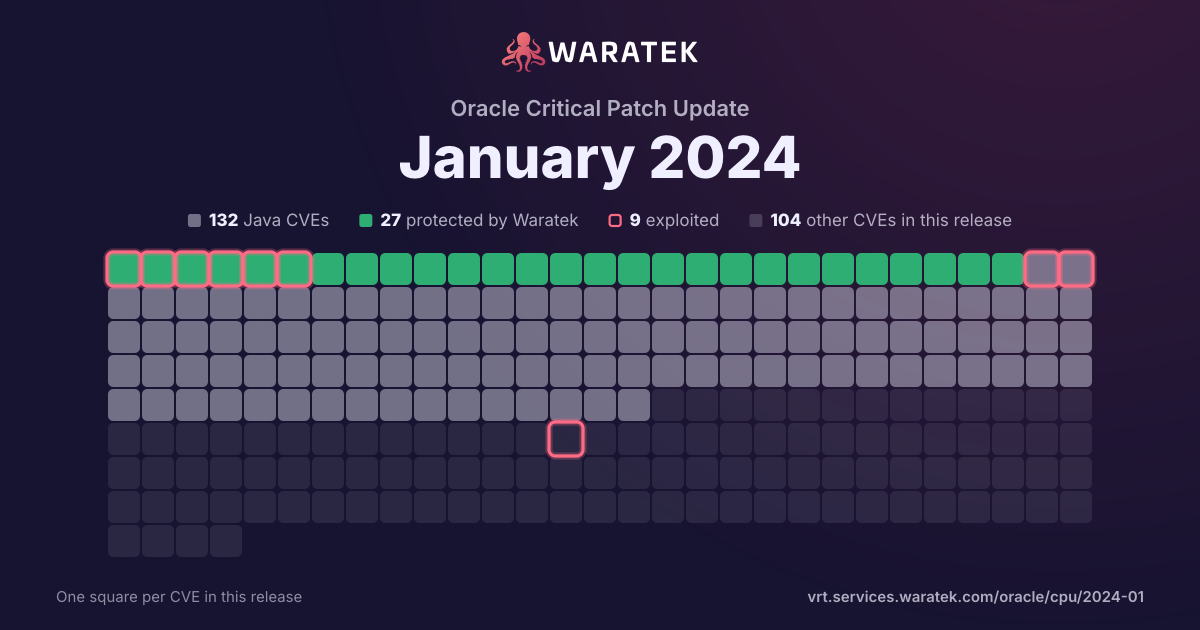
By status
22Protected by Waratek8Mitigation candidate105No exploit published10Outside Waratek scope91Not applicable
9Exploited, marked by the ring
No exploit published. For 38 of them, Oracle's security advisory is the source of public detail.
Protected by Waratek. Waratek RASP can block exploitation of these on systems that have not applied the patch yet.
Overview 4 matches · 0 protected · 1 exploited · 0 CISA KEV · 3 EPSS ≥ 0.5
Protected by Waratek
0
0.0%
Rule in development
0
0.0%
Mitigation candidate
4
100.0%
No exploit published
0
0.0%
blocked by ARMR today
0
0.0%
partly blocked
0
0.0%
not blocked
4
100.0%
not established
0
0.0%
unrecorded
0
0.0%
Exploited
1
25.0%
Working exploit published
2
50.0%
Proof of concept only
1
25.0%
Forecast only
0
0.0%
No public exploit
0
0.0%
split by
peak 2 / quarter
Q1 22Q2 22Q3 22Q4 22Q1 23Q2 23Q3 23Q4 23
| CVE | Severity | Published▾ | Status | Exploitation | Description |
|---|---|---|---|---|---|
| CVE-2023-50164 | Critical | 2023-12-07 | Mitigation candidate | Exploited | An attacker can manipulate file upload params to enable paths traversal and under some circumstances this can lead to uploading a malicious file which can be used to perform Remote Code Execution. Users are recommended to upgrade to versions Struts 2.5.33 or Struts 6.3.0.2 or greater to fix this issue. |
| CVE-2022-31692 | Critical | 2022-10-31 | Mitigation candidate | Proof of concept only | Spring Security, versions 5.7 prior to 5.7.5 and 5.6 prior to 5.6.9 could be susceptible to authorization rules bypass via forward or include dispatcher types. Specifically, an application is vulnerable when all of the following are true: The application expects that Spring Security applies security to forward and include dispatcher types. The application uses the AuthorizationFilter either manually or via the authorizeHttpRequests() method. The application configures the FilterChainProxy to apply to forward and/or include requests (e.g. spring.security.filter.dispatcher-types = request, error, async, forward, include). The application may forward or include the request to a higher privilege-secured endpoint.The application configures Spring Security to apply to every dispatcher type via authorizeHttpRequests().shouldFilterAllDispatcherTypes(true) |
| CVE-2022-23221 | Critical | 2022-01-19 | Mitigation candidate | Working exploit published | H2 Console before 2.1.210 allows remote attackers to execute arbitrary code via a jdbc:h2:mem JDBC URL containing the IGNORE_UNKNOWN_SETTINGS=TRUE;FORBID_CREATION=FALSE;INIT=RUNSCRIPT substring, a different vulnerability than CVE-2021-42392. |
| CVE-2021-42392 | Critical | 2022-01-10 | Mitigation candidate | Working exploit published | The org.h2.util.JdbcUtils.getConnection method of the H2 database takes as parameters the class name of the driver and URL of the database. An attacker may pass a JNDI driver name and a URL leading to a LDAP or RMI servers, causing remote code execution. This can be exploited through various attack vectors, most notably through the H2 Console which leads to unauthenticated remote code execution. |