
Oracle Critical Patch Update January 2024
Released January 2024 · Oracle's advisory ↗ · ← Critical Patch Update, October 2023 · Critical Patch Update, April 2024 →
236 CVEs in this release, one square each
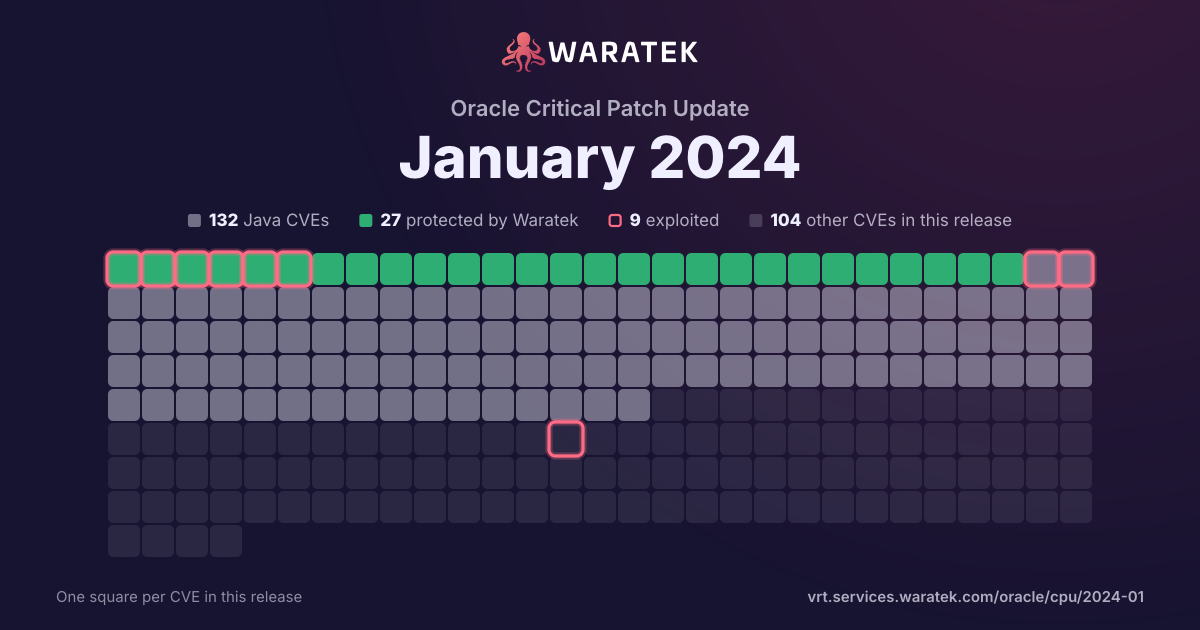
By status
27Protected by Waratek4Mitigation candidate101No exploit published26Outside Waratek scope78Not applicable
9Exploited, marked by the ring
No exploit published. For 47 of them, Oracle's security advisory is the source of public detail.
Protected by Waratek. Waratek RASP can block exploitation of these on systems that have not applied the patch yet.
Overview 63 matches · 43 in Waratek scope · 6 protected · 0 exploited · 0 CISA KEV · 0 public PoC · 0 EPSS ≥ 0.5
63matches
43in Waratek scope68.3%
6protected9.5%
0exploited0.0%
0CISA KEV0.0%
0public PoC0.0%
0EPSS ≥ 0.50.0%
Protected by Waratek
6
9.5%
Rule in development
0
0.0%
Mitigation candidate
0
0.0%
No exploit published
37
58.7%
Outside Waratek scope
1
1.6%
Not applicable
19
30.2%
Withdrawn CVE
0
0.0%
blocked by ARMR today
6
9.5%
partly blocked
0
0.0%
not blocked
57
90.5%
not established
0
0.0%
unrecorded
0
0.0%
Exploited
0
0.0%
Working exploit published
0
0.0%
Proof of concept only
0
0.0%
Forecast only
0
0.0%
No public exploit
63
100.0%
split by
peak 14 / quarter
Q3 191
Protected by Waratek1
High1
blocked by ARMR today1
No public exploit1
Q4 190
Q1 200
Q2 200
Q3 200
Q4 201
No exploit published1
High1
not blocked1
No public exploit1
Q1 211
No exploit published1
High1
not blocked1
No public exploit1
Q2 211
Protected by Waratek1
High1
blocked by ARMR today1
No public exploit1
Q3 214
No exploit published4
High4
not blocked4
No public exploit4
Q4 210
Q1 220
Q2 223
Protected by Waratek1
No exploit published1
Not applicable1
High3
blocked by ARMR today1
not blocked2
No public exploit3
Q3 221
Not applicable1
High1
not blocked1
No public exploit1
Q4 227
Protected by Waratek1
No exploit published5
Not applicable1
High7
blocked by ARMR today1
not blocked6
No public exploit7
Q1 233
No exploit published1
Not applicable2
High3
not blocked3
No public exploit3
Q2 238
No exploit published4
Not applicable4
High8
not blocked8
No public exploit8
Q3 2314
Protected by Waratek2
No exploit published7
Not applicable5
High14
blocked by ARMR today2
not blocked12
No public exploit14
Q4 239
No exploit published6
Not applicable3
High9
not blocked9
No public exploit9
Q1 2410
No exploit published7
Outside Waratek scope1
Not applicable2
High10
not blocked10
No public exploit10
Q3 19Q1 20Q3 20Q1 21Q3 21Q1 22Q3 22Q1 23Q3 23Q1 24
| CVE | Severity | Published▾ | Status | Exploitation | Description |
|---|---|---|---|---|---|
| CVE-2024-20956 | High | 2024-02-17 | No exploit published | No public exploit | Vulnerability in the Oracle Agile Product Lifecycle Management for Process product of Oracle Supply Chain (component: Installation). Supported versions that are affected are Prior to 6.2.4.2. Easily exploitable vulnerability allows unauthenticated attacker with network access via HTTP to compromise Oracle Agile Product Lifecycle Management for Process. Successful attacks of this vulnerability can result in unauthorized update, insert or delete access to some of Oracle Agile Product Lifecycle Management for Process accessible data as well as unauthorized read access to a subset of Oracle Agile Product Lifecycle Management for Process accessible data and unauthorized ability to cause a partial denial of service (partial DOS) of Oracle Agile Product Lifecycle Management for Process. CVSS 3.1 Base Score 7.3 (Confidentiality, Integrity and Availability impacts). CVSS Vector: (CVSS:3.1/AV:N/AC:L/PR:N/UI:N/S:U/C:L/I:L/A:L). |
| CVE-2024-20927 | High | 2024-02-17 | No exploit published | No public exploit | Vulnerability in the Oracle WebLogic Server product of Oracle Fusion Middleware (component: Core). Supported versions that are affected are 12.2.1.4.0 and 14.1.1.0.0. Easily exploitable vulnerability allows unauthenticated attacker with network access via HTTP to compromise Oracle WebLogic Server. While the vulnerability is in Oracle WebLogic Server, attacks may significantly impact additional products (scope change). Successful attacks of this vulnerability can result in unauthorized creation, deletion or modification access to critical data or all Oracle WebLogic Server accessible data. CVSS 3.1 Base Score 8.6 (Integrity impacts). CVSS Vector: (CVSS:3.1/AV:N/AC:L/PR:N/UI:N/S:C/C:N/I:H/A:N). |
| CVE-2024-20917 | High | 2024-02-17 | No exploit published | No public exploit | Vulnerability in the Oracle Enterprise Manager Base Platform product of Oracle Enterprise Manager (component: Log Management). The supported version that is affected is 13.5.0.0. Difficult to exploit vulnerability allows unauthenticated attacker with network access via HTTP to compromise Oracle Enterprise Manager Base Platform. Successful attacks require human interaction from a person other than the attacker and while the vulnerability is in Oracle Enterprise Manager Base Platform, attacks may significantly impact additional products (scope change). Successful attacks of this vulnerability can result in unauthorized access to critical data or complete access to all Oracle Enterprise Manager Base Platform accessible data as well as unauthorized update, insert or delete access to some of Oracle Enterprise Manager Base Platform accessible data and unauthorized ability to cause a partial denial of service (partial DOS) of Oracle Enterprise Manager Base Platform. CVSS 3.1 Base Score 7.5 (Confidentiality, Integrity and Availability impacts). CVSS Vector: (CVSS:3.1/AV:N/AC:H/PR:N/UI:R/S:C/C:H/I:L/A:L). |
| CVE-2024-20909 | High | 2024-02-17 | Not applicable | No public exploit | Vulnerability in Oracle Audit Vault and Database Firewall (component: Firewall). Supported versions that are affected are 20.1-20.9. Easily exploitable vulnerability allows unauthenticated attacker with network access via Oracle Net to compromise Oracle Audit Vault and Database Firewall. Successful attacks of this vulnerability can result in unauthorized creation, deletion or modification access to critical data or all Oracle Audit Vault and Database Firewall accessible data. CVSS 3.1 Base Score 7.5 (Integrity impacts). CVSS Vector: (CVSS:3.1/AV:N/AC:L/PR:N/UI:N/S:U/C:N/I:H/A:N). |
| CVE-2024-20952 | High | 2024-01-16 | No exploit published | No public exploit | Vulnerability in the Oracle Java SE, Oracle GraalVM for JDK, Oracle GraalVM Enterprise Edition product of Oracle Java SE (component: Security). Supported versions that are affected are Oracle Java SE: 8u391, 8u391-perf, 11.0.21, 17.0.9, 21.0.1; Oracle GraalVM for JDK: 17.0.9, 21.0.1; Oracle GraalVM Enterprise Edition: 20.3.12, 21.3.8 and 22.3.4. Difficult to exploit vulnerability allows unauthenticated attacker with network access via multiple protocols to compromise Oracle Java SE, Oracle GraalVM for JDK, Oracle GraalVM Enterprise Edition. Successful attacks of this vulnerability can result in unauthorized creation, deletion or modification access to critical data or all Oracle Java SE, Oracle GraalVM for JDK, Oracle GraalVM Enterprise Edition accessible data as well as unauthorized access to critical data or complete access to all Oracle Java SE, Oracle GraalVM for JDK, Oracle GraalVM Enterprise Edition accessible data. Note: This vulnerability applies to Java deployments, typically in clients running sandboxed Java Web Start applications or sandboxed Java applets, that load and run untrusted code (e.g., code that comes from the internet) and rely on the Java sandbox for security. This vulnerability does not apply to Java deployments, typically in servers, that load and run only trusted code (e.g., code installed by an administrator). CVSS 3.1 Base Score 7.4 (Confidentiality and Integrity impacts). CVSS Vector: (CVSS:3.1/AV:N/AC:H/PR:N/UI:N/S:U/C:H/I:H/A:N). |
| CVE-2024-20932 | High | 2024-01-16 | Outside Waratek scope | No public exploit | Vulnerability in the Oracle Java SE, Oracle GraalVM for JDK, Oracle GraalVM Enterprise Edition product of Oracle Java SE (component: Security). Supported versions that are affected are Oracle Java SE: 17.0.9; Oracle GraalVM for JDK: 17.0.9; Oracle GraalVM Enterprise Edition: 21.3.8 and 22.3.4. Easily exploitable vulnerability allows unauthenticated attacker with network access via multiple protocols to compromise Oracle Java SE, Oracle GraalVM for JDK, Oracle GraalVM Enterprise Edition. Successful attacks of this vulnerability can result in unauthorized creation, deletion or modification access to critical data or all Oracle Java SE, Oracle GraalVM for JDK, Oracle GraalVM Enterprise Edition accessible data. Note: This vulnerability applies to Java deployments, typically in clients running sandboxed Java Web Start applications or sandboxed Java applets, that load and run untrusted code (e.g., code that comes from the internet) and rely on the Java sandbox for security. This vulnerability does not apply to Java deployments, typically in servers, that load and run only trusted code (e.g., code installed by an administrator). CVSS 3.1 Base Score 7.5 (Integrity impacts). CVSS Vector: (CVSS:3.1/AV:N/AC:L/PR:N/UI:N/S:U/C:N/I:H/A:N). |
| CVE-2024-20924 | High | 2024-01-16 | Not applicable | No public exploit | Vulnerability in Oracle Audit Vault and Database Firewall (component: Firewall). Supported versions that are affected are 20.1-20.9. Difficult to exploit vulnerability allows high privileged attacker with network access via Oracle Net to compromise Oracle Audit Vault and Database Firewall. Successful attacks require human interaction from a person other than the attacker and while the vulnerability is in Oracle Audit Vault and Database Firewall, attacks may significantly impact additional products (scope change). Successful attacks of this vulnerability can result in takeover of Oracle Audit Vault and Database Firewall. CVSS 3.1 Base Score 7.6 (Confidentiality, Integrity and Availability impacts). CVSS Vector: (CVSS:3.1/AV:N/AC:H/PR:H/UI:R/S:C/C:H/I:H/A:H). |
| CVE-2024-20918 | High | 2024-01-16 | No exploit published | No public exploit | Vulnerability in the Oracle Java SE, Oracle GraalVM for JDK, Oracle GraalVM Enterprise Edition product of Oracle Java SE (component: Hotspot). Supported versions that are affected are Oracle Java SE: 8u391, 8u391-perf, 11.0.21, 17.0.9, 21.0.1; Oracle GraalVM for JDK: 17.0.9, 21.0.1; Oracle GraalVM Enterprise Edition: 20.3.12, 21.3.8 and 22.3.4. Difficult to exploit vulnerability allows unauthenticated attacker with network access via multiple protocols to compromise Oracle Java SE, Oracle GraalVM for JDK, Oracle GraalVM Enterprise Edition. Successful attacks of this vulnerability can result in unauthorized creation, deletion or modification access to critical data or all Oracle Java SE, Oracle GraalVM for JDK, Oracle GraalVM Enterprise Edition accessible data as well as unauthorized access to critical data or complete access to all Oracle Java SE, Oracle GraalVM for JDK, Oracle GraalVM Enterprise Edition accessible data. Note: This vulnerability can be exploited by using APIs in the specified Component, e.g., through a web service which supplies data to the APIs. This vulnerability also applies to Java deployments, typically in clients running sandboxed Java Web Start applications or sandboxed Java applets, that load and run untrusted code (e.g., code that comes from the internet) and rely on the Java sandbox for security. CVSS 3.1 Base Score 7.4 (Confidentiality and Integrity impacts). CVSS Vector: (CVSS:3.1/AV:N/AC:H/PR:N/UI:N/S:U/C:H/I:H/A:N). |
| CVE-2024-20916 | High | 2024-01-16 | No exploit published | No public exploit | Vulnerability in the Oracle Enterprise Manager Base Platform product of Oracle Enterprise Manager (component: Event Management). The supported version that is affected is 13.5.0.0. Easily exploitable vulnerability allows high privileged attacker with access to the physical communication segment attached to the hardware where the Oracle Enterprise Manager Base Platform executes to compromise Oracle Enterprise Manager Base Platform. While the vulnerability is in Oracle Enterprise Manager Base Platform, attacks may significantly impact additional products (scope change). Successful attacks of this vulnerability can result in unauthorized creation, deletion or modification access to critical data or all Oracle Enterprise Manager Base Platform accessible data as well as unauthorized access to critical data or complete access to all Oracle Enterprise Manager Base Platform accessible data and unauthorized ability to cause a partial denial of service (partial DOS) of Oracle Enterprise Manager Base Platform. CVSS 3.1 Base Score 8.3 (Confidentiality, Integrity and Availability impacts). CVSS Vector: (CVSS:3.1/AV:A/AC:L/PR:H/UI:N/S:C/C:H/I:H/A:L). |
| CVE-2023-21901 | High | 2024-01-16 | No exploit published | No public exploit | Vulnerability in the Oracle Financial Services Analytical Applications Infrastructure product of Oracle Financial Services Applications (component: Infrastructure). Supported versions that are affected are 8.0.7, 8.0.8, 8.0.9, 8.1.0, 8.1.1 and 8.1.2. Easily exploitable vulnerability allows low privileged attacker with network access via HTTP to compromise Oracle Financial Services Analytical Applications Infrastructure. While the vulnerability is in Oracle Financial Services Analytical Applications Infrastructure, attacks may significantly impact additional products (scope change). Successful attacks of this vulnerability can result in unauthorized update, insert or delete access to some of Oracle Financial Services Analytical Applications Infrastructure accessible data as well as unauthorized read access to a subset of Oracle Financial Services Analytical Applications Infrastructure accessible data and unauthorized ability to cause a partial denial of service (partial DOS) of Oracle Financial Services Analytical Applications Infrastructure. CVSS 3.1 Base Score 7.4 (Confidentiality, Integrity and Availability impacts). CVSS Vector: (CVSS:3.1/AV:N/AC:L/PR:L/UI:N/S:C/C:L/I:L/A:L). |
| CVE-2023-46589 | High | 2023-11-28 | No exploit published | No public exploit | Improper Input Validation vulnerability in Apache Tomcat.Tomcat from 11.0.0-M1 through 11.0.0-M10, from 10.1.0-M1 through 10.1.15, from 9.0.0-M1 through 9.0.82 and from 8.5.0 through 8.5.95 did not correctly parse HTTP trailer headers. A trailer header that exceeded the header size limit could cause Tomcat to treat a single request as multiple requests leading to the possibility of request smuggling when behind a reverse proxy. Older, EOL versions may also be affected. Users are recommended to upgrade to version 11.0.0-M11 onwards, 10.1.16 onwards, 9.0.83 onwards or 8.5.96 onwards, which fix the issue. |
| CVE-2023-34053 | High | 2023-11-28 | No exploit published | No public exploit | In Spring Framework versions 6.0.0 - 6.0.13, it is possible for a user to provide specially crafted HTTP requests that may cause a denial-of-service (DoS) condition. Specifically, an application is vulnerable when all of the following are true: * the application uses Spring MVC or Spring WebFlux * io.micrometer:micrometer-core is on the classpath * an ObservationRegistry is configured in the application to record observations Typically, Spring Boot applications need the org.springframework.boot:spring-boot-actuator dependency to meet all conditions. |
| CVE-2023-5363 | High | 2023-10-25 | Not applicable | No public exploit | Issue summary: A bug has been identified in the processing of key and initialisation vector (IV) lengths. This can lead to potential truncation or overruns during the initialisation of some symmetric ciphers. Impact summary: A truncation in the IV can result in non-uniqueness, which could result in loss of confidentiality for some cipher modes. When calling EVP_EncryptInit_ex2(), EVP_DecryptInit_ex2() or EVP_CipherInit_ex2() the provided OSSL_PARAM array is processed after the key and IV have been established. Any alterations to the key length, via the "keylen" parameter or the IV length, via the "ivlen" parameter, within the OSSL_PARAM array will not take effect as intended, potentially causing truncation or overreading of these values. The following ciphers and cipher modes are impacted: RC2, RC4, RC5, CCM, GCM and OCB. For the CCM, GCM and OCB cipher modes, truncation of the IV can result in loss of confidentiality. For example, when following NIST's SP 800-38D section 8.2.1 guidance for constructing a deterministic IV for AES in GCM mode, truncation of the counter portion could lead to IV reuse. Both truncations and overruns of the key and overruns of the IV will produce incorrect results and could, in some cases, trigger a memory exception. However, these issues are not currently assessed as security critical. Changing the key and/or IV lengths is not considered to be a common operation and the vulnerable API was recently introduced. Furthermore it is likely that application developers will have spotted this problem during testing since decryption would fail unless both peers in the communication were similarly vulnerable. For these reasons we expect the probability of an application being vulnerable to this to be quite low. However if an application is vulnerable then this issue is considered very serious. For these reasons we have assessed this issue as Moderate severity overall. The OpenSSL SSL/TLS implementation is not affected by this issue. The OpenSSL 3.0 and 3.1 FIPS providers are not affected by this because the issue lies outside of the FIPS provider boundary. OpenSSL 3.1 and 3.0 are vulnerable to this issue. |
| CVE-2023-31582 | High | 2023-10-25 | No exploit published | No public exploit | jose4j before v0.9.3 allows attackers to set a low iteration count of 1000 or less. |
| CVE-2023-31122 | High | 2023-10-23 | Not applicable | No public exploit | Out-of-bounds Read vulnerability in mod_macro of Apache HTTP Server.This issue affects Apache HTTP Server: through 2.4.57. |
| CVE-2023-22102 | High | 2023-10-17 | No exploit published | No public exploit | Vulnerability in the MySQL Connectors product of Oracle MySQL (component: Connector/J). Supported versions that are affected are 8.1.0 and prior. Difficult to exploit vulnerability allows unauthenticated attacker with network access via multiple protocols to compromise MySQL Connectors. Successful attacks require human interaction from a person other than the attacker and while the vulnerability is in MySQL Connectors, attacks may significantly impact additional products (scope change). Successful attacks of this vulnerability can result in takeover of MySQL Connectors. CVSS 3.1 Base Score 8.3 (Confidentiality, Integrity and Availability impacts). CVSS Vector: (CVSS:3.1/AV:N/AC:H/PR:N/UI:R/S:C/C:H/I:H/A:H). |
| CVE-2023-5072 | High | 2023-10-12 | No exploit published | No public exploit | Denial of Service in JSON-Java versions up to and including 20230618. A bug in the parser means that an input string of modest size can lead to indefinite amounts of memory being used. |
| CVE-2023-37536 | High | 2023-10-11 | Not applicable | No public exploit | An integer overflow in xerces-c++ 3.2.3 in BigFix Platform allows remote attackers to cause out-of-bound access via HTTP request. |
| CVE-2023-36478 | High | 2023-10-10 | No exploit published | No public exploit | Eclipse Jetty provides a web server and servlet container. In versions 11.0.0 through 11.0.15, 10.0.0 through 10.0.15, and 9.0.0 through 9.4.52, an integer overflow in `MetaDataBuilder.checkSize` allows for HTTP/2 HPACK header values to exceed their size limit. `MetaDataBuilder.java` determines if a header name or value exceeds the size limit, and throws an exception if the limit is exceeded. However, when length is very large and huffman is true, the multiplication by 4 in line 295 will overflow, and length will become negative. `(_size+length)` will now be negative, and the check on line 296 will not be triggered. Furthermore, `MetaDataBuilder.checkSize` allows for user-entered HPACK header value sizes to be negative, potentially leading to a very large buffer allocation later on when the user-entered size is multiplied by 2. This means that if a user provides a negative length value (or, more precisely, a length value which, when multiplied by the 4/3 fudge factor, is negative), and this length value is a very large positive number when multiplied by 2, then the user can cause a very large buffer to be allocated on the server. Users of HTTP/2 can be impacted by a remote denial of service attack. The issue has been fixed in versions 11.0.16, 10.0.16, and 9.4.53. There are no known workarounds. |
| CVE-2023-39410 | High | 2023-09-29 | Protected by Waratek | No public exploit | When deserializing untrusted or corrupted data, it is possible for a reader to consume memory beyond the allowed constraints and thus lead to out of memory on the system. This issue affects Java applications using Apache Avro Java SDK up to and including 1.11.2. Users should update to apache-avro version 1.11.3 which addresses this issue. |
| CVE-2023-43498 | High | 2023-09-20 | No exploit published | No public exploit | In Jenkins 2.423 and earlier, LTS 2.414.1 and earlier, processing file uploads using MultipartFormDataParser creates temporary files in the default system temporary directory with the default permissions for newly created files, potentially allowing attackers with access to the Jenkins controller file system to read and write the files before they are used. |
| CVE-2023-43497 | High | 2023-09-20 | No exploit published | No public exploit | In Jenkins 2.423 and earlier, LTS 2.414.1 and earlier, processing file uploads using the Stapler web framework creates temporary files in the default system temporary directory with the default permissions for newly created files, potentially allowing attackers with access to the Jenkins controller file system to read and write the files before they are used. |
| CVE-2023-43496 | High | 2023-09-20 | No exploit published | No public exploit | Jenkins 2.423 and earlier, LTS 2.414.1 and earlier creates a temporary file in the system temporary directory with the default permissions for newly created files when installing a plugin from a URL, potentially allowing attackers with access to the system temporary directory to replace the file before it is installed in Jenkins, potentially resulting in arbitrary code execution. |
| CVE-2023-1108 | High | 2023-09-14 | No exploit published | No public exploit | A flaw was found in undertow. This issue makes achieving a denial of service possible due to an unexpected handshake status updated in SslConduit, where the loop never terminates. |
| CVE-2023-32559 | High | 2023-08-24 | Not applicable | No public exploit | A privilege escalation vulnerability exists in the experimental policy mechanism in all active release lines: 16.x, 18.x and, 20.x. The use of the deprecated API `process.binding()` can bypass the policy mechanism by requiring internal modules and eventually take advantage of `process.binding('spawn_sync')` run arbitrary code, outside of the limits defined in a `policy.json` file. Please note that at the time this CVE was issued, the policy is an experimental feature of Node.js. |
| CVE-2023-41105 | High | 2023-08-23 | Not applicable | No public exploit | An issue was discovered in Python 3.11 through 3.11.4. If a path containing '\0' bytes is passed to os.path.normpath(), the path will be truncated unexpectedly at the first '\0' byte. There are plausible cases in which an application would have rejected a filename for security reasons in Python 3.10.x or earlier, but that filename is no longer rejected in Python 3.11.x. |
| CVE-2022-44729 | High | 2023-08-22 | No exploit published | No public exploit | Server-Side Request Forgery (SSRF) vulnerability in Apache Software Foundation Apache XML Graphics Batik.This issue affects Apache XML Graphics Batik: 1.16. On version 1.16, a malicious SVG could trigger loading external resources by default, causing resource consumption or in some cases even information disclosure. Users are recommended to upgrade to version 1.17 or later. |
| CVE-2022-46751 | High | 2023-08-21 | Protected by Waratek | No public exploit | Improper Restriction of XML External Entity Reference, XML Injection (aka Blind XPath Injection) vulnerability in Apache Software Foundation Apache Ivy.This issue affects any version of Apache Ivy prior to 2.5.2. When Apache Ivy prior to 2.5.2 parses XML files - either its own configuration, Ivy files or Apache Maven POMs - it will allow downloading external document type definitions and expand any entity references contained therein when used. This can be used to exfiltrate data, access resources only the machine running Ivy has access to or disturb the execution of Ivy in different ways. Starting with Ivy 2.5.2 DTD processing is disabled by default except when parsing Maven POMs where the default is to allow DTD processing but only to include a DTD snippet shipping with Ivy that is needed to deal with existing Maven POMs that are not valid XML files but are nevertheless accepted by Maven. Access can be be made more lenient via newly introduced system properties where needed. Users of Ivy prior to version 2.5.2 can use Java system properties to restrict processing of external DTDs, see the section about "JAXP Properties for External Access restrictions" inside Oracle's "Java API for XML Processing (JAXP) Security Guide". |
| CVE-2023-39975 | High | 2023-08-16 | Not applicable | No public exploit | kdc/do_tgs_req.c in MIT Kerberos 5 (aka krb5) 1.21 before 1.21.2 has a double free that is reachable if an authenticated user can trigger an authorization-data handling failure. Incorrect data is copied from one ticket to another. |
| CVE-2023-32006 | High | 2023-08-15 | Not applicable | No public exploit | The use of `module.constructor.createRequire()` can bypass the policy mechanism and require modules outside of the policy.json definition for a given module. This vulnerability affects all users using the experimental policy mechanism in all active release lines: 16.x, 18.x, and, 20.x. Please note that at the time this CVE was issued, the policy is an experimental feature of Node.js. |
| CVE-2023-28823 | High | 2023-08-11 | Not applicable | No public exploit | Uncontrolled search path in some Intel(R) oneAPI Toolkit and component software installers before version 4.3.1.493 may allow an authenticated user to potentially enable escalation of privilege via local access. |
| CVE-2023-34035 | High | 2023-07-18 | No exploit published | No public exploit | Spring Security versions 5.8 prior to 5.8.5, 6.0 prior to 6.0.5, and 6.1 prior to 6.1.2 could be susceptible to authorization rule misconfiguration if the application uses requestMatchers(String) and multiple servlets, one of them being Spring MVC’s DispatcherServlet. (DispatcherServlet is a Spring MVC component that maps HTTP endpoints to methods on @Controller-annotated classes.) Specifically, an application is vulnerable when all of the following are true: * Spring MVC is on the classpath * Spring Security is securing more than one servlet in a single application (one of them being Spring MVC’s DispatcherServlet) * The application uses requestMatchers(String) to refer to endpoints that are not Spring MVC endpoints An application is not vulnerable if any of the following is true: * The application does not have Spring MVC on the classpath * The application secures no servlets other than Spring MVC’s DispatcherServlet * The application uses requestMatchers(String) only for Spring MVC endpoints |
| CVE-2023-3635 | High | 2023-07-12 | No exploit published | No public exploit | GzipSource does not handle an exception that might be raised when parsing a malformed gzip buffer. This may lead to denial of service of the Okio client when handling a crafted GZIP archive, by using the GzipSource class. |
| CVE-2023-34981 | High | 2023-06-21 | No exploit published | No public exploit | A regression in the fix for bug 66512 in Apache Tomcat 11.0.0-M5, 10.1.8, 9.0.74 and 8.5.88 meant that, if a response did not include any HTTP headers no AJP SEND_HEADERS messare woudl be sent for the response which in turn meant that at least one AJP proxy (mod_proxy_ajp) would use the response headers from the previous request leading to an information leak. |
| CVE-2023-35141 | High | 2023-06-14 | No exploit published | No public exploit | In Jenkins 2.399 and earlier, LTS 2.387.3 and earlier, POST requests are sent in order to load the list of context actions. If part of the URL includes insufficiently escaped user-provided values, a victim may be tricked into sending a POST request to an unexpected endpoint by opening a context menu. |
| CVE-2023-2976 | High | 2023-06-14 | No exploit published | No public exploit | Use of Java's default temporary directory for file creation in `FileBackedOutputStream` in Google Guava versions 1.0 to 31.1 on Unix systems and Android Ice Cream Sandwich allows other users and apps on the machine with access to the default Java temporary directory to be able to access the files created by the class. Even though the security vulnerability is fixed in version 32.0.0, we recommend using version 32.0.1 as version 32.0.0 breaks some functionality under Windows. |
| CVE-2023-20883 | High | 2023-05-26 | No exploit published | No public exploit | In Spring Boot versions 3.0.0 - 3.0.6, 2.7.0 - 2.7.11, 2.6.0 - 2.6.14, 2.5.0 - 2.5.14 and older unsupported versions, there is potential for a denial-of-service (DoS) attack if Spring MVC is used together with a reverse proxy cache. |
| CVE-2023-2618 | High | 2023-05-10 | Not applicable | No public exploit | A vulnerability, which was classified as problematic, has been found in OpenCV wechat_qrcode Module up to 4.7.0. Affected by this issue is the function DecodedBitStreamParser::decodeHanziSegment of the file qrcode/decoder/decoded_bit_stream_parser.cpp. The manipulation leads to memory leak. The attack may be launched remotely. The name of the patch is 2b62ff6181163eea029ed1cab11363b4996e9cd6. It is recommended to apply a patch to fix this issue. The identifier of this vulnerability is VDB-228548. |
| CVE-2023-30861 | High | 2023-05-02 | Not applicable | No public exploit | Flask is a lightweight WSGI web application framework. When all of the following conditions are met, a response containing data intended for one client may be cached and subsequently sent by the proxy to other clients. If the proxy also caches `Set-Cookie` headers, it may send one client's `session` cookie to other clients. The severity depends on the application's use of the session and the proxy's behavior regarding cookies. The risk depends on all these conditions being met. 1. The application must be hosted behind a caching proxy that does not strip cookies or ignore responses with cookies. 2. The application sets `session.permanent = True` 3. The application does not access or modify the session at any point during a request. 4. `SESSION_REFRESH_EACH_REQUEST` enabled (the default). 5. The application does not set a `Cache-Control` header to indicate that a page is private or should not be cached. This happens because vulnerable versions of Flask only set the `Vary: Cookie` header when the session is accessed or modified, not when it is refreshed (re-sent to update the expiration) without being accessed or modified. This issue has been fixed in versions 2.3.2 and 2.2.5. |
| CVE-2023-31486 | High | 2023-04-29 | Not applicable | No public exploit | HTTP::Tiny before 0.083, a Perl core module since 5.13.9 and available standalone on CPAN, has an insecure default TLS configuration where users must opt in to verify certificates. |
| CVE-2023-31484 | High | 2023-04-29 | Not applicable | No public exploit | CPAN.pm before 2.35 does not verify TLS certificates when downloading distributions over HTTPS. |
| CVE-2023-0464 | High | 2023-03-22 | Not applicable | No public exploit | A security vulnerability has been identified in all supported versions of OpenSSL related to the verification of X.509 certificate chains that include policy constraints. Attackers may be able to exploit this vulnerability by creating a malicious certificate chain that triggers exponential use of computational resources, leading to a denial-of-service (DoS) attack on affected systems. Policy processing is disabled by default but can be enabled by passing the `-policy' argument to the command line utilities or by calling the `X509_VERIFY_PARAM_set1_policies()' function. |
| CVE-2023-24998 | High | 2023-02-20 | No exploit published | No public exploit | Apache Commons FileUpload before 1.5 does not limit the number of request parts to be processed resulting in the possibility of an attacker triggering a DoS with a malicious upload or series of uploads. Note that, like all of the file upload limits, the new configuration option (FileUploadBase#setFileCountMax) is not enabled by default and must be explicitly configured. |
| CVE-2022-4450 | High | 2023-02-08 | Not applicable | No public exploit | The function PEM_read_bio_ex() reads a PEM file from a BIO and parses and decodes the "name" (e.g. "CERTIFICATE"), any header data and the payload data. If the function succeeds then the "name_out", "header" and "data" arguments are populated with pointers to buffers containing the relevant decoded data. The caller is responsible for freeing those buffers. It is possible to construct a PEM file that results in 0 bytes of payload data. In this case PEM_read_bio_ex() will return a failure code but will populate the header argument with a pointer to a buffer that has already been freed. If the caller also frees this buffer then a double free will occur. This will most likely lead to a crash. This could be exploited by an attacker who has the ability to supply malicious PEM files for parsing to achieve a denial of service attack. The functions PEM_read_bio() and PEM_read() are simple wrappers around PEM_read_bio_ex() and therefore these functions are also directly affected. These functions are also called indirectly by a number of other OpenSSL functions including PEM_X509_INFO_read_bio_ex() and SSL_CTX_use_serverinfo_file() which are also vulnerable. Some OpenSSL internal uses of these functions are not vulnerable because the caller does not free the header argument if PEM_read_bio_ex() returns a failure code. These locations include the PEM_read_bio_TYPE() functions as well as the decoders introduced in OpenSSL 3.0. The OpenSSL asn1parse command line application is also impacted by this issue. |
| CVE-2022-3510 | High | 2022-12-12 | No exploit published | No public exploit | A parsing issue similar to CVE-2022-3171, but with Message-Type Extensions in protobuf-java core and lite versions prior to 3.21.7, 3.20.3, 3.19.6 and 3.16.3 can lead to a denial of service attack. Inputs containing multiple instances of non-repeated embedded messages with repeated or unknown fields causes objects to be converted back-n-forth between mutable and immutable forms, resulting in potentially long garbage collection pauses. We recommend updating to the versions mentioned above. |
| CVE-2022-31690 | High | 2022-10-31 | No exploit published | No public exploit | Spring Security, versions 5.7 prior to 5.7.5, and 5.6 prior to 5.6.9, and older unsupported versions could be susceptible to a privilege escalation under certain conditions. A malicious user or attacker can modify a request initiated by the Client (via the browser) to the Authorization Server which can lead to a privilege escalation on the subsequent approval. This scenario can happen if the Authorization Server responds with an OAuth2 Access Token Response containing an empty scope list (per RFC 6749, Section 5.1) on the subsequent request to the token endpoint to obtain the access token. |
| CVE-2022-42890 | High | 2022-10-25 | No exploit published | No public exploit | A vulnerability in Batik of Apache XML Graphics allows an attacker to run Java code from untrusted SVG via JavaScript. This issue affects Apache XML Graphics prior to 1.16. Users are recommended to upgrade to version 1.16. |
| CVE-2022-41704 | High | 2022-10-25 | No exploit published | No public exploit | A vulnerability in Batik of Apache XML Graphics allows an attacker to run untrusted Java code from an SVG. This issue affects Apache XML Graphics prior to 1.16. It is recommended to update to version 1.16. |
| CVE-2022-3479 | High | 2022-10-14 | Not applicable | No public exploit | A vulnerability found in nss. By this security vulnerability, nss client auth crash without a user certificate in the database and this can lead us to a segmentation fault or crash. |
| CVE-2022-42004 | High | 2022-10-02 | Protected by Waratek | No public exploit | In FasterXML jackson-databind before 2.13.4, resource exhaustion can occur because of a lack of a check in BeanDeserializer._deserializeFromArray to prevent use of deeply nested arrays. An application is vulnerable only with certain customized choices for deserialization. |
| CVE-2022-42003 | High | 2022-10-02 | No exploit published | No public exploit | In FasterXML jackson-databind before versions 2.13.4.1 and 2.12.17.1, resource exhaustion can occur because of a lack of a check in primitive value deserializers to avoid deep wrapper array nesting, when the UNWRAP_SINGLE_VALUE_ARRAYS feature is enabled. |
| CVE-2022-31147 | High | 2022-07-14 | Not applicable | No public exploit | The jQuery Validation Plugin (jquery-validation) provides drop-in validation for forms. Versions of jquery-validation prior to 1.19.5 are vulnerable to regular expression denial of service (ReDoS) when an attacker is able to supply arbitrary input to the url2 method. This is due to an incomplete fix for CVE-2021-43306. Users should upgrade to version 1.19.5 to receive a patch. |
| CVE-2022-22979 | High | 2022-06-21 | No exploit published | No public exploit | In Spring Cloud Function versions prior to 3.2.6, it is possible for a user who directly interacts with framework provided lookup functionality to cause a denial-of-service condition due to the caching issue in the Function Catalog component of the framework. |
| CVE-2021-43306 | High | 2022-06-02 | Not applicable | No public exploit | An exponential ReDoS (Regular Expression Denial of Service) can be triggered in the jquery-validation npm package, when an attacker is able to supply arbitrary input to the url2 method |
| CVE-2022-25647 | High | 2022-05-01 | Protected by Waratek | No public exploit | The package com.google.code.gson:gson before 2.8.9 are vulnerable to Deserialization of Untrusted Data via the writeReplace() method in internal classes, which may lead to DoS attacks. |
| CVE-2021-36090 | High | 2021-07-13 | No exploit published | No public exploit | When reading a specially crafted ZIP archive, Compress can be made to allocate large amounts of memory that finally leads to an out of memory error even for very small inputs. This could be used to mount a denial of service attack against services that use Compress' zip package. |
| CVE-2021-35517 | High | 2021-07-13 | No exploit published | No public exploit | When reading a specially crafted TAR archive, Compress can be made to allocate large amounts of memory that finally leads to an out of memory error even for very small inputs. This could be used to mount a denial of service attack against services that use Compress' tar package. |
| CVE-2021-35516 | High | 2021-07-13 | No exploit published | No public exploit | When reading a specially crafted 7Z archive, Compress can be made to allocate large amounts of memory that finally leads to an out of memory error even for very small inputs. This could be used to mount a denial of service attack against services that use Compress' sevenz package. |
| CVE-2021-35515 | High | 2021-07-13 | No exploit published | No public exploit | When reading a specially crafted 7Z archive, the construction of the list of codecs that decompress an entry can result in an infinite loop. This could be used to mount a denial of service attack against services that use Compress' sevenz package. |
| CVE-2021-33813 | High | 2021-06-16 | Protected by Waratek | No public exploit | An XXE issue in SAXBuilder in JDOM through 2.0.6 allows attackers to cause a denial of service via a crafted HTTP request. |
| CVE-2021-0341 | High | 2021-02-10 | No exploit published | No public exploit | In verifyHostName of OkHostnameVerifier.java, there is a possible way to accept a certificate for the wrong domain due to improperly used crypto. This could lead to remote information disclosure with no additional execution privileges needed. User interaction is not needed for exploitation.Product: AndroidVersions: Android-8.1 Android-9 Android-10 Android-11Android ID: A-171980069 |
| CVE-2020-7760 | High | 2020-10-30 | No exploit published | No public exploit | This affects the package codemirror before 5.58.2; the package org.apache.marmotta.webjars:codemirror before 5.58.2. The vulnerable regular expression is located in https://github.com/codemirror/CodeMirror/blob/cdb228ac736369c685865b122b736cd0d397836c/mode/javascript/javascript.jsL129. The ReDOS vulnerability of the regex is mainly due to the sub-pattern (s|/*.*?*/)* |
| CVE-2019-10086 | High | 2019-08-20 | Protected by Waratek | No public exploit | In Apache Commons Beanutils 1.9.2, a special BeanIntrospector class was added which allows suppressing the ability for an attacker to access the classloader via the class property available on all Java objects. We, however were not using this by default characteristic of the PropertyUtilsBean. |