
Oracle Critical Patch Update January 2024
Released January 2024 · Oracle's advisory ↗ · ← Critical Patch Update, October 2023 · Critical Patch Update, April 2024 →
236 CVEs in this release, one square each
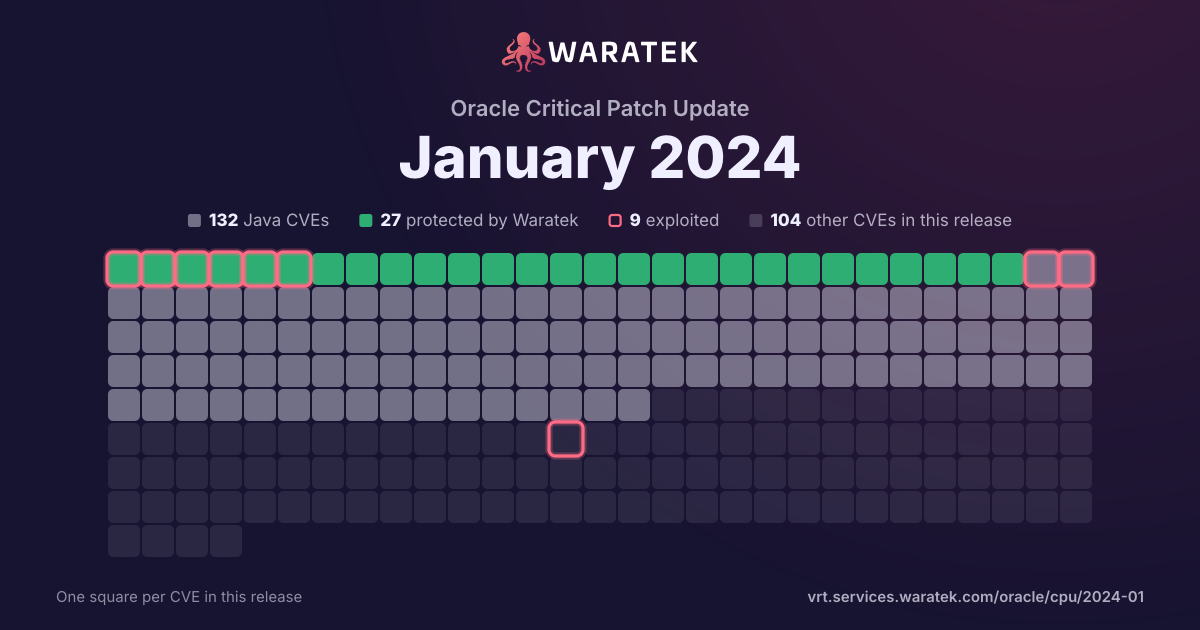
By status
21Protected by Waratek2Rule in development6Mitigation candidate103No exploit published9Outside Waratek scope95Not applicable
9Exploited, marked by the ring
No exploit published. For 38 of them, Oracle's security advisory is the source of public detail.
Protected by Waratek. Waratek RASP can block exploitation of these on systems that have not applied the patch yet.
Overview 7 matches · 0 protected · 0 exploited · 0 CISA KEV · 0 public PoC · 0 EPSS ≥ 0.5
7matches
0protected0.0%
0exploited0.0%
0CISA KEV0.0%
0public PoC0.0%
0EPSS ≥ 0.50.0%
Protected by Waratek
0
0.0%
Rule in development
0
0.0%
Mitigation candidate
0
0.0%
No exploit published
7
100.0%
blocked by ARMR today
0
0.0%
partly blocked
0
0.0%
not blocked
7
100.0%
not established
0
0.0%
unrecorded
0
0.0%
Exploited
0
0.0%
Working exploit published
0
0.0%
Proof of concept only
0
0.0%
Forecast only
0
0.0%
No public exploit
7
100.0%
| CVE | Severity | Published▾ | Status | Exploitation | Description |
|---|---|---|---|---|---|
| CVE-2023-21901 | High | 2024-01-16 | No exploit published | No public exploit | Vulnerability in the Oracle Financial Services Analytical Applications Infrastructure product of Oracle Financial Services Applications (component: Infrastructure). Supported versions that are affected are 8.0.7, 8.0.8, 8.0.9, 8.1.0, 8.1.1 and 8.1.2. Easily exploitable vulnerability allows low privileged attacker with network access via HTTP to compromise Oracle Financial Services Analytical Applications Infrastructure. While the vulnerability is in Oracle Financial Services Analytical Applications Infrastructure, attacks may significantly impact additional products (scope change). Successful attacks of this vulnerability can result in unauthorized update, insert or delete access to some of Oracle Financial Services Analytical Applications Infrastructure accessible data as well as unauthorized read access to a subset of Oracle Financial Services Analytical Applications Infrastructure accessible data and unauthorized ability to cause a partial denial of service (partial DOS) of Oracle Financial Services Analytical Applications Infrastructure. CVSS 3.1 Base Score 7.4 (Confidentiality, Integrity and Availability impacts). CVSS Vector: (CVSS:3.1/AV:N/AC:L/PR:L/UI:N/S:C/C:L/I:L/A:L). |
| CVE-2023-46589 | High | 2023-11-28 | No exploit published | No public exploit | Improper Input Validation vulnerability in Apache Tomcat.Tomcat from 11.0.0-M1 through 11.0.0-M10, from 10.1.0-M1 through 10.1.15, from 9.0.0-M1 through 9.0.82 and from 8.5.0 through 8.5.95 did not correctly parse HTTP trailer headers. A trailer header that exceeded the header size limit could cause Tomcat to treat a single request as multiple requests leading to the possibility of request smuggling when behind a reverse proxy. Older, EOL versions may also be affected. Users are recommended to upgrade to version 11.0.0-M11 onwards, 10.1.16 onwards, 9.0.83 onwards or 8.5.96 onwards, which fix the issue. |
| CVE-2023-34055 | Medium | 2023-11-28 | No exploit published | No public exploit | In Spring Boot versions 2.7.0 - 2.7.17, 3.0.0-3.0.12 and 3.1.0-3.1.5, it is possible for a user to provide specially crafted HTTP requests that may cause a denial-of-service (DoS) condition. Specifically, an application is vulnerable when all of the following are true: * the application uses Spring MVC or Spring WebFlux * org.springframework.boot:spring-boot-actuator is on the classpath |
| CVE-2023-44483 | Medium | 2023-10-20 | No exploit published | No public exploit | All versions of Apache Santuario - XML Security for Java prior to 2.2.6, 2.3.4, and 3.0.3, when using the JSR 105 API, are vulnerable to an issue where a private key may be disclosed in log files when generating an XML Signature and logging with debug level is enabled. Users are recommended to upgrade to version 2.2.6, 2.3.4, or 3.0.3, which fixes this issue. |
| CVE-2023-5072 | High | 2023-10-12 | No exploit published | No public exploit | Denial of Service in JSON-Java versions up to and including 20230618. A bug in the parser means that an input string of modest size can lead to indefinite amounts of memory being used. |
| CVE-2023-44981 | Critical | 2023-10-11 | No exploit published | No public exploit | Authorization Bypass Through User-Controlled Key vulnerability in Apache ZooKeeper. If SASL Quorum Peer authentication is enabled in ZooKeeper (quorum.auth.enableSasl=true), the authorization is done by verifying that the instance part in SASL authentication ID is listed in zoo.cfg server list. The instance part in SASL auth ID is optional and if it's missing, like 'eve@EXAMPLE.COM', the authorization check will be skipped. As a result an arbitrary endpoint could join the cluster and begin propagating counterfeit changes to the leader, essentially giving it complete read-write access to the data tree. Quorum Peer authentication is not enabled by default. Users are recommended to upgrade to version 3.9.1, 3.8.3, 3.7.2, which fixes the issue. Alternately ensure the ensemble election/quorum communication is protected by a firewall as this will mitigate the issue. See the documentation for more details on correct cluster administration. |
| CVE-2023-36478 | High | 2023-10-10 | No exploit published | No public exploit | Eclipse Jetty provides a web server and servlet container. In versions 11.0.0 through 11.0.15, 10.0.0 through 10.0.15, and 9.0.0 through 9.4.52, an integer overflow in `MetaDataBuilder.checkSize` allows for HTTP/2 HPACK header values to exceed their size limit. `MetaDataBuilder.java` determines if a header name or value exceeds the size limit, and throws an exception if the limit is exceeded. However, when length is very large and huffman is true, the multiplication by 4 in line 295 will overflow, and length will become negative. `(_size+length)` will now be negative, and the check on line 296 will not be triggered. Furthermore, `MetaDataBuilder.checkSize` allows for user-entered HPACK header value sizes to be negative, potentially leading to a very large buffer allocation later on when the user-entered size is multiplied by 2. This means that if a user provides a negative length value (or, more precisely, a length value which, when multiplied by the 4/3 fudge factor, is negative), and this length value is a very large positive number when multiplied by 2, then the user can cause a very large buffer to be allocated on the server. Users of HTTP/2 can be impacted by a remote denial of service attack. The issue has been fixed in versions 11.0.16, 10.0.16, and 9.4.53. There are no known workarounds. |