
Oracle Critical Patch Update January 2024
Released January 2024 · Oracle's advisory ↗ · ← Critical Patch Update, October 2023 · Critical Patch Update, April 2024 →
236 CVEs in this release, one square each
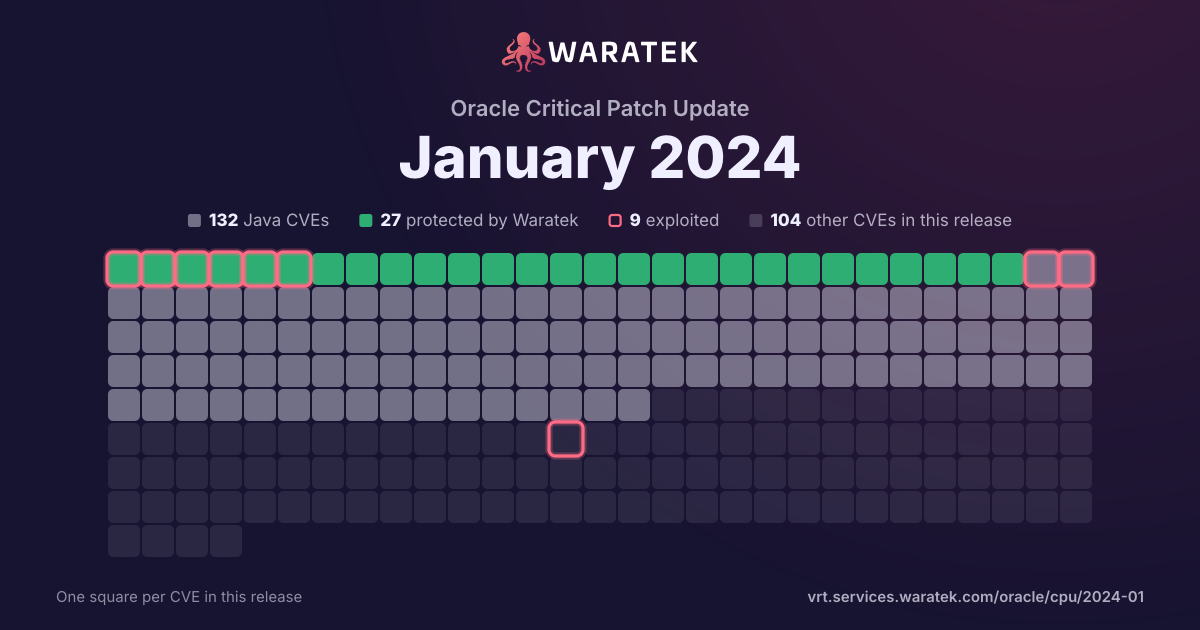
By status
21Protected by Waratek2Rule in development6Mitigation candidate103No exploit published9Outside Waratek scope95Not applicable
9Exploited, marked by the ring
No exploit published. For 38 of them, Oracle's security advisory is the source of public detail.
Protected by Waratek. Waratek RASP can block exploitation of these on systems that have not applied the patch yet.
Overview 15 matches · 1 protected · 2 exploited · 1 CISA KEV · 2 public PoC · 2 EPSS ≥ 0.5
Protected by Waratek
1
6.7%
Rule in development
1
6.7%
Mitigation candidate
1
6.7%
No exploit published
12
80.0%
blocked by ARMR today
1
6.7%
partly blocked
0
0.0%
not blocked
14
93.3%
not established
0
0.0%
unrecorded
0
0.0%
Exploited
2
13.3%
Working exploit published
0
0.0%
Proof of concept only
2
13.3%
Forecast only
0
0.0%
No public exploit
11
73.3%
split by
peak 3 / month
Feb 232
Rule in development1
No exploit published1
High2
not blocked2
Exploited1
No public exploit1
Mar 232
No exploit published2
High2
not blocked2
Proof of concept only2
Apr 230
May 231
No exploit published1
High1
not blocked1
No public exploit1
Jun 232
No exploit published2
High2
not blocked2
No public exploit2
Jul 231
No exploit published1
High1
not blocked1
No public exploit1
Aug 231
No exploit published1
High1
not blocked1
No public exploit1
Sep 231
Protected by Waratek1
High1
blocked by ARMR today1
No public exploit1
Oct 233
Mitigation candidate1
No exploit published2
High3
not blocked3
Exploited1
No public exploit2
Nov 231
No exploit published1
High1
not blocked1
No public exploit1
Dec 230
Jan 241
No exploit published1
High1
not blocked1
No public exploit1
Feb 23Mar 23Apr 23May 23Jun 23Jul 23Aug 23Sep 23Oct 23Nov 23Dec 23Jan 24
| CVE | Severity | Published▾ | Status | Exploitation | Description |
|---|---|---|---|---|---|
| CVE-2023-21901 | High | 2024-01-16 | No exploit published | No public exploit | Vulnerability in the Oracle Financial Services Analytical Applications Infrastructure product of Oracle Financial Services Applications (component: Infrastructure). Supported versions that are affected are 8.0.7, 8.0.8, 8.0.9, 8.1.0, 8.1.1 and 8.1.2. Easily exploitable vulnerability allows low privileged attacker with network access via HTTP to compromise Oracle Financial Services Analytical Applications Infrastructure. While the vulnerability is in Oracle Financial Services Analytical Applications Infrastructure, attacks may significantly impact additional products (scope change). Successful attacks of this vulnerability can result in unauthorized update, insert or delete access to some of Oracle Financial Services Analytical Applications Infrastructure accessible data as well as unauthorized read access to a subset of Oracle Financial Services Analytical Applications Infrastructure accessible data and unauthorized ability to cause a partial denial of service (partial DOS) of Oracle Financial Services Analytical Applications Infrastructure. CVSS 3.1 Base Score 7.4 (Confidentiality, Integrity and Availability impacts). CVSS Vector: (CVSS:3.1/AV:N/AC:L/PR:L/UI:N/S:C/C:L/I:L/A:L). |
| CVE-2023-46589 | High | 2023-11-28 | No exploit published | No public exploit | Improper Input Validation vulnerability in Apache Tomcat.Tomcat from 11.0.0-M1 through 11.0.0-M10, from 10.1.0-M1 through 10.1.15, from 9.0.0-M1 through 9.0.82 and from 8.5.0 through 8.5.95 did not correctly parse HTTP trailer headers. A trailer header that exceeded the header size limit could cause Tomcat to treat a single request as multiple requests leading to the possibility of request smuggling when behind a reverse proxy. Older, EOL versions may also be affected. Users are recommended to upgrade to version 11.0.0-M11 onwards, 10.1.16 onwards, 9.0.83 onwards or 8.5.96 onwards, which fix the issue. |
| CVE-2023-5072 | High | 2023-10-12 | No exploit published | No public exploit | Denial of Service in JSON-Java versions up to and including 20230618. A bug in the parser means that an input string of modest size can lead to indefinite amounts of memory being used. |
| CVE-2023-44487 | High | 2023-10-10 | Mitigation candidate | Exploited | The HTTP/2 protocol allows a denial of service (server resource consumption) because request cancellation can reset many streams quickly, as exploited in the wild in August through October 2023. |
| CVE-2023-36478 | High | 2023-10-10 | No exploit published | No public exploit | Eclipse Jetty provides a web server and servlet container. In versions 11.0.0 through 11.0.15, 10.0.0 through 10.0.15, and 9.0.0 through 9.4.52, an integer overflow in `MetaDataBuilder.checkSize` allows for HTTP/2 HPACK header values to exceed their size limit. `MetaDataBuilder.java` determines if a header name or value exceeds the size limit, and throws an exception if the limit is exceeded. However, when length is very large and huffman is true, the multiplication by 4 in line 295 will overflow, and length will become negative. `(_size+length)` will now be negative, and the check on line 296 will not be triggered. Furthermore, `MetaDataBuilder.checkSize` allows for user-entered HPACK header value sizes to be negative, potentially leading to a very large buffer allocation later on when the user-entered size is multiplied by 2. This means that if a user provides a negative length value (or, more precisely, a length value which, when multiplied by the 4/3 fudge factor, is negative), and this length value is a very large positive number when multiplied by 2, then the user can cause a very large buffer to be allocated on the server. Users of HTTP/2 can be impacted by a remote denial of service attack. The issue has been fixed in versions 11.0.16, 10.0.16, and 9.4.53. There are no known workarounds. |
| CVE-2023-39410 | High | 2023-09-29 | Protected by Waratek | No public exploit | When deserializing untrusted or corrupted data, it is possible for a reader to consume memory beyond the allowed constraints and thus lead to out of memory on the system. This issue affects Java applications using Apache Avro Java SDK up to and including 1.11.2. Users should update to apache-avro version 1.11.3 which addresses this issue. |
| CVE-2022-44729 | High | 2023-08-22 | No exploit published | No public exploit | Server-Side Request Forgery (SSRF) vulnerability in Apache Software Foundation Apache XML Graphics Batik.This issue affects Apache XML Graphics Batik: 1.16. On version 1.16, a malicious SVG could trigger loading external resources by default, causing resource consumption or in some cases even information disclosure. Users are recommended to upgrade to version 1.17 or later. |
| CVE-2023-34035 | High | 2023-07-18 | No exploit published | No public exploit | Spring Security versions 5.8 prior to 5.8.5, 6.0 prior to 6.0.5, and 6.1 prior to 6.1.2 could be susceptible to authorization rule misconfiguration if the application uses requestMatchers(String) and multiple servlets, one of them being Spring MVC’s DispatcherServlet. (DispatcherServlet is a Spring MVC component that maps HTTP endpoints to methods on @Controller-annotated classes.) Specifically, an application is vulnerable when all of the following are true: * Spring MVC is on the classpath * Spring Security is securing more than one servlet in a single application (one of them being Spring MVC’s DispatcherServlet) * The application uses requestMatchers(String) to refer to endpoints that are not Spring MVC endpoints An application is not vulnerable if any of the following is true: * The application does not have Spring MVC on the classpath * The application secures no servlets other than Spring MVC’s DispatcherServlet * The application uses requestMatchers(String) only for Spring MVC endpoints |
| CVE-2023-34981 | High | 2023-06-21 | No exploit published | No public exploit | A regression in the fix for bug 66512 in Apache Tomcat 11.0.0-M5, 10.1.8, 9.0.74 and 8.5.88 meant that, if a response did not include any HTTP headers no AJP SEND_HEADERS messare woudl be sent for the response which in turn meant that at least one AJP proxy (mod_proxy_ajp) would use the response headers from the previous request leading to an information leak. |
| CVE-2023-2976 | High | 2023-06-14 | No exploit published | No public exploit | Use of Java's default temporary directory for file creation in `FileBackedOutputStream` in Google Guava versions 1.0 to 31.1 on Unix systems and Android Ice Cream Sandwich allows other users and apps on the machine with access to the default Java temporary directory to be able to access the files created by the class. Even though the security vulnerability is fixed in version 32.0.0, we recommend using version 32.0.1 as version 32.0.0 breaks some functionality under Windows. |
| CVE-2023-20883 | High | 2023-05-26 | No exploit published | No public exploit | In Spring Boot versions 3.0.0 - 3.0.6, 2.7.0 - 2.7.11, 2.6.0 - 2.6.14, 2.5.0 - 2.5.14 and older unsupported versions, there is potential for a denial-of-service (DoS) attack if Spring MVC is used together with a reverse proxy cache. |
| CVE-2023-1436 | High | 2023-03-22 | No exploit published | Proof of concept only | An infinite recursion is triggered in Jettison when constructing a JSONArray from a Collection that contains a self-reference in one of its elements. This leads to a StackOverflowError exception being thrown. |
| CVE-2023-1370 | High | 2023-03-22 | No exploit published | Proof of concept only | [Json-smart](https://netplex.github.io/json-smart/) is a performance focused, JSON processor lib. When reaching a ‘[‘ or ‘{‘ character in the JSON input, the code parses an array or an object respectively. It was discovered that the code does not have any limit to the nesting of such arrays or objects. Since the parsing of nested arrays and objects is done recursively, nesting too many of them can cause a stack exhaustion (stack overflow) and crash the software. |
| CVE-2023-24998 | High | 2023-02-20 | No exploit published | No public exploit | Apache Commons FileUpload before 1.5 does not limit the number of request parts to be processed resulting in the possibility of an attacker triggering a DoS with a malicious upload or series of uploads. Note that, like all of the file upload limits, the new configuration option (FileUploadBase#setFileCountMax) is not enabled by default and must be explicitly configured. |
| CVE-2023-25194 | High | 2023-02-07 | Rule in development | Exploited | A possible security vulnerability has been identified in Apache Kafka Connect API. This requires access to a Kafka Connect worker, and the ability to create/modify connectors on it with an arbitrary Kafka client SASL JAAS config and a SASL-based security protocol, which has been possible on Kafka Connect clusters since Apache Kafka Connect 2.3.0. When configuring the connector via the Kafka Connect REST API, an authenticated operator can set the `sasl.jaas.config` property for any of the connector's Kafka clients to "com.sun.security.auth.module.JndiLoginModule", which can be done via the `producer.override.sasl.jaas.config`, `consumer.override.sasl.jaas.config`, or `admin.override.sasl.jaas.config` properties. This will allow the server to connect to the attacker's LDAP server and deserialize the LDAP response, which the attacker can use to execute java deserialization gadget chains on the Kafka connect server. Attacker can cause unrestricted deserialization of untrusted data (or) RCE vulnerability when there are gadgets in the classpath. Since Apache Kafka 3.0.0, users are allowed to specify these properties in connector configurations for Kafka Connect clusters running with out-of-the-box configurations. Before Apache Kafka 3.0.0, users may not specify these properties unless the Kafka Connect cluster has been reconfigured with a connector client override policy that permits them. Since Apache Kafka 3.4.0, we have added a system property ("-Dorg.apache.kafka.disallowed.login.modules") to disable the problematic login modules usage in SASL JAAS configuration. Also by default "com.sun.security.auth.module.JndiLoginModule" is disabled in Apache Kafka Connect 3.4.0. We advise the Kafka Connect users to validate connector configurations and only allow trusted JNDI configurations. Also examine connector dependencies for vulnerable versions and either upgrade their connectors, upgrading that specific dependency, or removing the connectors as options for remediation. Finally, in addition to leveraging the "org.apache.kafka.disallowed.login.modules" system property, Kafka Connect users can also implement their own connector client config override policy, which can be used to control which Kafka client properties can be overridden directly in a connector config and which cannot. |