
Oracle Critical Patch Update January 2024
Released January 2024 · Oracle's advisory ↗ · ← Critical Patch Update, October 2023 · Critical Patch Update, April 2024 →
236 CVEs in this release, one square each
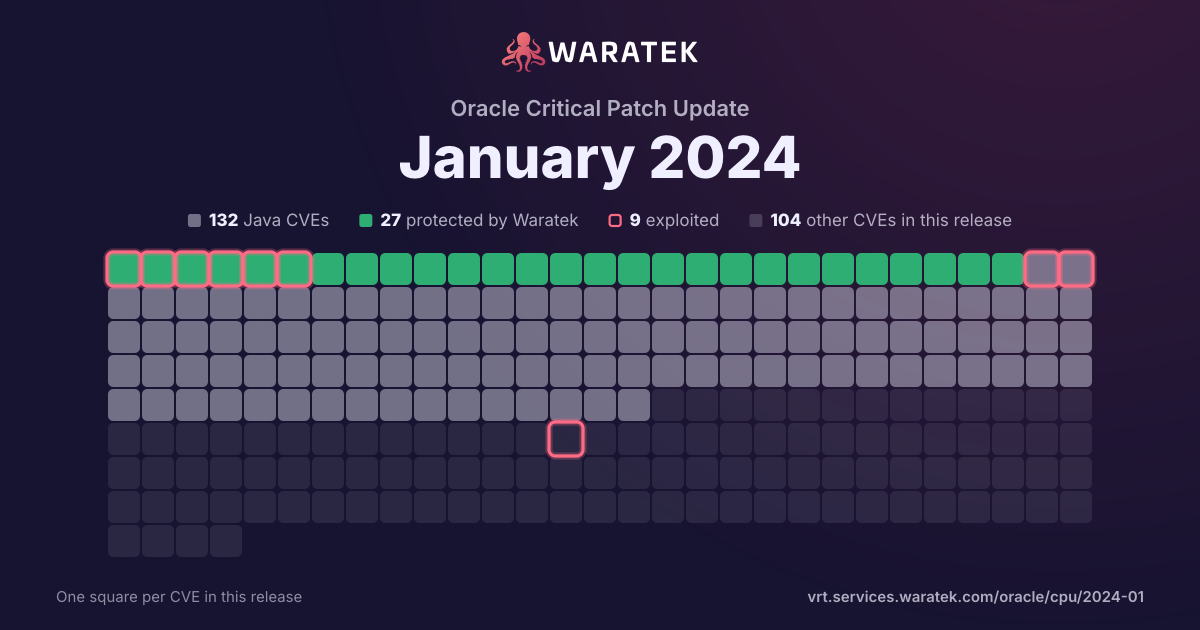
By status
21Protected by Waratek2Rule in development6Mitigation candidate103No exploit published9Outside Waratek scope95Not applicable
9Exploited, marked by the ring
No exploit published. For 38 of them, Oracle's security advisory is the source of public detail.
Protected by Waratek. Waratek RASP can block exploitation of these on systems that have not applied the patch yet.
Overview 20 matches · 1 protected · 0 exploited · 0 CISA KEV · 0 public PoC · 0 EPSS ≥ 0.5
Protected by Waratek
1
5.0%
Rule in development
0
0.0%
Mitigation candidate
0
0.0%
No exploit published
19
95.0%
blocked by ARMR today
1
5.0%
partly blocked
0
0.0%
not blocked
19
95.0%
not established
0
0.0%
unrecorded
0
0.0%
Exploited
0
0.0%
Working exploit published
0
0.0%
Proof of concept only
0
0.0%
Forecast only
0
0.0%
No public exploit
20
100.0%
split by
peak 10 / month
Sep 23Oct 23Nov 23
| CVE | Severity | Published▾ | Status | Exploitation | Description |
|---|---|---|---|---|---|
| CVE-2023-46589 | High | 2023-11-28 | No exploit published | No public exploit | Improper Input Validation vulnerability in Apache Tomcat.Tomcat from 11.0.0-M1 through 11.0.0-M10, from 10.1.0-M1 through 10.1.15, from 9.0.0-M1 through 9.0.82 and from 8.5.0 through 8.5.95 did not correctly parse HTTP trailer headers. A trailer header that exceeded the header size limit could cause Tomcat to treat a single request as multiple requests leading to the possibility of request smuggling when behind a reverse proxy. Older, EOL versions may also be affected. Users are recommended to upgrade to version 11.0.0-M11 onwards, 10.1.16 onwards, 9.0.83 onwards or 8.5.96 onwards, which fix the issue. |
| CVE-2023-34055 | Medium | 2023-11-28 | No exploit published | No public exploit | In Spring Boot versions 2.7.0 - 2.7.17, 3.0.0-3.0.12 and 3.1.0-3.1.5, it is possible for a user to provide specially crafted HTTP requests that may cause a denial-of-service (DoS) condition. Specifically, an application is vulnerable when all of the following are true: * the application uses Spring MVC or Spring WebFlux * org.springframework.boot:spring-boot-actuator is on the classpath |
| CVE-2023-34053 | High | 2023-11-28 | No exploit published | No public exploit | In Spring Framework versions 6.0.0 - 6.0.13, it is possible for a user to provide specially crafted HTTP requests that may cause a denial-of-service (DoS) condition. Specifically, an application is vulnerable when all of the following are true: * the application uses Spring MVC or Spring WebFlux * io.micrometer:micrometer-core is on the classpath * an ObservationRegistry is configured in the application to record observations Typically, Spring Boot applications need the org.springframework.boot:spring-boot-actuator dependency to meet all conditions. |
| CVE-2023-31582 | High | 2023-10-25 | No exploit published | No public exploit | jose4j before v0.9.3 allows attackers to set a low iteration count of 1000 or less. |
| CVE-2023-44483 | Medium | 2023-10-20 | No exploit published | No public exploit | All versions of Apache Santuario - XML Security for Java prior to 2.2.6, 2.3.4, and 3.0.3, when using the JSR 105 API, are vulnerable to an issue where a private key may be disclosed in log files when generating an XML Signature and logging with debug level is enabled. Users are recommended to upgrade to version 2.2.6, 2.3.4, or 3.0.3, which fixes this issue. |
| CVE-2023-22102 | High | 2023-10-17 | No exploit published | No public exploit | Vulnerability in the MySQL Connectors product of Oracle MySQL (component: Connector/J). Supported versions that are affected are 8.1.0 and prior. Difficult to exploit vulnerability allows unauthenticated attacker with network access via multiple protocols to compromise MySQL Connectors. Successful attacks require human interaction from a person other than the attacker and while the vulnerability is in MySQL Connectors, attacks may significantly impact additional products (scope change). Successful attacks of this vulnerability can result in takeover of MySQL Connectors. CVSS 3.1 Base Score 8.3 (Confidentiality, Integrity and Availability impacts). CVSS Vector: (CVSS:3.1/AV:N/AC:H/PR:N/UI:R/S:C/C:H/I:H/A:H). |
| CVE-2023-5072 | High | 2023-10-12 | No exploit published | No public exploit | Denial of Service in JSON-Java versions up to and including 20230618. A bug in the parser means that an input string of modest size can lead to indefinite amounts of memory being used. |
| CVE-2023-44981 | Critical | 2023-10-11 | No exploit published | No public exploit | Authorization Bypass Through User-Controlled Key vulnerability in Apache ZooKeeper. If SASL Quorum Peer authentication is enabled in ZooKeeper (quorum.auth.enableSasl=true), the authorization is done by verifying that the instance part in SASL authentication ID is listed in zoo.cfg server list. The instance part in SASL auth ID is optional and if it's missing, like 'eve@EXAMPLE.COM', the authorization check will be skipped. As a result an arbitrary endpoint could join the cluster and begin propagating counterfeit changes to the leader, essentially giving it complete read-write access to the data tree. Quorum Peer authentication is not enabled by default. Users are recommended to upgrade to version 3.9.1, 3.8.3, 3.7.2, which fixes the issue. Alternately ensure the ensemble election/quorum communication is protected by a firewall as this will mitigate the issue. See the documentation for more details on correct cluster administration. |
| CVE-2023-42795 | Medium | 2023-10-10 | No exploit published | No public exploit | Incomplete Cleanup vulnerability in Apache Tomcat.When recycling various internal objects in Apache Tomcat from 11.0.0-M1 through 11.0.0-M11, from 10.1.0-M1 through 10.1.13, from 9.0.0-M1 through 9.0.80 and from 8.5.0 through 8.5.93, an error could cause Tomcat to skip some parts of the recycling process leading to information leaking from the current request/response to the next. Older, EOL versions may also be affected. Users are recommended to upgrade to version 11.0.0-M12 onwards, 10.1.14 onwards, 9.0.81 onwards or 8.5.94 onwards, which fixes the issue. |
| CVE-2023-36478 | High | 2023-10-10 | No exploit published | No public exploit | Eclipse Jetty provides a web server and servlet container. In versions 11.0.0 through 11.0.15, 10.0.0 through 10.0.15, and 9.0.0 through 9.4.52, an integer overflow in `MetaDataBuilder.checkSize` allows for HTTP/2 HPACK header values to exceed their size limit. `MetaDataBuilder.java` determines if a header name or value exceeds the size limit, and throws an exception if the limit is exceeded. However, when length is very large and huffman is true, the multiplication by 4 in line 295 will overflow, and length will become negative. `(_size+length)` will now be negative, and the check on line 296 will not be triggered. Furthermore, `MetaDataBuilder.checkSize` allows for user-entered HPACK header value sizes to be negative, potentially leading to a very large buffer allocation later on when the user-entered size is multiplied by 2. This means that if a user provides a negative length value (or, more precisely, a length value which, when multiplied by the 4/3 fudge factor, is negative), and this length value is a very large positive number when multiplied by 2, then the user can cause a very large buffer to be allocated on the server. Users of HTTP/2 can be impacted by a remote denial of service attack. The issue has been fixed in versions 11.0.16, 10.0.16, and 9.4.53. There are no known workarounds. |
| CVE-2023-39410 | High | 2023-09-29 | Protected by Waratek | No public exploit | When deserializing untrusted or corrupted data, it is possible for a reader to consume memory beyond the allowed constraints and thus lead to out of memory on the system. This issue affects Java applications using Apache Avro Java SDK up to and including 1.11.2. Users should update to apache-avro version 1.11.3 which addresses this issue. |
| CVE-2023-43498 | High | 2023-09-20 | No exploit published | No public exploit | In Jenkins 2.423 and earlier, LTS 2.414.1 and earlier, processing file uploads using MultipartFormDataParser creates temporary files in the default system temporary directory with the default permissions for newly created files, potentially allowing attackers with access to the Jenkins controller file system to read and write the files before they are used. |
| CVE-2023-43497 | High | 2023-09-20 | No exploit published | No public exploit | In Jenkins 2.423 and earlier, LTS 2.414.1 and earlier, processing file uploads using the Stapler web framework creates temporary files in the default system temporary directory with the default permissions for newly created files, potentially allowing attackers with access to the Jenkins controller file system to read and write the files before they are used. |
| CVE-2023-43496 | High | 2023-09-20 | No exploit published | No public exploit | Jenkins 2.423 and earlier, LTS 2.414.1 and earlier creates a temporary file in the system temporary directory with the default permissions for newly created files when installing a plugin from a URL, potentially allowing attackers with access to the system temporary directory to replace the file before it is installed in Jenkins, potentially resulting in arbitrary code execution. |
| CVE-2023-43495 | Medium | 2023-09-20 | No exploit published | No public exploit | Jenkins 2.423 and earlier, LTS 2.414.1 and earlier does not escape the value of the 'caption' constructor parameter of 'ExpandableDetailsNote', resulting in a stored cross-site scripting (XSS) vulnerability exploitable by attackers able to control this parameter. |
| CVE-2023-43494 | Medium | 2023-09-20 | No exploit published | No public exploit | Jenkins 2.50 through 2.423 (both inclusive), LTS 2.60.1 through 2.414.1 (both inclusive) does not exclude sensitive build variables (e.g., password parameter values) from the search in the build history widget, allowing attackers with Item/Read permission to obtain values of sensitive variables used in builds by iteratively testing different characters until the correct sequence is discovered. |
| CVE-2023-41900 | Medium | 2023-09-15 | No exploit published | No public exploit | Jetty is a Java based web server and servlet engine. Versions 9.4.21 through 9.4.51, 10.0.15, and 11.0.15 are vulnerable to weak authentication. If a Jetty `OpenIdAuthenticator` uses the optional nested `LoginService`, and that `LoginService` decides to revoke an already authenticated user, then the current request will still treat the user as authenticated. The authentication is then cleared from the session and subsequent requests will not be treated as authenticated. So a request on a previously authenticated session could be allowed to bypass authentication after it had been rejected by the `LoginService`. This impacts usages of the jetty-openid which have configured a nested `LoginService` and where that `LoginService` will is capable of rejecting previously authenticated users. Versions 9.4.52, 10.0.16, and 11.0.16 have a patch for this issue. |
| CVE-2023-40167 | Medium | 2023-09-15 | No exploit published | No public exploit | Jetty is a Java based web server and servlet engine. Prior to versions 9.4.52, 10.0.16, 11.0.16, and 12.0.1, Jetty accepts the `+` character proceeding the content-length value in a HTTP/1 header field. This is more permissive than allowed by the RFC and other servers routinely reject such requests with 400 responses. There is no known exploit scenario, but it is conceivable that request smuggling could result if jetty is used in combination with a server that does not close the connection after sending such a 400 response. Versions 9.4.52, 10.0.16, 11.0.16, and 12.0.1 contain a patch for this issue. There is no workaround as there is no known exploit scenario. |
| CVE-2023-36479 | Low | 2023-09-15 | No exploit published | No public exploit | Eclipse Jetty Canonical Repository is the canonical repository for the Jetty project. Users of the CgiServlet with a very specific command structure may have the wrong command executed. If a user sends a request to a org.eclipse.jetty.servlets.CGI Servlet for a binary with a space in its name, the servlet will escape the command by wrapping it in quotation marks. This wrapped command, plus an optional command prefix, will then be executed through a call to Runtime.exec. If the original binary name provided by the user contains a quotation mark followed by a space, the resulting command line will contain multiple tokens instead of one. This issue was patched in version 9.4.52, 10.0.16, 11.0.16 and 12.0.0-beta2. |
| CVE-2023-1108 | High | 2023-09-14 | No exploit published | No public exploit | A flaw was found in undertow. This issue makes achieving a denial of service possible due to an unexpected handshake status updated in SslConduit, where the loop never terminates. |