
Oracle Critical Patch Update January 2024
Released January 2024 · Oracle's advisory ↗ · ← Critical Patch Update, October 2023 · Critical Patch Update, April 2024 →
236 CVEs in this release, one square each
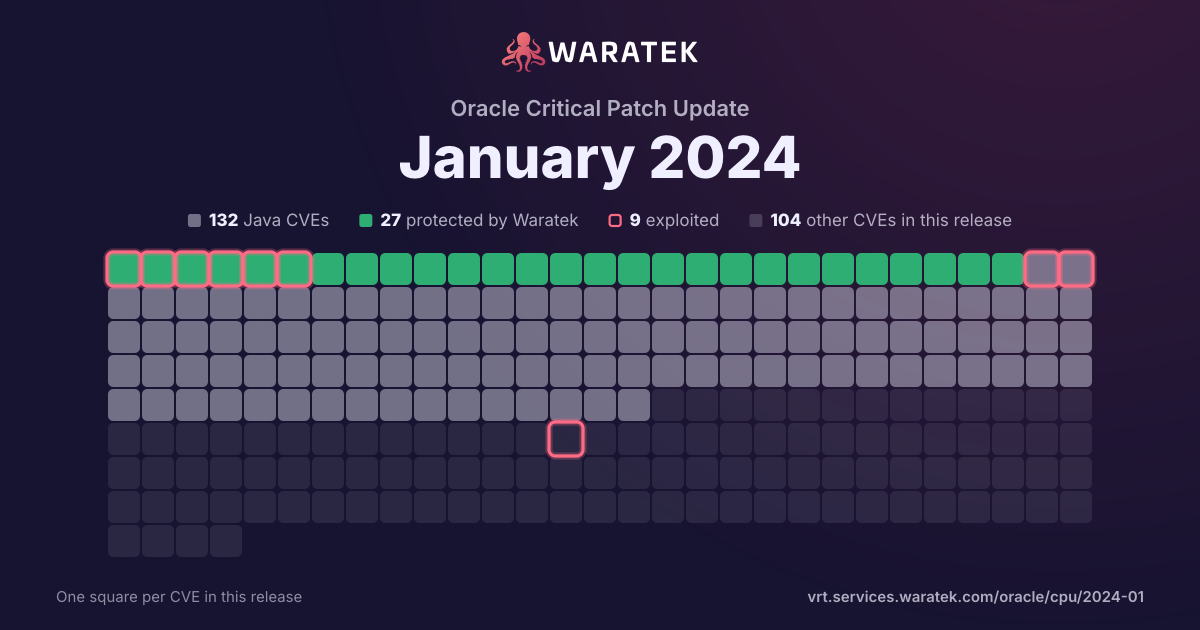
By status
27Protected by Waratek4Mitigation candidate101No exploit published26Outside Waratek scope78Not applicable
9Exploited, marked by the ring
No exploit published. For 47 of them, Oracle's security advisory is the source of public detail.
Protected by Waratek. Waratek RASP can block exploitation of these on systems that have not applied the patch yet.
Overview 29 matches · 16 in Waratek scope · 6 protected · 0 exploited · 0 CISA KEV · 8 public PoC · 8 EPSS ≥ 0.5
29matches
16in Waratek scope55.2%
6protected20.7%
0exploited0.0%
0CISA KEV0.0%
8public PoC27.6%
8EPSS ≥ 0.527.6%
Protected by Waratek
6
20.7%
Rule in development
0
0.0%
Mitigation candidate
1
3.4%
No exploit published
9
31.0%
Outside Waratek scope
4
13.8%
Not applicable
9
31.0%
Withdrawn CVE
0
0.0%
blocked by ARMR today
6
20.7%
partly blocked
0
0.0%
not blocked
23
79.3%
not established
0
0.0%
unrecorded
0
0.0%
Exploited
0
0.0%
Working exploit published
0
0.0%
Proof of concept only
29
100.0%
Forecast only
0
0.0%
No public exploit
0
0.0%
split by
peak 6 / quarter
Q4 211
Outside Waratek scope1
Medium1
not blocked1
Proof of concept only1
Q1 221
Protected by Waratek1
Critical1
blocked by ARMR today1
Proof of concept only1
Q2 220
Q3 226
Protected by Waratek3
No exploit published1
Outside Waratek scope2
Critical2
High2
Medium2
blocked by ARMR today3
not blocked3
Proof of concept only6
Q4 225
Mitigation candidate1
No exploit published1
Not applicable3
Critical1
High4
not blocked5
Proof of concept only5
Q1 233
No exploit published2
Not applicable1
High2
Medium1
not blocked3
Proof of concept only3
Q2 236
No exploit published4
Not applicable2
High6
not blocked6
Proof of concept only6
Q3 233
No exploit published1
Not applicable2
High3
not blocked3
Proof of concept only3
Q4 233
Protected by Waratek1
Outside Waratek scope1
Not applicable1
Critical2
High1
blocked by ARMR today1
not blocked2
Proof of concept only3
Q1 241
Protected by Waratek1
High1
blocked by ARMR today1
Proof of concept only1
Q4 21Q1 22Q2 22Q3 22Q4 22Q1 23Q2 23Q3 23Q4 23Q1 24
| CVE | Severity | Published▾ | Status | Exploitation | Description |
|---|---|---|---|---|---|
| CVE-2024-20931 | High | 2024-02-17 | Protected by Waratek | Proof of concept only | Vulnerability in the Oracle WebLogic Server product of Oracle Fusion Middleware (component: Core). Supported versions that are affected are 12.2.1.4.0 and 14.1.1.0.0. Easily exploitable vulnerability allows unauthenticated attacker with network access via T3, IIOP to compromise Oracle WebLogic Server. Successful attacks of this vulnerability can result in unauthorized access to critical data or complete access to all Oracle WebLogic Server accessible data. CVSS 3.1 Base Score 7.5 (Confidentiality impacts). CVSS Vector: (CVSS:3.1/AV:N/AC:L/PR:N/UI:N/S:U/C:H/I:N/A:N). |
| CVE-2023-49093 | Critical | 2023-12-04 | Protected by Waratek | Proof of concept only | HtmlUnit is a GUI-less browser for Java programs. HtmlUnit is vulnerable to Remote Code Execution (RCE) via XSTL, when browsing the attacker’s webpage. This vulnerability has been patched in version 3.9.0 |
| CVE-2023-43622 | High | 2023-10-23 | Not applicable | Proof of concept only | An attacker, opening a HTTP/2 connection with an initial window size of 0, was able to block handling of that connection indefinitely in Apache HTTP Server. This could be used to exhaust worker resources in the server, similar to the well known "slow loris" attack pattern. This has been fixed in version 2.4.58, so that such connection are terminated properly after the configured connection timeout. This issue affects Apache HTTP Server: from 2.4.55 through 2.4.57. Users are recommended to upgrade to version 2.4.58, which fixes the issue. |
| CVE-2023-38545 | Critical | 2023-10-18 | Outside Waratek scope | Proof of concept only | This flaw makes curl overflow a heap based buffer in the SOCKS5 proxy handshake. When curl is asked to pass along the host name to the SOCKS5 proxy to allow that to resolve the address instead of it getting done by curl itself, the maximum length that host name can be is 255 bytes. If the host name is detected to be longer, curl switches to local name resolving and instead passes on the resolved address only. Due to this bug, the local variable that means "let the host resolve the name" could get the wrong value during a slow SOCKS5 handshake, and contrary to the intention, copy the too long host name to the target buffer instead of copying just the resolved address there. The target buffer being a heap based buffer, and the host name coming from the URL that curl has been told to operate with. |
| CVE-2023-43642 | High | 2023-09-25 | No exploit published | Proof of concept only | snappy-java is a Java port of the snappy, a fast C++ compresser/decompresser developed by Google. The SnappyInputStream was found to be vulnerable to Denial of Service (DoS) attacks when decompressing data with a too large chunk size. Due to missing upper bound check on chunk length, an unrecoverable fatal error can occur. All versions of snappy-java including the latest released version 1.1.10.3 are vulnerable to this issue. A fix has been introduced in commit `9f8c3cf74` which will be included in the 1.1.10.4 release. Users are advised to upgrade. Users unable to upgrade should only accept compressed data from trusted sources. |
| CVE-2023-38039 | High | 2023-09-15 | Not applicable | Proof of concept only | When curl retrieves an HTTP response, it stores the incoming headers so that they can be accessed later via the libcurl headers API. However, curl did not have a limit in how many or how large headers it would accept in a response, allowing a malicious server to stream an endless series of headers and eventually cause curl to run out of heap memory. |
| CVE-2023-38325 | High | 2023-07-14 | Not applicable | Proof of concept only | The cryptography package before 41.0.2 for Python mishandles SSH certificates that have critical options. |
| CVE-2023-36632 | High | 2023-06-25 | Not applicable | Proof of concept only | The legacy email.utils.parseaddr function in Python through 3.11.4 allows attackers to trigger "RecursionError: maximum recursion depth exceeded while calling a Python object" via a crafted argument. This argument is plausibly an untrusted value from an application's input data that was supposed to contain a name and an e-mail address. NOTE: email.utils.parseaddr is categorized as a Legacy API in the documentation of the Python email package. Applications should instead use the email.parser.BytesParser or email.parser.Parser class. NOTE: the vendor's perspective is that this is neither a vulnerability nor a bug. The email package is intended to have size limits and to throw an exception when limits are exceeded; they were exceeded by the example demonstration code. |
| CVE-2023-34455 | High | 2023-06-15 | No exploit published | Proof of concept only | snappy-java is a fast compressor/decompressor for Java. Due to use of an unchecked chunk length, an unrecoverable fatal error can occur in versions prior to 1.1.10.1. The code in the function hasNextChunk in the fileSnappyInputStream.java checks if a given stream has more chunks to read. It does that by attempting to read 4 bytes. If it wasn’t possible to read the 4 bytes, the function returns false. Otherwise, if 4 bytes were available, the code treats them as the length of the next chunk. In the case that the `compressed` variable is null, a byte array is allocated with the size given by the input data. Since the code doesn’t test the legality of the `chunkSize` variable, it is possible to pass a negative number (such as 0xFFFFFFFF which is -1), which will cause the code to raise a `java.lang.NegativeArraySizeException` exception. A worse case would happen when passing a huge positive value (such as 0x7FFFFFFF), which would raise the fatal `java.lang.OutOfMemoryError` error. Version 1.1.10.1 contains a patch for this issue. |
| CVE-2023-34454 | High | 2023-06-15 | No exploit published | Proof of concept only | snappy-java is a fast compressor/decompressor for Java. Due to unchecked multiplications, an integer overflow may occur in versions prior to 1.1.10.1, causing an unrecoverable fatal error. The function `compress(char[] input)` in the file `Snappy.java` receives an array of characters and compresses it. It does so by multiplying the length by 2 and passing it to the rawCompress` function. Since the length is not tested, the multiplication by two can cause an integer overflow and become negative. The rawCompress function then uses the received length and passes it to the natively compiled maxCompressedLength function, using the returned value to allocate a byte array. Since the maxCompressedLength function treats the length as an unsigned integer, it doesn’t care that it is negative, and it returns a valid value, which is casted to a signed integer by the Java engine. If the result is negative, a `java.lang.NegativeArraySizeException` exception will be raised while trying to allocate the array `buf`. On the other side, if the result is positive, the `buf` array will successfully be allocated, but its size might be too small to use for the compression, causing a fatal Access Violation error. The same issue exists also when using the `compress` functions that receive double, float, int, long and short, each using a different multiplier that may cause the same issue. The issue most likely won’t occur when using a byte array, since creating a byte array of size 0x80000000 (or any other negative value) is impossible in the first place. Version 1.1.10.1 contains a patch for this issue. |
| CVE-2023-34453 | High | 2023-06-15 | No exploit published | Proof of concept only | snappy-java is a fast compressor/decompressor for Java. Due to unchecked multiplications, an integer overflow may occur in versions prior to 1.1.10.1, causing a fatal error. The function `shuffle(int[] input)` in the file `BitShuffle.java` receives an array of integers and applies a bit shuffle on it. It does so by multiplying the length by 4 and passing it to the natively compiled shuffle function. Since the length is not tested, the multiplication by four can cause an integer overflow and become a smaller value than the true size, or even zero or negative. In the case of a negative value, a `java.lang.NegativeArraySizeException` exception will raise, which can crash the program. In a case of a value that is zero or too small, the code that afterwards references the shuffled array will assume a bigger size of the array, which might cause exceptions such as `java.lang.ArrayIndexOutOfBoundsException`. The same issue exists also when using the `shuffle` functions that receive a double, float, long and short, each using a different multiplier that may cause the same issue. Version 1.1.10.1 contains a patch for this vulnerability. |
| CVE-2023-34624 | High | 2023-06-14 | No exploit published | Proof of concept only | An issue was discovered htmlcleaner thru = 2.28 allows attackers to cause a denial of service or other unspecified impacts via crafted object that uses cyclic dependencies. |
| CVE-2023-2617 | High | 2023-05-10 | Not applicable | Proof of concept only | A vulnerability classified as problematic was found in OpenCV wechat_qrcode Module up to 4.7.0. Affected by this vulnerability is the function DecodedBitStreamParser::decodeByteSegment of the file qrcode/decoder/decoded_bit_stream_parser.cpp. The manipulation leads to null pointer dereference. The attack can be launched remotely. The exploit has been disclosed to the public and may be used. It is recommended to apply a patch to fix this issue. The associated identifier of this vulnerability is VDB-228547. |
| CVE-2023-1436 | High | 2023-03-22 | No exploit published | Proof of concept only | An infinite recursion is triggered in Jettison when constructing a JSONArray from a Collection that contains a self-reference in one of its elements. This leads to a StackOverflowError exception being thrown. |
| CVE-2023-1370 | High | 2023-03-22 | No exploit published | Proof of concept only | [Json-smart](https://netplex.github.io/json-smart/) is a performance focused, JSON processor lib. When reaching a ‘[‘ or ‘{‘ character in the JSON input, the code parses an array or an object respectively. It was discovered that the code does not have any limit to the nesting of such arrays or objects. Since the parsing of nested arrays and objects is done recursively, nesting too many of them can cause a stack exhaustion (stack overflow) and crash the software. |
| CVE-2023-23931 | Medium | 2023-02-07 | Not applicable | Proof of concept only | cryptography is a package designed to expose cryptographic primitives and recipes to Python developers. In affected versions `Cipher.update_into` would accept Python objects which implement the buffer protocol, but provide only immutable buffers. This would allow immutable objects (such as `bytes`) to be mutated, thus violating fundamental rules of Python and resulting in corrupted output. This now correctly raises an exception. This issue has been present since `update_into` was originally introduced in cryptography 1.8. |
| CVE-2022-46908 | High | 2022-12-12 | Not applicable | Proof of concept only | SQLite through 3.40.0, when relying on --safe for execution of an untrusted CLI script, does not properly implement the azProhibitedFunctions protection mechanism, and instead allows UDF functions such as WRITEFILE. |
| CVE-2022-45868 | High | 2022-11-23 | No exploit published | Proof of concept only | The web-based admin console in H2 Database Engine before 2.2.220 can be started via the CLI with the argument -webAdminPassword, which allows the user to specify the password in cleartext for the web admin console. Consequently, a local user (or an attacker that has obtained local access through some means) would be able to discover the password by listing processes and their arguments. NOTE: the vendor states "This is not a vulnerability of H2 Console ... Passwords should never be passed on the command line and every qualified DBA or system administrator is expected to know that." Nonetheless, the issue was fixed in 2.2.220. |
| CVE-2022-3786 | High | 2022-11-01 | Not applicable | Proof of concept only | A buffer overrun can be triggered in X.509 certificate verification, specifically in name constraint checking. Note that this occurs after certificate chain signature verification and requires either a CA to have signed a malicious certificate or for an application to continue certificate verification despite failure to construct a path to a trusted issuer. An attacker can craft a malicious email address in a certificate to overflow an arbitrary number of bytes containing the `.' character (decimal 46) on the stack. This buffer overflow could result in a crash (causing a denial of service). In a TLS client, this can be triggered by connecting to a malicious server. In a TLS server, this can be triggered if the server requests client authentication and a malicious client connects. |
| CVE-2022-3602 | High | 2022-11-01 | Not applicable | Proof of concept only | A buffer overrun can be triggered in X.509 certificate verification, specifically in name constraint checking. Note that this occurs after certificate chain signature verification and requires either a CA to have signed the malicious certificate or for the application to continue certificate verification despite failure to construct a path to a trusted issuer. An attacker can craft a malicious email address to overflow four attacker-controlled bytes on the stack. This buffer overflow could result in a crash (causing a denial of service) or potentially remote code execution. Many platforms implement stack overflow protections which would mitigate against the risk of remote code execution. The risk may be further mitigated based on stack layout for any given platform/compiler. Pre-announcements of CVE-2022-3602 described this issue as CRITICAL. Further analysis based on some of the mitigating factors described above have led this to be downgraded to HIGH. Users are still encouraged to upgrade to a new version as soon as possible. In a TLS client, this can be triggered by connecting to a malicious server. In a TLS server, this can be triggered if the server requests client authentication and a malicious client connects. Fixed in OpenSSL 3.0.7 (Affected 3.0.0,3.0.1,3.0.2,3.0.3,3.0.4,3.0.5,3.0.6). |
| CVE-2022-31692 | Critical | 2022-10-31 | Mitigation candidate | Proof of concept only | Spring Security, versions 5.7 prior to 5.7.5 and 5.6 prior to 5.6.9 could be susceptible to authorization rules bypass via forward or include dispatcher types. Specifically, an application is vulnerable when all of the following are true: The application expects that Spring Security applies security to forward and include dispatcher types. The application uses the AuthorizationFilter either manually or via the authorizeHttpRequests() method. The application configures the FilterChainProxy to apply to forward and/or include requests (e.g. spring.security.filter.dispatcher-types = request, error, async, forward, include). The application may forward or include the request to a higher privilege-secured endpoint.The application configures Spring Security to apply to every dispatcher type via authorizeHttpRequests().shouldFilterAllDispatcherTypes(true) |
| CVE-2022-36944 | Critical | 2022-09-23 | Protected by Waratek | Proof of concept only | Scala 2.13.x before 2.13.9 has a Java deserialization chain in its JAR file. On its own, it cannot be exploited. There is only a risk in conjunction with Java object deserialization within an application. In such situations, it allows attackers to erase contents of arbitrary files, make network connections, or possibly run arbitrary code (specifically, Function0 functions) via a gadget chain. |
| CVE-2022-40152 | High | 2022-09-16 | No exploit published | Proof of concept only | Those using Woodstox to parse XML data may be vulnerable to Denial of Service attacks (DOS) if DTD support is enabled. If the parser is running on user supplied input, an attacker may supply content that causes the parser to crash by stackoverflow. This effect may support a denial of service attack. |
| CVE-2022-36033 | Medium | 2022-08-29 | Protected by Waratek | Proof of concept only | jsoup is a Java HTML parser, built for HTML editing, cleaning, scraping, and cross-site scripting (XSS) safety. jsoup may incorrectly sanitize HTML including `javascript:` URL expressions, which could allow XSS attacks when a reader subsequently clicks that link. If the non-default `SafeList.preserveRelativeLinks` option is enabled, HTML including `javascript:` URLs that have been crafted with control characters will not be sanitized. If the site that this HTML is published on does not set a Content Security Policy, an XSS attack is then possible. This issue is patched in jsoup 1.15.3. Users should upgrade to this version. Additionally, as the unsanitized input may have been persisted, old content should be cleaned again using the updated version. To remediate this issue without immediately upgrading: - disable `SafeList.preserveRelativeLinks`, which will rewrite input URLs as absolute URLs - ensure an appropriate [Content Security Policy](https://developer.mozilla.org/en-US/docs/Web/HTTP/CSP) is defined. (This should be used regardless of upgrading, as a defence-in-depth best practice.) |
| CVE-2022-37434 | Critical | 2022-08-05 | Outside Waratek scope | Proof of concept only | zlib through 1.2.12 has a heap-based buffer over-read or buffer overflow in inflate in inflate.c via a large gzip header extra field. NOTE: only applications that call inflateGetHeader are affected. Some common applications bundle the affected zlib source code but may be unable to call inflateGetHeader (e.g., see the nodejs/node reference). |
| CVE-2022-31160 | Medium | 2022-07-20 | Outside Waratek scope | Proof of concept only | jQuery UI is a curated set of user interface interactions, effects, widgets, and themes built on top of jQuery. Versions prior to 1.13.2 are potentially vulnerable to cross-site scripting. Initializing a checkboxradio widget on an input enclosed within a label makes that parent label contents considered as the input label. Calling `.checkboxradio( "refresh" )` on such a widget and the initial HTML contained encoded HTML entities will make them erroneously get decoded. This can lead to potentially executing JavaScript code. The bug has been patched in jQuery UI 1.13.2. To remediate the issue, someone who can change the initial HTML can wrap all the non-input contents of the `label` in a `span`. |
| CVE-2022-34169 | High | 2022-07-19 | Protected by Waratek | Proof of concept only | The Apache Xalan Java XSLT library is vulnerable to an integer truncation issue when processing malicious XSLT stylesheets. This can be used to corrupt Java class files generated by the internal XSLTC compiler and execute arbitrary Java bytecode. Users are recommended to update to version 2.7.3 or later. Note: Java runtimes (such as OpenJDK) include repackaged copies of Xalan. |
| CVE-2022-23221 | Critical | 2022-01-19 | Protected by Waratek | Proof of concept only | H2 Console before 2.1.210 allows remote attackers to execute arbitrary code via a jdbc:h2:mem JDBC URL containing the IGNORE_UNKNOWN_SETTINGS=TRUE;FORBID_CREATION=FALSE;INIT=RUNSCRIPT substring, a different vulnerability than CVE-2021-42392. |
| CVE-2021-41184 | Medium | 2021-10-26 | Outside Waratek scope | Proof of concept only | jQuery-UI is the official jQuery user interface library. Prior to version 1.13.0, accepting the value of the `of` option of the `.position()` util from untrusted sources may execute untrusted code. The issue is fixed in jQuery UI 1.13.0. Any string value passed to the `of` option is now treated as a CSS selector. A workaround is to not accept the value of the `of` option from untrusted sources. |