
Oracle Critical Patch Update October 2023
Released October 2023 · Oracle's advisory ↗ · ← Critical Patch Update, July 2023 · Critical Patch Update, January 2024 →
245 CVEs in this release, one square each
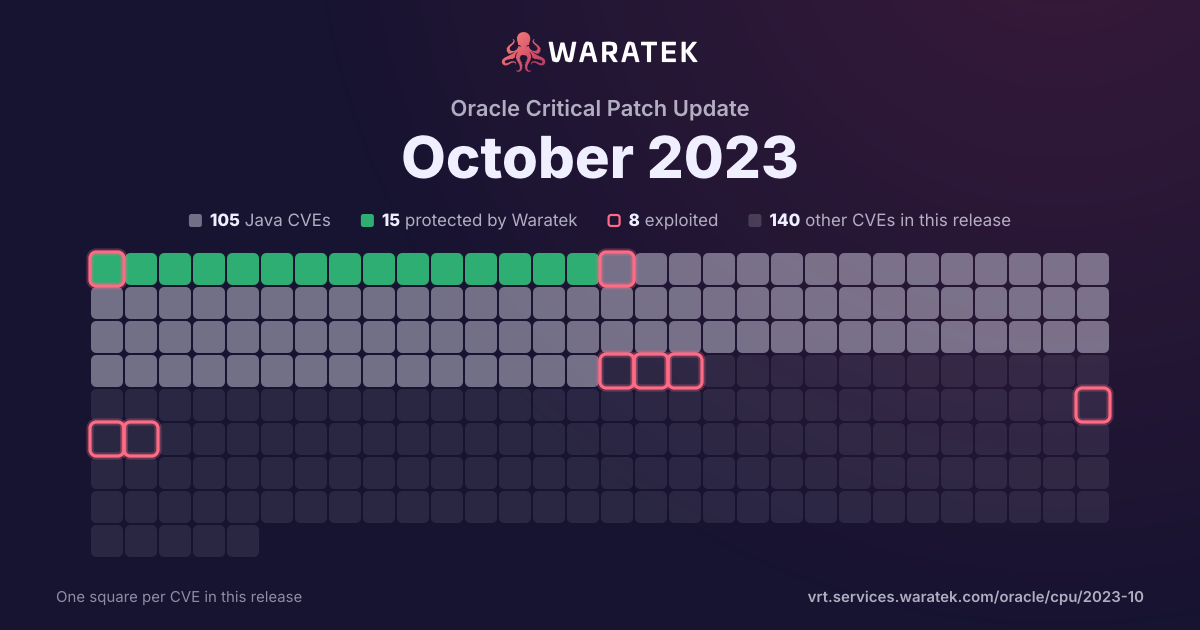
By status
15Protected by Waratek3Mitigation candidate87No exploit published44Outside Waratek scope96Not applicable
8Exploited, marked by the ring
No exploit published. For 35 of them, Oracle's security advisory is the source of public detail.
Protected by Waratek. Waratek RASP can block exploitation of these on systems that have not applied the patch yet.
Overview 245 matches · 105 in Waratek scope · 15 protected · 8 exploited · 1 CISA KEV · 16 public PoC · 12 EPSS ≥ 0.5
245matches
105in Waratek scope42.9%
15protected6.1%
8exploited3.3%
1CISA KEV0.4%
16public PoC6.5%
12EPSS ≥ 0.54.9%
Protected by Waratek
15
6.1%
Rule in development
0
0.0%
Mitigation candidate
3
1.2%
No exploit published
87
35.5%
Outside Waratek scope
44
18.0%
Not applicable
96
39.2%
Withdrawn CVE
0
0.0%
blocked by ARMR today
15
6.1%
partly blocked
0
0.0%
not blocked
229
93.5%
not established
1
0.4%
unrecorded
0
0.0%
Exploited
8
3.3%
Working exploit published
0
0.0%
Proof of concept only
47
19.2%
Forecast only
4
1.6%
No public exploit
186
75.9%
split by
peak 78 / quarter
Q2 191
Outside Waratek scope1
Medium1
not blocked1
Exploited1
Q3 191
Protected by Waratek1
High1
blocked by ARMR today1
No public exploit1
Q4 191
Outside Waratek scope1
High1
not blocked1
No public exploit1
Q1 201
No exploit published1
Critical1
not blocked1
No public exploit1
Q2 202
Outside Waratek scope2
Medium2
not blocked2
Exploited2
Q3 202
Outside Waratek scope2
High2
not blocked2
No public exploit2
Q4 202
No exploit published1
Outside Waratek scope1
High1
Medium1
not blocked2
No public exploit2
Q1 214
No exploit published3
Not applicable1
High2
Medium2
not blocked4
No public exploit4
Q2 211
No exploit published1
High1
not blocked1
Forecast only1
Q3 214
No exploit published4
High2
Medium2
not blocked4
No public exploit4
Q4 216
Protected by Waratek1
Outside Waratek scope3
Not applicable2
High3
Medium3
blocked by ARMR today1
not blocked5
Proof of concept only1
No public exploit5
Q1 224
No exploit published2
Outside Waratek scope1
Not applicable1
High3
Medium1
not blocked4
No public exploit4
Q2 2215
Protected by Waratek5
No exploit published3
Outside Waratek scope1
Not applicable6
Critical4
High8
Medium3
blocked by ARMR today5
not blocked10
Proof of concept only3
No public exploit12
Q3 228
Protected by Waratek2
Mitigation candidate1
No exploit published2
Outside Waratek scope1
Not applicable2
Critical3
High3
Medium2
blocked by ARMR today2
not blocked6
Proof of concept only7
No public exploit1
Q4 2221
Protected by Waratek3
No exploit published9
Outside Waratek scope2
Not applicable7
Critical3
High14
Medium3
Low1
blocked by ARMR today3
not blocked18
Exploited1
Proof of concept only8
No public exploit12
Q1 2329
No exploit published7
Not applicable22
Critical3
High15
Medium11
not blocked29
Exploited1
Proof of concept only9
Forecast only1
No public exploit18
Q2 2331
Protected by Waratek1
No exploit published14
Not applicable16
Critical2
High13
Medium16
blocked by ARMR today1
not blocked30
Proof of concept only7
Forecast only1
No public exploit23
Q3 2334
Protected by Waratek1
Mitigation candidate1
No exploit published10
Outside Waratek scope1
Not applicable21
Critical5
High13
Medium15
Low1
blocked by ARMR today1
not blocked33
Exploited2
Proof of concept only10
Forecast only1
No public exploit21
Q4 2378
Protected by Waratek1
Mitigation candidate1
No exploit published30
Outside Waratek scope28
Not applicable18
Critical4
High13
Medium55
Low6
blocked by ARMR today1
not blocked76
not established1
Exploited1
Proof of concept only2
No public exploit75
Q2 19Q4 19Q2 20Q4 20Q2 21Q4 21Q2 22Q4 22Q2 23Q4 23
| CVE | Severity | Published▾ | Status | Exploitation | Description |
|---|---|---|---|---|---|
| CVE-2022-31129 | High | 2022-07-06 | Not applicable | Proof of concept only | moment is a JavaScript date library for parsing, validating, manipulating, and formatting dates. Affected versions of moment were found to use an inefficient parsing algorithm. Specifically using string-to-date parsing in moment (more specifically rfc2822 parsing, which is tried by default) has quadratic (N^2) complexity on specific inputs. Users may notice a noticeable slowdown is observed with inputs above 10k characters. Users who pass user-provided strings without sanity length checks to moment constructor are vulnerable to (Re)DoS attacks. The problem is patched in 2.29.4, the patch can be applied to all affected versions with minimal tweaking. Users are advised to upgrade. Users unable to upgrade should consider limiting date lengths accepted from user input. |
| CVE-2021-33036 | High | 2022-06-15 | Protected by Waratek | No public exploit | In Apache Hadoop 2.2.0 to 2.10.1, 3.0.0-alpha1 to 3.1.4, 3.2.0 to 3.2.2, and 3.3.0 to 3.3.1, a user who can escalate to yarn user can possibly run arbitrary commands as root user. Users should upgrade to Apache Hadoop 2.10.2, 3.2.3, 3.3.2 or higher. |
| CVE-2021-37404 | Critical | 2022-06-13 | No exploit published | No public exploit | There is a potential heap buffer overflow in Apache Hadoop libhdfs native code. Opening a file path provided by user without validation may result in a denial of service or arbitrary code execution. Users should upgrade to Apache Hadoop 2.10.2, 3.2.3, 3.3.2 or higher. |
| CVE-2022-30115 | Medium | 2022-06-02 | Not applicable | No public exploit | Using its HSTS support, curl can be instructed to use HTTPS directly insteadof using an insecure clear-text HTTP step even when HTTP is provided in theURL. This mechanism could be bypassed if the host name in the given URL used atrailing dot while not using one when it built the HSTS cache. Or the otherway around - by having the trailing dot in the HSTS cache and *not* using thetrailing dot in the URL. |
| CVE-2022-27782 | High | 2022-06-02 | Not applicable | Proof of concept only | libcurl would reuse a previously created connection even when a TLS or SSHrelated option had been changed that should have prohibited reuse.libcurl keeps previously used connections in a connection pool for subsequenttransfers to reuse if one of them matches the setup. However, several TLS andSSH settings were left out from the configuration match checks, making themmatch too easily. |
| CVE-2022-27781 | High | 2022-06-02 | Not applicable | Proof of concept only | libcurl provides the `CURLOPT_CERTINFO` option to allow applications torequest details to be returned about a server's certificate chain.Due to an erroneous function, a malicious server could make libcurl built withNSS get stuck in a never-ending busy-loop when trying to retrieve thatinformation. |
| CVE-2022-27780 | High | 2022-06-02 | Not applicable | Proof of concept only | The curl URL parser wrongly accepts percent-encoded URL separators like '/'when decoding the host name part of a URL, making it a *different* URL usingthe wrong host name when it is later retrieved.For example, a URL like `http://example.com%2F127.0.0.1/`, would be allowed bythe parser and get transposed into `http://example.com/127.0.0.1/`. This flawcan be used to circumvent filters, checks and more. |
| CVE-2022-27779 | Medium | 2022-06-02 | Not applicable | No public exploit | libcurl wrongly allows cookies to be set for Top Level Domains (TLDs) if thehost name is provided with a trailing dot.curl can be told to receive and send cookies. curl's "cookie engine" can bebuilt with or without [Public Suffix List](https://publicsuffix.org/)awareness. If PSL support not provided, a more rudimentary check exists to atleast prevent cookies from being set on TLDs. This check was broken if thehost name in the URL uses a trailing dot.This can allow arbitrary sites to set cookies that then would get sent to adifferent and unrelated site or domain. |
| CVE-2022-27778 | High | 2022-06-02 | Outside Waratek scope | No public exploit | A use of incorrectly resolved name vulnerability fixed in 7.83.1 might remove the wrong file when `--no-clobber` is used together with `--remove-on-error`. |
| CVE-2022-29599 | Critical | 2022-05-23 | Protected by Waratek | No public exploit | In Apache Maven maven-shared-utils prior to version 3.3.3, the Commandline class can emit double-quoted strings without proper escaping, allowing shell injection attacks. |
| CVE-2022-25647 | High | 2022-05-01 | Protected by Waratek | No public exploit | The package com.google.code.gson:gson before 2.8.9 are vulnerable to Deserialization of Untrusted Data via the writeReplace() method in internal classes, which may lead to DoS attacks. |
| CVE-2021-41945 | Critical | 2022-04-28 | Not applicable | No public exploit | Encode OSS httpx < 0.23.0 is affected by improper input validation in `httpx.URL`, `httpx.Client` and some functions using `httpx.URL.copy_with`. |
| CVE-2022-29546 | High | 2022-04-25 | No exploit published | No public exploit | HtmlUnit NekoHtml Parser before 2.61.0 suffers from a denial of service vulnerability. Crafted input associated with the parsing of Processing Instruction (PI) data leads to heap memory consumption. This is similar to CVE-2022-28366 but affects a much later version of the product. |
| CVE-2022-29577 | Medium | 2022-04-21 | Protected by Waratek | No public exploit | OWASP AntiSamy before 1.6.7 allows XSS via HTML tag smuggling on STYLE content with crafted input. The output serializer does not properly encode the supposed Cascading Style Sheets (CSS) content. NOTE: this issue exists because of an incomplete fix for CVE-2022-28367. |
| CVE-2022-24839 | High | 2022-04-11 | No exploit published | No public exploit | org.cyberneko.html is an html parser written in Java. The fork of `org.cyberneko.html` used by Nokogiri (Rubygem) raises a `java.lang.OutOfMemoryError` exception when parsing ill-formed HTML markup. Users are advised to upgrade to `>= 1.9.22.noko2`. Note: The upstream library `org.cyberneko.html` is no longer maintained. Nokogiri uses its own fork of this library located at https://github.com/sparklemotion/nekohtml and this CVE applies only to that fork. Other forks of nekohtml may have a similar vulnerability. |
| CVE-2022-26612 | Critical | 2022-04-07 | Protected by Waratek | No public exploit | In Apache Hadoop, The unTar function uses unTarUsingJava function on Windows and the built-in tar utility on Unix and other OSes. As a result, a TAR entry may create a symlink under the expected extraction directory which points to an external directory. A subsequent TAR entry may extract an arbitrary file into the external directory using the symlink name. This however would be caught by the same targetDirPath check on Unix because of the getCanonicalPath call. However on Windows, getCanonicalPath doesn't resolve symbolic links, which bypasses the check. unpackEntries during TAR extraction follows symbolic links which allows writing outside expected base directory on Windows. This was addressed in Apache Hadoop 3.2.3 |
| CVE-2020-36518 | High | 2022-03-11 | No exploit published | No public exploit | jackson-databind before 2.13.0 allows a Java StackOverflow exception and denial of service via a large depth of nested objects. |
| CVE-2022-24329 | Medium | 2022-02-25 | No exploit published | No public exploit | In JetBrains Kotlin before 1.6.0, it was not possible to lock dependencies for Multiplatform Gradle Projects. |
| CVE-2022-23990 | High | 2022-01-26 | Outside Waratek scope | No public exploit | Expat (aka libexpat) before 2.4.4 has an integer overflow in the doProlog function. |
| CVE-2021-43045 | High | 2022-01-06 | Not applicable | No public exploit | A vulnerability in the .NET SDK of Apache Avro allows an attacker to allocate excessive resources, potentially causing a denial-of-service attack. This issue affects .NET applications using Apache Avro version 1.10.2 and prior versions. Users should update to version 1.11.0 which addresses this issue. |
| CVE-2021-41165 | High | 2021-11-17 | Not applicable | No public exploit | CKEditor4 is an open source WYSIWYG HTML editor. In affected version a vulnerability has been discovered in the core HTML processing module and may affect all plugins used by CKEditor 4. The vulnerability allowed to inject malformed comments HTML bypassing content sanitization, which could result in executing JavaScript code. It affects all users using the CKEditor 4 at version < 4.17.0. The problem has been recognized and patched. The fix will be available in version 4.17.0. |
| CVE-2021-41164 | High | 2021-11-17 | Not applicable | No public exploit | CKEditor4 is an open source WYSIWYG HTML editor. In affected versions a vulnerability has been discovered in the Advanced Content Filter (ACF) module and may affect all plugins used by CKEditor 4. The vulnerability allowed to inject malformed HTML bypassing content sanitization, which could result in executing JavaScript code. It affects all users using the CKEditor 4 at version < 4.17.0. The problem has been recognized and patched. The fix will be available in version 4.17.0. |
| CVE-2021-41184 | Medium | 2021-10-26 | Outside Waratek scope | Proof of concept only | jQuery-UI is the official jQuery user interface library. Prior to version 1.13.0, accepting the value of the `of` option of the `.position()` util from untrusted sources may execute untrusted code. The issue is fixed in jQuery UI 1.13.0. Any string value passed to the `of` option is now treated as a CSS selector. A workaround is to not accept the value of the `of` option from untrusted sources. |
| CVE-2021-41183 | Medium | 2021-10-26 | Outside Waratek scope | No public exploit | jQuery-UI is the official jQuery user interface library. Prior to version 1.13.0, accepting the value of various `*Text` options of the Datepicker widget from untrusted sources may execute untrusted code. The issue is fixed in jQuery UI 1.13.0. The values passed to various `*Text` options are now always treated as pure text, not HTML. A workaround is to not accept the value of the `*Text` options from untrusted sources. |
| CVE-2021-41182 | Medium | 2021-10-26 | Outside Waratek scope | No public exploit | jQuery-UI is the official jQuery user interface library. Prior to version 1.13.0, accepting the value of the `altField` option of the Datepicker widget from untrusted sources may execute untrusted code. The issue is fixed in jQuery UI 1.13.0. Any string value passed to the `altField` option is now treated as a CSS selector. A workaround is to not accept the value of the `altField` option from untrusted sources. |
| CVE-2021-37136 | High | 2021-10-19 | Protected by Waratek | No public exploit | The Bzip2 decompression decoder function doesn't allow setting size restrictions on the decompressed output data (which affects the allocation size used during decompression). All users of Bzip2Decoder are affected. The malicious input can trigger an OOME and so a DoS attack |
| CVE-2021-40690 | High | 2021-09-19 | No exploit published | No public exploit | All versions of Apache Santuario - XML Security for Java prior to 2.2.3 and 2.1.7 are vulnerable to an issue where the "secureValidation" property is not passed correctly when creating a KeyInfo from a KeyInfoReference element. This allows an attacker to abuse an XPath Transform to extract any local .xml files in a RetrievalMethod element. |
| CVE-2021-37714 | High | 2021-08-18 | No exploit published | No public exploit | jsoup is a Java library for working with HTML. Those using jsoup versions prior to 1.14.2 to parse untrusted HTML or XML may be vulnerable to DOS attacks. If the parser is run on user supplied input, an attacker may supply content that causes the parser to get stuck (loop indefinitely until cancelled), to complete more slowly than usual, or to throw an unexpected exception. This effect may support a denial of service attack. The issue is patched in version 1.14.2. There are a few available workarounds. Users may rate limit input parsing, limit the size of inputs based on system resources, and/or implement thread watchdogs to cap and timeout parse runtimes. |
| CVE-2021-36374 | Medium | 2021-07-14 | No exploit published | No public exploit | When reading a specially crafted ZIP archive, or a derived formats, an Apache Ant build can be made to allocate large amounts of memory that leads to an out of memory error, even for small inputs. This can be used to disrupt builds using Apache Ant. Commonly used derived formats from ZIP archives are for instance JAR files and many office files. Apache Ant prior to 1.9.16 and 1.10.11 were affected. |
| CVE-2021-36373 | Medium | 2021-07-14 | No exploit published | No public exploit | When reading a specially crafted TAR archive an Apache Ant build can be made to allocate large amounts of memory that finally leads to an out of memory error, even for small inputs. This can be used to disrupt builds using Apache Ant. Apache Ant prior to 1.9.16 and 1.10.11 were affected. |
| CVE-2021-28165 | High | 2021-04-01 | No exploit published | Forecast only | In Eclipse Jetty 7.2.2 to 9.4.38, 10.0.0.alpha0 to 10.0.1, and 11.0.0.alpha0 to 11.0.1, CPU usage can reach 100% upon receiving a large invalid TLS frame. |
| CVE-2020-11988 | High | 2021-02-24 | No exploit published | No public exploit | Apache XmlGraphics Commons 2.4 and earlier is vulnerable to server-side request forgery, caused by improper input validation by the XMPParser. By using a specially-crafted argument, an attacker could exploit this vulnerability to cause the underlying server to make arbitrary GET requests. Users should upgrade to 2.6 or later. |
| CVE-2020-29582 | Medium | 2021-02-03 | No exploit published | No public exploit | In JetBrains Kotlin before 1.4.21, a vulnerable Java API was used for temporary file and folder creation. An attacker was able to read data from such files and list directories due to insecure permissions. |
| CVE-2020-28493 | Medium | 2021-02-01 | Not applicable | No public exploit | This affects the package jinja2 from 0.0.0 and before 2.11.3. The ReDoS vulnerability is mainly due to the `_punctuation_re regex` operator and its use of multiple wildcards. The last wildcard is the most exploitable as it searches for trailing punctuation. This issue can be mitigated by Markdown to format user content instead of the urlize filter, or by implementing request timeouts and limiting process memory. |
| CVE-2020-9492 | High | 2021-01-26 | No exploit published | No public exploit | In Apache Hadoop 3.2.0 to 3.2.1, 3.0.0-alpha1 to 3.1.3, and 2.0.0-alpha to 2.10.0, WebHDFS client might send SPNEGO authorization header to remote URL without proper verification. |
| CVE-2020-13956 | Medium | 2020-12-02 | Outside Waratek scope | No public exploit | Apache HttpClient versions prior to version 4.5.13 and 5.0.3 can misinterpret malformed authority component in request URIs passed to the library as java.net.URI object and pick the wrong target host for request execution. |
| CVE-2020-7760 | High | 2020-10-30 | No exploit published | No public exploit | This affects the package codemirror before 5.58.2; the package org.apache.marmotta.webjars:codemirror before 5.58.2. The vulnerable regular expression is located in https://github.com/codemirror/CodeMirror/blob/cdb228ac736369c685865b122b736cd0d397836c/mode/javascript/javascript.jsL129. The ReDOS vulnerability of the regex is mainly due to the sub-pattern (s|/*.*?*/)* |
| CVE-2019-20916 | High | 2020-09-04 | Outside Waratek scope | No public exploit | The pip package before 19.2 for Python allows Directory Traversal when a URL is given in an install command, because a Content-Disposition header can have ../ in a filename, as demonstrated by overwriting the /root/.ssh/authorized_keys file. This occurs in _download_http_url in _internal/download.py. |
| CVE-2019-20907 | High | 2020-07-13 | Outside Waratek scope | No public exploit | In Lib/tarfile.py in Python through 3.8.3, an attacker is able to craft a TAR archive leading to an infinite loop when opened by tarfile.open, because _proc_pax lacks header validation. |
| CVE-2020-11023 | Medium | 2020-04-29 | Outside Waratek scope | Exploited | In jQuery versions greater than or equal to 1.0.3 and before 3.5.0, passing HTML containing <option> elements from untrusted sources - even after sanitizing it - to one of jQuery's DOM manipulation methods (i.e. .html(), .append(), and others) may execute untrusted code. This problem is patched in jQuery 3.5.0. |
| CVE-2020-11022 | Medium | 2020-04-29 | Outside Waratek scope | Exploited | In jQuery starting with 1.12.0 and before 3.5.0, passing HTML from untrusted sources - even after sanitizing it - to one of jQuery's DOM manipulation methods (i.e. .html(), .append(), and others) may execute untrusted code. This problem is patched in jQuery 3.5.0. |
| CVE-2020-1953 | Critical | 2020-03-13 | No exploit published | No public exploit | Apache Commons Configuration uses a third-party library to parse YAML files which by default allows the instantiation of classes if the YAML includes special statements. Apache Commons Configuration versions 2.2, 2.3, 2.4, 2.5, 2.6 did not change the default settings of this library. So if a YAML file was loaded from an untrusted source, it could therefore load and execute code out of the control of the host application. |
| CVE-2019-17498 | High | 2019-10-21 | Outside Waratek scope | No public exploit | In libssh2 v1.9.0 and earlier versions, the SSH_MSG_DISCONNECT logic in packet.c has an integer overflow in a bounds check, enabling an attacker to specify an arbitrary (out-of-bounds) offset for a subsequent memory read. A crafted SSH server may be able to disclose sensitive information or cause a denial of service condition on the client system when a user connects to the server. |
| CVE-2019-10086 | High | 2019-08-20 | Protected by Waratek | No public exploit | In Apache Commons Beanutils 1.9.2, a special BeanIntrospector class was added which allows suppressing the ability for an attacker to access the classloader via the class property available on all Java objects. We, however were not using this by default characteristic of the PropertyUtilsBean. |
| CVE-2019-11358 | Medium | 2019-04-20 | Outside Waratek scope | Exploited | jQuery before 3.4.0, as used in Drupal, Backdrop CMS, and other products, mishandles jQuery.extend(true, {}, ...) because of Object.prototype pollution. If an unsanitized source object contained an enumerable __proto__ property, it could extend the native Object.prototype. |