
Oracle Critical Patch Update July 2023
Released July 2023 · Oracle's advisory ↗ · ← Critical Patch Update, April 2023 · Critical Patch Update, October 2023 →
269 CVEs in this release, one square each
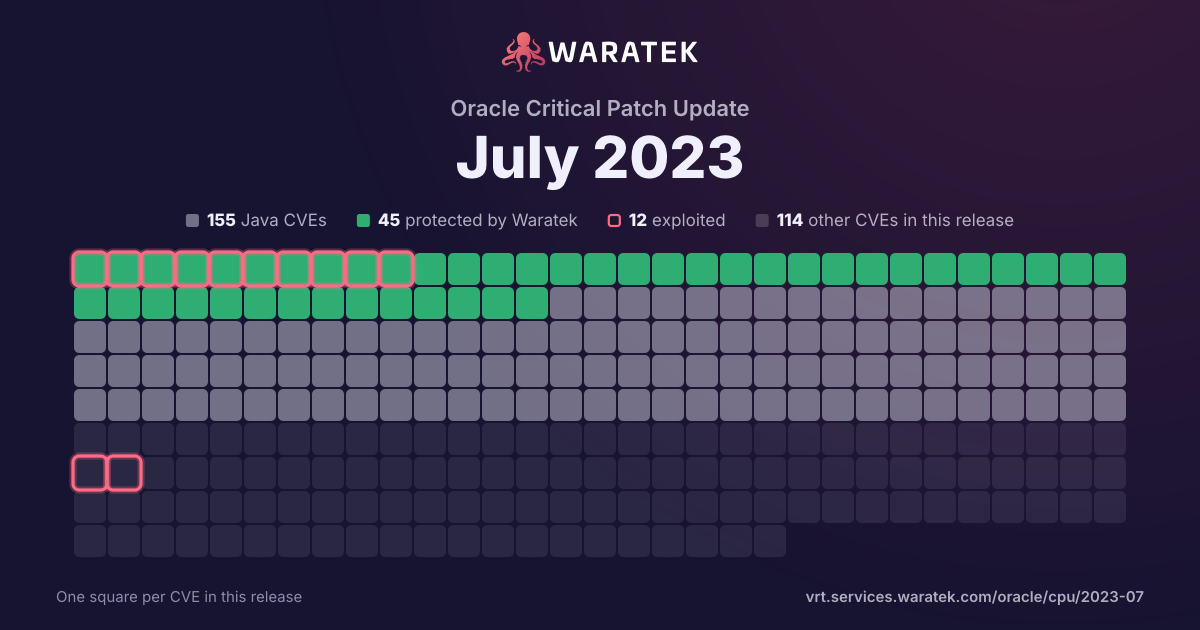
By status
45Protected by Waratek5Mitigation candidate105No exploit published31Outside Waratek scope83Not applicable
12Exploited, marked by the ring
No exploit published. For 37 of them, Oracle's security advisory is the source of public detail.
Protected by Waratek. Waratek RASP can block exploitation of these on systems that have not applied the patch yet.
Overview 95 matches · 47 in Waratek scope · 0 protected · 0 exploited · 0 CISA KEV · 1 public PoC · 3 EPSS ≥ 0.5
95matches
47in Waratek scope49.5%
0protected0.0%
0exploited0.0%
0CISA KEV0.0%
1public PoC1.1%
3EPSS ≥ 0.53.2%
Protected by Waratek
0
0.0%
Rule in development
0
0.0%
Mitigation candidate
0
0.0%
No exploit published
47
49.5%
Outside Waratek scope
17
17.9%
Not applicable
31
32.6%
Withdrawn CVE
0
0.0%
blocked by ARMR today
0
0.0%
partly blocked
0
0.0%
not blocked
95
100.0%
not established
0
0.0%
unrecorded
0
0.0%
Exploited
0
0.0%
Working exploit published
0
0.0%
Proof of concept only
8
8.4%
Forecast only
3
3.2%
No public exploit
84
88.4%
split by
peak 37 / quarter
Q3 181
No exploit published1
Medium1
not blocked1
No public exploit1
Q4 180
Q1 190
Q2 190
Q3 190
Q4 190
Q1 200
Q2 200
Q3 200
Q4 201
Outside Waratek scope1
Medium1
not blocked1
No public exploit1
Q1 213
No exploit published3
Medium3
not blocked3
Forecast only1
No public exploit2
Q2 212
No exploit published1
Not applicable1
Medium2
not blocked2
No public exploit2
Q3 213
No exploit published2
Not applicable1
Medium3
not blocked3
No public exploit3
Q4 213
Outside Waratek scope3
Medium3
not blocked3
Proof of concept only1
No public exploit2
Q1 224
No exploit published1
Not applicable3
Medium4
not blocked4
No public exploit4
Q2 222
No exploit published2
Medium2
not blocked2
Proof of concept only1
No public exploit1
Q3 225
No exploit published2
Outside Waratek scope1
Not applicable2
Medium5
not blocked5
Proof of concept only1
No public exploit4
Q4 225
No exploit published3
Not applicable2
Medium5
not blocked5
Proof of concept only2
No public exploit3
Q1 2319
No exploit published7
Outside Waratek scope1
Not applicable11
Medium19
not blocked19
Proof of concept only3
Forecast only1
No public exploit15
Q2 2310
No exploit published5
Not applicable5
Medium10
not blocked10
Forecast only1
No public exploit9
Q3 2337
No exploit published20
Outside Waratek scope11
Not applicable6
Medium37
not blocked37
No public exploit37
Q3 18Q1 19Q3 19Q1 20Q3 20Q1 21Q3 21Q1 22Q3 22Q1 23Q3 23
| CVE | Severity | Published▾ | Status | Exploitation | Description |
|---|---|---|---|---|---|
| CVE-2023-22061 | Medium | 2023-07-18 | No exploit published | No public exploit | Vulnerability in the Oracle Business Intelligence Enterprise Edition product of Oracle Analytics (component: Visual Analyzer). The supported version that is affected is 6.4.0.0.0. Easily exploitable vulnerability allows low privileged attacker with network access via HTTP to compromise Oracle Business Intelligence Enterprise Edition. Successful attacks require human interaction from a person other than the attacker and while the vulnerability is in Oracle Business Intelligence Enterprise Edition, attacks may significantly impact additional products (scope change). Successful attacks of this vulnerability can result in unauthorized update, insert or delete access to some of Oracle Business Intelligence Enterprise Edition accessible data as well as unauthorized read access to a subset of Oracle Business Intelligence Enterprise Edition accessible data. CVSS 3.1 Base Score 5.4 (Confidentiality and Integrity impacts). CVSS Vector: (CVSS:3.1/AV:N/AC:L/PR:L/UI:R/S:C/C:L/I:L/A:N). |
| CVE-2023-22058 | Medium | 2023-07-18 | Outside Waratek scope | No public exploit | Vulnerability in the MySQL Server product of Oracle MySQL (component: Server: DDL). Supported versions that are affected are 8.0.33 and prior. Difficult to exploit vulnerability allows high privileged attacker with network access via multiple protocols to compromise MySQL Server. Successful attacks of this vulnerability can result in unauthorized ability to cause a hang or frequently repeatable crash (complete DOS) of MySQL Server. CVSS 3.1 Base Score 4.4 (Availability impacts). CVSS Vector: (CVSS:3.1/AV:N/AC:H/PR:H/UI:N/S:U/C:N/I:N/A:H). |
| CVE-2023-22057 | Medium | 2023-07-18 | Outside Waratek scope | No public exploit | Vulnerability in the MySQL Server product of Oracle MySQL (component: Server: Replication). Supported versions that are affected are 8.0.33 and prior. Easily exploitable vulnerability allows high privileged attacker with network access via multiple protocols to compromise MySQL Server. Successful attacks of this vulnerability can result in unauthorized ability to cause a hang or frequently repeatable crash (complete DOS) of MySQL Server. CVSS 3.1 Base Score 4.9 (Availability impacts). CVSS Vector: (CVSS:3.1/AV:N/AC:L/PR:H/UI:N/S:U/C:N/I:N/A:H). |
| CVE-2023-22056 | Medium | 2023-07-18 | Outside Waratek scope | No public exploit | Vulnerability in the MySQL Server product of Oracle MySQL (component: Server: Optimizer). Supported versions that are affected are 8.0.33 and prior. Easily exploitable vulnerability allows high privileged attacker with network access via multiple protocols to compromise MySQL Server. Successful attacks of this vulnerability can result in unauthorized ability to cause a hang or frequently repeatable crash (complete DOS) of MySQL Server. CVSS 3.1 Base Score 4.9 (Availability impacts). CVSS Vector: (CVSS:3.1/AV:N/AC:L/PR:H/UI:N/S:U/C:N/I:N/A:H). |
| CVE-2023-22055 | Medium | 2023-07-18 | No exploit published | No public exploit | Vulnerability in the JD Edwards EnterpriseOne Tools product of Oracle JD Edwards (component: Web Runtime SEC). Supported versions that are affected are Prior to 9.2.7.4. Easily exploitable vulnerability allows unauthenticated attacker with network access via HTTP to compromise JD Edwards EnterpriseOne Tools. Successful attacks require human interaction from a person other than the attacker and while the vulnerability is in JD Edwards EnterpriseOne Tools, attacks may significantly impact additional products (scope change). Successful attacks of this vulnerability can result in unauthorized update, insert or delete access to some of JD Edwards EnterpriseOne Tools accessible data as well as unauthorized read access to a subset of JD Edwards EnterpriseOne Tools accessible data. CVSS 3.1 Base Score 6.1 (Confidentiality and Integrity impacts). CVSS Vector: (CVSS:3.1/AV:N/AC:L/PR:N/UI:R/S:C/C:L/I:L/A:N). |
| CVE-2023-22054 | Medium | 2023-07-18 | Outside Waratek scope | No public exploit | Vulnerability in the MySQL Server product of Oracle MySQL (component: Server: Optimizer). Supported versions that are affected are 8.0.33 and prior. Easily exploitable vulnerability allows high privileged attacker with network access via multiple protocols to compromise MySQL Server. Successful attacks of this vulnerability can result in unauthorized ability to cause a hang or frequently repeatable crash (complete DOS) of MySQL Server. CVSS 3.1 Base Score 4.9 (Availability impacts). CVSS Vector: (CVSS:3.1/AV:N/AC:L/PR:H/UI:N/S:U/C:N/I:N/A:H). |
| CVE-2023-22053 | Medium | 2023-07-18 | Outside Waratek scope | No public exploit | Vulnerability in the MySQL Server product of Oracle MySQL (component: Client programs). Supported versions that are affected are 5.7.42 and prior and 8.0.33 and prior. Difficult to exploit vulnerability allows low privileged attacker with network access via multiple protocols to compromise MySQL Server. Successful attacks of this vulnerability can result in unauthorized ability to cause a hang or frequently repeatable crash (complete DOS) of MySQL Server and unauthorized read access to a subset of MySQL Server accessible data. CVSS 3.1 Base Score 5.9 (Confidentiality and Availability impacts). CVSS Vector: (CVSS:3.1/AV:N/AC:H/PR:L/UI:N/S:U/C:L/I:N/A:H). |
| CVE-2023-22050 | Medium | 2023-07-18 | No exploit published | No public exploit | Vulnerability in the JD Edwards EnterpriseOne Orchestrator product of Oracle JD Edwards (component: E1 IOT Orchestrator Security). Supported versions that are affected are Prior to 9.2.7.4. Easily exploitable vulnerability allows low privileged attacker with network access via HTTP to compromise JD Edwards EnterpriseOne Orchestrator. Successful attacks of this vulnerability can result in unauthorized update, insert or delete access to some of JD Edwards EnterpriseOne Orchestrator accessible data as well as unauthorized read access to a subset of JD Edwards EnterpriseOne Orchestrator accessible data. CVSS 3.1 Base Score 5.4 (Confidentiality and Integrity impacts). CVSS Vector: (CVSS:3.1/AV:N/AC:L/PR:L/UI:N/S:U/C:L/I:L/A:N). |
| CVE-2023-22046 | Medium | 2023-07-18 | Outside Waratek scope | No public exploit | Vulnerability in the MySQL Server product of Oracle MySQL (component: Server: Optimizer). Supported versions that are affected are 8.0.33 and prior. Easily exploitable vulnerability allows high privileged attacker with network access via multiple protocols to compromise MySQL Server. Successful attacks of this vulnerability can result in unauthorized ability to cause a hang or frequently repeatable crash (complete DOS) of MySQL Server. CVSS 3.1 Base Score 4.9 (Availability impacts). CVSS Vector: (CVSS:3.1/AV:N/AC:L/PR:H/UI:N/S:U/C:N/I:N/A:H). |
| CVE-2023-22043 | Medium | 2023-07-18 | Outside Waratek scope | No public exploit | Vulnerability in Oracle Java SE (component: JavaFX). The supported version that is affected is Oracle Java SE: 8u371. Difficult to exploit vulnerability allows unauthenticated attacker with network access via multiple protocols to compromise Oracle Java SE. Successful attacks of this vulnerability can result in unauthorized creation, deletion or modification access to critical data or all Oracle Java SE accessible data. Note: This vulnerability applies to Java deployments, typically in clients running sandboxed Java Web Start applications or sandboxed Java applets, that load and run untrusted code (e.g., code that comes from the internet) and rely on the Java sandbox for security. This vulnerability does not apply to Java deployments, typically in servers, that load and run only trusted code (e.g., code installed by an administrator). CVSS 3.1 Base Score 5.9 (Integrity impacts). CVSS Vector: (CVSS:3.1/AV:N/AC:H/PR:N/UI:N/S:U/C:N/I:H/A:N). |
| CVE-2023-22042 | Medium | 2023-07-18 | No exploit published | No public exploit | Vulnerability in the Oracle Applications Framework product of Oracle E-Business Suite (component: Diagnostics). Supported versions that are affected are 12.2.3-12.3.12. Easily exploitable vulnerability allows unauthenticated attacker with network access via HTTP to compromise Oracle Applications Framework. Successful attacks require human interaction from a person other than the attacker and while the vulnerability is in Oracle Applications Framework, attacks may significantly impact additional products (scope change). Successful attacks of this vulnerability can result in unauthorized update, insert or delete access to some of Oracle Applications Framework accessible data as well as unauthorized read access to a subset of Oracle Applications Framework accessible data. CVSS 3.1 Base Score 6.1 (Confidentiality and Integrity impacts). CVSS Vector: (CVSS:3.1/AV:N/AC:L/PR:N/UI:R/S:C/C:L/I:L/A:N). |
| CVE-2023-22041 | Medium | 2023-07-18 | Outside Waratek scope | No public exploit | Vulnerability in the Oracle Java SE, Oracle GraalVM Enterprise Edition, Oracle GraalVM for JDK product of Oracle Java SE (component: Hotspot). Supported versions that are affected are Oracle Java SE: 8u371-perf, 11.0.19, 17.0.7, 20.0.1; Oracle GraalVM Enterprise Edition: 20.3.10, 21.3.6, 22.3.2; Oracle GraalVM for JDK: 17.0.7 and 20.0.1. Difficult to exploit vulnerability allows unauthenticated attacker with logon to the infrastructure where Oracle Java SE, Oracle GraalVM Enterprise Edition, Oracle GraalVM for JDK executes to compromise Oracle Java SE, Oracle GraalVM Enterprise Edition, Oracle GraalVM for JDK. Successful attacks of this vulnerability can result in unauthorized access to critical data or complete access to all Oracle Java SE, Oracle GraalVM Enterprise Edition, Oracle GraalVM for JDK accessible data. Note: This vulnerability applies to Java deployments, typically in clients running sandboxed Java Web Start applications or sandboxed Java applets, that load and run untrusted code (e.g., code that comes from the internet) and rely on the Java sandbox for security. This vulnerability does not apply to Java deployments, typically in servers, that load and run only trusted code (e.g., code installed by an administrator). CVSS 3.1 Base Score 5.1 (Confidentiality impacts). CVSS Vector: (CVSS:3.1/AV:L/AC:H/PR:N/UI:N/S:U/C:H/I:N/A:N). |
| CVE-2023-22040 | Medium | 2023-07-18 | No exploit published | No public exploit | Vulnerability in the Oracle WebLogic Server product of Oracle Fusion Middleware (component: Core). Supported versions that are affected are 12.2.1.4.0 and 14.1.1.0.0. Easily exploitable vulnerability allows high privileged attacker with network access via multiple protocols to compromise Oracle WebLogic Server. Successful attacks of this vulnerability can result in unauthorized creation, deletion or modification access to critical data or all Oracle WebLogic Server accessible data and unauthorized ability to cause a hang or frequently repeatable crash (complete DOS) of Oracle WebLogic Server. CVSS 3.1 Base Score 6.5 (Integrity and Availability impacts). CVSS Vector: (CVSS:3.1/AV:N/AC:L/PR:H/UI:N/S:U/C:N/I:H/A:H). |
| CVE-2023-22039 | Medium | 2023-07-18 | No exploit published | No public exploit | Vulnerability in the Oracle Agile PLM product of Oracle Supply Chain (component: WebClient). The supported version that is affected is 9.3.6. Easily exploitable vulnerability allows low privileged attacker with network access via HTTP to compromise Oracle Agile PLM. Successful attacks require human interaction from a person other than the attacker and while the vulnerability is in Oracle Agile PLM, attacks may significantly impact additional products (scope change). Successful attacks of this vulnerability can result in unauthorized update, insert or delete access to some of Oracle Agile PLM accessible data as well as unauthorized read access to a subset of Oracle Agile PLM accessible data. CVSS 3.1 Base Score 5.4 (Confidentiality and Integrity impacts). CVSS Vector: (CVSS:3.1/AV:N/AC:L/PR:L/UI:R/S:C/C:L/I:L/A:N). |
| CVE-2023-22037 | Medium | 2023-07-18 | No exploit published | No public exploit | Vulnerability in the Oracle Web Applications Desktop Integrator product of Oracle E-Business Suite (component: MS Excel Specific). Supported versions that are affected are 12.2.3-12.2.12. Easily exploitable vulnerability allows low privileged attacker with network access via HTTP to compromise Oracle Web Applications Desktop Integrator. Successful attacks require human interaction from a person other than the attacker and while the vulnerability is in Oracle Web Applications Desktop Integrator, attacks may significantly impact additional products (scope change). Successful attacks of this vulnerability can result in unauthorized update, insert or delete access to some of Oracle Web Applications Desktop Integrator accessible data as well as unauthorized read access to a subset of Oracle Web Applications Desktop Integrator accessible data and unauthorized ability to cause a partial denial of service (partial DOS) of Oracle Web Applications Desktop Integrator. CVSS 3.1 Base Score 6.5 (Confidentiality, Integrity and Availability impacts). CVSS Vector: (CVSS:3.1/AV:N/AC:L/PR:L/UI:R/S:C/C:L/I:L/A:L). |
| CVE-2023-22035 | Medium | 2023-07-18 | No exploit published | No public exploit | Vulnerability in the Oracle Scripting product of Oracle E-Business Suite (component: iSurvey Module). Supported versions that are affected are 12.2.3-12.2.12. Easily exploitable vulnerability allows unauthenticated attacker with network access via HTTP to compromise Oracle Scripting. Successful attacks require human interaction from a person other than the attacker and while the vulnerability is in Oracle Scripting, attacks may significantly impact additional products (scope change). Successful attacks of this vulnerability can result in unauthorized update, insert or delete access to some of Oracle Scripting accessible data as well as unauthorized read access to a subset of Oracle Scripting accessible data. CVSS 3.1 Base Score 6.1 (Confidentiality and Integrity impacts). CVSS Vector: (CVSS:3.1/AV:N/AC:L/PR:N/UI:R/S:C/C:L/I:L/A:N). |
| CVE-2023-22034 | Medium | 2023-07-18 | Not applicable | No public exploit | Vulnerability in the Unified Audit component of Oracle Database Server. Supported versions that are affected are 19.3-19.19 and 21.3-21.10. Easily exploitable vulnerability allows high privileged attacker having SYSDBA privilege with network access via Oracle Net to compromise Unified Audit. Successful attacks of this vulnerability can result in unauthorized creation, deletion or modification access to critical data or all Unified Audit accessible data. CVSS 3.1 Base Score 4.9 (Integrity impacts). CVSS Vector: (CVSS:3.1/AV:N/AC:L/PR:H/UI:N/S:U/C:N/I:H/A:N). |
| CVE-2023-22033 | Medium | 2023-07-18 | Outside Waratek scope | No public exploit | Vulnerability in the MySQL Server product of Oracle MySQL (component: InnoDB). Supported versions that are affected are 8.0.33 and prior. Difficult to exploit vulnerability allows high privileged attacker with network access via multiple protocols to compromise MySQL Server. Successful attacks of this vulnerability can result in unauthorized ability to cause a hang or frequently repeatable crash (complete DOS) of MySQL Server. CVSS 3.1 Base Score 4.4 (Availability impacts). CVSS Vector: (CVSS:3.1/AV:N/AC:H/PR:H/UI:N/S:U/C:N/I:N/A:H). |
| CVE-2023-22031 | Medium | 2023-07-18 | No exploit published | No public exploit | Vulnerability in the Oracle WebLogic Server product of Oracle Fusion Middleware (component: Core). Supported versions that are affected are 14.1.1.0.0 and 12.2.1.4.0. Difficult to exploit vulnerability allows high privileged attacker with network access via T3, IIOP to compromise Oracle WebLogic Server. Successful attacks of this vulnerability can result in unauthorized ability to cause a hang or frequently repeatable crash (complete DOS) of Oracle WebLogic Server. CVSS 3.1 Base Score 4.4 (Availability impacts). CVSS Vector: (CVSS:3.1/AV:N/AC:H/PR:H/UI:N/S:U/C:N/I:N/A:H). |
| CVE-2023-22027 | Medium | 2023-07-18 | No exploit published | No public exploit | Vulnerability in the Oracle Business Intelligence Enterprise Edition product of Oracle Analytics (component: Analytics Server). The supported version that is affected is 7.0.0.0.0. Easily exploitable vulnerability allows low privileged attacker with network access via HTTP to compromise Oracle Business Intelligence Enterprise Edition. Successful attacks of this vulnerability can result in unauthorized ability to cause a partial denial of service (partial DOS) of Oracle Business Intelligence Enterprise Edition. CVSS 3.1 Base Score 4.3 (Availability impacts). CVSS Vector: (CVSS:3.1/AV:N/AC:L/PR:L/UI:N/S:U/C:N/I:N/A:L). |
| CVE-2023-22022 | Medium | 2023-07-18 | No exploit published | No public exploit | Vulnerability in the Oracle Health Sciences Sciences Data Management Workbench product of Oracle Health Sciences Applications (component: Blinding Functionality). Supported versions that are affected are 3.1.0.2, 3.1.1.3 and 3.2.0.0. Easily exploitable vulnerability allows low privileged attacker with network access via HTTP to compromise Oracle Health Sciences Sciences Data Management Workbench. Successful attacks of this vulnerability can result in unauthorized access to critical data or complete access to all Oracle Health Sciences Sciences Data Management Workbench accessible data. CVSS 3.1 Base Score 6.5 (Confidentiality impacts). CVSS Vector: (CVSS:3.1/AV:N/AC:L/PR:L/UI:N/S:U/C:H/I:N/A:N). |
| CVE-2023-22021 | Medium | 2023-07-18 | No exploit published | No public exploit | Vulnerability in the Oracle Business Intelligence Enterprise Edition product of Oracle Analytics (component: Analytics Server). Supported versions that are affected are 6.4.0.0.0 and 7.0.0.0.0. Easily exploitable vulnerability allows low privileged attacker with network access via HTTP to compromise Oracle Business Intelligence Enterprise Edition. Successful attacks of this vulnerability can result in unauthorized ability to cause a partial denial of service (partial DOS) of Oracle Business Intelligence Enterprise Edition. CVSS 3.1 Base Score 4.3 (Availability impacts). CVSS Vector: (CVSS:3.1/AV:N/AC:L/PR:L/UI:N/S:U/C:N/I:N/A:L). |
| CVE-2023-22020 | Medium | 2023-07-18 | No exploit published | No public exploit | Vulnerability in the Oracle Business Intelligence Enterprise Edition product of Oracle Analytics (component: Analytics Server). Supported versions that are affected are 6.4.0.0.0 and 7.0.0.0.0. Easily exploitable vulnerability allows low privileged attacker with network access via HTTP to compromise Oracle Business Intelligence Enterprise Edition. Successful attacks of this vulnerability can result in unauthorized update, insert or delete access to some of Oracle Business Intelligence Enterprise Edition accessible data as well as unauthorized read access to a subset of Oracle Business Intelligence Enterprise Edition accessible data. CVSS 3.1 Base Score 5.4 (Confidentiality and Integrity impacts). CVSS Vector: (CVSS:3.1/AV:N/AC:L/PR:L/UI:N/S:U/C:L/I:L/A:N). |
| CVE-2023-22017 | Medium | 2023-07-18 | Not applicable | No public exploit | Vulnerability in the Oracle VM VirtualBox product of Oracle Virtualization (component: Core). Supported versions that are affected are Prior to 6.1.46 and Prior to 7.0.10. Easily exploitable vulnerability allows low privileged attacker with logon to the infrastructure where Oracle VM VirtualBox executes to compromise Oracle VM VirtualBox. Successful attacks of this vulnerability can result in unauthorized ability to cause a hang or frequently repeatable crash (complete DOS) of Oracle VM VirtualBox. Note: This vulnerability applies to Windows VMs only. CVSS 3.1 Base Score 5.5 (Availability impacts). CVSS Vector: (CVSS:3.1/AV:L/AC:L/PR:L/UI:N/S:U/C:N/I:N/A:H). |
| CVE-2023-22016 | Medium | 2023-07-18 | Not applicable | No public exploit | Vulnerability in the Oracle VM VirtualBox product of Oracle Virtualization (component: Core). Supported versions that are affected are Prior to 6.1.46 and Prior to 7.0.10. Easily exploitable vulnerability allows high privileged attacker with logon to the infrastructure where Oracle VM VirtualBox executes to compromise Oracle VM VirtualBox. Successful attacks require human interaction from a person other than the attacker. Successful attacks of this vulnerability can result in unauthorized ability to cause a hang or frequently repeatable crash (complete DOS) of Oracle VM VirtualBox. CVSS 3.1 Base Score 4.2 (Availability impacts). CVSS Vector: (CVSS:3.1/AV:L/AC:L/PR:H/UI:R/S:U/C:N/I:N/A:H). |
| CVE-2023-22013 | Medium | 2023-07-18 | No exploit published | No public exploit | Vulnerability in the Oracle Business Intelligence Enterprise Edition product of Oracle Analytics (component: Analytics Server). Supported versions that are affected are 6.4.0.0.0 and 7.0.0.0.0. Easily exploitable vulnerability allows low privileged attacker with network access via HTTP to compromise Oracle Business Intelligence Enterprise Edition. Successful attacks of this vulnerability can result in unauthorized update, insert or delete access to some of Oracle Business Intelligence Enterprise Edition accessible data. CVSS 3.1 Base Score 4.3 (Integrity impacts). CVSS Vector: (CVSS:3.1/AV:N/AC:L/PR:L/UI:N/S:U/C:N/I:L/A:N). |
| CVE-2023-22012 | Medium | 2023-07-18 | No exploit published | No public exploit | Vulnerability in the Oracle Business Intelligence Enterprise Edition product of Oracle Analytics (component: Analytics Server). The supported version that is affected is 7.0.0.0.0. Easily exploitable vulnerability allows low privileged attacker with network access via HTTP to compromise Oracle Business Intelligence Enterprise Edition. Successful attacks of this vulnerability can result in unauthorized update, insert or delete access to some of Oracle Business Intelligence Enterprise Edition accessible data. CVSS 3.1 Base Score 4.3 (Integrity impacts). CVSS Vector: (CVSS:3.1/AV:N/AC:L/PR:L/UI:N/S:U/C:N/I:L/A:N). |
| CVE-2023-22011 | Medium | 2023-07-18 | No exploit published | No public exploit | Vulnerability in the Oracle Business Intelligence Enterprise Edition product of Oracle Analytics (component: Analytics Server). Supported versions that are affected are 6.4.0.0.0 and 7.0.0.0.0. Easily exploitable vulnerability allows low privileged attacker with network access via HTTP to compromise Oracle Business Intelligence Enterprise Edition. Successful attacks of this vulnerability can result in unauthorized update, insert or delete access to some of Oracle Business Intelligence Enterprise Edition accessible data and unauthorized ability to cause a partial denial of service (partial DOS) of Oracle Business Intelligence Enterprise Edition. CVSS 3.1 Base Score 5.4 (Integrity and Availability impacts). CVSS Vector: (CVSS:3.1/AV:N/AC:L/PR:L/UI:N/S:U/C:N/I:L/A:L). |
| CVE-2023-22009 | Medium | 2023-07-18 | No exploit published | No public exploit | Vulnerability in the Oracle Self-Service Human Resources product of Oracle E-Business Suite (component: Workforce Management). Supported versions that are affected are 12.2.3-12.2.12. Easily exploitable vulnerability allows low privileged attacker with network access via HTTP to compromise Oracle Self-Service Human Resources. Successful attacks of this vulnerability can result in unauthorized read access to a subset of Oracle Self-Service Human Resources accessible data. CVSS 3.1 Base Score 4.3 (Confidentiality impacts). CVSS Vector: (CVSS:3.1/AV:N/AC:L/PR:L/UI:N/S:U/C:L/I:N/A:N). |
| CVE-2023-22008 | Medium | 2023-07-18 | Outside Waratek scope | No public exploit | Vulnerability in the MySQL Server product of Oracle MySQL (component: InnoDB). Supported versions that are affected are 8.0.33 and prior. Easily exploitable vulnerability allows high privileged attacker with network access via multiple protocols to compromise MySQL Server. Successful attacks of this vulnerability can result in unauthorized ability to cause a hang or frequently repeatable crash (complete DOS) of MySQL Server. CVSS 3.1 Base Score 4.9 (Availability impacts). CVSS Vector: (CVSS:3.1/AV:N/AC:L/PR:H/UI:N/S:U/C:N/I:N/A:H). |
| CVE-2023-22007 | Medium | 2023-07-18 | Not applicable | No public exploit | Vulnerability in the MySQL Server product of Oracle MySQL (component: Server: Replication). Supported versions that are affected are 5.7.41 and prior and 8.0.32 and prior. Easily exploitable vulnerability allows high privileged attacker with network access via multiple protocols to compromise MySQL Server. Successful attacks of this vulnerability can result in unauthorized ability to cause a hang or frequently repeatable crash (complete DOS) of MySQL Server. CVSS 3.1 Base Score 4.9 (Availability impacts). CVSS Vector: (CVSS:3.1/AV:N/AC:L/PR:H/UI:N/S:U/C:N/I:N/A:H). |
| CVE-2023-22005 | Medium | 2023-07-18 | Outside Waratek scope | No public exploit | Vulnerability in the MySQL Server product of Oracle MySQL (component: Server: Replication). Supported versions that are affected are 8.0.33 and prior. Difficult to exploit vulnerability allows high privileged attacker with network access via multiple protocols to compromise MySQL Server. Successful attacks of this vulnerability can result in unauthorized ability to cause a hang or frequently repeatable crash (complete DOS) of MySQL Server. CVSS 3.1 Base Score 4.4 (Availability impacts). CVSS Vector: (CVSS:3.1/AV:N/AC:H/PR:H/UI:N/S:U/C:N/I:N/A:H). |
| CVE-2023-22004 | Medium | 2023-07-18 | No exploit published | No public exploit | Vulnerability in the Oracle Applications Technology product of Oracle E-Business Suite (component: Reports Configuration). Supported versions that are affected are 12.2.3-12.2.12. Easily exploitable vulnerability allows unauthenticated attacker with network access via HTTP to compromise Oracle Applications Technology. Successful attacks require human interaction from a person other than the attacker. Successful attacks of this vulnerability can result in unauthorized update, insert or delete access to some of Oracle Applications Technology accessible data. CVSS 3.1 Base Score 4.3 (Integrity impacts). CVSS Vector: (CVSS:3.1/AV:N/AC:L/PR:N/UI:R/S:U/C:N/I:L/A:N). |
| CVE-2023-21994 | Medium | 2023-07-18 | No exploit published | No public exploit | Vulnerability in the Oracle Mobile Security Suite product of Oracle Fusion Middleware (component: Android Mobile Authenticator App). Supported versions that are affected are Prior to 11.1.2.3.1. Easily exploitable vulnerability allows unauthenticated attacker with access to the physical communication segment attached to the hardware where the Oracle Mobile Security Suite executes to compromise Oracle Mobile Security Suite. Successful attacks of this vulnerability can result in unauthorized access to critical data or complete access to all Oracle Mobile Security Suite accessible data. CVSS 3.1 Base Score 6.5 (Confidentiality impacts). CVSS Vector: (CVSS:3.1/AV:A/AC:L/PR:N/UI:N/S:U/C:H/I:N/A:N). |
| CVE-2023-21983 | Medium | 2023-07-18 | Not applicable | No public exploit | Vulnerability in the Application Express Administration product of Oracle Application Express (component: None). Supported versions that are affected are Application Express Administration: 18.2-22.2. Difficult to exploit vulnerability allows unauthenticated attacker with network access via HTTP to compromise Application Express Administration. Successful attacks of this vulnerability can result in unauthorized update, insert or delete access to some of Application Express Administration accessible data as well as unauthorized read access to a subset of Application Express Administration accessible data and unauthorized ability to cause a partial denial of service (partial DOS) of Application Express Administration. CVSS 3.1 Base Score 5.6 (Confidentiality, Integrity and Availability impacts). CVSS Vector: (CVSS:3.1/AV:N/AC:H/PR:N/UI:N/S:U/C:L/I:L/A:L). |
| CVE-2023-21961 | Medium | 2023-07-18 | No exploit published | No public exploit | Vulnerability in the Oracle Hyperion Essbase Administration Services product of Oracle Essbase (component: EAS Administration and EAS Console). The supported version that is affected is 21.4.3.0.0. Easily exploitable vulnerability allows high privileged attacker with logon to the infrastructure where Oracle Hyperion Essbase Administration Services executes to compromise Oracle Hyperion Essbase Administration Services. While the vulnerability is in Oracle Hyperion Essbase Administration Services, attacks may significantly impact additional products (scope change). Successful attacks of this vulnerability can result in unauthorized access to critical data or complete access to all Oracle Hyperion Essbase Administration Services accessible data. CVSS 3.1 Base Score 6.0 (Confidentiality impacts). CVSS Vector: (CVSS:3.1/AV:L/AC:L/PR:H/UI:N/S:C/C:H/I:N/A:N). |
| CVE-2023-21950 | Medium | 2023-07-18 | Not applicable | No public exploit | Vulnerability in the MySQL Server product of Oracle MySQL (component: Server: Replication). Supported versions that are affected are 8.0.27 and prior. Easily exploitable vulnerability allows high privileged attacker with network access via multiple protocols to compromise MySQL Server. Successful attacks of this vulnerability can result in unauthorized ability to cause a hang or frequently repeatable crash (complete DOS) of MySQL Server. CVSS 3.1 Base Score 4.9 (Availability impacts). CVSS Vector: (CVSS:3.1/AV:N/AC:L/PR:H/UI:N/S:U/C:N/I:N/A:H). |
| CVE-2023-2650 | Medium | 2023-05-30 | Not applicable | Forecast only | Issue summary: Processing some specially crafted ASN.1 object identifiers or data containing them may be very slow. Impact summary: Applications that use OBJ_obj2txt() directly, or use any of the OpenSSL subsystems OCSP, PKCS7/SMIME, CMS, CMP/CRMF or TS with no message size limit may experience notable to very long delays when processing those messages, which may lead to a Denial of Service. An OBJECT IDENTIFIER is composed of a series of numbers - sub-identifiers - most of which have no size limit. OBJ_obj2txt() may be used to translate an ASN.1 OBJECT IDENTIFIER given in DER encoding form (using the OpenSSL type ASN1_OBJECT) to its canonical numeric text form, which are the sub-identifiers of the OBJECT IDENTIFIER in decimal form, separated by periods. When one of the sub-identifiers in the OBJECT IDENTIFIER is very large (these are sizes that are seen as absurdly large, taking up tens or hundreds of KiBs), the translation to a decimal number in text may take a very long time. The time complexity is O(n^2) with 'n' being the size of the sub-identifiers in bytes (*). With OpenSSL 3.0, support to fetch cryptographic algorithms using names / identifiers in string form was introduced. This includes using OBJECT IDENTIFIERs in canonical numeric text form as identifiers for fetching algorithms. Such OBJECT IDENTIFIERs may be received through the ASN.1 structure AlgorithmIdentifier, which is commonly used in multiple protocols to specify what cryptographic algorithm should be used to sign or verify, encrypt or decrypt, or digest passed data. Applications that call OBJ_obj2txt() directly with untrusted data are affected, with any version of OpenSSL. If the use is for the mere purpose of display, the severity is considered low. In OpenSSL 3.0 and newer, this affects the subsystems OCSP, PKCS7/SMIME, CMS, CMP/CRMF or TS. It also impacts anything that processes X.509 certificates, including simple things like verifying its signature. The impact on TLS is relatively low, because all versions of OpenSSL have a 100KiB limit on the peer's certificate chain. Additionally, this only impacts clients, or servers that have explicitly enabled client authentication. In OpenSSL 1.1.1 and 1.0.2, this only affects displaying diverse objects, such as X.509 certificates. This is assumed to not happen in such a way that it would cause a Denial of Service, so these versions are considered not affected by this issue in such a way that it would be cause for concern, and the severity is therefore considered low. |
| CVE-2023-29469 | Medium | 2023-04-24 | Not applicable | No public exploit | An issue was discovered in libxml2 before 2.10.4. When hashing empty dict strings in a crafted XML document, xmlDictComputeFastKey in dict.c can produce non-deterministic values, leading to various logic and memory errors, such as a double free. This behavior occurs because there is an attempt to use the first byte of an empty string, and any value is possible (not solely the '\0' value). |
| CVE-2023-28484 | Medium | 2023-04-24 | Not applicable | No public exploit | In libxml2 before 2.10.4, parsing of certain invalid XSD schemas can lead to a NULL pointer dereference and subsequently a segfault. This occurs in xmlSchemaFixupComplexType in xmlschemas.c. |
| CVE-2023-1255 | Medium | 2023-04-20 | Not applicable | No public exploit | Issue summary: The AES-XTS cipher decryption implementation for 64 bit ARM platform contains a bug that could cause it to read past the input buffer, leading to a crash. Impact summary: Applications that use the AES-XTS algorithm on the 64 bit ARM platform can crash in rare circumstances. The AES-XTS algorithm is usually used for disk encryption. The AES-XTS cipher decryption implementation for 64 bit ARM platform will read past the end of the ciphertext buffer if the ciphertext size is 4 mod 5 in 16 byte blocks, e.g. 144 bytes or 1024 bytes. If the memory after the ciphertext buffer is unmapped, this will trigger a crash which results in a denial of service. If an attacker can control the size and location of the ciphertext buffer being decrypted by an application using AES-XTS on 64 bit ARM, the application is affected. This is fairly unlikely making this issue a Low severity one. |
| CVE-2023-20862 | Medium | 2023-04-19 | No exploit published | No public exploit | In Spring Security, versions 5.7.x prior to 5.7.8, versions 5.8.x prior to 5.8.3, and versions 6.0.x prior to 6.0.3, the logout support does not properly clean the security context if using serialized versions. Additionally, it is not possible to explicitly save an empty security context to the HttpSessionSecurityContextRepository. This vulnerability can keep users authenticated even after they performed logout. Users of affected versions should apply the following mitigation. 5.7.x users should upgrade to 5.7.8. 5.8.x users should upgrade to 5.8.3. 6.0.x users should upgrade to 6.0.3. |
| CVE-2023-28856 | Medium | 2023-04-18 | Not applicable | No public exploit | Redis is an open source, in-memory database that persists on disk. Authenticated users can use the `HINCRBYFLOAT` command to create an invalid hash field that will crash Redis on access in affected versions. This issue has been addressed in in versions 7.0.11, 6.2.12, and 6.0.19. Users are advised to upgrade. There are no known workarounds for this issue. |
| CVE-2023-26049 | Medium | 2023-04-18 | No exploit published | No public exploit | Jetty is a java based web server and servlet engine. Nonstandard cookie parsing in Jetty may allow an attacker to smuggle cookies within other cookies, or otherwise perform unintended behavior by tampering with the cookie parsing mechanism. If Jetty sees a cookie VALUE that starts with `"` (double quote), it will continue to read the cookie string until it sees a closing quote -- even if a semicolon is encountered. So, a cookie header such as: `DISPLAY_LANGUAGE="b; JSESSIONID=1337; c=d"` will be parsed as one cookie, with the name DISPLAY_LANGUAGE and a value of b; JSESSIONID=1337; c=d instead of 3 separate cookies. This has security implications because if, say, JSESSIONID is an HttpOnly cookie, and the DISPLAY_LANGUAGE cookie value is rendered on the page, an attacker can smuggle the JSESSIONID cookie into the DISPLAY_LANGUAGE cookie and thereby exfiltrate it. This is significant when an intermediary is enacting some policy based on cookies, so a smuggled cookie can bypass that policy yet still be seen by the Jetty server or its logging system. This issue has been addressed in versions 9.4.51, 10.0.14, 11.0.14, and 12.0.0.beta0 and users are advised to upgrade. There are no known workarounds for this issue. |
| CVE-2023-26048 | Medium | 2023-04-18 | No exploit published | No public exploit | Jetty is a java based web server and servlet engine. In affected versions servlets with multipart support (e.g. annotated with `@MultipartConfig`) that call `HttpServletRequest.getParameter()` or `HttpServletRequest.getParts()` may cause `OutOfMemoryError` when the client sends a multipart request with a part that has a name but no filename and very large content. This happens even with the default settings of `fileSizeThreshold=0` which should stream the whole part content to disk. An attacker client may send a large multipart request and cause the server to throw `OutOfMemoryError`. However, the server may be able to recover after the `OutOfMemoryError` and continue its service -- although it may take some time. This issue has been patched in versions 9.4.51, 10.0.14, and 11.0.14. Users are advised to upgrade. Users unable to upgrade may set the multipart parameter `maxRequestSize` which must be set to a non-negative value, so the whole multipart content is limited (although still read into memory). |
| CVE-2023-21971 | Medium | 2023-04-18 | No exploit published | No public exploit | Vulnerability in the MySQL Connectors product of Oracle MySQL (component: Connector/J). Supported versions that are affected are 8.0.32 and prior. Difficult to exploit vulnerability allows high privileged attacker with network access via multiple protocols to compromise MySQL Connectors. Successful attacks require human interaction from a person other than the attacker. Successful attacks of this vulnerability can result in unauthorized ability to cause a hang or frequently repeatable crash (complete DOS) of MySQL Connectors as well as unauthorized update, insert or delete access to some of MySQL Connectors accessible data and unauthorized read access to a subset of MySQL Connectors accessible data. CVSS 3.1 Base Score 5.3 (Confidentiality, Integrity and Availability impacts). CVSS Vector: (CVSS:3.1/AV:N/AC:H/PR:H/UI:R/S:U/C:L/I:L/A:H). |
| CVE-2023-20863 | Medium | 2023-04-13 | No exploit published | No public exploit | In spring framework versions prior to 5.2.24 release+ ,5.3.27+ and 6.0.8+ , it is possible for a user to provide a specially crafted SpEL expression that may cause a denial-of-service (DoS) condition. |
| CVE-2023-0466 | Medium | 2023-03-28 | Not applicable | No public exploit | The function X509_VERIFY_PARAM_add0_policy() is documented to implicitly enable the certificate policy check when doing certificate verification. However the implementation of the function does not enable the check which allows certificates with invalid or incorrect policies to pass the certificate verification. As suddenly enabling the policy check could break existing deployments it was decided to keep the existing behavior of the X509_VERIFY_PARAM_add0_policy() function. Instead the applications that require OpenSSL to perform certificate policy check need to use X509_VERIFY_PARAM_set1_policies() or explicitly enable the policy check by calling X509_VERIFY_PARAM_set_flags() with the X509_V_FLAG_POLICY_CHECK flag argument. Certificate policy checks are disabled by default in OpenSSL and are not commonly used by applications. |
| CVE-2023-0465 | Medium | 2023-03-28 | Not applicable | No public exploit | Applications that use a non-default option when verifying certificates may be vulnerable to an attack from a malicious CA to circumvent certain checks. Invalid certificate policies in leaf certificates are silently ignored by OpenSSL and other certificate policy checks are skipped for that certificate. A malicious CA could use this to deliberately assert invalid certificate policies in order to circumvent policy checking on the certificate altogether. Policy processing is disabled by default but can be enabled by passing the `-policy' argument to the command line utilities or by calling the `X509_VERIFY_PARAM_set1_policies()' function. |
| CVE-2023-20861 | Medium | 2023-03-23 | No exploit published | No public exploit | In Spring Framework versions 6.0.0 - 6.0.6, 5.3.0 - 5.3.25, 5.2.0.RELEASE - 5.2.22.RELEASE, and older unsupported versions, it is possible for a user to provide a specially crafted SpEL expression that may cause a denial-of-service (DoS) condition. |
| CVE-2023-28708 | Medium | 2023-03-22 | No exploit published | No public exploit | When using the RemoteIpFilter with requests received from a reverse proxy via HTTP that include the X-Forwarded-Proto header set to https, session cookies created by Apache Tomcat 11.0.0-M1 to 11.0.0.-M2, 10.1.0-M1 to 10.1.5, 9.0.0-M1 to 9.0.71 and 8.5.0 to 8.5.85 did not include the secure attribute. This could result in the user agent transmitting the session cookie over an insecure channel. Older, EOL versions may also be affected. |
| CVE-2023-28439 | Medium | 2023-03-22 | Not applicable | No public exploit | CKEditor4 is an open source what-you-see-is-what-you-get HTML editor. A cross-site scripting vulnerability has been discovered affecting Iframe Dialog and Media Embed packages. The vulnerability may trigger a JavaScript code after fulfilling special conditions: using one of the affected packages on a web page with missing proper Content Security Policy configuration; initializing the editor on an element and using an element other than `<textarea>` as a base; and destroying the editor instance. This vulnerability might affect a small percentage of integrators that depend on dynamic editor initialization/destroy mechanism. A fix is available in CKEditor4 version 4.21.0. In some rare cases, a security fix may be considered a breaking change. Starting from version 4.21.0, the Iframe Dialog plugin applies the `sandbox` attribute by default, which restricts JavaScript code execution in the iframe element. To change this behavior, configure the `config.iframe_attributes` option. Also starting from version 4.21.0, the Media Embed plugin regenerates the entire content of the embed widget by default. To change this behavior, configure the `config.embed_keepOriginalContent` option. Those who choose to enable either of the more permissive options or who cannot upgrade to a patched version should properly configure Content Security Policy to avoid any potential security issues that may arise from embedding iframe elements on their web page. |
| CVE-2023-27904 | Medium | 2023-03-10 | No exploit published | No public exploit | Jenkins 2.393 and earlier, LTS 2.375.3 and earlier prints an error stack trace on agent-related pages when agent connections are broken, potentially revealing information about Jenkins configuration that is otherwise inaccessible to attackers. |
| CVE-2023-27903 | Medium | 2023-03-10 | No exploit published | No public exploit | Jenkins 2.393 and earlier, LTS 2.375.3 and earlier creates a temporary file in the default temporary directory with the default permissions for newly created files when uploading a file parameter through the CLI, potentially allowing attackers with access to the Jenkins controller file system to read and write the file before it is used. |
| CVE-2023-27902 | Medium | 2023-03-10 | No exploit published | No public exploit | Jenkins 2.393 and earlier, LTS 2.375.3 and earlier shows temporary directories related to job workspaces, which allows attackers with Item/Workspace permission to access their contents. |
| CVE-2022-4203 | Medium | 2023-02-24 | Not applicable | No public exploit | A read buffer overrun can be triggered in X.509 certificate verification, specifically in name constraint checking. Note that this occurs after certificate chain signature verification and requires either a CA to have signed the malicious certificate or for the application to continue certificate verification despite failure to construct a path to a trusted issuer. The read buffer overrun might result in a crash which could lead to a denial of service attack. In theory it could also result in the disclosure of private memory contents (such as private keys, or sensitive plaintext) although we are not aware of any working exploit leading to memory contents disclosure as of the time of release of this advisory. In a TLS client, this can be triggered by connecting to a malicious server. In a TLS server, this can be triggered if the server requests client authentication and a malicious client connects. |
| CVE-2023-23916 | Medium | 2023-02-23 | Not applicable | Proof of concept only | An allocation of resources without limits or throttling vulnerability exists in curl <v7.88.0 based on the "chained" HTTP compression algorithms, meaning that a server response can be compressed multiple times and potentially with differentalgorithms. The number of acceptable "links" in this "decompression chain" wascapped, but the cap was implemented on a per-header basis allowing a maliciousserver to insert a virtually unlimited number of compression steps simply byusing many headers. The use of such a decompression chain could result in a "malloc bomb", making curl end up spending enormous amounts of allocated heap memory, or trying to and returning out of memory errors. |
| CVE-2023-23915 | Medium | 2023-02-23 | Not applicable | No public exploit | A cleartext transmission of sensitive information vulnerability exists in curl <v7.88.0 that could cause HSTS functionality to behave incorrectly when multiple URLs are requested in parallel. Using its HSTS support, curl can be instructed to use HTTPS instead of using an insecure clear-text HTTP step even when HTTP is provided in the URL. This HSTS mechanism would however surprisingly fail when multiple transfers are done in parallel as the HSTS cache file gets overwritten by the most recentlycompleted transfer. A later HTTP-only transfer to the earlier host name would then *not* get upgraded properly to HSTS. |
| CVE-2022-34364 | Medium | 2023-02-10 | Not applicable | No public exploit | Dell BSAFE SSL-J, versions before 6.5 and version 7.0 contain a debug message revealing unnecessary information vulnerability. This may lead to disclosing sensitive information to a locally privileged user. . |
| CVE-2022-4304 | Medium | 2023-02-08 | Not applicable | No public exploit | A timing based side channel exists in the OpenSSL RSA Decryption implementation which could be sufficient to recover a plaintext across a network in a Bleichenbacher style attack. To achieve a successful decryption an attacker would have to be able to send a very large number of trial messages for decryption. The vulnerability affects all RSA padding modes: PKCS#1 v1.5, RSA-OEAP and RSASVE. For example, in a TLS connection, RSA is commonly used by a client to send an encrypted pre-master secret to the server. An attacker that had observed a genuine connection between a client and a server could use this flaw to send trial messages to the server and record the time taken to process them. After a sufficiently large number of messages the attacker could recover the pre-master secret used for the original connection and thus be able to decrypt the application data sent over that connection. |
| CVE-2023-23931 | Medium | 2023-02-07 | Not applicable | Proof of concept only | cryptography is a package designed to expose cryptographic primitives and recipes to Python developers. In affected versions `Cipher.update_into` would accept Python objects which implement the buffer protocol, but provide only immutable buffers. This would allow immutable objects (such as `bytes`) to be mutated, thus violating fundamental rules of Python and resulting in corrupted output. This now correctly raises an exception. This issue has been present since `update_into` was originally introduced in cryptography 1.8. |
| CVE-2022-25147 | Medium | 2023-01-31 | Not applicable | No public exploit | Integer Overflow or Wraparound vulnerability in apr_base64 functions of Apache Portable Runtime Utility (APR-util) allows an attacker to write beyond bounds of a buffer. This issue affects Apache Portable Runtime Utility (APR-util) 1.6.1 and prior versions. |
| CVE-2023-21835 | Medium | 2023-01-18 | Outside Waratek scope | No public exploit | Vulnerability in the Oracle Java SE, Oracle GraalVM Enterprise Edition product of Oracle Java SE (component: JSSE). Supported versions that are affected are Oracle Java SE: 11.0.17, 17.0.5, 19.0.1; Oracle GraalVM Enterprise Edition: 20.3.8, 21.3.4 and 22.3.0. Easily exploitable vulnerability allows unauthenticated attacker with network access via DTLS to compromise Oracle Java SE, Oracle GraalVM Enterprise Edition. Successful attacks of this vulnerability can result in unauthorized ability to cause a partial denial of service (partial DOS) of Oracle Java SE, Oracle GraalVM Enterprise Edition. Note: This vulnerability applies to Java deployments, typically in clients running sandboxed Java Web Start applications or sandboxed Java applets, that load and run untrusted code (e.g., code that comes from the internet) and rely on the Java sandbox for security. This vulnerability does not apply to Java deployments, typically in servers, that load and run only trusted code (e.g., code installed by an administrator). CVSS 3.1 Base Score 5.3 (Availability impacts). CVSS Vector: (CVSS:3.1/AV:N/AC:L/PR:N/UI:N/S:U/C:N/I:N/A:L). |
| CVE-2022-37436 | Medium | 2023-01-17 | Not applicable | Forecast only | Prior to Apache HTTP Server 2.4.55, a malicious backend can cause the response headers to be truncated early, resulting in some headers being incorporated into the response body. If the later headers have any security purpose, they will not be interpreted by the client. |
| CVE-2023-22899 | Medium | 2023-01-10 | No exploit published | Proof of concept only | Zip4j through 2.11.2, as used in Threema and other products, does not always check the MAC when decrypting a ZIP archive. |
| CVE-2022-45787 | Medium | 2023-01-06 | No exploit published | No public exploit | Unproper laxist permissions on the temporary files used by MIME4J TempFileStorageProvider may lead to information disclosure to other local users. This issue affects Apache James MIME4J version 0.8.8 and prior versions. We recommend users to upgrade to MIME4j version 0.8.9 or later. |
| CVE-2022-40897 | Medium | 2022-12-23 | Not applicable | No public exploit | Python Packaging Authority (PyPA) setuptools before 65.5.1 allows remote attackers to cause a denial of service via HTML in a crafted package or custom PackageIndex page. There is a Regular Expression Denial of Service (ReDoS) in package_index.py. |
| CVE-2022-41915 | Medium | 2022-12-13 | No exploit published | Proof of concept only | Netty project is an event-driven asynchronous network application framework. Starting in version 4.1.83.Final and prior to 4.1.86.Final, when calling `DefaultHttpHeadesr.set` with an _iterator_ of values, header value validation was not performed, allowing malicious header values in the iterator to perform HTTP Response Splitting. This issue has been patched in version 4.1.86.Final. Integrators can work around the issue by changing the `DefaultHttpHeaders.set(CharSequence, Iterator<?>)` call, into a `remove()` call, and call `add()` in a loop over the iterator of values. |
| CVE-2022-23469 | Medium | 2022-12-08 | Not applicable | Proof of concept only | Traefik is an open source HTTP reverse proxy and load balancer. Versions prior to 2.9.6 are subject to a potential vulnerability in Traefik displaying the Authorization header in its debug logs. In certain cases, if the log level is set to DEBUG, credentials provided using the Authorization header are displayed in the debug logs. Attackers must have access to a users logging system in order for credentials to be stolen. This issue has been addressed in version 2.9.6. Users are advised to upgrade. Users unable to upgrade may set the log level to `INFO`, `WARN`, or `ERROR`. |
| CVE-2021-37533 | Medium | 2022-12-03 | No exploit published | No public exploit | Prior to Apache Commons Net 3.9.0, Net's FTP client trusts the host from PASV response by default. A malicious server can redirect the Commons Net code to use a different host, but the user has to connect to the malicious server in the first place. This may lead to leakage of information about services running on the private network of the client. The default in version 3.9.0 is now false to ignore such hosts, as cURL does. See https://issues.apache.org/jira/browse/NET-711. |
| CVE-2022-31777 | Medium | 2022-11-01 | No exploit published | No public exploit | A stored cross-site scripting (XSS) vulnerability in Apache Spark 3.2.1 and earlier, and 3.3.0, allows remote attackers to execute arbitrary JavaScript in the web browser of a user, by including a malicious payload into the logs which would be returned in logs rendered in the UI. |
| CVE-2022-38648 | Medium | 2022-09-22 | No exploit published | No public exploit | Server-Side Request Forgery (SSRF) vulnerability in Batik of Apache XML Graphics allows an attacker to fetch external resources. This issue affects Apache XML Graphics Batik 1.14. |
| CVE-2022-38398 | Medium | 2022-09-22 | No exploit published | No public exploit | Server-Side Request Forgery (SSRF) vulnerability in Batik of Apache XML Graphics allows an attacker to load a url thru the jar protocol. This issue affects Apache XML Graphics Batik 1.14. |
| CVE-2022-2795 | Medium | 2022-09-21 | Not applicable | No public exploit | By flooding the target resolver with queries exploiting this flaw an attacker can significantly impair the resolver's performance, effectively denying legitimate clients access to the DNS resolution service. |
| CVE-2022-40755 | Medium | 2022-09-16 | Not applicable | No public exploit | JasPer 3.0.6 allows denial of service via a reachable assertion in the function inttobits in libjasper/base/jas_image.c. |
| CVE-2022-31160 | Medium | 2022-07-20 | Outside Waratek scope | Proof of concept only | jQuery UI is a curated set of user interface interactions, effects, widgets, and themes built on top of jQuery. Versions prior to 1.13.2 are potentially vulnerable to cross-site scripting. Initializing a checkboxradio widget on an input enclosed within a label makes that parent label contents considered as the input label. Calling `.checkboxradio( "refresh" )` on such a widget and the initial HTML contained encoded HTML entities will make them erroneously get decoded. This can lead to potentially executing JavaScript code. The bug has been patched in jQuery UI 1.13.2. To remediate the issue, someone who can change the initial HTML can wrap all the non-input contents of the `label` in a `span`. |
| CVE-2022-22970 | Medium | 2022-05-12 | No exploit published | No public exploit | In spring framework versions prior to 5.3.20+ , 5.2.22+ and old unsupported versions, applications that handle file uploads are vulnerable to DoS attack if they rely on data binding to set a MultipartFile or javax.servlet.Part to a field in a model object. |
| CVE-2022-24891 | Medium | 2022-04-27 | No exploit published | Proof of concept only | ESAPI (The OWASP Enterprise Security API) is a free, open source, web application security control library. Prior to version 2.3.0.0, there is a potential for a cross-site scripting vulnerability in ESAPI caused by a incorrect regular expression for "onsiteURL" in the **antisamy-esapi.xml** configuration file that can cause "javascript:" URLs to fail to be correctly sanitized. This issue is patched in ESAPI 2.3.0.0. As a workaround, manually edit the **antisamy-esapi.xml** configuration files to change the "onsiteURL" regular expression. More information about remediation of the vulnerability, including the workaround, is available in the maintainers' release notes and security bulletin. |
| CVE-2022-1122 | Medium | 2022-03-29 | Not applicable | No public exploit | A flaw was found in the opj2_decompress program in openjpeg2 2.4.0 in the way it handles an input directory with a large number of files. When it fails to allocate a buffer to store the filenames of the input directory, it calls free() on an uninitialized pointer, leading to a segmentation fault and a denial of service. |
| CVE-2021-25220 | Medium | 2022-03-23 | Not applicable | No public exploit | BIND 9.11.0 -> 9.11.36 9.12.0 -> 9.16.26 9.17.0 -> 9.18.0 BIND Supported Preview Editions: 9.11.4-S1 -> 9.11.36-S1 9.16.8-S1 -> 9.16.26-S1 Versions of BIND 9 earlier than those shown - back to 9.1.0, including Supported Preview Editions - are also believed to be affected but have not been tested as they are EOL. The cache could become poisoned with incorrect records leading to queries being made to the wrong servers, which might also result in false information being returned to clients. |
| CVE-2022-24728 | Medium | 2022-03-16 | Not applicable | No public exploit | CKEditor4 is an open source what-you-see-is-what-you-get HTML editor. A vulnerability has been discovered in the core HTML processing module and may affect all plugins used by CKEditor 4 prior to version 4.18.0. The vulnerability allows someone to inject malformed HTML bypassing content sanitization, which could result in executing JavaScript code. This problem has been patched in version 4.18.0. There are currently no known workarounds. |
| CVE-2022-23437 | Medium | 2022-01-24 | No exploit published | No public exploit | There's a vulnerability within the Apache Xerces Java (XercesJ) XML parser when handling specially crafted XML document payloads. This causes, the XercesJ XML parser to wait in an infinite loop, which may sometimes consume system resources for prolonged duration. This vulnerability is present within XercesJ version 2.12.1 and the previous versions. |
| CVE-2021-41184 | Medium | 2021-10-26 | Outside Waratek scope | Proof of concept only | jQuery-UI is the official jQuery user interface library. Prior to version 1.13.0, accepting the value of the `of` option of the `.position()` util from untrusted sources may execute untrusted code. The issue is fixed in jQuery UI 1.13.0. Any string value passed to the `of` option is now treated as a CSS selector. A workaround is to not accept the value of the `of` option from untrusted sources. |
| CVE-2021-41183 | Medium | 2021-10-26 | Outside Waratek scope | No public exploit | jQuery-UI is the official jQuery user interface library. Prior to version 1.13.0, accepting the value of various `*Text` options of the Datepicker widget from untrusted sources may execute untrusted code. The issue is fixed in jQuery UI 1.13.0. The values passed to various `*Text` options are now always treated as pure text, not HTML. A workaround is to not accept the value of the `*Text` options from untrusted sources. |
| CVE-2021-41182 | Medium | 2021-10-26 | Outside Waratek scope | No public exploit | jQuery-UI is the official jQuery user interface library. Prior to version 1.13.0, accepting the value of the `altField` option of the Datepicker widget from untrusted sources may execute untrusted code. The issue is fixed in jQuery UI 1.13.0. Any string value passed to the `altField` option is now treated as a CSS selector. A workaround is to not accept the value of the `altField` option from untrusted sources. |
| CVE-2021-40528 | Medium | 2021-09-06 | Not applicable | No public exploit | The ElGamal implementation in Libgcrypt before 1.9.4 allows plaintext recovery because, during interaction between two cryptographic libraries, a certain dangerous combination of the prime defined by the receiver's public key, the generator defined by the receiver's public key, and the sender's ephemeral exponents can lead to a cross-configuration attack against OpenPGP. |
| CVE-2021-36374 | Medium | 2021-07-14 | No exploit published | No public exploit | When reading a specially crafted ZIP archive, or a derived formats, an Apache Ant build can be made to allocate large amounts of memory that leads to an out of memory error, even for small inputs. This can be used to disrupt builds using Apache Ant. Commonly used derived formats from ZIP archives are for instance JAR files and many office files. Apache Ant prior to 1.9.16 and 1.10.11 were affected. |
| CVE-2021-36373 | Medium | 2021-07-14 | No exploit published | No public exploit | When reading a specially crafted TAR archive an Apache Ant build can be made to allocate large amounts of memory that finally leads to an out of memory error, even for small inputs. This can be used to disrupt builds using Apache Ant. Apache Ant prior to 1.9.16 and 1.10.11 were affected. |
| CVE-2021-28168 | Medium | 2021-04-22 | No exploit published | No public exploit | Eclipse Jersey 2.28 to 2.33 and Eclipse Jersey 3.0.0 to 3.0.1 contains a local information disclosure vulnerability. This is due to the use of the File.createTempFile which creates a file inside of the system temporary directory with the permissions: -rw-r--r--. Thus the contents of this file are viewable by all other users locally on the system. As such, if the contents written is security sensitive, it can be disclosed to other local users. |
| CVE-2021-29338 | Medium | 2021-04-14 | Not applicable | No public exploit | Integer Overflow in OpenJPEG v2.4.0 allows remote attackers to crash the application, causing a Denial of Service (DoS). This occurs when the attacker uses the command line option "-ImgDir" on a directory that contains 1048576 files. |
| CVE-2020-1926 | Medium | 2021-03-16 | No exploit published | No public exploit | Apache Hive cookie signature verification used a non constant time comparison which is known to be vulnerable to timing attacks. This could allow recovery of another users cookie signature. The issue was addressed in Apache Hive 2.3.8 |
| CVE-2021-21295 | Medium | 2021-03-09 | No exploit published | No public exploit | Netty is an open-source, asynchronous event-driven network application framework for rapid development of maintainable high performance protocol servers & clients. In Netty (io.netty:netty-codec-http2) before version 4.1.60.Final there is a vulnerability that enables request smuggling. If a Content-Length header is present in the original HTTP/2 request, the field is not validated by `Http2MultiplexHandler` as it is propagated up. This is fine as long as the request is not proxied through as HTTP/1.1. If the request comes in as an HTTP/2 stream, gets converted into the HTTP/1.1 domain objects (`HttpRequest`, `HttpContent`, etc.) via `Http2StreamFrameToHttpObjectCodec `and then sent up to the child channel's pipeline and proxied through a remote peer as HTTP/1.1 this may result in request smuggling. In a proxy case, users may assume the content-length is validated somehow, which is not the case. If the request is forwarded to a backend channel that is a HTTP/1.1 connection, the Content-Length now has meaning and needs to be checked. An attacker can smuggle requests inside the body as it gets downgraded from HTTP/2 to HTTP/1.1. For an example attack refer to the linked GitHub Advisory. Users are only affected if all of this is true: `HTTP2MultiplexCodec` or `Http2FrameCodec` is used, `Http2StreamFrameToHttpObjectCodec` is used to convert to HTTP/1.1 objects, and these HTTP/1.1 objects are forwarded to another remote peer. This has been patched in 4.1.60.Final As a workaround, the user can do the validation by themselves by implementing a custom `ChannelInboundHandler` that is put in the `ChannelPipeline` behind `Http2StreamFrameToHttpObjectCodec`. |
| CVE-2020-13947 | Medium | 2021-02-08 | No exploit published | Forecast only | An instance of a cross-site scripting vulnerability was identified to be present in the web based administration console on the message.jsp page of Apache ActiveMQ versions 5.15.12 through 5.16.0. |
| CVE-2020-13956 | Medium | 2020-12-02 | Outside Waratek scope | No public exploit | Apache HttpClient versions prior to version 4.5.13 and 5.0.3 can misinterpret malformed authority component in request URIs passed to the library as java.net.URI object and pick the wrong target host for request execution. |
| CVE-2018-8032 | Medium | 2018-08-02 | No exploit published | No public exploit | Apache Axis 1.x up to and including 1.4 is vulnerable to a cross-site scripting (XSS) attack in the default servlet/services. |