
Oracle Critical Patch Update July 2023
Released July 2023 · Oracle's advisory ↗ · ← Critical Patch Update, April 2023 · Critical Patch Update, October 2023 →
269 CVEs in this release, one square each
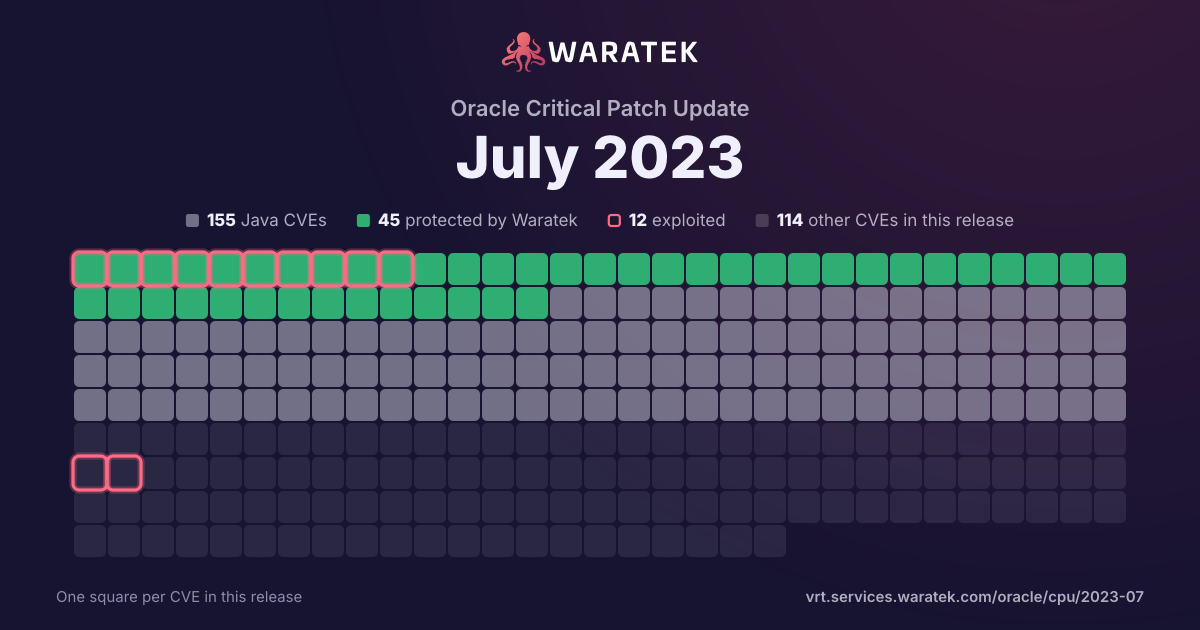
By status
45Protected by Waratek5Mitigation candidate105No exploit published31Outside Waratek scope83Not applicable
12Exploited, marked by the ring
No exploit published. For 37 of them, Oracle's security advisory is the source of public detail.
Protected by Waratek. Waratek RASP can block exploitation of these on systems that have not applied the patch yet.
Overview 49 matches · 6 protected · 0 exploited · 0 CISA KEV · 0 public PoC · 0 EPSS ≥ 0.5
Protected by Waratek
6
12.2%
Rule in development
0
0.0%
Mitigation candidate
0
0.0%
No exploit published
43
87.8%
blocked by ARMR today
6
12.2%
partly blocked
0
0.0%
not blocked
43
87.8%
not established
0
0.0%
unrecorded
0
0.0%
Exploited
0
0.0%
Working exploit published
0
0.0%
Proof of concept only
0
0.0%
Forecast only
0
0.0%
No public exploit
49
100.0%
split by
peak 20 / quarter
Q3 181
No exploit published1
Medium1
not blocked1
No public exploit1
Q4 180
Q1 190
Q2 190
Q3 190
Q4 190
Q1 200
Q2 200
Q3 200
Q4 202
Protected by Waratek2
Medium2
blocked by ARMR today2
No public exploit2
Q1 212
No exploit published2
Medium2
not blocked2
No public exploit2
Q2 212
Protected by Waratek1
No exploit published1
Medium2
blocked by ARMR today1
not blocked1
No public exploit2
Q3 212
No exploit published2
Medium2
not blocked2
No public exploit2
Q4 210
Q1 221
No exploit published1
Medium1
not blocked1
No public exploit1
Q2 223
Protected by Waratek2
No exploit published1
Medium3
blocked by ARMR today2
not blocked1
No public exploit3
Q3 222
No exploit published2
Medium2
not blocked2
No public exploit2
Q4 222
No exploit published2
Medium2
not blocked2
No public exploit2
Q1 237
Protected by Waratek1
No exploit published6
Medium7
blocked by ARMR today1
not blocked6
No public exploit7
Q2 235
No exploit published5
Medium5
not blocked5
No public exploit5
Q3 2320
No exploit published20
Medium20
not blocked20
No public exploit20
Q3 18Q1 19Q3 19Q1 20Q3 20Q1 21Q3 21Q1 22Q3 22Q1 23Q3 23
| CVE | Severity | Published▾ | Status | Exploitation | Description |
|---|---|---|---|---|---|
| CVE-2023-22061 | Medium | 2023-07-18 | No exploit published | No public exploit | Vulnerability in the Oracle Business Intelligence Enterprise Edition product of Oracle Analytics (component: Visual Analyzer). The supported version that is affected is 6.4.0.0.0. Easily exploitable vulnerability allows low privileged attacker with network access via HTTP to compromise Oracle Business Intelligence Enterprise Edition. Successful attacks require human interaction from a person other than the attacker and while the vulnerability is in Oracle Business Intelligence Enterprise Edition, attacks may significantly impact additional products (scope change). Successful attacks of this vulnerability can result in unauthorized update, insert or delete access to some of Oracle Business Intelligence Enterprise Edition accessible data as well as unauthorized read access to a subset of Oracle Business Intelligence Enterprise Edition accessible data. CVSS 3.1 Base Score 5.4 (Confidentiality and Integrity impacts). CVSS Vector: (CVSS:3.1/AV:N/AC:L/PR:L/UI:R/S:C/C:L/I:L/A:N). |
| CVE-2023-22055 | Medium | 2023-07-18 | No exploit published | No public exploit | Vulnerability in the JD Edwards EnterpriseOne Tools product of Oracle JD Edwards (component: Web Runtime SEC). Supported versions that are affected are Prior to 9.2.7.4. Easily exploitable vulnerability allows unauthenticated attacker with network access via HTTP to compromise JD Edwards EnterpriseOne Tools. Successful attacks require human interaction from a person other than the attacker and while the vulnerability is in JD Edwards EnterpriseOne Tools, attacks may significantly impact additional products (scope change). Successful attacks of this vulnerability can result in unauthorized update, insert or delete access to some of JD Edwards EnterpriseOne Tools accessible data as well as unauthorized read access to a subset of JD Edwards EnterpriseOne Tools accessible data. CVSS 3.1 Base Score 6.1 (Confidentiality and Integrity impacts). CVSS Vector: (CVSS:3.1/AV:N/AC:L/PR:N/UI:R/S:C/C:L/I:L/A:N). |
| CVE-2023-22050 | Medium | 2023-07-18 | No exploit published | No public exploit | Vulnerability in the JD Edwards EnterpriseOne Orchestrator product of Oracle JD Edwards (component: E1 IOT Orchestrator Security). Supported versions that are affected are Prior to 9.2.7.4. Easily exploitable vulnerability allows low privileged attacker with network access via HTTP to compromise JD Edwards EnterpriseOne Orchestrator. Successful attacks of this vulnerability can result in unauthorized update, insert or delete access to some of JD Edwards EnterpriseOne Orchestrator accessible data as well as unauthorized read access to a subset of JD Edwards EnterpriseOne Orchestrator accessible data. CVSS 3.1 Base Score 5.4 (Confidentiality and Integrity impacts). CVSS Vector: (CVSS:3.1/AV:N/AC:L/PR:L/UI:N/S:U/C:L/I:L/A:N). |
| CVE-2023-22042 | Medium | 2023-07-18 | No exploit published | No public exploit | Vulnerability in the Oracle Applications Framework product of Oracle E-Business Suite (component: Diagnostics). Supported versions that are affected are 12.2.3-12.3.12. Easily exploitable vulnerability allows unauthenticated attacker with network access via HTTP to compromise Oracle Applications Framework. Successful attacks require human interaction from a person other than the attacker and while the vulnerability is in Oracle Applications Framework, attacks may significantly impact additional products (scope change). Successful attacks of this vulnerability can result in unauthorized update, insert or delete access to some of Oracle Applications Framework accessible data as well as unauthorized read access to a subset of Oracle Applications Framework accessible data. CVSS 3.1 Base Score 6.1 (Confidentiality and Integrity impacts). CVSS Vector: (CVSS:3.1/AV:N/AC:L/PR:N/UI:R/S:C/C:L/I:L/A:N). |
| CVE-2023-22040 | Medium | 2023-07-18 | No exploit published | No public exploit | Vulnerability in the Oracle WebLogic Server product of Oracle Fusion Middleware (component: Core). Supported versions that are affected are 12.2.1.4.0 and 14.1.1.0.0. Easily exploitable vulnerability allows high privileged attacker with network access via multiple protocols to compromise Oracle WebLogic Server. Successful attacks of this vulnerability can result in unauthorized creation, deletion or modification access to critical data or all Oracle WebLogic Server accessible data and unauthorized ability to cause a hang or frequently repeatable crash (complete DOS) of Oracle WebLogic Server. CVSS 3.1 Base Score 6.5 (Integrity and Availability impacts). CVSS Vector: (CVSS:3.1/AV:N/AC:L/PR:H/UI:N/S:U/C:N/I:H/A:H). |
| CVE-2023-22039 | Medium | 2023-07-18 | No exploit published | No public exploit | Vulnerability in the Oracle Agile PLM product of Oracle Supply Chain (component: WebClient). The supported version that is affected is 9.3.6. Easily exploitable vulnerability allows low privileged attacker with network access via HTTP to compromise Oracle Agile PLM. Successful attacks require human interaction from a person other than the attacker and while the vulnerability is in Oracle Agile PLM, attacks may significantly impact additional products (scope change). Successful attacks of this vulnerability can result in unauthorized update, insert or delete access to some of Oracle Agile PLM accessible data as well as unauthorized read access to a subset of Oracle Agile PLM accessible data. CVSS 3.1 Base Score 5.4 (Confidentiality and Integrity impacts). CVSS Vector: (CVSS:3.1/AV:N/AC:L/PR:L/UI:R/S:C/C:L/I:L/A:N). |
| CVE-2023-22037 | Medium | 2023-07-18 | No exploit published | No public exploit | Vulnerability in the Oracle Web Applications Desktop Integrator product of Oracle E-Business Suite (component: MS Excel Specific). Supported versions that are affected are 12.2.3-12.2.12. Easily exploitable vulnerability allows low privileged attacker with network access via HTTP to compromise Oracle Web Applications Desktop Integrator. Successful attacks require human interaction from a person other than the attacker and while the vulnerability is in Oracle Web Applications Desktop Integrator, attacks may significantly impact additional products (scope change). Successful attacks of this vulnerability can result in unauthorized update, insert or delete access to some of Oracle Web Applications Desktop Integrator accessible data as well as unauthorized read access to a subset of Oracle Web Applications Desktop Integrator accessible data and unauthorized ability to cause a partial denial of service (partial DOS) of Oracle Web Applications Desktop Integrator. CVSS 3.1 Base Score 6.5 (Confidentiality, Integrity and Availability impacts). CVSS Vector: (CVSS:3.1/AV:N/AC:L/PR:L/UI:R/S:C/C:L/I:L/A:L). |
| CVE-2023-22035 | Medium | 2023-07-18 | No exploit published | No public exploit | Vulnerability in the Oracle Scripting product of Oracle E-Business Suite (component: iSurvey Module). Supported versions that are affected are 12.2.3-12.2.12. Easily exploitable vulnerability allows unauthenticated attacker with network access via HTTP to compromise Oracle Scripting. Successful attacks require human interaction from a person other than the attacker and while the vulnerability is in Oracle Scripting, attacks may significantly impact additional products (scope change). Successful attacks of this vulnerability can result in unauthorized update, insert or delete access to some of Oracle Scripting accessible data as well as unauthorized read access to a subset of Oracle Scripting accessible data. CVSS 3.1 Base Score 6.1 (Confidentiality and Integrity impacts). CVSS Vector: (CVSS:3.1/AV:N/AC:L/PR:N/UI:R/S:C/C:L/I:L/A:N). |
| CVE-2023-22031 | Medium | 2023-07-18 | No exploit published | No public exploit | Vulnerability in the Oracle WebLogic Server product of Oracle Fusion Middleware (component: Core). Supported versions that are affected are 14.1.1.0.0 and 12.2.1.4.0. Difficult to exploit vulnerability allows high privileged attacker with network access via T3, IIOP to compromise Oracle WebLogic Server. Successful attacks of this vulnerability can result in unauthorized ability to cause a hang or frequently repeatable crash (complete DOS) of Oracle WebLogic Server. CVSS 3.1 Base Score 4.4 (Availability impacts). CVSS Vector: (CVSS:3.1/AV:N/AC:H/PR:H/UI:N/S:U/C:N/I:N/A:H). |
| CVE-2023-22027 | Medium | 2023-07-18 | No exploit published | No public exploit | Vulnerability in the Oracle Business Intelligence Enterprise Edition product of Oracle Analytics (component: Analytics Server). The supported version that is affected is 7.0.0.0.0. Easily exploitable vulnerability allows low privileged attacker with network access via HTTP to compromise Oracle Business Intelligence Enterprise Edition. Successful attacks of this vulnerability can result in unauthorized ability to cause a partial denial of service (partial DOS) of Oracle Business Intelligence Enterprise Edition. CVSS 3.1 Base Score 4.3 (Availability impacts). CVSS Vector: (CVSS:3.1/AV:N/AC:L/PR:L/UI:N/S:U/C:N/I:N/A:L). |
| CVE-2023-22022 | Medium | 2023-07-18 | No exploit published | No public exploit | Vulnerability in the Oracle Health Sciences Sciences Data Management Workbench product of Oracle Health Sciences Applications (component: Blinding Functionality). Supported versions that are affected are 3.1.0.2, 3.1.1.3 and 3.2.0.0. Easily exploitable vulnerability allows low privileged attacker with network access via HTTP to compromise Oracle Health Sciences Sciences Data Management Workbench. Successful attacks of this vulnerability can result in unauthorized access to critical data or complete access to all Oracle Health Sciences Sciences Data Management Workbench accessible data. CVSS 3.1 Base Score 6.5 (Confidentiality impacts). CVSS Vector: (CVSS:3.1/AV:N/AC:L/PR:L/UI:N/S:U/C:H/I:N/A:N). |
| CVE-2023-22021 | Medium | 2023-07-18 | No exploit published | No public exploit | Vulnerability in the Oracle Business Intelligence Enterprise Edition product of Oracle Analytics (component: Analytics Server). Supported versions that are affected are 6.4.0.0.0 and 7.0.0.0.0. Easily exploitable vulnerability allows low privileged attacker with network access via HTTP to compromise Oracle Business Intelligence Enterprise Edition. Successful attacks of this vulnerability can result in unauthorized ability to cause a partial denial of service (partial DOS) of Oracle Business Intelligence Enterprise Edition. CVSS 3.1 Base Score 4.3 (Availability impacts). CVSS Vector: (CVSS:3.1/AV:N/AC:L/PR:L/UI:N/S:U/C:N/I:N/A:L). |
| CVE-2023-22020 | Medium | 2023-07-18 | No exploit published | No public exploit | Vulnerability in the Oracle Business Intelligence Enterprise Edition product of Oracle Analytics (component: Analytics Server). Supported versions that are affected are 6.4.0.0.0 and 7.0.0.0.0. Easily exploitable vulnerability allows low privileged attacker with network access via HTTP to compromise Oracle Business Intelligence Enterprise Edition. Successful attacks of this vulnerability can result in unauthorized update, insert or delete access to some of Oracle Business Intelligence Enterprise Edition accessible data as well as unauthorized read access to a subset of Oracle Business Intelligence Enterprise Edition accessible data. CVSS 3.1 Base Score 5.4 (Confidentiality and Integrity impacts). CVSS Vector: (CVSS:3.1/AV:N/AC:L/PR:L/UI:N/S:U/C:L/I:L/A:N). |
| CVE-2023-22013 | Medium | 2023-07-18 | No exploit published | No public exploit | Vulnerability in the Oracle Business Intelligence Enterprise Edition product of Oracle Analytics (component: Analytics Server). Supported versions that are affected are 6.4.0.0.0 and 7.0.0.0.0. Easily exploitable vulnerability allows low privileged attacker with network access via HTTP to compromise Oracle Business Intelligence Enterprise Edition. Successful attacks of this vulnerability can result in unauthorized update, insert or delete access to some of Oracle Business Intelligence Enterprise Edition accessible data. CVSS 3.1 Base Score 4.3 (Integrity impacts). CVSS Vector: (CVSS:3.1/AV:N/AC:L/PR:L/UI:N/S:U/C:N/I:L/A:N). |
| CVE-2023-22012 | Medium | 2023-07-18 | No exploit published | No public exploit | Vulnerability in the Oracle Business Intelligence Enterprise Edition product of Oracle Analytics (component: Analytics Server). The supported version that is affected is 7.0.0.0.0. Easily exploitable vulnerability allows low privileged attacker with network access via HTTP to compromise Oracle Business Intelligence Enterprise Edition. Successful attacks of this vulnerability can result in unauthorized update, insert or delete access to some of Oracle Business Intelligence Enterprise Edition accessible data. CVSS 3.1 Base Score 4.3 (Integrity impacts). CVSS Vector: (CVSS:3.1/AV:N/AC:L/PR:L/UI:N/S:U/C:N/I:L/A:N). |
| CVE-2023-22011 | Medium | 2023-07-18 | No exploit published | No public exploit | Vulnerability in the Oracle Business Intelligence Enterprise Edition product of Oracle Analytics (component: Analytics Server). Supported versions that are affected are 6.4.0.0.0 and 7.0.0.0.0. Easily exploitable vulnerability allows low privileged attacker with network access via HTTP to compromise Oracle Business Intelligence Enterprise Edition. Successful attacks of this vulnerability can result in unauthorized update, insert or delete access to some of Oracle Business Intelligence Enterprise Edition accessible data and unauthorized ability to cause a partial denial of service (partial DOS) of Oracle Business Intelligence Enterprise Edition. CVSS 3.1 Base Score 5.4 (Integrity and Availability impacts). CVSS Vector: (CVSS:3.1/AV:N/AC:L/PR:L/UI:N/S:U/C:N/I:L/A:L). |
| CVE-2023-22009 | Medium | 2023-07-18 | No exploit published | No public exploit | Vulnerability in the Oracle Self-Service Human Resources product of Oracle E-Business Suite (component: Workforce Management). Supported versions that are affected are 12.2.3-12.2.12. Easily exploitable vulnerability allows low privileged attacker with network access via HTTP to compromise Oracle Self-Service Human Resources. Successful attacks of this vulnerability can result in unauthorized read access to a subset of Oracle Self-Service Human Resources accessible data. CVSS 3.1 Base Score 4.3 (Confidentiality impacts). CVSS Vector: (CVSS:3.1/AV:N/AC:L/PR:L/UI:N/S:U/C:L/I:N/A:N). |
| CVE-2023-22004 | Medium | 2023-07-18 | No exploit published | No public exploit | Vulnerability in the Oracle Applications Technology product of Oracle E-Business Suite (component: Reports Configuration). Supported versions that are affected are 12.2.3-12.2.12. Easily exploitable vulnerability allows unauthenticated attacker with network access via HTTP to compromise Oracle Applications Technology. Successful attacks require human interaction from a person other than the attacker. Successful attacks of this vulnerability can result in unauthorized update, insert or delete access to some of Oracle Applications Technology accessible data. CVSS 3.1 Base Score 4.3 (Integrity impacts). CVSS Vector: (CVSS:3.1/AV:N/AC:L/PR:N/UI:R/S:U/C:N/I:L/A:N). |
| CVE-2023-21994 | Medium | 2023-07-18 | No exploit published | No public exploit | Vulnerability in the Oracle Mobile Security Suite product of Oracle Fusion Middleware (component: Android Mobile Authenticator App). Supported versions that are affected are Prior to 11.1.2.3.1. Easily exploitable vulnerability allows unauthenticated attacker with access to the physical communication segment attached to the hardware where the Oracle Mobile Security Suite executes to compromise Oracle Mobile Security Suite. Successful attacks of this vulnerability can result in unauthorized access to critical data or complete access to all Oracle Mobile Security Suite accessible data. CVSS 3.1 Base Score 6.5 (Confidentiality impacts). CVSS Vector: (CVSS:3.1/AV:A/AC:L/PR:N/UI:N/S:U/C:H/I:N/A:N). |
| CVE-2023-21961 | Medium | 2023-07-18 | No exploit published | No public exploit | Vulnerability in the Oracle Hyperion Essbase Administration Services product of Oracle Essbase (component: EAS Administration and EAS Console). The supported version that is affected is 21.4.3.0.0. Easily exploitable vulnerability allows high privileged attacker with logon to the infrastructure where Oracle Hyperion Essbase Administration Services executes to compromise Oracle Hyperion Essbase Administration Services. While the vulnerability is in Oracle Hyperion Essbase Administration Services, attacks may significantly impact additional products (scope change). Successful attacks of this vulnerability can result in unauthorized access to critical data or complete access to all Oracle Hyperion Essbase Administration Services accessible data. CVSS 3.1 Base Score 6.0 (Confidentiality impacts). CVSS Vector: (CVSS:3.1/AV:L/AC:L/PR:H/UI:N/S:C/C:H/I:N/A:N). |
| CVE-2023-20862 | Medium | 2023-04-19 | No exploit published | No public exploit | In Spring Security, versions 5.7.x prior to 5.7.8, versions 5.8.x prior to 5.8.3, and versions 6.0.x prior to 6.0.3, the logout support does not properly clean the security context if using serialized versions. Additionally, it is not possible to explicitly save an empty security context to the HttpSessionSecurityContextRepository. This vulnerability can keep users authenticated even after they performed logout. Users of affected versions should apply the following mitigation. 5.7.x users should upgrade to 5.7.8. 5.8.x users should upgrade to 5.8.3. 6.0.x users should upgrade to 6.0.3. |
| CVE-2023-26049 | Medium | 2023-04-18 | No exploit published | No public exploit | Jetty is a java based web server and servlet engine. Nonstandard cookie parsing in Jetty may allow an attacker to smuggle cookies within other cookies, or otherwise perform unintended behavior by tampering with the cookie parsing mechanism. If Jetty sees a cookie VALUE that starts with `"` (double quote), it will continue to read the cookie string until it sees a closing quote -- even if a semicolon is encountered. So, a cookie header such as: `DISPLAY_LANGUAGE="b; JSESSIONID=1337; c=d"` will be parsed as one cookie, with the name DISPLAY_LANGUAGE and a value of b; JSESSIONID=1337; c=d instead of 3 separate cookies. This has security implications because if, say, JSESSIONID is an HttpOnly cookie, and the DISPLAY_LANGUAGE cookie value is rendered on the page, an attacker can smuggle the JSESSIONID cookie into the DISPLAY_LANGUAGE cookie and thereby exfiltrate it. This is significant when an intermediary is enacting some policy based on cookies, so a smuggled cookie can bypass that policy yet still be seen by the Jetty server or its logging system. This issue has been addressed in versions 9.4.51, 10.0.14, 11.0.14, and 12.0.0.beta0 and users are advised to upgrade. There are no known workarounds for this issue. |
| CVE-2023-26048 | Medium | 2023-04-18 | No exploit published | No public exploit | Jetty is a java based web server and servlet engine. In affected versions servlets with multipart support (e.g. annotated with `@MultipartConfig`) that call `HttpServletRequest.getParameter()` or `HttpServletRequest.getParts()` may cause `OutOfMemoryError` when the client sends a multipart request with a part that has a name but no filename and very large content. This happens even with the default settings of `fileSizeThreshold=0` which should stream the whole part content to disk. An attacker client may send a large multipart request and cause the server to throw `OutOfMemoryError`. However, the server may be able to recover after the `OutOfMemoryError` and continue its service -- although it may take some time. This issue has been patched in versions 9.4.51, 10.0.14, and 11.0.14. Users are advised to upgrade. Users unable to upgrade may set the multipart parameter `maxRequestSize` which must be set to a non-negative value, so the whole multipart content is limited (although still read into memory). |
| CVE-2023-21971 | Medium | 2023-04-18 | No exploit published | No public exploit | Vulnerability in the MySQL Connectors product of Oracle MySQL (component: Connector/J). Supported versions that are affected are 8.0.32 and prior. Difficult to exploit vulnerability allows high privileged attacker with network access via multiple protocols to compromise MySQL Connectors. Successful attacks require human interaction from a person other than the attacker. Successful attacks of this vulnerability can result in unauthorized ability to cause a hang or frequently repeatable crash (complete DOS) of MySQL Connectors as well as unauthorized update, insert or delete access to some of MySQL Connectors accessible data and unauthorized read access to a subset of MySQL Connectors accessible data. CVSS 3.1 Base Score 5.3 (Confidentiality, Integrity and Availability impacts). CVSS Vector: (CVSS:3.1/AV:N/AC:H/PR:H/UI:R/S:U/C:L/I:L/A:H). |
| CVE-2023-20863 | Medium | 2023-04-13 | No exploit published | No public exploit | In spring framework versions prior to 5.2.24 release+ ,5.3.27+ and 6.0.8+ , it is possible for a user to provide a specially crafted SpEL expression that may cause a denial-of-service (DoS) condition. |
| CVE-2023-20861 | Medium | 2023-03-23 | No exploit published | No public exploit | In Spring Framework versions 6.0.0 - 6.0.6, 5.3.0 - 5.3.25, 5.2.0.RELEASE - 5.2.22.RELEASE, and older unsupported versions, it is possible for a user to provide a specially crafted SpEL expression that may cause a denial-of-service (DoS) condition. |
| CVE-2023-28708 | Medium | 2023-03-22 | No exploit published | No public exploit | When using the RemoteIpFilter with requests received from a reverse proxy via HTTP that include the X-Forwarded-Proto header set to https, session cookies created by Apache Tomcat 11.0.0-M1 to 11.0.0.-M2, 10.1.0-M1 to 10.1.5, 9.0.0-M1 to 9.0.71 and 8.5.0 to 8.5.85 did not include the secure attribute. This could result in the user agent transmitting the session cookie over an insecure channel. Older, EOL versions may also be affected. |
| CVE-2023-27904 | Medium | 2023-03-10 | No exploit published | No public exploit | Jenkins 2.393 and earlier, LTS 2.375.3 and earlier prints an error stack trace on agent-related pages when agent connections are broken, potentially revealing information about Jenkins configuration that is otherwise inaccessible to attackers. |
| CVE-2023-27903 | Medium | 2023-03-10 | No exploit published | No public exploit | Jenkins 2.393 and earlier, LTS 2.375.3 and earlier creates a temporary file in the default temporary directory with the default permissions for newly created files when uploading a file parameter through the CLI, potentially allowing attackers with access to the Jenkins controller file system to read and write the file before it is used. |
| CVE-2023-27902 | Medium | 2023-03-10 | No exploit published | No public exploit | Jenkins 2.393 and earlier, LTS 2.375.3 and earlier shows temporary directories related to job workspaces, which allows attackers with Item/Workspace permission to access their contents. |
| CVE-2023-21830 | Medium | 2023-01-18 | Protected by Waratek | No public exploit | Vulnerability in the Oracle Java SE, Oracle GraalVM Enterprise Edition product of Oracle Java SE (component: Serialization). Supported versions that are affected are Oracle Java SE: 8u351, 8u351-perf; Oracle GraalVM Enterprise Edition: 20.3.8 and 21.3.4. Easily exploitable vulnerability allows unauthenticated attacker with network access via multiple protocols to compromise Oracle Java SE, Oracle GraalVM Enterprise Edition. Successful attacks of this vulnerability can result in unauthorized update, insert or delete access to some of Oracle Java SE, Oracle GraalVM Enterprise Edition accessible data. Note: This vulnerability applies to Java deployments, typically in clients running sandboxed Java Web Start applications or sandboxed Java applets, that load and run untrusted code (e.g., code that comes from the internet) and rely on the Java sandbox for security. This vulnerability does not apply to Java deployments, typically in servers, that load and run only trusted code (e.g., code installed by an administrator). CVSS 3.1 Base Score 5.3 (Integrity impacts). CVSS Vector: (CVSS:3.1/AV:N/AC:L/PR:N/UI:N/S:U/C:N/I:L/A:N). |
| CVE-2022-45787 | Medium | 2023-01-06 | No exploit published | No public exploit | Unproper laxist permissions on the temporary files used by MIME4J TempFileStorageProvider may lead to information disclosure to other local users. This issue affects Apache James MIME4J version 0.8.8 and prior versions. We recommend users to upgrade to MIME4j version 0.8.9 or later. |
| CVE-2021-37533 | Medium | 2022-12-03 | No exploit published | No public exploit | Prior to Apache Commons Net 3.9.0, Net's FTP client trusts the host from PASV response by default. A malicious server can redirect the Commons Net code to use a different host, but the user has to connect to the malicious server in the first place. This may lead to leakage of information about services running on the private network of the client. The default in version 3.9.0 is now false to ignore such hosts, as cURL does. See https://issues.apache.org/jira/browse/NET-711. |
| CVE-2022-31777 | Medium | 2022-11-01 | No exploit published | No public exploit | A stored cross-site scripting (XSS) vulnerability in Apache Spark 3.2.1 and earlier, and 3.3.0, allows remote attackers to execute arbitrary JavaScript in the web browser of a user, by including a malicious payload into the logs which would be returned in logs rendered in the UI. |
| CVE-2022-38648 | Medium | 2022-09-22 | No exploit published | No public exploit | Server-Side Request Forgery (SSRF) vulnerability in Batik of Apache XML Graphics allows an attacker to fetch external resources. This issue affects Apache XML Graphics Batik 1.14. |
| CVE-2022-38398 | Medium | 2022-09-22 | No exploit published | No public exploit | Server-Side Request Forgery (SSRF) vulnerability in Batik of Apache XML Graphics allows an attacker to load a url thru the jar protocol. This issue affects Apache XML Graphics Batik 1.14. |
| CVE-2022-22971 | Medium | 2022-05-12 | Protected by Waratek | No public exploit | In spring framework versions prior to 5.3.20+ , 5.2.22+ and old unsupported versions, application with a STOMP over WebSocket endpoint is vulnerable to a denial of service attack by an authenticated user. |
| CVE-2022-22970 | Medium | 2022-05-12 | No exploit published | No public exploit | In spring framework versions prior to 5.3.20+ , 5.2.22+ and old unsupported versions, applications that handle file uploads are vulnerable to DoS attack if they rely on data binding to set a MultipartFile or javax.servlet.Part to a field in a model object. |
| CVE-2022-22950 | Medium | 2022-04-01 | Protected by Waratek | No public exploit | n Spring Framework versions 5.3.0 - 5.3.16 and older unsupported versions, it is possible for a user to provide a specially crafted SpEL expression that may cause a denial of service condition. |
| CVE-2022-23437 | Medium | 2022-01-24 | No exploit published | No public exploit | There's a vulnerability within the Apache Xerces Java (XercesJ) XML parser when handling specially crafted XML document payloads. This causes, the XercesJ XML parser to wait in an infinite loop, which may sometimes consume system resources for prolonged duration. This vulnerability is present within XercesJ version 2.12.1 and the previous versions. |
| CVE-2021-36374 | Medium | 2021-07-14 | No exploit published | No public exploit | When reading a specially crafted ZIP archive, or a derived formats, an Apache Ant build can be made to allocate large amounts of memory that leads to an out of memory error, even for small inputs. This can be used to disrupt builds using Apache Ant. Commonly used derived formats from ZIP archives are for instance JAR files and many office files. Apache Ant prior to 1.9.16 and 1.10.11 were affected. |
| CVE-2021-36373 | Medium | 2021-07-14 | No exploit published | No public exploit | When reading a specially crafted TAR archive an Apache Ant build can be made to allocate large amounts of memory that finally leads to an out of memory error, even for small inputs. This can be used to disrupt builds using Apache Ant. Apache Ant prior to 1.9.16 and 1.10.11 were affected. |
| CVE-2021-28168 | Medium | 2021-04-22 | No exploit published | No public exploit | Eclipse Jersey 2.28 to 2.33 and Eclipse Jersey 3.0.0 to 3.0.1 contains a local information disclosure vulnerability. This is due to the use of the File.createTempFile which creates a file inside of the system temporary directory with the permissions: -rw-r--r--. Thus the contents of this file are viewable by all other users locally on the system. As such, if the contents written is security sensitive, it can be disclosed to other local users. |
| CVE-2021-29425 | Medium | 2021-04-13 | Protected by Waratek | No public exploit | In Apache Commons IO before 2.7, When invoking the method FileNameUtils.normalize with an improper input string, like "//../foo", or "\\..\foo", the result would be the same value, thus possibly providing access to files in the parent directory, but not further above (thus "limited" path traversal), if the calling code would use the result to construct a path value. |
| CVE-2020-1926 | Medium | 2021-03-16 | No exploit published | No public exploit | Apache Hive cookie signature verification used a non constant time comparison which is known to be vulnerable to timing attacks. This could allow recovery of another users cookie signature. The issue was addressed in Apache Hive 2.3.8 |
| CVE-2021-21295 | Medium | 2021-03-09 | No exploit published | No public exploit | Netty is an open-source, asynchronous event-driven network application framework for rapid development of maintainable high performance protocol servers & clients. In Netty (io.netty:netty-codec-http2) before version 4.1.60.Final there is a vulnerability that enables request smuggling. If a Content-Length header is present in the original HTTP/2 request, the field is not validated by `Http2MultiplexHandler` as it is propagated up. This is fine as long as the request is not proxied through as HTTP/1.1. If the request comes in as an HTTP/2 stream, gets converted into the HTTP/1.1 domain objects (`HttpRequest`, `HttpContent`, etc.) via `Http2StreamFrameToHttpObjectCodec `and then sent up to the child channel's pipeline and proxied through a remote peer as HTTP/1.1 this may result in request smuggling. In a proxy case, users may assume the content-length is validated somehow, which is not the case. If the request is forwarded to a backend channel that is a HTTP/1.1 connection, the Content-Length now has meaning and needs to be checked. An attacker can smuggle requests inside the body as it gets downgraded from HTTP/2 to HTTP/1.1. For an example attack refer to the linked GitHub Advisory. Users are only affected if all of this is true: `HTTP2MultiplexCodec` or `Http2FrameCodec` is used, `Http2StreamFrameToHttpObjectCodec` is used to convert to HTTP/1.1 objects, and these HTTP/1.1 objects are forwarded to another remote peer. This has been patched in 4.1.60.Final As a workaround, the user can do the validation by themselves by implementing a custom `ChannelInboundHandler` that is put in the `ChannelPipeline` behind `Http2StreamFrameToHttpObjectCodec`. |
| CVE-2020-17521 | Medium | 2020-12-07 | Protected by Waratek | No public exploit | Apache Groovy provides extension methods to aid with creating temporary directories. Prior to this fix, Groovy's implementation of those extension methods was using a now superseded Java JDK method call that is potentially not secure on some operating systems in some contexts. Users not using the extension methods mentioned in the advisory are not affected, but may wish to read the advisory for further details. Versions Affected: 2.0 to 2.4.20, 2.5.0 to 2.5.13, 3.0.0 to 3.0.6, and 4.0.0-alpha-1. Fixed in versions 2.4.21, 2.5.14, 3.0.7, 4.0.0-alpha-2. |
| CVE-2020-15250 | Medium | 2020-10-12 | Protected by Waratek | No public exploit | In JUnit4 from version 4.7 and before 4.13.1, the test rule TemporaryFolder contains a local information disclosure vulnerability. On Unix like systems, the system's temporary directory is shared between all users on that system. Because of this, when files and directories are written into this directory they are, by default, readable by other users on that same system. This vulnerability does not allow other users to overwrite the contents of these directories or files. This is purely an information disclosure vulnerability. This vulnerability impacts you if the JUnit tests write sensitive information, like API keys or passwords, into the temporary folder, and the JUnit tests execute in an environment where the OS has other untrusted users. Because certain JDK file system APIs were only added in JDK 1.7, this this fix is dependent upon the version of the JDK you are using. For Java 1.7 and higher users: this vulnerability is fixed in 4.13.1. For Java 1.6 and lower users: no patch is available, you must use the workaround below. If you are unable to patch, or are stuck running on Java 1.6, specifying the `java.io.tmpdir` system environment variable to a directory that is exclusively owned by the executing user will fix this vulnerability. For more information, including an example of vulnerable code, see the referenced GitHub Security Advisory. |
| CVE-2018-8032 | Medium | 2018-08-02 | No exploit published | No public exploit | Apache Axis 1.x up to and including 1.4 is vulnerable to a cross-site scripting (XSS) attack in the default servlet/services. |