
Oracle Critical Patch Update July 2023
Released July 2023 · Oracle's advisory ↗ · ← Critical Patch Update, April 2023 · Critical Patch Update, October 2023 →
269 CVEs in this release, one square each
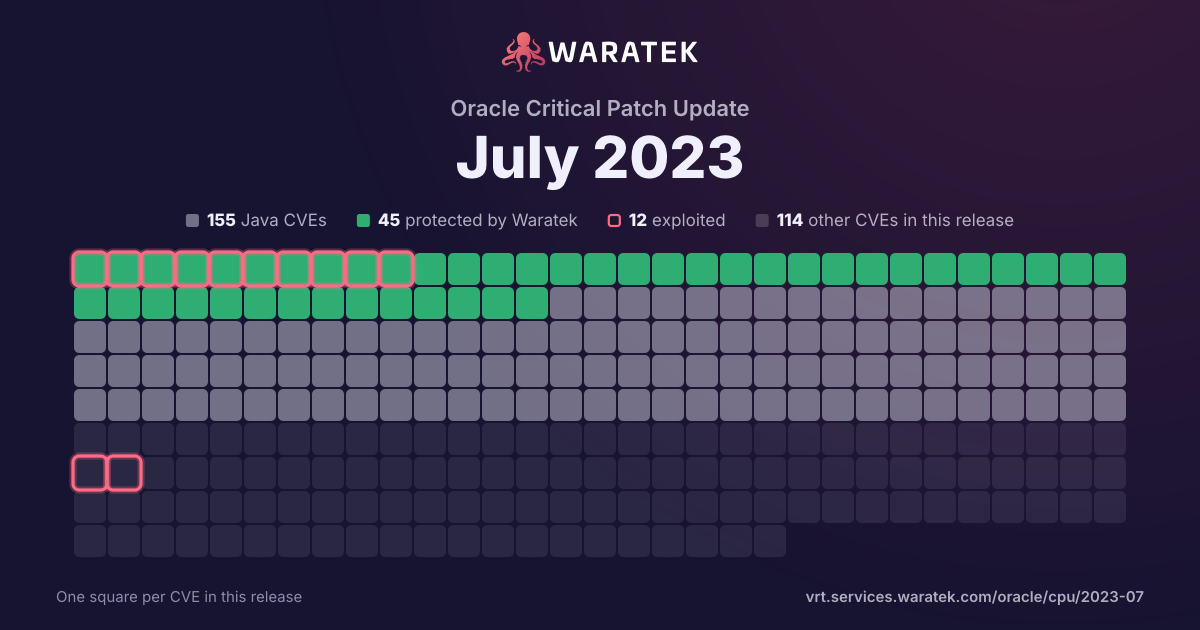
By status
45Protected by Waratek5Mitigation candidate105No exploit published31Outside Waratek scope83Not applicable
12Exploited, marked by the ring
No exploit published. For 37 of them, Oracle's security advisory is the source of public detail.
Protected by Waratek. Waratek RASP can block exploitation of these on systems that have not applied the patch yet.
Overview 207 matches · 117 in Waratek scope · 26 protected · 0 exploited · 0 CISA KEV · 0 public PoC · 0 EPSS ≥ 0.5
207matches
117in Waratek scope56.5%
26protected12.6%
0exploited0.0%
0CISA KEV0.0%
0public PoC0.0%
0EPSS ≥ 0.50.0%
Protected by Waratek
26
12.6%
Rule in development
0
0.0%
Mitigation candidate
0
0.0%
No exploit published
91
44.0%
Outside Waratek scope
26
12.6%
Not applicable
64
30.9%
Withdrawn CVE
0
0.0%
blocked by ARMR today
26
12.6%
partly blocked
0
0.0%
not blocked
181
87.4%
not established
0
0.0%
unrecorded
0
0.0%
Exploited
0
0.0%
Working exploit published
0
0.0%
Proof of concept only
0
0.0%
Forecast only
0
0.0%
No public exploit
207
100.0%
split by
peak 55 / quarter
Q2 181
Protected by Waratek1
Critical1
blocked by ARMR today1
No public exploit1
Q3 181
No exploit published1
Medium1
not blocked1
No public exploit1
Q4 180
Q1 190
Q2 190
Q3 193
Protected by Waratek1
No exploit published1
Outside Waratek scope1
Critical1
High2
blocked by ARMR today1
not blocked2
No public exploit3
Q4 191
No exploit published1
Critical1
not blocked1
No public exploit1
Q1 201
No exploit published1
Critical1
not blocked1
No public exploit1
Q2 200
Q3 201
Protected by Waratek1
Critical1
blocked by ARMR today1
No public exploit1
Q4 205
Protected by Waratek2
No exploit published2
Outside Waratek scope1
High1
Medium3
Low1
blocked by ARMR today2
not blocked3
No public exploit5
Q1 218
Protected by Waratek1
No exploit published6
Not applicable1
Critical2
High4
Medium2
blocked by ARMR today1
not blocked7
No public exploit8
Q2 215
Protected by Waratek3
No exploit published1
Not applicable1
Critical1
High1
Medium3
blocked by ARMR today3
not blocked2
No public exploit5
Q3 218
No exploit published7
Not applicable1
High5
Medium3
not blocked8
No public exploit8
Q4 214
Protected by Waratek2
Outside Waratek scope2
Critical2
Medium2
blocked by ARMR today2
not blocked2
No public exploit4
Q1 227
No exploit published2
Outside Waratek scope1
Not applicable4
High3
Medium4
not blocked7
No public exploit7
Q2 2210
Protected by Waratek4
No exploit published3
Not applicable3
Critical2
High4
Medium3
Low1
blocked by ARMR today4
not blocked6
No public exploit10
Q3 2219
Protected by Waratek1
No exploit published11
Not applicable7
Critical6
High8
Medium4
Low1
blocked by ARMR today1
not blocked18
No public exploit19
Q4 2225
Protected by Waratek5
No exploit published10
Outside Waratek scope1
Not applicable9
Critical3
High19
Medium3
blocked by ARMR today5
not blocked20
No public exploit25
Q1 2337
Protected by Waratek3
No exploit published13
Outside Waratek scope1
Not applicable20
Critical2
High18
Medium16
Low1
blocked by ARMR today3
not blocked34
No public exploit37
Q2 2316
Protected by Waratek1
No exploit published8
Not applicable7
Critical2
High5
Medium9
blocked by ARMR today1
not blocked15
No public exploit16
Q3 2355
Protected by Waratek1
No exploit published24
Outside Waratek scope19
Not applicable11
Critical2
High5
Medium37
Low11
blocked by ARMR today1
not blocked54
No public exploit55
Q3 18Q1 19Q3 19Q1 20Q3 20Q1 21Q3 21Q1 22Q3 22Q1 23Q3 23
| CVE | Severity | Published▾ | Status | Exploitation | Description |
|---|---|---|---|---|---|
| CVE-2023-22062 | High | 2023-07-18 | No exploit published | No public exploit | Vulnerability in the Oracle Hyperion Financial Reporting product of Oracle Hyperion (component: Repository). The supported version that is affected is 11.2.13.0.000. Easily exploitable vulnerability allows low privileged attacker with network access via HTTP to compromise Oracle Hyperion Financial Reporting. While the vulnerability is in Oracle Hyperion Financial Reporting, attacks may significantly impact additional products (scope change). Successful attacks of this vulnerability can result in unauthorized access to critical data or complete access to all Oracle Hyperion Financial Reporting accessible data and unauthorized ability to cause a partial denial of service (partial DOS) of Oracle Hyperion Financial Reporting. CVSS 3.1 Base Score 8.5 (Confidentiality and Availability impacts). CVSS Vector: (CVSS:3.1/AV:N/AC:L/PR:L/UI:N/S:C/C:H/I:N/A:L). |
| CVE-2023-22061 | Medium | 2023-07-18 | No exploit published | No public exploit | Vulnerability in the Oracle Business Intelligence Enterprise Edition product of Oracle Analytics (component: Visual Analyzer). The supported version that is affected is 6.4.0.0.0. Easily exploitable vulnerability allows low privileged attacker with network access via HTTP to compromise Oracle Business Intelligence Enterprise Edition. Successful attacks require human interaction from a person other than the attacker and while the vulnerability is in Oracle Business Intelligence Enterprise Edition, attacks may significantly impact additional products (scope change). Successful attacks of this vulnerability can result in unauthorized update, insert or delete access to some of Oracle Business Intelligence Enterprise Edition accessible data as well as unauthorized read access to a subset of Oracle Business Intelligence Enterprise Edition accessible data. CVSS 3.1 Base Score 5.4 (Confidentiality and Integrity impacts). CVSS Vector: (CVSS:3.1/AV:N/AC:L/PR:L/UI:R/S:C/C:L/I:L/A:N). |
| CVE-2023-22060 | High | 2023-07-18 | No exploit published | No public exploit | Vulnerability in the Oracle Hyperion Workspace product of Oracle Hyperion (component: UI and Visualization). The supported version that is affected is 11.2.13.0.000. Easily exploitable vulnerability allows low privileged attacker with network access via HTTP to compromise Oracle Hyperion Workspace. Successful attacks require human interaction from a person other than the attacker. Successful attacks of this vulnerability can result in unauthorized creation, deletion or modification access to critical data or all Oracle Hyperion Workspace accessible data as well as unauthorized access to critical data or complete access to all Oracle Hyperion Workspace accessible data and unauthorized ability to cause a partial denial of service (partial DOS) of Oracle Hyperion Workspace. CVSS 3.1 Base Score 7.6 (Confidentiality, Integrity and Availability impacts). CVSS Vector: (CVSS:3.1/AV:N/AC:L/PR:L/UI:R/S:U/C:H/I:H/A:L). |
| CVE-2023-22058 | Medium | 2023-07-18 | Outside Waratek scope | No public exploit | Vulnerability in the MySQL Server product of Oracle MySQL (component: Server: DDL). Supported versions that are affected are 8.0.33 and prior. Difficult to exploit vulnerability allows high privileged attacker with network access via multiple protocols to compromise MySQL Server. Successful attacks of this vulnerability can result in unauthorized ability to cause a hang or frequently repeatable crash (complete DOS) of MySQL Server. CVSS 3.1 Base Score 4.4 (Availability impacts). CVSS Vector: (CVSS:3.1/AV:N/AC:H/PR:H/UI:N/S:U/C:N/I:N/A:H). |
| CVE-2023-22057 | Medium | 2023-07-18 | Outside Waratek scope | No public exploit | Vulnerability in the MySQL Server product of Oracle MySQL (component: Server: Replication). Supported versions that are affected are 8.0.33 and prior. Easily exploitable vulnerability allows high privileged attacker with network access via multiple protocols to compromise MySQL Server. Successful attacks of this vulnerability can result in unauthorized ability to cause a hang or frequently repeatable crash (complete DOS) of MySQL Server. CVSS 3.1 Base Score 4.9 (Availability impacts). CVSS Vector: (CVSS:3.1/AV:N/AC:L/PR:H/UI:N/S:U/C:N/I:N/A:H). |
| CVE-2023-22056 | Medium | 2023-07-18 | Outside Waratek scope | No public exploit | Vulnerability in the MySQL Server product of Oracle MySQL (component: Server: Optimizer). Supported versions that are affected are 8.0.33 and prior. Easily exploitable vulnerability allows high privileged attacker with network access via multiple protocols to compromise MySQL Server. Successful attacks of this vulnerability can result in unauthorized ability to cause a hang or frequently repeatable crash (complete DOS) of MySQL Server. CVSS 3.1 Base Score 4.9 (Availability impacts). CVSS Vector: (CVSS:3.1/AV:N/AC:L/PR:H/UI:N/S:U/C:N/I:N/A:H). |
| CVE-2023-22055 | Medium | 2023-07-18 | No exploit published | No public exploit | Vulnerability in the JD Edwards EnterpriseOne Tools product of Oracle JD Edwards (component: Web Runtime SEC). Supported versions that are affected are Prior to 9.2.7.4. Easily exploitable vulnerability allows unauthenticated attacker with network access via HTTP to compromise JD Edwards EnterpriseOne Tools. Successful attacks require human interaction from a person other than the attacker and while the vulnerability is in JD Edwards EnterpriseOne Tools, attacks may significantly impact additional products (scope change). Successful attacks of this vulnerability can result in unauthorized update, insert or delete access to some of JD Edwards EnterpriseOne Tools accessible data as well as unauthorized read access to a subset of JD Edwards EnterpriseOne Tools accessible data. CVSS 3.1 Base Score 6.1 (Confidentiality and Integrity impacts). CVSS Vector: (CVSS:3.1/AV:N/AC:L/PR:N/UI:R/S:C/C:L/I:L/A:N). |
| CVE-2023-22054 | Medium | 2023-07-18 | Outside Waratek scope | No public exploit | Vulnerability in the MySQL Server product of Oracle MySQL (component: Server: Optimizer). Supported versions that are affected are 8.0.33 and prior. Easily exploitable vulnerability allows high privileged attacker with network access via multiple protocols to compromise MySQL Server. Successful attacks of this vulnerability can result in unauthorized ability to cause a hang or frequently repeatable crash (complete DOS) of MySQL Server. CVSS 3.1 Base Score 4.9 (Availability impacts). CVSS Vector: (CVSS:3.1/AV:N/AC:L/PR:H/UI:N/S:U/C:N/I:N/A:H). |
| CVE-2023-22053 | Medium | 2023-07-18 | Outside Waratek scope | No public exploit | Vulnerability in the MySQL Server product of Oracle MySQL (component: Client programs). Supported versions that are affected are 5.7.42 and prior and 8.0.33 and prior. Difficult to exploit vulnerability allows low privileged attacker with network access via multiple protocols to compromise MySQL Server. Successful attacks of this vulnerability can result in unauthorized ability to cause a hang or frequently repeatable crash (complete DOS) of MySQL Server and unauthorized read access to a subset of MySQL Server accessible data. CVSS 3.1 Base Score 5.9 (Confidentiality and Availability impacts). CVSS Vector: (CVSS:3.1/AV:N/AC:H/PR:L/UI:N/S:U/C:L/I:N/A:H). |
| CVE-2023-22052 | Low | 2023-07-18 | Not applicable | No public exploit | Vulnerability in the Java VM component of Oracle Database Server. Supported versions that are affected are 19.3-19.19 and 21.3-21.10. Difficult to exploit vulnerability allows low privileged attacker having Create Session, Create Procedure privilege with network access via multiple protocols to compromise Java VM. Successful attacks of this vulnerability can result in unauthorized update, insert or delete access to some of Java VM accessible data. CVSS 3.1 Base Score 3.1 (Integrity impacts). CVSS Vector: (CVSS:3.1/AV:N/AC:H/PR:L/UI:N/S:U/C:N/I:L/A:N). |
| CVE-2023-22051 | Low | 2023-07-18 | Outside Waratek scope | No public exploit | Vulnerability in the Oracle GraalVM Enterprise Edition, Oracle GraalVM for JDK product of Oracle Java SE (component: GraalVM Compiler). Supported versions that are affected are Oracle GraalVM Enterprise Edition: 21.3.6, 22.3.2; Oracle GraalVM for JDK: 17.0.7 and 20.0.1. Difficult to exploit vulnerability allows unauthenticated attacker with network access via multiple protocols to compromise Oracle GraalVM Enterprise Edition, Oracle GraalVM for JDK. Successful attacks of this vulnerability can result in unauthorized read access to a subset of Oracle GraalVM Enterprise Edition, Oracle GraalVM for JDK accessible data. CVSS 3.1 Base Score 3.7 (Confidentiality impacts). CVSS Vector: (CVSS:3.1/AV:N/AC:H/PR:N/UI:N/S:U/C:L/I:N/A:N). |
| CVE-2023-22050 | Medium | 2023-07-18 | No exploit published | No public exploit | Vulnerability in the JD Edwards EnterpriseOne Orchestrator product of Oracle JD Edwards (component: E1 IOT Orchestrator Security). Supported versions that are affected are Prior to 9.2.7.4. Easily exploitable vulnerability allows low privileged attacker with network access via HTTP to compromise JD Edwards EnterpriseOne Orchestrator. Successful attacks of this vulnerability can result in unauthorized update, insert or delete access to some of JD Edwards EnterpriseOne Orchestrator accessible data as well as unauthorized read access to a subset of JD Edwards EnterpriseOne Orchestrator accessible data. CVSS 3.1 Base Score 5.4 (Confidentiality and Integrity impacts). CVSS Vector: (CVSS:3.1/AV:N/AC:L/PR:L/UI:N/S:U/C:L/I:L/A:N). |
| CVE-2023-22049 | Low | 2023-07-18 | Protected by Waratek | No public exploit | Vulnerability in the Oracle Java SE, Oracle GraalVM Enterprise Edition, Oracle GraalVM for JDK product of Oracle Java SE (component: Libraries). Supported versions that are affected are Oracle Java SE: 8u371, 8u371-perf, 11.0.19, 17.0.7, 20.0.1; Oracle GraalVM Enterprise Edition: 20.3.10, 21.3.6, 22.3.2; Oracle GraalVM for JDK: 17.0.7 and 20.0.1. Difficult to exploit vulnerability allows unauthenticated attacker with network access via multiple protocols to compromise Oracle Java SE, Oracle GraalVM Enterprise Edition, Oracle GraalVM for JDK. Successful attacks of this vulnerability can result in unauthorized update, insert or delete access to some of Oracle Java SE, Oracle GraalVM Enterprise Edition, Oracle GraalVM for JDK accessible data. Note: This vulnerability can be exploited by using APIs in the specified Component, e.g., through a web service which supplies data to the APIs. This vulnerability also applies to Java deployments, typically in clients running sandboxed Java Web Start applications or sandboxed Java applets, that load and run untrusted code (e.g., code that comes from the internet) and rely on the Java sandbox for security. CVSS 3.1 Base Score 3.7 (Integrity impacts). CVSS Vector: (CVSS:3.1/AV:N/AC:H/PR:N/UI:N/S:U/C:N/I:L/A:N). |
| CVE-2023-22048 | Low | 2023-07-18 | Outside Waratek scope | No public exploit | Vulnerability in the MySQL Server product of Oracle MySQL (component: Server: Pluggable Auth). Supported versions that are affected are 8.0.33 and prior. Difficult to exploit vulnerability allows low privileged attacker with network access via multiple protocols to compromise MySQL Server. Successful attacks of this vulnerability can result in unauthorized read access to a subset of MySQL Server accessible data. CVSS 3.1 Base Score 3.1 (Confidentiality impacts). CVSS Vector: (CVSS:3.1/AV:N/AC:H/PR:L/UI:N/S:U/C:L/I:N/A:N). |
| CVE-2023-22046 | Medium | 2023-07-18 | Outside Waratek scope | No public exploit | Vulnerability in the MySQL Server product of Oracle MySQL (component: Server: Optimizer). Supported versions that are affected are 8.0.33 and prior. Easily exploitable vulnerability allows high privileged attacker with network access via multiple protocols to compromise MySQL Server. Successful attacks of this vulnerability can result in unauthorized ability to cause a hang or frequently repeatable crash (complete DOS) of MySQL Server. CVSS 3.1 Base Score 4.9 (Availability impacts). CVSS Vector: (CVSS:3.1/AV:N/AC:L/PR:H/UI:N/S:U/C:N/I:N/A:H). |
| CVE-2023-22045 | Low | 2023-07-18 | Outside Waratek scope | No public exploit | Vulnerability in the Oracle Java SE, Oracle GraalVM Enterprise Edition, Oracle GraalVM for JDK product of Oracle Java SE (component: Hotspot). Supported versions that are affected are Oracle Java SE: 8u371, 8u371-perf, 11.0.19, 17.0.7, 20.0.1; Oracle GraalVM Enterprise Edition: 20.3.10, 21.3.6, 22.3.2; Oracle GraalVM for JDK: 17.0.7 and 20.0.1. Difficult to exploit vulnerability allows unauthenticated attacker with network access via multiple protocols to compromise Oracle Java SE, Oracle GraalVM Enterprise Edition, Oracle GraalVM for JDK. Successful attacks of this vulnerability can result in unauthorized read access to a subset of Oracle Java SE, Oracle GraalVM Enterprise Edition, Oracle GraalVM for JDK accessible data. Note: This vulnerability can be exploited by using APIs in the specified Component, e.g., through a web service which supplies data to the APIs. This vulnerability also applies to Java deployments, typically in clients running sandboxed Java Web Start applications or sandboxed Java applets, that load and run untrusted code (e.g., code that comes from the internet) and rely on the Java sandbox for security. CVSS 3.1 Base Score 3.7 (Confidentiality impacts). CVSS Vector: (CVSS:3.1/AV:N/AC:H/PR:N/UI:N/S:U/C:L/I:N/A:N). |
| CVE-2023-22044 | Low | 2023-07-18 | Outside Waratek scope | No public exploit | Vulnerability in the Oracle Java SE, Oracle GraalVM Enterprise Edition, Oracle GraalVM for JDK product of Oracle Java SE (component: Hotspot). Supported versions that are affected are Oracle Java SE: 8u371-perf, 17.0.7, 20.0.1; Oracle GraalVM Enterprise Edition: 21.3.6, 22.3.2; Oracle GraalVM for JDK: 17.0.7 and 20.0.1. Difficult to exploit vulnerability allows unauthenticated attacker with network access via multiple protocols to compromise Oracle Java SE, Oracle GraalVM Enterprise Edition, Oracle GraalVM for JDK. Successful attacks of this vulnerability can result in unauthorized read access to a subset of Oracle Java SE, Oracle GraalVM Enterprise Edition, Oracle GraalVM for JDK accessible data. Note: This vulnerability can be exploited by using APIs in the specified Component, e.g., through a web service which supplies data to the APIs. This vulnerability also applies to Java deployments, typically in clients running sandboxed Java Web Start applications or sandboxed Java applets, that load and run untrusted code (e.g., code that comes from the internet) and rely on the Java sandbox for security. CVSS 3.1 Base Score 3.7 (Confidentiality impacts). CVSS Vector: (CVSS:3.1/AV:N/AC:H/PR:N/UI:N/S:U/C:L/I:N/A:N). |
| CVE-2023-22043 | Medium | 2023-07-18 | Outside Waratek scope | No public exploit | Vulnerability in Oracle Java SE (component: JavaFX). The supported version that is affected is Oracle Java SE: 8u371. Difficult to exploit vulnerability allows unauthenticated attacker with network access via multiple protocols to compromise Oracle Java SE. Successful attacks of this vulnerability can result in unauthorized creation, deletion or modification access to critical data or all Oracle Java SE accessible data. Note: This vulnerability applies to Java deployments, typically in clients running sandboxed Java Web Start applications or sandboxed Java applets, that load and run untrusted code (e.g., code that comes from the internet) and rely on the Java sandbox for security. This vulnerability does not apply to Java deployments, typically in servers, that load and run only trusted code (e.g., code installed by an administrator). CVSS 3.1 Base Score 5.9 (Integrity impacts). CVSS Vector: (CVSS:3.1/AV:N/AC:H/PR:N/UI:N/S:U/C:N/I:H/A:N). |
| CVE-2023-22042 | Medium | 2023-07-18 | No exploit published | No public exploit | Vulnerability in the Oracle Applications Framework product of Oracle E-Business Suite (component: Diagnostics). Supported versions that are affected are 12.2.3-12.3.12. Easily exploitable vulnerability allows unauthenticated attacker with network access via HTTP to compromise Oracle Applications Framework. Successful attacks require human interaction from a person other than the attacker and while the vulnerability is in Oracle Applications Framework, attacks may significantly impact additional products (scope change). Successful attacks of this vulnerability can result in unauthorized update, insert or delete access to some of Oracle Applications Framework accessible data as well as unauthorized read access to a subset of Oracle Applications Framework accessible data. CVSS 3.1 Base Score 6.1 (Confidentiality and Integrity impacts). CVSS Vector: (CVSS:3.1/AV:N/AC:L/PR:N/UI:R/S:C/C:L/I:L/A:N). |
| CVE-2023-22041 | Medium | 2023-07-18 | Outside Waratek scope | No public exploit | Vulnerability in the Oracle Java SE, Oracle GraalVM Enterprise Edition, Oracle GraalVM for JDK product of Oracle Java SE (component: Hotspot). Supported versions that are affected are Oracle Java SE: 8u371-perf, 11.0.19, 17.0.7, 20.0.1; Oracle GraalVM Enterprise Edition: 20.3.10, 21.3.6, 22.3.2; Oracle GraalVM for JDK: 17.0.7 and 20.0.1. Difficult to exploit vulnerability allows unauthenticated attacker with logon to the infrastructure where Oracle Java SE, Oracle GraalVM Enterprise Edition, Oracle GraalVM for JDK executes to compromise Oracle Java SE, Oracle GraalVM Enterprise Edition, Oracle GraalVM for JDK. Successful attacks of this vulnerability can result in unauthorized access to critical data or complete access to all Oracle Java SE, Oracle GraalVM Enterprise Edition, Oracle GraalVM for JDK accessible data. Note: This vulnerability applies to Java deployments, typically in clients running sandboxed Java Web Start applications or sandboxed Java applets, that load and run untrusted code (e.g., code that comes from the internet) and rely on the Java sandbox for security. This vulnerability does not apply to Java deployments, typically in servers, that load and run only trusted code (e.g., code installed by an administrator). CVSS 3.1 Base Score 5.1 (Confidentiality impacts). CVSS Vector: (CVSS:3.1/AV:L/AC:H/PR:N/UI:N/S:U/C:H/I:N/A:N). |
| CVE-2023-22040 | Medium | 2023-07-18 | No exploit published | No public exploit | Vulnerability in the Oracle WebLogic Server product of Oracle Fusion Middleware (component: Core). Supported versions that are affected are 12.2.1.4.0 and 14.1.1.0.0. Easily exploitable vulnerability allows high privileged attacker with network access via multiple protocols to compromise Oracle WebLogic Server. Successful attacks of this vulnerability can result in unauthorized creation, deletion or modification access to critical data or all Oracle WebLogic Server accessible data and unauthorized ability to cause a hang or frequently repeatable crash (complete DOS) of Oracle WebLogic Server. CVSS 3.1 Base Score 6.5 (Integrity and Availability impacts). CVSS Vector: (CVSS:3.1/AV:N/AC:L/PR:H/UI:N/S:U/C:N/I:H/A:H). |
| CVE-2023-22039 | Medium | 2023-07-18 | No exploit published | No public exploit | Vulnerability in the Oracle Agile PLM product of Oracle Supply Chain (component: WebClient). The supported version that is affected is 9.3.6. Easily exploitable vulnerability allows low privileged attacker with network access via HTTP to compromise Oracle Agile PLM. Successful attacks require human interaction from a person other than the attacker and while the vulnerability is in Oracle Agile PLM, attacks may significantly impact additional products (scope change). Successful attacks of this vulnerability can result in unauthorized update, insert or delete access to some of Oracle Agile PLM accessible data as well as unauthorized read access to a subset of Oracle Agile PLM accessible data. CVSS 3.1 Base Score 5.4 (Confidentiality and Integrity impacts). CVSS Vector: (CVSS:3.1/AV:N/AC:L/PR:L/UI:R/S:C/C:L/I:L/A:N). |
| CVE-2023-22038 | Low | 2023-07-18 | Outside Waratek scope | No public exploit | Vulnerability in the MySQL Server product of Oracle MySQL (component: Server: Security: Privileges). Supported versions that are affected are 8.0.33 and prior. Easily exploitable vulnerability allows high privileged attacker with network access via multiple protocols to compromise MySQL Server. Successful attacks of this vulnerability can result in unauthorized update, insert or delete access to some of MySQL Server accessible data. CVSS 3.1 Base Score 2.7 (Integrity impacts). CVSS Vector: (CVSS:3.1/AV:N/AC:L/PR:H/UI:N/S:U/C:N/I:L/A:N). |
| CVE-2023-22037 | Medium | 2023-07-18 | No exploit published | No public exploit | Vulnerability in the Oracle Web Applications Desktop Integrator product of Oracle E-Business Suite (component: MS Excel Specific). Supported versions that are affected are 12.2.3-12.2.12. Easily exploitable vulnerability allows low privileged attacker with network access via HTTP to compromise Oracle Web Applications Desktop Integrator. Successful attacks require human interaction from a person other than the attacker and while the vulnerability is in Oracle Web Applications Desktop Integrator, attacks may significantly impact additional products (scope change). Successful attacks of this vulnerability can result in unauthorized update, insert or delete access to some of Oracle Web Applications Desktop Integrator accessible data as well as unauthorized read access to a subset of Oracle Web Applications Desktop Integrator accessible data and unauthorized ability to cause a partial denial of service (partial DOS) of Oracle Web Applications Desktop Integrator. CVSS 3.1 Base Score 6.5 (Confidentiality, Integrity and Availability impacts). CVSS Vector: (CVSS:3.1/AV:N/AC:L/PR:L/UI:R/S:C/C:L/I:L/A:L). |
| CVE-2023-22036 | Low | 2023-07-18 | Outside Waratek scope | No public exploit | Vulnerability in the Oracle Java SE, Oracle GraalVM Enterprise Edition, Oracle GraalVM for JDK product of Oracle Java SE (component: Utility). Supported versions that are affected are Oracle Java SE: 11.0.19, 17.0.7, 20.0.1; Oracle GraalVM Enterprise Edition: 20.3.10, 21.3.6, 22.3.2; Oracle GraalVM for JDK: 17.0.7 and 20.0.1. Difficult to exploit vulnerability allows unauthenticated attacker with network access via multiple protocols to compromise Oracle Java SE, Oracle GraalVM Enterprise Edition, Oracle GraalVM for JDK. Successful attacks of this vulnerability can result in unauthorized ability to cause a partial denial of service (partial DOS) of Oracle Java SE, Oracle GraalVM Enterprise Edition, Oracle GraalVM for JDK. Note: This vulnerability can be exploited by using APIs in the specified Component, e.g., through a web service which supplies data to the APIs. This vulnerability also applies to Java deployments, typically in clients running sandboxed Java Web Start applications or sandboxed Java applets, that load and run untrusted code (e.g., code that comes from the internet) and rely on the Java sandbox for security. CVSS 3.1 Base Score 3.7 (Availability impacts). CVSS Vector: (CVSS:3.1/AV:N/AC:H/PR:N/UI:N/S:U/C:N/I:N/A:L). |
| CVE-2023-22035 | Medium | 2023-07-18 | No exploit published | No public exploit | Vulnerability in the Oracle Scripting product of Oracle E-Business Suite (component: iSurvey Module). Supported versions that are affected are 12.2.3-12.2.12. Easily exploitable vulnerability allows unauthenticated attacker with network access via HTTP to compromise Oracle Scripting. Successful attacks require human interaction from a person other than the attacker and while the vulnerability is in Oracle Scripting, attacks may significantly impact additional products (scope change). Successful attacks of this vulnerability can result in unauthorized update, insert or delete access to some of Oracle Scripting accessible data as well as unauthorized read access to a subset of Oracle Scripting accessible data. CVSS 3.1 Base Score 6.1 (Confidentiality and Integrity impacts). CVSS Vector: (CVSS:3.1/AV:N/AC:L/PR:N/UI:R/S:C/C:L/I:L/A:N). |
| CVE-2023-22034 | Medium | 2023-07-18 | Not applicable | No public exploit | Vulnerability in the Unified Audit component of Oracle Database Server. Supported versions that are affected are 19.3-19.19 and 21.3-21.10. Easily exploitable vulnerability allows high privileged attacker having SYSDBA privilege with network access via Oracle Net to compromise Unified Audit. Successful attacks of this vulnerability can result in unauthorized creation, deletion or modification access to critical data or all Unified Audit accessible data. CVSS 3.1 Base Score 4.9 (Integrity impacts). CVSS Vector: (CVSS:3.1/AV:N/AC:L/PR:H/UI:N/S:U/C:N/I:H/A:N). |
| CVE-2023-22033 | Medium | 2023-07-18 | Outside Waratek scope | No public exploit | Vulnerability in the MySQL Server product of Oracle MySQL (component: InnoDB). Supported versions that are affected are 8.0.33 and prior. Difficult to exploit vulnerability allows high privileged attacker with network access via multiple protocols to compromise MySQL Server. Successful attacks of this vulnerability can result in unauthorized ability to cause a hang or frequently repeatable crash (complete DOS) of MySQL Server. CVSS 3.1 Base Score 4.4 (Availability impacts). CVSS Vector: (CVSS:3.1/AV:N/AC:H/PR:H/UI:N/S:U/C:N/I:N/A:H). |
| CVE-2023-22031 | Medium | 2023-07-18 | No exploit published | No public exploit | Vulnerability in the Oracle WebLogic Server product of Oracle Fusion Middleware (component: Core). Supported versions that are affected are 14.1.1.0.0 and 12.2.1.4.0. Difficult to exploit vulnerability allows high privileged attacker with network access via T3, IIOP to compromise Oracle WebLogic Server. Successful attacks of this vulnerability can result in unauthorized ability to cause a hang or frequently repeatable crash (complete DOS) of Oracle WebLogic Server. CVSS 3.1 Base Score 4.4 (Availability impacts). CVSS Vector: (CVSS:3.1/AV:N/AC:H/PR:H/UI:N/S:U/C:N/I:N/A:H). |
| CVE-2023-22027 | Medium | 2023-07-18 | No exploit published | No public exploit | Vulnerability in the Oracle Business Intelligence Enterprise Edition product of Oracle Analytics (component: Analytics Server). The supported version that is affected is 7.0.0.0.0. Easily exploitable vulnerability allows low privileged attacker with network access via HTTP to compromise Oracle Business Intelligence Enterprise Edition. Successful attacks of this vulnerability can result in unauthorized ability to cause a partial denial of service (partial DOS) of Oracle Business Intelligence Enterprise Edition. CVSS 3.1 Base Score 4.3 (Availability impacts). CVSS Vector: (CVSS:3.1/AV:N/AC:L/PR:L/UI:N/S:U/C:N/I:N/A:L). |
| CVE-2023-22023 | High | 2023-07-18 | Not applicable | No public exploit | Vulnerability in the Oracle Solaris product of Oracle Systems (component: Device Driver Interface). The supported version that is affected is 11. Easily exploitable vulnerability allows low privileged attacker with logon to the infrastructure where Oracle Solaris executes to compromise Oracle Solaris. Successful attacks of this vulnerability can result in takeover of Oracle Solaris. Note: CVE-2023-22023 is equivalent to CVE-2023-31284. CVSS 3.1 Base Score 7.8 (Confidentiality, Integrity and Availability impacts). CVSS Vector: (CVSS:3.1/AV:L/AC:L/PR:L/UI:N/S:U/C:H/I:H/A:H). |
| CVE-2023-22022 | Medium | 2023-07-18 | No exploit published | No public exploit | Vulnerability in the Oracle Health Sciences Sciences Data Management Workbench product of Oracle Health Sciences Applications (component: Blinding Functionality). Supported versions that are affected are 3.1.0.2, 3.1.1.3 and 3.2.0.0. Easily exploitable vulnerability allows low privileged attacker with network access via HTTP to compromise Oracle Health Sciences Sciences Data Management Workbench. Successful attacks of this vulnerability can result in unauthorized access to critical data or complete access to all Oracle Health Sciences Sciences Data Management Workbench accessible data. CVSS 3.1 Base Score 6.5 (Confidentiality impacts). CVSS Vector: (CVSS:3.1/AV:N/AC:L/PR:L/UI:N/S:U/C:H/I:N/A:N). |
| CVE-2023-22021 | Medium | 2023-07-18 | No exploit published | No public exploit | Vulnerability in the Oracle Business Intelligence Enterprise Edition product of Oracle Analytics (component: Analytics Server). Supported versions that are affected are 6.4.0.0.0 and 7.0.0.0.0. Easily exploitable vulnerability allows low privileged attacker with network access via HTTP to compromise Oracle Business Intelligence Enterprise Edition. Successful attacks of this vulnerability can result in unauthorized ability to cause a partial denial of service (partial DOS) of Oracle Business Intelligence Enterprise Edition. CVSS 3.1 Base Score 4.3 (Availability impacts). CVSS Vector: (CVSS:3.1/AV:N/AC:L/PR:L/UI:N/S:U/C:N/I:N/A:L). |
| CVE-2023-22020 | Medium | 2023-07-18 | No exploit published | No public exploit | Vulnerability in the Oracle Business Intelligence Enterprise Edition product of Oracle Analytics (component: Analytics Server). Supported versions that are affected are 6.4.0.0.0 and 7.0.0.0.0. Easily exploitable vulnerability allows low privileged attacker with network access via HTTP to compromise Oracle Business Intelligence Enterprise Edition. Successful attacks of this vulnerability can result in unauthorized update, insert or delete access to some of Oracle Business Intelligence Enterprise Edition accessible data as well as unauthorized read access to a subset of Oracle Business Intelligence Enterprise Edition accessible data. CVSS 3.1 Base Score 5.4 (Confidentiality and Integrity impacts). CVSS Vector: (CVSS:3.1/AV:N/AC:L/PR:L/UI:N/S:U/C:L/I:L/A:N). |
| CVE-2023-22018 | High | 2023-07-18 | Not applicable | No public exploit | Vulnerability in the Oracle VM VirtualBox product of Oracle Virtualization (component: Core). Supported versions that are affected are Prior to 6.1.46 and Prior to 7.0.10. Difficult to exploit vulnerability allows unauthenticated attacker with network access via RDP to compromise Oracle VM VirtualBox. Successful attacks of this vulnerability can result in takeover of Oracle VM VirtualBox. CVSS 3.1 Base Score 8.1 (Confidentiality, Integrity and Availability impacts). CVSS Vector: (CVSS:3.1/AV:N/AC:H/PR:N/UI:N/S:U/C:H/I:H/A:H). |
| CVE-2023-22017 | Medium | 2023-07-18 | Not applicable | No public exploit | Vulnerability in the Oracle VM VirtualBox product of Oracle Virtualization (component: Core). Supported versions that are affected are Prior to 6.1.46 and Prior to 7.0.10. Easily exploitable vulnerability allows low privileged attacker with logon to the infrastructure where Oracle VM VirtualBox executes to compromise Oracle VM VirtualBox. Successful attacks of this vulnerability can result in unauthorized ability to cause a hang or frequently repeatable crash (complete DOS) of Oracle VM VirtualBox. Note: This vulnerability applies to Windows VMs only. CVSS 3.1 Base Score 5.5 (Availability impacts). CVSS Vector: (CVSS:3.1/AV:L/AC:L/PR:L/UI:N/S:U/C:N/I:N/A:H). |
| CVE-2023-22016 | Medium | 2023-07-18 | Not applicable | No public exploit | Vulnerability in the Oracle VM VirtualBox product of Oracle Virtualization (component: Core). Supported versions that are affected are Prior to 6.1.46 and Prior to 7.0.10. Easily exploitable vulnerability allows high privileged attacker with logon to the infrastructure where Oracle VM VirtualBox executes to compromise Oracle VM VirtualBox. Successful attacks require human interaction from a person other than the attacker. Successful attacks of this vulnerability can result in unauthorized ability to cause a hang or frequently repeatable crash (complete DOS) of Oracle VM VirtualBox. CVSS 3.1 Base Score 4.2 (Availability impacts). CVSS Vector: (CVSS:3.1/AV:L/AC:L/PR:H/UI:R/S:U/C:N/I:N/A:H). |
| CVE-2023-22014 | High | 2023-07-18 | No exploit published | No public exploit | Vulnerability in the PeopleSoft Enterprise PeopleTools product of Oracle PeopleSoft (component: Portal). Supported versions that are affected are 8.59 and 8.60. Easily exploitable vulnerability allows unauthenticated attacker with logon to the infrastructure where PeopleSoft Enterprise PeopleTools executes to compromise PeopleSoft Enterprise PeopleTools. Successful attacks of this vulnerability can result in takeover of PeopleSoft Enterprise PeopleTools. CVSS 3.1 Base Score 8.4 (Confidentiality, Integrity and Availability impacts). CVSS Vector: (CVSS:3.1/AV:L/AC:L/PR:N/UI:N/S:U/C:H/I:H/A:H). |
| CVE-2023-22013 | Medium | 2023-07-18 | No exploit published | No public exploit | Vulnerability in the Oracle Business Intelligence Enterprise Edition product of Oracle Analytics (component: Analytics Server). Supported versions that are affected are 6.4.0.0.0 and 7.0.0.0.0. Easily exploitable vulnerability allows low privileged attacker with network access via HTTP to compromise Oracle Business Intelligence Enterprise Edition. Successful attacks of this vulnerability can result in unauthorized update, insert or delete access to some of Oracle Business Intelligence Enterprise Edition accessible data. CVSS 3.1 Base Score 4.3 (Integrity impacts). CVSS Vector: (CVSS:3.1/AV:N/AC:L/PR:L/UI:N/S:U/C:N/I:L/A:N). |
| CVE-2023-22012 | Medium | 2023-07-18 | No exploit published | No public exploit | Vulnerability in the Oracle Business Intelligence Enterprise Edition product of Oracle Analytics (component: Analytics Server). The supported version that is affected is 7.0.0.0.0. Easily exploitable vulnerability allows low privileged attacker with network access via HTTP to compromise Oracle Business Intelligence Enterprise Edition. Successful attacks of this vulnerability can result in unauthorized update, insert or delete access to some of Oracle Business Intelligence Enterprise Edition accessible data. CVSS 3.1 Base Score 4.3 (Integrity impacts). CVSS Vector: (CVSS:3.1/AV:N/AC:L/PR:L/UI:N/S:U/C:N/I:L/A:N). |
| CVE-2023-22011 | Medium | 2023-07-18 | No exploit published | No public exploit | Vulnerability in the Oracle Business Intelligence Enterprise Edition product of Oracle Analytics (component: Analytics Server). Supported versions that are affected are 6.4.0.0.0 and 7.0.0.0.0. Easily exploitable vulnerability allows low privileged attacker with network access via HTTP to compromise Oracle Business Intelligence Enterprise Edition. Successful attacks of this vulnerability can result in unauthorized update, insert or delete access to some of Oracle Business Intelligence Enterprise Edition accessible data and unauthorized ability to cause a partial denial of service (partial DOS) of Oracle Business Intelligence Enterprise Edition. CVSS 3.1 Base Score 5.4 (Integrity and Availability impacts). CVSS Vector: (CVSS:3.1/AV:N/AC:L/PR:L/UI:N/S:U/C:N/I:L/A:L). |
| CVE-2023-22010 | Low | 2023-07-18 | No exploit published | No public exploit | Vulnerability in Oracle Essbase (component: Security and Provisioning). The supported version that is affected is 21.4.3.0.0. Difficult to exploit vulnerability allows high privileged attacker with network access via HTTP to compromise Oracle Essbase. Successful attacks of this vulnerability can result in unauthorized read access to a subset of Oracle Essbase accessible data. CVSS 3.1 Base Score 2.2 (Confidentiality impacts). CVSS Vector: (CVSS:3.1/AV:N/AC:H/PR:H/UI:N/S:U/C:L/I:N/A:N). |
| CVE-2023-22009 | Medium | 2023-07-18 | No exploit published | No public exploit | Vulnerability in the Oracle Self-Service Human Resources product of Oracle E-Business Suite (component: Workforce Management). Supported versions that are affected are 12.2.3-12.2.12. Easily exploitable vulnerability allows low privileged attacker with network access via HTTP to compromise Oracle Self-Service Human Resources. Successful attacks of this vulnerability can result in unauthorized read access to a subset of Oracle Self-Service Human Resources accessible data. CVSS 3.1 Base Score 4.3 (Confidentiality impacts). CVSS Vector: (CVSS:3.1/AV:N/AC:L/PR:L/UI:N/S:U/C:L/I:N/A:N). |
| CVE-2023-22008 | Medium | 2023-07-18 | Outside Waratek scope | No public exploit | Vulnerability in the MySQL Server product of Oracle MySQL (component: InnoDB). Supported versions that are affected are 8.0.33 and prior. Easily exploitable vulnerability allows high privileged attacker with network access via multiple protocols to compromise MySQL Server. Successful attacks of this vulnerability can result in unauthorized ability to cause a hang or frequently repeatable crash (complete DOS) of MySQL Server. CVSS 3.1 Base Score 4.9 (Availability impacts). CVSS Vector: (CVSS:3.1/AV:N/AC:L/PR:H/UI:N/S:U/C:N/I:N/A:H). |
| CVE-2023-22007 | Medium | 2023-07-18 | Not applicable | No public exploit | Vulnerability in the MySQL Server product of Oracle MySQL (component: Server: Replication). Supported versions that are affected are 5.7.41 and prior and 8.0.32 and prior. Easily exploitable vulnerability allows high privileged attacker with network access via multiple protocols to compromise MySQL Server. Successful attacks of this vulnerability can result in unauthorized ability to cause a hang or frequently repeatable crash (complete DOS) of MySQL Server. CVSS 3.1 Base Score 4.9 (Availability impacts). CVSS Vector: (CVSS:3.1/AV:N/AC:L/PR:H/UI:N/S:U/C:N/I:N/A:H). |
| CVE-2023-22006 | Low | 2023-07-18 | Outside Waratek scope | No public exploit | Vulnerability in the Oracle Java SE, Oracle GraalVM Enterprise Edition, Oracle GraalVM for JDK product of Oracle Java SE (component: Networking). Supported versions that are affected are Oracle Java SE: 11.0.19, 17.0.7, 20.0.1; Oracle GraalVM Enterprise Edition: 20.3.10, 21.3.6, 22.3.2; Oracle GraalVM for JDK: 17.0.7 and 20.0.1. Difficult to exploit vulnerability allows unauthenticated attacker with network access via multiple protocols to compromise Oracle Java SE, Oracle GraalVM Enterprise Edition, Oracle GraalVM for JDK. Successful attacks require human interaction from a person other than the attacker. Successful attacks of this vulnerability can result in unauthorized update, insert or delete access to some of Oracle Java SE, Oracle GraalVM Enterprise Edition, Oracle GraalVM for JDK accessible data. Note: This vulnerability applies to Java deployments, typically in clients running sandboxed Java Web Start applications or sandboxed Java applets, that load and run untrusted code (e.g., code that comes from the internet) and rely on the Java sandbox for security. This vulnerability does not apply to Java deployments, typically in servers, that load and run only trusted code (e.g., code installed by an administrator). CVSS 3.1 Base Score 3.1 (Integrity impacts). CVSS Vector: (CVSS:3.1/AV:N/AC:H/PR:N/UI:R/S:U/C:N/I:L/A:N). |
| CVE-2023-22005 | Medium | 2023-07-18 | Outside Waratek scope | No public exploit | Vulnerability in the MySQL Server product of Oracle MySQL (component: Server: Replication). Supported versions that are affected are 8.0.33 and prior. Difficult to exploit vulnerability allows high privileged attacker with network access via multiple protocols to compromise MySQL Server. Successful attacks of this vulnerability can result in unauthorized ability to cause a hang or frequently repeatable crash (complete DOS) of MySQL Server. CVSS 3.1 Base Score 4.4 (Availability impacts). CVSS Vector: (CVSS:3.1/AV:N/AC:H/PR:H/UI:N/S:U/C:N/I:N/A:H). |
| CVE-2023-22004 | Medium | 2023-07-18 | No exploit published | No public exploit | Vulnerability in the Oracle Applications Technology product of Oracle E-Business Suite (component: Reports Configuration). Supported versions that are affected are 12.2.3-12.2.12. Easily exploitable vulnerability allows unauthenticated attacker with network access via HTTP to compromise Oracle Applications Technology. Successful attacks require human interaction from a person other than the attacker. Successful attacks of this vulnerability can result in unauthorized update, insert or delete access to some of Oracle Applications Technology accessible data. CVSS 3.1 Base Score 4.3 (Integrity impacts). CVSS Vector: (CVSS:3.1/AV:N/AC:L/PR:N/UI:R/S:U/C:N/I:L/A:N). |
| CVE-2023-21994 | Medium | 2023-07-18 | No exploit published | No public exploit | Vulnerability in the Oracle Mobile Security Suite product of Oracle Fusion Middleware (component: Android Mobile Authenticator App). Supported versions that are affected are Prior to 11.1.2.3.1. Easily exploitable vulnerability allows unauthenticated attacker with access to the physical communication segment attached to the hardware where the Oracle Mobile Security Suite executes to compromise Oracle Mobile Security Suite. Successful attacks of this vulnerability can result in unauthorized access to critical data or complete access to all Oracle Mobile Security Suite accessible data. CVSS 3.1 Base Score 6.5 (Confidentiality impacts). CVSS Vector: (CVSS:3.1/AV:A/AC:L/PR:N/UI:N/S:U/C:H/I:N/A:N). |
| CVE-2023-21983 | Medium | 2023-07-18 | Not applicable | No public exploit | Vulnerability in the Application Express Administration product of Oracle Application Express (component: None). Supported versions that are affected are Application Express Administration: 18.2-22.2. Difficult to exploit vulnerability allows unauthenticated attacker with network access via HTTP to compromise Application Express Administration. Successful attacks of this vulnerability can result in unauthorized update, insert or delete access to some of Application Express Administration accessible data as well as unauthorized read access to a subset of Application Express Administration accessible data and unauthorized ability to cause a partial denial of service (partial DOS) of Application Express Administration. CVSS 3.1 Base Score 5.6 (Confidentiality, Integrity and Availability impacts). CVSS Vector: (CVSS:3.1/AV:N/AC:H/PR:N/UI:N/S:U/C:L/I:L/A:L). |
| CVE-2023-21975 | Critical | 2023-07-18 | Not applicable | No public exploit | Vulnerability in the Application Express Customers Plugin product of Oracle Application Express (component: User Account). Supported versions that are affected are Application Express Customers Plugin: 18.2-22.2. Easily exploitable vulnerability allows low privileged attacker with network access via HTTP to compromise Application Express Customers Plugin. Successful attacks require human interaction from a person other than the attacker and while the vulnerability is in Application Express Customers Plugin, attacks may significantly impact additional products (scope change). Successful attacks of this vulnerability can result in takeover of Application Express Customers Plugin. CVSS 3.1 Base Score 9.0 (Confidentiality, Integrity and Availability impacts). CVSS Vector: (CVSS:3.1/AV:N/AC:L/PR:L/UI:R/S:C/C:H/I:H/A:H). |
| CVE-2023-21974 | Critical | 2023-07-18 | Not applicable | No public exploit | Vulnerability in the Application Express Team Calendar Plugin product of Oracle Application Express (component: User Account). Supported versions that are affected are Application Express Team Calendar Plugin: 18.2-22.1. Easily exploitable vulnerability allows low privileged attacker with network access via HTTP to compromise Application Express Team Calendar Plugin. Successful attacks require human interaction from a person other than the attacker and while the vulnerability is in Application Express Team Calendar Plugin, attacks may significantly impact additional products (scope change). Successful attacks of this vulnerability can result in takeover of Application Express Team Calendar Plugin. CVSS 3.1 Base Score 9.0 (Confidentiality, Integrity and Availability impacts). CVSS Vector: (CVSS:3.1/AV:N/AC:L/PR:L/UI:R/S:C/C:H/I:H/A:H). |
| CVE-2023-21961 | Medium | 2023-07-18 | No exploit published | No public exploit | Vulnerability in the Oracle Hyperion Essbase Administration Services product of Oracle Essbase (component: EAS Administration and EAS Console). The supported version that is affected is 21.4.3.0.0. Easily exploitable vulnerability allows high privileged attacker with logon to the infrastructure where Oracle Hyperion Essbase Administration Services executes to compromise Oracle Hyperion Essbase Administration Services. While the vulnerability is in Oracle Hyperion Essbase Administration Services, attacks may significantly impact additional products (scope change). Successful attacks of this vulnerability can result in unauthorized access to critical data or complete access to all Oracle Hyperion Essbase Administration Services accessible data. CVSS 3.1 Base Score 6.0 (Confidentiality impacts). CVSS Vector: (CVSS:3.1/AV:L/AC:L/PR:H/UI:N/S:C/C:H/I:N/A:N). |
| CVE-2023-21950 | Medium | 2023-07-18 | Not applicable | No public exploit | Vulnerability in the MySQL Server product of Oracle MySQL (component: Server: Replication). Supported versions that are affected are 8.0.27 and prior. Easily exploitable vulnerability allows high privileged attacker with network access via multiple protocols to compromise MySQL Server. Successful attacks of this vulnerability can result in unauthorized ability to cause a hang or frequently repeatable crash (complete DOS) of MySQL Server. CVSS 3.1 Base Score 4.9 (Availability impacts). CVSS Vector: (CVSS:3.1/AV:N/AC:L/PR:H/UI:N/S:U/C:N/I:N/A:H). |
| CVE-2023-21949 | Low | 2023-07-18 | Outside Waratek scope | No public exploit | Vulnerability in the Advanced Networking Option component of Oracle Database Server. Supported versions that are affected are 19.3-19.19 and 21.3-21.10. Difficult to exploit vulnerability allows unauthenticated attacker with network access via Oracle Net to compromise Advanced Networking Option. Successful attacks of this vulnerability can result in unauthorized update, insert or delete access to some of Advanced Networking Option accessible data. CVSS 3.1 Base Score 3.7 (Integrity impacts). CVSS Vector: (CVSS:3.1/AV:N/AC:H/PR:N/UI:N/S:U/C:N/I:L/A:N). |
| CVE-2023-1999 | High | 2023-06-20 | Not applicable | No public exploit | There exists a use after free/double free in libwebp. An attacker can use the ApplyFiltersAndEncode() function and loop through to free best.bw and assign best = trial pointer. The second loop will then return 0 because of an Out of memory error in VP8 encoder, the pointer is still assigned to trial and the AddressSanitizer will attempt a double free. |
| CVE-2023-0767 | High | 2023-06-02 | Not applicable | No public exploit | An attacker could construct a PKCS 12 cert bundle in such a way that could allow for arbitrary memory writes via PKCS 12 Safe Bag attributes being mishandled. This vulnerability affects Firefox < 110, Thunderbird < 102.8, and Firefox ESR < 102.8. |
| CVE-2023-28709 | High | 2023-05-22 | No exploit published | No public exploit | The fix for CVE-2023-24998 was incomplete for Apache Tomcat 11.0.0-M2 to 11.0.0-M4, 10.1.5 to 10.1.7, 9.0.71 to 9.0.73 and 8.5.85 to 8.5.87. If non-default HTTP connector settings were used such that the maxParameterCount could be reached using query string parameters and a request was submitted that supplied exactly maxParameterCount parameters in the query string, the limit for uploaded request parts could be bypassed with the potential for a denial of service to occur. |
| CVE-2023-30861 | High | 2023-05-02 | Not applicable | No public exploit | Flask is a lightweight WSGI web application framework. When all of the following conditions are met, a response containing data intended for one client may be cached and subsequently sent by the proxy to other clients. If the proxy also caches `Set-Cookie` headers, it may send one client's `session` cookie to other clients. The severity depends on the application's use of the session and the proxy's behavior regarding cookies. The risk depends on all these conditions being met. 1. The application must be hosted behind a caching proxy that does not strip cookies or ignore responses with cookies. 2. The application sets `session.permanent = True` 3. The application does not access or modify the session at any point during a request. 4. `SESSION_REFRESH_EACH_REQUEST` enabled (the default). 5. The application does not set a `Cache-Control` header to indicate that a page is private or should not be cached. This happens because vulnerable versions of Flask only set the `Vary: Cookie` header when the session is accessed or modified, not when it is refreshed (re-sent to update the expiration) without being accessed or modified. This issue has been fixed in versions 2.3.2 and 2.2.5. |
| CVE-2023-29469 | Medium | 2023-04-24 | Not applicable | No public exploit | An issue was discovered in libxml2 before 2.10.4. When hashing empty dict strings in a crafted XML document, xmlDictComputeFastKey in dict.c can produce non-deterministic values, leading to various logic and memory errors, such as a double free. This behavior occurs because there is an attempt to use the first byte of an empty string, and any value is possible (not solely the '\0' value). |
| CVE-2023-28484 | Medium | 2023-04-24 | Not applicable | No public exploit | In libxml2 before 2.10.4, parsing of certain invalid XSD schemas can lead to a NULL pointer dereference and subsequently a segfault. This occurs in xmlSchemaFixupComplexType in xmlschemas.c. |
| CVE-2023-20873 | Critical | 2023-04-20 | No exploit published | No public exploit | In Spring Boot versions 3.0.0 - 3.0.5, 2.7.0 - 2.7.10, and older unsupported versions, an application that is deployed to Cloud Foundry could be susceptible to a security bypass. Users of affected versions should apply the following mitigation: 3.0.x users should upgrade to 3.0.6+. 2.7.x users should upgrade to 2.7.11+. Users of older, unsupported versions should upgrade to 3.0.6+ or 2.7.11+. |
| CVE-2023-1255 | Medium | 2023-04-20 | Not applicable | No public exploit | Issue summary: The AES-XTS cipher decryption implementation for 64 bit ARM platform contains a bug that could cause it to read past the input buffer, leading to a crash. Impact summary: Applications that use the AES-XTS algorithm on the 64 bit ARM platform can crash in rare circumstances. The AES-XTS algorithm is usually used for disk encryption. The AES-XTS cipher decryption implementation for 64 bit ARM platform will read past the end of the ciphertext buffer if the ciphertext size is 4 mod 5 in 16 byte blocks, e.g. 144 bytes or 1024 bytes. If the memory after the ciphertext buffer is unmapped, this will trigger a crash which results in a denial of service. If an attacker can control the size and location of the ciphertext buffer being decrypted by an application using AES-XTS on 64 bit ARM, the application is affected. This is fairly unlikely making this issue a Low severity one. |
| CVE-2023-20862 | Medium | 2023-04-19 | No exploit published | No public exploit | In Spring Security, versions 5.7.x prior to 5.7.8, versions 5.8.x prior to 5.8.3, and versions 6.0.x prior to 6.0.3, the logout support does not properly clean the security context if using serialized versions. Additionally, it is not possible to explicitly save an empty security context to the HttpSessionSecurityContextRepository. This vulnerability can keep users authenticated even after they performed logout. Users of affected versions should apply the following mitigation. 5.7.x users should upgrade to 5.7.8. 5.8.x users should upgrade to 5.8.3. 6.0.x users should upgrade to 6.0.3. |
| CVE-2023-28856 | Medium | 2023-04-18 | Not applicable | No public exploit | Redis is an open source, in-memory database that persists on disk. Authenticated users can use the `HINCRBYFLOAT` command to create an invalid hash field that will crash Redis on access in affected versions. This issue has been addressed in in versions 7.0.11, 6.2.12, and 6.0.19. Users are advised to upgrade. There are no known workarounds for this issue. |
| CVE-2023-26049 | Medium | 2023-04-18 | No exploit published | No public exploit | Jetty is a java based web server and servlet engine. Nonstandard cookie parsing in Jetty may allow an attacker to smuggle cookies within other cookies, or otherwise perform unintended behavior by tampering with the cookie parsing mechanism. If Jetty sees a cookie VALUE that starts with `"` (double quote), it will continue to read the cookie string until it sees a closing quote -- even if a semicolon is encountered. So, a cookie header such as: `DISPLAY_LANGUAGE="b; JSESSIONID=1337; c=d"` will be parsed as one cookie, with the name DISPLAY_LANGUAGE and a value of b; JSESSIONID=1337; c=d instead of 3 separate cookies. This has security implications because if, say, JSESSIONID is an HttpOnly cookie, and the DISPLAY_LANGUAGE cookie value is rendered on the page, an attacker can smuggle the JSESSIONID cookie into the DISPLAY_LANGUAGE cookie and thereby exfiltrate it. This is significant when an intermediary is enacting some policy based on cookies, so a smuggled cookie can bypass that policy yet still be seen by the Jetty server or its logging system. This issue has been addressed in versions 9.4.51, 10.0.14, 11.0.14, and 12.0.0.beta0 and users are advised to upgrade. There are no known workarounds for this issue. |
| CVE-2023-26048 | Medium | 2023-04-18 | No exploit published | No public exploit | Jetty is a java based web server and servlet engine. In affected versions servlets with multipart support (e.g. annotated with `@MultipartConfig`) that call `HttpServletRequest.getParameter()` or `HttpServletRequest.getParts()` may cause `OutOfMemoryError` when the client sends a multipart request with a part that has a name but no filename and very large content. This happens even with the default settings of `fileSizeThreshold=0` which should stream the whole part content to disk. An attacker client may send a large multipart request and cause the server to throw `OutOfMemoryError`. However, the server may be able to recover after the `OutOfMemoryError` and continue its service -- although it may take some time. This issue has been patched in versions 9.4.51, 10.0.14, and 11.0.14. Users are advised to upgrade. Users unable to upgrade may set the multipart parameter `maxRequestSize` which must be set to a non-negative value, so the whole multipart content is limited (although still read into memory). |
| CVE-2023-21971 | Medium | 2023-04-18 | No exploit published | No public exploit | Vulnerability in the MySQL Connectors product of Oracle MySQL (component: Connector/J). Supported versions that are affected are 8.0.32 and prior. Difficult to exploit vulnerability allows high privileged attacker with network access via multiple protocols to compromise MySQL Connectors. Successful attacks require human interaction from a person other than the attacker. Successful attacks of this vulnerability can result in unauthorized ability to cause a hang or frequently repeatable crash (complete DOS) of MySQL Connectors as well as unauthorized update, insert or delete access to some of MySQL Connectors accessible data and unauthorized read access to a subset of MySQL Connectors accessible data. CVSS 3.1 Base Score 5.3 (Confidentiality, Integrity and Availability impacts). CVSS Vector: (CVSS:3.1/AV:N/AC:H/PR:H/UI:R/S:U/C:L/I:L/A:H). |
| CVE-2023-30535 | High | 2023-04-14 | Protected by Waratek | No public exploit | Snowflake JDBC provides a JDBC type 4 driver that supports core functionality, allowing Java program to connect to Snowflake. Users of the Snowflake JDBC driver were vulnerable to a command injection vulnerability. An attacker could set up a malicious, publicly accessible server which responds to the SSO URL with an attack payload. If the attacker then tricked a user into visiting the maliciously crafted connection URL, the user’s local machine would render the malicious payload, leading to a remote code execution. The vulnerability was patched on March 17, 2023 as part of Snowflake JDBC driver Version 3.13.29. All users should immediately upgrade the Snowflake JDBC driver to the latest version: 3.13.29. |
| CVE-2023-20863 | Medium | 2023-04-13 | No exploit published | No public exploit | In spring framework versions prior to 5.2.24 release+ ,5.3.27+ and 6.0.8+ , it is possible for a user to provide a specially crafted SpEL expression that may cause a denial-of-service (DoS) condition. |
| CVE-2023-26119 | Critical | 2023-04-03 | No exploit published | No public exploit | Versions of the package net.sourceforge.htmlunit:htmlunit from 0 and before 3.0.0 are vulnerable to Remote Code Execution (RCE) via XSTL, when browsing the attacker’s webpage. |
| CVE-2022-4899 | High | 2023-03-31 | Not applicable | No public exploit | A vulnerability was found in zstd v1.4.10, where an attacker can supply empty string as an argument to the command line tool to cause buffer overrun. |
| CVE-2023-0466 | Medium | 2023-03-28 | Not applicable | No public exploit | The function X509_VERIFY_PARAM_add0_policy() is documented to implicitly enable the certificate policy check when doing certificate verification. However the implementation of the function does not enable the check which allows certificates with invalid or incorrect policies to pass the certificate verification. As suddenly enabling the policy check could break existing deployments it was decided to keep the existing behavior of the X509_VERIFY_PARAM_add0_policy() function. Instead the applications that require OpenSSL to perform certificate policy check need to use X509_VERIFY_PARAM_set1_policies() or explicitly enable the policy check by calling X509_VERIFY_PARAM_set_flags() with the X509_V_FLAG_POLICY_CHECK flag argument. Certificate policy checks are disabled by default in OpenSSL and are not commonly used by applications. |
| CVE-2023-0465 | Medium | 2023-03-28 | Not applicable | No public exploit | Applications that use a non-default option when verifying certificates may be vulnerable to an attack from a malicious CA to circumvent certain checks. Invalid certificate policies in leaf certificates are silently ignored by OpenSSL and other certificate policy checks are skipped for that certificate. A malicious CA could use this to deliberately assert invalid certificate policies in order to circumvent policy checking on the certificate altogether. Policy processing is disabled by default but can be enabled by passing the `-policy' argument to the command line utilities or by calling the `X509_VERIFY_PARAM_set1_policies()' function. |
| CVE-2023-20860 | High | 2023-03-27 | No exploit published | No public exploit | Spring Framework running version 6.0.0 - 6.0.6 or 5.3.0 - 5.3.25 using "**" as a pattern in Spring Security configuration with the mvcRequestMatcher creates a mismatch in pattern matching between Spring Security and Spring MVC, and the potential for a security bypass. |
| CVE-2023-20861 | Medium | 2023-03-23 | No exploit published | No public exploit | In Spring Framework versions 6.0.0 - 6.0.6, 5.3.0 - 5.3.25, 5.2.0.RELEASE - 5.2.22.RELEASE, and older unsupported versions, it is possible for a user to provide a specially crafted SpEL expression that may cause a denial-of-service (DoS) condition. |
| CVE-2023-28708 | Medium | 2023-03-22 | No exploit published | No public exploit | When using the RemoteIpFilter with requests received from a reverse proxy via HTTP that include the X-Forwarded-Proto header set to https, session cookies created by Apache Tomcat 11.0.0-M1 to 11.0.0.-M2, 10.1.0-M1 to 10.1.5, 9.0.0-M1 to 9.0.71 and 8.5.0 to 8.5.85 did not include the secure attribute. This could result in the user agent transmitting the session cookie over an insecure channel. Older, EOL versions may also be affected. |
| CVE-2023-28439 | Medium | 2023-03-22 | Not applicable | No public exploit | CKEditor4 is an open source what-you-see-is-what-you-get HTML editor. A cross-site scripting vulnerability has been discovered affecting Iframe Dialog and Media Embed packages. The vulnerability may trigger a JavaScript code after fulfilling special conditions: using one of the affected packages on a web page with missing proper Content Security Policy configuration; initializing the editor on an element and using an element other than `<textarea>` as a base; and destroying the editor instance. This vulnerability might affect a small percentage of integrators that depend on dynamic editor initialization/destroy mechanism. A fix is available in CKEditor4 version 4.21.0. In some rare cases, a security fix may be considered a breaking change. Starting from version 4.21.0, the Iframe Dialog plugin applies the `sandbox` attribute by default, which restricts JavaScript code execution in the iframe element. To change this behavior, configure the `config.iframe_attributes` option. Also starting from version 4.21.0, the Media Embed plugin regenerates the entire content of the embed widget by default. To change this behavior, configure the `config.embed_keepOriginalContent` option. Those who choose to enable either of the more permissive options or who cannot upgrade to a patched version should properly configure Content Security Policy to avoid any potential security issues that may arise from embedding iframe elements on their web page. |
| CVE-2023-0464 | High | 2023-03-22 | Not applicable | No public exploit | A security vulnerability has been identified in all supported versions of OpenSSL related to the verification of X.509 certificate chains that include policy constraints. Attackers may be able to exploit this vulnerability by creating a malicious certificate chain that triggers exponential use of computational resources, leading to a denial-of-service (DoS) attack on affected systems. Policy processing is disabled by default but can be enabled by passing the `-policy' argument to the command line utilities or by calling the `X509_VERIFY_PARAM_set1_policies()' function. |
| CVE-2021-46877 | High | 2023-03-18 | Protected by Waratek | No public exploit | jackson-databind 2.10.x through 2.12.x before 2.12.6 and 2.13.x before 2.13.1 allows attackers to cause a denial of service (2 GB transient heap usage per read) in uncommon situations involving JsonNode JDK serialization. |
| CVE-2023-27904 | Medium | 2023-03-10 | No exploit published | No public exploit | Jenkins 2.393 and earlier, LTS 2.375.3 and earlier prints an error stack trace on agent-related pages when agent connections are broken, potentially revealing information about Jenkins configuration that is otherwise inaccessible to attackers. |
| CVE-2023-27903 | Medium | 2023-03-10 | No exploit published | No public exploit | Jenkins 2.393 and earlier, LTS 2.375.3 and earlier creates a temporary file in the default temporary directory with the default permissions for newly created files when uploading a file parameter through the CLI, potentially allowing attackers with access to the Jenkins controller file system to read and write the file before it is used. |
| CVE-2023-27902 | Medium | 2023-03-10 | No exploit published | No public exploit | Jenkins 2.393 and earlier, LTS 2.375.3 and earlier shows temporary directories related to job workspaces, which allows attackers with Item/Workspace permission to access their contents. |
| CVE-2023-27901 | High | 2023-03-10 | No exploit published | No public exploit | Jenkins 2.393 and earlier, LTS 2.375.3 and earlier uses the Apache Commons FileUpload library without specifying limits for the number of request parts introduced in version 1.5 for CVE-2023-24998 in org.kohsuke.stapler.RequestImpl, allowing attackers to trigger a denial of service. |
| CVE-2023-27900 | High | 2023-03-10 | No exploit published | No public exploit | Jenkins 2.393 and earlier, LTS 2.375.3 and earlier uses the Apache Commons FileUpload library without specifying limits for the number of request parts introduced in version 1.5 for CVE-2023-24998 in hudson.util.MultipartFormDataParser, allowing attackers to trigger a denial of service. |
| CVE-2023-27899 | High | 2023-03-10 | No exploit published | No public exploit | Jenkins 2.393 and earlier, LTS 2.375.3 and earlier creates a temporary file in the default temporary directory with the default permissions for newly created files when uploading a plugin for installation, potentially allowing attackers with access to the Jenkins controller file system to read and write the file before it is used, potentially resulting in arbitrary code execution. |
| CVE-2023-27898 | Critical | 2023-03-10 | No exploit published | No public exploit | Jenkins 2.270 through 2.393 (both inclusive), LTS 2.277.1 through 2.375.3 (both inclusive) does not escape the Jenkins version a plugin depends on when rendering the error message stating its incompatibility with the current version of Jenkins, resulting in a stored cross-site scripting (XSS) vulnerability exploitable by attackers able to provide plugins to the configured update sites and have this message shown by Jenkins instances. |
| CVE-2023-27522 | High | 2023-03-07 | Not applicable | No public exploit | HTTP Response Smuggling vulnerability in Apache HTTP Server via mod_proxy_uwsgi. This issue affects Apache HTTP Server: from 2.4.30 through 2.4.55. Special characters in the origin response header can truncate/split the response forwarded to the client. |
| CVE-2022-4203 | Medium | 2023-02-24 | Not applicable | No public exploit | A read buffer overrun can be triggered in X.509 certificate verification, specifically in name constraint checking. Note that this occurs after certificate chain signature verification and requires either a CA to have signed the malicious certificate or for the application to continue certificate verification despite failure to construct a path to a trusted issuer. The read buffer overrun might result in a crash which could lead to a denial of service attack. In theory it could also result in the disclosure of private memory contents (such as private keys, or sensitive plaintext) although we are not aware of any working exploit leading to memory contents disclosure as of the time of release of this advisory. In a TLS client, this can be triggered by connecting to a malicious server. In a TLS server, this can be triggered if the server requests client authentication and a malicious client connects. |
| CVE-2023-23915 | Medium | 2023-02-23 | Not applicable | No public exploit | A cleartext transmission of sensitive information vulnerability exists in curl <v7.88.0 that could cause HSTS functionality to behave incorrectly when multiple URLs are requested in parallel. Using its HSTS support, curl can be instructed to use HTTPS instead of using an insecure clear-text HTTP step even when HTTP is provided in the URL. This HSTS mechanism would however surprisingly fail when multiple transfers are done in parallel as the HSTS cache file gets overwritten by the most recentlycompleted transfer. A later HTTP-only transfer to the earlier host name would then *not* get upgraded properly to HSTS. |
| CVE-2023-24998 | High | 2023-02-20 | No exploit published | No public exploit | Apache Commons FileUpload before 1.5 does not limit the number of request parts to be processed resulting in the possibility of an attacker triggering a DoS with a malicious upload or series of uploads. Note that, like all of the file upload limits, the new configuration option (FileUploadBase#setFileCountMax) is not enabled by default and must be explicitly configured. |
| CVE-2022-34364 | Medium | 2023-02-10 | Not applicable | No public exploit | Dell BSAFE SSL-J, versions before 6.5 and version 7.0 contain a debug message revealing unnecessary information vulnerability. This may lead to disclosing sensitive information to a locally privileged user. . |
| CVE-2023-0401 | High | 2023-02-08 | Not applicable | No public exploit | A NULL pointer can be dereferenced when signatures are being verified on PKCS7 signed or signedAndEnveloped data. In case the hash algorithm used for the signature is known to the OpenSSL library but the implementation of the hash algorithm is not available the digest initialization will fail. There is a missing check for the return value from the initialization function which later leads to invalid usage of the digest API most likely leading to a crash. The unavailability of an algorithm can be caused by using FIPS enabled configuration of providers or more commonly by not loading the legacy provider. PKCS7 data is processed by the SMIME library calls and also by the time stamp (TS) library calls. The TLS implementation in OpenSSL does not call these functions however third party applications would be affected if they call these functions to verify signatures on untrusted data. |
| CVE-2023-0217 | High | 2023-02-08 | Not applicable | No public exploit | An invalid pointer dereference on read can be triggered when an application tries to check a malformed DSA public key by the EVP_PKEY_public_check() function. This will most likely lead to an application crash. This function can be called on public keys supplied from untrusted sources which could allow an attacker to cause a denial of service attack. The TLS implementation in OpenSSL does not call this function but applications might call the function if there are additional security requirements imposed by standards such as FIPS 140-3. |
| CVE-2023-0216 | High | 2023-02-08 | Not applicable | No public exploit | An invalid pointer dereference on read can be triggered when an application tries to load malformed PKCS7 data with the d2i_PKCS7(), d2i_PKCS7_bio() or d2i_PKCS7_fp() functions. The result of the dereference is an application crash which could lead to a denial of service attack. The TLS implementation in OpenSSL does not call this function however third party applications might call these functions on untrusted data. |
| CVE-2023-0215 | High | 2023-02-08 | Not applicable | No public exploit | The public API function BIO_new_NDEF is a helper function used for streaming ASN.1 data via a BIO. It is primarily used internally to OpenSSL to support the SMIME, CMS and PKCS7 streaming capabilities, but may also be called directly by end user applications. The function receives a BIO from the caller, prepends a new BIO_f_asn1 filter BIO onto the front of it to form a BIO chain, and then returns the new head of the BIO chain to the caller. Under certain conditions, for example if a CMS recipient public key is invalid, the new filter BIO is freed and the function returns a NULL result indicating a failure. However, in this case, the BIO chain is not properly cleaned up and the BIO passed by the caller still retains internal pointers to the previously freed filter BIO. If the caller then goes on to call BIO_pop() on the BIO then a use-after-free will occur. This will most likely result in a crash. This scenario occurs directly in the internal function B64_write_ASN1() which may cause BIO_new_NDEF() to be called and will subsequently call BIO_pop() on the BIO. This internal function is in turn called by the public API functions PEM_write_bio_ASN1_stream, PEM_write_bio_CMS_stream, PEM_write_bio_PKCS7_stream, SMIME_write_ASN1, SMIME_write_CMS and SMIME_write_PKCS7. Other public API functions that may be impacted by this include i2d_ASN1_bio_stream, BIO_new_CMS, BIO_new_PKCS7, i2d_CMS_bio_stream and i2d_PKCS7_bio_stream. The OpenSSL cms and smime command line applications are similarly affected. |
| CVE-2022-4450 | High | 2023-02-08 | Not applicable | No public exploit | The function PEM_read_bio_ex() reads a PEM file from a BIO and parses and decodes the "name" (e.g. "CERTIFICATE"), any header data and the payload data. If the function succeeds then the "name_out", "header" and "data" arguments are populated with pointers to buffers containing the relevant decoded data. The caller is responsible for freeing those buffers. It is possible to construct a PEM file that results in 0 bytes of payload data. In this case PEM_read_bio_ex() will return a failure code but will populate the header argument with a pointer to a buffer that has already been freed. If the caller also frees this buffer then a double free will occur. This will most likely lead to a crash. This could be exploited by an attacker who has the ability to supply malicious PEM files for parsing to achieve a denial of service attack. The functions PEM_read_bio() and PEM_read() are simple wrappers around PEM_read_bio_ex() and therefore these functions are also directly affected. These functions are also called indirectly by a number of other OpenSSL functions including PEM_X509_INFO_read_bio_ex() and SSL_CTX_use_serverinfo_file() which are also vulnerable. Some OpenSSL internal uses of these functions are not vulnerable because the caller does not free the header argument if PEM_read_bio_ex() returns a failure code. These locations include the PEM_read_bio_TYPE() functions as well as the decoders introduced in OpenSSL 3.0. The OpenSSL asn1parse command line application is also impacted by this issue. |
| CVE-2022-4304 | Medium | 2023-02-08 | Not applicable | No public exploit | A timing based side channel exists in the OpenSSL RSA Decryption implementation which could be sufficient to recover a plaintext across a network in a Bleichenbacher style attack. To achieve a successful decryption an attacker would have to be able to send a very large number of trial messages for decryption. The vulnerability affects all RSA padding modes: PKCS#1 v1.5, RSA-OEAP and RSASVE. For example, in a TLS connection, RSA is commonly used by a client to send an encrypted pre-master secret to the server. An attacker that had observed a genuine connection between a client and a server could use this flaw to send trial messages to the server and record the time taken to process them. After a sufficiently large number of messages the attacker could recover the pre-master secret used for the original connection and thus be able to decrypt the application data sent over that connection. |
| CVE-2023-25193 | High | 2023-02-04 | Not applicable | No public exploit | hb-ot-layout-gsubgpos.hh in HarfBuzz through 6.0.0 allows attackers to trigger O(n^2) growth via consecutive marks during the process of looking back for base glyphs when attaching marks. |
| CVE-2022-25147 | Medium | 2023-01-31 | Not applicable | No public exploit | Integer Overflow or Wraparound vulnerability in apr_base64 functions of Apache Portable Runtime Utility (APR-util) allows an attacker to write beyond bounds of a buffer. This issue affects Apache Portable Runtime Utility (APR-util) 1.6.1 and prior versions. |