
Oracle Critical Patch Update July 2023
Released July 2023 · Oracle's advisory ↗ · ← Critical Patch Update, April 2023 · Critical Patch Update, October 2023 →
269 CVEs in this release, one square each
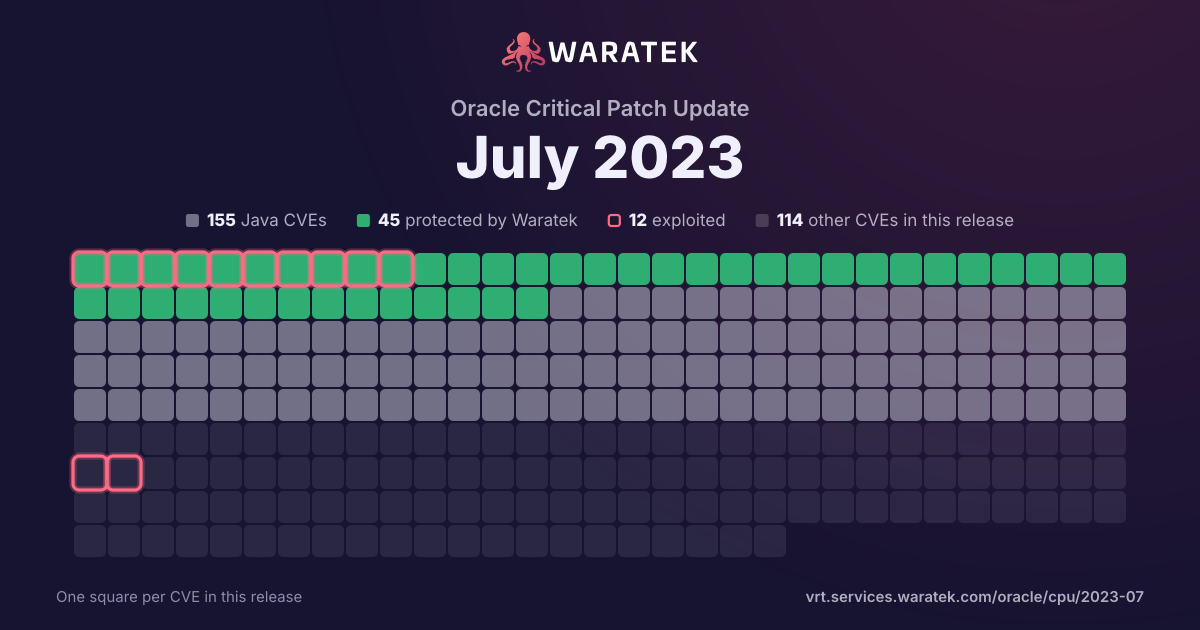
By status
43Protected by Waratek1Rule in development6Mitigation candidate112No exploit published5Outside Waratek scope102Not applicable
12Exploited, marked by the ring
No exploit published. For 28 of them, Oracle's security advisory is the source of public detail.
Protected by Waratek. Waratek RASP can block exploitation of these on systems that have not applied the patch yet.
Overview 12 matches · 7 in Waratek scope · 3 protected · 0 exploited · 0 CISA KEV · 5 public PoC · 3 EPSS ≥ 0.5
12matches
7in Waratek scope58.3%
3protected25.0%
0exploited0.0%
0CISA KEV0.0%
5public PoC41.7%
3EPSS ≥ 0.525.0%
Protected by Waratek
3
25.0%
Rule in development
0
0.0%
Mitigation candidate
1
8.3%
No exploit published
3
25.0%
Outside Waratek scope
0
0.0%
Not applicable
5
41.7%
Withdrawn CVE
0
0.0%
blocked by ARMR today
3
25.0%
partly blocked
0
0.0%
not blocked
9
75.0%
not established
0
0.0%
unrecorded
0
0.0%
Exploited
0
0.0%
Working exploit published
0
0.0%
Proof of concept only
12
100.0%
Forecast only
0
0.0%
No public exploit
0
0.0%
split by
peak 4 / quarter
Q4 191
Protected by Waratek1
Critical1
blocked by ARMR today1
Proof of concept only1
Q1 200
Q2 200
Q3 200
Q4 200
Q1 210
Q2 210
Q3 210
Q4 211
Not applicable1
Medium1
not blocked1
Proof of concept only1
Q1 224
Protected by Waratek1
No exploit published2
Not applicable1
Critical1
High3
blocked by ARMR today1
not blocked3
Proof of concept only4
Q2 223
Protected by Waratek1
No exploit published1
Not applicable1
Critical2
Medium1
blocked by ARMR today1
not blocked2
Proof of concept only3
Q3 223
Mitigation candidate1
Not applicable2
Critical1
High1
Medium1
not blocked3
Proof of concept only3
Q4 19Q1 20Q2 20Q3 20Q4 20Q1 21Q2 21Q3 21Q4 21Q1 22Q2 22Q3 22
| CVE | Severity | Published▾ | Status | Exploitation | Description |
|---|---|---|---|---|---|
| CVE-2022-31160 | Medium | 2022-07-20 | Not applicable | Proof of concept only | jQuery UI is a curated set of user interface interactions, effects, widgets, and themes built on top of jQuery. Versions prior to 1.13.2 are potentially vulnerable to cross-site scripting. Initializing a checkboxradio widget on an input enclosed within a label makes that parent label contents considered as the input label. Calling `.checkboxradio( "refresh" )` on such a widget and the initial HTML contained encoded HTML entities will make them erroneously get decoded. This can lead to potentially executing JavaScript code. The bug has been patched in jQuery UI 1.13.2. To remediate the issue, someone who can change the initial HTML can wrap all the non-input contents of the `label` in a `span`. |
| CVE-2022-33980 | Critical | 2022-07-06 | Mitigation candidate | Proof of concept only | Apache Commons Configuration performs variable interpolation, allowing properties to be dynamically evaluated and expanded. The standard format for interpolation is "${prefix:name}", where "prefix" is used to locate an instance of org.apache.commons.configuration2.interpol.Lookup that performs the interpolation. Starting with version 2.4 and continuing through 2.7, the set of default Lookup instances included interpolators that could result in arbitrary code execution or contact with remote servers. These lookups are: - "script" - execute expressions using the JVM script execution engine (javax.script) - "dns" - resolve dns records - "url" - load values from urls, including from remote servers Applications using the interpolation defaults in the affected versions may be vulnerable to remote code execution or unintentional contact with remote servers if untrusted configuration values are used. Users are recommended to upgrade to Apache Commons Configuration 2.8.0, which disables the problematic interpolators by default. |
| CVE-2022-31129 | High | 2022-07-06 | Not applicable | Proof of concept only | moment is a JavaScript date library for parsing, validating, manipulating, and formatting dates. Affected versions of moment were found to use an inefficient parsing algorithm. Specifically using string-to-date parsing in moment (more specifically rfc2822 parsing, which is tried by default) has quadratic (N^2) complexity on specific inputs. Users may notice a noticeable slowdown is observed with inputs above 10k characters. Users who pass user-provided strings without sanity length checks to moment constructor are vulnerable to (Re)DoS attacks. The problem is patched in 2.29.4, the patch can be applied to all affected versions with minimal tweaking. Users are advised to upgrade. Users unable to upgrade should consider limiting date lengths accepted from user input. |
| CVE-2022-29361 | Critical | 2022-05-25 | Not applicable | Proof of concept only | Improper parsing of HTTP requests in Pallets Werkzeug v2.1.0 and below allows attackers to perform HTTP Request Smuggling using a crafted HTTP request with multiple requests included inside the body. NOTE: the vendor's position is that this behavior can only occur in unsupported configurations involving development mode and an HTTP server from outside the Werkzeug project |
| CVE-2022-24891 | Medium | 2022-04-27 | No exploit published | Proof of concept only | ESAPI (The OWASP Enterprise Security API) is a free, open source, web application security control library. Prior to version 2.3.0.0, there is a potential for a cross-site scripting vulnerability in ESAPI caused by a incorrect regular expression for "onsiteURL" in the **antisamy-esapi.xml** configuration file that can cause "javascript:" URLs to fail to be correctly sanitized. This issue is patched in ESAPI 2.3.0.0. As a workaround, manually edit the **antisamy-esapi.xml** configuration files to change the "onsiteURL" regular expression. More information about remediation of the vulnerability, including the workaround, is available in the maintainers' release notes and security bulletin. |
| CVE-2022-23457 | Critical | 2022-04-25 | Protected by Waratek | Proof of concept only | ESAPI (The OWASP Enterprise Security API) is a free, open source, web application security control library. Prior to version 2.3.0.0, the default implementation of `Validator.getValidDirectoryPath(String, String, File, boolean)` may incorrectly treat the tested input string as a child of the specified parent directory. This potentially could allow control-flow bypass checks to be defeated if an attack can specify the entire string representing the 'input' path. This vulnerability is patched in release 2.3.0.0 of ESAPI. As a workaround, it is possible to write one's own implementation of the Validator interface. However, maintainers do not recommend this. |
| CVE-2018-25032 | High | 2022-03-25 | Not applicable | Proof of concept only | zlib before 1.2.12 allows memory corruption when deflating (i.e., when compressing) if the input has many distant matches. |
| CVE-2021-43859 | High | 2022-02-01 | No exploit published | Proof of concept only | XStream is an open source java library to serialize objects to XML and back again. Versions prior to 1.4.19 may allow a remote attacker to allocate 100% CPU time on the target system depending on CPU type or parallel execution of such a payload resulting in a denial of service only by manipulating the processed input stream. XStream 1.4.19 monitors and accumulates the time it takes to add elements to collections and throws an exception if a set threshold is exceeded. Users are advised to upgrade as soon as possible. Users unable to upgrade may set the NO_REFERENCE mode to prevent recursion. See GHSA-rmr5-cpv2-vgjf for further details on a workaround if an upgrade is not possible. |
| CVE-2022-23305 | Critical | 2022-01-18 | Protected by Waratek | Proof of concept only | By design, the JDBCAppender in Log4j 1.2.x accepts an SQL statement as a configuration parameter where the values to be inserted are converters from PatternLayout. The message converter, %m, is likely to always be included. This allows attackers to manipulate the SQL by entering crafted strings into input fields or headers of an application that are logged allowing unintended SQL queries to be executed. Note this issue only affects Log4j 1.x when specifically configured to use the JDBCAppender, which is not the default. Beginning in version 2.0-beta8, the JDBCAppender was re-introduced with proper support for parameterized SQL queries and further customization over the columns written to in logs. Apache Log4j 1.2 reached end of life in August 2015. Users should upgrade to Log4j 2 as it addresses numerous other issues from the previous versions. |
| CVE-2021-22569 | High | 2022-01-10 | No exploit published | Proof of concept only | An issue in protobuf-java allowed the interleaving of com.google.protobuf.UnknownFieldSet fields in such a way that would be processed out of order. A small malicious payload can occupy the parser for several minutes by creating large numbers of short-lived objects that cause frequent, repeated pauses. We recommend upgrading libraries beyond the vulnerable versions. |
| CVE-2021-41184 | Medium | 2021-10-26 | Not applicable | Proof of concept only | jQuery-UI is the official jQuery user interface library. Prior to version 1.13.0, accepting the value of the `of` option of the `.position()` util from untrusted sources may execute untrusted code. The issue is fixed in jQuery UI 1.13.0. Any string value passed to the `of` option is now treated as a CSS selector. A workaround is to not accept the value of the `of` option from untrusted sources. |
| CVE-2019-17571 | Critical | 2019-12-20 | Protected by Waratek | Proof of concept only | Included in Log4j 1.2 is a SocketServer class that is vulnerable to deserialization of untrusted data which can be exploited to remotely execute arbitrary code when combined with a deserialization gadget when listening to untrusted network traffic for log data. This affects Log4j versions up to 1.2 up to 1.2.17. |