
Oracle Critical Patch Update July 2023
Released July 2023 · Oracle's advisory ↗ · ← Critical Patch Update, April 2023 · Critical Patch Update, October 2023 →
269 CVEs in this release, one square each
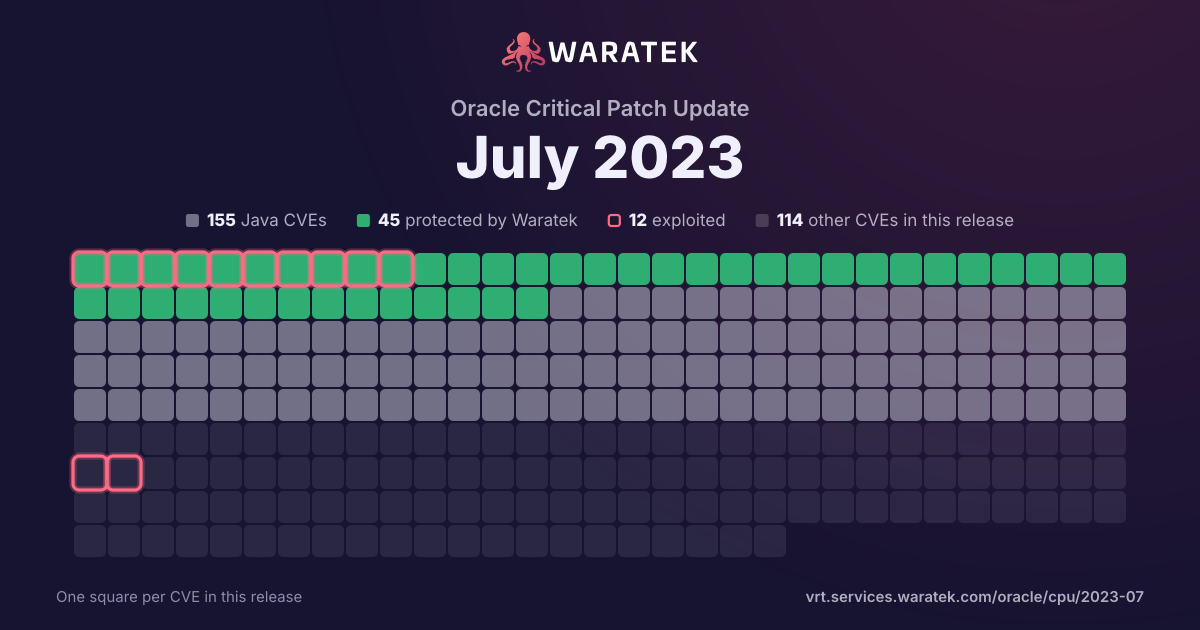
By status
43Protected by Waratek1Rule in development6Mitigation candidate112No exploit published5Outside Waratek scope102Not applicable
12Exploited, marked by the ring
No exploit published. For 28 of them, Oracle's security advisory is the source of public detail.
Protected by Waratek. Waratek RASP can block exploitation of these on systems that have not applied the patch yet.
Overview 8 matches · 5 protected · 0 exploited · 0 CISA KEV · 2 public PoC · 3 EPSS ≥ 0.5
Protected by Waratek
5
62.5%
Rule in development
0
0.0%
Mitigation candidate
1
12.5%
No exploit published
2
25.0%
blocked by ARMR today
5
62.5%
partly blocked
0
0.0%
not blocked
3
37.5%
not established
0
0.0%
unrecorded
0
0.0%
split by
peak 2 / month
May 191
Mitigation candidate1
High1
not blocked1
Working exploit published1
Jun 190
Jul 191
Protected by Waratek1
Critical1
blocked by ARMR today1
No public exploit1
Aug 192
Protected by Waratek1
No exploit published1
High2
blocked by ARMR today1
not blocked1
No public exploit2
Sep 190
Oct 191
No exploit published1
Critical1
not blocked1
No public exploit1
Nov 190
Dec 191
Protected by Waratek1
Critical1
blocked by ARMR today1
Proof of concept only1
Jan 200
Feb 200
Mar 200
Apr 200
May 200
Jun 200
Jul 200
Aug 200
Sep 201
Protected by Waratek1
Critical1
blocked by ARMR today1
Forecast only1
Oct 201
Protected by Waratek1
Medium1
blocked by ARMR today1
No public exploit1
Jun 19Aug 19Oct 19Dec 19Feb 20Apr 20Jun 20Aug 20Oct 20
| CVE | Severity | Published▾ | Status | Exploitation | Description |
|---|---|---|---|---|---|
| CVE-2020-15250 | Medium | 2020-10-12 | Protected by Waratek | No public exploit | In JUnit4 from version 4.7 and before 4.13.1, the test rule TemporaryFolder contains a local information disclosure vulnerability. On Unix like systems, the system's temporary directory is shared between all users on that system. Because of this, when files and directories are written into this directory they are, by default, readable by other users on that same system. This vulnerability does not allow other users to overwrite the contents of these directories or files. This is purely an information disclosure vulnerability. This vulnerability impacts you if the JUnit tests write sensitive information, like API keys or passwords, into the temporary folder, and the JUnit tests execute in an environment where the OS has other untrusted users. Because certain JDK file system APIs were only added in JDK 1.7, this this fix is dependent upon the version of the JDK you are using. For Java 1.7 and higher users: this vulnerability is fixed in 4.13.1. For Java 1.6 and lower users: no patch is available, you must use the workaround below. If you are unable to patch, or are stuck running on Java 1.6, specifying the `java.io.tmpdir` system environment variable to a directory that is exclusively owned by the executing user will fix this vulnerability. For more information, including an example of vulnerable code, see the referenced GitHub Security Advisory. |
| CVE-2020-11998 | Critical | 2020-09-10 | Protected by Waratek | Forecast only | A regression has been introduced in the commit preventing JMX re-bind. By passing an empty environment map to RMIConnectorServer, instead of the map that contains the authentication credentials, it leaves ActiveMQ open to the following attack: https://docs.oracle.com/javase/8/docs/technotes/guides/management/agent.html "A remote client could create a javax.management.loading.MLet MBean and use it to create new MBeans from arbitrary URLs, at least if there is no security manager. In other words, a rogue remote client could make your Java application execute arbitrary code." Mitigation: Upgrade to Apache ActiveMQ 5.15.13 |
| CVE-2019-17571 | Critical | 2019-12-20 | Protected by Waratek | Proof of concept only | Included in Log4j 1.2 is a SocketServer class that is vulnerable to deserialization of untrusted data which can be exploited to remotely execute arbitrary code when combined with a deserialization gadget when listening to untrusted network traffic for log data. This affects Log4j versions up to 1.2 up to 1.2.17. |
| CVE-2019-17531 | Critical | 2019-10-12 | No exploit published | No public exploit | A Polymorphic Typing issue was discovered in FasterXML jackson-databind 2.0.0 through 2.9.10. When Default Typing is enabled (either globally or for a specific property) for an externally exposed JSON endpoint and the service has the apache-log4j-extra (version 1.2.x) jar in the classpath, and an attacker can provide a JNDI service to access, it is possible to make the service execute a malicious payload. |
| CVE-2019-12402 | High | 2019-08-30 | No exploit published | No public exploit | The file name encoding algorithm used internally in Apache Commons Compress 1.15 to 1.18 can get into an infinite loop when faced with specially crafted inputs. This can lead to a denial of service attack if an attacker can choose the file names inside of an archive created by Compress. |
| CVE-2019-10086 | High | 2019-08-20 | Protected by Waratek | No public exploit | In Apache Commons Beanutils 1.9.2, a special BeanIntrospector class was added which allows suppressing the ability for an attacker to access the classloader via the class property available on all Java objects. We, however were not using this by default characteristic of the PropertyUtilsBean. |
| CVE-2019-13990 | Critical | 2019-07-26 | Protected by Waratek | No public exploit | initDocumentParser in xml/XMLSchedulingDataProcessor.java in Terracotta Quartz Scheduler through 2.3.0 allows XXE attacks via a job description. |
| CVE-2019-0227 | High | 2019-05-01 | Mitigation candidate | Working exploit published | A Server Side Request Forgery (SSRF) vulnerability affected the Apache Axis 1.4 distribution that was last released in 2006. Security and bug commits commits continue in the projects Axis 1.x Subversion repository, legacy users are encouraged to build from source. The successor to Axis 1.x is Axis2, the latest version is 1.7.9 and is not vulnerable to this issue. |