
Oracle Critical Patch Update July 2023
Released July 2023 · Oracle's advisory ↗ · ← Critical Patch Update, April 2023 · Critical Patch Update, October 2023 →
269 CVEs in this release, one square each
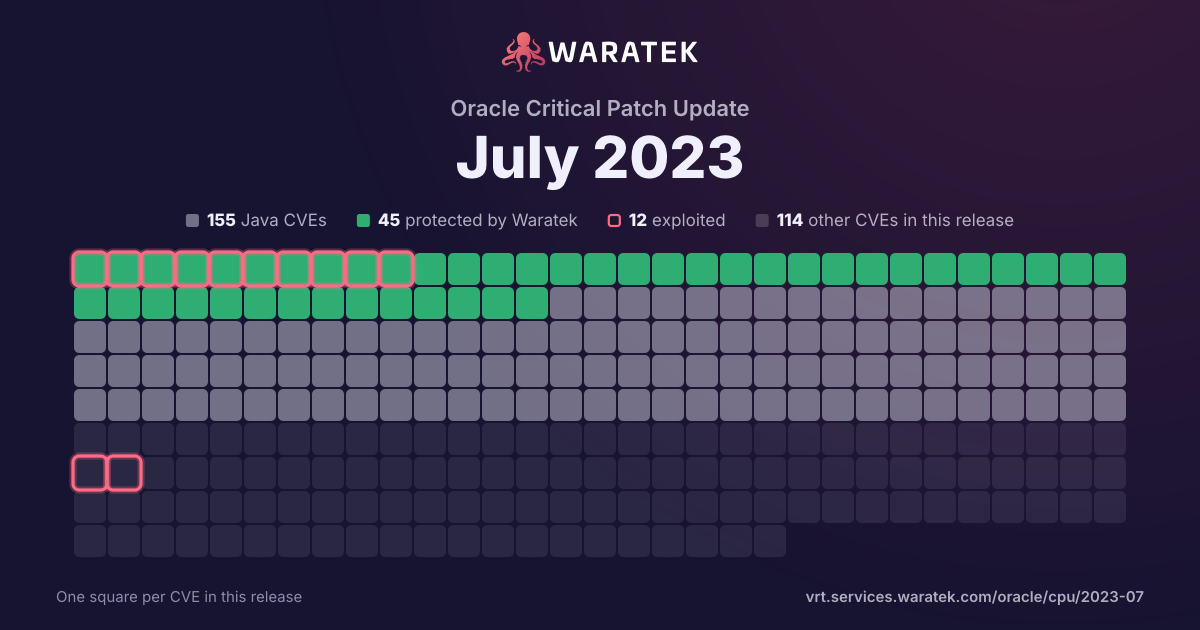
By status
43Protected by Waratek1Rule in development6Mitigation candidate112No exploit published5Outside Waratek scope102Not applicable
12Exploited, marked by the ring
No exploit published. For 28 of them, Oracle's security advisory is the source of public detail.
Protected by Waratek. Waratek RASP can block exploitation of these on systems that have not applied the patch yet.
Overview 11 matches · 0 protected · 0 exploited · 0 CISA KEV · 0 public PoC · 0 EPSS ≥ 0.5
11matches
0protected0.0%
0exploited0.0%
0CISA KEV0.0%
0public PoC0.0%
0EPSS ≥ 0.50.0%
Protected by Waratek
0
0.0%
Rule in development
0
0.0%
Mitigation candidate
0
0.0%
No exploit published
11
100.0%
blocked by ARMR today
0
0.0%
partly blocked
0
0.0%
not blocked
11
100.0%
not established
0
0.0%
unrecorded
0
0.0%
Exploited
0
0.0%
Working exploit published
0
0.0%
Proof of concept only
0
0.0%
Forecast only
0
0.0%
No public exploit
11
100.0%
| CVE | Severity | Published▾ | Status | Exploitation | Description |
|---|---|---|---|---|---|
| CVE-2023-20862 | Medium | 2023-04-19 | No exploit published | No public exploit | In Spring Security, versions 5.7.x prior to 5.7.8, versions 5.8.x prior to 5.8.3, and versions 6.0.x prior to 6.0.3, the logout support does not properly clean the security context if using serialized versions. Additionally, it is not possible to explicitly save an empty security context to the HttpSessionSecurityContextRepository. This vulnerability can keep users authenticated even after they performed logout. Users of affected versions should apply the following mitigation. 5.7.x users should upgrade to 5.7.8. 5.8.x users should upgrade to 5.8.3. 6.0.x users should upgrade to 6.0.3. |
| CVE-2023-26049 | Medium | 2023-04-18 | No exploit published | No public exploit | Jetty is a java based web server and servlet engine. Nonstandard cookie parsing in Jetty may allow an attacker to smuggle cookies within other cookies, or otherwise perform unintended behavior by tampering with the cookie parsing mechanism. If Jetty sees a cookie VALUE that starts with `"` (double quote), it will continue to read the cookie string until it sees a closing quote -- even if a semicolon is encountered. So, a cookie header such as: `DISPLAY_LANGUAGE="b; JSESSIONID=1337; c=d"` will be parsed as one cookie, with the name DISPLAY_LANGUAGE and a value of b; JSESSIONID=1337; c=d instead of 3 separate cookies. This has security implications because if, say, JSESSIONID is an HttpOnly cookie, and the DISPLAY_LANGUAGE cookie value is rendered on the page, an attacker can smuggle the JSESSIONID cookie into the DISPLAY_LANGUAGE cookie and thereby exfiltrate it. This is significant when an intermediary is enacting some policy based on cookies, so a smuggled cookie can bypass that policy yet still be seen by the Jetty server or its logging system. This issue has been addressed in versions 9.4.51, 10.0.14, 11.0.14, and 12.0.0.beta0 and users are advised to upgrade. There are no known workarounds for this issue. |
| CVE-2023-26048 | Medium | 2023-04-18 | No exploit published | No public exploit | Jetty is a java based web server and servlet engine. In affected versions servlets with multipart support (e.g. annotated with `@MultipartConfig`) that call `HttpServletRequest.getParameter()` or `HttpServletRequest.getParts()` may cause `OutOfMemoryError` when the client sends a multipart request with a part that has a name but no filename and very large content. This happens even with the default settings of `fileSizeThreshold=0` which should stream the whole part content to disk. An attacker client may send a large multipart request and cause the server to throw `OutOfMemoryError`. However, the server may be able to recover after the `OutOfMemoryError` and continue its service -- although it may take some time. This issue has been patched in versions 9.4.51, 10.0.14, and 11.0.14. Users are advised to upgrade. Users unable to upgrade may set the multipart parameter `maxRequestSize` which must be set to a non-negative value, so the whole multipart content is limited (although still read into memory). |
| CVE-2023-21971 | Medium | 2023-04-18 | No exploit published | No public exploit | Vulnerability in the MySQL Connectors product of Oracle MySQL (component: Connector/J). Supported versions that are affected are 8.0.32 and prior. Difficult to exploit vulnerability allows high privileged attacker with network access via multiple protocols to compromise MySQL Connectors. Successful attacks require human interaction from a person other than the attacker. Successful attacks of this vulnerability can result in unauthorized ability to cause a hang or frequently repeatable crash (complete DOS) of MySQL Connectors as well as unauthorized update, insert or delete access to some of MySQL Connectors accessible data and unauthorized read access to a subset of MySQL Connectors accessible data. CVSS 3.1 Base Score 5.3 (Confidentiality, Integrity and Availability impacts). CVSS Vector: (CVSS:3.1/AV:N/AC:H/PR:H/UI:R/S:U/C:L/I:L/A:H). |
| CVE-2023-20863 | Medium | 2023-04-13 | No exploit published | No public exploit | In spring framework versions prior to 5.2.24 release+ ,5.3.27+ and 6.0.8+ , it is possible for a user to provide a specially crafted SpEL expression that may cause a denial-of-service (DoS) condition. |
| CVE-2023-20861 | Medium | 2023-03-23 | No exploit published | No public exploit | In Spring Framework versions 6.0.0 - 6.0.6, 5.3.0 - 5.3.25, 5.2.0.RELEASE - 5.2.22.RELEASE, and older unsupported versions, it is possible for a user to provide a specially crafted SpEL expression that may cause a denial-of-service (DoS) condition. |
| CVE-2023-28708 | Medium | 2023-03-22 | No exploit published | No public exploit | When using the RemoteIpFilter with requests received from a reverse proxy via HTTP that include the X-Forwarded-Proto header set to https, session cookies created by Apache Tomcat 11.0.0-M1 to 11.0.0.-M2, 10.1.0-M1 to 10.1.5, 9.0.0-M1 to 9.0.71 and 8.5.0 to 8.5.85 did not include the secure attribute. This could result in the user agent transmitting the session cookie over an insecure channel. Older, EOL versions may also be affected. |
| CVE-2023-27904 | Medium | 2023-03-10 | No exploit published | No public exploit | Jenkins 2.393 and earlier, LTS 2.375.3 and earlier prints an error stack trace on agent-related pages when agent connections are broken, potentially revealing information about Jenkins configuration that is otherwise inaccessible to attackers. |
| CVE-2023-27903 | Medium | 2023-03-10 | No exploit published | No public exploit | Jenkins 2.393 and earlier, LTS 2.375.3 and earlier creates a temporary file in the default temporary directory with the default permissions for newly created files when uploading a file parameter through the CLI, potentially allowing attackers with access to the Jenkins controller file system to read and write the file before it is used. |
| CVE-2023-27902 | Medium | 2023-03-10 | No exploit published | No public exploit | Jenkins 2.393 and earlier, LTS 2.375.3 and earlier shows temporary directories related to job workspaces, which allows attackers with Item/Workspace permission to access their contents. |
| CVE-2022-45787 | Medium | 2023-01-06 | No exploit published | No public exploit | Unproper laxist permissions on the temporary files used by MIME4J TempFileStorageProvider may lead to information disclosure to other local users. This issue affects Apache James MIME4J version 0.8.8 and prior versions. We recommend users to upgrade to MIME4j version 0.8.9 or later. |