
Oracle Critical Patch Update July 2023
Released July 2023 · Oracle's advisory ↗ · ← Critical Patch Update, April 2023 · Critical Patch Update, October 2023 →
269 CVEs in this release, one square each
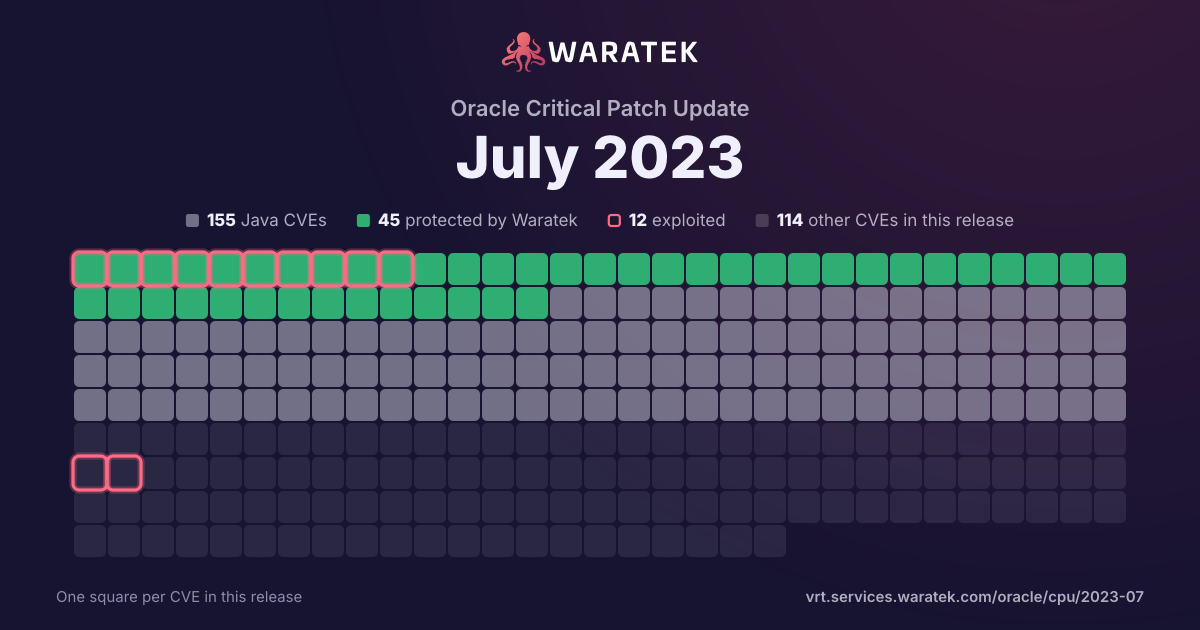
By status
45Protected by Waratek5Mitigation candidate105No exploit published31Outside Waratek scope83Not applicable
12Exploited, marked by the ring
No exploit published. For 37 of them, Oracle's security advisory is the source of public detail.
Protected by Waratek. Waratek RASP can block exploitation of these on systems that have not applied the patch yet.
Overview 43 matches · 29 in Waratek scope · 18 protected · 4 exploited · 2 CISA KEV · 11 public PoC · 6 EPSS ≥ 0.5
43matches
29in Waratek scope67.4%
18protected41.9%
4exploited9.3%
2CISA KEV4.7%
11public PoC25.6%
6EPSS ≥ 0.514.0%
Protected by Waratek
18
41.9%
Rule in development
0
0.0%
Mitigation candidate
3
7.0%
No exploit published
8
18.6%
Outside Waratek scope
2
4.7%
Not applicable
12
27.9%
Withdrawn CVE
0
0.0%
blocked by ARMR today
18
41.9%
partly blocked
0
0.0%
not blocked
25
58.1%
not established
0
0.0%
unrecorded
0
0.0%
Exploited
4
9.3%
Working exploit published
0
0.0%
Proof of concept only
12
27.9%
Forecast only
0
0.0%
No public exploit
27
62.8%
split by
peak 9 / quarter
Q2 181
Protected by Waratek1
Critical1
blocked by ARMR today1
No public exploit1
Q3 180
Q4 180
Q1 190
Q2 190
Q3 191
Outside Waratek scope1
Critical1
not blocked1
No public exploit1
Q4 192
Protected by Waratek1
No exploit published1
Critical2
blocked by ARMR today1
not blocked1
Proof of concept only1
No public exploit1
Q1 201
No exploit published1
Critical1
not blocked1
No public exploit1
Q2 200
Q3 201
Protected by Waratek1
Critical1
blocked by ARMR today1
No public exploit1
Q4 200
Q1 212
Protected by Waratek1
Not applicable1
Critical2
blocked by ARMR today1
not blocked1
No public exploit2
Q2 211
Protected by Waratek1
Critical1
blocked by ARMR today1
No public exploit1
Q3 210
Q4 214
Protected by Waratek4
Critical4
blocked by ARMR today4
Exploited2
No public exploit2
Q1 221
Protected by Waratek1
Critical1
blocked by ARMR today1
Proof of concept only1
Q2 224
Protected by Waratek2
Not applicable2
Critical4
blocked by ARMR today2
not blocked2
Proof of concept only2
No public exploit2
Q3 229
Protected by Waratek1
Mitigation candidate1
No exploit published3
Outside Waratek scope1
Not applicable3
Critical9
blocked by ARMR today1
not blocked8
Proof of concept only3
No public exploit6
Q4 228
Protected by Waratek5
Mitigation candidate2
Not applicable1
Critical8
blocked by ARMR today5
not blocked3
Exploited1
Proof of concept only4
No public exploit3
Q1 234
No exploit published1
Not applicable3
Critical4
not blocked4
Exploited1
Proof of concept only1
No public exploit2
Q2 232
No exploit published2
Critical2
not blocked2
No public exploit2
Q3 232
Not applicable2
Critical2
not blocked2
No public exploit2
Q3 18Q1 19Q3 19Q1 20Q3 20Q1 21Q3 21Q1 22Q3 22Q1 23Q3 23
| CVE | Severity | Published▾ | Status | Exploitation | Description |
|---|---|---|---|---|---|
| CVE-2023-21975 | Critical | 2023-07-18 | Not applicable | No public exploit | Vulnerability in the Application Express Customers Plugin product of Oracle Application Express (component: User Account). Supported versions that are affected are Application Express Customers Plugin: 18.2-22.2. Easily exploitable vulnerability allows low privileged attacker with network access via HTTP to compromise Application Express Customers Plugin. Successful attacks require human interaction from a person other than the attacker and while the vulnerability is in Application Express Customers Plugin, attacks may significantly impact additional products (scope change). Successful attacks of this vulnerability can result in takeover of Application Express Customers Plugin. CVSS 3.1 Base Score 9.0 (Confidentiality, Integrity and Availability impacts). CVSS Vector: (CVSS:3.1/AV:N/AC:L/PR:L/UI:R/S:C/C:H/I:H/A:H). |
| CVE-2023-21974 | Critical | 2023-07-18 | Not applicable | No public exploit | Vulnerability in the Application Express Team Calendar Plugin product of Oracle Application Express (component: User Account). Supported versions that are affected are Application Express Team Calendar Plugin: 18.2-22.1. Easily exploitable vulnerability allows low privileged attacker with network access via HTTP to compromise Application Express Team Calendar Plugin. Successful attacks require human interaction from a person other than the attacker and while the vulnerability is in Application Express Team Calendar Plugin, attacks may significantly impact additional products (scope change). Successful attacks of this vulnerability can result in takeover of Application Express Team Calendar Plugin. CVSS 3.1 Base Score 9.0 (Confidentiality, Integrity and Availability impacts). CVSS Vector: (CVSS:3.1/AV:N/AC:L/PR:L/UI:R/S:C/C:H/I:H/A:H). |
| CVE-2023-20873 | Critical | 2023-04-20 | No exploit published | No public exploit | In Spring Boot versions 3.0.0 - 3.0.5, 2.7.0 - 2.7.10, and older unsupported versions, an application that is deployed to Cloud Foundry could be susceptible to a security bypass. Users of affected versions should apply the following mitigation: 3.0.x users should upgrade to 3.0.6+. 2.7.x users should upgrade to 2.7.11+. Users of older, unsupported versions should upgrade to 3.0.6+ or 2.7.11+. |
| CVE-2023-26119 | Critical | 2023-04-03 | No exploit published | No public exploit | Versions of the package net.sourceforge.htmlunit:htmlunit from 0 and before 3.0.0 are vulnerable to Remote Code Execution (RCE) via XSTL, when browsing the attacker’s webpage. |
| CVE-2023-27898 | Critical | 2023-03-10 | No exploit published | No public exploit | Jenkins 2.270 through 2.393 (both inclusive), LTS 2.277.1 through 2.375.3 (both inclusive) does not escape the Jenkins version a plugin depends on when rendering the error message stating its incompatibility with the current version of Jenkins, resulting in a stored cross-site scripting (XSS) vulnerability exploitable by attackers able to provide plugins to the configured update sites and have this message shown by Jenkins instances. |
| CVE-2023-25690 | Critical | 2023-03-07 | Not applicable | Exploited | Some mod_proxy configurations on Apache HTTP Server versions 2.4.0 through 2.4.55 allow a HTTP Request Smuggling attack. Configurations are affected when mod_proxy is enabled along with some form of RewriteRule or ProxyPassMatch in which a non-specific pattern matches some portion of the user-supplied request-target (URL) data and is then re-inserted into the proxied request-target using variable substitution. For example, something like: RewriteEngine on RewriteRule "^/here/(.*)" "http://example.com:8080/elsewhere?$1"; [P] ProxyPassReverse /here/ http://example.com:8080/ Request splitting/smuggling could result in bypass of access controls in the proxy server, proxying unintended URLs to existing origin servers, and cache poisoning. Users are recommended to update to at least version 2.4.56 of Apache HTTP Server. |
| CVE-2023-23914 | Critical | 2023-02-23 | Not applicable | Proof of concept only | A cleartext transmission of sensitive information vulnerability exists in curl <v7.88.0 that could cause HSTS functionality fail when multiple URLs are requested serially. Using its HSTS support, curl can be instructed to use HTTPS instead of usingan insecure clear-text HTTP step even when HTTP is provided in the URL. ThisHSTS mechanism would however surprisingly be ignored by subsequent transferswhen done on the same command line because the state would not be properlycarried on. |
| CVE-2022-36760 | Critical | 2023-01-17 | Not applicable | No public exploit | Inconsistent Interpretation of HTTP Requests ('HTTP Request Smuggling') vulnerability in mod_proxy_ajp of Apache HTTP Server allows an attacker to smuggle requests to the AJP server it forwards requests to. This issue affects Apache HTTP Server Apache HTTP Server 2.4 version 2.4.54 and prior versions. |
| CVE-2022-46364 | Critical | 2022-12-13 | Mitigation candidate | Proof of concept only | A SSRF vulnerability in parsing the href attribute of XOP:Include in MTOM requests in versions of Apache CXF before 3.5.5 and 3.4.10 allows an attacker to perform SSRF style attacks on webservices that take at least one parameter of any type. |
| CVE-2022-1471 | Critical | 2022-12-01 | Protected by Waratek | Exploited | SnakeYaml's Constructor() class does not restrict types which can be instantiated during deserialization. Deserializing yaml content provided by an attacker can lead to remote code execution. We recommend using SnakeYaml's SafeConsturctor when parsing untrusted content to restrict deserialization. We recommend upgrading to version 2.0 and beyond. |
| CVE-2022-45047 | Critical | 2022-11-16 | Protected by Waratek | Proof of concept only | Class org.apache.sshd.server.keyprovider.SimpleGeneratorHostKeyProvider in Apache MINA SSHD <= 2.9.1 uses Java deserialization to load a serialized java.security.PrivateKey. The class is one of several implementations that an implementor using Apache MINA SSHD can choose for loading the host keys of an SSH server. |
| CVE-2022-42920 | Critical | 2022-11-07 | Protected by Waratek | No public exploit | Apache Commons BCEL has a number of APIs that would normally only allow changing specific class characteristics. However, due to an out-of-bounds writing issue, these APIs can be used to produce arbitrary bytecode. This could be abused in applications that pass attacker-controllable data to those APIs, giving the attacker more control over the resulting bytecode than otherwise expected. Update to Apache Commons BCEL 6.6.0. |
| CVE-2022-37865 | Critical | 2022-11-07 | Protected by Waratek | No public exploit | With Apache Ivy 2.4.0 an optional packaging attribute has been introduced that allows artifacts to be unpacked on the fly if they used pack200 or zip packaging. For artifacts using the "zip", "jar" or "war" packaging Ivy prior to 2.5.1 doesn't verify the target path when extracting the archive. An archive containing absolute paths or paths that try to traverse "upwards" using ".." sequences can then write files to any location on the local fie system that the user executing Ivy has write access to. Ivy users of version 2.4.0 to 2.5.0 should upgrade to Ivy 2.5.1. |
| CVE-2022-31692 | Critical | 2022-10-31 | Mitigation candidate | Proof of concept only | Spring Security, versions 5.7 prior to 5.7.5 and 5.6 prior to 5.6.9 could be susceptible to authorization rules bypass via forward or include dispatcher types. Specifically, an application is vulnerable when all of the following are true: The application expects that Spring Security applies security to forward and include dispatcher types. The application uses the AuthorizationFilter either manually or via the authorizeHttpRequests() method. The application configures the FilterChainProxy to apply to forward and/or include requests (e.g. spring.security.filter.dispatcher-types = request, error, async, forward, include). The application may forward or include the request to a higher privilege-secured endpoint.The application configures Spring Security to apply to every dispatcher type via authorizeHttpRequests().shouldFilterAllDispatcherTypes(true) |
| CVE-2022-37454 | Critical | 2022-10-21 | Not applicable | Proof of concept only | The Keccak XKCP SHA-3 reference implementation before fdc6fef has an integer overflow and resultant buffer overflow that allows attackers to execute arbitrary code or eliminate expected cryptographic properties. This occurs in the sponge function interface. |
| CVE-2022-41853 | Critical | 2022-10-06 | Protected by Waratek | No public exploit | Those using java.sql.Statement or java.sql.PreparedStatement in hsqldb (HyperSQL DataBase) to process untrusted input may be vulnerable to a remote code execution attack. By default it is allowed to call any static method of any Java class in the classpath resulting in code execution. The issue can be prevented by updating to 2.7.1 or by setting the system property "hsqldb.method_class_names" to classes which are allowed to be called. For example, System.setProperty("hsqldb.method_class_names", "abc") or Java argument -Dhsqldb.method_class_names="abc" can be used. From version 2.7.1 all classes by default are not accessible except those in java.lang.Math and need to be manually enabled. |
| CVE-2022-36944 | Critical | 2022-09-23 | Protected by Waratek | Proof of concept only | Scala 2.13.x before 2.13.9 has a Java deserialization chain in its JAR file. On its own, it cannot be exploited. There is only a risk in conjunction with Java object deserialization within an application. In such situations, it allows attackers to erase contents of arbitrary files, make network connections, or possibly run arbitrary code (specifically, Function0 functions) via a gadget chain. |
| CVE-2022-37434 | Critical | 2022-08-05 | Outside Waratek scope | Proof of concept only | zlib through 1.2.12 has a heap-based buffer over-read or buffer overflow in inflate in inflate.c via a large gzip header extra field. NOTE: only applications that call inflateGetHeader are affected. Some common applications bundle the affected zlib source code but may be unable to call inflateGetHeader (e.g., see the nodejs/node reference). |
| CVE-2020-35169 | Critical | 2022-07-11 | No exploit published | No public exploit | Dell BSAFE Crypto-C Micro Edition, versions before 4.1.5, and Dell BSAFE Micro Edition Suite, versions before 4.5.2, contain an Improper Input Validation Vulnerability. |
| CVE-2020-35168 | Critical | 2022-07-11 | Not applicable | No public exploit | Dell BSAFE Crypto-C Micro Edition, versions before 4.1.5, and Dell BSAFE Micro Edition Suite, versions before 4.6, contain an Observable Timing Discrepancy Vulnerability. |
| CVE-2020-35167 | Critical | 2022-07-11 | Not applicable | No public exploit | Dell BSAFE Crypto-C Micro Edition, versions before 4.1.5, and Dell BSAFE Micro Edition Suite, versions before 4.6, contain an Observable Timing Discrepancy Vulnerability. |
| CVE-2020-35166 | Critical | 2022-07-11 | No exploit published | No public exploit | Dell BSAFE Crypto-C Micro Edition, versions before 4.1.5, and Dell BSAFE Micro Edition Suite, versions before 4.6, contain an Observable Timing Discrepancy Vulnerability. |
| CVE-2020-35163 | Critical | 2022-07-11 | Not applicable | No public exploit | Dell BSAFE Crypto-C Micro Edition, versions before 4.1.5, and Dell BSAFE Micro Edition Suite, versions before 4.6, contain a Use of Insufficiently Random Values Vulnerability. |
| CVE-2020-29508 | Critical | 2022-07-11 | No exploit published | No public exploit | Dell BSAFE Crypto-C Micro Edition, versions before 4.1.5, and Dell BSAFE Micro Edition Suite, versions before 4.6, contain an Improper Input Validation Vulnerability. |
| CVE-2022-33980 | Critical | 2022-07-06 | Mitigation candidate | Proof of concept only | Apache Commons Configuration performs variable interpolation, allowing properties to be dynamically evaluated and expanded. The standard format for interpolation is "${prefix:name}", where "prefix" is used to locate an instance of org.apache.commons.configuration2.interpol.Lookup that performs the interpolation. Starting with version 2.4 and continuing through 2.7, the set of default Lookup instances included interpolators that could result in arbitrary code execution or contact with remote servers. These lookups are: - "script" - execute expressions using the JVM script execution engine (javax.script) - "dns" - resolve dns records - "url" - load values from urls, including from remote servers Applications using the interpolation defaults in the affected versions may be vulnerable to remote code execution or unintentional contact with remote servers if untrusted configuration values are used. Users are recommended to upgrade to Apache Commons Configuration 2.8.0, which disables the problematic interpolators by default. |
| CVE-2022-29361 | Critical | 2022-05-25 | Not applicable | Proof of concept only | Improper parsing of HTTP requests in Pallets Werkzeug v2.1.0 and below allows attackers to perform HTTP Request Smuggling using a crafted HTTP request with multiple requests included inside the body. NOTE: the vendor's position is that this behavior can only occur in unsupported configurations involving development mode and an HTTP server from outside the Werkzeug project |
| CVE-2022-23457 | Critical | 2022-04-25 | Protected by Waratek | Proof of concept only | ESAPI (The OWASP Enterprise Security API) is a free, open source, web application security control library. Prior to version 2.3.0.0, the default implementation of `Validator.getValidDirectoryPath(String, String, File, boolean)` may incorrectly treat the tested input string as a child of the specified parent directory. This potentially could allow control-flow bypass checks to be defeated if an attack can specify the entire string representing the 'input' path. This vulnerability is patched in release 2.3.0.0 of ESAPI. As a workaround, it is possible to write one's own implementation of the Validator interface. However, maintainers do not recommend this. |
| CVE-2022-27404 | Critical | 2022-04-22 | Not applicable | No public exploit | FreeType commit 1e2eb65048f75c64b68708efed6ce904c31f3b2f was discovered to contain a heap buffer overflow via the function sfnt_init_face. |
| CVE-2022-26612 | Critical | 2022-04-07 | Protected by Waratek | No public exploit | In Apache Hadoop, The unTar function uses unTarUsingJava function on Windows and the built-in tar utility on Unix and other OSes. As a result, a TAR entry may create a symlink under the expected extraction directory which points to an external directory. A subsequent TAR entry may extract an arbitrary file into the external directory using the symlink name. This however would be caught by the same targetDirPath check on Unix because of the getCanonicalPath call. However on Windows, getCanonicalPath doesn't resolve symbolic links, which bypasses the check. unpackEntries during TAR extraction follows symbolic links which allows writing outside expected base directory on Windows. This was addressed in Apache Hadoop 3.2.3 |
| CVE-2022-23305 | Critical | 2022-01-18 | Protected by Waratek | Proof of concept only | By design, the JDBCAppender in Log4j 1.2.x accepts an SQL statement as a configuration parameter where the values to be inserted are converters from PatternLayout. The message converter, %m, is likely to always be included. This allows attackers to manipulate the SQL by entering crafted strings into input fields or headers of an application that are logged allowing unintended SQL queries to be executed. Note this issue only affects Log4j 1.x when specifically configured to use the JDBCAppender, which is not the default. Beginning in version 2.0-beta8, the JDBCAppender was re-introduced with proper support for parameterized SQL queries and further customization over the columns written to in logs. Apache Log4j 1.2 reached end of life in August 2015. Users should upgrade to Log4j 2 as it addresses numerous other issues from the previous versions. |
| CVE-2021-43113 | Critical | 2021-12-15 | Protected by Waratek | No public exploit | iTextPDF in iText 7 and up to (excluding 4.4.13.3) 7.1.17 allows command injection via a CompareTool filename that is mishandled on the gs (aka Ghostscript) command line in GhostscriptHelper.java. |
| CVE-2021-45046 | Critical | 2021-12-14 | Protected by Waratek | Exploited | It was found that the fix to address CVE-2021-44228 in Apache Log4j 2.15.0 was incomplete in certain non-default configurations. This could allows attackers with control over Thread Context Map (MDC) input data when the logging configuration uses a non-default Pattern Layout with either a Context Lookup (for example, $${ctx:loginId}) or a Thread Context Map pattern (%X, %mdc, or %MDC) to craft malicious input data using a JNDI Lookup pattern resulting in an information leak and remote code execution in some environments and local code execution in all environments. Log4j 2.16.0 (Java 8) and 2.12.2 (Java 7) fix this issue by removing support for message lookup patterns and disabling JNDI functionality by default. |
| CVE-2021-44228 | Critical | 2021-12-10 | Protected by Waratek | Exploited | Apache Log4j2 2.0-beta9 through 2.15.0 (excluding security releases 2.12.2, 2.12.3, and 2.3.1) JNDI features used in configuration, log messages, and parameters do not protect against attacker controlled LDAP and other JNDI related endpoints. An attacker who can control log messages or log message parameters can execute arbitrary code loaded from LDAP servers when message lookup substitution is enabled. From log4j 2.15.0, this behavior has been disabled by default. From version 2.16.0 (along with 2.12.2, 2.12.3, and 2.3.1), this functionality has been completely removed. Note that this vulnerability is specific to log4j-core and does not affect log4net, log4cxx, or other Apache Logging Services projects. |
| CVE-2021-42575 | Critical | 2021-10-18 | Protected by Waratek | No public exploit | The OWASP Java HTML Sanitizer before 20211018.1 does not properly enforce policies associated with the SELECT, STYLE, and OPTION elements. |
| CVE-2020-9493 | Critical | 2021-06-16 | Protected by Waratek | No public exploit | A deserialization flaw was found in Apache Chainsaw versions prior to 2.1.0 which could lead to malicious code execution. |
| CVE-2021-24112 | Critical | 2021-02-25 | Not applicable | No public exploit | .NET Core Remote Code Execution Vulnerability |
| CVE-2021-23926 | Critical | 2021-01-14 | Protected by Waratek | No public exploit | The XML parsers used by XMLBeans up to version 2.6.0 did not set the properties needed to protect the user from malicious XML input. Vulnerabilities include possibilities for XML Entity Expansion attacks. Affects XMLBeans up to and including v2.6.0. |
| CVE-2020-11998 | Critical | 2020-09-10 | Protected by Waratek | No public exploit | A regression has been introduced in the commit preventing JMX re-bind. By passing an empty environment map to RMIConnectorServer, instead of the map that contains the authentication credentials, it leaves ActiveMQ open to the following attack: https://docs.oracle.com/javase/8/docs/technotes/guides/management/agent.html "A remote client could create a javax.management.loading.MLet MBean and use it to create new MBeans from arbitrary URLs, at least if there is no security manager. In other words, a rogue remote client could make your Java application execute arbitrary code." Mitigation: Upgrade to Apache ActiveMQ 5.15.13 |
| CVE-2020-1953 | Critical | 2020-03-13 | No exploit published | No public exploit | Apache Commons Configuration uses a third-party library to parse YAML files which by default allows the instantiation of classes if the YAML includes special statements. Apache Commons Configuration versions 2.2, 2.3, 2.4, 2.5, 2.6 did not change the default settings of this library. So if a YAML file was loaded from an untrusted source, it could therefore load and execute code out of the control of the host application. |
| CVE-2019-17571 | Critical | 2019-12-20 | Protected by Waratek | Proof of concept only | Included in Log4j 1.2 is a SocketServer class that is vulnerable to deserialization of untrusted data which can be exploited to remotely execute arbitrary code when combined with a deserialization gadget when listening to untrusted network traffic for log data. This affects Log4j versions up to 1.2 up to 1.2.17. |
| CVE-2019-17531 | Critical | 2019-10-12 | No exploit published | No public exploit | A Polymorphic Typing issue was discovered in FasterXML jackson-databind 2.0.0 through 2.9.10. When Default Typing is enabled (either globally or for a specific property) for an externally exposed JSON endpoint and the service has the apache-log4j-extra (version 1.2.x) jar in the classpath, and an attacker can provide a JNDI service to access, it is possible to make the service execute a malicious payload. |
| CVE-2019-13990 | Critical | 2019-07-26 | Outside Waratek scope | No public exploit | initDocumentParser in xml/XMLSchedulingDataProcessor.java in Terracotta Quartz Scheduler through 2.3.0 allows XXE attacks via a job description. |
| CVE-2018-1282 | Critical | 2018-04-05 | Protected by Waratek | No public exploit | This vulnerability in Apache Hive JDBC driver 0.7.1 to 2.3.2 allows carefully crafted arguments to be used to bypass the argument escaping/cleanup that JDBC driver does in PreparedStatement implementation. |