
Oracle Critical Patch Update July 2023
Released July 2023 · Oracle's advisory ↗ · ← Critical Patch Update, April 2023 · Critical Patch Update, October 2023 →
269 CVEs in this release, one square each
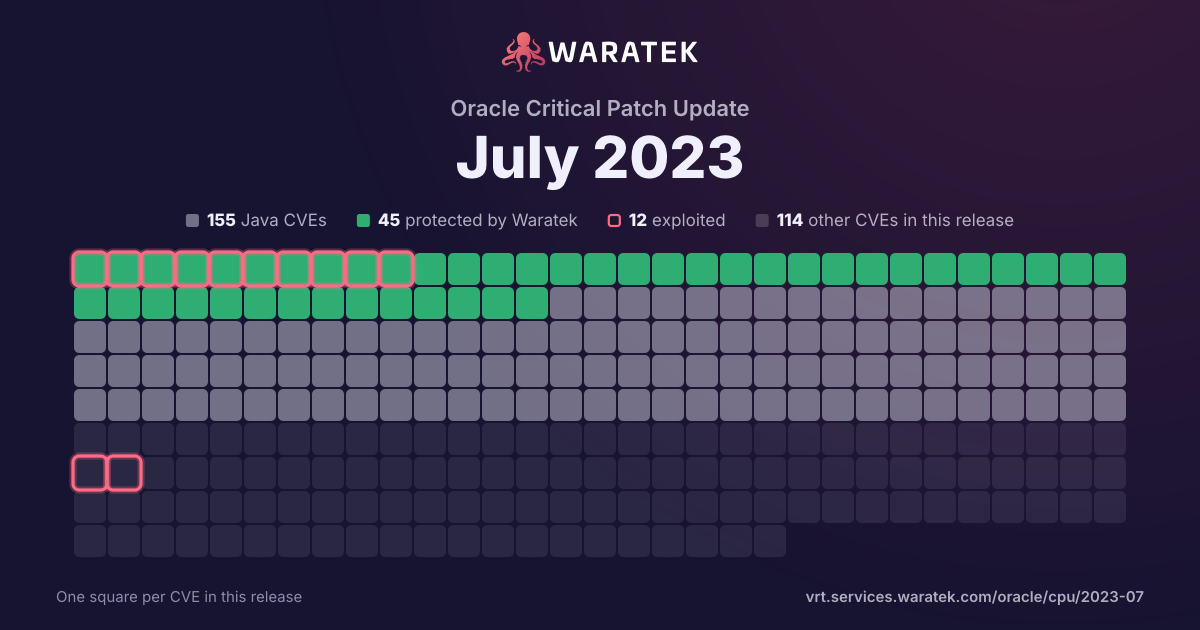
By status
45Protected by Waratek5Mitigation candidate105No exploit published31Outside Waratek scope83Not applicable
12Exploited, marked by the ring
No exploit published. For 37 of them, Oracle's security advisory is the source of public detail.
Protected by Waratek. Waratek RASP can block exploitation of these on systems that have not applied the patch yet.
Overview 9 matches · 6 protected · 3 exploited · 2 CISA KEV · 5 EPSS ≥ 0.5
Protected by Waratek
6
66.7%
Rule in development
0
0.0%
Mitigation candidate
3
33.3%
No exploit published
0
0.0%
blocked by ARMR today
6
66.7%
partly blocked
0
0.0%
not blocked
3
33.3%
not established
0
0.0%
unrecorded
0
0.0%
Exploited
3
33.3%
Working exploit published
0
0.0%
Proof of concept only
6
66.7%
Forecast only
0
0.0%
No public exploit
0
0.0%
split by
peak 3 / quarter
Q4 191
Protected by Waratek1
Critical1
blocked by ARMR today1
Proof of concept only1
Q1 200
Q2 200
Q3 200
Q4 200
Q1 210
Q2 210
Q3 210
Q4 212
Protected by Waratek2
Critical2
blocked by ARMR today2
Exploited2
Q1 221
Protected by Waratek1
Critical1
blocked by ARMR today1
Proof of concept only1
Q2 220
Q3 222
Protected by Waratek1
Mitigation candidate1
Critical2
blocked by ARMR today1
not blocked1
Proof of concept only2
Q4 223
Protected by Waratek1
Mitigation candidate2
Critical3
blocked by ARMR today1
not blocked2
Exploited1
Proof of concept only2
Q4 19Q2 20Q4 20Q2 21Q4 21Q2 22Q4 22
| CVE | Severity | Published▾ | Status | Exploitation | Description |
|---|---|---|---|---|---|
| CVE-2022-46364 | Critical | 2022-12-13 | Mitigation candidate | Proof of concept only | A SSRF vulnerability in parsing the href attribute of XOP:Include in MTOM requests in versions of Apache CXF before 3.5.5 and 3.4.10 allows an attacker to perform SSRF style attacks on webservices that take at least one parameter of any type. |
| CVE-2022-1471 | Critical | 2022-12-01 | Protected by Waratek | Exploited | SnakeYaml's Constructor() class does not restrict types which can be instantiated during deserialization. Deserializing yaml content provided by an attacker can lead to remote code execution. We recommend using SnakeYaml's SafeConsturctor when parsing untrusted content to restrict deserialization. We recommend upgrading to version 2.0 and beyond. |
| CVE-2022-31692 | Critical | 2022-10-31 | Mitigation candidate | Proof of concept only | Spring Security, versions 5.7 prior to 5.7.5 and 5.6 prior to 5.6.9 could be susceptible to authorization rules bypass via forward or include dispatcher types. Specifically, an application is vulnerable when all of the following are true: The application expects that Spring Security applies security to forward and include dispatcher types. The application uses the AuthorizationFilter either manually or via the authorizeHttpRequests() method. The application configures the FilterChainProxy to apply to forward and/or include requests (e.g. spring.security.filter.dispatcher-types = request, error, async, forward, include). The application may forward or include the request to a higher privilege-secured endpoint.The application configures Spring Security to apply to every dispatcher type via authorizeHttpRequests().shouldFilterAllDispatcherTypes(true) |
| CVE-2022-36944 | Critical | 2022-09-23 | Protected by Waratek | Proof of concept only | Scala 2.13.x before 2.13.9 has a Java deserialization chain in its JAR file. On its own, it cannot be exploited. There is only a risk in conjunction with Java object deserialization within an application. In such situations, it allows attackers to erase contents of arbitrary files, make network connections, or possibly run arbitrary code (specifically, Function0 functions) via a gadget chain. |
| CVE-2022-33980 | Critical | 2022-07-06 | Mitigation candidate | Proof of concept only | Apache Commons Configuration performs variable interpolation, allowing properties to be dynamically evaluated and expanded. The standard format for interpolation is "${prefix:name}", where "prefix" is used to locate an instance of org.apache.commons.configuration2.interpol.Lookup that performs the interpolation. Starting with version 2.4 and continuing through 2.7, the set of default Lookup instances included interpolators that could result in arbitrary code execution or contact with remote servers. These lookups are: - "script" - execute expressions using the JVM script execution engine (javax.script) - "dns" - resolve dns records - "url" - load values from urls, including from remote servers Applications using the interpolation defaults in the affected versions may be vulnerable to remote code execution or unintentional contact with remote servers if untrusted configuration values are used. Users are recommended to upgrade to Apache Commons Configuration 2.8.0, which disables the problematic interpolators by default. |
| CVE-2022-23305 | Critical | 2022-01-18 | Protected by Waratek | Proof of concept only | By design, the JDBCAppender in Log4j 1.2.x accepts an SQL statement as a configuration parameter where the values to be inserted are converters from PatternLayout. The message converter, %m, is likely to always be included. This allows attackers to manipulate the SQL by entering crafted strings into input fields or headers of an application that are logged allowing unintended SQL queries to be executed. Note this issue only affects Log4j 1.x when specifically configured to use the JDBCAppender, which is not the default. Beginning in version 2.0-beta8, the JDBCAppender was re-introduced with proper support for parameterized SQL queries and further customization over the columns written to in logs. Apache Log4j 1.2 reached end of life in August 2015. Users should upgrade to Log4j 2 as it addresses numerous other issues from the previous versions. |
| CVE-2021-45046 | Critical | 2021-12-14 | Protected by Waratek | Exploited | It was found that the fix to address CVE-2021-44228 in Apache Log4j 2.15.0 was incomplete in certain non-default configurations. This could allows attackers with control over Thread Context Map (MDC) input data when the logging configuration uses a non-default Pattern Layout with either a Context Lookup (for example, $${ctx:loginId}) or a Thread Context Map pattern (%X, %mdc, or %MDC) to craft malicious input data using a JNDI Lookup pattern resulting in an information leak and remote code execution in some environments and local code execution in all environments. Log4j 2.16.0 (Java 8) and 2.12.2 (Java 7) fix this issue by removing support for message lookup patterns and disabling JNDI functionality by default. |
| CVE-2021-44228 | Critical | 2021-12-10 | Protected by Waratek | Exploited | Apache Log4j2 2.0-beta9 through 2.15.0 (excluding security releases 2.12.2, 2.12.3, and 2.3.1) JNDI features used in configuration, log messages, and parameters do not protect against attacker controlled LDAP and other JNDI related endpoints. An attacker who can control log messages or log message parameters can execute arbitrary code loaded from LDAP servers when message lookup substitution is enabled. From log4j 2.15.0, this behavior has been disabled by default. From version 2.16.0 (along with 2.12.2, 2.12.3, and 2.3.1), this functionality has been completely removed. Note that this vulnerability is specific to log4j-core and does not affect log4net, log4cxx, or other Apache Logging Services projects. |
| CVE-2019-17571 | Critical | 2019-12-20 | Protected by Waratek | Proof of concept only | Included in Log4j 1.2 is a SocketServer class that is vulnerable to deserialization of untrusted data which can be exploited to remotely execute arbitrary code when combined with a deserialization gadget when listening to untrusted network traffic for log data. This affects Log4j versions up to 1.2 up to 1.2.17. |