
Oracle Critical Patch Update April 2023
Released April 2023 · Oracle's advisory ↗ · ← Critical Patch Update, January 2023 · Critical Patch Update, July 2023 →
328 CVEs in this release, one square each
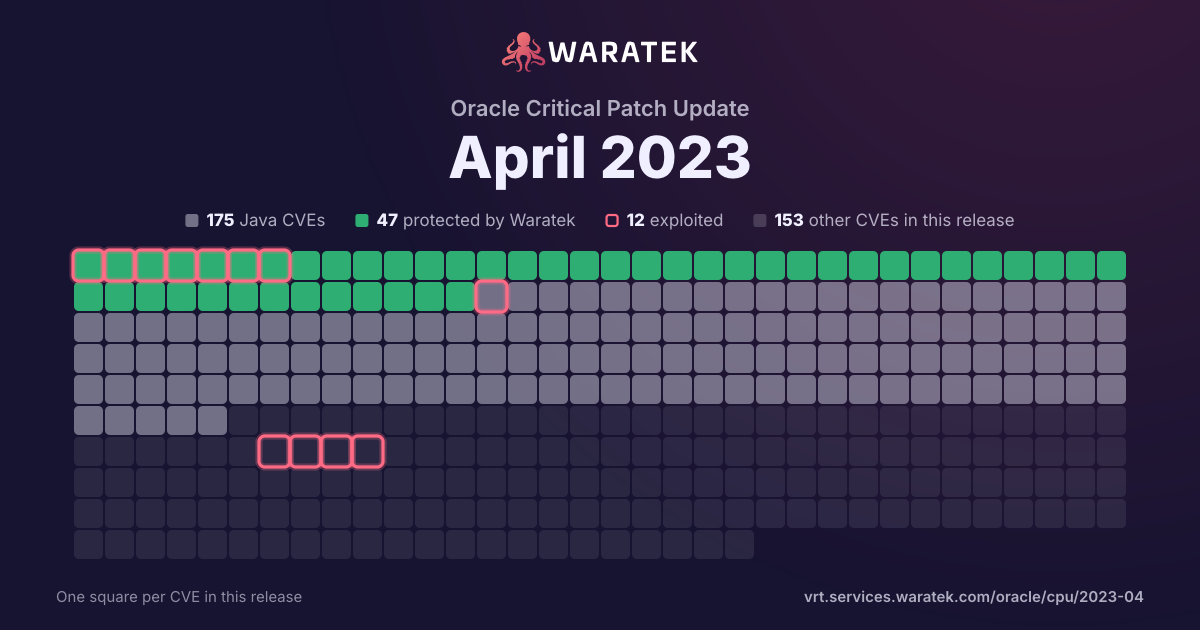
By status
47Protected by Waratek9Mitigation candidate119No exploit published35Outside Waratek scope118Not applicable
12Exploited, marked by the ring
No exploit published. For 56 of them, Oracle's security advisory is the source of public detail.
Protected by Waratek. Waratek RASP can block exploitation of these on systems that have not applied the patch yet.
Overview 107 matches · 57 in Waratek scope · 12 protected · 0 exploited · 0 CISA KEV · 0 public PoC · 0 EPSS ≥ 0.5
107matches
57in Waratek scope53.3%
12protected11.2%
0exploited0.0%
0CISA KEV0.0%
0public PoC0.0%
0EPSS ≥ 0.50.0%
Protected by Waratek
12
11.2%
Rule in development
0
0.0%
Mitigation candidate
0
0.0%
No exploit published
45
42.1%
Outside Waratek scope
7
6.5%
Not applicable
43
40.2%
Withdrawn CVE
0
0.0%
blocked by ARMR today
12
11.2%
partly blocked
0
0.0%
not blocked
95
88.8%
not established
0
0.0%
unrecorded
0
0.0%
Exploited
0
0.0%
Working exploit published
0
0.0%
Proof of concept only
0
0.0%
Forecast only
0
0.0%
No public exploit
107
100.0%
split by
peak 24 / quarter
Q3 182
Protected by Waratek1
Not applicable1
High2
blocked by ARMR today1
not blocked1
No public exploit2
Q4 181
Not applicable1
High1
not blocked1
No public exploit1
Q1 190
Q2 190
Q3 192
Protected by Waratek1
No exploit published1
High2
blocked by ARMR today1
not blocked1
No public exploit2
Q4 192
Not applicable2
High2
not blocked2
No public exploit2
Q1 201
No exploit published1
High1
not blocked1
No public exploit1
Q2 201
Not applicable1
High1
not blocked1
No public exploit1
Q3 203
Protected by Waratek1
Outside Waratek scope2
High3
blocked by ARMR today1
not blocked2
No public exploit3
Q4 206
Protected by Waratek2
No exploit published4
High6
blocked by ARMR today2
not blocked4
No public exploit6
Q1 2111
No exploit published11
High11
not blocked11
No public exploit11
Q2 211
No exploit published1
High1
not blocked1
No public exploit1
Q3 219
No exploit published6
Outside Waratek scope1
Not applicable2
High9
not blocked9
No public exploit9
Q4 212
Protected by Waratek1
Outside Waratek scope1
High2
blocked by ARMR today1
not blocked1
No public exploit2
Q1 225
Protected by Waratek1
No exploit published1
Outside Waratek scope1
Not applicable2
High5
blocked by ARMR today1
not blocked4
No public exploit5
Q2 228
Protected by Waratek1
No exploit published2
Not applicable5
High8
blocked by ARMR today1
not blocked7
No public exploit8
Q3 228
Protected by Waratek1
No exploit published4
Not applicable3
High8
blocked by ARMR today1
not blocked7
No public exploit8
Q4 2224
Protected by Waratek2
No exploit published8
Outside Waratek scope2
Not applicable12
High24
blocked by ARMR today2
not blocked22
No public exploit24
Q1 239
No exploit published2
Not applicable7
High9
not blocked9
No public exploit9
Q2 2312
Protected by Waratek1
No exploit published4
Not applicable7
High12
blocked by ARMR today1
not blocked11
No public exploit12
Q4 18Q2 19Q4 19Q2 20Q4 20Q2 21Q4 21Q2 22Q4 22Q2 23
| CVE | Severity | Published▾ | Status | Exploitation | Description |
|---|---|---|---|---|---|
| CVE-2023-21996 | High | 2023-04-18 | No exploit published | No public exploit | Vulnerability in the Oracle WebLogic Server product of Oracle Fusion Middleware (component: Web Services). Supported versions that are affected are 12.2.1.3.0, 12.2.1.4.0 and 14.1.1.0.0. Easily exploitable vulnerability allows unauthenticated attacker with network access via HTTP to compromise Oracle WebLogic Server. Successful attacks of this vulnerability can result in unauthorized ability to cause a hang or frequently repeatable crash (complete DOS) of Oracle WebLogic Server. CVSS 3.1 Base Score 7.5 (Availability impacts). CVSS Vector: (CVSS:3.1/AV:N/AC:L/PR:N/UI:N/S:U/C:N/I:N/A:H). |
| CVE-2023-21990 | High | 2023-04-18 | Not applicable | No public exploit | Vulnerability in the Oracle VM VirtualBox product of Oracle Virtualization (component: Core). Supported versions that are affected are Prior to 6.1.44 and Prior to 7.0.8. Easily exploitable vulnerability allows high privileged attacker with logon to the infrastructure where Oracle VM VirtualBox executes to compromise Oracle VM VirtualBox. While the vulnerability is in Oracle VM VirtualBox, attacks may significantly impact additional products (scope change). Successful attacks of this vulnerability can result in takeover of Oracle VM VirtualBox. CVSS 3.1 Base Score 8.2 (Confidentiality, Integrity and Availability impacts). CVSS Vector: (CVSS:3.1/AV:L/AC:L/PR:H/UI:N/S:C/C:H/I:H/A:H). |
| CVE-2023-21987 | High | 2023-04-18 | Not applicable | No public exploit | Vulnerability in the Oracle VM VirtualBox product of Oracle Virtualization (component: Core). Supported versions that are affected are Prior to 6.1.44 and Prior to 7.0.8. Difficult to exploit vulnerability allows low privileged attacker with logon to the infrastructure where Oracle VM VirtualBox executes to compromise Oracle VM VirtualBox. While the vulnerability is in Oracle VM VirtualBox, attacks may significantly impact additional products (scope change). Successful attacks of this vulnerability can result in takeover of Oracle VM VirtualBox. CVSS 3.1 Base Score 7.8 (Confidentiality, Integrity and Availability impacts). CVSS Vector: (CVSS:3.1/AV:L/AC:H/PR:L/UI:N/S:C/C:H/I:H/A:H). |
| CVE-2023-21985 | High | 2023-04-18 | Not applicable | No public exploit | Vulnerability in the Oracle Solaris product of Oracle Systems (component: Utility). Supported versions that are affected are 10 and 11. Easily exploitable vulnerability allows high privileged attacker with logon to the infrastructure where Oracle Solaris executes to compromise Oracle Solaris. Successful attacks require human interaction from a person other than the attacker and while the vulnerability is in Oracle Solaris, attacks may significantly impact additional products (scope change). Successful attacks of this vulnerability can result in takeover of Oracle Solaris. CVSS 3.1 Base Score 7.7 (Confidentiality, Integrity and Availability impacts). CVSS Vector: (CVSS:3.1/AV:L/AC:L/PR:H/UI:R/S:C/C:H/I:H/A:H). |
| CVE-2023-21980 | High | 2023-04-18 | Not applicable | No public exploit | Vulnerability in the MySQL Server product of Oracle MySQL (component: Client programs). Supported versions that are affected are 5.7.41 and prior and 8.0.32 and prior. Difficult to exploit vulnerability allows low privileged attacker with network access via multiple protocols to compromise MySQL Server. Successful attacks require human interaction from a person other than the attacker. Successful attacks of this vulnerability can result in takeover of MySQL Server. CVSS 3.1 Base Score 7.1 (Confidentiality, Integrity and Availability impacts). CVSS Vector: (CVSS:3.1/AV:N/AC:H/PR:L/UI:R/S:U/C:H/I:H/A:H). |
| CVE-2023-21979 | High | 2023-04-18 | No exploit published | No public exploit | Vulnerability in the Oracle WebLogic Server product of Oracle Fusion Middleware (component: Core). Supported versions that are affected are 12.2.1.3.0, 12.2.1.4.0 and 14.1.1.0.0. Easily exploitable vulnerability allows unauthenticated attacker with network access via T3 to compromise Oracle WebLogic Server. Successful attacks of this vulnerability can result in unauthorized access to critical data or complete access to all Oracle WebLogic Server accessible data. CVSS 3.1 Base Score 7.5 (Confidentiality impacts). CVSS Vector: (CVSS:3.1/AV:N/AC:L/PR:N/UI:N/S:U/C:H/I:N/A:N). |
| CVE-2023-21964 | High | 2023-04-18 | No exploit published | No public exploit | Vulnerability in the Oracle WebLogic Server product of Oracle Fusion Middleware (component: Core). Supported versions that are affected are 12.2.1.3.0, 12.2.1.4.0 and 14.1.1.0.0. Easily exploitable vulnerability allows unauthenticated attacker with network access via T3 to compromise Oracle WebLogic Server. Successful attacks of this vulnerability can result in unauthorized ability to cause a hang or frequently repeatable crash (complete DOS) of Oracle WebLogic Server. CVSS 3.1 Base Score 7.5 (Availability impacts). CVSS Vector: (CVSS:3.1/AV:N/AC:L/PR:N/UI:N/S:U/C:N/I:N/A:H). |
| CVE-2023-21948 | High | 2023-04-18 | Not applicable | No public exploit | Vulnerability in the Oracle Solaris product of Oracle Systems (component: Core). The supported version that is affected is 10. Easily exploitable vulnerability allows low privileged attacker with logon to the infrastructure where Oracle Solaris executes to compromise Oracle Solaris. Successful attacks of this vulnerability can result in takeover of Oracle Solaris. CVSS 3.1 Base Score 7.8 (Confidentiality, Integrity and Availability impacts). CVSS Vector: (CVSS:3.1/AV:L/AC:L/PR:L/UI:N/S:U/C:H/I:H/A:H). |
| CVE-2023-21930 | High | 2023-04-18 | Protected by Waratek | No public exploit | Vulnerability in the Oracle Java SE, Oracle GraalVM Enterprise Edition product of Oracle Java SE (component: JSSE). Supported versions that are affected are Oracle Java SE: 8u361, 8u361-perf, 11.0.18, 17.0.6, 20; Oracle GraalVM Enterprise Edition: 20.3.9, 21.3.5 and 22.3.1. Difficult to exploit vulnerability allows unauthenticated attacker with network access via TLS to compromise Oracle Java SE, Oracle GraalVM Enterprise Edition. Successful attacks of this vulnerability can result in unauthorized creation, deletion or modification access to critical data or all Oracle Java SE, Oracle GraalVM Enterprise Edition accessible data as well as unauthorized access to critical data or complete access to all Oracle Java SE, Oracle GraalVM Enterprise Edition accessible data. Note: This vulnerability applies to Java deployments, typically in clients running sandboxed Java Web Start applications or sandboxed Java applets, that load and run untrusted code (e.g., code that comes from the internet) and rely on the Java sandbox for security. This vulnerability can also be exploited by using APIs in the specified Component, e.g., through a web service which supplies data to the APIs. CVSS 3.1 Base Score 7.4 (Confidentiality and Integrity impacts). CVSS Vector: (CVSS:3.1/AV:N/AC:H/PR:N/UI:N/S:U/C:H/I:H/A:N). |
| CVE-2023-21923 | High | 2023-04-18 | No exploit published | No public exploit | Vulnerability in the Oracle Health Sciences InForm product of Oracle Health Sciences Applications (component: Core). Supported versions that are affected are Prior to 6.3.1.3 and Prior to 7.0.0.1. Easily exploitable vulnerability allows low privileged attacker with network access via HTTP to compromise Oracle Health Sciences InForm. Successful attacks of this vulnerability can result in unauthorized creation, deletion or modification access to critical data or all Oracle Health Sciences InForm accessible data as well as unauthorized access to critical data or complete access to all Oracle Health Sciences InForm accessible data and unauthorized ability to cause a partial denial of service (partial DOS) of Oracle Health Sciences InForm. CVSS 3.1 Base Score 8.3 (Confidentiality, Integrity and Availability impacts). CVSS Vector: (CVSS:3.1/AV:N/AC:L/PR:L/UI:N/S:U/C:H/I:H/A:L). |
| CVE-2023-21912 | High | 2023-04-18 | Not applicable | No public exploit | Vulnerability in the MySQL Server product of Oracle MySQL (component: Server: Security: Privileges). Supported versions that are affected are 5.7.41 and prior and 8.0.30 and prior. Easily exploitable vulnerability allows unauthenticated attacker with network access via multiple protocols to compromise MySQL Server. Successful attacks of this vulnerability can result in unauthorized ability to cause a hang or frequently repeatable crash (complete DOS) of MySQL Server. CVSS 3.1 Base Score 7.5 (Availability impacts). CVSS Vector: (CVSS:3.1/AV:N/AC:L/PR:N/UI:N/S:U/C:N/I:N/A:H). |
| CVE-2023-21896 | High | 2023-04-18 | Not applicable | No public exploit | Vulnerability in the Oracle Solaris product of Oracle Systems (component: NSSwitch). Supported versions that are affected are 10 and 11. Difficult to exploit vulnerability allows low privileged attacker with logon to the infrastructure where Oracle Solaris executes to compromise Oracle Solaris. Successful attacks of this vulnerability can result in takeover of Oracle Solaris. CVSS 3.1 Base Score 7.0 (Confidentiality, Integrity and Availability impacts). CVSS Vector: (CVSS:3.1/AV:L/AC:H/PR:L/UI:N/S:U/C:H/I:H/A:H). |
| CVE-2023-27522 | High | 2023-03-07 | Not applicable | No public exploit | HTTP Response Smuggling vulnerability in Apache HTTP Server via mod_proxy_uwsgi. This issue affects Apache HTTP Server: from 2.4.30 through 2.4.55. Special characters in the origin response header can truncate/split the response forwarded to the client. |
| CVE-2023-0567 | High | 2023-03-01 | Not applicable | No public exploit | In PHP 8.0.X before 8.0.28, 8.1.X before 8.1.16 and 8.2.X before 8.2.3, password_verify() function may accept some invalid Blowfish hashes as valid. If such invalid hash ever ends up in the password database, it may lead to an application allowing any password for this entry as valid. |
| CVE-2023-24998 | High | 2023-02-20 | No exploit published | No public exploit | Apache Commons FileUpload before 1.5 does not limit the number of request parts to be processed resulting in the possibility of an attacker triggering a DoS with a malicious upload or series of uploads. Note that, like all of the file upload limits, the new configuration option (FileUploadBase#setFileCountMax) is not enabled by default and must be explicitly configured. |
| CVE-2023-0662 | High | 2023-02-16 | Not applicable | No public exploit | In PHP 8.0.X before 8.0.28, 8.1.X before 8.1.16 and 8.2.X before 8.2.3, excessive number of parts in HTTP form upload can cause high resource consumption and excessive number of log entries. This can cause denial of service on the affected server by exhausting CPU resources or disk space. |
| CVE-2023-0568 | High | 2023-02-16 | Not applicable | No public exploit | In PHP 8.0.X before 8.0.28, 8.1.X before 8.1.16 and 8.2.X before 8.2.3, core path resolution function allocate buffer one byte too small. When resolving paths with lengths close to system MAXPATHLEN setting, this may lead to the byte after the allocated buffer being overwritten with NUL value, which might lead to unauthorized data access or modification. |
| CVE-2023-25577 | High | 2023-02-14 | Not applicable | No public exploit | Werkzeug is a comprehensive WSGI web application library. Prior to version 2.2.3, Werkzeug's multipart form data parser will parse an unlimited number of parts, including file parts. Parts can be a small amount of bytes, but each requires CPU time to parse and may use more memory as Python data. If a request can be made to an endpoint that accesses `request.data`, `request.form`, `request.files`, or `request.get_data(parse_form_data=False)`, it can cause unexpectedly high resource usage. This allows an attacker to cause a denial of service by sending crafted multipart data to an endpoint that will parse it. The amount of CPU time required can block worker processes from handling legitimate requests. The amount of RAM required can trigger an out of memory kill of the process. Unlimited file parts can use up memory and file handles. If many concurrent requests are sent continuously, this can exhaust or kill all available workers. Version 2.2.3 contains a patch for this issue. |
| CVE-2023-0215 | High | 2023-02-08 | Not applicable | No public exploit | The public API function BIO_new_NDEF is a helper function used for streaming ASN.1 data via a BIO. It is primarily used internally to OpenSSL to support the SMIME, CMS and PKCS7 streaming capabilities, but may also be called directly by end user applications. The function receives a BIO from the caller, prepends a new BIO_f_asn1 filter BIO onto the front of it to form a BIO chain, and then returns the new head of the BIO chain to the caller. Under certain conditions, for example if a CMS recipient public key is invalid, the new filter BIO is freed and the function returns a NULL result indicating a failure. However, in this case, the BIO chain is not properly cleaned up and the BIO passed by the caller still retains internal pointers to the previously freed filter BIO. If the caller then goes on to call BIO_pop() on the BIO then a use-after-free will occur. This will most likely result in a crash. This scenario occurs directly in the internal function B64_write_ASN1() which may cause BIO_new_NDEF() to be called and will subsequently call BIO_pop() on the BIO. This internal function is in turn called by the public API functions PEM_write_bio_ASN1_stream, PEM_write_bio_CMS_stream, PEM_write_bio_PKCS7_stream, SMIME_write_ASN1, SMIME_write_CMS and SMIME_write_PKCS7. Other public API functions that may be impacted by this include i2d_ASN1_bio_stream, BIO_new_CMS, BIO_new_PKCS7, i2d_CMS_bio_stream and i2d_PKCS7_bio_stream. The OpenSSL cms and smime command line applications are similarly affected. |
| CVE-2022-4450 | High | 2023-02-08 | Not applicable | No public exploit | The function PEM_read_bio_ex() reads a PEM file from a BIO and parses and decodes the "name" (e.g. "CERTIFICATE"), any header data and the payload data. If the function succeeds then the "name_out", "header" and "data" arguments are populated with pointers to buffers containing the relevant decoded data. The caller is responsible for freeing those buffers. It is possible to construct a PEM file that results in 0 bytes of payload data. In this case PEM_read_bio_ex() will return a failure code but will populate the header argument with a pointer to a buffer that has already been freed. If the caller also frees this buffer then a double free will occur. This will most likely lead to a crash. This could be exploited by an attacker who has the ability to supply malicious PEM files for parsing to achieve a denial of service attack. The functions PEM_read_bio() and PEM_read() are simple wrappers around PEM_read_bio_ex() and therefore these functions are also directly affected. These functions are also called indirectly by a number of other OpenSSL functions including PEM_X509_INFO_read_bio_ex() and SSL_CTX_use_serverinfo_file() which are also vulnerable. Some OpenSSL internal uses of these functions are not vulnerable because the caller does not free the header argument if PEM_read_bio_ex() returns a failure code. These locations include the PEM_read_bio_TYPE() functions as well as the decoders introduced in OpenSSL 3.0. The OpenSSL asn1parse command line application is also impacted by this issue. |
| CVE-2022-45143 | High | 2023-01-03 | No exploit published | No public exploit | The JsonErrorReportValve in Apache Tomcat 8.5.83, 9.0.40 to 9.0.68 and 10.1.0-M1 to 10.1.1 did not escape the type, message or description values. In some circumstances these are constructed from user provided data and it was therefore possible for users to supply values that invalidated or manipulated the JSON output. |
| CVE-2022-42898 | High | 2022-12-25 | Not applicable | No public exploit | PAC parsing in MIT Kerberos 5 (aka krb5) before 1.19.4 and 1.20.x before 1.20.1 has integer overflows that may lead to remote code execution (in KDC, kadmind, or a GSS or Kerberos application server) on 32-bit platforms (which have a resultant heap-based buffer overflow), and cause a denial of service on other platforms. This occurs in krb5_pac_parse in lib/krb5/krb/pac.c. Heimdal before 7.7.1 has "a similar bug." |
| CVE-2022-46363 | High | 2022-12-13 | No exploit published | No public exploit | A vulnerability in Apache CXF before versions 3.5.5 and 3.4.10 allows an attacker to perform a remote directory listing or code exfiltration. The vulnerability only applies when the CXFServlet is configured with both the static-resources-list and redirect-query-check attributes. These attributes are not supposed to be used together, and so the vulnerability can only arise if the CXF service is misconfigured. |
| CVE-2022-45685 | High | 2022-12-13 | No exploit published | No public exploit | A stack overflow in Jettison before v1.5.2 allows attackers to cause a Denial of Service (DoS) via crafted JSON data. |
| CVE-2022-23491 | High | 2022-12-07 | Outside Waratek scope | No public exploit | Certifi is a curated collection of Root Certificates for validating the trustworthiness of SSL certificates while verifying the identity of TLS hosts. Certifi 2022.12.07 removes root certificates from "TrustCor" from the root store. These are in the process of being removed from Mozilla's trust store. TrustCor's root certificates are being removed pursuant to an investigation prompted by media reporting that TrustCor's ownership also operated a business that produced spyware. Conclusions of Mozilla's investigation can be found in the linked google group discussion. |
| CVE-2022-43548 | High | 2022-12-05 | Not applicable | No public exploit | A OS Command Injection vulnerability exists in Node.js versions <14.21.1, <16.18.1, <18.12.1, <19.0.1 due to an insufficient IsAllowedHost check that can easily be bypassed because IsIPAddress does not properly check if an IP address is invalid before making DBS requests allowing rebinding attacks.The fix for this issue in https://cve.mitre.org/cgi-bin/cvename.cgi?name=CVE-2022-32212 was incomplete and this new CVE is to complete the fix. |
| CVE-2022-31630 | High | 2022-11-14 | Not applicable | No public exploit | In PHP versions prior to 7.4.33, 8.0.25 and 8.1.12, when using imageloadfont() function in gd extension, it is possible to supply a specially crafted font file, such as if the loaded font is used with imagechar() function, the read outside allocated buffer will be used. This can lead to crashes or disclosure of confidential information. |
| CVE-2022-42919 | High | 2022-11-07 | Not applicable | No public exploit | Python 3.9.x before 3.9.16 and 3.10.x before 3.10.9 on Linux allows local privilege escalation in a non-default configuration. The Python multiprocessing library, when used with the forkserver start method on Linux, allows pickles to be deserialized from any user in the same machine local network namespace, which in many system configurations means any user on the same machine. Pickles can execute arbitrary code. Thus, this allows for local user privilege escalation to the user that any forkserver process is running as. Setting multiprocessing.util.abstract_sockets_supported to False is a workaround. The forkserver start method for multiprocessing is not the default start method. This issue is Linux specific because only Linux supports abstract namespace sockets. CPython before 3.9 does not make use of Linux abstract namespace sockets by default. Support for users manually specifying an abstract namespace socket was added as a bugfix in 3.7.8 and 3.8.3, but users would need to make specific uncommon API calls in order to do that in CPython before 3.9. |
| CVE-2022-37866 | High | 2022-11-07 | Protected by Waratek | No public exploit | When Apache Ivy downloads artifacts from a repository it stores them in the local file system based on a user-supplied "pattern" that may include placeholders for artifacts coordinates like the organisation, module or version. If said coordinates contain "../" sequences - which are valid characters for Ivy coordinates in general - it is possible the artifacts are stored outside of Ivy's local cache or repository or can overwrite different artifacts inside of the local cache. In order to exploit this vulnerability an attacker needs collaboration by the remote repository as Ivy will issue http requests containing ".." sequences and a "normal" repository will not interpret them as part of the artifact coordinates. Users of Apache Ivy 2.0.0 to 2.5.1 should upgrade to Ivy 2.5.1. |
| CVE-2022-42252 | High | 2022-11-01 | No exploit published | No public exploit | If Apache Tomcat 8.5.0 to 8.5.82, 9.0.0-M1 to 9.0.67, 10.0.0-M1 to 10.0.26 or 10.1.0-M1 to 10.1.0 was configured to ignore invalid HTTP headers via setting rejectIllegalHeader to false (the default for 8.5.x only), Tomcat did not reject a request containing an invalid Content-Length header making a request smuggling attack possible if Tomcat was located behind a reverse proxy that also failed to reject the request with the invalid header. |
| CVE-2022-31690 | High | 2022-10-31 | No exploit published | No public exploit | Spring Security, versions 5.7 prior to 5.7.5, and 5.6 prior to 5.6.9, and older unsupported versions could be susceptible to a privilege escalation under certain conditions. A malicious user or attacker can modify a request initiated by the Client (via the browser) to the Authorization Server which can lead to a privilege escalation on the subsequent approval. This scenario can happen if the Authorization Server responds with an OAuth2 Access Token Response containing an empty scope list (per RFC 6749, Section 5.1) on the subsequent request to the token endpoint to obtain the access token. |
| CVE-2022-42916 | High | 2022-10-29 | Not applicable | No public exploit | In curl before 7.86.0, the HSTS check could be bypassed to trick it into staying with HTTP. Using its HSTS support, curl can be instructed to use HTTPS directly (instead of using an insecure cleartext HTTP step) even when HTTP is provided in the URL. This mechanism could be bypassed if the host name in the given URL uses IDN characters that get replaced with ASCII counterparts as part of the IDN conversion, e.g., using the character UTF-8 U+3002 (IDEOGRAPHIC FULL STOP) instead of the common ASCII full stop of U+002E (.). The earliest affected version is 7.77.0 2021-05-26. |
| CVE-2022-42915 | High | 2022-10-29 | Not applicable | No public exploit | curl before 7.86.0 has a double free. If curl is told to use an HTTP proxy for a transfer with a non-HTTP(S) URL, it sets up the connection to the remote server by issuing a CONNECT request to the proxy, and then tunnels the rest of the protocol through. An HTTP proxy might refuse this request (HTTP proxies often only allow outgoing connections to specific port numbers, like 443 for HTTPS) and instead return a non-200 status code to the client. Due to flaws in the error/cleanup handling, this could trigger a double free in curl if one of the following schemes were used in the URL for the transfer: dict, gopher, gophers, ldap, ldaps, rtmp, rtmps, or telnet. The earliest affected version is 7.77.0. |
| CVE-2022-42890 | High | 2022-10-25 | No exploit published | No public exploit | A vulnerability in Batik of Apache XML Graphics allows an attacker to run Java code from untrusted SVG via JavaScript. This issue affects Apache XML Graphics prior to 1.16. Users are recommended to upgrade to version 1.16. |
| CVE-2022-41704 | High | 2022-10-25 | No exploit published | No public exploit | A vulnerability in Batik of Apache XML Graphics allows an attacker to run untrusted Java code from an SVG. This issue affects Apache XML Graphics prior to 1.16. It is recommended to update to version 1.16. |
| CVE-2022-43680 | High | 2022-10-24 | Not applicable | No public exploit | In libexpat through 2.4.9, there is a use-after free caused by overeager destruction of a shared DTD in XML_ExternalEntityParserCreate in out-of-memory situations. |
| CVE-2022-3479 | High | 2022-10-14 | Not applicable | No public exploit | A vulnerability found in nss. By this security vulnerability, nss client auth crash without a user certificate in the database and this can lead us to a segmentation fault or crash. |
| CVE-2022-39201 | High | 2022-10-13 | Not applicable | No public exploit | Grafana is an open source observability and data visualization platform. Starting with version 5.0.0-beta1 and prior to versions 8.5.14 and 9.1.8, Grafana could leak the authentication cookie of users to plugins. The vulnerability impacts data source and plugin proxy endpoints under certain conditions. The destination plugin could receive a user's Grafana authentication cookie. Versions 9.1.8 and 8.5.14 contain a patch for this issue. There are no known workarounds. |
| CVE-2022-31130 | High | 2022-10-13 | Not applicable | No public exploit | Grafana is an open source observability and data visualization platform. Versions of Grafana for endpoints prior to 9.1.8 and 8.5.14 could leak authentication tokens to some destination plugins under some conditions. The vulnerability impacts data source and plugin proxy endpoints with authentication tokens. The destination plugin could receive a user's Grafana authentication token. Versions 9.1.8 and 8.5.14 contain a patch for this issue. As a workaround, do not use API keys, JWT authentication, or any HTTP Header based authentication. |
| CVE-2022-31123 | High | 2022-10-13 | Outside Waratek scope | No public exploit | Grafana is an open source observability and data visualization platform. Versions prior to 9.1.8 and 8.5.14 are vulnerable to a bypass in the plugin signature verification. An attacker can convince a server admin to download and successfully run a malicious plugin even though unsigned plugins are not allowed. Versions 9.1.8 and 8.5.14 contain a patch for this issue. As a workaround, do not install plugins downloaded from untrusted sources. |
| CVE-2022-3171 | High | 2022-10-12 | No exploit published | No public exploit | A parsing issue with binary data in protobuf-java core and lite versions prior to 3.21.7, 3.20.3, 3.19.6 and 3.16.3 can lead to a denial of service attack. Inputs containing multiple instances of non-repeated embedded messages with repeated or unknown fields causes objects to be converted back-n-forth between mutable and immutable forms, resulting in potentially long garbage collection pauses. We recommend updating to the versions mentioned above. |
| CVE-2022-39271 | High | 2022-10-11 | Not applicable | No public exploit | Traefik (pronounced traffic) is a modern HTTP reverse proxy and load balancer that assists in deploying microservices. There is a potential vulnerability in Traefik managing HTTP/2 connections. A closing HTTP/2 server connection could hang forever because of a subsequent fatal error. This failure mode could be exploited to cause a denial of service. There has been a patch released in versions 2.8.8 and 2.9.0-rc5. There are currently no known workarounds. |
| CVE-2022-3358 | High | 2022-10-11 | Not applicable | No public exploit | OpenSSL supports creating a custom cipher via the legacy EVP_CIPHER_meth_new() function and associated function calls. This function was deprecated in OpenSSL 3.0 and application authors are instead encouraged to use the new provider mechanism in order to implement custom ciphers. OpenSSL versions 3.0.0 to 3.0.5 incorrectly handle legacy custom ciphers passed to the EVP_EncryptInit_ex2(), EVP_DecryptInit_ex2() and EVP_CipherInit_ex2() functions (as well as other similarly named encryption and decryption initialisation functions). Instead of using the custom cipher directly it incorrectly tries to fetch an equivalent cipher from the available providers. An equivalent cipher is found based on the NID passed to EVP_CIPHER_meth_new(). This NID is supposed to represent the unique NID for a given cipher. However it is possible for an application to incorrectly pass NID_undef as this value in the call to EVP_CIPHER_meth_new(). When NID_undef is used in this way the OpenSSL encryption/decryption initialisation function will match the NULL cipher as being equivalent and will fetch this from the available providers. This will succeed if the default provider has been loaded (or if a third party provider has been loaded that offers this cipher). Using the NULL cipher means that the plaintext is emitted as the ciphertext. Applications are only affected by this issue if they call EVP_CIPHER_meth_new() using NID_undef and subsequently use it in a call to an encryption/decryption initialisation function. Applications that only use SSL/TLS are not impacted by this issue. Fixed in OpenSSL 3.0.6 (Affected 3.0.0-3.0.5). |
| CVE-2022-42004 | High | 2022-10-02 | Protected by Waratek | No public exploit | In FasterXML jackson-databind before 2.13.4, resource exhaustion can occur because of a lack of a check in BeanDeserializer._deserializeFromArray to prevent use of deeply nested arrays. An application is vulnerable only with certain customized choices for deserialization. |
| CVE-2022-42003 | High | 2022-10-02 | No exploit published | No public exploit | In FasterXML jackson-databind before versions 2.13.4.1 and 2.12.17.1, resource exhaustion can occur because of a lack of a check in primitive value deserializers to avoid deep wrapper array nesting, when the UNWRAP_SINGLE_VALUE_ARRAYS feature is enabled. |
| CVE-2022-40150 | High | 2022-09-16 | No exploit published | No public exploit | Those using Jettison to parse untrusted XML or JSON data may be vulnerable to Denial of Service attacks (DOS). If the parser is running on user supplied input, an attacker may supply content that causes the parser to crash by Out of memory. This effect may support a denial of service attack. |
| CVE-2022-40149 | High | 2022-09-16 | No exploit published | No public exploit | Those using Jettison to parse untrusted XML or JSON data may be vulnerable to Denial of Service attacks (DOS). If the parser is running on user supplied input, an attacker may supply content that causes the parser to crash by stackoverflow. This effect may support a denial of service attack. |
| CVE-2022-28199 | High | 2022-09-01 | Not applicable | No public exploit | NVIDIA’s distribution of the Data Plane Development Kit (MLNX_DPDK) contains a vulnerability in the network stack, where error recovery is not handled properly, which can allow a remote attacker to cause denial of service and some impact to data integrity and confidentiality. |
| CVE-2022-25857 | High | 2022-08-30 | Protected by Waratek | No public exploit | The package org.yaml:snakeyaml from 0 and before 1.31 are vulnerable to Denial of Service (DoS) due missing to nested depth limitation for collections. |
| CVE-2022-32212 | High | 2022-07-14 | Not applicable | No public exploit | A OS Command Injection vulnerability exists in Node.js versions <14.20.0, <16.20.0, <18.5.0 due to an insufficient IsAllowedHost check that can easily be bypassed because IsIPAddress does not properly check if an IP address is invalid before making DBS requests allowing rebinding attacks. |
| CVE-2020-35164 | High | 2022-07-11 | Not applicable | No public exploit | Dell BSAFE Crypto-C Micro Edition, versions before 4.1.5, and Dell BSAFE Micro Edition Suite, versions before 4.6, contain an Observable Timing Discrepancy Vulnerability. |
| CVE-2022-2191 | High | 2022-07-07 | No exploit published | No public exploit | In Eclipse Jetty versions 10.0.0 thru 10.0.9, and 11.0.0 thru 11.0.9 versions, SslConnection does not release ByteBuffers from configured ByteBufferPool in case of error code paths. |
| CVE-2022-2048 | High | 2022-07-07 | No exploit published | No public exploit | In Eclipse Jetty HTTP/2 server implementation, when encountering an invalid HTTP/2 request, the error handling has a bug that can wind up not properly cleaning up the active connections and associated resources. This can lead to a Denial of Service scenario where there are no enough resources left to process good requests. |
| CVE-2022-22979 | High | 2022-06-21 | No exploit published | No public exploit | In Spring Cloud Function versions prior to 3.2.6, it is possible for a user who directly interacts with framework provided lookup functionality to cause a denial-of-service condition due to the caching issue in the Function Catalog component of the framework. |
| CVE-2022-28739 | High | 2022-05-09 | Not applicable | No public exploit | There is a buffer over-read in Ruby before 2.6.10, 2.7.x before 2.7.6, 3.x before 3.0.4, and 3.1.x before 3.1.2. It occurs in String-to-Float conversion, including Kernel#Float and String#to_f. |
| CVE-2022-25647 | High | 2022-05-01 | Protected by Waratek | No public exploit | The package com.google.code.gson:gson before 2.8.9 are vulnerable to Deserialization of Untrusted Data via the writeReplace() method in internal classes, which may lead to DoS attacks. |
| CVE-2022-27406 | High | 2022-04-22 | Not applicable | No public exploit | FreeType commit 22a0cccb4d9d002f33c1ba7a4b36812c7d4f46b5 was discovered to contain a segmentation violation via the function FT_Request_Size. |
| CVE-2022-27405 | High | 2022-04-22 | Not applicable | No public exploit | FreeType commit 53dfdcd8198d2b3201a23c4bad9190519ba918db was discovered to contain a segmentation violation via the function FNT_Size_Request. |
| CVE-2022-28327 | High | 2022-04-20 | Not applicable | No public exploit | The generic P-256 feature in crypto/elliptic in Go before 1.17.9 and 1.18.x before 1.18.1 allows a panic via long scalar input. |
| CVE-2022-24675 | High | 2022-04-20 | Not applicable | No public exploit | encoding/pem in Go before 1.17.9 and 1.18.x before 1.18.1 has a Decode stack overflow via a large amount of PEM data. |
| CVE-2022-24839 | High | 2022-04-11 | No exploit published | No public exploit | org.cyberneko.html is an html parser written in Java. The fork of `org.cyberneko.html` used by Nokogiri (Rubygem) raises a `java.lang.OutOfMemoryError` exception when parsing ill-formed HTML markup. Users are advised to upgrade to `>= 1.9.22.noko2`. Note: The upstream library `org.cyberneko.html` is no longer maintained. Nokogiri uses its own fork of this library located at https://github.com/sparklemotion/nekohtml and this CVE applies only to that fork. Other forks of nekohtml may have a similar vulnerability. |
| CVE-2022-24729 | High | 2022-03-16 | Outside Waratek scope | No public exploit | CKEditor4 is an open source what-you-see-is-what-you-get HTML editor. CKEditor4 prior to version 4.18.0 contains a vulnerability in the `dialog` plugin. The vulnerability allows abuse of a dialog input validator regular expression, which can cause a significant performance drop resulting in a browser tab freeze. A patch is available in version 4.18.0. There are currently no known workarounds. |
| CVE-2020-36518 | High | 2022-03-11 | No exploit published | No public exploit | jackson-databind before 2.13.0 allows a Java StackOverflow exception and denial of service via a large depth of nested objects. |
| CVE-2022-21824 | High | 2022-02-24 | Not applicable | No public exploit | Due to the formatting logic of the "console.table()" function it was not safe to allow user controlled input to be passed to the "properties" parameter while simultaneously passing a plain object with at least one property as the first parameter, which could be "__proto__". The prototype pollution has very limited control, in that it only allows an empty string to be assigned to numerical keys of the object prototype.Node.js >= 12.22.9, >= 14.18.3, >= 16.13.2, and >= 17.3.1 use a null protoype for the object these properties are being assigned to. |
| CVE-2021-44531 | High | 2022-02-24 | Not applicable | No public exploit | Accepting arbitrary Subject Alternative Name (SAN) types, unless a PKI is specifically defined to use a particular SAN type, can result in bypassing name-constrained intermediates. Node.js < 12.22.9, < 14.18.3, < 16.13.2, and < 17.3.1 was accepting URI SAN types, which PKIs are often not defined to use. Additionally, when a protocol allows URI SANs, Node.js did not match the URI correctly.Versions of Node.js with the fix for this disable the URI SAN type when checking a certificate against a hostname. This behavior can be reverted through the --security-revert command-line option. |
| CVE-2022-23181 | High | 2022-01-27 | Protected by Waratek | No public exploit | The fix for bug CVE-2020-9484 introduced a time of check, time of use vulnerability into Apache Tomcat 10.1.0-M1 to 10.1.0-M8, 10.0.0-M5 to 10.0.14, 9.0.35 to 9.0.56 and 8.5.55 to 8.5.73 that allowed a local attacker to perform actions with the privileges of the user that the Tomcat process is using. This issue is only exploitable when Tomcat is configured to persist sessions using the FileStore. |
| CVE-2021-37137 | High | 2021-10-19 | Outside Waratek scope | No public exploit | The Snappy frame decoder function doesn't restrict the chunk length which may lead to excessive memory usage. Beside this it also may buffer reserved skippable chunks until the whole chunk was received which may lead to excessive memory usage as well. This vulnerability can be triggered by supplying malicious input that decompresses to a very big size (via a network stream or a file) or by sending a huge skippable chunk. |
| CVE-2021-37136 | High | 2021-10-19 | Protected by Waratek | No public exploit | The Bzip2 decompression decoder function doesn't allow setting size restrictions on the decompressed output data (which affects the allocation size used during decompression). All users of Bzip2Decoder are affected. The malicious input can trigger an OOME and so a DoS attack |
| CVE-2021-40690 | High | 2021-09-19 | No exploit published | No public exploit | All versions of Apache Santuario - XML Security for Java prior to 2.2.3 and 2.1.7 are vulnerable to an issue where the "secureValidation" property is not passed correctly when creating a KeyInfo from a KeyInfoReference element. This allows an attacker to abuse an XPath Transform to extract any local .xml files in a RetrievalMethod element. |
| CVE-2021-3712 | High | 2021-08-24 | Outside Waratek scope | No public exploit | ASN.1 strings are represented internally within OpenSSL as an ASN1_STRING structure which contains a buffer holding the string data and a field holding the buffer length. This contrasts with normal C strings which are repesented as a buffer for the string data which is terminated with a NUL (0) byte. Although not a strict requirement, ASN.1 strings that are parsed using OpenSSL's own "d2i" functions (and other similar parsing functions) as well as any string whose value has been set with the ASN1_STRING_set() function will additionally NUL terminate the byte array in the ASN1_STRING structure. However, it is possible for applications to directly construct valid ASN1_STRING structures which do not NUL terminate the byte array by directly setting the "data" and "length" fields in the ASN1_STRING array. This can also happen by using the ASN1_STRING_set0() function. Numerous OpenSSL functions that print ASN.1 data have been found to assume that the ASN1_STRING byte array will be NUL terminated, even though this is not guaranteed for strings that have been directly constructed. Where an application requests an ASN.1 structure to be printed, and where that ASN.1 structure contains ASN1_STRINGs that have been directly constructed by the application without NUL terminating the "data" field, then a read buffer overrun can occur. The same thing can also occur during name constraints processing of certificates (for example if a certificate has been directly constructed by the application instead of loading it via the OpenSSL parsing functions, and the certificate contains non NUL terminated ASN1_STRING structures). It can also occur in the X509_get1_email(), X509_REQ_get1_email() and X509_get1_ocsp() functions. If a malicious actor can cause an application to directly construct an ASN1_STRING and then process it through one of the affected OpenSSL functions then this issue could be hit. This might result in a crash (causing a Denial of Service attack). It could also result in the disclosure of private memory contents (such as private keys, or sensitive plaintext). Fixed in OpenSSL 1.1.1l (Affected 1.1.1-1.1.1k). Fixed in OpenSSL 1.0.2za (Affected 1.0.2-1.0.2y). |
| CVE-2021-37695 | High | 2021-08-13 | Not applicable | No public exploit | ckeditor is an open source WYSIWYG HTML editor with rich content support. A potential vulnerability has been discovered in CKEditor 4 [Fake Objects](https://ckeditor.com/cke4/addon/fakeobjects) package. The vulnerability allowed to inject malformed Fake Objects HTML, which could result in executing JavaScript code. It affects all users using the CKEditor 4 plugins listed above at version < 4.16.2. The problem has been recognized and patched. The fix will be available in version 4.16.2. |
| CVE-2021-32808 | High | 2021-08-12 | Not applicable | No public exploit | ckeditor is an open source WYSIWYG HTML editor with rich content support. A vulnerability has been discovered in the clipboard Widget plugin if used alongside the undo feature. The vulnerability allows a user to abuse undo functionality using malformed widget HTML, which could result in executing JavaScript code. It affects all users using the CKEditor 4 plugins listed above at version >= 4.13.0. The problem has been recognized and patched. The fix will be available in version 4.16.2. |
| CVE-2021-2351 | High | 2021-07-21 | No exploit published | No public exploit | Vulnerability in the Advanced Networking Option component of Oracle Database Server. Supported versions that are affected are 12.1.0.2, 12.2.0.1 and 19c. Difficult to exploit vulnerability allows unauthenticated attacker with network access via Oracle Net to compromise Advanced Networking Option. Successful attacks require human interaction from a person other than the attacker and while the vulnerability is in Advanced Networking Option, attacks may significantly impact additional products. Successful attacks of this vulnerability can result in takeover of Advanced Networking Option. Note: The July 2021 Critical Patch Update introduces a number of Native Network Encryption changes to deal with vulnerability CVE-2021-2351 and prevent the use of weaker ciphers. Customers should review: "Changes in Native Network Encryption with the July 2021 Critical Patch Update" (Doc ID 2791571.1). CVSS 3.1 Base Score 8.3 (Confidentiality, Integrity and Availability impacts). CVSS Vector: (CVSS:3.1/AV:N/AC:H/PR:N/UI:R/S:C/C:H/I:H/A:H). |
| CVE-2021-36090 | High | 2021-07-13 | No exploit published | No public exploit | When reading a specially crafted ZIP archive, Compress can be made to allocate large amounts of memory that finally leads to an out of memory error even for very small inputs. This could be used to mount a denial of service attack against services that use Compress' zip package. |
| CVE-2021-35517 | High | 2021-07-13 | No exploit published | No public exploit | When reading a specially crafted TAR archive, Compress can be made to allocate large amounts of memory that finally leads to an out of memory error even for very small inputs. This could be used to mount a denial of service attack against services that use Compress' tar package. |
| CVE-2021-35516 | High | 2021-07-13 | No exploit published | No public exploit | When reading a specially crafted 7Z archive, Compress can be made to allocate large amounts of memory that finally leads to an out of memory error even for very small inputs. This could be used to mount a denial of service attack against services that use Compress' sevenz package. |
| CVE-2021-35515 | High | 2021-07-13 | No exploit published | No public exploit | When reading a specially crafted 7Z archive, the construction of the list of codecs that decompress an entry can result in an infinite loop. This could be used to mount a denial of service attack against services that use Compress' sevenz package. |
| CVE-2021-31684 | High | 2021-06-01 | No exploit published | No public exploit | A vulnerability was discovered in the indexOf function of JSONParserByteArray in JSON Smart versions 1.3 and 2.4 which causes a denial of service (DOS) via a crafted web request. |
| CVE-2020-13936 | High | 2021-03-10 | No exploit published | No public exploit | An attacker that is able to modify Velocity templates may execute arbitrary Java code or run arbitrary system commands with the same privileges as the account running the Servlet container. This applies to applications that allow untrusted users to upload/modify velocity templates running Apache Velocity Engine versions up to 2.2. |
| CVE-2020-11988 | High | 2021-02-24 | No exploit published | No public exploit | Apache XmlGraphics Commons 2.4 and earlier is vulnerable to server-side request forgery, caused by improper input validation by the XMPParser. By using a specially-crafted argument, an attacker could exploit this vulnerability to cause the underlying server to make arbitrary GET requests. Users should upgrade to 2.6 or later. |
| CVE-2020-11987 | High | 2021-02-24 | No exploit published | No public exploit | Apache Batik 1.13 is vulnerable to server-side request forgery, caused by improper input validation by the NodePickerPanel. By using a specially-crafted argument, an attacker could exploit this vulnerability to cause the underlying server to make arbitrary GET requests. |
| CVE-2020-36183 | High | 2021-01-07 | No exploit published | No public exploit | FasterXML jackson-databind 2.x before 2.9.10.8 mishandles the interaction between serialization gadgets and typing, related to org.docx4j.org.apache.xalan.lib.sql.JNDIConnectionPool. |
| CVE-2020-36182 | High | 2021-01-07 | No exploit published | No public exploit | FasterXML jackson-databind 2.x before 2.9.10.8 mishandles the interaction between serialization gadgets and typing, related to org.apache.tomcat.dbcp.dbcp2.cpdsadapter.DriverAdapterCPDS. |
| CVE-2020-36180 | High | 2021-01-07 | No exploit published | No public exploit | FasterXML jackson-databind 2.x before 2.9.10.8 mishandles the interaction between serialization gadgets and typing, related to org.apache.commons.dbcp2.cpdsadapter.DriverAdapterCPDS. |
| CVE-2020-36189 | High | 2021-01-06 | No exploit published | No public exploit | FasterXML jackson-databind 2.x before 2.9.10.8 mishandles the interaction between serialization gadgets and typing, related to com.newrelic.agent.deps.ch.qos.logback.core.db.DriverManagerConnectionSource. |
| CVE-2020-36187 | High | 2021-01-06 | No exploit published | No public exploit | FasterXML jackson-databind 2.x before 2.9.10.8 mishandles the interaction between serialization gadgets and typing, related to org.apache.tomcat.dbcp.dbcp.datasources.SharedPoolDataSource. |
| CVE-2020-36186 | High | 2021-01-06 | No exploit published | No public exploit | FasterXML jackson-databind 2.x before 2.9.10.8 mishandles the interaction between serialization gadgets and typing, related to org.apache.tomcat.dbcp.dbcp.datasources.PerUserPoolDataSource. |
| CVE-2020-36185 | High | 2021-01-06 | No exploit published | No public exploit | FasterXML jackson-databind 2.x before 2.9.10.8 mishandles the interaction between serialization gadgets and typing, related to org.apache.tomcat.dbcp.dbcp2.datasources.SharedPoolDataSource. |
| CVE-2020-36181 | High | 2021-01-06 | No exploit published | No public exploit | FasterXML jackson-databind 2.x before 2.9.10.8 mishandles the interaction between serialization gadgets and typing, related to org.apache.tomcat.dbcp.dbcp.cpdsadapter.DriverAdapterCPDS. |
| CVE-2020-28052 | High | 2020-12-18 | No exploit published | No public exploit | An issue was discovered in Legion of the Bouncy Castle BC Java 1.65 and 1.66. The OpenBSDBCrypt.checkPassword utility method compared incorrect data when checking the password, allowing incorrect passwords to indicate they were matching with previously hashed ones that were different. |
| CVE-2020-35491 | High | 2020-12-17 | No exploit published | No public exploit | FasterXML jackson-databind 2.x before 2.9.10.8 mishandles the interaction between serialization gadgets and typing, related to org.apache.commons.dbcp2.datasources.SharedPoolDataSource. |
| CVE-2020-35490 | High | 2020-12-17 | No exploit published | No public exploit | FasterXML jackson-databind 2.x before 2.9.10.8 mishandles the interaction between serialization gadgets and typing, related to org.apache.commons.dbcp2.datasources.PerUserPoolDataSource. |
| CVE-2020-25649 | High | 2020-12-03 | Protected by Waratek | No public exploit | A flaw was found in FasterXML Jackson Databind, where it did not have entity expansion secured properly. This flaw allows vulnerability to XML external entity (XXE) attacks. The highest threat from this vulnerability is data integrity. |
| CVE-2020-25638 | High | 2020-12-02 | Protected by Waratek | No public exploit | A flaw was found in hibernate-core in versions prior to and including 5.4.23.Final. A SQL injection in the implementation of the JPA Criteria API can permit unsanitized literals when a literal is used in the SQL comments of the query. This flaw could allow an attacker to access unauthorized information or possibly conduct further attacks. The highest threat from this vulnerability is to data confidentiality and integrity. |
| CVE-2020-11979 | High | 2020-10-01 | No exploit published | No public exploit | As mitigation for CVE-2020-1945 Apache Ant 1.10.8 changed the permissions of temporary files it created so that only the current user was allowed to access them. Unfortunately the fixcrlf task deleted the temporary file and created a new one without said protection, effectively nullifying the effort. This would still allow an attacker to inject modified source files into the build process. |
| CVE-2019-20916 | High | 2020-09-04 | Outside Waratek scope | No public exploit | The pip package before 19.2 for Python allows Directory Traversal when a URL is given in an install command, because a Content-Disposition header can have ../ in a filename, as demonstrated by overwriting the /root/.ssh/authorized_keys file. This occurs in _download_http_url in _internal/download.py. |
| CVE-2020-7712 | High | 2020-08-30 | Protected by Waratek | No public exploit | This affects the package json before 10.0.0. It is possible to inject arbritary commands using the parseLookup function. |
| CVE-2019-20907 | High | 2020-07-13 | Outside Waratek scope | No public exploit | In Lib/tarfile.py in Python through 3.8.3, an attacker is able to craft a TAR archive leading to an infinite loop when opened by tarfile.open, because _proc_pax lacks header validation. |
| CVE-2018-20225 | High | 2020-05-08 | Not applicable | No public exploit | An issue was discovered in pip (all versions) because it installs the version with the highest version number, even if the user had intended to obtain a private package from a private index. This only affects use of the --extra-index-url option, and exploitation requires that the package does not already exist in the public index (and thus the attacker can put the package there with an arbitrary version number). NOTE: it has been reported that this is intended functionality and the user is responsible for using --extra-index-url securely |
| CVE-2020-7009 | High | 2020-03-31 | No exploit published | No public exploit | Elasticsearch versions from 6.7.0 before 6.8.8 and 7.0.0 before 7.6.2 contain a privilege escalation flaw if an attacker is able to create API keys. An attacker who is able to generate an API key can perform a series of steps that result in an API key being generated with elevated privileges. |