
Oracle Critical Patch Update April 2023
Released April 2023 · Oracle's advisory ↗ · ← Critical Patch Update, January 2023 · Critical Patch Update, July 2023 →
328 CVEs in this release, one square each
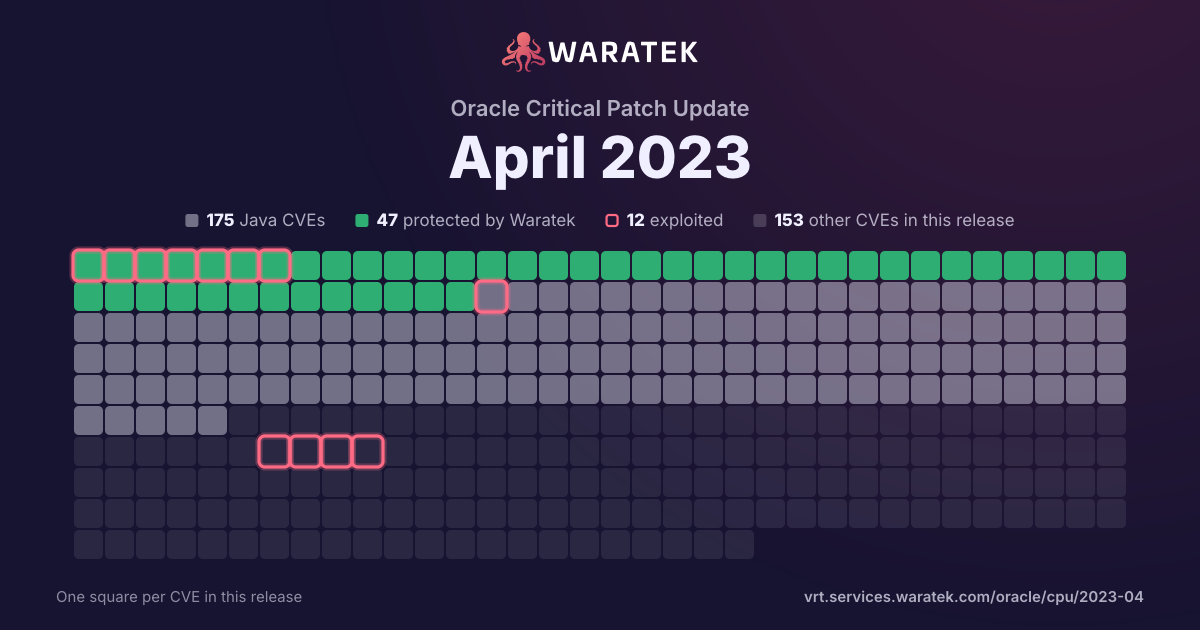
By status
43Protected by Waratek1Rule in development10Mitigation candidate123No exploit published2Outside Waratek scope149Not applicable
10Exploited, marked by the ring
No exploit published. For 44 of them, Oracle's security advisory is the source of public detail.
Protected by Waratek. Waratek RASP can block exploitation of these on systems that have not applied the patch yet.
Overview 33 matches · 5 protected · 0 exploited · 0 CISA KEV · 0 public PoC · 0 EPSS ≥ 0.5
Protected by Waratek
5
15.2%
Rule in development
0
0.0%
Mitigation candidate
0
0.0%
No exploit published
28
84.8%
blocked by ARMR today
5
15.2%
partly blocked
0
0.0%
not blocked
28
84.8%
not established
0
0.0%
unrecorded
0
0.0%
Exploited
0
0.0%
Working exploit published
0
0.0%
Proof of concept only
0
0.0%
Forecast only
0
0.0%
No public exploit
33
100.0%
split by
peak 8 / month
Jan 222
Protected by Waratek2
High1
Medium1
blocked by ARMR today2
No public exploit2
Feb 220
Mar 221
No exploit published1
High1
not blocked1
No public exploit1
Apr 222
Protected by Waratek1
No exploit published1
High1
Medium1
blocked by ARMR today1
not blocked1
No public exploit2
May 224
Protected by Waratek2
No exploit published2
High1
Medium3
blocked by ARMR today2
not blocked2
No public exploit4
Jun 221
No exploit published1
High1
not blocked1
No public exploit1
Jul 223
No exploit published3
High2
Low1
not blocked3
No public exploit3
Aug 220
Sep 220
Oct 226
No exploit published6
High6
not blocked6
No public exploit6
Nov 221
No exploit published1
High1
not blocked1
No public exploit1
Dec 222
No exploit published2
High1
Medium1
not blocked2
No public exploit2
Jan 231
No exploit published1
High1
not blocked1
No public exploit1
Feb 231
No exploit published1
High1
not blocked1
No public exploit1
Mar 231
No exploit published1
Medium1
not blocked1
No public exploit1
Apr 238
No exploit published8
Medium8
not blocked8
No public exploit8
Feb 22Apr 22Jun 22Aug 22Oct 22Dec 22Feb 23Apr 23
| CVE | Severity | Published▾ | Status | Exploitation | Description |
|---|---|---|---|---|---|
| CVE-2023-21915 | Medium | 2023-04-18 | No exploit published | No public exploit | Vulnerability in the Oracle Banking Payments product of Oracle Financial Services Applications (component: Book/Internal Transfer). Supported versions that are affected are 14.5, 14.6 and 14.7. Easily exploitable vulnerability allows low privileged attacker with network access via HTTP to compromise Oracle Banking Payments. Successful attacks require human interaction from a person other than the attacker. Successful attacks of this vulnerability can result in unauthorized update, insert or delete access to some of Oracle Banking Payments accessible data as well as unauthorized read access to a subset of Oracle Banking Payments accessible data. CVSS 3.1 Base Score 4.6 (Confidentiality and Integrity impacts). CVSS Vector: (CVSS:3.1/AV:N/AC:L/PR:L/UI:R/S:U/C:L/I:L/A:N). |
| CVE-2023-21908 | Medium | 2023-04-18 | No exploit published | No public exploit | Vulnerability in the Oracle Banking Virtual Account Management product of Oracle Financial Services Applications (component: OBVAM Trn Journal Domain). Supported versions that are affected are 14.5, 14.6 and 14.7. Difficult to exploit vulnerability allows high privileged attacker with network access via HTTP to compromise Oracle Banking Virtual Account Management. Successful attacks require human interaction from a person other than the attacker. Successful attacks of this vulnerability can result in unauthorized access to critical data or complete access to all Oracle Banking Virtual Account Management accessible data as well as unauthorized update, insert or delete access to some of Oracle Banking Virtual Account Management accessible data and unauthorized ability to cause a hang or frequently repeatable crash (complete DOS) of Oracle Banking Virtual Account Management. CVSS 3.1 Base Score 6.0 (Confidentiality, Integrity and Availability impacts). CVSS Vector: (CVSS:3.1/AV:N/AC:H/PR:H/UI:R/S:U/C:H/I:L/A:H). |
| CVE-2023-21907 | Medium | 2023-04-18 | No exploit published | No public exploit | Vulnerability in the Oracle Banking Virtual Account Management product of Oracle Financial Services Applications (component: OBVAM Trn Journal Domain). Supported versions that are affected are 14.5, 14.6 and 14.7. Difficult to exploit vulnerability allows high privileged attacker with network access via HTTP to compromise Oracle Banking Virtual Account Management. Successful attacks require human interaction from a person other than the attacker. Successful attacks of this vulnerability can result in unauthorized access to critical data or complete access to all Oracle Banking Virtual Account Management accessible data as well as unauthorized update, insert or delete access to some of Oracle Banking Virtual Account Management accessible data and unauthorized ability to cause a hang or frequently repeatable crash (complete DOS) of Oracle Banking Virtual Account Management. CVSS 3.1 Base Score 6.0 (Confidentiality, Integrity and Availability impacts). CVSS Vector: (CVSS:3.1/AV:N/AC:H/PR:H/UI:R/S:U/C:H/I:L/A:H). |
| CVE-2023-21906 | Medium | 2023-04-18 | No exploit published | No public exploit | Vulnerability in the Oracle Banking Virtual Account Management product of Oracle Financial Services Applications (component: SMS Module). Supported versions that are affected are 14.5, 14.6 and 14.7. Easily exploitable vulnerability allows high privileged attacker with network access via HTTP to compromise Oracle Banking Virtual Account Management. Successful attacks require human interaction from a person other than the attacker. Successful attacks of this vulnerability can result in unauthorized creation, deletion or modification access to critical data or all Oracle Banking Virtual Account Management accessible data as well as unauthorized access to critical data or complete access to all Oracle Banking Virtual Account Management accessible data. CVSS 3.1 Base Score 6.1 (Confidentiality and Integrity impacts). CVSS Vector: (CVSS:3.1/AV:N/AC:L/PR:H/UI:R/S:U/C:H/I:H/A:N). |
| CVE-2023-21905 | Medium | 2023-04-18 | No exploit published | No public exploit | Vulnerability in the Oracle Banking Virtual Account Management product of Oracle Financial Services Applications (component: Routing Hub). Supported versions that are affected are 14.5, 14.6 and 14.7. Easily exploitable vulnerability allows high privileged attacker with network access via HTTP to compromise Oracle Banking Virtual Account Management. Successful attacks require human interaction from a person other than the attacker. Successful attacks of this vulnerability can result in unauthorized creation, deletion or modification access to critical data or all Oracle Banking Virtual Account Management accessible data as well as unauthorized access to critical data or complete access to all Oracle Banking Virtual Account Management accessible data. CVSS 3.1 Base Score 6.1 (Confidentiality and Integrity impacts). CVSS Vector: (CVSS:3.1/AV:N/AC:L/PR:H/UI:R/S:U/C:H/I:H/A:N). |
| CVE-2023-21904 | Medium | 2023-04-18 | No exploit published | No public exploit | Vulnerability in the Oracle Banking Virtual Account Management product of Oracle Financial Services Applications (component: OBVAM Trn Journal Domain). Supported versions that are affected are 14.5, 14.6 and 14.7. Difficult to exploit vulnerability allows high privileged attacker with network access via HTTP to compromise Oracle Banking Virtual Account Management. Successful attacks require human interaction from a person other than the attacker. Successful attacks of this vulnerability can result in unauthorized access to critical data or complete access to all Oracle Banking Virtual Account Management accessible data as well as unauthorized update, insert or delete access to some of Oracle Banking Virtual Account Management accessible data and unauthorized ability to cause a partial denial of service (partial DOS) of Oracle Banking Virtual Account Management. CVSS 3.1 Base Score 5.3 (Confidentiality, Integrity and Availability impacts). CVSS Vector: (CVSS:3.1/AV:N/AC:H/PR:H/UI:R/S:U/C:H/I:L/A:L). |
| CVE-2023-21903 | Medium | 2023-04-18 | No exploit published | No public exploit | Vulnerability in the Oracle Banking Virtual Account Management product of Oracle Financial Services Applications (component: OBVAM Internal Tfr Domain). Supported versions that are affected are 14.5, 14.6 and 14.7. Difficult to exploit vulnerability allows high privileged attacker with network access via HTTP to compromise Oracle Banking Virtual Account Management. Successful attacks require human interaction from a person other than the attacker. Successful attacks of this vulnerability can result in unauthorized access to critical data or complete access to all Oracle Banking Virtual Account Management accessible data as well as unauthorized update, insert or delete access to some of Oracle Banking Virtual Account Management accessible data and unauthorized ability to cause a partial denial of service (partial DOS) of Oracle Banking Virtual Account Management. CVSS 3.1 Base Score 5.3 (Confidentiality, Integrity and Availability impacts). CVSS Vector: (CVSS:3.1/AV:N/AC:H/PR:H/UI:R/S:U/C:H/I:L/A:L). |
| CVE-2023-21902 | Medium | 2023-04-18 | No exploit published | No public exploit | Vulnerability in the Oracle Financial Services Behavior Detection Platform product of Oracle Financial Services Applications (component: Application). The supported version that is affected is 8.0.8.1. Easily exploitable vulnerability allows low privileged attacker with network access via HTTP to compromise Oracle Financial Services Behavior Detection Platform. Successful attacks of this vulnerability can result in unauthorized read access to a subset of Oracle Financial Services Behavior Detection Platform accessible data. CVSS 3.1 Base Score 4.3 (Confidentiality impacts). CVSS Vector: (CVSS:3.1/AV:N/AC:L/PR:L/UI:N/S:U/C:L/I:N/A:N). |
| CVE-2023-28708 | Medium | 2023-03-22 | No exploit published | No public exploit | When using the RemoteIpFilter with requests received from a reverse proxy via HTTP that include the X-Forwarded-Proto header set to https, session cookies created by Apache Tomcat 11.0.0-M1 to 11.0.0.-M2, 10.1.0-M1 to 10.1.5, 9.0.0-M1 to 9.0.71 and 8.5.0 to 8.5.85 did not include the secure attribute. This could result in the user agent transmitting the session cookie over an insecure channel. Older, EOL versions may also be affected. |
| CVE-2023-24998 | High | 2023-02-20 | No exploit published | No public exploit | Apache Commons FileUpload before 1.5 does not limit the number of request parts to be processed resulting in the possibility of an attacker triggering a DoS with a malicious upload or series of uploads. Note that, like all of the file upload limits, the new configuration option (FileUploadBase#setFileCountMax) is not enabled by default and must be explicitly configured. |
| CVE-2022-45143 | High | 2023-01-03 | No exploit published | No public exploit | The JsonErrorReportValve in Apache Tomcat 8.5.83, 9.0.40 to 9.0.68 and 10.1.0-M1 to 10.1.1 did not escape the type, message or description values. In some circumstances these are constructed from user provided data and it was therefore possible for users to supply values that invalidated or manipulated the JSON output. |
| CVE-2022-46363 | High | 2022-12-13 | No exploit published | No public exploit | A vulnerability in Apache CXF before versions 3.5.5 and 3.4.10 allows an attacker to perform a remote directory listing or code exfiltration. The vulnerability only applies when the CXFServlet is configured with both the static-resources-list and redirect-query-check attributes. These attributes are not supposed to be used together, and so the vulnerability can only arise if the CXF service is misconfigured. |
| CVE-2021-37533 | Medium | 2022-12-03 | No exploit published | No public exploit | Prior to Apache Commons Net 3.9.0, Net's FTP client trusts the host from PASV response by default. A malicious server can redirect the Commons Net code to use a different host, but the user has to connect to the malicious server in the first place. This may lead to leakage of information about services running on the private network of the client. The default in version 3.9.0 is now false to ignore such hosts, as cURL does. See https://issues.apache.org/jira/browse/NET-711. |
| CVE-2022-42252 | High | 2022-11-01 | No exploit published | No public exploit | If Apache Tomcat 8.5.0 to 8.5.82, 9.0.0-M1 to 9.0.67, 10.0.0-M1 to 10.0.26 or 10.1.0-M1 to 10.1.0 was configured to ignore invalid HTTP headers via setting rejectIllegalHeader to false (the default for 8.5.x only), Tomcat did not reject a request containing an invalid Content-Length header making a request smuggling attack possible if Tomcat was located behind a reverse proxy that also failed to reject the request with the invalid header. |
| CVE-2022-31690 | High | 2022-10-31 | No exploit published | No public exploit | Spring Security, versions 5.7 prior to 5.7.5, and 5.6 prior to 5.6.9, and older unsupported versions could be susceptible to a privilege escalation under certain conditions. A malicious user or attacker can modify a request initiated by the Client (via the browser) to the Authorization Server which can lead to a privilege escalation on the subsequent approval. This scenario can happen if the Authorization Server responds with an OAuth2 Access Token Response containing an empty scope list (per RFC 6749, Section 5.1) on the subsequent request to the token endpoint to obtain the access token. |
| CVE-2022-42890 | High | 2022-10-25 | No exploit published | No public exploit | A vulnerability in Batik of Apache XML Graphics allows an attacker to run Java code from untrusted SVG via JavaScript. This issue affects Apache XML Graphics prior to 1.16. Users are recommended to upgrade to version 1.16. |
| CVE-2022-41704 | High | 2022-10-25 | No exploit published | No public exploit | A vulnerability in Batik of Apache XML Graphics allows an attacker to run untrusted Java code from an SVG. This issue affects Apache XML Graphics prior to 1.16. It is recommended to update to version 1.16. |
| CVE-2022-3171 | High | 2022-10-12 | No exploit published | No public exploit | A parsing issue with binary data in protobuf-java core and lite versions prior to 3.21.7, 3.20.3, 3.19.6 and 3.16.3 can lead to a denial of service attack. Inputs containing multiple instances of non-repeated embedded messages with repeated or unknown fields causes objects to be converted back-n-forth between mutable and immutable forms, resulting in potentially long garbage collection pauses. We recommend updating to the versions mentioned above. |
| CVE-2022-42004 | High | 2022-10-02 | No exploit published | No public exploit | In FasterXML jackson-databind before 2.13.4, resource exhaustion can occur because of a lack of a check in BeanDeserializer._deserializeFromArray to prevent use of deeply nested arrays. An application is vulnerable only with certain customized choices for deserialization. |
| CVE-2022-42003 | High | 2022-10-02 | No exploit published | No public exploit | In FasterXML jackson-databind before versions 2.13.4.1 and 2.12.17.1, resource exhaustion can occur because of a lack of a check in primitive value deserializers to avoid deep wrapper array nesting, when the UNWRAP_SINGLE_VALUE_ARRAYS feature is enabled. |
| CVE-2022-2191 | High | 2022-07-07 | No exploit published | No public exploit | In Eclipse Jetty versions 10.0.0 thru 10.0.9, and 11.0.0 thru 11.0.9 versions, SslConnection does not release ByteBuffers from configured ByteBufferPool in case of error code paths. |
| CVE-2022-2048 | High | 2022-07-07 | No exploit published | No public exploit | In Eclipse Jetty HTTP/2 server implementation, when encountering an invalid HTTP/2 request, the error handling has a bug that can wind up not properly cleaning up the active connections and associated resources. This can lead to a Denial of Service scenario where there are no enough resources left to process good requests. |
| CVE-2022-2047 | Low | 2022-07-07 | No exploit published | No public exploit | In Eclipse Jetty versions 9.4.0 thru 9.4.46, and 10.0.0 thru 10.0.9, and 11.0.0 thru 11.0.9 versions, the parsing of the authority segment of an http scheme URI, the Jetty HttpURI class improperly detects an invalid input as a hostname. This can lead to failures in a Proxy scenario. |
| CVE-2022-22979 | High | 2022-06-21 | No exploit published | No public exploit | In Spring Cloud Function versions prior to 3.2.6, it is possible for a user who directly interacts with framework provided lookup functionality to cause a denial-of-service condition due to the caching issue in the Function Catalog component of the framework. |
| CVE-2022-22976 | Medium | 2022-05-19 | No exploit published | No public exploit | Spring Security versions 5.5.x prior to 5.5.7, 5.6.x prior to 5.6.4, and earlier unsupported versions contain an integer overflow vulnerability. When using the BCrypt class with the maximum work factor (31), the encoder does not perform any salt rounds, due to an integer overflow error. The default settings are not affected by this CVE. |
| CVE-2022-22971 | Medium | 2022-05-12 | Protected by Waratek | No public exploit | In spring framework versions prior to 5.3.20+ , 5.2.22+ and old unsupported versions, application with a STOMP over WebSocket endpoint is vulnerable to a denial of service attack by an authenticated user. |
| CVE-2022-22970 | Medium | 2022-05-12 | No exploit published | No public exploit | In spring framework versions prior to 5.3.20+ , 5.2.22+ and old unsupported versions, applications that handle file uploads are vulnerable to DoS attack if they rely on data binding to set a MultipartFile or javax.servlet.Part to a field in a model object. |
| CVE-2022-25647 | High | 2022-05-01 | Protected by Waratek | No public exploit | The package com.google.code.gson:gson before 2.8.9 are vulnerable to Deserialization of Untrusted Data via the writeReplace() method in internal classes, which may lead to DoS attacks. |
| CVE-2022-29577 | Medium | 2022-04-21 | Protected by Waratek | No public exploit | OWASP AntiSamy before 1.6.7 allows XSS via HTML tag smuggling on STYLE content with crafted input. The output serializer does not properly encode the supposed Cascading Style Sheets (CSS) content. NOTE: this issue exists because of an incomplete fix for CVE-2022-28367. |
| CVE-2022-24839 | High | 2022-04-11 | No exploit published | No public exploit | org.cyberneko.html is an html parser written in Java. The fork of `org.cyberneko.html` used by Nokogiri (Rubygem) raises a `java.lang.OutOfMemoryError` exception when parsing ill-formed HTML markup. Users are advised to upgrade to `>= 1.9.22.noko2`. Note: The upstream library `org.cyberneko.html` is no longer maintained. Nokogiri uses its own fork of this library located at https://github.com/sparklemotion/nekohtml and this CVE applies only to that fork. Other forks of nekohtml may have a similar vulnerability. |
| CVE-2020-36518 | High | 2022-03-11 | No exploit published | No public exploit | jackson-databind before 2.13.0 allows a Java StackOverflow exception and denial of service via a large depth of nested objects. |
| CVE-2022-23181 | High | 2022-01-27 | Protected by Waratek | No public exploit | The fix for bug CVE-2020-9484 introduced a time of check, time of use vulnerability into Apache Tomcat 10.1.0-M1 to 10.1.0-M8, 10.0.0-M5 to 10.0.14, 9.0.35 to 9.0.56 and 8.5.55 to 8.5.73 that allowed a local attacker to perform actions with the privileges of the user that the Tomcat process is using. This issue is only exploitable when Tomcat is configured to persist sessions using the FileStore. |
| CVE-2022-23437 | Medium | 2022-01-24 | Protected by Waratek | No public exploit | There's a vulnerability within the Apache Xerces Java (XercesJ) XML parser when handling specially crafted XML document payloads. This causes, the XercesJ XML parser to wait in an infinite loop, which may sometimes consume system resources for prolonged duration. This vulnerability is present within XercesJ version 2.12.1 and the previous versions. |