
Oracle Critical Patch Update January 2023
Released January 2023 · Oracle's advisory ↗ · ← Critical Patch Update, October 2022 · Critical Patch Update, April 2023 →
183 CVEs in this release, one square each
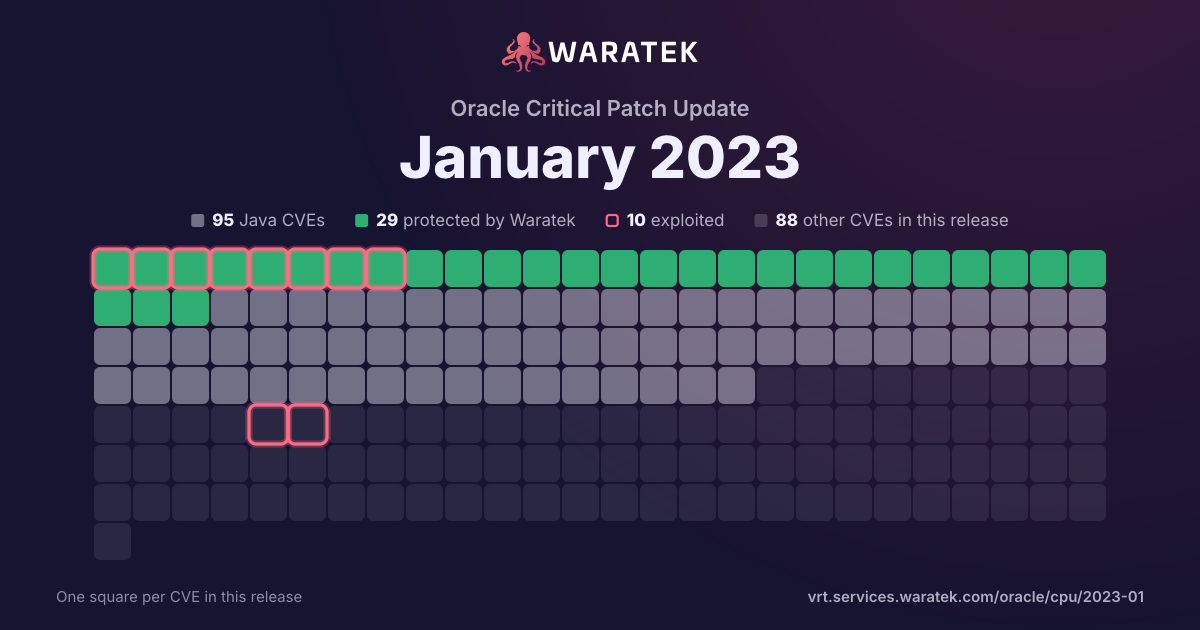
By status
28Protected by Waratek5Mitigation candidate66No exploit published3Outside Waratek scope80Not applicable1Withdrawn CVE
9Exploited, marked by the ring
No exploit published. For 35 of them, Oracle's security advisory is the source of public detail.
Protected by Waratek. Waratek RASP can block exploitation of these on systems that have not applied the patch yet.
Overview 7 matches · 6 protected · 1 exploited · 1 CISA KEV · 4 public PoC · 3 EPSS ≥ 0.5
Protected by Waratek
6
85.7%
Rule in development
0
0.0%
Mitigation candidate
1
14.3%
No exploit published
0
0.0%
blocked by ARMR today
6
85.7%
partly blocked
0
0.0%
not blocked
1
14.3%
not established
0
0.0%
unrecorded
0
0.0%
split by
peak 2 / quarter
Q1 181
Protected by Waratek1
Critical1
blocked by ARMR today1
No public exploit1
Q2 180
Q3 180
Q4 180
Q1 190
Q2 190
Q3 190
Q4 191
Protected by Waratek1
Critical1
blocked by ARMR today1
Proof of concept only1
Q1 200
Q2 201
Protected by Waratek1
Critical1
blocked by ARMR today1
No public exploit1
Q3 200
Q4 200
Q1 210
Q2 210
Q3 210
Q4 210
Q1 222
Protected by Waratek1
Mitigation candidate1
Critical2
blocked by ARMR today1
not blocked1
Working exploit published1
Proof of concept only1
Q2 222
Protected by Waratek2
Critical2
blocked by ARMR today2
Exploited1
Proof of concept only1
Q2 18Q4 18Q2 19Q4 19Q2 20Q4 20Q2 21Q4 21Q2 22
| CVE | Severity | Published▾ | Status | Exploitation | Description |
|---|---|---|---|---|---|
| CVE-2022-23457 | Critical | 2022-04-25 | Protected by Waratek | Proof of concept only | ESAPI (The OWASP Enterprise Security API) is a free, open source, web application security control library. Prior to version 2.3.0.0, the default implementation of `Validator.getValidDirectoryPath(String, String, File, boolean)` may incorrectly treat the tested input string as a child of the specified parent directory. This potentially could allow control-flow bypass checks to be defeated if an attack can specify the entire string representing the 'input' path. This vulnerability is patched in release 2.3.0.0 of ESAPI. As a workaround, it is possible to write one's own implementation of the Validator interface. However, maintainers do not recommend this. |
| CVE-2022-22965 | Critical | 2022-04-01 | Protected by Waratek | Exploited | A Spring MVC or Spring WebFlux application running on JDK 9+ may be vulnerable to remote code execution (RCE) via data binding. The specific exploit requires the application to run on Tomcat as a WAR deployment. If the application is deployed as a Spring Boot executable jar, i.e. the default, it is not vulnerable to the exploit. However, the nature of the vulnerability is more general, and there may be other ways to exploit it. |
| CVE-2022-23221 | Critical | 2022-01-19 | Mitigation candidate | Working exploit published | H2 Console before 2.1.210 allows remote attackers to execute arbitrary code via a jdbc:h2:mem JDBC URL containing the IGNORE_UNKNOWN_SETTINGS=TRUE;FORBID_CREATION=FALSE;INIT=RUNSCRIPT substring, a different vulnerability than CVE-2021-42392. |
| CVE-2022-23305 | Critical | 2022-01-18 | Protected by Waratek | Proof of concept only | By design, the JDBCAppender in Log4j 1.2.x accepts an SQL statement as a configuration parameter where the values to be inserted are converters from PatternLayout. The message converter, %m, is likely to always be included. This allows attackers to manipulate the SQL by entering crafted strings into input fields or headers of an application that are logged allowing unintended SQL queries to be executed. Note this issue only affects Log4j 1.x when specifically configured to use the JDBCAppender, which is not the default. Beginning in version 2.0-beta8, the JDBCAppender was re-introduced with proper support for parameterized SQL queries and further customization over the columns written to in logs. Apache Log4j 1.2 reached end of life in August 2015. Users should upgrade to Log4j 2 as it addresses numerous other issues from the previous versions. |
| CVE-2020-10683 | Critical | 2020-05-01 | Protected by Waratek | No public exploit | dom4j before 2.0.3 and 2.1.x before 2.1.3 allows external DTDs and External Entities by default, which might enable XXE attacks. However, there is popular external documentation from OWASP showing how to enable the safe, non-default behavior in any application that uses dom4j. |
| CVE-2019-17571 | Critical | 2019-12-20 | Protected by Waratek | Proof of concept only | Included in Log4j 1.2 is a SocketServer class that is vulnerable to deserialization of untrusted data which can be exploited to remotely execute arbitrary code when combined with a deserialization gadget when listening to untrusted network traffic for log data. This affects Log4j versions up to 1.2 up to 1.2.17. |
| CVE-2018-7489 | Critical | 2018-02-26 | Protected by Waratek | No public exploit | FasterXML jackson-databind before 2.7.9.3, 2.8.x before 2.8.11.1 and 2.9.x before 2.9.5 allows unauthenticated remote code execution because of an incomplete fix for the CVE-2017-7525 deserialization flaw. This is exploitable by sending maliciously crafted JSON input to the readValue method of the ObjectMapper, bypassing a blacklist that is ineffective if the c3p0 libraries are available in the classpath. |