
Oracle Critical Patch Update January 2023
Released January 2023 · Oracle's advisory ↗ · ← Critical Patch Update, October 2022 · Critical Patch Update, April 2023 →
183 CVEs in this release, one square each
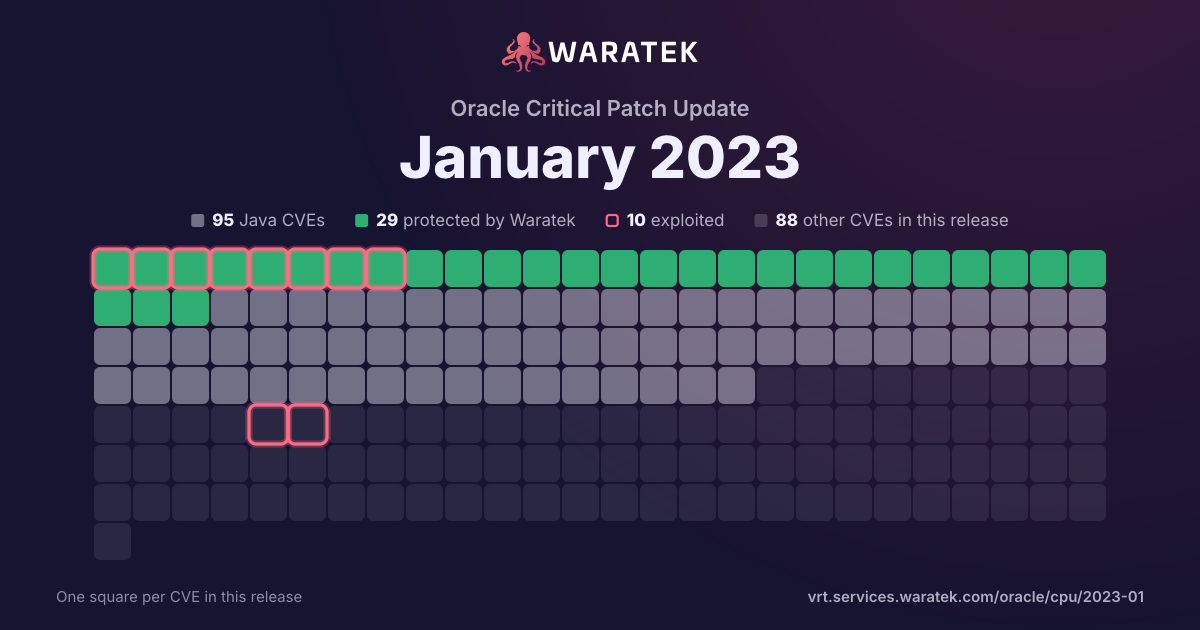
By status
29Protected by Waratek4Mitigation candidate62No exploit published13Outside Waratek scope74Not applicable1Withdrawn CVE
10Exploited, marked by the ring
No exploit published. For 39 of them, Oracle's security advisory is the source of public detail.
Protected by Waratek. Waratek RASP can block exploitation of these on systems that have not applied the patch yet.
Overview 183 matches · 95 in Waratek scope · 29 protected · 10 exploited · 4 CISA KEV · 18 public PoC · 12 EPSS ≥ 0.5
183matches
95in Waratek scope51.9%
29protected15.8%
10exploited5.5%
4CISA KEV2.2%
18public PoC9.8%
12EPSS ≥ 0.56.6%
Protected by Waratek
29
15.8%
Rule in development
0
0.0%
Mitigation candidate
4
2.2%
No exploit published
62
33.9%
Outside Waratek scope
13
7.1%
Not applicable
74
40.4%
Withdrawn CVE
1
0.5%
blocked by ARMR today
29
15.8%
partly blocked
0
0.0%
not blocked
154
84.2%
not established
0
0.0%
unrecorded
0
0.0%
Exploited
10
5.5%
Working exploit published
0
0.0%
Proof of concept only
26
14.2%
Forecast only
0
0.0%
No public exploit
147
80.3%
split by
peak 74 / quarter
Q1 181
Protected by Waratek1
Critical1
blocked by ARMR today1
No public exploit1
Q2 181
Protected by Waratek1
Critical1
blocked by ARMR today1
Exploited1
Q3 180
Q4 180
Q1 191
Not applicable1
Medium1
not blocked1
No public exploit1
Q2 190
Q3 190
Q4 192
Protected by Waratek2
Critical1
Medium1
blocked by ARMR today2
Proof of concept only1
No public exploit1
Q1 200
Q2 202
Protected by Waratek1
No exploit published1
Critical1
Medium1
blocked by ARMR today1
not blocked1
No public exploit2
Q3 200
Q4 202
No exploit published1
Outside Waratek scope1
High1
Medium1
not blocked2
No public exploit2
Q1 214
No exploit published1
Outside Waratek scope1
Not applicable2
Critical1
High3
not blocked4
Proof of concept only1
No public exploit3
Q2 212
Protected by Waratek1
No exploit published1
Medium2
blocked by ARMR today1
not blocked1
No public exploit2
Q3 215
No exploit published2
Not applicable3
High4
Medium1
not blocked5
No public exploit5
Q4 217
Protected by Waratek2
Outside Waratek scope2
Not applicable3
Critical1
High2
Medium4
blocked by ARMR today2
not blocked5
Exploited2
Proof of concept only1
No public exploit4
Q1 2215
Protected by Waratek3
No exploit published3
Outside Waratek scope3
Not applicable6
Critical5
High6
Medium4
blocked by ARMR today3
not blocked12
Exploited1
Proof of concept only5
No public exploit9
Q2 2219
Protected by Waratek7
Mitigation candidate1
No exploit published4
Outside Waratek scope1
Not applicable6
Critical7
High6
Medium6
blocked by ARMR today7
not blocked12
Exploited3
Proof of concept only4
No public exploit12
Q3 2227
Protected by Waratek4
Mitigation candidate2
No exploit published7
Outside Waratek scope3
Not applicable10
Withdrawn CVE1
Critical4
High18
Medium4
Unknown1
blocked by ARMR today4
not blocked23
Proof of concept only9
No public exploit18
Q4 2221
Protected by Waratek3
Mitigation candidate1
No exploit published9
Not applicable8
Critical8
High12
Medium1
blocked by ARMR today3
not blocked18
Exploited2
Proof of concept only5
No public exploit14
Q1 2374
Protected by Waratek4
No exploit published33
Outside Waratek scope2
Not applicable35
Critical1
High24
Medium44
Low5
blocked by ARMR today4
not blocked70
Exploited1
No public exploit73
Q1 18Q3 18Q1 19Q3 19Q1 20Q3 20Q1 21Q3 21Q1 22Q3 22Q1 23
| CVE | Severity | Published▾ | Status | Exploitation | Description |
|---|---|---|---|---|---|
| CVE-2023-21900 | Medium | 2023-01-18 | Not applicable | No public exploit | Vulnerability in the Oracle Solaris product of Oracle Systems (component: NSSwitch). Supported versions that are affected are 10 and 11. Difficult to exploit vulnerability allows high privileged attacker with network access via multiple protocols to compromise Oracle Solaris. Successful attacks require human interaction from a person other than the attacker and while the vulnerability is in Oracle Solaris, attacks may significantly impact additional products (scope change). Successful attacks of this vulnerability can result in unauthorized update, insert or delete access to some of Oracle Solaris accessible data and unauthorized ability to cause a partial denial of service (partial DOS) of Oracle Solaris. CVSS 3.1 Base Score 4.0 (Integrity and Availability impacts). CVSS Vector: (CVSS:3.1/AV:N/AC:H/PR:H/UI:R/S:C/C:N/I:L/A:L). |
| CVE-2023-21899 | Medium | 2023-01-18 | Not applicable | No public exploit | Vulnerability in the Oracle VM VirtualBox product of Oracle Virtualization (component: Core). Supported versions that are affected are Prior to 6.1.42 and prior to 7.0.6. Easily exploitable vulnerability allows low privileged attacker with logon to the infrastructure where Oracle VM VirtualBox executes to compromise Oracle VM VirtualBox. Successful attacks of this vulnerability can result in unauthorized ability to cause a hang or frequently repeatable crash (complete DOS) of Oracle VM VirtualBox. Note: Applies to VirtualBox VMs running Windows 7 and later. CVSS 3.1 Base Score 5.5 (Availability impacts). CVSS Vector: (CVSS:3.1/AV:L/AC:L/PR:L/UI:N/S:U/C:N/I:N/A:H). |
| CVE-2023-21898 | Medium | 2023-01-18 | Not applicable | No public exploit | Vulnerability in the Oracle VM VirtualBox product of Oracle Virtualization (component: Core). Supported versions that are affected are Prior to 6.1.42 and prior to 7.0.6. Easily exploitable vulnerability allows low privileged attacker with logon to the infrastructure where Oracle VM VirtualBox executes to compromise Oracle VM VirtualBox. Successful attacks of this vulnerability can result in unauthorized ability to cause a hang or frequently repeatable crash (complete DOS) of Oracle VM VirtualBox. Note: Applies to VirtualBox VMs running Windows 7 and later. CVSS 3.1 Base Score 5.5 (Availability impacts). CVSS Vector: (CVSS:3.1/AV:L/AC:L/PR:L/UI:N/S:U/C:N/I:N/A:H). |
| CVE-2023-21894 | High | 2023-01-18 | No exploit published | No public exploit | Vulnerability in the Oracle Global Lifecycle Management NextGen OUI Framework product of Oracle Fusion Middleware (component: NextGen Installer issues). Supported versions that are affected are Prior to 13.9.4.2.11. Easily exploitable vulnerability allows low privileged attacker with logon to the infrastructure where Oracle Global Lifecycle Management NextGen OUI Framework executes to compromise Oracle Global Lifecycle Management NextGen OUI Framework. Successful attacks require human interaction from a person other than the attacker. Successful attacks of this vulnerability can result in takeover of Oracle Global Lifecycle Management NextGen OUI Framework. CVSS 3.1 Base Score 7.3 (Confidentiality, Integrity and Availability impacts). CVSS Vector: (CVSS:3.1/AV:L/AC:L/PR:L/UI:R/S:U/C:H/I:H/A:H). |
| CVE-2023-21893 | High | 2023-01-18 | Outside Waratek scope | No public exploit | Vulnerability in the Oracle Data Provider for .NET component of Oracle Database Server. Supported versions that are affected are 19c and 21c. Difficult to exploit vulnerability allows unauthenticated attacker with network access via TCPS to compromise Oracle Data Provider for .NET. Successful attacks require human interaction from a person other than the attacker. Successful attacks of this vulnerability can result in takeover of Oracle Data Provider for .NET. Note: Applies also to Database client-only on Windows platform. CVSS 3.1 Base Score 7.5 (Confidentiality, Integrity and Availability impacts). CVSS Vector: (CVSS:3.1/AV:N/AC:H/PR:N/UI:R/S:U/C:H/I:H/A:H). |
| CVE-2023-21892 | Medium | 2023-01-18 | No exploit published | No public exploit | Vulnerability in the Oracle Business Intelligence Enterprise Edition product of Oracle Fusion Middleware (component: Visual Analyzer). Supported versions that are affected are 5.9.0.0.0 and 6.4.0.0.0. Easily exploitable vulnerability allows low privileged attacker with network access via HTTP to compromise Oracle Business Intelligence Enterprise Edition. Successful attacks require human interaction from a person other than the attacker and while the vulnerability is in Oracle Business Intelligence Enterprise Edition, attacks may significantly impact additional products (scope change). Successful attacks of this vulnerability can result in unauthorized update, insert or delete access to some of Oracle Business Intelligence Enterprise Edition accessible data as well as unauthorized read access to a subset of Oracle Business Intelligence Enterprise Edition accessible data. CVSS 3.1 Base Score 5.4 (Confidentiality and Integrity impacts). CVSS Vector: (CVSS:3.1/AV:N/AC:L/PR:L/UI:R/S:C/C:L/I:L/A:N). |
| CVE-2023-21891 | Medium | 2023-01-18 | No exploit published | No public exploit | Vulnerability in the Oracle Business Intelligence Enterprise Edition product of Oracle Fusion Middleware (component: Visual Analyzer). Supported versions that are affected are 5.9.0.0.0 and 6.4.0.0.0. Easily exploitable vulnerability allows low privileged attacker with network access via HTTP to compromise Oracle Business Intelligence Enterprise Edition. Successful attacks require human interaction from a person other than the attacker and while the vulnerability is in Oracle Business Intelligence Enterprise Edition, attacks may significantly impact additional products (scope change). Successful attacks of this vulnerability can result in unauthorized update, insert or delete access to some of Oracle Business Intelligence Enterprise Edition accessible data as well as unauthorized read access to a subset of Oracle Business Intelligence Enterprise Edition accessible data. CVSS 3.1 Base Score 5.4 (Confidentiality and Integrity impacts). CVSS Vector: (CVSS:3.1/AV:N/AC:L/PR:L/UI:R/S:C/C:L/I:L/A:N). |
| CVE-2023-21890 | Critical | 2023-01-18 | No exploit published | No public exploit | Vulnerability in the Oracle Communications Converged Application Server product of Oracle Communications (component: Core). Supported versions that are affected are 7.1.0 and 8.0.0. Easily exploitable vulnerability allows unauthenticated attacker with network access via UDP to compromise Oracle Communications Converged Application Server. Successful attacks of this vulnerability can result in takeover of Oracle Communications Converged Application Server. CVSS 3.1 Base Score 9.8 (Confidentiality, Integrity and Availability impacts). CVSS Vector: (CVSS:3.1/AV:N/AC:L/PR:N/UI:N/S:U/C:H/I:H/A:H). |
| CVE-2023-21889 | Low | 2023-01-18 | Not applicable | No public exploit | Vulnerability in the Oracle VM VirtualBox product of Oracle Virtualization (component: Core). Supported versions that are affected are Prior to 6.1.42 and prior to 7.0.6. Easily exploitable vulnerability allows low privileged attacker with logon to the infrastructure where Oracle VM VirtualBox executes to compromise Oracle VM VirtualBox. While the vulnerability is in Oracle VM VirtualBox, attacks may significantly impact additional products (scope change). Successful attacks of this vulnerability can result in unauthorized read access to a subset of Oracle VM VirtualBox accessible data. CVSS 3.1 Base Score 3.8 (Confidentiality impacts). CVSS Vector: (CVSS:3.1/AV:L/AC:L/PR:L/UI:N/S:C/C:L/I:N/A:N). |
| CVE-2023-21888 | Medium | 2023-01-18 | No exploit published | No public exploit | Vulnerability in the Primavera Gateway product of Oracle Construction and Engineering (component: WebUI). Supported versions that are affected are 18.8.0-18.8.15, 19.12.0-19.12.15, 20.12.0-20.12.10 and 21.12.0-21.12.8. Easily exploitable vulnerability allows low privileged attacker with network access via HTTP to compromise Primavera Gateway. Successful attacks require human interaction from a person other than the attacker and while the vulnerability is in Primavera Gateway, attacks may significantly impact additional products (scope change). Successful attacks of this vulnerability can result in unauthorized update, insert or delete access to some of Primavera Gateway accessible data as well as unauthorized read access to a subset of Primavera Gateway accessible data. CVSS 3.1 Base Score 5.4 (Confidentiality and Integrity impacts). CVSS Vector: (CVSS:3.1/AV:N/AC:L/PR:L/UI:R/S:C/C:L/I:L/A:N). |
| CVE-2023-21887 | Medium | 2023-01-18 | Not applicable | No public exploit | Vulnerability in the MySQL Server product of Oracle MySQL (component: Server: GIS). Supported versions that are affected are 8.0.31 and prior. Easily exploitable vulnerability allows high privileged attacker with network access via multiple protocols to compromise MySQL Server. Successful attacks of this vulnerability can result in unauthorized ability to cause a hang or frequently repeatable crash (complete DOS) of MySQL Server. CVSS 3.1 Base Score 4.9 (Availability impacts). CVSS Vector: (CVSS:3.1/AV:N/AC:L/PR:H/UI:N/S:U/C:N/I:N/A:H). |
| CVE-2023-21886 | High | 2023-01-18 | Not applicable | No public exploit | Vulnerability in the Oracle VM VirtualBox product of Oracle Virtualization (component: Core). Supported versions that are affected are Prior to 6.1.42 and prior to 7.0.6. Difficult to exploit vulnerability allows unauthenticated attacker with network access via multiple protocols to compromise Oracle VM VirtualBox. Successful attacks of this vulnerability can result in takeover of Oracle VM VirtualBox. CVSS 3.1 Base Score 8.1 (Confidentiality, Integrity and Availability impacts). CVSS Vector: (CVSS:3.1/AV:N/AC:H/PR:N/UI:N/S:U/C:H/I:H/A:H). |
| CVE-2023-21885 | Low | 2023-01-18 | Not applicable | No public exploit | Vulnerability in the Oracle VM VirtualBox product of Oracle Virtualization (component: Core). Supported versions that are affected are Prior to 6.1.42 and prior to 7.0.6. Easily exploitable vulnerability allows low privileged attacker with logon to the infrastructure where Oracle VM VirtualBox executes to compromise Oracle VM VirtualBox. While the vulnerability is in Oracle VM VirtualBox, attacks may significantly impact additional products (scope change). Successful attacks of this vulnerability can result in unauthorized read access to a subset of Oracle VM VirtualBox accessible data. Note: Applies to Windows only. CVSS 3.1 Base Score 3.8 (Confidentiality impacts). CVSS Vector: (CVSS:3.1/AV:L/AC:L/PR:L/UI:N/S:C/C:L/I:N/A:N). |
| CVE-2023-21884 | Medium | 2023-01-18 | Not applicable | No public exploit | Vulnerability in the Oracle VM VirtualBox product of Oracle Virtualization (component: Core). Supported versions that are affected are Prior to 6.1.42 and prior to 7.0.6. Easily exploitable vulnerability allows high privileged attacker with logon to the infrastructure where Oracle VM VirtualBox executes to compromise Oracle VM VirtualBox. Successful attacks of this vulnerability can result in unauthorized ability to cause a hang or frequently repeatable crash (complete DOS) of Oracle VM VirtualBox. CVSS 3.1 Base Score 4.4 (Availability impacts). CVSS Vector: (CVSS:3.1/AV:L/AC:L/PR:H/UI:N/S:U/C:N/I:N/A:H). |
| CVE-2023-21883 | Medium | 2023-01-18 | Not applicable | No public exploit | Vulnerability in the MySQL Server product of Oracle MySQL (component: Server: Optimizer). Supported versions that are affected are 8.0.31 and prior. Easily exploitable vulnerability allows high privileged attacker with network access via multiple protocols to compromise MySQL Server. Successful attacks of this vulnerability can result in unauthorized ability to cause a hang or frequently repeatable crash (complete DOS) of MySQL Server. CVSS 3.1 Base Score 4.9 (Availability impacts). CVSS Vector: (CVSS:3.1/AV:N/AC:L/PR:H/UI:N/S:U/C:N/I:N/A:H). |
| CVE-2023-21882 | Low | 2023-01-18 | Not applicable | No public exploit | Vulnerability in the MySQL Server product of Oracle MySQL (component: Server: Optimizer). Supported versions that are affected are 8.0.31 and prior. Easily exploitable vulnerability allows high privileged attacker with network access via multiple protocols to compromise MySQL Server. Successful attacks of this vulnerability can result in unauthorized update, insert or delete access to some of MySQL Server accessible data. CVSS 3.1 Base Score 2.7 (Integrity impacts). CVSS Vector: (CVSS:3.1/AV:N/AC:L/PR:H/UI:N/S:U/C:N/I:L/A:N). |
| CVE-2023-21881 | Medium | 2023-01-18 | Not applicable | No public exploit | Vulnerability in the MySQL Server product of Oracle MySQL (component: Server: Optimizer). Supported versions that are affected are 8.0.31 and prior. Easily exploitable vulnerability allows high privileged attacker with network access via multiple protocols to compromise MySQL Server. Successful attacks of this vulnerability can result in unauthorized ability to cause a hang or frequently repeatable crash (complete DOS) of MySQL Server. CVSS 3.1 Base Score 4.9 (Availability impacts). CVSS Vector: (CVSS:3.1/AV:N/AC:L/PR:H/UI:N/S:U/C:N/I:N/A:H). |
| CVE-2023-21880 | Medium | 2023-01-18 | Not applicable | No public exploit | Vulnerability in the MySQL Server product of Oracle MySQL (component: InnoDB). Supported versions that are affected are 8.0.31 and prior. Easily exploitable vulnerability allows high privileged attacker with network access via multiple protocols to compromise MySQL Server. Successful attacks of this vulnerability can result in unauthorized ability to cause a hang or frequently repeatable crash (complete DOS) of MySQL Server as well as unauthorized update, insert or delete access to some of MySQL Server accessible data. CVSS 3.1 Base Score 5.5 (Integrity and Availability impacts). CVSS Vector: (CVSS:3.1/AV:N/AC:L/PR:H/UI:N/S:U/C:N/I:L/A:H). |
| CVE-2023-21879 | Medium | 2023-01-18 | Not applicable | No public exploit | Vulnerability in the MySQL Server product of Oracle MySQL (component: Server: Optimizer). Supported versions that are affected are 8.0.31 and prior. Easily exploitable vulnerability allows high privileged attacker with network access via multiple protocols to compromise MySQL Server. Successful attacks of this vulnerability can result in unauthorized ability to cause a hang or frequently repeatable crash (complete DOS) of MySQL Server. CVSS 3.1 Base Score 4.9 (Availability impacts). CVSS Vector: (CVSS:3.1/AV:N/AC:L/PR:H/UI:N/S:U/C:N/I:N/A:H). |
| CVE-2023-21878 | Medium | 2023-01-18 | Not applicable | No public exploit | Vulnerability in the MySQL Server product of Oracle MySQL (component: Server: Optimizer). Supported versions that are affected are 8.0.31 and prior. Easily exploitable vulnerability allows high privileged attacker with network access via multiple protocols to compromise MySQL Server. Successful attacks of this vulnerability can result in unauthorized ability to cause a hang or frequently repeatable crash (complete DOS) of MySQL Server. CVSS 3.1 Base Score 4.9 (Availability impacts). CVSS Vector: (CVSS:3.1/AV:N/AC:L/PR:H/UI:N/S:U/C:N/I:N/A:H). |
| CVE-2023-21877 | Medium | 2023-01-18 | Not applicable | No public exploit | Vulnerability in the MySQL Server product of Oracle MySQL (component: InnoDB). Supported versions that are affected are 8.0.31 and prior. Easily exploitable vulnerability allows high privileged attacker with network access via multiple protocols to compromise MySQL Server. Successful attacks of this vulnerability can result in unauthorized ability to cause a hang or frequently repeatable crash (complete DOS) of MySQL Server as well as unauthorized update, insert or delete access to some of MySQL Server accessible data. CVSS 3.1 Base Score 5.5 (Integrity and Availability impacts). CVSS Vector: (CVSS:3.1/AV:N/AC:L/PR:H/UI:N/S:U/C:N/I:L/A:H). |
| CVE-2023-21876 | Medium | 2023-01-18 | Not applicable | No public exploit | Vulnerability in the MySQL Server product of Oracle MySQL (component: Server: Optimizer). Supported versions that are affected are 8.0.31 and prior. Easily exploitable vulnerability allows high privileged attacker with network access via multiple protocols to compromise MySQL Server. Successful attacks of this vulnerability can result in unauthorized ability to cause a hang or frequently repeatable crash (complete DOS) of MySQL Server. CVSS 3.1 Base Score 4.9 (Availability impacts). CVSS Vector: (CVSS:3.1/AV:N/AC:L/PR:H/UI:N/S:U/C:N/I:N/A:H). |
| CVE-2023-21875 | Medium | 2023-01-18 | Not applicable | No public exploit | Vulnerability in the MySQL Server product of Oracle MySQL (component: Server: Security: Encryption). Supported versions that are affected are 8.0.31 and prior. Difficult to exploit vulnerability allows high privileged attacker with network access via multiple protocols to compromise MySQL Server. Successful attacks of this vulnerability can result in unauthorized creation, deletion or modification access to critical data or all MySQL Server accessible data and unauthorized ability to cause a hang or frequently repeatable crash (complete DOS) of MySQL Server. CVSS 3.1 Base Score 5.9 (Integrity and Availability impacts). CVSS Vector: (CVSS:3.1/AV:N/AC:H/PR:H/UI:N/S:U/C:N/I:H/A:H). |
| CVE-2023-21874 | Low | 2023-01-18 | Not applicable | No public exploit | Vulnerability in the MySQL Server product of Oracle MySQL (component: Server: Thread Pooling). Supported versions that are affected are 8.0.30 and prior. Easily exploitable vulnerability allows high privileged attacker with network access via multiple protocols to compromise MySQL Server. Successful attacks of this vulnerability can result in unauthorized ability to cause a partial denial of service (partial DOS) of MySQL Server. CVSS 3.1 Base Score 2.7 (Availability impacts). CVSS Vector: (CVSS:3.1/AV:N/AC:L/PR:H/UI:N/S:U/C:N/I:N/A:L). |
| CVE-2023-21873 | Medium | 2023-01-18 | Not applicable | No public exploit | Vulnerability in the MySQL Server product of Oracle MySQL (component: Server: Optimizer). Supported versions that are affected are 8.0.31 and prior. Easily exploitable vulnerability allows high privileged attacker with network access via multiple protocols to compromise MySQL Server. Successful attacks of this vulnerability can result in unauthorized ability to cause a hang or frequently repeatable crash (complete DOS) of MySQL Server. CVSS 3.1 Base Score 4.9 (Availability impacts). CVSS Vector: (CVSS:3.1/AV:N/AC:L/PR:H/UI:N/S:U/C:N/I:N/A:H). |
| CVE-2023-21872 | Medium | 2023-01-18 | Not applicable | No public exploit | Vulnerability in the MySQL Server product of Oracle MySQL (component: Server: Optimizer). Supported versions that are affected are 8.0.29 and prior. Easily exploitable vulnerability allows high privileged attacker with network access via multiple protocols to compromise MySQL Server. Successful attacks of this vulnerability can result in unauthorized ability to cause a hang or frequently repeatable crash (complete DOS) of MySQL Server as well as unauthorized update, insert or delete access to some of MySQL Server accessible data. CVSS 3.1 Base Score 5.5 (Integrity and Availability impacts). CVSS Vector: (CVSS:3.1/AV:N/AC:L/PR:H/UI:N/S:U/C:N/I:L/A:H). |
| CVE-2023-21871 | Medium | 2023-01-18 | Not applicable | No public exploit | Vulnerability in the MySQL Server product of Oracle MySQL (component: InnoDB). Supported versions that are affected are 8.0.31 and prior. Easily exploitable vulnerability allows high privileged attacker with network access via multiple protocols to compromise MySQL Server. Successful attacks of this vulnerability can result in unauthorized ability to cause a hang or frequently repeatable crash (complete DOS) of MySQL Server. CVSS 3.1 Base Score 4.9 (Availability impacts). CVSS Vector: (CVSS:3.1/AV:N/AC:L/PR:H/UI:N/S:U/C:N/I:N/A:H). |
| CVE-2023-21870 | Medium | 2023-01-18 | Not applicable | No public exploit | Vulnerability in the MySQL Server product of Oracle MySQL (component: Server: Optimizer). Supported versions that are affected are 8.0.31 and prior. Easily exploitable vulnerability allows high privileged attacker with network access via multiple protocols to compromise MySQL Server. Successful attacks of this vulnerability can result in unauthorized ability to cause a hang or frequently repeatable crash (complete DOS) of MySQL Server. CVSS 3.1 Base Score 4.9 (Availability impacts). CVSS Vector: (CVSS:3.1/AV:N/AC:L/PR:H/UI:N/S:U/C:N/I:N/A:H). |
| CVE-2023-21869 | Medium | 2023-01-18 | Not applicable | No public exploit | Vulnerability in the MySQL Server product of Oracle MySQL (component: InnoDB). Supported versions that are affected are 8.0.31 and prior. Easily exploitable vulnerability allows high privileged attacker with network access via multiple protocols to compromise MySQL Server. Successful attacks of this vulnerability can result in unauthorized ability to cause a hang or frequently repeatable crash (complete DOS) of MySQL Server as well as unauthorized update, insert or delete access to some of MySQL Server accessible data. CVSS 3.1 Base Score 5.5 (Integrity and Availability impacts). CVSS Vector: (CVSS:3.1/AV:N/AC:L/PR:H/UI:N/S:U/C:N/I:L/A:H). |
| CVE-2023-21868 | Medium | 2023-01-18 | Not applicable | No public exploit | Vulnerability in the MySQL Server product of Oracle MySQL (component: Server: Optimizer). Supported versions that are affected are 8.0.31 and prior. Easily exploitable vulnerability allows low privileged attacker with network access via multiple protocols to compromise MySQL Server. Successful attacks of this vulnerability can result in unauthorized ability to cause a hang or frequently repeatable crash (complete DOS) of MySQL Server. CVSS 3.1 Base Score 6.5 (Availability impacts). CVSS Vector: (CVSS:3.1/AV:N/AC:L/PR:L/UI:N/S:U/C:N/I:N/A:H). |
| CVE-2023-21867 | Medium | 2023-01-18 | Not applicable | No public exploit | Vulnerability in the MySQL Server product of Oracle MySQL (component: Server: Optimizer). Supported versions that are affected are 8.0.31 and prior. Easily exploitable vulnerability allows high privileged attacker with network access via multiple protocols to compromise MySQL Server. Successful attacks of this vulnerability can result in unauthorized ability to cause a hang or frequently repeatable crash (complete DOS) of MySQL Server. CVSS 3.1 Base Score 4.9 (Availability impacts). CVSS Vector: (CVSS:3.1/AV:N/AC:L/PR:H/UI:N/S:U/C:N/I:N/A:H). |
| CVE-2023-21866 | Medium | 2023-01-18 | Not applicable | No public exploit | Vulnerability in the MySQL Server product of Oracle MySQL (component: Server: Optimizer). Supported versions that are affected are 8.0.28 and prior. Easily exploitable vulnerability allows high privileged attacker with network access via multiple protocols to compromise MySQL Server. Successful attacks of this vulnerability can result in unauthorized ability to cause a hang or frequently repeatable crash (complete DOS) of MySQL Server. CVSS 3.1 Base Score 4.9 (Availability impacts). CVSS Vector: (CVSS:3.1/AV:N/AC:L/PR:H/UI:N/S:U/C:N/I:N/A:H). |
| CVE-2023-21865 | Medium | 2023-01-18 | Not applicable | No public exploit | Vulnerability in the MySQL Server product of Oracle MySQL (component: Server: Optimizer). Supported versions that are affected are 8.0.30 and prior. Easily exploitable vulnerability allows high privileged attacker with network access via multiple protocols to compromise MySQL Server. Successful attacks of this vulnerability can result in unauthorized ability to cause a hang or frequently repeatable crash (complete DOS) of MySQL Server. CVSS 3.1 Base Score 4.9 (Availability impacts). CVSS Vector: (CVSS:3.1/AV:N/AC:L/PR:H/UI:N/S:U/C:N/I:N/A:H). |
| CVE-2023-21864 | Medium | 2023-01-18 | Not applicable | No public exploit | Vulnerability in the MySQL Server product of Oracle MySQL (component: Server: Optimizer). Supported versions that are affected are 8.0.30 and prior. Easily exploitable vulnerability allows high privileged attacker with network access via multiple protocols to compromise MySQL Server. Successful attacks of this vulnerability can result in unauthorized ability to cause a hang or frequently repeatable crash (complete DOS) of MySQL Server. CVSS 3.1 Base Score 4.9 (Availability impacts). CVSS Vector: (CVSS:3.1/AV:N/AC:L/PR:H/UI:N/S:U/C:N/I:N/A:H). |
| CVE-2023-21863 | Medium | 2023-01-18 | Not applicable | No public exploit | Vulnerability in the MySQL Server product of Oracle MySQL (component: Server: Optimizer). Supported versions that are affected are 8.0.31 and prior. Easily exploitable vulnerability allows high privileged attacker with network access via multiple protocols to compromise MySQL Server. Successful attacks of this vulnerability can result in unauthorized ability to cause a hang or frequently repeatable crash (complete DOS) of MySQL Server. CVSS 3.1 Base Score 4.9 (Availability impacts). CVSS Vector: (CVSS:3.1/AV:N/AC:L/PR:H/UI:N/S:U/C:N/I:N/A:H). |
| CVE-2023-21862 | High | 2023-01-18 | No exploit published | No public exploit | Vulnerability in the Oracle Web Services Manager product of Oracle Fusion Middleware (component: XML Security component). The supported version that is affected is 12.2.1.4.0. Easily exploitable vulnerability allows unauthenticated attacker with network access via HTTP to compromise Oracle Web Services Manager. Successful attacks require human interaction from a person other than the attacker. Successful attacks of this vulnerability can result in unauthorized creation, deletion or modification access to critical data or all Oracle Web Services Manager accessible data as well as unauthorized access to critical data or complete access to all Oracle Web Services Manager accessible data. CVSS 3.1 Base Score 8.1 (Confidentiality and Integrity impacts). CVSS Vector: (CVSS:3.1/AV:N/AC:L/PR:N/UI:R/S:U/C:H/I:H/A:N). |
| CVE-2023-21861 | Medium | 2023-01-18 | No exploit published | No public exploit | Vulnerability in the Oracle Business Intelligence Enterprise Edition product of Oracle Fusion Middleware (component: Visual Analyzer). Supported versions that are affected are 5.9.0.0.0 and 6.4.0.0.0. Easily exploitable vulnerability allows low privileged attacker with network access via HTTP to compromise Oracle Business Intelligence Enterprise Edition. Successful attacks require human interaction from a person other than the attacker and while the vulnerability is in Oracle Business Intelligence Enterprise Edition, attacks may significantly impact additional products (scope change). Successful attacks of this vulnerability can result in unauthorized update, insert or delete access to some of Oracle Business Intelligence Enterprise Edition accessible data as well as unauthorized read access to a subset of Oracle Business Intelligence Enterprise Edition accessible data. CVSS 3.1 Base Score 5.4 (Confidentiality and Integrity impacts). CVSS Vector: (CVSS:3.1/AV:N/AC:L/PR:L/UI:R/S:C/C:L/I:L/A:N). |
| CVE-2023-21860 | Medium | 2023-01-18 | Not applicable | No public exploit | Vulnerability in the MySQL Cluster product of Oracle MySQL (component: Cluster: Internal Operations). Supported versions that are affected are 7.4.38 and prior, 7.5.28 and prior, 7.6.24 and prior and 8.0.31 and prior. Difficult to exploit vulnerability allows high privileged attacker with access to the physical communication segment attached to the hardware where the MySQL Cluster executes to compromise MySQL Cluster. Successful attacks require human interaction from a person other than the attacker. Successful attacks of this vulnerability can result in takeover of MySQL Cluster. CVSS 3.1 Base Score 6.3 (Confidentiality, Integrity and Availability impacts). CVSS Vector: (CVSS:3.1/AV:A/AC:H/PR:H/UI:R/S:U/C:H/I:H/A:H). |
| CVE-2023-21859 | Medium | 2023-01-18 | No exploit published | No public exploit | Vulnerability in the Oracle Access Manager product of Oracle Fusion Middleware (component: Authentication Engine). The supported version that is affected is 12.2.1.4.0. Easily exploitable vulnerability allows high privileged attacker with logon to the infrastructure where Oracle Access Manager executes to compromise Oracle Access Manager. Successful attacks of this vulnerability can result in unauthorized access to critical data or complete access to all Oracle Access Manager accessible data. CVSS 3.1 Base Score 4.4 (Confidentiality impacts). CVSS Vector: (CVSS:3.1/AV:L/AC:L/PR:H/UI:N/S:U/C:H/I:N/A:N). |
| CVE-2023-21858 | High | 2023-01-18 | No exploit published | No public exploit | Vulnerability in the Oracle Collaborative Planning product of Oracle E-Business Suite (component: Installation). Supported versions that are affected are 12.2.3-12.2.12. Easily exploitable vulnerability allows unauthenticated attacker with network access via HTTP to compromise Oracle Collaborative Planning. Successful attacks of this vulnerability can result in unauthorized creation, deletion or modification access to critical data or all Oracle Collaborative Planning accessible data. CVSS 3.1 Base Score 7.5 (Integrity impacts). CVSS Vector: (CVSS:3.1/AV:N/AC:L/PR:N/UI:N/S:U/C:N/I:H/A:N). |
| CVE-2023-21857 | High | 2023-01-18 | No exploit published | No public exploit | Vulnerability in the Oracle HCM Common Architecture product of Oracle E-Business Suite (component: Auomated Test Suite). Supported versions that are affected are 12.2.3-12.2.12. Easily exploitable vulnerability allows unauthenticated attacker with network access via HTTP to compromise Oracle HCM Common Architecture. Successful attacks of this vulnerability can result in unauthorized creation, deletion or modification access to critical data or all Oracle HCM Common Architecture accessible data. CVSS 3.1 Base Score 7.5 (Integrity impacts). CVSS Vector: (CVSS:3.1/AV:N/AC:L/PR:N/UI:N/S:U/C:N/I:H/A:N). |
| CVE-2023-21856 | High | 2023-01-18 | No exploit published | No public exploit | Vulnerability in the Oracle iSetup product of Oracle E-Business Suite (component: General Ledger Update Transform, Reports). Supported versions that are affected are 12.2.3-12.2.12. Easily exploitable vulnerability allows unauthenticated attacker with network access via HTTP to compromise Oracle iSetup. Successful attacks of this vulnerability can result in unauthorized creation, deletion or modification access to critical data or all Oracle iSetup accessible data. CVSS 3.1 Base Score 7.5 (Integrity impacts). CVSS Vector: (CVSS:3.1/AV:N/AC:L/PR:N/UI:N/S:U/C:N/I:H/A:N). |
| CVE-2023-21855 | High | 2023-01-18 | No exploit published | No public exploit | Vulnerability in the Oracle Sales for Handhelds product of Oracle E-Business Suite (component: Pocket Outlook Sync(PocketPC)). Supported versions that are affected are 12.2.3-12.2.12. Easily exploitable vulnerability allows unauthenticated attacker with network access via HTTP to compromise Oracle Sales for Handhelds. Successful attacks of this vulnerability can result in unauthorized creation, deletion or modification access to critical data or all Oracle Sales for Handhelds accessible data. CVSS 3.1 Base Score 7.5 (Integrity impacts). CVSS Vector: (CVSS:3.1/AV:N/AC:L/PR:N/UI:N/S:U/C:N/I:H/A:N). |
| CVE-2023-21854 | High | 2023-01-18 | No exploit published | No public exploit | Vulnerability in the Oracle Sales Offline product of Oracle E-Business Suite (component: Core Components). Supported versions that are affected are 12.2.3-12.2.12. Easily exploitable vulnerability allows unauthenticated attacker with network access via HTTP to compromise Oracle Sales Offline. Successful attacks of this vulnerability can result in unauthorized creation, deletion or modification access to critical data or all Oracle Sales Offline accessible data. CVSS 3.1 Base Score 7.5 (Integrity impacts). CVSS Vector: (CVSS:3.1/AV:N/AC:L/PR:N/UI:N/S:U/C:N/I:H/A:N). |
| CVE-2023-21853 | High | 2023-01-18 | No exploit published | No public exploit | Vulnerability in the Oracle Mobile Field Service product of Oracle E-Business Suite (component: Synchronization). Supported versions that are affected are 12.2.3-12.2.12. Easily exploitable vulnerability allows unauthenticated attacker with network access via HTTP to compromise Oracle Mobile Field Service. Successful attacks of this vulnerability can result in unauthorized creation, deletion or modification access to critical data or all Oracle Mobile Field Service accessible data. CVSS 3.1 Base Score 7.5 (Integrity impacts). CVSS Vector: (CVSS:3.1/AV:N/AC:L/PR:N/UI:N/S:U/C:N/I:H/A:N). |
| CVE-2023-21852 | High | 2023-01-18 | No exploit published | No public exploit | Vulnerability in the Oracle Learning Management product of Oracle E-Business Suite (component: Setup). Supported versions that are affected are 12.2.3-12.2.12. Easily exploitable vulnerability allows unauthenticated attacker with network access via HTTP to compromise Oracle Learning Management. Successful attacks of this vulnerability can result in unauthorized creation, deletion or modification access to critical data or all Oracle Learning Management accessible data. CVSS 3.1 Base Score 7.5 (Integrity impacts). CVSS Vector: (CVSS:3.1/AV:N/AC:L/PR:N/UI:N/S:U/C:N/I:H/A:N). |
| CVE-2023-21851 | High | 2023-01-18 | No exploit published | No public exploit | Vulnerability in the Oracle Marketing product of Oracle E-Business Suite (component: Marketing Administration). Supported versions that are affected are 12.2.3-12.2.12. Easily exploitable vulnerability allows unauthenticated attacker with network access via HTTP to compromise Oracle Marketing. Successful attacks of this vulnerability can result in unauthorized creation, deletion or modification access to critical data or all Oracle Marketing accessible data. CVSS 3.1 Base Score 7.5 (Integrity impacts). CVSS Vector: (CVSS:3.1/AV:N/AC:L/PR:N/UI:N/S:U/C:N/I:H/A:N). |
| CVE-2023-21850 | High | 2023-01-18 | No exploit published | No public exploit | Vulnerability in the Oracle Demantra Demand Management product of Oracle Supply Chain (component: E-Business Collections). Supported versions that are affected are 12.1 and 12.2. Easily exploitable vulnerability allows unauthenticated attacker with network access via HTTP to compromise Oracle Demantra Demand Management. Successful attacks of this vulnerability can result in unauthorized creation, deletion or modification access to critical data or all Oracle Demantra Demand Management accessible data. CVSS 3.1 Base Score 7.5 (Integrity impacts). CVSS Vector: (CVSS:3.1/AV:N/AC:L/PR:N/UI:N/S:U/C:N/I:H/A:N). |
| CVE-2023-21849 | High | 2023-01-18 | No exploit published | No public exploit | Vulnerability in the Oracle Applications DBA product of Oracle E-Business Suite (component: Java utils). Supported versions that are affected are 12.2.3-12.2.12. Easily exploitable vulnerability allows unauthenticated attacker with network access via HTTP to compromise Oracle Applications DBA. Successful attacks of this vulnerability can result in unauthorized creation, deletion or modification access to critical data or all Oracle Applications DBA accessible data. CVSS 3.1 Base Score 7.5 (Integrity impacts). CVSS Vector: (CVSS:3.1/AV:N/AC:L/PR:N/UI:N/S:U/C:N/I:H/A:N). |
| CVE-2023-21848 | High | 2023-01-18 | No exploit published | No public exploit | Vulnerability in the Oracle Communications Convergence product of Oracle Communications Applications (component: Admin Configuration). The supported version that is affected is 3.0.3.1.0. Easily exploitable vulnerability allows low privileged attacker with network access via HTTP to compromise Oracle Communications Convergence. Successful attacks of this vulnerability can result in takeover of Oracle Communications Convergence. CVSS 3.1 Base Score 8.8 (Confidentiality, Integrity and Availability impacts). CVSS Vector: (CVSS:3.1/AV:N/AC:L/PR:L/UI:N/S:U/C:H/I:H/A:H). |
| CVE-2023-21847 | Medium | 2023-01-18 | No exploit published | No public exploit | Vulnerability in the Oracle Web Applications Desktop Integrator product of Oracle E-Business Suite (component: Download). Supported versions that are affected are 12.2.3-12.2.12. Easily exploitable vulnerability allows low privileged attacker with network access via HTTP to compromise Oracle Web Applications Desktop Integrator. Successful attacks require human interaction from a person other than the attacker and while the vulnerability is in Oracle Web Applications Desktop Integrator, attacks may significantly impact additional products (scope change). Successful attacks of this vulnerability can result in unauthorized update, insert or delete access to some of Oracle Web Applications Desktop Integrator accessible data as well as unauthorized read access to a subset of Oracle Web Applications Desktop Integrator accessible data. CVSS 3.1 Base Score 5.4 (Confidentiality and Integrity impacts). CVSS Vector: (CVSS:3.1/AV:N/AC:L/PR:L/UI:R/S:C/C:L/I:L/A:N). |
| CVE-2023-21846 | High | 2023-01-18 | No exploit published | No public exploit | Vulnerability in the Oracle BI Publisher product of Oracle Fusion Middleware (component: Security). Supported versions that are affected are 5.9.0.0.0, 6.4.0.0.0 and 12.2.1.4.0. Easily exploitable vulnerability allows low privileged attacker with network access via multiple protocols to compromise Oracle BI Publisher. Successful attacks of this vulnerability can result in takeover of Oracle BI Publisher. CVSS 3.1 Base Score 8.8 (Confidentiality, Integrity and Availability impacts). CVSS Vector: (CVSS:3.1/AV:N/AC:L/PR:L/UI:N/S:U/C:H/I:H/A:H). |
| CVE-2023-21845 | Medium | 2023-01-18 | No exploit published | No public exploit | Vulnerability in the PeopleSoft Enterprise PeopleTools product of Oracle PeopleSoft (component: Panel Processor). The supported version that is affected is 8.60. Easily exploitable vulnerability allows low privileged attacker with network access via HTTP to compromise PeopleSoft Enterprise PeopleTools. Successful attacks of this vulnerability can result in unauthorized update, insert or delete access to some of PeopleSoft Enterprise PeopleTools accessible data as well as unauthorized read access to a subset of PeopleSoft Enterprise PeopleTools accessible data. CVSS 3.1 Base Score 5.4 (Confidentiality and Integrity impacts). CVSS Vector: (CVSS:3.1/AV:N/AC:L/PR:L/UI:N/S:U/C:L/I:L/A:N). |
| CVE-2023-21844 | Medium | 2023-01-18 | No exploit published | No public exploit | Vulnerability in the PeopleSoft Enterprise PeopleTools product of Oracle PeopleSoft (component: Elastic Search). Supported versions that are affected are 8.59 and 8.60. Easily exploitable vulnerability allows low privileged attacker with network access via HTTP to compromise PeopleSoft Enterprise PeopleTools. Successful attacks require human interaction from a person other than the attacker and while the vulnerability is in PeopleSoft Enterprise PeopleTools, attacks may significantly impact additional products (scope change). Successful attacks of this vulnerability can result in unauthorized update, insert or delete access to some of PeopleSoft Enterprise PeopleTools accessible data as well as unauthorized read access to a subset of PeopleSoft Enterprise PeopleTools accessible data. CVSS 3.1 Base Score 5.4 (Confidentiality and Integrity impacts). CVSS Vector: (CVSS:3.1/AV:N/AC:L/PR:L/UI:R/S:C/C:L/I:L/A:N). |
| CVE-2023-21843 | Low | 2023-01-18 | Protected by Waratek | No public exploit | Vulnerability in the Oracle Java SE, Oracle GraalVM Enterprise Edition product of Oracle Java SE (component: Sound). Supported versions that are affected are Oracle Java SE: 8u351, 8u351-perf, 11.0.17, 17.0.5, 19.0.1; Oracle GraalVM Enterprise Edition: 20.3.8, 21.3.4 and 22.3.0. Difficult to exploit vulnerability allows unauthenticated attacker with network access via multiple protocols to compromise Oracle Java SE, Oracle GraalVM Enterprise Edition. Successful attacks of this vulnerability can result in unauthorized update, insert or delete access to some of Oracle Java SE, Oracle GraalVM Enterprise Edition accessible data. Note: This vulnerability applies to Java deployments, typically in clients running sandboxed Java Web Start applications or sandboxed Java applets, that load and run untrusted code (e.g., code that comes from the internet) and rely on the Java sandbox for security. This vulnerability does not apply to Java deployments, typically in servers, that load and run only trusted code (e.g., code installed by an administrator). CVSS 3.1 Base Score 3.7 (Integrity impacts). CVSS Vector: (CVSS:3.1/AV:N/AC:H/PR:N/UI:N/S:U/C:N/I:L/A:N). |
| CVE-2023-21842 | High | 2023-01-18 | No exploit published | No public exploit | Vulnerability in the Oracle WebLogic Server product of Oracle Fusion Middleware (component: Web Container). Supported versions that are affected are 12.2.1.3.0, 12.2.1.4.0 and 14.1.1.0.0. Easily exploitable vulnerability allows unauthenticated attacker with network access via HTTP to compromise Oracle WebLogic Server. Successful attacks of this vulnerability can result in unauthorized access to critical data or complete access to all Oracle WebLogic Server accessible data. CVSS 3.1 Base Score 7.5 (Confidentiality impacts). CVSS Vector: (CVSS:3.1/AV:N/AC:L/PR:N/UI:N/S:U/C:H/I:N/A:N). |
| CVE-2023-21841 | High | 2023-01-18 | No exploit published | No public exploit | Vulnerability in the Oracle WebLogic Server product of Oracle Fusion Middleware (component: Core). Supported versions that are affected are 12.2.1.3.0, 12.2.1.4.0 and 14.1.1.0.0. Easily exploitable vulnerability allows unauthenticated attacker with network access via T3, IIOP to compromise Oracle WebLogic Server. Successful attacks of this vulnerability can result in unauthorized access to critical data or complete access to all Oracle WebLogic Server accessible data. CVSS 3.1 Base Score 7.5 (Confidentiality impacts). CVSS Vector: (CVSS:3.1/AV:N/AC:L/PR:N/UI:N/S:U/C:H/I:N/A:N). |
| CVE-2023-21840 | Medium | 2023-01-18 | Not applicable | No public exploit | Vulnerability in the MySQL Server product of Oracle MySQL (component: Server: PS). Supported versions that are affected are 5.7.40 and prior. Easily exploitable vulnerability allows high privileged attacker with network access via multiple protocols to compromise MySQL Server. Successful attacks of this vulnerability can result in unauthorized ability to cause a hang or frequently repeatable crash (complete DOS) of MySQL Server. CVSS 3.1 Base Score 4.9 (Availability impacts). CVSS Vector: (CVSS:3.1/AV:N/AC:L/PR:H/UI:N/S:U/C:N/I:N/A:H). |
| CVE-2023-21839 | High | 2023-01-18 | Protected by Waratek | Exploited | Vulnerability in the Oracle WebLogic Server product of Oracle Fusion Middleware (component: Core). Supported versions that are affected are 12.2.1.3.0, 12.2.1.4.0 and 14.1.1.0.0. Easily exploitable vulnerability allows unauthenticated attacker with network access via T3, IIOP to compromise Oracle WebLogic Server. Successful attacks of this vulnerability can result in unauthorized access to critical data or complete access to all Oracle WebLogic Server accessible data. CVSS 3.1 Base Score 7.5 (Confidentiality impacts). CVSS Vector: (CVSS:3.1/AV:N/AC:L/PR:N/UI:N/S:U/C:H/I:N/A:N). |
| CVE-2023-21838 | High | 2023-01-18 | No exploit published | No public exploit | Vulnerability in the Oracle WebLogic Server product of Oracle Fusion Middleware (component: Core). Supported versions that are affected are 12.2.1.3.0, 12.2.1.4.0 and 14.1.1.0.0. Easily exploitable vulnerability allows unauthenticated attacker with network access via T3, IIOP to compromise Oracle WebLogic Server. Successful attacks of this vulnerability can result in unauthorized ability to cause a hang or frequently repeatable crash (complete DOS) of Oracle WebLogic Server. CVSS 3.1 Base Score 7.5 (Availability impacts). CVSS Vector: (CVSS:3.1/AV:N/AC:L/PR:N/UI:N/S:U/C:N/I:N/A:H). |
| CVE-2023-21837 | High | 2023-01-18 | Protected by Waratek | No public exploit | Vulnerability in the Oracle WebLogic Server product of Oracle Fusion Middleware (component: Core). Supported versions that are affected are 12.2.1.3.0, 12.2.1.4.0 and 14.1.1.0.0. Easily exploitable vulnerability allows unauthenticated attacker with network access via IIOP to compromise Oracle WebLogic Server. Successful attacks of this vulnerability can result in unauthorized access to critical data or complete access to all Oracle WebLogic Server accessible data. CVSS 3.1 Base Score 7.5 (Confidentiality impacts). CVSS Vector: (CVSS:3.1/AV:N/AC:L/PR:N/UI:N/S:U/C:H/I:N/A:N). |
| CVE-2023-21836 | Medium | 2023-01-18 | Not applicable | No public exploit | Vulnerability in the MySQL Server product of Oracle MySQL (component: Server: DML). Supported versions that are affected are 8.0.31 and prior. Easily exploitable vulnerability allows high privileged attacker with network access via multiple protocols to compromise MySQL Server. Successful attacks of this vulnerability can result in unauthorized ability to cause a hang or frequently repeatable crash (complete DOS) of MySQL Server. CVSS 3.1 Base Score 4.9 (Availability impacts). CVSS Vector: (CVSS:3.1/AV:N/AC:L/PR:H/UI:N/S:U/C:N/I:N/A:H). |
| CVE-2023-21835 | Medium | 2023-01-18 | Outside Waratek scope | No public exploit | Vulnerability in the Oracle Java SE, Oracle GraalVM Enterprise Edition product of Oracle Java SE (component: JSSE). Supported versions that are affected are Oracle Java SE: 11.0.17, 17.0.5, 19.0.1; Oracle GraalVM Enterprise Edition: 20.3.8, 21.3.4 and 22.3.0. Easily exploitable vulnerability allows unauthenticated attacker with network access via DTLS to compromise Oracle Java SE, Oracle GraalVM Enterprise Edition. Successful attacks of this vulnerability can result in unauthorized ability to cause a partial denial of service (partial DOS) of Oracle Java SE, Oracle GraalVM Enterprise Edition. Note: This vulnerability applies to Java deployments, typically in clients running sandboxed Java Web Start applications or sandboxed Java applets, that load and run untrusted code (e.g., code that comes from the internet) and rely on the Java sandbox for security. This vulnerability does not apply to Java deployments, typically in servers, that load and run only trusted code (e.g., code installed by an administrator). CVSS 3.1 Base Score 5.3 (Availability impacts). CVSS Vector: (CVSS:3.1/AV:N/AC:L/PR:N/UI:N/S:U/C:N/I:N/A:L). |
| CVE-2023-21834 | Medium | 2023-01-18 | No exploit published | No public exploit | Vulnerability in the Oracle Self-Service Human Resources product of Oracle E-Business Suite (component: Workflow, Approval, Work Force Management). Supported versions that are affected are 12.2.3-12.2.12. Easily exploitable vulnerability allows low privileged attacker with network access via HTTP to compromise Oracle Self-Service Human Resources. Successful attacks of this vulnerability can result in unauthorized update, insert or delete access to some of Oracle Self-Service Human Resources accessible data. CVSS 3.1 Base Score 4.3 (Integrity impacts). CVSS Vector: (CVSS:3.1/AV:N/AC:L/PR:L/UI:N/S:U/C:N/I:L/A:N). |
| CVE-2023-21832 | High | 2023-01-18 | No exploit published | No public exploit | Vulnerability in the Oracle BI Publisher product of Oracle Fusion Middleware (component: Security). Supported versions that are affected are 5.9.0.0.0, 6.4.0.0.0 and 12.2.1.4.0. Easily exploitable vulnerability allows low privileged attacker with network access via multiple protocols to compromise Oracle BI Publisher. Successful attacks of this vulnerability can result in takeover of Oracle BI Publisher. CVSS 3.1 Base Score 8.8 (Confidentiality, Integrity and Availability impacts). CVSS Vector: (CVSS:3.1/AV:N/AC:L/PR:L/UI:N/S:U/C:H/I:H/A:H). |
| CVE-2023-21831 | Medium | 2023-01-18 | No exploit published | No public exploit | Vulnerability in the PeopleSoft Enterprise CS Academic Advisement product of Oracle PeopleSoft (component: Advising Notes). The supported version that is affected is 9.2. Easily exploitable vulnerability allows unauthenticated attacker with network access via HTTP to compromise PeopleSoft Enterprise CS Academic Advisement. Successful attacks of this vulnerability can result in unauthorized read access to a subset of PeopleSoft Enterprise CS Academic Advisement accessible data. CVSS 3.1 Base Score 5.3 (Confidentiality impacts). CVSS Vector: (CVSS:3.1/AV:N/AC:L/PR:N/UI:N/S:U/C:L/I:N/A:N). |
| CVE-2023-21830 | Medium | 2023-01-18 | Protected by Waratek | No public exploit | Vulnerability in the Oracle Java SE, Oracle GraalVM Enterprise Edition product of Oracle Java SE (component: Serialization). Supported versions that are affected are Oracle Java SE: 8u351, 8u351-perf; Oracle GraalVM Enterprise Edition: 20.3.8 and 21.3.4. Easily exploitable vulnerability allows unauthenticated attacker with network access via multiple protocols to compromise Oracle Java SE, Oracle GraalVM Enterprise Edition. Successful attacks of this vulnerability can result in unauthorized update, insert or delete access to some of Oracle Java SE, Oracle GraalVM Enterprise Edition accessible data. Note: This vulnerability applies to Java deployments, typically in clients running sandboxed Java Web Start applications or sandboxed Java applets, that load and run untrusted code (e.g., code that comes from the internet) and rely on the Java sandbox for security. This vulnerability does not apply to Java deployments, typically in servers, that load and run only trusted code (e.g., code installed by an administrator). CVSS 3.1 Base Score 5.3 (Integrity impacts). CVSS Vector: (CVSS:3.1/AV:N/AC:L/PR:N/UI:N/S:U/C:N/I:L/A:N). |
| CVE-2023-21829 | Medium | 2023-01-18 | Not applicable | No public exploit | Vulnerability in the Oracle Database RDBMS Security component of Oracle Database Server. Supported versions that are affected are 19c and 21c. Easily exploitable vulnerability allows low privileged attacker having Create Session privilege with network access via Oracle Net to compromise Oracle Database RDBMS Security. Successful attacks require human interaction from a person other than the attacker. Successful attacks of this vulnerability can result in unauthorized creation, deletion or modification access to critical data or all Oracle Database RDBMS Security accessible data as well as unauthorized read access to a subset of Oracle Database RDBMS Security accessible data. CVSS 3.1 Base Score 6.3 (Confidentiality and Integrity impacts). CVSS Vector: (CVSS:3.1/AV:N/AC:L/PR:L/UI:R/S:U/C:L/I:H/A:N). |
| CVE-2023-21828 | High | 2023-01-18 | No exploit published | No public exploit | Vulnerability in the Oracle Hospitality Reporting and Analytics product of Oracle Food and Beverage Applications (component: Reporting). The supported version that is affected is 9.1.0. Easily exploitable vulnerability allows low privileged attacker with network access via HTTPS to compromise Oracle Hospitality Reporting and Analytics. Successful attacks of this vulnerability can result in unauthorized creation, deletion or modification access to critical data or all Oracle Hospitality Reporting and Analytics accessible data as well as unauthorized access to critical data or complete access to all Oracle Hospitality Reporting and Analytics accessible data. CVSS 3.1 Base Score 8.1 (Confidentiality and Integrity impacts). CVSS Vector: (CVSS:3.1/AV:N/AC:L/PR:L/UI:N/S:U/C:H/I:H/A:N). |
| CVE-2023-21827 | Medium | 2023-01-18 | Not applicable | No public exploit | Vulnerability in the Oracle Database Data Redaction component of Oracle Database Server. Supported versions that are affected are 19c and 21c. Easily exploitable vulnerability allows low privileged attacker having Create Session privilege with network access via Oracle Net to compromise Oracle Database Data Redaction. Successful attacks of this vulnerability can result in unauthorized read access to a subset of Oracle Database Data Redaction accessible data. CVSS 3.1 Base Score 4.3 (Confidentiality impacts). CVSS Vector: (CVSS:3.1/AV:N/AC:L/PR:L/UI:N/S:U/C:L/I:N/A:N). |
| CVE-2023-21826 | High | 2023-01-18 | No exploit published | No public exploit | Vulnerability in the Oracle Hospitality Reporting and Analytics product of Oracle Food and Beverage Applications (component: Reporting). The supported version that is affected is 9.1.0. Easily exploitable vulnerability allows low privileged attacker with network access via HTTPS to compromise Oracle Hospitality Reporting and Analytics. Successful attacks require human interaction from a person other than the attacker. Successful attacks of this vulnerability can result in unauthorized access to critical data or complete access to all Oracle Hospitality Reporting and Analytics accessible data as well as unauthorized update, insert or delete access to some of Oracle Hospitality Reporting and Analytics accessible data and unauthorized ability to cause a hang or frequently repeatable crash (complete DOS) of Oracle Hospitality Reporting and Analytics. CVSS 3.1 Base Score 7.6 (Confidentiality, Integrity and Availability impacts). CVSS Vector: (CVSS:3.1/AV:N/AC:L/PR:L/UI:R/S:U/C:H/I:L/A:H). |
| CVE-2023-21825 | Medium | 2023-01-18 | No exploit published | No public exploit | Vulnerability in the Oracle iSupplier Portal product of Oracle E-Business Suite (component: Supplier Management). Supported versions that are affected are 12.2.6-12.2.8. Easily exploitable vulnerability allows unauthenticated attacker with network access via HTTP to compromise Oracle iSupplier Portal. Successful attacks of this vulnerability can result in unauthorized read access to a subset of Oracle iSupplier Portal accessible data. CVSS 3.1 Base Score 5.3 (Confidentiality impacts). CVSS Vector: (CVSS:3.1/AV:N/AC:L/PR:N/UI:N/S:U/C:L/I:N/A:N). |
| CVE-2023-21824 | Medium | 2023-01-18 | No exploit published | No public exploit | Vulnerability in the Oracle Communications BRM - Elastic Charging Engine product of Oracle Communications Applications (component: Customer, Config, Pricing Manager). Supported versions that are affected are 12.0.0.3.0-12.0.0.7.0. Easily exploitable vulnerability allows high privileged attacker with logon to the infrastructure where Oracle Communications BRM - Elastic Charging Engine executes to compromise Oracle Communications BRM - Elastic Charging Engine. Successful attacks of this vulnerability can result in unauthorized access to critical data or complete access to all Oracle Communications BRM - Elastic Charging Engine accessible data. CVSS 3.1 Base Score 4.4 (Confidentiality impacts). CVSS Vector: (CVSS:3.1/AV:L/AC:L/PR:H/UI:N/S:U/C:H/I:N/A:N). |
| CVE-2022-39429 | Medium | 2023-01-18 | Not applicable | No public exploit | Vulnerability in the Java VM component of Oracle Database Server. Supported versions that are affected are 19c and 21c. Easily exploitable vulnerability allows low privileged attacker having Create Procedure privilege with network access via Oracle Net to compromise Java VM. Successful attacks of this vulnerability can result in unauthorized ability to cause a partial denial of service (partial DOS) of Java VM. CVSS 3.1 Base Score 4.3 (Availability impacts). CVSS Vector: (CVSS:3.1/AV:N/AC:L/PR:L/UI:N/S:U/C:N/I:N/A:L). |
| CVE-2022-41881 | High | 2022-12-12 | No exploit published | Proof of concept only | Netty project is an event-driven asynchronous network application framework. In versions prior to 4.1.86.Final, a StackOverflowError can be raised when parsing a malformed crafted message due to an infinite recursion. This issue is patched in version 4.1.86.Final. There is no workaround, except using a custom HaProxyMessageDecoder. |
| CVE-2022-3510 | High | 2022-12-12 | No exploit published | No public exploit | A parsing issue similar to CVE-2022-3171, but with Message-Type Extensions in protobuf-java core and lite versions prior to 3.21.7, 3.20.3, 3.19.6 and 3.16.3 can lead to a denial of service attack. Inputs containing multiple instances of non-repeated embedded messages with repeated or unknown fields causes objects to be converted back-n-forth between mutable and immutable forms, resulting in potentially long garbage collection pauses. We recommend updating to the versions mentioned above. |
| CVE-2022-41720 | High | 2022-12-07 | Not applicable | No public exploit | On Windows, restricted files can be accessed via os.DirFS and http.Dir. The os.DirFS function and http.Dir type provide access to a tree of files rooted at a given directory. These functions permit access to Windows device files under that root. For example, os.DirFS("C:/tmp").Open("COM1") opens the COM1 device. Both os.DirFS and http.Dir only provide read-only filesystem access. In addition, on Windows, an os.DirFS for the directory (the root of the current drive) can permit a maliciously crafted path to escape from the drive and access any path on the system. With fix applied, the behavior of os.DirFS("") has changed. Previously, an empty root was treated equivalently to "/", so os.DirFS("").Open("tmp") would open the path "/tmp". This now returns an error. |
| CVE-2022-4147 | High | 2022-12-06 | No exploit published | No public exploit | Quarkus CORS filter allows simple GET and POST requests with invalid Origin to proceed. Simple GET or POST requests made with XMLHttpRequest are the ones which have no event listeners registered on the object returned by the XMLHttpRequest upload property and have no ReadableStream object used in the request. |
| CVE-2022-43548 | High | 2022-12-05 | Not applicable | No public exploit | A OS Command Injection vulnerability exists in Node.js versions <14.21.1, <16.18.1, <18.12.1, <19.0.1 due to an insufficient IsAllowedHost check that can easily be bypassed because IsIPAddress does not properly check if an IP address is invalid before making DBS requests allowing rebinding attacks.The fix for this issue in https://cve.mitre.org/cgi-bin/cvename.cgi?name=CVE-2022-32212 was incomplete and this new CVE is to complete the fix. |
| CVE-2022-32221 | Critical | 2022-12-05 | Not applicable | Proof of concept only | When doing HTTP(S) transfers, libcurl might erroneously use the read callback (`CURLOPT_READFUNCTION`) to ask for data to send, even when the `CURLOPT_POSTFIELDS` option has been set, if the same handle previously was used to issue a `PUT` request which used that callback. This flaw may surprise the application and cause it to misbehave and either send off the wrong data or use memory after free or similar in the subsequent `POST` request. The problem exists in the logic for a reused handle when it is changed from a PUT to a POST. |
| CVE-2021-37533 | Medium | 2022-12-03 | No exploit published | No public exploit | Prior to Apache Commons Net 3.9.0, Net's FTP client trusts the host from PASV response by default. A malicious server can redirect the Commons Net code to use a different host, but the user has to connect to the malicious server in the first place. This may lead to leakage of information about services running on the private network of the client. The default in version 3.9.0 is now false to ignore such hosts, as cURL does. See https://issues.apache.org/jira/browse/NET-711. |
| CVE-2022-40304 | High | 2022-11-23 | Not applicable | Exploited | An issue was discovered in libxml2 before 2.10.3. Certain invalid XML entity definitions can corrupt a hash table key, potentially leading to subsequent logic errors. In one case, a double-free can be provoked. |
| CVE-2022-45047 | Critical | 2022-11-16 | Protected by Waratek | Proof of concept only | Class org.apache.sshd.server.keyprovider.SimpleGeneratorHostKeyProvider in Apache MINA SSHD <= 2.9.1 uses Java deserialization to load a serialized java.security.PrivateKey. The class is one of several implementations that an implementor using Apache MINA SSHD can choose for loading the host keys of an SSH server. |
| CVE-2022-42920 | Critical | 2022-11-07 | Protected by Waratek | No public exploit | Apache Commons BCEL has a number of APIs that would normally only allow changing specific class characteristics. However, due to an out-of-bounds writing issue, these APIs can be used to produce arbitrary bytecode. This could be abused in applications that pass attacker-controllable data to those APIs, giving the attacker more control over the resulting bytecode than otherwise expected. Update to Apache Commons BCEL 6.6.0. |
| CVE-2022-42252 | High | 2022-11-01 | No exploit published | No public exploit | If Apache Tomcat 8.5.0 to 8.5.82, 9.0.0-M1 to 9.0.67, 10.0.0-M1 to 10.0.26 or 10.1.0-M1 to 10.1.0 was configured to ignore invalid HTTP headers via setting rejectIllegalHeader to false (the default for 8.5.x only), Tomcat did not reject a request containing an invalid Content-Length header making a request smuggling attack possible if Tomcat was located behind a reverse proxy that also failed to reject the request with the invalid header. |
| CVE-2022-31692 | Critical | 2022-10-31 | Mitigation candidate | Proof of concept only | Spring Security, versions 5.7 prior to 5.7.5 and 5.6 prior to 5.6.9 could be susceptible to authorization rules bypass via forward or include dispatcher types. Specifically, an application is vulnerable when all of the following are true: The application expects that Spring Security applies security to forward and include dispatcher types. The application uses the AuthorizationFilter either manually or via the authorizeHttpRequests() method. The application configures the FilterChainProxy to apply to forward and/or include requests (e.g. spring.security.filter.dispatcher-types = request, error, async, forward, include). The application may forward or include the request to a higher privilege-secured endpoint.The application configures Spring Security to apply to every dispatcher type via authorizeHttpRequests().shouldFilterAllDispatcherTypes(true) |
| CVE-2022-42915 | High | 2022-10-29 | Not applicable | No public exploit | curl before 7.86.0 has a double free. If curl is told to use an HTTP proxy for a transfer with a non-HTTP(S) URL, it sets up the connection to the remote server by issuing a CONNECT request to the proxy, and then tunnels the rest of the protocol through. An HTTP proxy might refuse this request (HTTP proxies often only allow outgoing connections to specific port numbers, like 443 for HTTPS) and instead return a non-200 status code to the client. Due to flaws in the error/cleanup handling, this could trigger a double free in curl if one of the following schemes were used in the URL for the transfer: dict, gopher, gophers, ldap, ldaps, rtmp, rtmps, or telnet. The earliest affected version is 7.77.0. |
| CVE-2022-43680 | High | 2022-10-24 | Not applicable | No public exploit | In libexpat through 2.4.9, there is a use-after free caused by overeager destruction of a shared DTD in XML_ExternalEntityParserCreate in out-of-memory situations. |
| CVE-2022-37454 | Critical | 2022-10-21 | Not applicable | Proof of concept only | The Keccak XKCP SHA-3 reference implementation before fdc6fef has an integer overflow and resultant buffer overflow that allows attackers to execute arbitrary code or eliminate expected cryptographic properties. This occurs in the sponge function interface. |
| CVE-2022-43403 | Critical | 2022-10-19 | No exploit published | No public exploit | A sandbox bypass vulnerability involving casting an array-like value to an array type in Jenkins Script Security Plugin 1183.v774b_0b_0a_a_451 and earlier allows attackers with permission to define and run sandboxed scripts, including Pipelines, to bypass the sandbox protection and execute arbitrary code in the context of the Jenkins controller JVM. |
| CVE-2022-42889 | Critical | 2022-10-13 | Protected by Waratek | Exploited | Apache Commons Text performs variable interpolation, allowing properties to be dynamically evaluated and expanded. The standard format for interpolation is "${prefix:name}", where "prefix" is used to locate an instance of org.apache.commons.text.lookup.StringLookup that performs the interpolation. Starting with version 1.5 and continuing through 1.9, the set of default Lookup instances included interpolators that could result in arbitrary code execution or contact with remote servers. These lookups are: - "script" - execute expressions using the JVM script execution engine (javax.script) - "dns" - resolve dns records - "url" - load values from urls, including from remote servers Applications using the interpolation defaults in the affected versions may be vulnerable to remote code execution or unintentional contact with remote servers if untrusted configuration values are used. Users are recommended to upgrade to Apache Commons Text 1.10.0, which disables the problematic interpolators by default. |
| CVE-2022-40664 | Critical | 2022-10-12 | No exploit published | No public exploit | Apache Shiro before 1.10.0, Authentication Bypass Vulnerability in Shiro when forwarding or including via RequestDispatcher. |
| CVE-2022-3171 | High | 2022-10-12 | No exploit published | No public exploit | A parsing issue with binary data in protobuf-java core and lite versions prior to 3.21.7, 3.20.3, 3.19.6 and 3.16.3 can lead to a denial of service attack. Inputs containing multiple instances of non-repeated embedded messages with repeated or unknown fields causes objects to be converted back-n-forth between mutable and immutable forms, resulting in potentially long garbage collection pauses. We recommend updating to the versions mentioned above. |
| CVE-2022-39271 | High | 2022-10-11 | Not applicable | No public exploit | Traefik (pronounced traffic) is a modern HTTP reverse proxy and load balancer that assists in deploying microservices. There is a potential vulnerability in Traefik managing HTTP/2 connections. A closing HTTP/2 server connection could hang forever because of a subsequent fatal error. This failure mode could be exploited to cause a denial of service. There has been a patch released in versions 2.8.8 and 2.9.0-rc5. There are currently no known workarounds. |
| CVE-2022-42003 | High | 2022-10-02 | No exploit published | No public exploit | In FasterXML jackson-databind before versions 2.13.4.1 and 2.12.17.1, resource exhaustion can occur because of a lack of a check in primitive value deserializers to avoid deep wrapper array nesting, when the UNWRAP_SINGLE_VALUE_ARRAYS feature is enabled. |
| CVE-2022-31629 | Medium | 2022-09-28 | Not applicable | No public exploit | In PHP versions before 7.4.31, 8.0.24 and 8.1.11, the vulnerability enables network and same-site attackers to set a standard insecure cookie in the victim's browser which is treated as a `__Host-` or `__Secure-` cookie by PHP applications. |
| CVE-2022-40146 | High | 2022-09-22 | Mitigation candidate | Proof of concept only | Server-Side Request Forgery (SSRF) vulnerability in Batik of Apache XML Graphics allows an attacker to access files using a Jar url. This issue affects Apache XML Graphics Batik 1.14. |
| CVE-2022-1941 | High | 2022-09-22 | Not applicable | No public exploit | A parsing vulnerability for the MessageSet type in the ProtocolBuffers versions prior to and including 3.16.1, 3.17.3, 3.18.2, 3.19.4, 3.20.1 and 3.21.5 for protobuf-cpp, and versions prior to and including 3.16.1, 3.17.3, 3.18.2, 3.19.4, 3.20.1 and 4.21.5 for protobuf-python can lead to out of memory failures. A specially crafted message with multiple key-value per elements creates parsing issues, and can lead to a Denial of Service against services receiving unsanitized input. We recommend upgrading to versions 3.18.3, 3.19.5, 3.20.2, 3.21.6 for protobuf-cpp and 3.18.3, 3.19.5, 3.20.2, 4.21.6 for protobuf-python. Versions for 3.16 and 3.17 are no longer updated. |
| CVE-2022-34917 | High | 2022-09-20 | No exploit published | No public exploit | A security vulnerability has been identified in Apache Kafka. It affects all releases since 2.8.0. The vulnerability allows malicious unauthenticated clients to allocate large amounts of memory on brokers. This can lead to brokers hitting OutOfMemoryException and causing denial of service. Example scenarios: - Kafka cluster without authentication: Any clients able to establish a network connection to a broker can trigger the issue. - Kafka cluster with SASL authentication: Any clients able to establish a network connection to a broker, without the need for valid SASL credentials, can trigger the issue. - Kafka cluster with TLS authentication: Only clients able to successfully authenticate via TLS can trigger the issue. We advise the users to upgrade the Kafka installations to one of the 3.2.3, 3.1.2, 3.0.2, 2.8.2 versions. |
| CVE-2022-40153 | Unknown | 2022-09-16 | Withdrawn CVE | No public exploit | Rejected reason: DO NOT USE THIS CANDIDATE NUMBER. Reason: This CVE has been rejected as it was incorrectly assigned. All references and descriptions in this candidate have been removed to prevent accidental usage. |