
Oracle Critical Patch Update January 2023
Released January 2023 · Oracle's advisory ↗ · ← Critical Patch Update, October 2022 · Critical Patch Update, April 2023 →
183 CVEs in this release, one square each
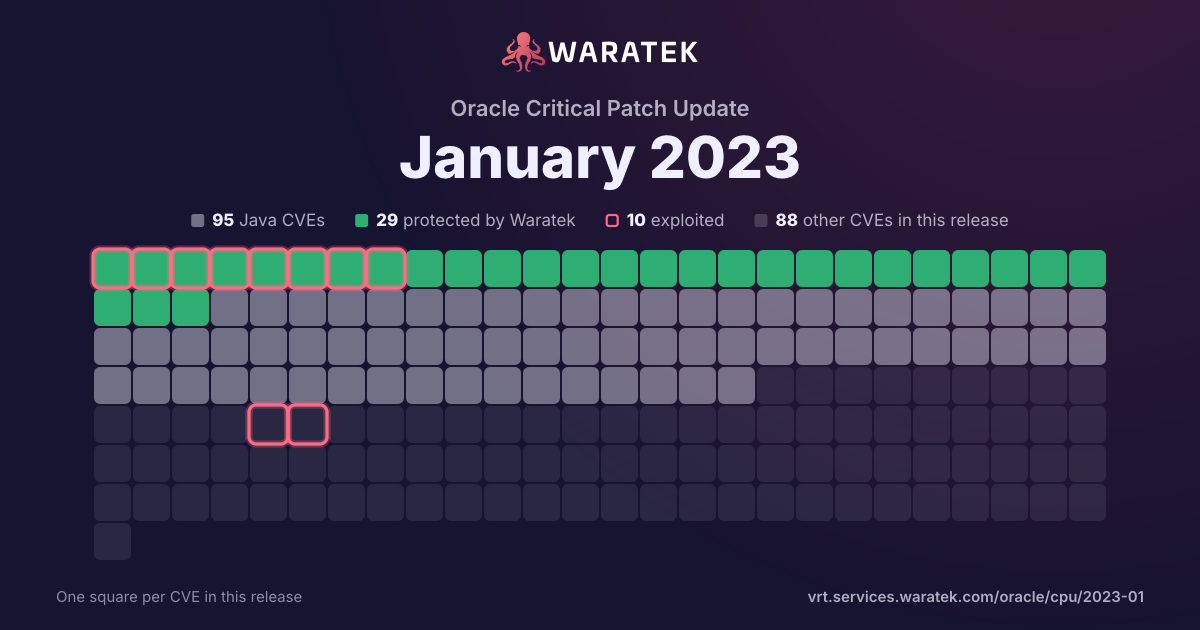
By status
28Protected by Waratek5Mitigation candidate66No exploit published3Outside Waratek scope80Not applicable1Withdrawn CVE
9Exploited, marked by the ring
No exploit published. For 35 of them, Oracle's security advisory is the source of public detail.
Protected by Waratek. Waratek RASP can block exploitation of these on systems that have not applied the patch yet.
Overview 22 matches · 7 protected · 1 exploited · 0 CISA KEV · 4 public PoC · 1 EPSS ≥ 0.5
Protected by Waratek
7
31.8%
Rule in development
0
0.0%
Mitigation candidate
2
9.1%
No exploit published
13
59.1%
blocked by ARMR today
7
31.8%
partly blocked
0
0.0%
not blocked
15
68.2%
not established
0
0.0%
unrecorded
0
0.0%
Exploited
1
4.5%
Working exploit published
0
0.0%
Proof of concept only
7
31.8%
Forecast only
0
0.0%
No public exploit
14
63.6%
split by
peak 5 / month
Jul 222
Protected by Waratek1
No exploit published1
High2
blocked by ARMR today1
not blocked1
Proof of concept only1
No public exploit1
Aug 225
Protected by Waratek2
No exploit published3
High4
Medium1
blocked by ARMR today2
not blocked3
Proof of concept only1
No public exploit4
Sep 222
Protected by Waratek1
Mitigation candidate1
High1
Medium1
blocked by ARMR today1
not blocked1
Proof of concept only2
Oct 225
Protected by Waratek1
Mitigation candidate1
No exploit published3
Critical3
High2
blocked by ARMR today1
not blocked4
Exploited1
Proof of concept only1
No public exploit3
Nov 223
Protected by Waratek2
No exploit published1
Critical2
High1
blocked by ARMR today2
not blocked1
Proof of concept only1
No public exploit2
Dec 224
No exploit published4
High3
Medium1
not blocked4
Proof of concept only1
No public exploit3
Jan 231
No exploit published1
Critical1
not blocked1
No public exploit1
Jul 22Aug 22Sep 22Oct 22Nov 22Dec 22Jan 23
| CVE | Severity | Published▾ | Status | Exploitation | Description |
|---|---|---|---|---|---|
| CVE-2023-21890 | Critical | 2023-01-18 | No exploit published | No public exploit | Vulnerability in the Oracle Communications Converged Application Server product of Oracle Communications (component: Core). Supported versions that are affected are 7.1.0 and 8.0.0. Easily exploitable vulnerability allows unauthenticated attacker with network access via UDP to compromise Oracle Communications Converged Application Server. Successful attacks of this vulnerability can result in takeover of Oracle Communications Converged Application Server. CVSS 3.1 Base Score 9.8 (Confidentiality, Integrity and Availability impacts). CVSS Vector: (CVSS:3.1/AV:N/AC:L/PR:N/UI:N/S:U/C:H/I:H/A:H). |
| CVE-2022-41881 | High | 2022-12-12 | No exploit published | Proof of concept only | Netty project is an event-driven asynchronous network application framework. In versions prior to 4.1.86.Final, a StackOverflowError can be raised when parsing a malformed crafted message due to an infinite recursion. This issue is patched in version 4.1.86.Final. There is no workaround, except using a custom HaProxyMessageDecoder. |
| CVE-2022-3510 | High | 2022-12-12 | No exploit published | No public exploit | A parsing issue similar to CVE-2022-3171, but with Message-Type Extensions in protobuf-java core and lite versions prior to 3.21.7, 3.20.3, 3.19.6 and 3.16.3 can lead to a denial of service attack. Inputs containing multiple instances of non-repeated embedded messages with repeated or unknown fields causes objects to be converted back-n-forth between mutable and immutable forms, resulting in potentially long garbage collection pauses. We recommend updating to the versions mentioned above. |
| CVE-2022-4147 | High | 2022-12-06 | No exploit published | No public exploit | Quarkus CORS filter allows simple GET and POST requests with invalid Origin to proceed. Simple GET or POST requests made with XMLHttpRequest are the ones which have no event listeners registered on the object returned by the XMLHttpRequest upload property and have no ReadableStream object used in the request. |
| CVE-2021-37533 | Medium | 2022-12-03 | No exploit published | No public exploit | Prior to Apache Commons Net 3.9.0, Net's FTP client trusts the host from PASV response by default. A malicious server can redirect the Commons Net code to use a different host, but the user has to connect to the malicious server in the first place. This may lead to leakage of information about services running on the private network of the client. The default in version 3.9.0 is now false to ignore such hosts, as cURL does. See https://issues.apache.org/jira/browse/NET-711. |
| CVE-2022-45047 | Critical | 2022-11-16 | Protected by Waratek | Proof of concept only | Class org.apache.sshd.server.keyprovider.SimpleGeneratorHostKeyProvider in Apache MINA SSHD <= 2.9.1 uses Java deserialization to load a serialized java.security.PrivateKey. The class is one of several implementations that an implementor using Apache MINA SSHD can choose for loading the host keys of an SSH server. |
| CVE-2022-42920 | Critical | 2022-11-07 | Protected by Waratek | No public exploit | Apache Commons BCEL has a number of APIs that would normally only allow changing specific class characteristics. However, due to an out-of-bounds writing issue, these APIs can be used to produce arbitrary bytecode. This could be abused in applications that pass attacker-controllable data to those APIs, giving the attacker more control over the resulting bytecode than otherwise expected. Update to Apache Commons BCEL 6.6.0. |
| CVE-2022-42252 | High | 2022-11-01 | No exploit published | No public exploit | If Apache Tomcat 8.5.0 to 8.5.82, 9.0.0-M1 to 9.0.67, 10.0.0-M1 to 10.0.26 or 10.1.0-M1 to 10.1.0 was configured to ignore invalid HTTP headers via setting rejectIllegalHeader to false (the default for 8.5.x only), Tomcat did not reject a request containing an invalid Content-Length header making a request smuggling attack possible if Tomcat was located behind a reverse proxy that also failed to reject the request with the invalid header. |
| CVE-2022-31692 | Critical | 2022-10-31 | Mitigation candidate | Proof of concept only | Spring Security, versions 5.7 prior to 5.7.5 and 5.6 prior to 5.6.9 could be susceptible to authorization rules bypass via forward or include dispatcher types. Specifically, an application is vulnerable when all of the following are true: The application expects that Spring Security applies security to forward and include dispatcher types. The application uses the AuthorizationFilter either manually or via the authorizeHttpRequests() method. The application configures the FilterChainProxy to apply to forward and/or include requests (e.g. spring.security.filter.dispatcher-types = request, error, async, forward, include). The application may forward or include the request to a higher privilege-secured endpoint.The application configures Spring Security to apply to every dispatcher type via authorizeHttpRequests().shouldFilterAllDispatcherTypes(true) |
| CVE-2022-43403 | Critical | 2022-10-19 | No exploit published | No public exploit | A sandbox bypass vulnerability involving casting an array-like value to an array type in Jenkins Script Security Plugin 1183.v774b_0b_0a_a_451 and earlier allows attackers with permission to define and run sandboxed scripts, including Pipelines, to bypass the sandbox protection and execute arbitrary code in the context of the Jenkins controller JVM. |
| CVE-2022-42889 | Critical | 2022-10-13 | Protected by Waratek | Exploited | Apache Commons Text performs variable interpolation, allowing properties to be dynamically evaluated and expanded. The standard format for interpolation is "${prefix:name}", where "prefix" is used to locate an instance of org.apache.commons.text.lookup.StringLookup that performs the interpolation. Starting with version 1.5 and continuing through 1.9, the set of default Lookup instances included interpolators that could result in arbitrary code execution or contact with remote servers. These lookups are: - "script" - execute expressions using the JVM script execution engine (javax.script) - "dns" - resolve dns records - "url" - load values from urls, including from remote servers Applications using the interpolation defaults in the affected versions may be vulnerable to remote code execution or unintentional contact with remote servers if untrusted configuration values are used. Users are recommended to upgrade to Apache Commons Text 1.10.0, which disables the problematic interpolators by default. |
| CVE-2022-3171 | High | 2022-10-12 | No exploit published | No public exploit | A parsing issue with binary data in protobuf-java core and lite versions prior to 3.21.7, 3.20.3, 3.19.6 and 3.16.3 can lead to a denial of service attack. Inputs containing multiple instances of non-repeated embedded messages with repeated or unknown fields causes objects to be converted back-n-forth between mutable and immutable forms, resulting in potentially long garbage collection pauses. We recommend updating to the versions mentioned above. |
| CVE-2022-42003 | High | 2022-10-02 | No exploit published | No public exploit | In FasterXML jackson-databind before versions 2.13.4.1 and 2.12.17.1, resource exhaustion can occur because of a lack of a check in primitive value deserializers to avoid deep wrapper array nesting, when the UNWRAP_SINGLE_VALUE_ARRAYS feature is enabled. |
| CVE-2022-40146 | High | 2022-09-22 | Mitigation candidate | Proof of concept only | Server-Side Request Forgery (SSRF) vulnerability in Batik of Apache XML Graphics allows an attacker to access files using a Jar url. This issue affects Apache XML Graphics Batik 1.14. |
| CVE-2022-38752 | Medium | 2022-09-05 | Protected by Waratek | Proof of concept only | Using snakeYAML to parse untrusted YAML files may be vulnerable to Denial of Service attacks (DOS). If the parser is running on user supplied input, an attacker may supply content that causes the parser to crash by stack-overflow. |
| CVE-2022-1319 | High | 2022-08-31 | No exploit published | No public exploit | A flaw was found in Undertow. For an AJP 400 response, EAP 7 is improperly sending two response packets, and those packets have the reuse flag set even though JBoss EAP closes the connection. A failure occurs when the connection is reused after a 400 by CPING since it reads in the second SEND_HEADERS response packet instead of a CPONG. |
| CVE-2022-25857 | High | 2022-08-30 | Protected by Waratek | No public exploit | The package org.yaml:snakeyaml from 0 and before 1.31 are vulnerable to Denial of Service (DoS) due missing to nested depth limitation for collections. |
| CVE-2022-36033 | Medium | 2022-08-29 | Protected by Waratek | Proof of concept only | jsoup is a Java HTML parser, built for HTML editing, cleaning, scraping, and cross-site scripting (XSS) safety. jsoup may incorrectly sanitize HTML including `javascript:` URL expressions, which could allow XSS attacks when a reader subsequently clicks that link. If the non-default `SafeList.preserveRelativeLinks` option is enabled, HTML including `javascript:` URLs that have been crafted with control characters will not be sanitized. If the site that this HTML is published on does not set a Content Security Policy, an XSS attack is then possible. This issue is patched in jsoup 1.15.3. Users should upgrade to this version. Additionally, as the unsanitized input may have been persisted, old content should be cleaned again using the updated version. To remediate this issue without immediately upgrading: - disable `SafeList.preserveRelativeLinks`, which will rewrite input URLs as absolute URLs - ensure an appropriate [Content Security Policy](https://developer.mozilla.org/en-US/docs/Web/HTTP/CSP) is defined. (This should be used regardless of upgrading, as a defence-in-depth best practice.) |
| CVE-2022-0084 | High | 2022-08-26 | No exploit published | No public exploit | A flaw was found in XNIO, specifically in the notifyReadClosed method. The issue revealed this method was logging a message to another expected end. This flaw allows an attacker to send flawed requests to a server, possibly causing log contention-related performance concerns or an unwanted disk fill-up. |
| CVE-2022-2053 | High | 2022-08-05 | No exploit published | No public exploit | When a POST request comes through AJP and the request exceeds the max-post-size limit (maxEntitySize), Undertow's AjpServerRequestConduit implementation closes a connection without sending any response to the client/proxy. This behavior results in that a front-end proxy marking the backend worker (application server) as an error state and not forward requests to the worker for a while. In mod_cluster, this continues until the next STATUS request (10 seconds intervals) from the application server updates the server state. So, in the worst case, it can result in "All workers are in error state" and mod_cluster responds "503 Service Unavailable" for a while (up to 10 seconds). In mod_proxy_balancer, it does not forward requests to the worker until the "retry" timeout passes. However, luckily, mod_proxy_balancer has "forcerecovery" setting (On by default; this parameter can force the immediate recovery of all workers without considering the retry parameter of the workers if all workers of a balancer are in error state.). So, unlike mod_cluster, mod_proxy_balancer does not result in responding "503 Service Unavailable". An attacker could use this behavior to send a malicious request and trigger server errors, resulting in DoS (denial of service). This flaw was fixed in Undertow 2.2.19.Final, Undertow 2.3.0.Alpha2. |
| CVE-2022-34169 | High | 2022-07-19 | Protected by Waratek | Proof of concept only | The Apache Xalan Java XSLT library is vulnerable to an integer truncation issue when processing malicious XSLT stylesheets. This can be used to corrupt Java class files generated by the internal XSLTC compiler and execute arbitrary Java bytecode. Users are recommended to update to version 2.7.3 or later. Note: Java runtimes (such as OpenJDK) include repackaged copies of Xalan. |
| CVE-2022-2048 | High | 2022-07-07 | No exploit published | No public exploit | In Eclipse Jetty HTTP/2 server implementation, when encountering an invalid HTTP/2 request, the error handling has a bug that can wind up not properly cleaning up the active connections and associated resources. This can lead to a Denial of Service scenario where there are no enough resources left to process good requests. |