
Oracle Critical Patch Update July 2022
Released July 2022 · Oracle's advisory ↗ · ← Critical Patch Update, April 2022 · Critical Patch Update, October 2022 →
188 CVEs in this release, one square each
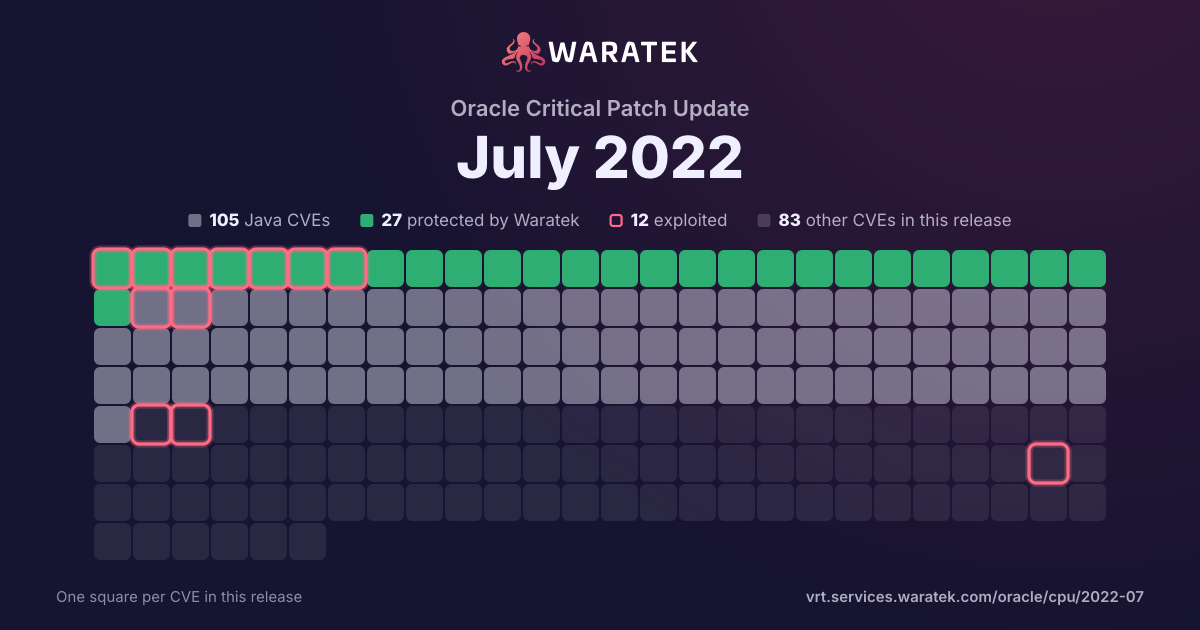
By status
27Protected by Waratek6Mitigation candidate72No exploit published49Outside Waratek scope34Not applicable
12Exploited, marked by the ring
No exploit published. For 47 of them, Oracle's security advisory is the source of public detail.
Protected by Waratek. Waratek RASP can block exploitation of these on systems that have not applied the patch yet.
Overview 161 matches · 78 in Waratek scope · 0 protected · 5 exploited · 2 CISA KEV · 13 public PoC · 12 EPSS ≥ 0.5
161matches
78in Waratek scope48.4%
0protected0.0%
5exploited3.1%
2CISA KEV1.2%
13public PoC8.1%
12EPSS ≥ 0.57.5%
Protected by Waratek
0
0.0%
Rule in development
0
0.0%
Mitigation candidate
6
3.7%
No exploit published
72
44.7%
Outside Waratek scope
49
30.4%
Not applicable
34
21.1%
Withdrawn CVE
0
0.0%
blocked by ARMR today
0
0.0%
partly blocked
0
0.0%
not blocked
161
100.0%
not established
0
0.0%
unrecorded
0
0.0%
split by
peak 85 / quarter
Q2 192
Outside Waratek scope1
Not applicable1
High1
Medium1
not blocked2
Working exploit published1
No public exploit1
Q3 191
Outside Waratek scope1
Critical1
not blocked1
No public exploit1
Q4 191
No exploit published1
Critical1
not blocked1
No public exploit1
Q1 202
No exploit published1
Outside Waratek scope1
Critical1
High1
not blocked2
No public exploit2
Q2 203
Outside Waratek scope3
Medium3
not blocked3
Exploited2
Forecast only1
Q3 201
Outside Waratek scope1
High1
not blocked1
No public exploit1
Q4 202
No exploit published1
Outside Waratek scope1
High2
not blocked2
No public exploit2
Q1 217
No exploit published3
Outside Waratek scope2
Not applicable2
Critical2
High5
not blocked7
Exploited1
Proof of concept only1
No public exploit5
Q2 215
Mitigation candidate1
No exploit published3
Outside Waratek scope1
Critical1
High3
Medium1
not blocked5
Working exploit published1
No public exploit4
Q3 2114
Mitigation candidate1
No exploit published8
Outside Waratek scope2
Not applicable3
Critical2
High8
Medium4
not blocked14
Exploited1
Proof of concept only1
Forecast only1
No public exploit11
Q4 217
Outside Waratek scope5
Not applicable2
Critical1
High1
Medium5
not blocked7
Proof of concept only1
No public exploit6
Q1 2218
Mitigation candidate1
No exploit published5
Outside Waratek scope6
Not applicable6
Critical3
High12
Medium3
not blocked18
Exploited1
Proof of concept only5
No public exploit12
Q2 2213
Mitigation candidate3
No exploit published6
Outside Waratek scope2
Not applicable2
Critical3
High6
Medium4
not blocked13
Working exploit published1
Proof of concept only5
No public exploit7
Q3 2285
No exploit published44
Outside Waratek scope23
Not applicable18
Critical2
High18
Medium61
Low4
not blocked85
Forecast only1
No public exploit84
Q3 19Q1 20Q3 20Q1 21Q3 21Q1 22Q3 22
| CVE | Severity | Published▾ | Status | Exploitation | Description |
|---|---|---|---|---|---|
| CVE-2022-24729 | High | 2022-03-16 | Outside Waratek scope | No public exploit | CKEditor4 is an open source what-you-see-is-what-you-get HTML editor. CKEditor4 prior to version 4.18.0 contains a vulnerability in the `dialog` plugin. The vulnerability allows abuse of a dialog input validator regular expression, which can cause a significant performance drop resulting in a browser tab freeze. A patch is available in version 4.18.0. There are currently no known workarounds. |
| CVE-2022-0778 | High | 2022-03-15 | Outside Waratek scope | Proof of concept only | The BN_mod_sqrt() function, which computes a modular square root, contains a bug that can cause it to loop forever for non-prime moduli. Internally this function is used when parsing certificates that contain elliptic curve public keys in compressed form or explicit elliptic curve parameters with a base point encoded in compressed form. It is possible to trigger the infinite loop by crafting a certificate that has invalid explicit curve parameters. Since certificate parsing happens prior to verification of the certificate signature, any process that parses an externally supplied certificate may thus be subject to a denial of service attack. The infinite loop can also be reached when parsing crafted private keys as they can contain explicit elliptic curve parameters. Thus vulnerable situations include: - TLS clients consuming server certificates - TLS servers consuming client certificates - Hosting providers taking certificates or private keys from customers - Certificate authorities parsing certification requests from subscribers - Anything else which parses ASN.1 elliptic curve parameters Also any other applications that use the BN_mod_sqrt() where the attacker can control the parameter values are vulnerable to this DoS issue. In the OpenSSL 1.0.2 version the public key is not parsed during initial parsing of the certificate which makes it slightly harder to trigger the infinite loop. However any operation which requires the public key from the certificate will trigger the infinite loop. In particular the attacker can use a self-signed certificate to trigger the loop during verification of the certificate signature. This issue affects OpenSSL versions 1.0.2, 1.1.1 and 3.0. It was addressed in the releases of 1.1.1n and 3.0.2 on the 15th March 2022. Fixed in OpenSSL 3.0.2 (Affected 3.0.0,3.0.1). Fixed in OpenSSL 1.1.1n (Affected 1.1.1-1.1.1m). Fixed in OpenSSL 1.0.2zd (Affected 1.0.2-1.0.2zc). |
| CVE-2022-22721 | Critical | 2022-03-14 | Outside Waratek scope | No public exploit | If LimitXMLRequestBody is set to allow request bodies larger than 350MB (defaults to 1M) on 32 bit systems an integer overflow happens which later causes out of bounds writes. This issue affects Apache HTTP Server 2.4.52 and earlier. |
| CVE-2020-36518 | High | 2022-03-11 | No exploit published | No public exploit | jackson-databind before 2.13.0 allows a Java StackOverflow exception and denial of service via a large depth of nested objects. |
| CVE-2021-38296 | High | 2022-03-10 | No exploit published | No public exploit | Apache Spark supports end-to-end encryption of RPC connections via "spark.authenticate" and "spark.network.crypto.enabled". In versions 3.1.2 and earlier, it uses a bespoke mutual authentication protocol that allows for full encryption key recovery. After an initial interactive attack, this would allow someone to decrypt plaintext traffic offline. Note that this does not affect security mechanisms controlled by "spark.authenticate.enableSaslEncryption", "spark.io.encryption.enabled", "spark.ssl", "spark.ui.strictTransportSecurity". Update to Apache Spark 3.1.3 or later |
| CVE-2022-22947 | Critical | 2022-03-03 | Mitigation candidate | Exploited | In spring cloud gateway versions prior to 3.1.1+ and 3.0.7+ , applications are vulnerable to a code injection attack when the Gateway Actuator endpoint is enabled, exposed and unsecured. A remote attacker could make a maliciously crafted request that could allow arbitrary remote execution on the remote host. |
| CVE-2022-23308 | High | 2022-02-26 | Not applicable | No public exploit | valid.c in libxml2 before 2.9.13 has a use-after-free of ID and IDREF attributes. |
| CVE-2022-24329 | Medium | 2022-02-25 | No exploit published | No public exploit | In JetBrains Kotlin before 1.6.0, it was not possible to lock dependencies for Multiplatform Gradle Projects. |
| CVE-2022-25636 | High | 2022-02-24 | Not applicable | Proof of concept only | net/netfilter/nf_dup_netdev.c in the Linux kernel 5.4 through 5.6.10 allows local users to gain privileges because of a heap out-of-bounds write. This is related to nf_tables_offload. |
| CVE-2022-24407 | High | 2022-02-24 | Outside Waratek scope | No public exploit | In Cyrus SASL 2.1.17 through 2.1.27 before 2.1.28, plugins/sql.c does not escape the password for a SQL INSERT or UPDATE statement. |
| CVE-2022-21824 | High | 2022-02-24 | Not applicable | No public exploit | Due to the formatting logic of the "console.table()" function it was not safe to allow user controlled input to be passed to the "properties" parameter while simultaneously passing a plain object with at least one property as the first parameter, which could be "__proto__". The prototype pollution has very limited control, in that it only allows an empty string to be assigned to numerical keys of the object prototype.Node.js >= 12.22.9, >= 14.18.3, >= 16.13.2, and >= 17.3.1 use a null protoype for the object these properties are being assigned to. |
| CVE-2022-23632 | High | 2022-02-17 | Not applicable | No public exploit | Traefik is an HTTP reverse proxy and load balancer. Prior to version 2.6.1, Traefik skips the router transport layer security (TLS) configuration when the host header is a fully qualified domain name (FQDN). For a request, the TLS configuration choice can be different than the router choice, which implies the use of a wrong TLS configuration. When sending a request using FQDN handled by a router configured with a dedicated TLS configuration, the TLS configuration falls back to the default configuration that might not correspond to the configured one. If the CNAME flattening is enabled, the selected TLS configuration is the SNI one and the routing uses the CNAME value, so this can skip the expected TLS configuration. Version 2.6.1 contains a patch for this issue. As a workaround, one may add the FDQN to the host rule. However, there is no workaround if the CNAME flattening is enabled. |
| CVE-2021-43859 | High | 2022-02-01 | No exploit published | Proof of concept only | XStream is an open source java library to serialize objects to XML and back again. Versions prior to 1.4.19 may allow a remote attacker to allocate 100% CPU time on the target system depending on CPU type or parallel execution of such a payload resulting in a denial of service only by manipulating the processed input stream. XStream 1.4.19 monitors and accumulates the time it takes to add elements to collections and throws an exception if a set threshold is exceeded. Users are advised to upgrade as soon as possible. Users unable to upgrade may set the NO_REFERENCE mode to prevent recursion. See GHSA-rmr5-cpv2-vgjf for further details on a workaround if an upgrade is not possible. |
| CVE-2022-23437 | Medium | 2022-01-24 | No exploit published | No public exploit | There's a vulnerability within the Apache Xerces Java (XercesJ) XML parser when handling specially crafted XML document payloads. This causes, the XercesJ XML parser to wait in an infinite loop, which may sometimes consume system resources for prolonged duration. This vulnerability is present within XercesJ version 2.12.1 and the previous versions. |
| CVE-2022-23219 | Critical | 2022-01-14 | Outside Waratek scope | Proof of concept only | The deprecated compatibility function clnt_create in the sunrpc module of the GNU C Library (aka glibc) through 2.34 copies its hostname argument on the stack without validating its length, which may result in a buffer overflow, potentially resulting in a denial of service or (if an application is not built with a stack protector enabled) arbitrary code execution. |
| CVE-2021-45943 | Medium | 2022-01-01 | Not applicable | No public exploit | GDAL 3.3.0 through 3.4.0 has a heap-based buffer overflow in PCIDSK::CPCIDSKFile::ReadFromFile (called from PCIDSK::CPCIDSKSegment::ReadFromFile and PCIDSK::CPCIDSKBinarySegment::CPCIDSKBinarySegment). |
| CVE-2021-34141 | Medium | 2021-12-17 | Not applicable | No public exploit | An incomplete string comparison in the numpy.core component in NumPy before 1.22.0 allows attackers to trigger slightly incorrect copying by constructing specific string objects. NOTE: the vendor states that this reported code behavior is "completely harmless." |
| CVE-2021-23450 | Critical | 2021-12-17 | Outside Waratek scope | No public exploit | All versions of package dojo are vulnerable to Prototype Pollution via the setObject function. |
| CVE-2021-43797 | Medium | 2021-12-09 | Outside Waratek scope | No public exploit | Netty is an asynchronous event-driven network application framework for rapid development of maintainable high performance protocol servers & clients. Netty prior to version 4.1.71.Final skips control chars when they are present at the beginning / end of the header name. It should instead fail fast as these are not allowed by the spec and could lead to HTTP request smuggling. Failing to do the validation might cause netty to "sanitize" header names before it forward these to another remote system when used as proxy. This remote system can't see the invalid usage anymore, and therefore does not do the validation itself. Users should upgrade to version 4.1.71.Final. |
| CVE-2021-3572 | Medium | 2021-11-10 | Not applicable | No public exploit | A flaw was found in python-pip in the way it handled Unicode separators in git references. A remote attacker could possibly use this issue to install a different revision on a repository. The highest threat from this vulnerability is to data integrity. This is fixed in python-pip version 21.1. |
| CVE-2021-41184 | Medium | 2021-10-26 | Outside Waratek scope | Proof of concept only | jQuery-UI is the official jQuery user interface library. Prior to version 1.13.0, accepting the value of the `of` option of the `.position()` util from untrusted sources may execute untrusted code. The issue is fixed in jQuery UI 1.13.0. Any string value passed to the `of` option is now treated as a CSS selector. A workaround is to not accept the value of the `of` option from untrusted sources. |
| CVE-2021-41182 | Medium | 2021-10-26 | Outside Waratek scope | No public exploit | jQuery-UI is the official jQuery user interface library. Prior to version 1.13.0, accepting the value of the `altField` option of the Datepicker widget from untrusted sources may execute untrusted code. The issue is fixed in jQuery UI 1.13.0. Any string value passed to the `altField` option is now treated as a CSS selector. A workaround is to not accept the value of the `altField` option from untrusted sources. |
| CVE-2021-37137 | High | 2021-10-19 | Outside Waratek scope | No public exploit | The Snappy frame decoder function doesn't restrict the chunk length which may lead to excessive memory usage. Beside this it also may buffer reserved skippable chunks until the whole chunk was received which may lead to excessive memory usage as well. This vulnerability can be triggered by supplying malicious input that decompresses to a very big size (via a network stream or a file) or by sending a huge skippable chunk. |
| CVE-2021-22946 | High | 2021-09-29 | Outside Waratek scope | Proof of concept only | A user can tell curl >= 7.20.0 and <= 7.78.0 to require a successful upgrade to TLS when speaking to an IMAP, POP3 or FTP server (`--ssl-reqd` on the command line or`CURLOPT_USE_SSL` set to `CURLUSESSL_CONTROL` or `CURLUSESSL_ALL` withlibcurl). This requirement could be bypassed if the server would return a properly crafted but perfectly legitimate response.This flaw would then make curl silently continue its operations **withoutTLS** contrary to the instructions and expectations, exposing possibly sensitive data in clear text over the network. |
| CVE-2021-38153 | Medium | 2021-09-22 | Mitigation candidate | Exploited | Some components in Apache Kafka use `Arrays.equals` to validate a password or key, which is vulnerable to timing attacks that make brute force attacks for such credentials more likely to be successful. Users should upgrade to 2.8.1 or higher, or 3.0.0 or higher where this vulnerability has been fixed. The affected versions include Apache Kafka 2.0.0, 2.0.1, 2.1.0, 2.1.1, 2.2.0, 2.2.1, 2.2.2, 2.3.0, 2.3.1, 2.4.0, 2.4.1, 2.5.0, 2.5.1, 2.6.0, 2.6.1, 2.6.2, 2.7.0, 2.7.1, and 2.8.0. |
| CVE-2021-40690 | High | 2021-09-19 | No exploit published | No public exploit | All versions of Apache Santuario - XML Security for Java prior to 2.2.3 and 2.1.7 are vulnerable to an issue where the "secureValidation" property is not passed correctly when creating a KeyInfo from a KeyInfoReference element. This allows an attacker to abuse an XPath Transform to extract any local .xml files in a RetrievalMethod element. |
| CVE-2021-41303 | Critical | 2021-09-17 | No exploit published | Forecast only | Apache Shiro before 1.8.0, when using Apache Shiro with Spring Boot, a specially crafted HTTP request may cause an authentication bypass. Users should update to Apache Shiro 1.8.0. |
| CVE-2021-3749 | High | 2021-08-31 | Not applicable | No public exploit | axios is vulnerable to Inefficient Regular Expression Complexity |
| CVE-2021-39139 | High | 2021-08-23 | No exploit published | No public exploit | XStream is a simple library to serialize objects to XML and back again. In affected versions this vulnerability may allow a remote attacker to load and execute arbitrary code from a remote host only by manipulating the processed input stream. A user is only affected if using the version out of the box with JDK 1.7u21 or below. However, this scenario can be adjusted easily to an external Xalan that works regardless of the version of the Java runtime. No user is affected, who followed the recommendation to setup XStream's security framework with a whitelist limited to the minimal required types. XStream 1.4.18 uses no longer a blacklist by default, since it cannot be secured for general purpose. |
| CVE-2021-37750 | Medium | 2021-08-23 | Outside Waratek scope | No public exploit | The Key Distribution Center (KDC) in MIT Kerberos 5 (aka krb5) before 1.18.5 and 1.19.x before 1.19.3 has a NULL pointer dereference in kdc/do_tgs_req.c via a FAST inner body that lacks a server field. |
| CVE-2021-35940 | High | 2021-08-23 | Not applicable | No public exploit | An out-of-bounds array read in the apr_time_exp*() functions was fixed in the Apache Portable Runtime 1.6.3 release (CVE-2017-12613). The fix for this issue was not carried forward to the APR 1.7.x branch, and hence version 1.7.0 regressed compared to 1.6.3 and is vulnerable to the same issue. |
| CVE-2021-37714 | High | 2021-08-18 | No exploit published | No public exploit | jsoup is a Java library for working with HTML. Those using jsoup versions prior to 1.14.2 to parse untrusted HTML or XML may be vulnerable to DOS attacks. If the parser is run on user supplied input, an attacker may supply content that causes the parser to get stuck (loop indefinitely until cancelled), to complete more slowly than usual, or to throw an unexpected exception. This effect may support a denial of service attack. The issue is patched in version 1.14.2. There are a few available workarounds. Users may rate limit input parsing, limit the size of inputs based on system resources, and/or implement thread watchdogs to cap and timeout parse runtimes. |
| CVE-2021-22931 | Critical | 2021-08-16 | Not applicable | No public exploit | Node.js before 16.6.0, 14.17.4, and 12.22.4 is vulnerable to Remote Code Execution, XSS, Application crashes due to missing input validation of host names returned by Domain Name Servers in Node.js dns library which can lead to output of wrong hostnames (leading to Domain Hijacking) and injection vulnerabilities in applications using the library. |
| CVE-2021-2351 | High | 2021-07-21 | No exploit published | No public exploit | Vulnerability in the Advanced Networking Option component of Oracle Database Server. Supported versions that are affected are 12.1.0.2, 12.2.0.1 and 19c. Difficult to exploit vulnerability allows unauthenticated attacker with network access via Oracle Net to compromise Advanced Networking Option. Successful attacks require human interaction from a person other than the attacker and while the vulnerability is in Advanced Networking Option, attacks may significantly impact additional products. Successful attacks of this vulnerability can result in takeover of Advanced Networking Option. Note: The July 2021 Critical Patch Update introduces a number of Native Network Encryption changes to deal with vulnerability CVE-2021-2351 and prevent the use of weaker ciphers. Customers should review: "Changes in Native Network Encryption with the July 2021 Critical Patch Update" (Doc ID 2791571.1). CVSS 3.1 Base Score 8.3 (Confidentiality, Integrity and Availability impacts). CVSS Vector: (CVSS:3.1/AV:N/AC:H/PR:N/UI:R/S:C/C:H/I:H/A:H). |
| CVE-2021-36374 | Medium | 2021-07-14 | No exploit published | No public exploit | When reading a specially crafted ZIP archive, or a derived formats, an Apache Ant build can be made to allocate large amounts of memory that leads to an out of memory error, even for small inputs. This can be used to disrupt builds using Apache Ant. Commonly used derived formats from ZIP archives are for instance JAR files and many office files. Apache Ant prior to 1.9.16 and 1.10.11 were affected. |
| CVE-2021-36090 | High | 2021-07-13 | No exploit published | No public exploit | When reading a specially crafted ZIP archive, Compress can be made to allocate large amounts of memory that finally leads to an out of memory error even for very small inputs. This could be used to mount a denial of service attack against services that use Compress' zip package. |
| CVE-2021-30129 | Medium | 2021-07-12 | No exploit published | No public exploit | A vulnerability in sshd-core of Apache Mina SSHD allows an attacker to overflow the server causing an OutOfMemory error. This issue affects the SFTP and port forwarding features of Apache Mina SSHD version 2.0.0 and later versions. It was addressed in Apache Mina SSHD 2.7.0 |
| CVE-2021-22119 | High | 2021-06-29 | No exploit published | No public exploit | Spring Security versions 5.5.x prior to 5.5.1, 5.4.x prior to 5.4.7, 5.3.x prior to 5.3.10 and 5.2.x prior to 5.2.11 are susceptible to a Denial-of-Service (DoS) attack via the initiation of the Authorization Request in an OAuth 2.0 Client Web and WebFlux application. A malicious user or attacker can send multiple requests initiating the Authorization Request for the Authorization Code Grant, which has the potential of exhausting system resources using a single session or multiple sessions. |
| CVE-2021-31812 | Medium | 2021-06-12 | No exploit published | No public exploit | In Apache PDFBox, a carefully crafted PDF file can trigger an infinite loop while loading the file. This issue affects Apache PDFBox version 2.0.23 and prior 2.0.x versions. |
| CVE-2021-31684 | High | 2021-06-01 | No exploit published | No public exploit | A vulnerability was discovered in the indexOf function of JSONParserByteArray in JSON Smart versions 1.3 and 2.4 which causes a denial of service (DOS) via a crafted web request. |
| CVE-2021-29505 | High | 2021-05-28 | Mitigation candidate | Working exploit published | XStream is software for serializing Java objects to XML and back again. A vulnerability in XStream versions prior to 1.4.17 may allow a remote attacker has sufficient rights to execute commands of the host only by manipulating the processed input stream. No user who followed the recommendation to setup XStream's security framework with a whitelist limited to the minimal required types is affected. The vulnerability is patched in version 1.4.17. |
| CVE-2021-26291 | Critical | 2021-04-23 | Outside Waratek scope | No public exploit | Apache Maven will follow repositories that are defined in a dependency’s Project Object Model (pom) which may be surprising to some users, resulting in potential risk if a malicious actor takes over that repository or is able to insert themselves into a position to pretend to be that repository. Maven is changing the default behavior in 3.8.1+ to no longer follow http (non-SSL) repository references by default. More details available in the referenced urls. If you are currently using a repository manager to govern the repositories used by your builds, you are unaffected by the risks present in the legacy behavior, and are unaffected by this vulnerability and change to default behavior. See this link for more information about repository management: https://maven.apache.org/repository-management.html |
| CVE-2021-3450 | High | 2021-03-25 | Not applicable | No public exploit | The X509_V_FLAG_X509_STRICT flag enables additional security checks of the certificates present in a certificate chain. It is not set by default. Starting from OpenSSL version 1.1.1h a check to disallow certificates in the chain that have explicitly encoded elliptic curve parameters was added as an additional strict check. An error in the implementation of this check meant that the result of a previous check to confirm that certificates in the chain are valid CA certificates was overwritten. This effectively bypasses the check that non-CA certificates must not be able to issue other certificates. If a "purpose" has been configured then there is a subsequent opportunity for checks that the certificate is a valid CA. All of the named "purpose" values implemented in libcrypto perform this check. Therefore, where a purpose is set the certificate chain will still be rejected even when the strict flag has been used. A purpose is set by default in libssl client and server certificate verification routines, but it can be overridden or removed by an application. In order to be affected, an application must explicitly set the X509_V_FLAG_X509_STRICT verification flag and either not set a purpose for the certificate verification or, in the case of TLS client or server applications, override the default purpose. OpenSSL versions 1.1.1h and newer are affected by this issue. Users of these versions should upgrade to OpenSSL 1.1.1k. OpenSSL 1.0.2 is not impacted by this issue. Fixed in OpenSSL 1.1.1k (Affected 1.1.1h-1.1.1j). |
| CVE-2020-11987 | High | 2021-02-24 | No exploit published | No public exploit | Apache Batik 1.13 is vulnerable to server-side request forgery, caused by improper input validation by the NodePickerPanel. By using a specially-crafted argument, an attacker could exploit this vulnerability to cause the underlying server to make arbitrary GET requests. |
| CVE-2020-28491 | High | 2021-02-18 | No exploit published | No public exploit | This affects the package com.fasterxml.jackson.dataformat:jackson-dataformat-cbor from 0 and before 2.11.4, from 2.12.0-rc1 and before 2.12.1. Unchecked allocation of byte buffer can cause a java.lang.OutOfMemoryError exception. |
| CVE-2021-23337 | High | 2021-02-15 | Not applicable | Exploited | Lodash versions prior to 4.17.21 are vulnerable to Command Injection via the template function. |
| CVE-2020-14343 | Critical | 2021-02-09 | Outside Waratek scope | No public exploit | A vulnerability was discovered in the PyYAML library in versions before 5.4, where it is susceptible to arbitrary code execution when it processes untrusted YAML files through the full_load method or with the FullLoader loader. Applications that use the library to process untrusted input may be vulnerable to this flaw. This flaw allows an attacker to execute arbitrary code on the system by abusing the python/object/new constructor. This flaw is due to an incomplete fix for CVE-2020-1747. |
| CVE-2020-9492 | High | 2021-01-26 | No exploit published | No public exploit | In Apache Hadoop 3.2.0 to 3.2.1, 3.0.0-alpha1 to 3.1.3, and 2.0.0-alpha to 2.10.0, WebHDFS client might send SPNEGO authorization header to remote URL without proper verification. |
| CVE-2021-3177 | Critical | 2021-01-19 | Outside Waratek scope | Proof of concept only | Python 3.x through 3.9.1 has a buffer overflow in PyCArg_repr in _ctypes/callproc.c, which may lead to remote code execution in certain Python applications that accept floating-point numbers as untrusted input, as demonstrated by a 1e300 argument to c_double.from_param. This occurs because sprintf is used unsafely. |
| CVE-2020-28052 | High | 2020-12-18 | No exploit published | No public exploit | An issue was discovered in Legion of the Bouncy Castle BC Java 1.65 and 1.66. The OpenBSDBCrypt.checkPassword utility method compared incorrect data when checking the password, allowing incorrect passwords to indicate they were matching with previously hashed ones that were different. |
| CVE-2020-26237 | High | 2020-11-24 | Outside Waratek scope | No public exploit | Highlight.js is a syntax highlighter written in JavaScript. Highlight.js versions before 9.18.2 and 10.1.2 are vulnerable to Prototype Pollution. A malicious HTML code block can be crafted that will result in prototype pollution of the base object's prototype during highlighting. If you allow users to insert custom HTML code blocks into your page/app via parsing Markdown code blocks (or similar) and do not filter the language names the user can provide you may be vulnerable. The pollution should just be harmless data but this can cause problems for applications not expecting these properties to exist and can result in strange behavior or application crashes, i.e. a potential DOS vector. If your website or application does not render user provided data it should be unaffected. Versions 9.18.2 and 10.1.2 and newer include fixes for this vulnerability. If you are using version 7 or 8 you are encouraged to upgrade to a newer release. |
| CVE-2019-20916 | High | 2020-09-04 | Outside Waratek scope | No public exploit | The pip package before 19.2 for Python allows Directory Traversal when a URL is given in an install command, because a Content-Disposition header can have ../ in a filename, as demonstrated by overwriting the /root/.ssh/authorized_keys file. This occurs in _download_http_url in _internal/download.py. |
| CVE-2020-11023 | Medium | 2020-04-29 | Outside Waratek scope | Exploited | In jQuery versions greater than or equal to 1.0.3 and before 3.5.0, passing HTML containing <option> elements from untrusted sources - even after sanitizing it - to one of jQuery's DOM manipulation methods (i.e. .html(), .append(), and others) may execute untrusted code. This problem is patched in jQuery 3.5.0. |
| CVE-2020-11022 | Medium | 2020-04-29 | Outside Waratek scope | Exploited | In jQuery starting with 1.12.0 and before 3.5.0, passing HTML from untrusted sources - even after sanitizing it - to one of jQuery's DOM manipulation methods (i.e. .html(), .append(), and others) may execute untrusted code. This problem is patched in jQuery 3.5.0. |
| CVE-2020-1927 | Medium | 2020-04-02 | Outside Waratek scope | Forecast only | In Apache HTTP Server 2.4.0 to 2.4.41, redirects configured with mod_rewrite that were intended to be self-referential might be fooled by encoded newlines and redirect instead to an an unexpected URL within the request URL. |
| CVE-2020-5258 | High | 2020-03-10 | Outside Waratek scope | No public exploit | In affected versions of dojo (NPM package), the deepCopy method is vulnerable to Prototype Pollution. Prototype Pollution refers to the ability to inject properties into existing JavaScript language construct prototypes, such as objects. An attacker manipulates these attributes to overwrite, or pollute, a JavaScript application object prototype of the base object by injecting other values. This has been patched in versions 1.12.8, 1.13.7, 1.14.6, 1.15.3 and 1.16.2 |
| CVE-2019-0219 | Critical | 2020-01-14 | No exploit published | No public exploit | A website running in the InAppBrowser webview on Android could execute arbitrary JavaScript in the main application's webview using a specially crafted gap-iab: URI. |
| CVE-2019-17495 | Critical | 2019-10-10 | No exploit published | No public exploit | A Cascading Style Sheets (CSS) injection vulnerability in Swagger UI before 3.23.11 allows attackers to use the Relative Path Overwrite (RPO) technique to perform CSS-based input field value exfiltration, such as exfiltration of a CSRF token value. In other words, this product intentionally allows the embedding of untrusted JSON data from remote servers, but it was not previously known that <style>@import within the JSON data was a functional attack method. |
| CVE-2019-10082 | Critical | 2019-09-26 | Outside Waratek scope | No public exploit | In Apache HTTP Server 2.4.18-2.4.39, using fuzzed network input, the http/2 session handling could be made to read memory after being freed, during connection shutdown. |
| CVE-2019-0220 | Medium | 2019-06-11 | Not applicable | No public exploit | A vulnerability was found in Apache HTTP Server 2.4.0 to 2.4.38. When the path component of a request URL contains multiple consecutive slashes ('/'), directives such as LocationMatch and RewriteRule must account for duplicates in regular expressions while other aspects of the servers processing will implicitly collapse them. |
| CVE-2019-0227 | High | 2019-05-01 | Outside Waratek scope | Working exploit published | A Server Side Request Forgery (SSRF) vulnerability affected the Apache Axis 1.4 distribution that was last released in 2006. Security and bug commits commits continue in the projects Axis 1.x Subversion repository, legacy users are encouraged to build from source. The successor to Axis 1.x is Axis2, the latest version is 1.7.9 and is not vulnerable to this issue. |