
Oracle Critical Patch Update April 2022
Released April 2022 · Oracle's advisory ↗ · ← Critical Patch Update, January 2022 · Critical Patch Update, July 2022 →
222 CVEs in this release, one square each
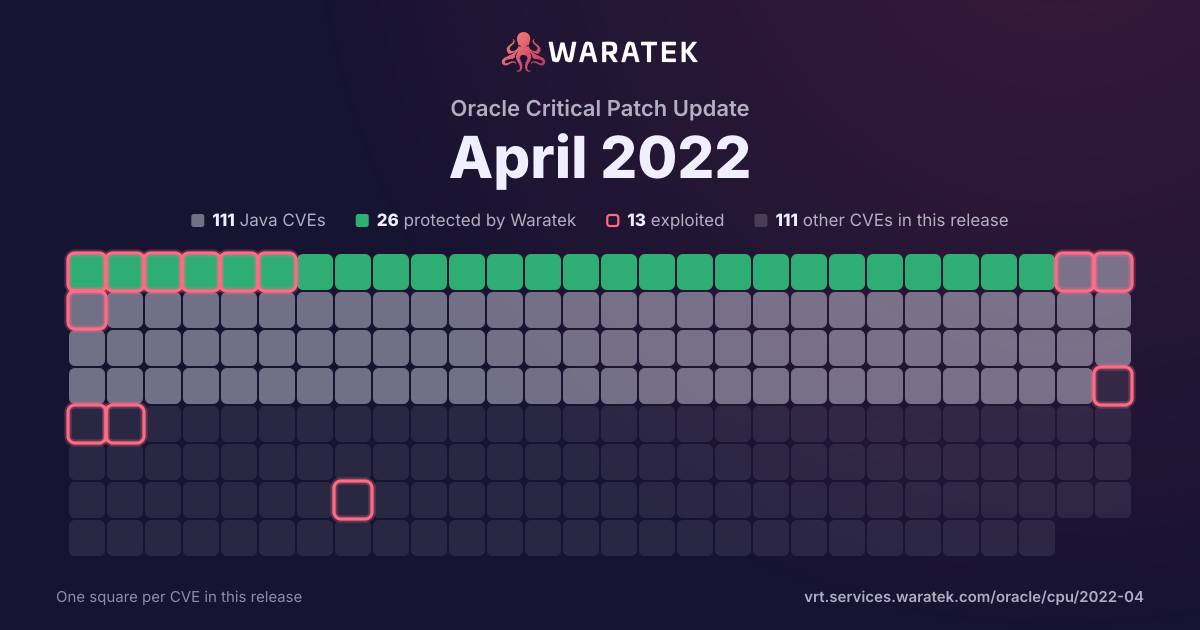
By status
26Protected by Waratek5Mitigation candidate80No exploit published64Outside Waratek scope47Not applicable
13Exploited, marked by the ring
No exploit published. For 40 of them, Oracle's security advisory is the source of public detail.
Protected by Waratek. Waratek RASP can block exploitation of these on systems that have not applied the patch yet.
Overview 222 matches · 111 in Waratek scope · 26 protected · 13 exploited · 8 CISA KEV · 24 public PoC · 28 EPSS ≥ 0.5
222matches
111in Waratek scope50.0%
26protected11.7%
13exploited5.9%
8CISA KEV3.6%
24public PoC10.8%
28EPSS ≥ 0.512.6%
Protected by Waratek
26
11.7%
Rule in development
0
0.0%
Mitigation candidate
5
2.3%
No exploit published
80
36.0%
Outside Waratek scope
64
28.8%
Not applicable
47
21.2%
Withdrawn CVE
0
0.0%
blocked by ARMR today
26
11.7%
partly blocked
0
0.0%
not blocked
196
88.3%
not established
0
0.0%
unrecorded
0
0.0%
split by
peak 86 / quarter
Q1 181
Protected by Waratek1
Critical1
blocked by ARMR today1
Exploited1
Q2 181
Not applicable1
Medium1
not blocked1
No public exploit1
Q3 180
Q4 180
Q1 190
Q2 193
Protected by Waratek2
Outside Waratek scope1
High2
Medium1
blocked by ARMR today2
not blocked1
Working exploit published2
No public exploit1
Q3 193
Protected by Waratek1
Outside Waratek scope1
Not applicable1
High2
Medium1
blocked by ARMR today1
not blocked2
No public exploit3
Q4 193
Outside Waratek scope1
Not applicable2
Critical1
High2
not blocked3
Proof of concept only2
No public exploit1
Q1 204
No exploit published3
Outside Waratek scope1
High3
Medium1
not blocked4
Proof of concept only1
No public exploit3
Q2 208
No exploit published1
Outside Waratek scope5
Not applicable2
Critical1
High3
Medium3
Low1
not blocked8
Exploited1
No public exploit7
Q3 207
Protected by Waratek1
No exploit published1
Outside Waratek scope2
Not applicable3
High3
Medium3
Low1
blocked by ARMR today1
not blocked6
No public exploit7
Q4 2016
Protected by Waratek5
No exploit published6
Outside Waratek scope5
Critical1
High9
Medium5
Low1
blocked by ARMR today5
not blocked11
Exploited1
Proof of concept only1
No public exploit14
Q1 2112
No exploit published7
Outside Waratek scope4
Not applicable1
Critical2
High3
Medium7
not blocked12
Exploited1
No public exploit11
Q2 2119
Protected by Waratek4
Mitigation candidate1
No exploit published4
Outside Waratek scope4
Not applicable6
Critical4
High6
Medium8
Low1
blocked by ARMR today4
not blocked15
Exploited1
Working exploit published2
Forecast only1
No public exploit15
Q3 2122
Protected by Waratek1
Mitigation candidate1
No exploit published12
Outside Waratek scope5
Not applicable3
Critical3
High12
Medium7
blocked by ARMR today1
not blocked21
Exploited3
Proof of concept only1
Forecast only2
No public exploit16
Q4 2117
Protected by Waratek2
Mitigation candidate1
No exploit published3
Outside Waratek scope7
Not applicable4
Critical4
High6
Medium7
blocked by ARMR today2
not blocked15
Exploited2
Working exploit published1
Proof of concept only2
Forecast only1
No public exploit11
Q1 2218
Protected by Waratek4
Mitigation candidate1
No exploit published8
Outside Waratek scope4
Not applicable1
Critical4
High6
Medium8
blocked by ARMR today4
not blocked14
Exploited1
Working exploit published1
Proof of concept only5
Forecast only1
No public exploit10
Q2 2286
Protected by Waratek5
Mitigation candidate1
No exploit published34
Outside Waratek scope24
Not applicable22
Critical4
High15
Medium60
Low7
blocked by ARMR today5
not blocked81
Exploited2
Proof of concept only1
Forecast only2
No public exploit81
Q3 222
No exploit published1
Not applicable1
High1
Medium1
not blocked2
No public exploit2
Q1 18Q3 18Q1 19Q3 19Q1 20Q3 20Q1 21Q3 21Q1 22Q3 22
| CVE | Severity | Published▾ | Status | Exploitation | Description |
|---|---|---|---|---|---|
| CVE-2020-10878 | High | 2020-06-05 | Outside Waratek scope | No public exploit | Perl before 5.30.3 has an integer overflow related to mishandling of a "PL_regkind[OP(n)] == NOTHING" situation. A crafted regular expression could lead to malformed bytecode with a possibility of instruction injection. |
| CVE-2020-13434 | Medium | 2020-05-24 | Not applicable | No public exploit | SQLite through 3.32.0 has an integer overflow in sqlite3_str_vappendf in printf.c. |
| CVE-2020-11971 | High | 2020-05-14 | No exploit published | No public exploit | Apache Camel's JMX is vulnerable to Rebind Flaw. Apache Camel 2.22.x, 2.23.x, 2.24.x, 2.25.x, 3.0.0 up to 3.1.0 is affected. Users should upgrade to 3.2.0. |
| CVE-2018-1285 | Critical | 2020-05-11 | Outside Waratek scope | No public exploit | Apache log4net versions before 2.0.10 do not disable XML external entities when parsing log4net configuration files. This allows for XXE-based attacks in applications that accept attacker-controlled log4net configuration files. |
| CVE-2020-11022 | Medium | 2020-04-29 | Outside Waratek scope | Exploited | In jQuery starting with 1.12.0 and before 3.5.0, passing HTML from untrusted sources - even after sanitizing it - to one of jQuery's DOM manipulation methods (i.e. .html(), .append(), and others) may execute untrusted code. This problem is patched in jQuery 3.5.0. |
| CVE-2020-9488 | Low | 2020-04-27 | Outside Waratek scope | No public exploit | Improper validation of certificate with host mismatch in Apache Log4j SMTP appender. This could allow an SMTPS connection to be intercepted by a man-in-the-middle attack which could leak any log messages sent through that appender. Fixed in Apache Log4j 2.12.3 and 2.13.1 |
| CVE-2020-11612 | High | 2020-04-07 | Outside Waratek scope | No public exploit | The ZlibDecoders in Netty 4.1.x before 4.1.46 allow for unbounded memory allocation while decoding a ZlibEncoded byte stream. An attacker could send a large ZlibEncoded byte stream to the Netty server, forcing the server to allocate all of its free memory to a single decoder. |
| CVE-2020-5245 | High | 2020-02-24 | No exploit published | Proof of concept only | Dropwizard-Validation before 1.3.19, and 2.0.2 may allow arbitrary code execution on the host system, with the privileges of the Dropwizard service account, by injecting arbitrary Java Expression Language expressions when using the self-validating feature. The issue has been fixed in dropwizard-validation 1.3.19 and 2.0.2. |
| CVE-2020-7226 | High | 2020-01-24 | No exploit published | No public exploit | CiphertextHeader.java in Cryptacular 1.2.3, as used in Apereo CAS and other products, allows attackers to trigger excessive memory allocation during a decode operation, because the nonce array length associated with "new byte" may depend on untrusted input within the header of encoded data. |
| CVE-2019-12399 | High | 2020-01-14 | No exploit published | No public exploit | When Connect workers in Apache Kafka 2.0.0, 2.0.1, 2.1.0, 2.1.1, 2.2.0, 2.2.1, or 2.3.0 are configured with one or more config providers, and a connector is created/updated on that Connect cluster to use an externalized secret variable in a substring of a connector configuration property value, then any client can issue a request to the same Connect cluster to obtain the connector's task configuration and the response will contain the plaintext secret rather than the externalized secrets variables. |
| CVE-2019-14862 | Medium | 2020-01-02 | Outside Waratek scope | No public exploit | There is a vulnerability in knockout before version 3.5.0-beta, where after escaping the context of the web application, the web application delivers data to its users along with other trusted dynamic content, without validating it. |
| CVE-2019-16789 | High | 2019-12-26 | Not applicable | No public exploit | In Waitress through version 1.4.0, if a proxy server is used in front of waitress, an invalid request may be sent by an attacker that bypasses the front-end and is parsed differently by waitress leading to a potential for HTTP request smuggling. Specially crafted requests containing special whitespace characters in the Transfer-Encoding header would get parsed by Waitress as being a chunked request, but a front-end server would use the Content-Length instead as the Transfer-Encoding header is considered invalid due to containing invalid characters. If a front-end server does HTTP pipelining to a backend Waitress server this could lead to HTTP request splitting which may lead to potential cache poisoning or unexpected information disclosure. This issue is fixed in Waitress 1.4.1 through more strict HTTP field validation. |
| CVE-2019-18276 | High | 2019-11-28 | Not applicable | Proof of concept only | An issue was discovered in disable_priv_mode in shell.c in GNU Bash through 5.0 patch 11. By default, if Bash is run with its effective UID not equal to its real UID, it will drop privileges by setting its effective UID to its real UID. However, it does so incorrectly. On Linux and other systems that support "saved UID" functionality, the saved UID is not dropped. An attacker with command execution in the shell can use "enable -f" for runtime loading of a new builtin, which can be a shared object that calls setuid() and therefore regains privileges. However, binaries running with an effective UID of 0 are unaffected. |
| CVE-2019-17195 | Critical | 2019-10-15 | Outside Waratek scope | Proof of concept only | Connect2id Nimbus JOSE+JWT before v7.9 can throw various uncaught exceptions while parsing a JWT, which could result in an application crash (potential information disclosure) or a potential authentication bypass. |
| CVE-2019-3740 | Medium | 2019-09-18 | Outside Waratek scope | No public exploit | RSA BSAFE Crypto-J versions prior to 6.2.5 are vulnerable to an Information Exposure Through Timing Discrepancy vulnerabilities during DSA key generation. A malicious remote attacker could potentially exploit those vulnerabilities to recover DSA keys. |
| CVE-2019-10086 | High | 2019-08-20 | Protected by Waratek | No public exploit | In Apache Commons Beanutils 1.9.2, a special BeanIntrospector class was added which allows suppressing the ability for an attacker to access the classloader via the class property available on all Java objects. We, however were not using this by default characteristic of the PropertyUtilsBean. |
| CVE-2019-13565 | High | 2019-07-26 | Not applicable | No public exploit | An issue was discovered in OpenLDAP 2.x before 2.4.48. When using SASL authentication and session encryption, and relying on the SASL security layers in slapd access controls, it is possible to obtain access that would otherwise be denied via a simple bind for any identity covered in those ACLs. After the first SASL bind is completed, the sasl_ssf value is retained for all new non-SASL connections. Depending on the ACL configuration, this can affect different types of operations (searches, modifications, etc.). In other words, a successful authorization step completed by one user affects the authorization requirement for a different user. |
| CVE-2019-12086 | High | 2019-05-17 | Protected by Waratek | No public exploit | A Polymorphic Typing issue was discovered in FasterXML jackson-databind 2.x before 2.9.9. When Default Typing is enabled (either globally or for a specific property) for an externally exposed JSON endpoint, the service has the mysql-connector-java jar (8.0.14 or earlier) in the classpath, and an attacker can host a crafted MySQL server reachable by the victim, an attacker can send a crafted JSON message that allows them to read arbitrary local files on the server. This occurs because of missing com.mysql.cj.jdbc.admin.MiniAdmin validation. |
| CVE-2019-3799 | Medium | 2019-05-06 | Protected by Waratek | Working exploit published | Spring Cloud Config, versions 2.1.x prior to 2.1.2, versions 2.0.x prior to 2.0.4, and versions 1.4.x prior to 1.4.6, and older unsupported versions allow applications to serve arbitrary configuration files through the spring-cloud-config-server module. A malicious user, or attacker, can send a request using a specially crafted URL that can lead a directory traversal attack. |
| CVE-2019-0227 | High | 2019-05-01 | Outside Waratek scope | Working exploit published | A Server Side Request Forgery (SSRF) vulnerability affected the Apache Axis 1.4 distribution that was last released in 2006. Security and bug commits commits continue in the projects Axis 1.x Subversion repository, legacy users are encouraged to build from source. The successor to Axis 1.x is Axis2, the latest version is 1.7.9 and is not vulnerable to this issue. |
| CVE-2018-11212 | Medium | 2018-05-16 | Not applicable | No public exploit | An issue was discovered in libjpeg 9a and 9d. The alloc_sarray function in jmemmgr.c allows remote attackers to cause a denial of service (divide-by-zero error) via a crafted file. |
| CVE-2017-1000353 | Critical | 2018-01-29 | Protected by Waratek | Exploited | Jenkins versions 2.56 and earlier as well as 2.46.1 LTS and earlier are vulnerable to an unauthenticated remote code execution. An unauthenticated remote code execution vulnerability allowed attackers to transfer a serialized Java `SignedObject` object to the Jenkins CLI, that would be deserialized using a new `ObjectInputStream`, bypassing the existing blacklist-based protection mechanism. We're fixing this issue by adding `SignedObject` to the blacklist. We're also backporting the new HTTP CLI protocol from Jenkins 2.54 to LTS 2.46.2, and deprecating the remoting-based (i.e. Java serialization) CLI protocol, disabling it by default. |