
Oracle Critical Patch Update April 2022
Released April 2022 · Oracle's advisory ↗ · ← Critical Patch Update, January 2022 · Critical Patch Update, July 2022 →
222 CVEs in this release, one square each
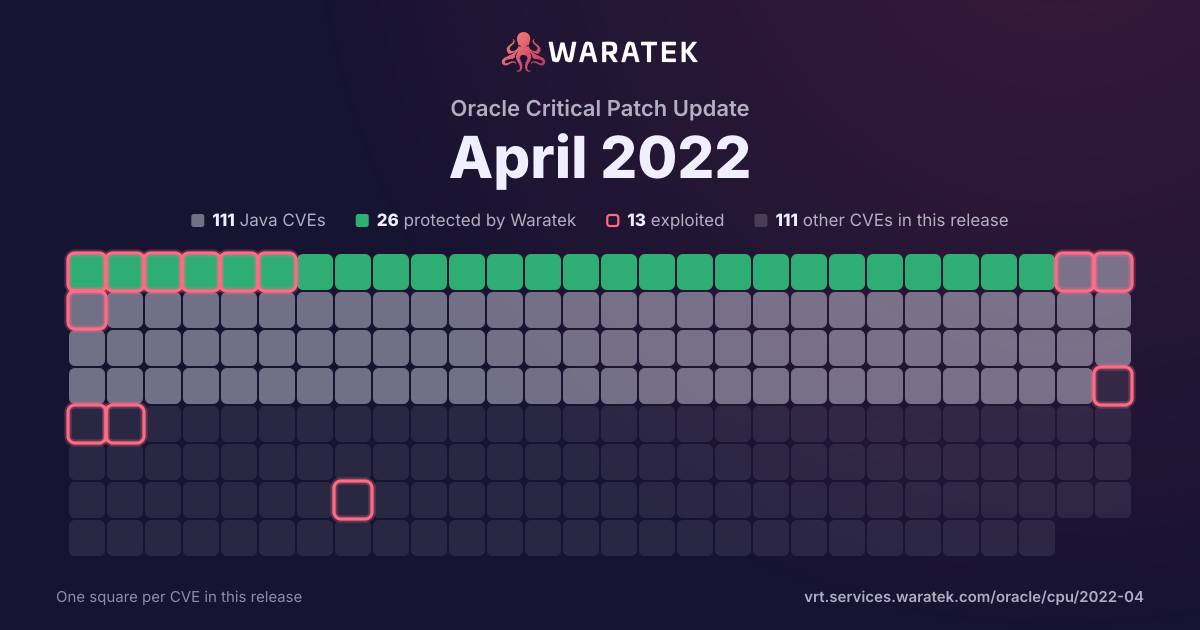
By status
25Protected by Waratek1Rule in development7Mitigation candidate98No exploit published91Not applicable
13Exploited, marked by the ring
No exploit published. For 40 of them, Oracle's security advisory is the source of public detail.
Protected by Waratek. Waratek RASP can block exploitation of these on systems that have not applied the patch yet.
Overview 11 matches · 0 protected · 1 exploited · 1 CISA KEV · 3 public PoC · 2 EPSS ≥ 0.5
Protected by Waratek
0
0.0%
Rule in development
1
9.1%
Mitigation candidate
2
18.2%
No exploit published
8
72.7%
blocked by ARMR today
0
0.0%
partly blocked
0
0.0%
not blocked
11
100.0%
not established
0
0.0%
unrecorded
0
0.0%
split by
peak 6 / month
Jan 226
Mitigation candidate2
No exploit published4
Critical2
High1
Medium3
not blocked6
Working exploit published2
Proof of concept only1
No public exploit3
Feb 222
No exploit published2
High1
Medium1
not blocked2
Proof of concept only1
No public exploit1
Mar 222
Rule in development1
No exploit published1
Critical1
High1
not blocked2
Exploited1
No public exploit1
Apr 220
May 220
Jun 220
Jul 220
Aug 221
No exploit published1
High1
not blocked1
No public exploit1
Jan 22Feb 22Mar 22Apr 22May 22Jun 22Jul 22Aug 22
| CVE | Severity | Published▾ | Status | Exploitation | Description |
|---|---|---|---|---|---|
| CVE-2021-3690 | High | 2022-08-23 | No exploit published | No public exploit | A flaw was found in Undertow. A buffer leak on the incoming WebSocket PONG message may lead to memory exhaustion. This flaw allows an attacker to cause a denial of service. The highest threat from this vulnerability is availability. |
| CVE-2020-36518 | High | 2022-03-11 | No exploit published | No public exploit | jackson-databind before 2.13.0 allows a Java StackOverflow exception and denial of service via a large depth of nested objects. |
| CVE-2022-22947 | Critical | 2022-03-03 | Rule in development | Exploited | In spring cloud gateway versions prior to 3.1.1+ and 3.0.7+ , applications are vulnerable to a code injection attack when the Gateway Actuator endpoint is enabled, exposed and unsecured. A remote attacker could make a maliciously crafted request that could allow arbitrary remote execution on the remote host. |
| CVE-2022-24329 | Medium | 2022-02-25 | No exploit published | No public exploit | In JetBrains Kotlin before 1.6.0, it was not possible to lock dependencies for Multiplatform Gradle Projects. |
| CVE-2021-43859 | High | 2022-02-01 | No exploit published | Proof of concept only | XStream is an open source java library to serialize objects to XML and back again. Versions prior to 1.4.19 may allow a remote attacker to allocate 100% CPU time on the target system depending on CPU type or parallel execution of such a payload resulting in a denial of service only by manipulating the processed input stream. XStream 1.4.19 monitors and accumulates the time it takes to add elements to collections and throws an exception if a set threshold is exceeded. Users are advised to upgrade as soon as possible. Users unable to upgrade may set the NO_REFERENCE mode to prevent recursion. See GHSA-rmr5-cpv2-vgjf for further details on a workaround if an upgrade is not possible. |
| CVE-2022-23221 | Critical | 2022-01-19 | Mitigation candidate | Working exploit published | H2 Console before 2.1.210 allows remote attackers to execute arbitrary code via a jdbc:h2:mem JDBC URL containing the IGNORE_UNKNOWN_SETTINGS=TRUE;FORBID_CREATION=FALSE;INIT=RUNSCRIPT substring, a different vulnerability than CVE-2021-42392. |
| CVE-2022-20615 | Medium | 2022-01-12 | No exploit published | No public exploit | Jenkins Matrix Project Plugin 1.19 and earlier does not escape HTML metacharacters in node and label names, and label descriptions, resulting in a stored cross-site scripting (XSS) vulnerability exploitable by attackers with Agent/Configure permission. |
| CVE-2022-20613 | Medium | 2022-01-12 | No exploit published | No public exploit | A cross-site request forgery (CSRF) vulnerability in Jenkins Mailer Plugin 391.ve4a_38c1b_cf4b_ and earlier allows attackers to use the DNS used by the Jenkins instance to resolve an attacker-specified hostname. |
| CVE-2022-20612 | Medium | 2022-01-12 | No exploit published | No public exploit | A cross-site request forgery (CSRF) vulnerability in Jenkins 2.329 and earlier, LTS 2.319.1 and earlier allows attackers to trigger build of job without parameters when no security realm is set. |
| CVE-2021-42392 | Critical | 2022-01-10 | Mitigation candidate | Working exploit published | The org.h2.util.JdbcUtils.getConnection method of the H2 database takes as parameters the class name of the driver and URL of the database. An attacker may pass a JNDI driver name and a URL leading to a LDAP or RMI servers, causing remote code execution. This can be exploited through various attack vectors, most notably through the H2 Console which leads to unauthenticated remote code execution. |
| CVE-2021-22569 | High | 2022-01-10 | No exploit published | Proof of concept only | An issue in protobuf-java allowed the interleaving of com.google.protobuf.UnknownFieldSet fields in such a way that would be processed out of order. A small malicious payload can occupy the parser for several minutes by creating large numbers of short-lived objects that cause frequent, repeated pauses. We recommend upgrading libraries beyond the vulnerable versions. |