
Oracle Critical Patch Update April 2022
Released April 2022 · Oracle's advisory ↗ · ← Critical Patch Update, January 2022 · Critical Patch Update, July 2022 →
222 CVEs in this release, one square each
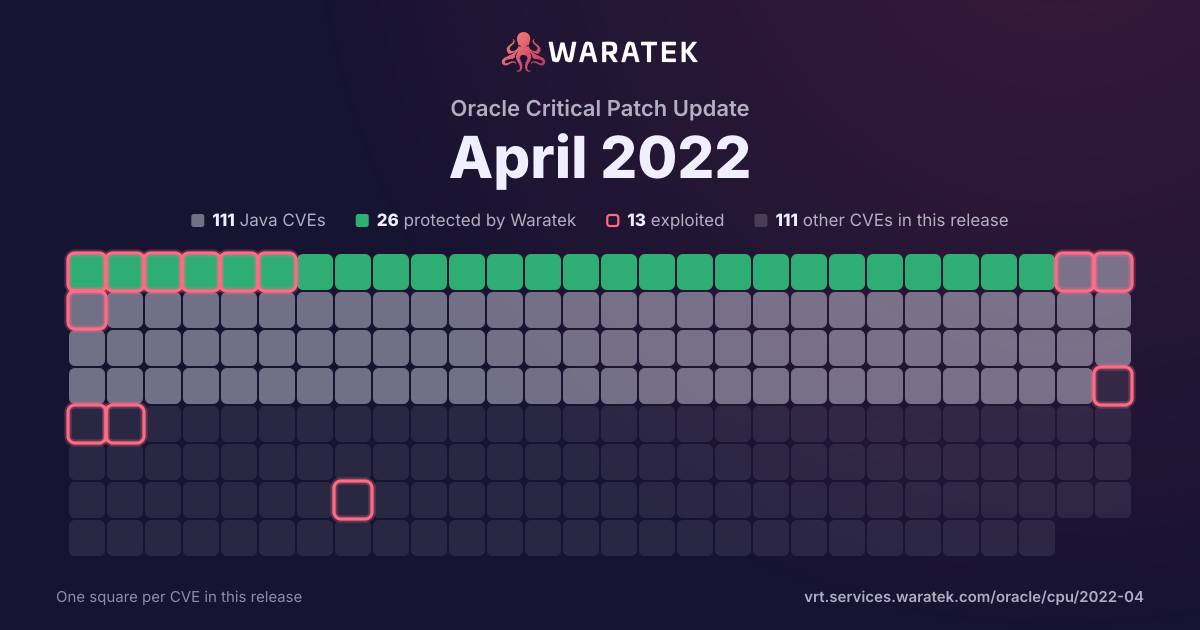
By status
25Protected by Waratek1Rule in development7Mitigation candidate98No exploit published91Not applicable
13Exploited, marked by the ring
No exploit published. For 40 of them, Oracle's security advisory is the source of public detail.
Protected by Waratek. Waratek RASP can block exploitation of these on systems that have not applied the patch yet.
Overview 33 matches · 0 protected · 3 exploited · 1 CISA KEV · 5 public PoC · 4 EPSS ≥ 0.5
Protected by Waratek
0
0.0%
Rule in development
1
3.0%
Mitigation candidate
5
15.2%
No exploit published
27
81.8%
blocked by ARMR today
0
0.0%
partly blocked
0
0.0%
not blocked
33
100.0%
not established
0
0.0%
unrecorded
0
0.0%
split by
peak 6 / month
Jun 213
Mitigation candidate1
No exploit published2
High1
Medium2
not blocked3
Exploited1
No public exploit2
Jul 216
No exploit published6
High3
Medium3
not blocked6
Forecast only1
No public exploit5
Aug 213
No exploit published3
High2
Medium1
not blocked3
No public exploit3
Sep 212
Mitigation candidate1
No exploit published1
High1
Medium1
not blocked2
Exploited1
No public exploit1
Oct 215
Mitigation candidate1
No exploit published4
High3
Medium2
not blocked5
Proof of concept only1
No public exploit4
Nov 210
Dec 213
No exploit published3
Critical2
Medium1
not blocked3
No public exploit3
Jan 226
Mitigation candidate2
No exploit published4
Critical2
High1
Medium3
not blocked6
Working exploit published2
Proof of concept only1
No public exploit3
Feb 222
No exploit published2
High1
Medium1
not blocked2
Proof of concept only1
No public exploit1
Mar 222
Rule in development1
No exploit published1
Critical1
High1
not blocked2
Exploited1
No public exploit1
Apr 220
May 220
Jun 220
Jul 220
Aug 221
No exploit published1
High1
not blocked1
No public exploit1
Jun 21Aug 21Oct 21Dec 21Feb 22Apr 22Jun 22Aug 22
| CVE | Severity | Published▾ | Status | Exploitation | Description |
|---|---|---|---|---|---|
| CVE-2021-3690 | High | 2022-08-23 | No exploit published | No public exploit | A flaw was found in Undertow. A buffer leak on the incoming WebSocket PONG message may lead to memory exhaustion. This flaw allows an attacker to cause a denial of service. The highest threat from this vulnerability is availability. |
| CVE-2020-36518 | High | 2022-03-11 | No exploit published | No public exploit | jackson-databind before 2.13.0 allows a Java StackOverflow exception and denial of service via a large depth of nested objects. |
| CVE-2022-22947 | Critical | 2022-03-03 | Rule in development | Exploited | In spring cloud gateway versions prior to 3.1.1+ and 3.0.7+ , applications are vulnerable to a code injection attack when the Gateway Actuator endpoint is enabled, exposed and unsecured. A remote attacker could make a maliciously crafted request that could allow arbitrary remote execution on the remote host. |
| CVE-2022-24329 | Medium | 2022-02-25 | No exploit published | No public exploit | In JetBrains Kotlin before 1.6.0, it was not possible to lock dependencies for Multiplatform Gradle Projects. |
| CVE-2021-43859 | High | 2022-02-01 | No exploit published | Proof of concept only | XStream is an open source java library to serialize objects to XML and back again. Versions prior to 1.4.19 may allow a remote attacker to allocate 100% CPU time on the target system depending on CPU type or parallel execution of such a payload resulting in a denial of service only by manipulating the processed input stream. XStream 1.4.19 monitors and accumulates the time it takes to add elements to collections and throws an exception if a set threshold is exceeded. Users are advised to upgrade as soon as possible. Users unable to upgrade may set the NO_REFERENCE mode to prevent recursion. See GHSA-rmr5-cpv2-vgjf for further details on a workaround if an upgrade is not possible. |
| CVE-2022-23221 | Critical | 2022-01-19 | Mitigation candidate | Working exploit published | H2 Console before 2.1.210 allows remote attackers to execute arbitrary code via a jdbc:h2:mem JDBC URL containing the IGNORE_UNKNOWN_SETTINGS=TRUE;FORBID_CREATION=FALSE;INIT=RUNSCRIPT substring, a different vulnerability than CVE-2021-42392. |
| CVE-2022-20615 | Medium | 2022-01-12 | No exploit published | No public exploit | Jenkins Matrix Project Plugin 1.19 and earlier does not escape HTML metacharacters in node and label names, and label descriptions, resulting in a stored cross-site scripting (XSS) vulnerability exploitable by attackers with Agent/Configure permission. |
| CVE-2022-20613 | Medium | 2022-01-12 | No exploit published | No public exploit | A cross-site request forgery (CSRF) vulnerability in Jenkins Mailer Plugin 391.ve4a_38c1b_cf4b_ and earlier allows attackers to use the DNS used by the Jenkins instance to resolve an attacker-specified hostname. |
| CVE-2022-20612 | Medium | 2022-01-12 | No exploit published | No public exploit | A cross-site request forgery (CSRF) vulnerability in Jenkins 2.329 and earlier, LTS 2.319.1 and earlier allows attackers to trigger build of job without parameters when no security realm is set. |
| CVE-2021-42392 | Critical | 2022-01-10 | Mitigation candidate | Working exploit published | The org.h2.util.JdbcUtils.getConnection method of the H2 database takes as parameters the class name of the driver and URL of the database. An attacker may pass a JNDI driver name and a URL leading to a LDAP or RMI servers, causing remote code execution. This can be exploited through various attack vectors, most notably through the H2 Console which leads to unauthenticated remote code execution. |
| CVE-2021-22569 | High | 2022-01-10 | No exploit published | Proof of concept only | An issue in protobuf-java allowed the interleaving of com.google.protobuf.UnknownFieldSet fields in such a way that would be processed out of order. A small malicious payload can occupy the parser for several minutes by creating large numbers of short-lived objects that cause frequent, repeated pauses. We recommend upgrading libraries beyond the vulnerable versions. |
| CVE-2021-23450 | Critical | 2021-12-17 | No exploit published | No public exploit | All versions of package dojo are vulnerable to Prototype Pollution via the setObject function. |
| CVE-2021-43797 | Medium | 2021-12-09 | No exploit published | No public exploit | Netty is an asynchronous event-driven network application framework for rapid development of maintainable high performance protocol servers & clients. Netty prior to version 4.1.71.Final skips control chars when they are present at the beginning / end of the header name. It should instead fail fast as these are not allowed by the spec and could lead to HTTP request smuggling. Failing to do the validation might cause netty to "sanitize" header names before it forward these to another remote system when used as proxy. This remote system can't see the invalid usage anymore, and therefore does not do the validation itself. Users should upgrade to version 4.1.71.Final. |
| CVE-2021-43527 | Critical | 2021-12-08 | No exploit published | No public exploit | NSS (Network Security Services) versions prior to 3.73 or 3.68.1 ESR are vulnerable to a heap overflow when handling DER-encoded DSA or RSA-PSS signatures. Applications using NSS for handling signatures encoded within CMS, S/MIME, PKCS \#7, or PKCS \#12 are likely to be impacted. Applications using NSS for certificate validation or other TLS, X.509, OCSP or CRL functionality may be impacted, depending on how they configure NSS. *Note: This vulnerability does NOT impact Mozilla Firefox.* However, email clients and PDF viewers that use NSS for signature verification, such as Thunderbird, LibreOffice, Evolution and Evince are believed to be impacted. This vulnerability affects NSS < 3.73 and NSS < 3.68.1. |
| CVE-2021-22096 | Medium | 2021-10-28 | No exploit published | No public exploit | In Spring Framework versions 5.3.0 - 5.3.10, 5.2.0 - 5.2.17, and older unsupported versions, it is possible for a user to provide malicious input to cause the insertion of additional log entries. |
| CVE-2021-35574 | High | 2021-10-20 | No exploit published | No public exploit | Vulnerability in the Oracle Outside In Technology product of Oracle Fusion Middleware (component: Outside In Filters). The supported version that is affected is 8.5.5. Easily exploitable vulnerability allows unauthenticated attacker with network access via HTTP to compromise Oracle Outside In Technology. Successful attacks of this vulnerability can result in unauthorized ability to cause a hang or frequently repeatable crash (complete DOS) of Oracle Outside In Technology. Note: Outside In Technology is a suite of software development kits (SDKs). The protocol and CVSS Base Score depend on the software that uses Outside In Technology. The CVSS score assumes that the software passes data received over a network directly to Outside In Technology, but if data is not received over a network the CVSS score may be lower. CVSS 3.1 Base Score 7.5 (Availability impacts). CVSS Vector: (CVSS:3.1/AV:N/AC:L/PR:N/UI:N/S:U/C:N/I:N/A:H). |
| CVE-2021-2471 | Medium | 2021-10-20 | Mitigation candidate | Proof of concept only | Vulnerability in the MySQL Connectors product of Oracle MySQL (component: Connector/J). Supported versions that are affected are 8.0.26 and prior. Difficult to exploit vulnerability allows high privileged attacker with network access via multiple protocols to compromise MySQL Connectors. Successful attacks of this vulnerability can result in unauthorized access to critical data or complete access to all MySQL Connectors accessible data and unauthorized ability to cause a hang or frequently repeatable crash (complete DOS) of MySQL Connectors. CVSS 3.1 Base Score 5.9 (Confidentiality and Availability impacts). CVSS Vector: (CVSS:3.1/AV:N/AC:H/PR:H/UI:N/S:U/C:H/I:N/A:H). |
| CVE-2021-37137 | High | 2021-10-19 | No exploit published | No public exploit | The Snappy frame decoder function doesn't restrict the chunk length which may lead to excessive memory usage. Beside this it also may buffer reserved skippable chunks until the whole chunk was received which may lead to excessive memory usage as well. This vulnerability can be triggered by supplying malicious input that decompresses to a very big size (via a network stream or a file) or by sending a huge skippable chunk. |
| CVE-2021-42340 | High | 2021-10-14 | No exploit published | No public exploit | The fix for bug 63362 present in Apache Tomcat 10.1.0-M1 to 10.1.0-M5, 10.0.0-M1 to 10.0.11, 9.0.40 to 9.0.53 and 8.5.60 to 8.5.71 introduced a memory leak. The object introduced to collect metrics for HTTP upgrade connections was not released for WebSocket connections once the connection was closed. This created a memory leak that, over time, could lead to a denial of service via an OutOfMemoryError. |
| CVE-2021-38153 | Medium | 2021-09-22 | Mitigation candidate | Exploited | Some components in Apache Kafka use `Arrays.equals` to validate a password or key, which is vulnerable to timing attacks that make brute force attacks for such credentials more likely to be successful. Users should upgrade to 2.8.1 or higher, or 3.0.0 or higher where this vulnerability has been fixed. The affected versions include Apache Kafka 2.0.0, 2.0.1, 2.1.0, 2.1.1, 2.2.0, 2.2.1, 2.2.2, 2.3.0, 2.3.1, 2.4.0, 2.4.1, 2.5.0, 2.5.1, 2.6.0, 2.6.1, 2.6.2, 2.7.0, 2.7.1, and 2.8.0. |
| CVE-2021-40690 | High | 2021-09-19 | No exploit published | No public exploit | All versions of Apache Santuario - XML Security for Java prior to 2.2.3 and 2.1.7 are vulnerable to an issue where the "secureValidation" property is not passed correctly when creating a KeyInfo from a KeyInfoReference element. This allows an attacker to abuse an XPath Transform to extract any local .xml files in a RetrievalMethod element. |
| CVE-2021-39153 | High | 2021-08-23 | No exploit published | No public exploit | XStream is a simple library to serialize objects to XML and back again. In affected versions this vulnerability may allow a remote attacker to load and execute arbitrary code from a remote host only by manipulating the processed input stream, if using the version out of the box with Java runtime version 14 to 8 or with JavaFX installed. No user is affected, who followed the recommendation to setup XStream's security framework with a whitelist limited to the minimal required types. XStream 1.4.18 uses no longer a blacklist by default, since it cannot be secured for general purpose. |
| CVE-2021-39140 | Medium | 2021-08-23 | No exploit published | No public exploit | XStream is a simple library to serialize objects to XML and back again. In affected versions this vulnerability may allow a remote attacker to allocate 100% CPU time on the target system depending on CPU type or parallel execution of such a payload resulting in a denial of service only by manipulating the processed input stream. No user is affected, who followed the recommendation to setup XStream's security framework with a whitelist limited to the minimal required types. XStream 1.4.18 uses no longer a blacklist by default, since it cannot be secured for general purpose. |
| CVE-2021-39139 | High | 2021-08-23 | No exploit published | No public exploit | XStream is a simple library to serialize objects to XML and back again. In affected versions this vulnerability may allow a remote attacker to load and execute arbitrary code from a remote host only by manipulating the processed input stream. A user is only affected if using the version out of the box with JDK 1.7u21 or below. However, this scenario can be adjusted easily to an external Xalan that works regardless of the version of the Java runtime. No user is affected, who followed the recommendation to setup XStream's security framework with a whitelist limited to the minimal required types. XStream 1.4.18 uses no longer a blacklist by default, since it cannot be secured for general purpose. |
| CVE-2021-2351 | High | 2021-07-21 | No exploit published | No public exploit | Vulnerability in the Advanced Networking Option component of Oracle Database Server. Supported versions that are affected are 12.1.0.2, 12.2.0.1 and 19c. Difficult to exploit vulnerability allows unauthenticated attacker with network access via Oracle Net to compromise Advanced Networking Option. Successful attacks require human interaction from a person other than the attacker and while the vulnerability is in Advanced Networking Option, attacks may significantly impact additional products. Successful attacks of this vulnerability can result in takeover of Advanced Networking Option. Note: The July 2021 Critical Patch Update introduces a number of Native Network Encryption changes to deal with vulnerability CVE-2021-2351 and prevent the use of weaker ciphers. Customers should review: "Changes in Native Network Encryption with the July 2021 Critical Patch Update" (Doc ID 2791571.1). CVSS 3.1 Base Score 8.3 (Confidentiality, Integrity and Availability impacts). CVSS Vector: (CVSS:3.1/AV:N/AC:H/PR:N/UI:R/S:C/C:H/I:H/A:H). |
| CVE-2021-36374 | Medium | 2021-07-14 | No exploit published | No public exploit | When reading a specially crafted ZIP archive, or a derived formats, an Apache Ant build can be made to allocate large amounts of memory that leads to an out of memory error, even for small inputs. This can be used to disrupt builds using Apache Ant. Commonly used derived formats from ZIP archives are for instance JAR files and many office files. Apache Ant prior to 1.9.16 and 1.10.11 were affected. |
| CVE-2021-36090 | High | 2021-07-13 | No exploit published | No public exploit | When reading a specially crafted ZIP archive, Compress can be made to allocate large amounts of memory that finally leads to an out of memory error even for very small inputs. This could be used to mount a denial of service attack against services that use Compress' zip package. |
| CVE-2021-35515 | High | 2021-07-13 | No exploit published | No public exploit | When reading a specially crafted 7Z archive, the construction of the list of codecs that decompress an entry can result in an infinite loop. This could be used to mount a denial of service attack against services that use Compress' sevenz package. |
| CVE-2021-33037 | Medium | 2021-07-12 | No exploit published | Forecast only | Apache Tomcat 10.0.0-M1 to 10.0.6, 9.0.0.M1 to 9.0.46 and 8.5.0 to 8.5.66 did not correctly parse the HTTP transfer-encoding request header in some circumstances leading to the possibility to request smuggling when used with a reverse proxy. Specifically: - Tomcat incorrectly ignored the transfer encoding header if the client declared it would only accept an HTTP/1.0 response; - Tomcat honoured the identify encoding; and - Tomcat did not ensure that, if present, the chunked encoding was the final encoding. |
| CVE-2021-30129 | Medium | 2021-07-12 | No exploit published | No public exploit | A vulnerability in sshd-core of Apache Mina SSHD allows an attacker to overflow the server causing an OutOfMemory error. This issue affects the SFTP and port forwarding features of Apache Mina SSHD version 2.0.0 and later versions. It was addressed in Apache Mina SSHD 2.7.0 |
| CVE-2021-30468 | High | 2021-06-16 | No exploit published | No public exploit | A vulnerability in the JsonMapObjectReaderWriter of Apache CXF allows an attacker to submit malformed JSON to a web service, which results in the thread getting stuck in an infinite loop, consuming CPU indefinitely. This issue affects Apache CXF versions prior to 3.4.4; Apache CXF versions prior to 3.3.11. |
| CVE-2021-28169 | Medium | 2021-06-09 | Mitigation candidate | Exploited | For Eclipse Jetty versions <= 9.4.40, <= 10.0.2, <= 11.0.2, it is possible for requests to the ConcatServlet with a doubly encoded path to access protected resources within the WEB-INF directory. For example a request to `/concat?/%2557EB-INF/web.xml` can retrieve the web.xml file. This can reveal sensitive information regarding the implementation of a web application. |
| CVE-2020-14340 | Medium | 2021-06-02 | No exploit published | No public exploit | A vulnerability was discovered in XNIO where file descriptor leak caused by growing amounts of NIO Selector file handles between garbage collection cycles. It may allow the attacker to cause a denial of service. It affects XNIO versions 3.6.0.Beta1 through 3.8.1.Final. |