
Oracle Critical Patch Update January 2022
Released January 2022 · Oracle's advisory ↗ · ← Critical Patch Update, October 2021 · Critical Patch Update, April 2022 →
266 CVEs in this release, one square each
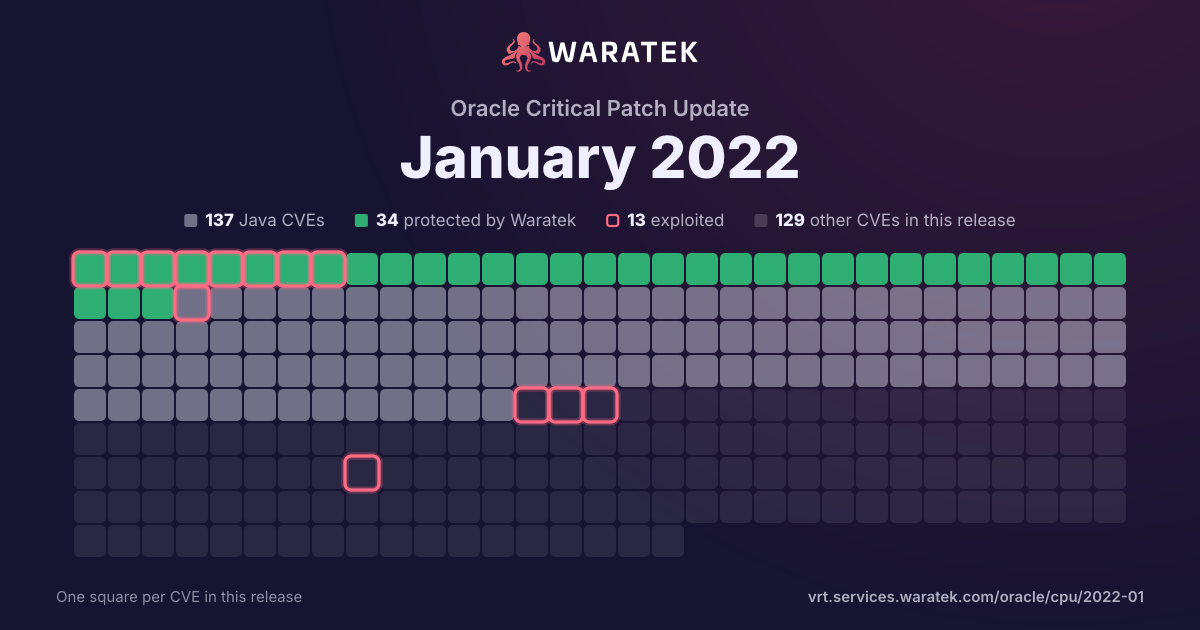
By status
34Protected by Waratek3Mitigation candidate100No exploit published57Outside Waratek scope72Not applicable
13Exploited, marked by the ring
No exploit published. For 71 of them, Oracle's security advisory is the source of public detail.
Protected by Waratek. Waratek RASP can block exploitation of these on systems that have not applied the patch yet.
Overview 23 matches · 15 in Waratek scope · 6 protected · 4 exploited · 3 CISA KEV · 5 public PoC · 7 EPSS ≥ 0.5
23matches
15in Waratek scope65.2%
6protected26.1%
4exploited17.4%
3CISA KEV13.0%
5public PoC21.7%
7EPSS ≥ 0.530.4%
Protected by Waratek
6
26.1%
Rule in development
0
0.0%
Mitigation candidate
0
0.0%
No exploit published
9
39.1%
Outside Waratek scope
6
26.1%
Not applicable
2
8.7%
Withdrawn CVE
0
0.0%
blocked by ARMR today
6
26.1%
partly blocked
0
0.0%
not blocked
17
73.9%
not established
0
0.0%
unrecorded
0
0.0%
split by
peak 8 / quarter
Q4 191
No exploit published1
Critical1
not blocked1
No public exploit1
Q1 200
Q2 201
Protected by Waratek1
Critical1
blocked by ARMR today1
No public exploit1
Q3 200
Q4 201
Protected by Waratek1
Critical1
blocked by ARMR today1
Exploited1
Q1 213
Protected by Waratek1
No exploit published1
Outside Waratek scope1
Critical3
blocked by ARMR today1
not blocked2
Exploited1
Proof of concept only1
No public exploit1
Q2 212
Outside Waratek scope2
Critical2
not blocked2
Forecast only1
No public exploit1
Q3 215
No exploit published1
Outside Waratek scope2
Not applicable2
Critical5
not blocked5
Exploited1
Forecast only1
No public exploit3
Q4 212
Protected by Waratek1
Outside Waratek scope1
Critical2
blocked by ARMR today1
not blocked1
Working exploit published1
No public exploit1
Q1 228
Protected by Waratek2
No exploit published6
Critical8
blocked by ARMR today2
not blocked6
Exploited1
No public exploit7
Q4 19Q1 20Q2 20Q3 20Q4 20Q1 21Q2 21Q3 21Q4 21Q1 22
| CVE | Severity | Published▾ | Status | Exploitation | Description |
|---|---|---|---|---|---|
| CVE-2022-21391 | Critical | 2022-01-19 | No exploit published | No public exploit | Vulnerability in the Oracle Communications Billing and Revenue Management product of Oracle Communications Applications (component: Connection Manager). Supported versions that are affected are 12.0.0.3 and 12.0.0.4. Easily exploitable vulnerability allows low privileged attacker with network access via HTTP to compromise Oracle Communications Billing and Revenue Management. While the vulnerability is in Oracle Communications Billing and Revenue Management, attacks may significantly impact additional products. Successful attacks of this vulnerability can result in takeover of Oracle Communications Billing and Revenue Management. CVSS 3.1 Base Score 9.9 (Confidentiality, Integrity and Availability impacts). CVSS Vector: (CVSS:3.1/AV:N/AC:L/PR:L/UI:N/S:C/C:H/I:H/A:H). |
| CVE-2022-21390 | Critical | 2022-01-19 | No exploit published | No public exploit | Vulnerability in the Oracle Communications Billing and Revenue Management product of Oracle Communications Applications (component: Webservices Manager). Supported versions that are affected are 12.0.0.3 and 12.0.0.4. Easily exploitable vulnerability allows unauthenticated attacker with network access via HTTP to compromise Oracle Communications Billing and Revenue Management. While the vulnerability is in Oracle Communications Billing and Revenue Management, attacks may significantly impact additional products. Successful attacks of this vulnerability can result in takeover of Oracle Communications Billing and Revenue Management. CVSS 3.1 Base Score 10.0 (Confidentiality, Integrity and Availability impacts). CVSS Vector: (CVSS:3.1/AV:N/AC:L/PR:N/UI:N/S:C/C:H/I:H/A:H). |
| CVE-2022-21389 | Critical | 2022-01-19 | No exploit published | No public exploit | Vulnerability in the Oracle Communications Billing and Revenue Management product of Oracle Communications Applications (component: Connection Manager). Supported versions that are affected are 12.0.0.3 and 12.0.0.4. Easily exploitable vulnerability allows unauthenticated attacker with network access via HTTP to compromise Oracle Communications Billing and Revenue Management. While the vulnerability is in Oracle Communications Billing and Revenue Management, attacks may significantly impact additional products. Successful attacks of this vulnerability can result in takeover of Oracle Communications Billing and Revenue Management. CVSS 3.1 Base Score 10.0 (Confidentiality, Integrity and Availability impacts). CVSS Vector: (CVSS:3.1/AV:N/AC:L/PR:N/UI:N/S:C/C:H/I:H/A:H). |
| CVE-2022-21306 | Critical | 2022-01-19 | Protected by Waratek | No public exploit | Vulnerability in the Oracle WebLogic Server product of Oracle Fusion Middleware (component: Core). Supported versions that are affected are 12.1.3.0.0, 12.2.1.3.0, 12.2.1.4.0 and 14.1.1.0.0. Easily exploitable vulnerability allows unauthenticated attacker with network access via T3 to compromise Oracle WebLogic Server. Successful attacks of this vulnerability can result in takeover of Oracle WebLogic Server. CVSS 3.1 Base Score 9.8 (Confidentiality, Integrity and Availability impacts). CVSS Vector: (CVSS:3.1/AV:N/AC:L/PR:N/UI:N/S:U/C:H/I:H/A:H). |
| CVE-2022-21276 | Critical | 2022-01-19 | No exploit published | No public exploit | Vulnerability in the Oracle Communications Billing and Revenue Management product of Oracle Communications Applications (component: Connection Manager). Supported versions that are affected are 12.0.0.3 and 12.0.0.4. Easily exploitable vulnerability allows low privileged attacker with network access via HTTP to compromise Oracle Communications Billing and Revenue Management. While the vulnerability is in Oracle Communications Billing and Revenue Management, attacks may significantly impact additional products. Successful attacks of this vulnerability can result in takeover of Oracle Communications Billing and Revenue Management. CVSS 3.1 Base Score 9.9 (Confidentiality, Integrity and Availability impacts). CVSS Vector: (CVSS:3.1/AV:N/AC:L/PR:L/UI:N/S:C/C:H/I:H/A:H). |
| CVE-2022-21275 | Critical | 2022-01-19 | No exploit published | No public exploit | Vulnerability in the Oracle Communications Billing and Revenue Management product of Oracle Communications Applications (component: Connection Manager). Supported versions that are affected are 12.0.0.3 and 12.0.0.4. Easily exploitable vulnerability allows unauthenticated attacker with network access via HTTP to compromise Oracle Communications Billing and Revenue Management. While the vulnerability is in Oracle Communications Billing and Revenue Management, attacks may significantly impact additional products. Successful attacks of this vulnerability can result in takeover of Oracle Communications Billing and Revenue Management. CVSS 3.1 Base Score 10.0 (Confidentiality, Integrity and Availability impacts). CVSS Vector: (CVSS:3.1/AV:N/AC:L/PR:N/UI:N/S:C/C:H/I:H/A:H). |
| CVE-2021-35683 | Critical | 2022-01-19 | No exploit published | No public exploit | Vulnerability in the Oracle Essbase Administration Services product of Oracle Essbase (component: EAS Console). The supported version that is affected is Prior to 11.1.2.4.047. Easily exploitable vulnerability allows low privileged attacker with network access via HTTP to compromise Oracle Essbase Administration Services. While the vulnerability is in Oracle Essbase Administration Services, attacks may significantly impact additional products. Successful attacks of this vulnerability can result in takeover of Oracle Essbase Administration Services. CVSS 3.1 Base Score 9.9 (Confidentiality, Integrity and Availability impacts). CVSS Vector: (CVSS:3.1/AV:N/AC:L/PR:L/UI:N/S:C/C:H/I:H/A:H). |
| CVE-2021-35587 | Critical | 2022-01-19 | Protected by Waratek | Exploited | Vulnerability in the Oracle Access Manager product of Oracle Fusion Middleware (component: OpenSSO Agent). Supported versions that are affected are 11.1.2.3.0, 12.2.1.3.0 and 12.2.1.4.0. Easily exploitable vulnerability allows unauthenticated attacker with network access via HTTP to compromise Oracle Access Manager. Successful attacks of this vulnerability can result in takeover of Oracle Access Manager. CVSS 3.1 Base Score 9.8 (Confidentiality, Integrity and Availability impacts). CVSS Vector: (CVSS:3.1/AV:N/AC:L/PR:N/UI:N/S:U/C:H/I:H/A:H). |
| CVE-2021-44790 | Critical | 2021-12-20 | Outside Waratek scope | Working exploit published | A carefully crafted request body can cause a buffer overflow in the mod_lua multipart parser (r:parsebody() called from Lua scripts). The Apache httpd team is not aware of an exploit for the vulnerabilty though it might be possible to craft one. This issue affects Apache HTTP Server 2.4.51 and earlier. |
| CVE-2021-42575 | Critical | 2021-10-18 | Protected by Waratek | No public exploit | The OWASP Java HTML Sanitizer before 20211018.1 does not properly enforce policies associated with the SELECT, STYLE, and OPTION elements. |
| CVE-2021-40438 | Critical | 2021-09-16 | Outside Waratek scope | Exploited | A crafted request uri-path can cause mod_proxy to forward the request to an origin server choosen by the remote user. This issue affects Apache HTTP Server 2.4.48 and earlier. |
| CVE-2021-23440 | Critical | 2021-09-12 | Not applicable | No public exploit | This affects the package set-value before <2.0.1, >=3.0.0 <4.0.1. A type confusion vulnerability can lead to a bypass of CVE-2019-10747 when the user-provided keys used in the path parameter are arrays. |
| CVE-2021-3711 | Critical | 2021-08-24 | Outside Waratek scope | Forecast only | In order to decrypt SM2 encrypted data an application is expected to call the API function EVP_PKEY_decrypt(). Typically an application will call this function twice. The first time, on entry, the "out" parameter can be NULL and, on exit, the "outlen" parameter is populated with the buffer size required to hold the decrypted plaintext. The application can then allocate a sufficiently sized buffer and call EVP_PKEY_decrypt() again, but this time passing a non-NULL value for the "out" parameter. A bug in the implementation of the SM2 decryption code means that the calculation of the buffer size required to hold the plaintext returned by the first call to EVP_PKEY_decrypt() can be smaller than the actual size required by the second call. This can lead to a buffer overflow when EVP_PKEY_decrypt() is called by the application a second time with a buffer that is too small. A malicious attacker who is able present SM2 content for decryption to an application could cause attacker chosen data to overflow the buffer by up to a maximum of 62 bytes altering the contents of other data held after the buffer, possibly changing application behaviour or causing the application to crash. The location of the buffer is application dependent but is typically heap allocated. Fixed in OpenSSL 1.1.1l (Affected 1.1.1-1.1.1k). |
| CVE-2021-32827 | Critical | 2021-08-16 | No exploit published | No public exploit | MockServer is open source software which enables easy mocking of any system you integrate with via HTTP or HTTPS. An attacker that can trick a victim into visiting a malicious site while running MockServer locally, will be able to run arbitrary code on the MockServer machine. With an overly broad default CORS configuration MockServer allows any site to send cross-site requests. Additionally, MockServer allows you to create dynamic expectations using Javascript or Velocity templates. Both engines may allow an attacker to execute arbitrary code on-behalf of MockServer. By combining these two issues (Overly broad CORS configuration + Script injection), an attacker could serve a malicious page so that if a developer running MockServer visits it, they will get compromised. For more details including a PoC see the referenced GHSL-2021-059. |
| CVE-2021-22931 | Critical | 2021-08-16 | Not applicable | No public exploit | Node.js before 16.6.0, 14.17.4, and 12.22.4 is vulnerable to Remote Code Execution, XSS, Application crashes due to missing input validation of host names returned by Domain Name Servers in Node.js dns library which can lead to output of wrong hostnames (leading to Domain Hijacking) and injection vulnerabilities in applications using the library. |
| CVE-2021-26691 | Critical | 2021-06-10 | Outside Waratek scope | Forecast only | In Apache HTTP Server versions 2.4.0 to 2.4.46 a specially crafted SessionHeader sent by an origin server could cause a heap overflow |
| CVE-2021-29921 | Critical | 2021-05-06 | Outside Waratek scope | No public exploit | In Python before 3,9,5, the ipaddress library mishandles leading zero characters in the octets of an IP address string. This (in some situations) allows attackers to bypass access control that is based on IP addresses. |
| CVE-2021-21783 | Critical | 2021-03-25 | No exploit published | No public exploit | A code execution vulnerability exists in the WS-Addressing plugin functionality of Genivia gSOAP 2.8.107. A specially crafted SOAP request can lead to remote code execution. An attacker can send an HTTP request to trigger this vulnerability. |
| CVE-2020-14756 | Critical | 2021-01-20 | Protected by Waratek | Exploited | Vulnerability in the Oracle Coherence product of Oracle Fusion Middleware (component: Core Components). Supported versions that are affected are 3.7.1.0, 12.1.3.0.0, 12.2.1.3.0, 12.2.1.4.0 and 14.1.1.0.0. Easily exploitable vulnerability allows unauthenticated attacker with network access via IIOP, T3 to compromise Oracle Coherence. Successful attacks of this vulnerability can result in takeover of Oracle Coherence. CVSS 3.1 Base Score 9.8 (Confidentiality, Integrity and Availability impacts). CVSS Vector: (CVSS:3.1/AV:N/AC:L/PR:N/UI:N/S:U/C:H/I:H/A:H). |
| CVE-2021-3177 | Critical | 2021-01-19 | Outside Waratek scope | Proof of concept only | Python 3.x through 3.9.1 has a buffer overflow in PyCArg_repr in _ctypes/callproc.c, which may lead to remote code execution in certain Python applications that accept floating-point numbers as untrusted input, as demonstrated by a 1e300 argument to c_double.from_param. This occurs because sprintf is used unsafely. |
| CVE-2020-17530 | Critical | 2020-12-11 | Protected by Waratek | Exploited | Forced OGNL evaluation, when evaluated on raw user input in tag attributes, may lead to remote code execution. Affected software : Apache Struts 2.0.0 - Struts 2.5.25. |
| CVE-2020-10683 | Critical | 2020-05-01 | Protected by Waratek | No public exploit | dom4j before 2.0.3 and 2.1.x before 2.1.3 allows external DTDs and External Entities by default, which might enable XXE attacks. However, there is popular external documentation from OWASP showing how to enable the safe, non-default behavior in any application that uses dom4j. |
| CVE-2019-17495 | Critical | 2019-10-10 | No exploit published | No public exploit | A Cascading Style Sheets (CSS) injection vulnerability in Swagger UI before 3.23.11 allows attackers to use the Relative Path Overwrite (RPO) technique to perform CSS-based input field value exfiltration, such as exfiltration of a CSRF token value. In other words, this product intentionally allows the embedding of untrusted JSON data from remote servers, but it was not previously known that <style>@import within the JSON data was a functional attack method. |