
Oracle Critical Patch Update January 2022
Released January 2022 · Oracle's advisory ↗ · ← Critical Patch Update, October 2021 · Critical Patch Update, April 2022 →
266 CVEs in this release, one square each
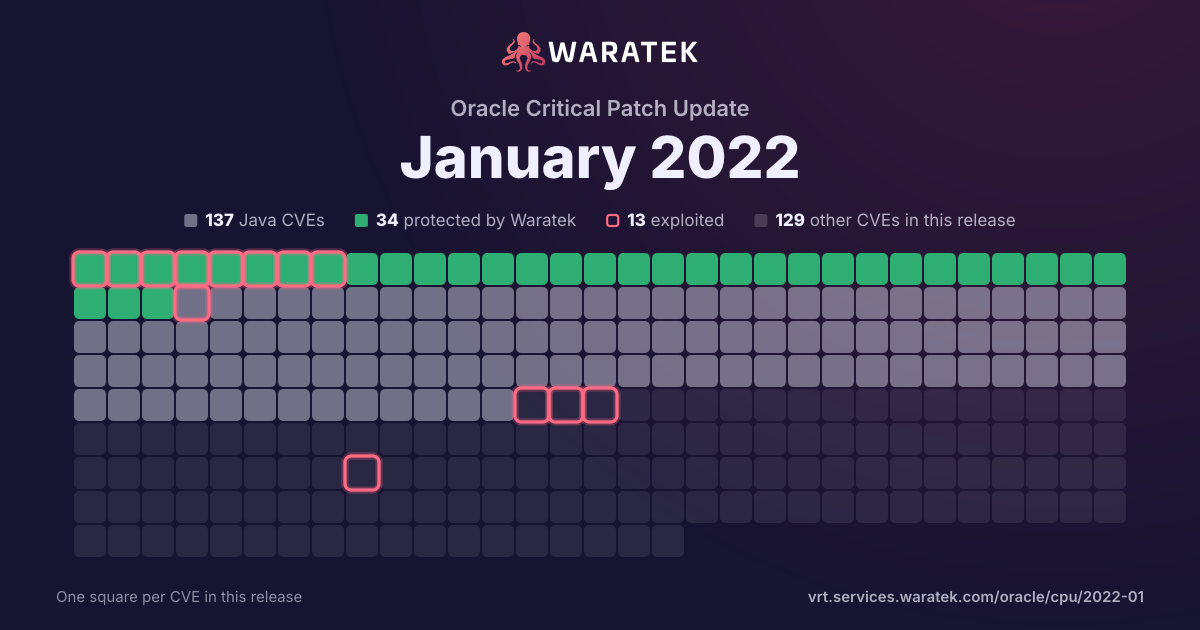
By status
34Protected by Waratek3Mitigation candidate100No exploit published57Outside Waratek scope72Not applicable
13Exploited, marked by the ring
No exploit published. For 71 of them, Oracle's security advisory is the source of public detail.
Protected by Waratek. Waratek RASP can block exploitation of these on systems that have not applied the patch yet.
Overview 24 matches · 13 in Waratek scope · 9 protected · 11 exploited · 4 CISA KEV · 15 public PoC
Protected by Waratek
9
37.5%
Rule in development
0
0.0%
Mitigation candidate
2
8.3%
No exploit published
2
8.3%
Outside Waratek scope
8
33.3%
Not applicable
3
12.5%
Withdrawn CVE
0
0.0%
blocked by ARMR today
9
37.5%
partly blocked
0
0.0%
not blocked
15
62.5%
not established
0
0.0%
unrecorded
0
0.0%
Exploited
11
45.8%
Working exploit published
5
20.8%
Proof of concept only
0
0.0%
Forecast only
8
33.3%
No public exploit
0
0.0%
split by
peak 6 / quarter
Q2 202
Outside Waratek scope2
Medium2
not blocked2
Exploited2
Q3 201
Mitigation candidate1
High1
not blocked1
Working exploit published1
Q4 201
Protected by Waratek1
Critical1
blocked by ARMR today1
Exploited1
Q1 212
Protected by Waratek1
Outside Waratek scope1
Critical1
High1
blocked by ARMR today1
not blocked1
Exploited1
Forecast only1
Q2 216
Protected by Waratek1
Mitigation candidate1
No exploit published1
Outside Waratek scope2
Not applicable1
Critical1
High4
Medium1
blocked by ARMR today1
not blocked5
Working exploit published3
Forecast only3
Q3 214
Protected by Waratek1
No exploit published1
Outside Waratek scope2
Critical2
Medium2
blocked by ARMR today1
not blocked3
Exploited2
Forecast only2
Q4 214
Protected by Waratek3
Outside Waratek scope1
Critical1
High1
Medium2
blocked by ARMR today3
not blocked1
Exploited3
Working exploit published1
Q1 224
Protected by Waratek2
Not applicable2
Critical1
High1
Medium2
blocked by ARMR today2
not blocked2
Exploited2
Forecast only2
Q2 20Q3 20Q4 20Q1 21Q2 21Q3 21Q4 21Q1 22
| CVE | Severity | Published▾ | Status | Exploitation | Description |
|---|---|---|---|---|---|
| CVE-2022-21371 | High | 2022-01-19 | Protected by Waratek | Exploited | Vulnerability in the Oracle WebLogic Server product of Oracle Fusion Middleware (component: Web Container). Supported versions that are affected are 12.1.3.0.0, 12.2.1.3.0, 12.2.1.4.0 and 14.1.1.0.0. Easily exploitable vulnerability allows unauthenticated attacker with network access via HTTP to compromise Oracle WebLogic Server. Successful attacks of this vulnerability can result in unauthorized access to critical data or complete access to all Oracle WebLogic Server accessible data. CVSS 3.1 Base Score 7.5 (Confidentiality impacts). CVSS Vector: (CVSS:3.1/AV:N/AC:L/PR:N/UI:N/S:U/C:H/I:N/A:N). |
| CVE-2022-21280 | Medium | 2022-01-19 | Not applicable | Forecast only | Vulnerability in the MySQL Cluster product of Oracle MySQL (component: Cluster: General). Supported versions that are affected are 7.4.34 and prior, 7.5.24 and prior, 7.6.20 and prior and 8.0.27 and prior. Difficult to exploit vulnerability allows high privileged attacker with access to the physical communication segment attached to the hardware where the MySQL Cluster executes to compromise MySQL Cluster. Successful attacks require human interaction from a person other than the attacker. Successful attacks of this vulnerability can result in takeover of MySQL Cluster. CVSS 3.1 Base Score 6.3 (Confidentiality, Integrity and Availability impacts). CVSS Vector: (CVSS:3.1/AV:A/AC:H/PR:H/UI:R/S:U/C:H/I:H/A:H). |
| CVE-2022-21279 | Medium | 2022-01-19 | Not applicable | Forecast only | Vulnerability in the MySQL Cluster product of Oracle MySQL (component: Cluster: General). Supported versions that are affected are 7.4.34 and prior, 7.5.24 and prior, 7.6.20 and prior and 8.0.27 and prior. Difficult to exploit vulnerability allows high privileged attacker with access to the physical communication segment attached to the hardware where the MySQL Cluster executes to compromise MySQL Cluster. Successful attacks require human interaction from a person other than the attacker. Successful attacks of this vulnerability can result in takeover of MySQL Cluster. CVSS 3.1 Base Score 6.3 (Confidentiality, Integrity and Availability impacts). CVSS Vector: (CVSS:3.1/AV:A/AC:H/PR:H/UI:R/S:U/C:H/I:H/A:H). |
| CVE-2021-35587 | Critical | 2022-01-19 | Protected by Waratek | Exploited | Vulnerability in the Oracle Access Manager product of Oracle Fusion Middleware (component: OpenSSO Agent). Supported versions that are affected are 11.1.2.3.0, 12.2.1.3.0 and 12.2.1.4.0. Easily exploitable vulnerability allows unauthenticated attacker with network access via HTTP to compromise Oracle Access Manager. Successful attacks of this vulnerability can result in takeover of Oracle Access Manager. CVSS 3.1 Base Score 9.8 (Confidentiality, Integrity and Availability impacts). CVSS Vector: (CVSS:3.1/AV:N/AC:L/PR:N/UI:N/S:U/C:H/I:H/A:H). |
| CVE-2021-44832 | Medium | 2021-12-28 | Protected by Waratek | Exploited | Apache Log4j2 versions 2.0-beta7 through 2.17.0 (excluding security fix releases 2.3.2 and 2.12.4) are vulnerable to a remote code execution (RCE) attack when a configuration uses a JDBC Appender with a JNDI LDAP data source URI when an attacker has control of the target LDAP server. This issue is fixed by limiting JNDI data source names to the java protocol in Log4j2 versions 2.17.1, 2.12.4, and 2.3.2. |
| CVE-2021-44790 | Critical | 2021-12-20 | Outside Waratek scope | Working exploit published | A carefully crafted request body can cause a buffer overflow in the mod_lua multipart parser (r:parsebody() called from Lua scripts). The Apache httpd team is not aware of an exploit for the vulnerabilty though it might be possible to craft one. This issue affects Apache HTTP Server 2.4.51 and earlier. |
| CVE-2021-45105 | Medium | 2021-12-18 | Protected by Waratek | Exploited | Apache Log4j2 versions 2.0-alpha1 through 2.16.0 (excluding 2.12.3 and 2.3.1) did not protect from uncontrolled recursion from self-referential lookups. This allows an attacker with control over Thread Context Map data to cause a denial of service when a crafted string is interpreted. This issue was fixed in Log4j 2.17.0, 2.12.3, and 2.3.1. |
| CVE-2021-4104 | High | 2021-12-14 | Protected by Waratek | Exploited | JMSAppender in Log4j 1.2 is vulnerable to deserialization of untrusted data when the attacker has write access to the Log4j configuration. The attacker can provide TopicBindingName and TopicConnectionFactoryBindingName configurations causing JMSAppender to perform JNDI requests that result in remote code execution in a similar fashion to CVE-2021-44228. Note this issue only affects Log4j 1.2 when specifically configured to use JMSAppender, which is not the default. Apache Log4j 1.2 reached end of life in August 2015. Users should upgrade to Log4j 2 as it addresses numerous other issues from the previous versions. |
| CVE-2021-40438 | Critical | 2021-09-16 | Outside Waratek scope | Exploited | A crafted request uri-path can cause mod_proxy to forward the request to an origin server choosen by the remote user. This issue affects Apache HTTP Server 2.4.48 and earlier. |
| CVE-2021-3711 | Critical | 2021-08-24 | Outside Waratek scope | Forecast only | In order to decrypt SM2 encrypted data an application is expected to call the API function EVP_PKEY_decrypt(). Typically an application will call this function twice. The first time, on entry, the "out" parameter can be NULL and, on exit, the "outlen" parameter is populated with the buffer size required to hold the decrypted plaintext. The application can then allocate a sufficiently sized buffer and call EVP_PKEY_decrypt() again, but this time passing a non-NULL value for the "out" parameter. A bug in the implementation of the SM2 decryption code means that the calculation of the buffer size required to hold the plaintext returned by the first call to EVP_PKEY_decrypt() can be smaller than the actual size required by the second call. This can lead to a buffer overflow when EVP_PKEY_decrypt() is called by the application a second time with a buffer that is too small. A malicious attacker who is able present SM2 content for decryption to an application could cause attacker chosen data to overflow the buffer by up to a maximum of 62 bytes altering the contents of other data held after the buffer, possibly changing application behaviour or causing the application to crash. The location of the buffer is application dependent but is typically heap allocated. Fixed in OpenSSL 1.1.1l (Affected 1.1.1-1.1.1k). |
| CVE-2021-34429 | Medium | 2021-07-15 | Protected by Waratek | Exploited | For Eclipse Jetty versions 9.4.37-9.4.42, 10.0.1-10.0.5 & 11.0.1-11.0.5, URIs can be crafted using some encoded characters to access the content of the WEB-INF directory and/or bypass some security constraints. This is a variation of the vulnerability reported in CVE-2021-28164/GHSA-v7ff-8wcx-gmc5. |
| CVE-2021-33037 | Medium | 2021-07-12 | No exploit published | Forecast only | Apache Tomcat 10.0.0-M1 to 10.0.6, 9.0.0.M1 to 9.0.46 and 8.5.0 to 8.5.66 did not correctly parse the HTTP transfer-encoding request header in some circumstances leading to the possibility to request smuggling when used with a reverse proxy. Specifically: - Tomcat incorrectly ignored the transfer encoding header if the client declared it would only accept an HTTP/1.0 response; - Tomcat honoured the identify encoding; and - Tomcat did not ensure that, if present, the chunked encoding was the final encoding. |
| CVE-2021-22901 | High | 2021-06-11 | Outside Waratek scope | Forecast only | curl 7.75.0 through 7.76.1 suffers from a use-after-free vulnerability resulting in already freed memory being used when a TLS 1.3 session ticket arrives over a connection. A malicious server can use this in rare unfortunate circumstances to potentially reach remote code execution in the client. When libcurl at run-time sets up support for TLS 1.3 session tickets on a connection using OpenSSL, it stores pointers to the transfer in-memory object for later retrieval when a session ticket arrives. If the connection is used by multiple transfers (like with a reused HTTP/1.1 connection or multiplexed HTTP/2 connection) that first transfer object might be freed before the new session is established on that connection and then the function will access a memory buffer that might be freed. When using that memory, libcurl might even call a function pointer in the object, making it possible for a remote code execution if the server could somehow manage to get crafted memory content into the correct place in memory. |
| CVE-2021-26691 | Critical | 2021-06-10 | Outside Waratek scope | Forecast only | In Apache HTTP Server versions 2.4.0 to 2.4.46 a specially crafted SessionHeader sent by an origin server could cause a heap overflow |
| CVE-2021-23017 | High | 2021-06-01 | Not applicable | Working exploit published | A security issue in nginx resolver was identified, which might allow an attacker who is able to forge UDP packets from the DNS server to cause 1-byte memory overwrite, resulting in worker process crash or potential other impact. |
| CVE-2021-29505 | High | 2021-05-28 | Mitigation candidate | Working exploit published | XStream is software for serializing Java objects to XML and back again. A vulnerability in XStream versions prior to 1.4.17 may allow a remote attacker has sufficient rights to execute commands of the host only by manipulating the processed input stream. No user who followed the recommendation to setup XStream's security framework with a whitelist limited to the minimal required types is affected. The vulnerability is patched in version 1.4.17. |
| CVE-2021-28165 | High | 2021-04-01 | No exploit published | Forecast only | In Eclipse Jetty 7.2.2 to 9.4.38, 10.0.0.alpha0 to 10.0.1, and 11.0.0.alpha0 to 11.0.1, CPU usage can reach 100% upon receiving a large invalid TLS frame. |
| CVE-2021-28164 | Medium | 2021-04-01 | Protected by Waratek | Working exploit published | In Eclipse Jetty 9.4.37.v20210219 to 9.4.38.v20210224, the default compliance mode allows requests with URIs that contain %2e or %2e%2e segments to access protected resources within the WEB-INF directory. For example a request to /context/%2e/WEB-INF/web.xml can retrieve the web.xml file. This can reveal sensitive information regarding the implementation of a web application. |
| CVE-2021-23840 | High | 2021-02-16 | Outside Waratek scope | Forecast only | Calls to EVP_CipherUpdate, EVP_EncryptUpdate and EVP_DecryptUpdate may overflow the output length argument in some cases where the input length is close to the maximum permissable length for an integer on the platform. In such cases the return value from the function call will be 1 (indicating success), but the output length value will be negative. This could cause applications to behave incorrectly or crash. OpenSSL versions 1.1.1i and below are affected by this issue. Users of these versions should upgrade to OpenSSL 1.1.1j. OpenSSL versions 1.0.2x and below are affected by this issue. However OpenSSL 1.0.2 is out of support and no longer receiving public updates. Premium support customers of OpenSSL 1.0.2 should upgrade to 1.0.2y. Other users should upgrade to 1.1.1j. Fixed in OpenSSL 1.1.1j (Affected 1.1.1-1.1.1i). Fixed in OpenSSL 1.0.2y (Affected 1.0.2-1.0.2x). |
| CVE-2020-14756 | Critical | 2021-01-20 | Protected by Waratek | Exploited | Vulnerability in the Oracle Coherence product of Oracle Fusion Middleware (component: Core Components). Supported versions that are affected are 3.7.1.0, 12.1.3.0.0, 12.2.1.3.0, 12.2.1.4.0 and 14.1.1.0.0. Easily exploitable vulnerability allows unauthenticated attacker with network access via IIOP, T3 to compromise Oracle Coherence. Successful attacks of this vulnerability can result in takeover of Oracle Coherence. CVSS 3.1 Base Score 9.8 (Confidentiality, Integrity and Availability impacts). CVSS Vector: (CVSS:3.1/AV:N/AC:L/PR:N/UI:N/S:U/C:H/I:H/A:H). |
| CVE-2020-17530 | Critical | 2020-12-11 | Protected by Waratek | Exploited | Forced OGNL evaluation, when evaluated on raw user input in tag attributes, may lead to remote code execution. Affected software : Apache Struts 2.0.0 - Struts 2.5.25. |
| CVE-2020-13935 | High | 2020-07-14 | Mitigation candidate | Working exploit published | The payload length in a WebSocket frame was not correctly validated in Apache Tomcat 10.0.0-M1 to 10.0.0-M6, 9.0.0.M1 to 9.0.36, 8.5.0 to 8.5.56 and 7.0.27 to 7.0.104. Invalid payload lengths could trigger an infinite loop. Multiple requests with invalid payload lengths could lead to a denial of service. |
| CVE-2020-11023 | Medium | 2020-04-29 | Outside Waratek scope | Exploited | In jQuery versions greater than or equal to 1.0.3 and before 3.5.0, passing HTML containing <option> elements from untrusted sources - even after sanitizing it - to one of jQuery's DOM manipulation methods (i.e. .html(), .append(), and others) may execute untrusted code. This problem is patched in jQuery 3.5.0. |
| CVE-2020-11022 | Medium | 2020-04-29 | Outside Waratek scope | Exploited | In jQuery starting with 1.12.0 and before 3.5.0, passing HTML from untrusted sources - even after sanitizing it - to one of jQuery's DOM manipulation methods (i.e. .html(), .append(), and others) may execute untrusted code. This problem is patched in jQuery 3.5.0. |